Publication: Succulenta (Netherlands) 71(2): 66. 1992
Description
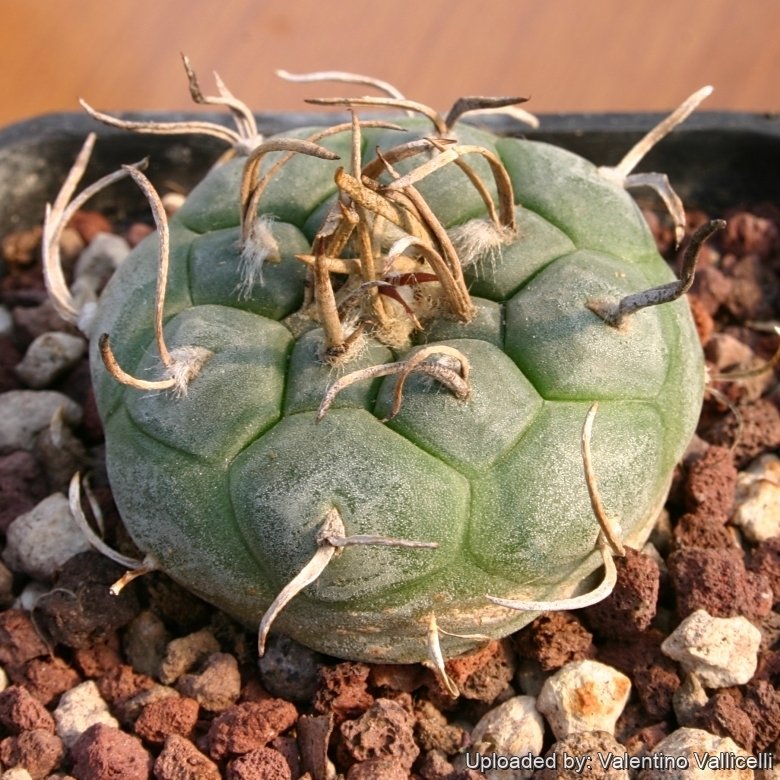
Stem are usually solitary, depressed globular, 1,5 cm high 2,5-3,5 cm wide light green. With low rhomboidal and very flat tubercles.
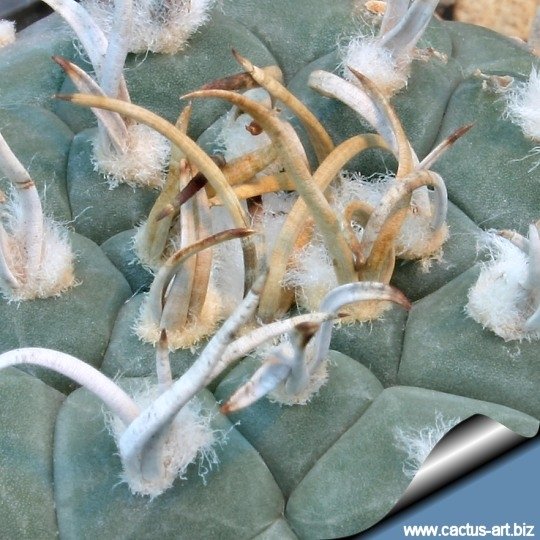
Areoles: Yung areoles woolly, later bare.
Root: It has a swollen taproot.
Spines: 1-3 papery twisted cream/brown coloured, to 12 mm long. No central spine(s).
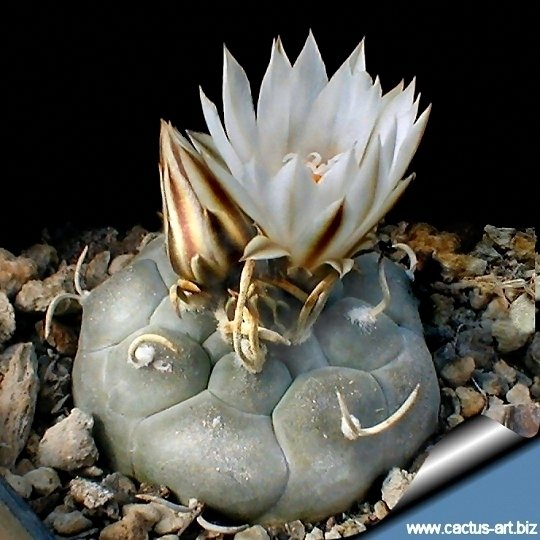
Flowers: White 25 mm long at the top of the stem, outside petals with greenish mid-stripes.
Origin and Habitat
Rio Verde in the state of San Lois Potosi (Mexico). Altitude 1500m.
Cultivation and Propagation
This species is relatively easy to cultivate. Requires full sun and careful watering to keep plant compact and low. It has a tap root, and watering it properly is often difficult and tends to crack open or rot if over-watered. Requires full sun and careful watering to keep plant compact. Hardy to -4°C for a short period.
Bibliography
Major references and further lectures
-
Edward Anderson “The Cactus family” Timber Press, Incorporated, 2001
-
James Cullen, Sabina G. Knees, H. Suzanne Cubey “The European Garden Flora Flowering Plants: A Manual for the Identification of Plants Cultivated in Europe, Both Out-of-Doors and Under Glass” Cambridge University Press, 11/Aug/2011
-
David R Hunt; Nigel P Taylor; Graham Charles; International Cactaceae Systematics Group. “The New Cactus Lexicon” dh books, 2006
-
Davide Donati, Carlo Zanovello “Conoscere, capire, coltivare i Turbinicarpus-Rapicactus” Cactus Trentino Sudtirol, 2004
From llifle page Turbinicarpus longispinus
Description
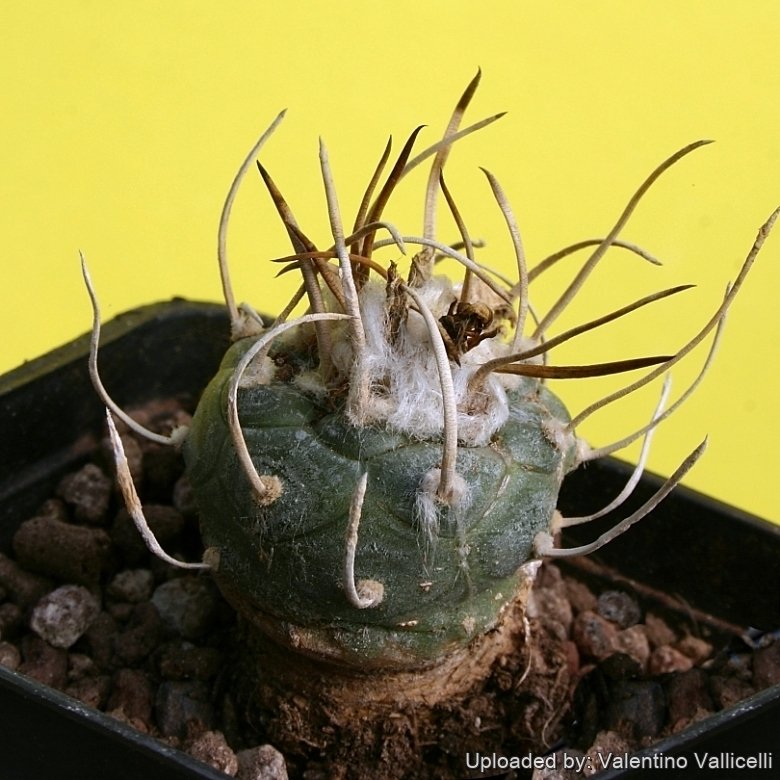
This taxon looks like to subsp. rioverdensis, but smaller, with larger but narrow whitish flowers. The seeds are smaller. Spines are whitish, longer, nidiform (nest-like) and curved up to 50 mm long.
Stem: Dark green, unbranced, sub-globose, flattened above ground, up to 25 mm wide and 15 mm high.
Ribs: Not evident, forming flattened rhomboidal tubercles.
Areoles: Rounded, with white wool when young, later glabrous.
Spines: 2, whitish/yellowish, 25-50 mm long, papyraceus. The spines are nidiform (bunched at plant apex) and persistent only on the upper body, below they fall off and the body and tubercles are corky and bare.
Root: Larger than the stem, napiform about 40 mm long and 20 mm thick.
Flowers: Apical, narrow funnelform, whitish, 20-30 mm long, 25-40 mm wide. Fruit: Tiny, ovate, 5x3 mm.
Seed: Obtuse pyriform, ca. 0,9 x 0,6 mm, testa black, glossy.
Turbinicarpus rioverdensis ssp. paoli is considered to be a transitional form between Turbinicarpus schmiedickeanus ssp. klinkerianus fa. schwarzii and Turbinicarpus schmiedickeanus ssp. rioverdensis.
Origin and Habitat
Central Mexico, San Luis Potosi
Habitat: Grows in slopes near Cerritos, in calcareous soil, at 1600m above sea level.
Cultivation and Propagation
It’s a fairly easy species to cultivate. Need a very well drained soil. Requires strong sun to part sun to develop good spinal growth and waterings should be rather infrequent to keep the plant compact and not to become excessively elongated and unnatural in appearance. keep dry in winter or when night temperatures remain below 10° C, it is hardy to -4°C for a short period. Assure a good ventilation.
Notes
This plant was previously known with its provisional name Turbinicarpus longispinus. It was discovered in 1982 by Heinz Swobodae and named after the Turbinicarpus grower Paolino Panarotto.
Source: Turbinicarpus longispinus, LLIFLE - Encyclopedia of living forms, CC-BY-SA, retrieved 2026-10-25.