Publication: Kaktusy (Brno) 19(1): 22, 1983; cf. Repert. Pl. Succ. (I.O.S.) 34: 8 (1985):. 1983
Description
Solitary.
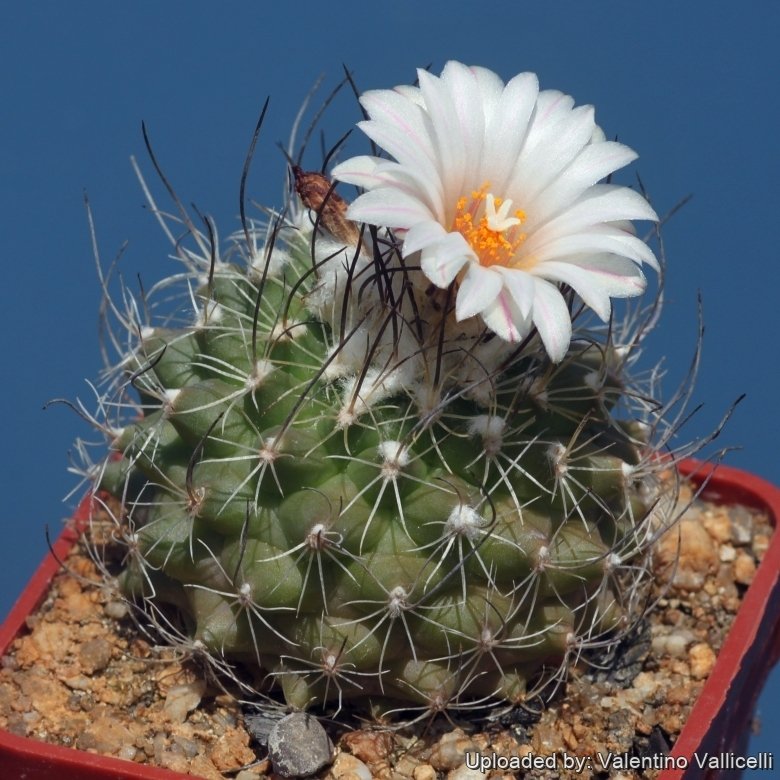
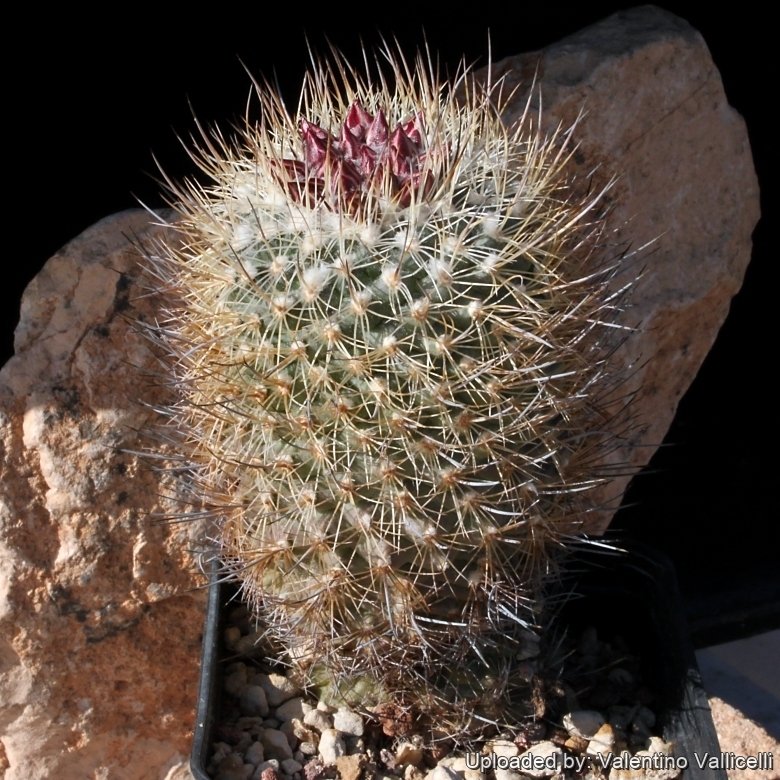
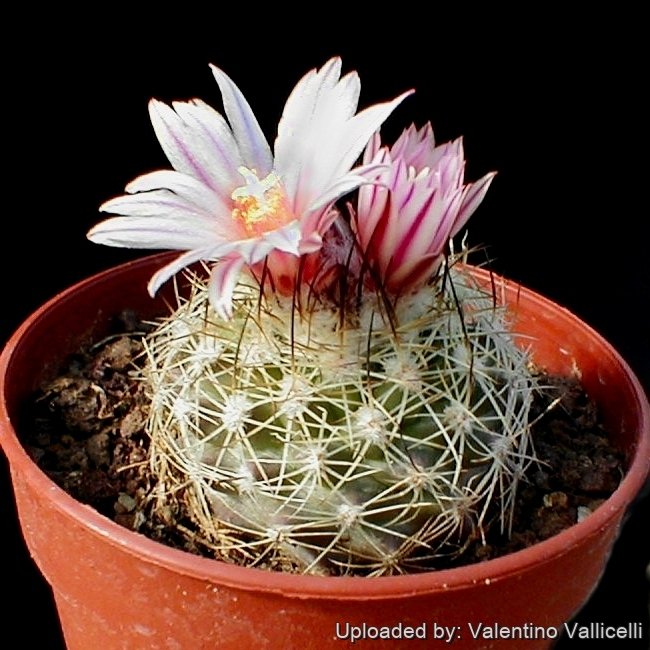
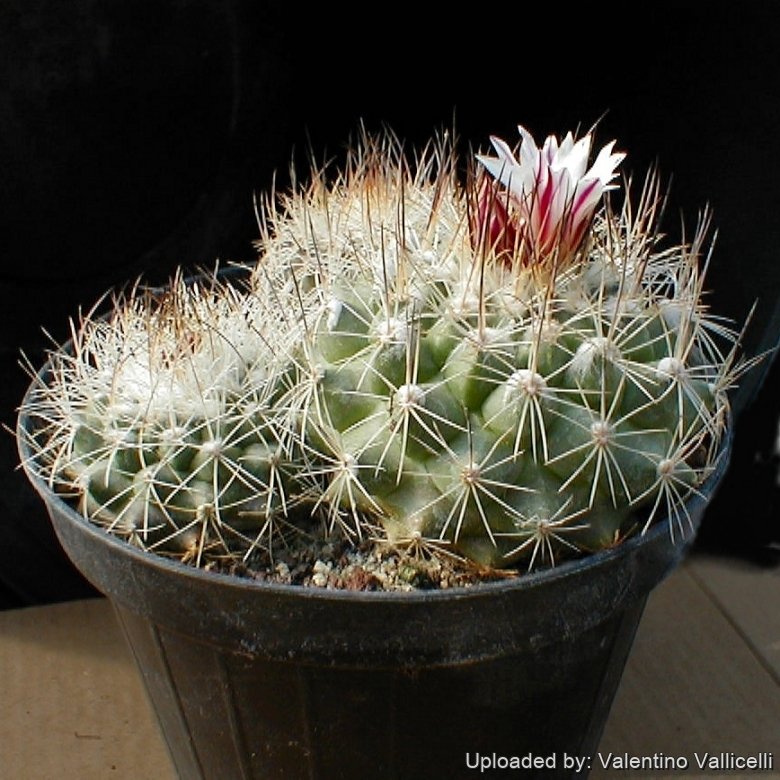
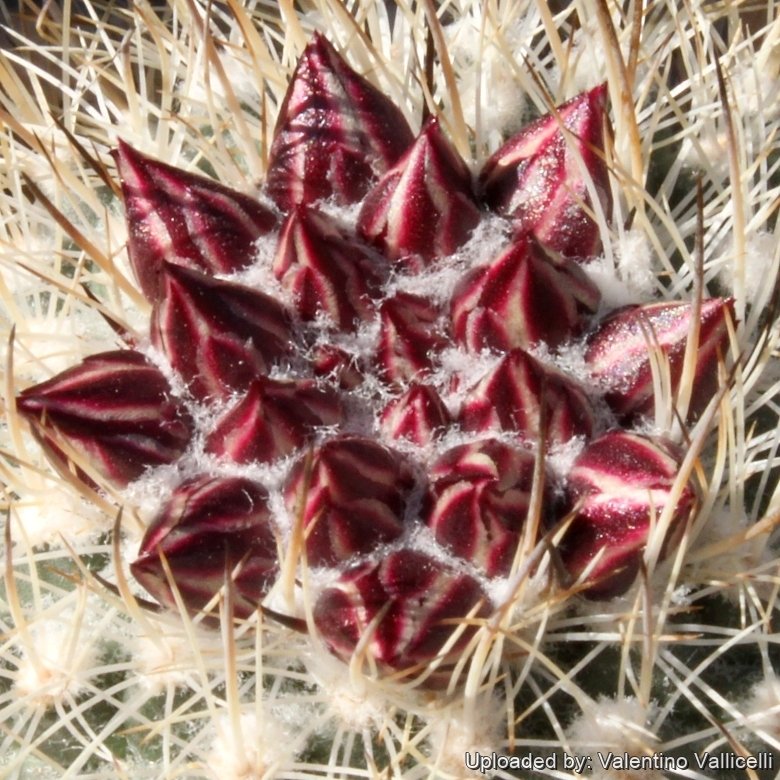
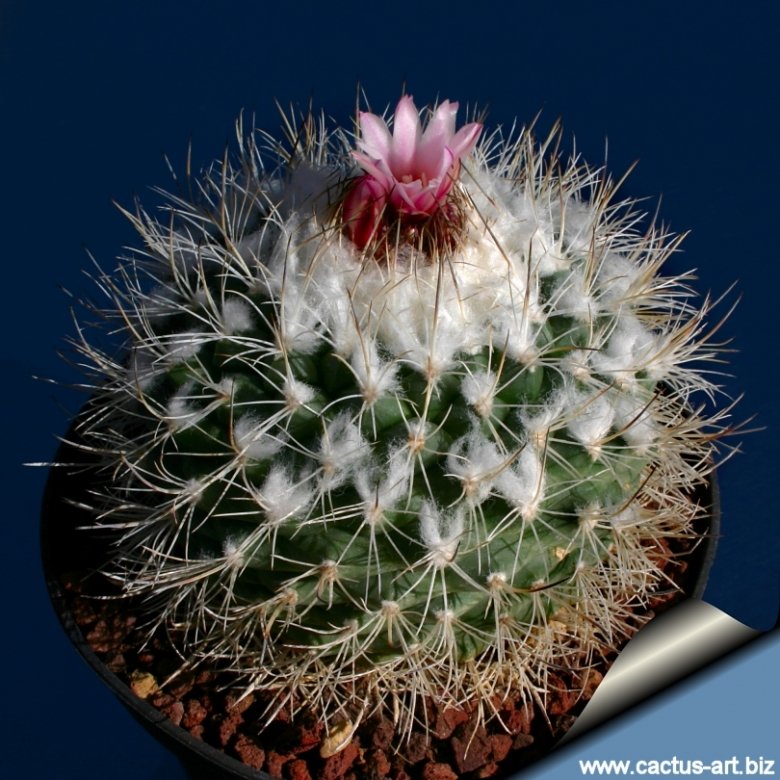
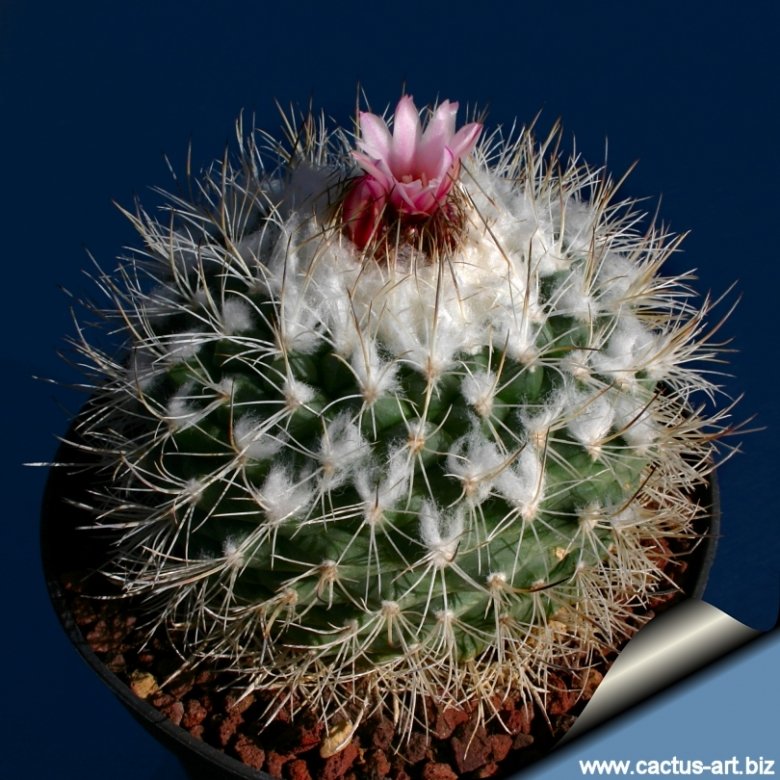
Stem: Grey green to bluish, depressed globose, 4 cm tall, 6 cm diameter. Apex woolly.
Ribs: Divided in 6-sided angular tubercles, rounded above, in 8 and 13 series, 2-5 mm long, up to 8 mm broad;
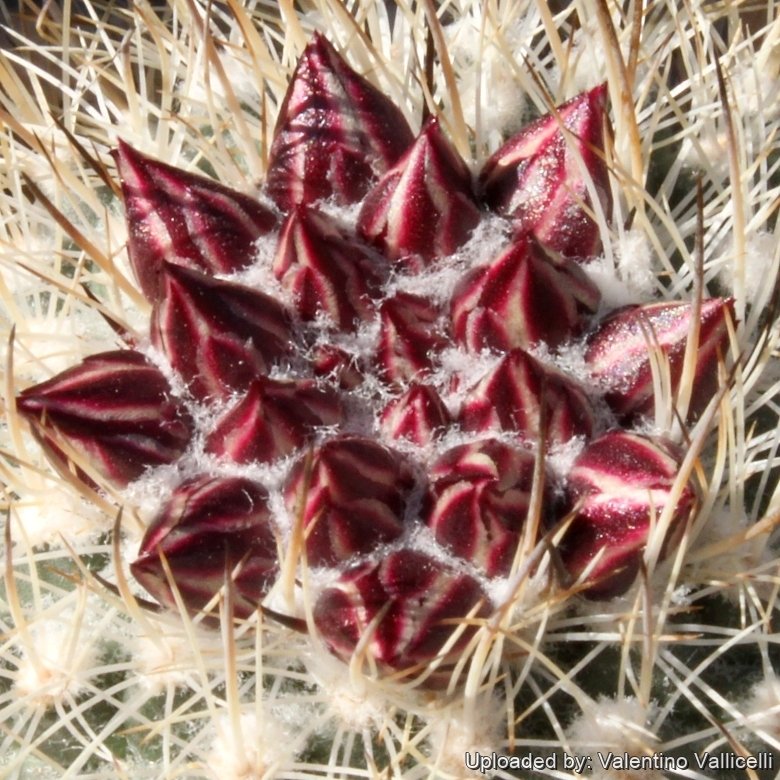
Areoles: Round, at the apex with very much white wool.
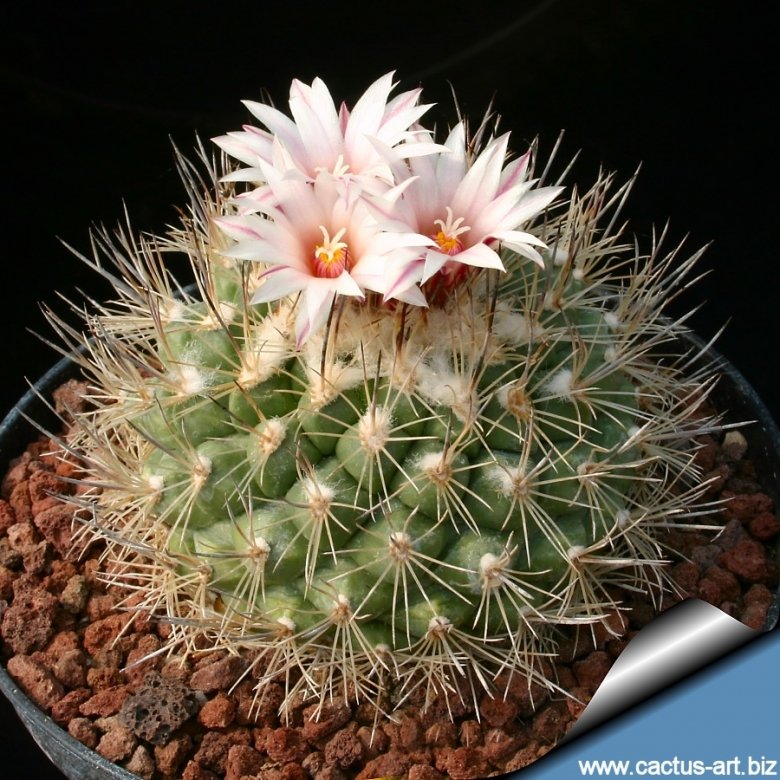
Radial spines: About 7-14(or more), horizontally spread out, needle-like, but somewhat curved down and to the body, glassy white, some with brown tips, 5-15 mm long
Central spine: One (occasionally up to 3) curved upward and/or tortuous, only somewhat thicker than the radial spines, 1,5-2 cm long (occasionally more), greyish, dark brown or black (often with a paler base), covered with whitish scales below.
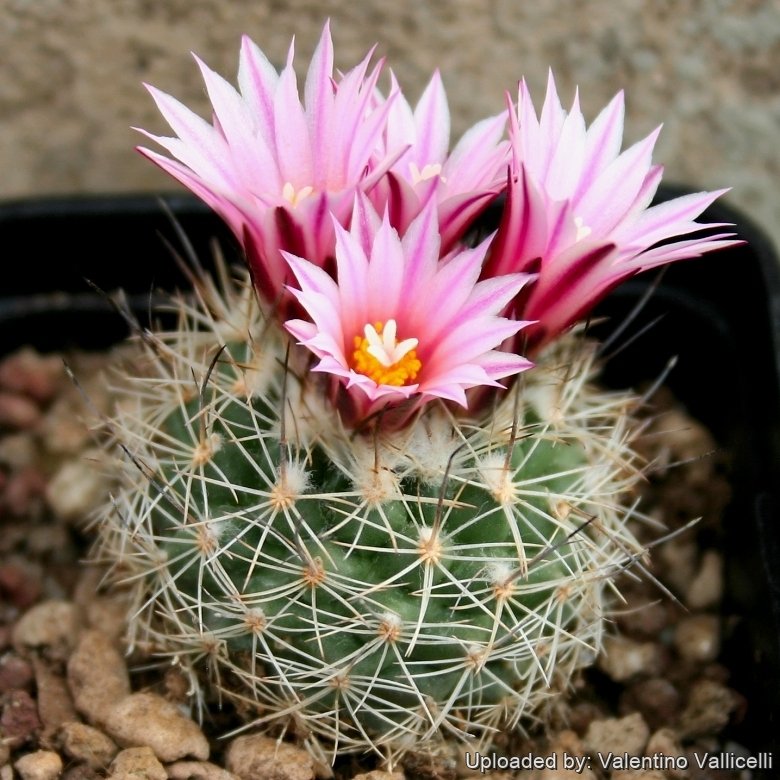
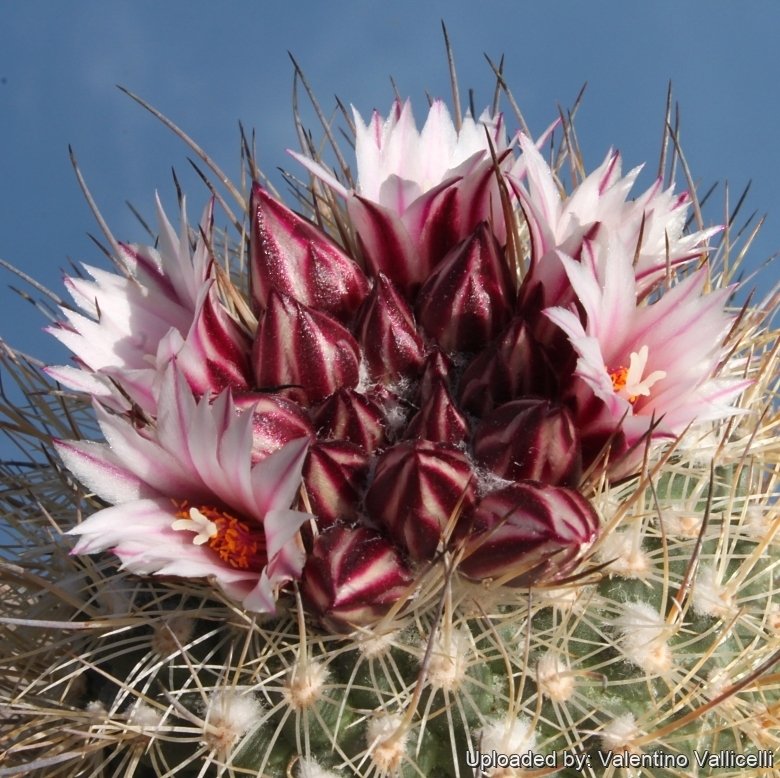
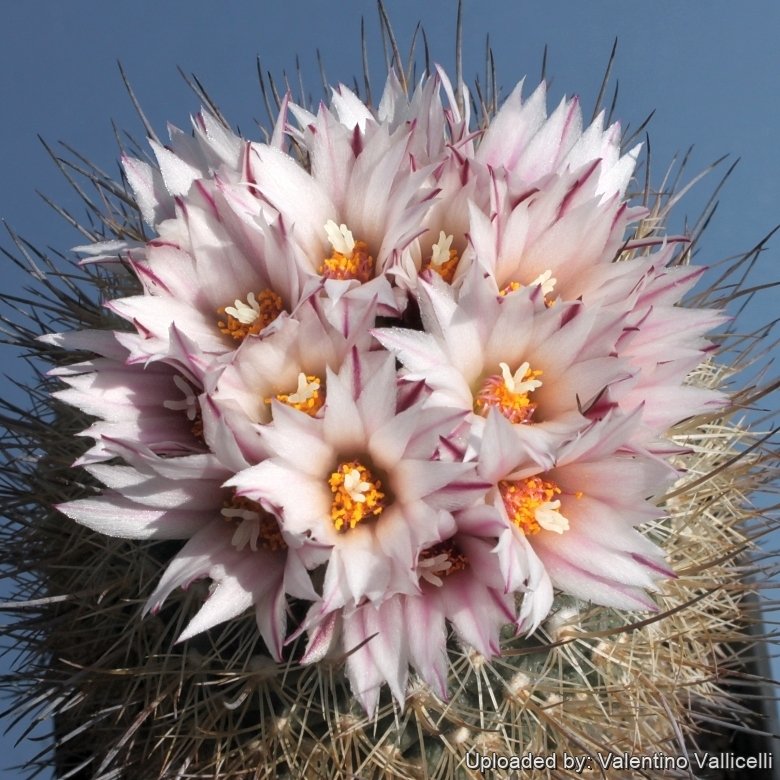
Flowers: Several at the apex, funnel-shaped, white with a faint pinkish midstripe about 15 mm long and 20 mm in diameter. Anther golden brown.
Fruit: Whitish to brownish, small and hidden in the apical wool, 4-7 mm long, 3-5 mm in diameter.
Origin and Habitat
Mexico, San Vicente at Salamanca, valley of Jaumave, Tamaulipas.
Cultivation and Propagation
Robust species to cultivate. It has a tap root, and watering it properly is often difficult and rot if over-watered. The fact that the plant retracts into the soil between watering, is perfectly natural and doesn’t cause any damage. keep dry in winter or when night temperatures remain below 10° C, it is hardy to -4°C for a short period. Assure a good ventilation.
Exposures: Full sun where it obtains a flat natural looking or part sun.
Bibliography
Major references and further lectures
-
Edward Anderson “The Cactus family” Timber Press, Incorporated, 2001
-
Nathaniel Lord Britton, Joseph Nelson Rose “Cactaceae: Descriptions and Illustrations of Plants of the Cactus Family” vol. 4 The Carnegie Institution of Washington, Washington 1923
-
James Cullen, Sabina G. Knees, H. Suzanne Cubey “The European Garden Flora Flowering Plants: A Manual for the Identification of Plants Cultivated in Europe, Both Out-of-Doors and Under Glass” Cambridge University Press, 11/Aug/2011
-
David R Hunt; Nigel P Taylor; Graham Charles; International Cactaceae Systematics Group. “The New Cactus Lexicon” dh books, 2006
From llifle page Gymnocactus preenii
Description
Small cactus, usually solitary.
Stem: Flat, globose, 7-8 cm wide, 6-7 cm tall, but often in cultivation plants develop an elongated shape and grow up to 10 (or more) cm tall.
Tubercle: 4-angled, 5 mm long.
Areoles: Young areoles with white down.
Root: Tap root.
Spines: 1 stiff central, grey-coloured, ivory with a black tip, 1-3,5 cm long; 8 to 16 radials, 5-10 mm long.
Flowers: Funnel shaped, creamy white, with pinkish mid-stripes, 2 cm long. In January-April.
Fruit: 6 mm long, splitting at maturity.
Origin and Habitat
Mexico Northeast (vicinity of Bustamante,Tamaulipas)
Cultivation and Propagation
Robust species to cultivate. Requires full sun and careful watering to keep plant compact and low. It has a tap root, and watering it properly is often difficult, as it tends to crack open or rot if over-watered.
Notes
Turbinicarpus saueri ssp. nelissae At beginning, Charles Glass referred to this undescribed species as sp. or var. nov. “preenii” (also spelled as “preemii” for a while). However, in 1998 it was formally described as T. saueri ssp. nelissae by Halda and Panarotto. The sub-specific name come from “Nelissa Panarotto” the daughter of Paolino Panarotto - Italian nurseryman, expert of Turbinicarpus.
This plant is also the hybridparent of:
Turbinicarpus x amabilis Halda & Panar. Acta Mus. Richnov., Sect. Nat. 10(2): 162 (fig. 27). 2003
Turbinicarpus x azanthus Halda & Panar. Acta Mus. Richnov., Sect. Nat. 10(2): 165. 2003
Turbinicarpus x concinnus Halda & Panar. Acta Mus. Richnov., Sect. Nat. 10(2): 168. 2003
Source: Gymnocactus preenii, LLIFLE - Encyclopedia of living forms, CC-BY-SA, retrieved 2026-10-25.
Cultivars and forms (4)
Gallery