Publication: Guía Identif. Cact. Amenazadas México 1: Tu/vi ssp. major (1998 publ. 1997)
Description
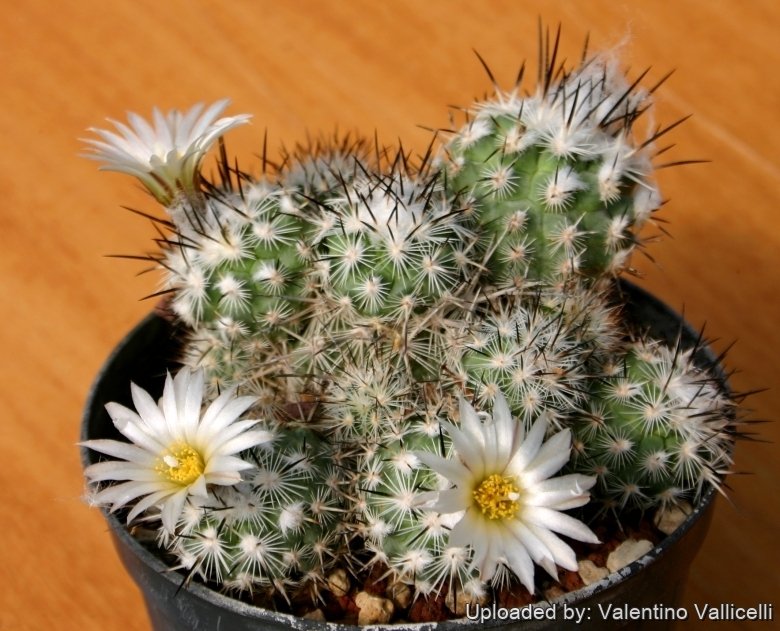
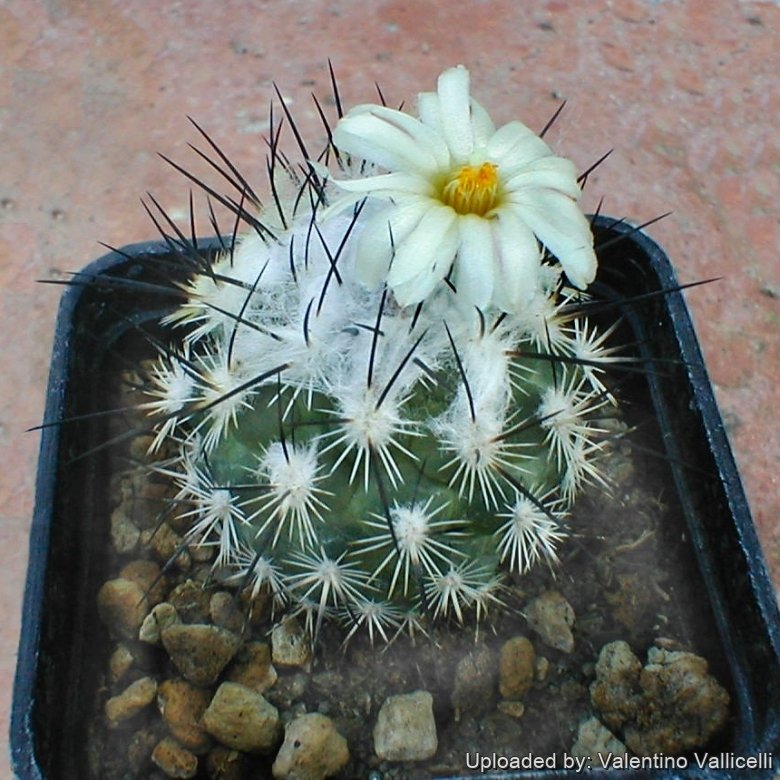
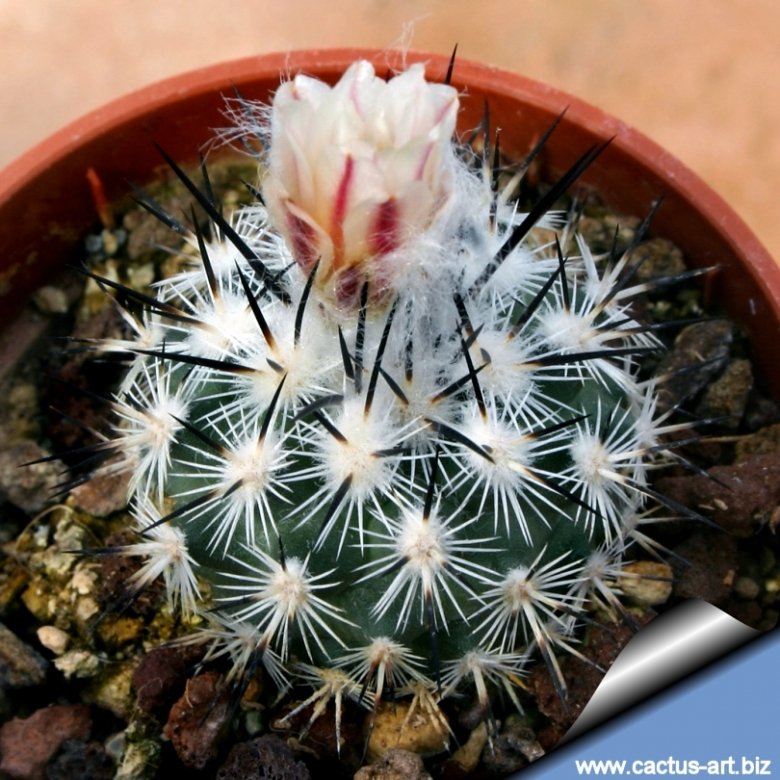
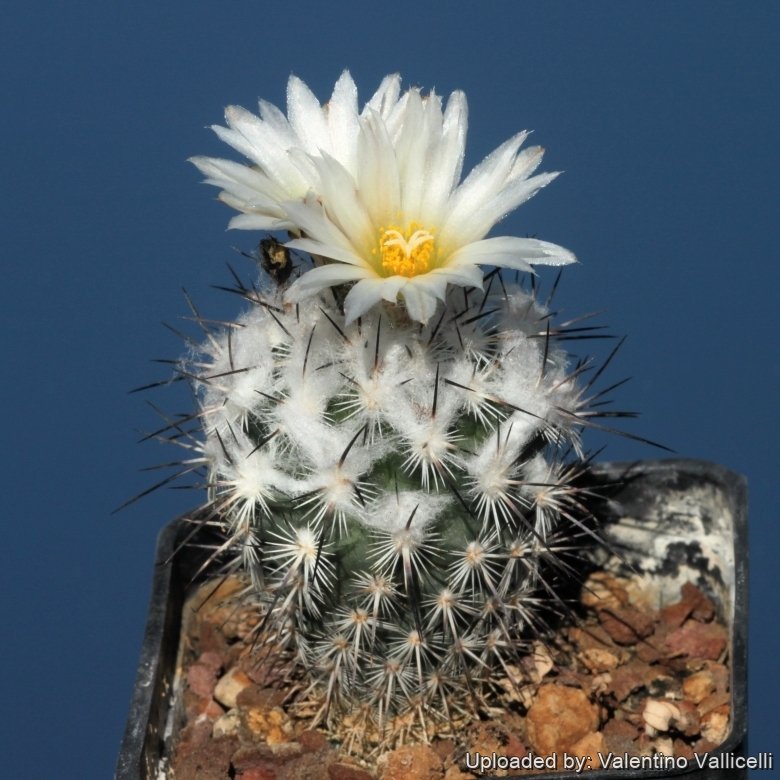
Turbinicarpus viereckii subsp. major is one of the local or morphological form of Turbinicarpus viereckii. It is an attractive dwarf cactus covered with characteristic glassy white and black spines and whitish wool which is distinguished from the type species for having white flowers instead of purple.
Habit: Contrary to the standard Turbinicarpus viereckii, which often clusters and forms small group with time, subsp. major usually remains solitary.
Stem: Dull green or blue-green, globose to slightly cylindrical 4-7(-12) cm tall, 4-7 cm in diameter apex with with very woolly top.
Ribs: 15 to 18 ribs divided in tubercles.
Tubercles: 6 mm long rhomboidal conical.
Central spines: 3 to 7 white with black tips in a cross like formation, 2-4 cm long.
Radial spines: 13 to 16 rigid white translucent, some with brown tips, 0,8-1,3 cm long.
Root: Swollen bundled.
Flowers: White (sometime with a pink midstripe), 3 cm long, 3,5 mm broad
Fruits: Greenish-magenta.
Origin and Habitat
Mexico (municipalities of Guadalcazar in the state of San Luis Potosi and in Nuevo León)
Cultivation and Propagation
It’s a fairly easy and robust species to cultivate, but very slow growing. It needs a very well-drained soil, and requires strong sun to part sun to keep the plant compact and low and to develop a good spinal growth. Waterings should be rather infrequent to keep the plant compact, and avoid its becoming excessively elongated and unnatural in appearance. Furthermore it has a tap root, and watering it properly is often difficult, because it tends to crack open or rot if over-watered. Careful watering away from the body of the plant will allow the areoles to keep their wool. Keep dry in winter, or when night temperatures remain below 10° C. It is hardy to -4°C for a short period. Assure a good ventilation.
Reproduction: From seed, since the plant rarely produces plantlets, or grafted.
Bibliography
Major references and further lectures
-
Edward Anderson “The Cactus family” Timber Press, Incorporated, 2001
-
James Cullen, Sabina G. Knees, H. Suzanne Cubey “The European Garden Flora Flowering Plants: A Manual for the Identification of Plants Cultivated in Europe, Both Out-of-Doors and Under Glass” Cambridge University Press, 11/Aug/2011
-
David R Hunt; Nigel P Taylor; Graham Charles; International Cactaceae Systematics Group. “The New Cactus Lexicon” dh books, 2006
-
Davide Donati, Carlo Zanovello “Conoscere, capire, coltivare i Turbinicarpus-Rapicactus” Cactus Trentino Sudtirol, 2004