Description
Solitary cactus 50(-80)cm tall.
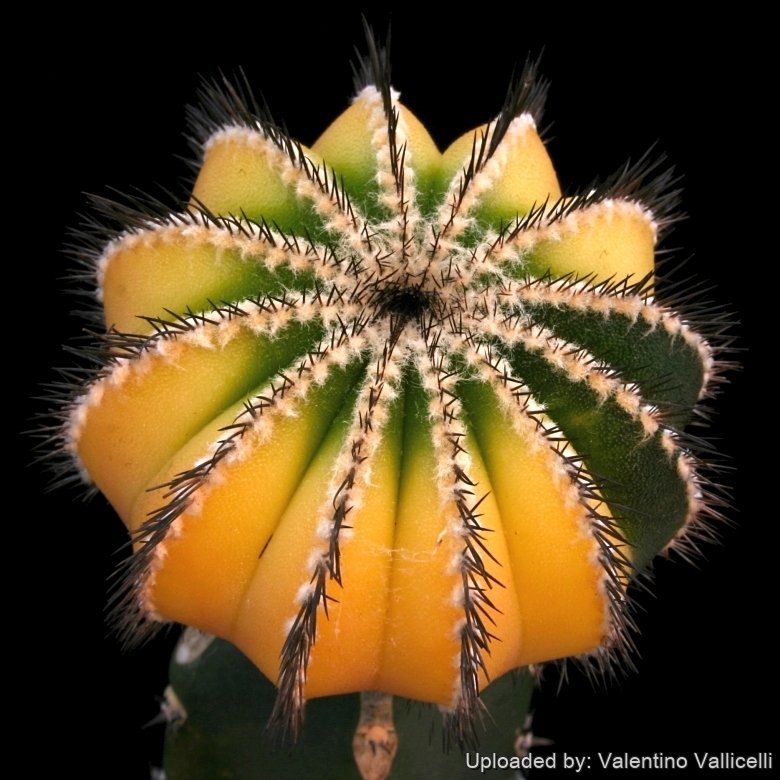
Stem: Although usually globular or slightly elongated with age. It is colourful dark/green to reddish-green with yellow or orange variegated part.
Ribs: 15 to 18 vertical and prominent.
Areoles: Set closely to form an almost continuous felty line down the ribs sides.
Spines: Dark brown to black closely set neatly arranged straight and give a comb-like effect.
Flowers: Diurnal, funnel-shaped greenish yellow. They are 15 mm long, 12 mm in diameter.
Blooming season: Flowers come sporadically from Early Summer to Late Summer
Origin and Habitat
Garden origin (Nursery produced cultivar)
Cultivation and Propagation
This tropical cactus prefers loves warm moist, humid conditions and mist spraying is a must in summer. Water regularly during the growing season and use a very draining mineral potting substrate. At the onset of winter, do not water. Uebelmannias need heat all year round and extra winter heat, minimum 10C is best. Avoid any frost. Keep cool in summer. It prefers a half-sun position and possibly afternoon shade in summer. If you can place it so that this occurs the plant will be much happier.
Propagation:* Grafting. If possible using a rootstock that is more hardy than the Uebelmannia is the ideal.
Bibliography
Major references and further lectures
-
Edward Anderson “The Cactus family” Timber Press, Incorporated, 2001
-
James Cullen, Sabina G. Knees, H. Suzanne Cubey “The European Garden Flora Flowering Plants: A Manual for the Identification of Plants Cultivated in Europe, Both Out-of-Doors and Under Glass” Cambridge University Press, 11/Aug/2011
-
David R Hunt; Nigel P Taylor; Graham Charles; International Cactaceae Systematics Group. “The New Cactus Lexicon” dh books, 2006
-
Machado, M., Taylor, N.P. & Braun, P. 2013. Uebelmannia pectinifera. In: IUCN 2013. “IUCN Red List of Threatened Species.” Version 2013.2. <www.iucnredlist.org>. Downloaded on 08 January 2014.
Gallery