Publication: Bradleya 10: 15 (1992) [see also : L.Bolus in Notes Mesembryanthemum 3: 136. 1938 nom. inval. genus name not validly published ]
Description
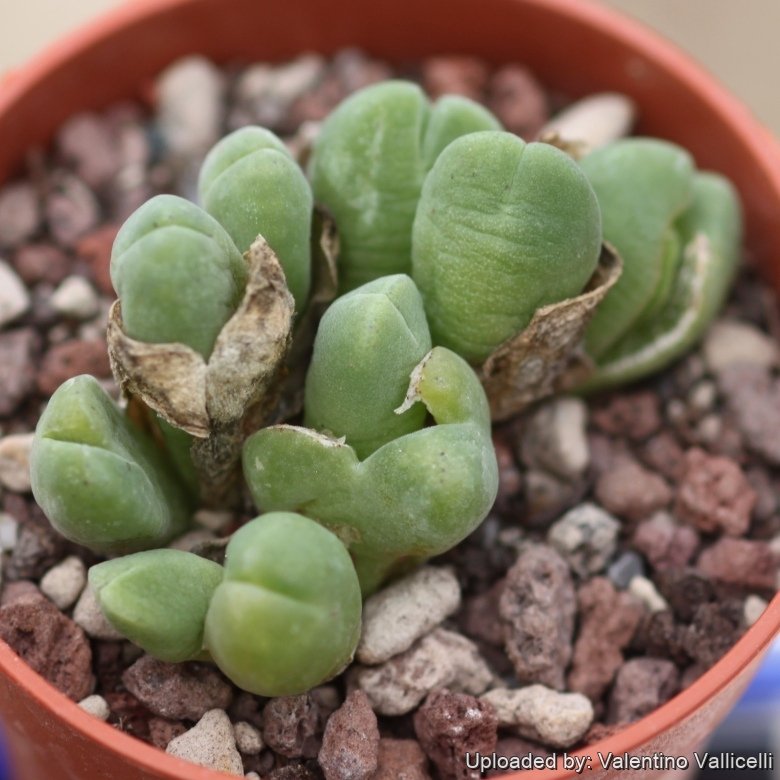
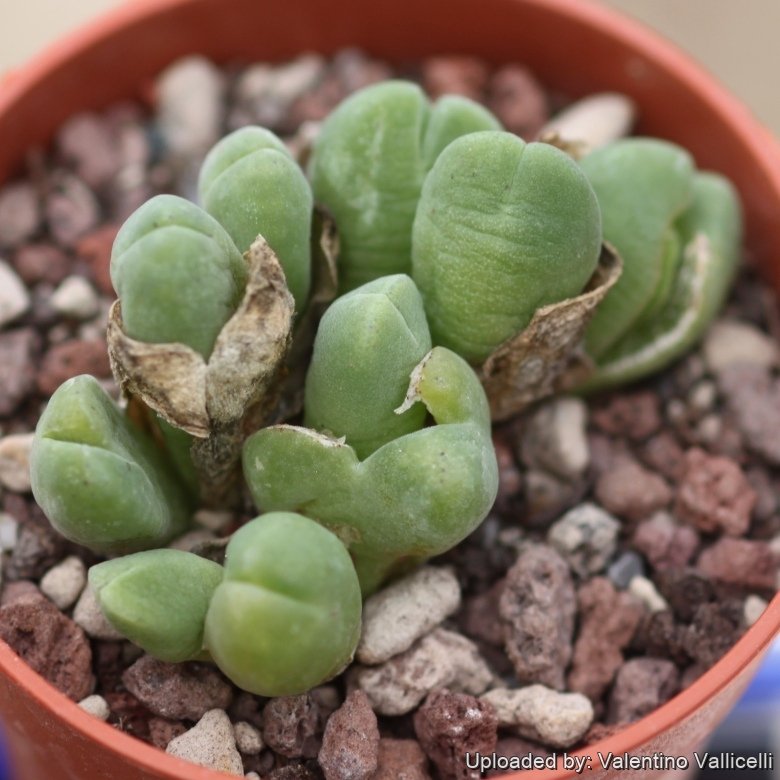
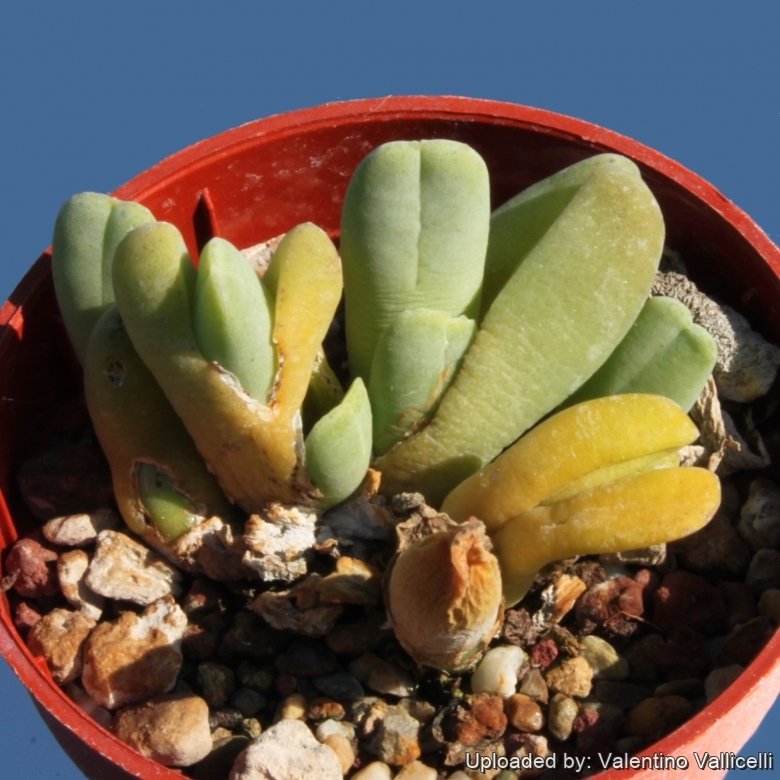
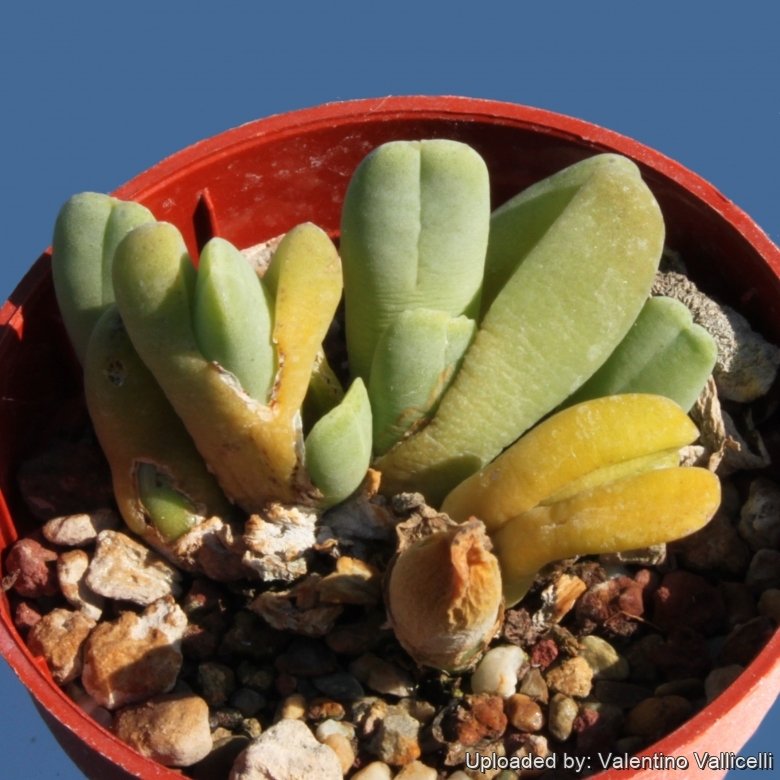
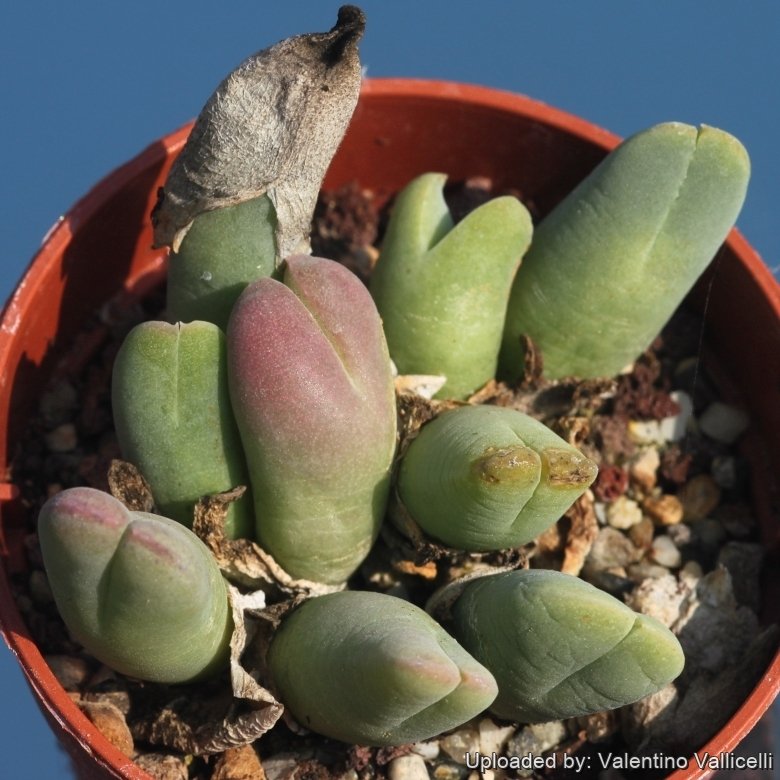
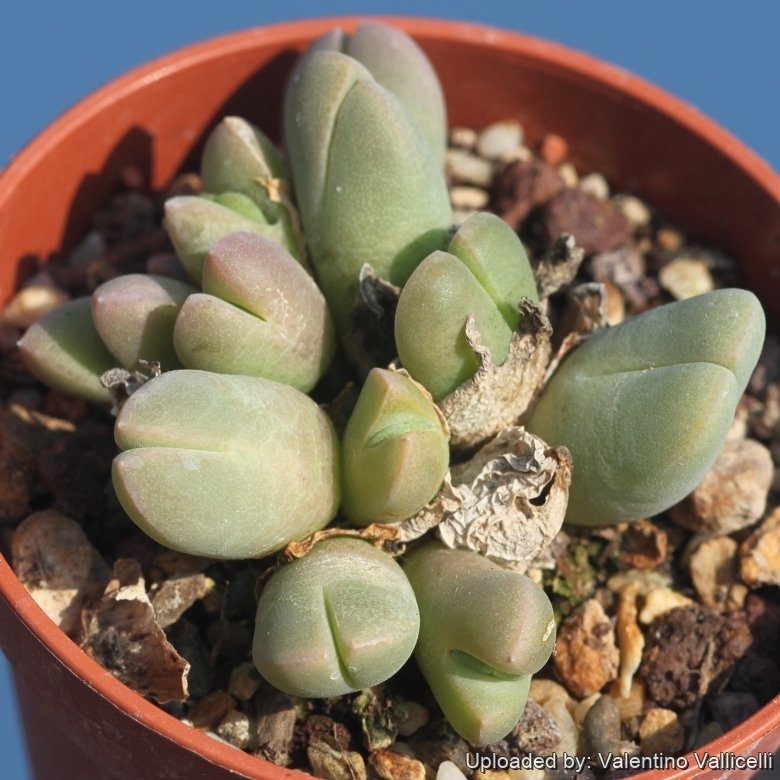
Vanheerdea roodiae is a dwarf compact ground-cover perennial succulent with bi-lobed light green bodies. It is not sunken or partly sunken and grows in tight mats or clusters of 20-40 branches. The similar Vanheerdea divergens has even larger purplish bodies with with several fine sharp teeth.
Stem: Internodes very short.
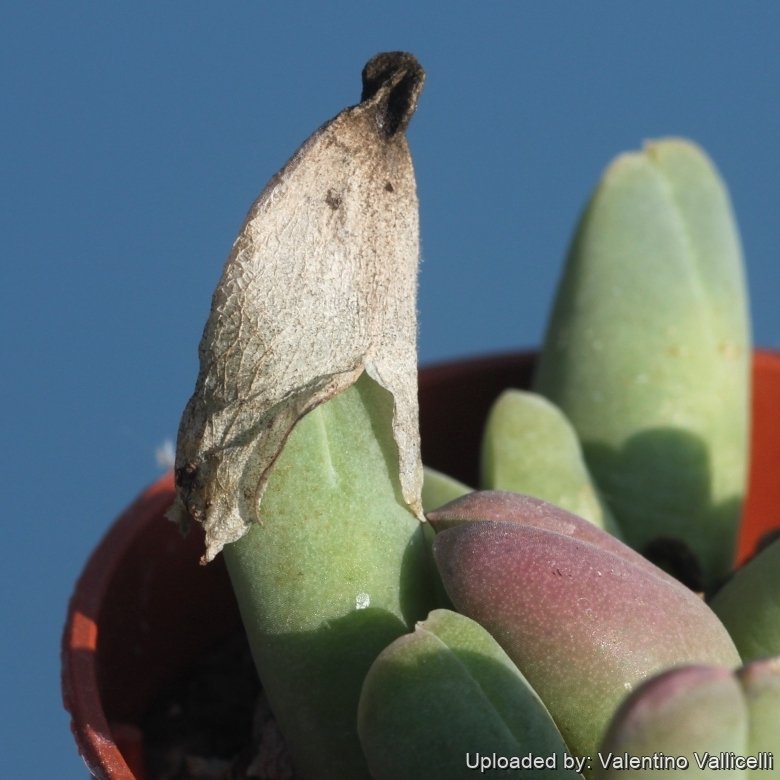
Bodies (Paired leaves): Crowded, ovoid 4-6 cm long, 2,5-3 cm wide, leaves more or less hemispherical at the base then 3-angled and flattened above, joined below two third of their length, pale green or greysh-green often tinged in red, undotted and non-windowed; keel and angles serrate (with several fine teeth). The bodies are sheathed in the summer with new leaves emerging in the autumn, with full development in late winter. In early spring they bear one to three flowers per body and then begin their annual retreat.
Flowers: 2-4 cm in diameter, petals in three rows, dull yellow. Staminodes absent.
Blooming season: Early spring.
Fruit: Capsules 8-12 loculled.
Seeds: Many, very small, brown, spherical and pointed.
Origin and Habitat
Uitenhage, Eastern Cape, South Africa.
Habitat: Vanheerdea is found in a harsh climate, hot and cold, where winter and summer rain occurs.
Cultivation and Propagation
Vanheerdea roodiae is a “winter” grower which is most active from early winter until spring and heading for summer dormancy, but in favourable growing conditions it keeps going over the summer too and doesn’t need particular care. It is relatively easy to grow.
Soil: Requires good drainage as it it is prone to root rot. It can grows outdoor in sunny, dry, rock crevices (protection against winter wet is required) It can also be cultivated in alpine house, in poor, drained soil.
Fertilization: Feed it once during the growing season with a fertilizer specifically formulated for cactus succulents (poor in nitrogen), including all micro nutrients and trace elements diluted to ½ the strength recommended on the label. It thrives in poor soils and need a limited supplies of fertilizer to avoid the plants developing excess vegetation, which is easily attacked by fungal diseases.
Watering: Water minimally in summer, water more abundantly when they are growing in the autumn and spring. Requires little water otherwise its epidermis breaks (resulting in unsightly scars).
Light: It needs a bright sunny or light shade exposure in winter, but keep cool and shaded in summer. However, it only reveal its beauty in good light.
Hardiness: It prefer a very bright situation and will take a some frost (Hardy to -12°C) if it is in dry soil. USDA zones 8 – 11.
Uses: Container, rock garden.
Pests & diseases: Stomatium suaveolens may be attractive to a variety of insects, but plants in good condition should be nearly pest-free, particularly if they are grown in a mineral potting-mix, with good exposure and ventilation. Nonetheless, there are several pests to watch for:
- Red spiders: they may be effectively rubbed up by misting the vulnerable plants every day
- Mealy bugs: occasianlly they develop aerial into the new leaves and flowers with disfiguring results, but the worst types develop underground on the roots and are invisible except by their effects.
- Sciara Flies: they are one of the major problems for seedlings. It is a good practice to mulch your seedlings with a layer of grit, which will strongly discourage the flies.
- Scales, thrips and aphids: they are rarely a problem.
It is wise to treat your whole collection with a systemic insecticide twice a year in spring and autumn.
- Rot: it is only a minor problem with mesembs if the plants are watered and “aired” correctly. If they are not, fungicides won’t help all that much.
Propagation: It is very quick and easy to start from seed or (rarely) cuttings. Seeds germinate in 7-14 days at 21°C in spring. To make a cutting twist off a branch with at least a part of roots and permit it to dry out a couple of days, lay it on the soil and insert the stem end partially into the soil. Try to keep the cutting somewhat upright so that the roots are able to grow downward. Vanheerdea roodiae can be hybridized with Titanopsis schwantesii.
Bibliography
Major references and further lectures
-
Klaus Kubitzki, Jens G. Rohwer, Volker Bittrich “Flowering Plants. Dicotyledons: Magnoliid, Hamamelid and Caryophyllid Families” Springer, 30/lug/1993
-
Heidrun E. K. Hartmann “Aizoaceae F – Z” Springer, 2002
-
James Cullen, Sabina G. Knees, H. Suzanne Cubey “The European Garden Flora Flowering Plants: A Manual for the Identification of Plants Cultivated in Europe, Both Out-of-Doors and Under Glass - Casuarinaceae to Aristolochiaceae” Cambridge University Press, 11/ago/2011
-
Burgoyne, P.M. 2006. Vanheerdea roodiae (N.E.Br.) L.Bolus ex H.E.K.Hartmann. National Assessment: “Red List of South African Plants” version 2013.1. Accessed on 2014/02/07
From llifle page Rimaria divergens
Description
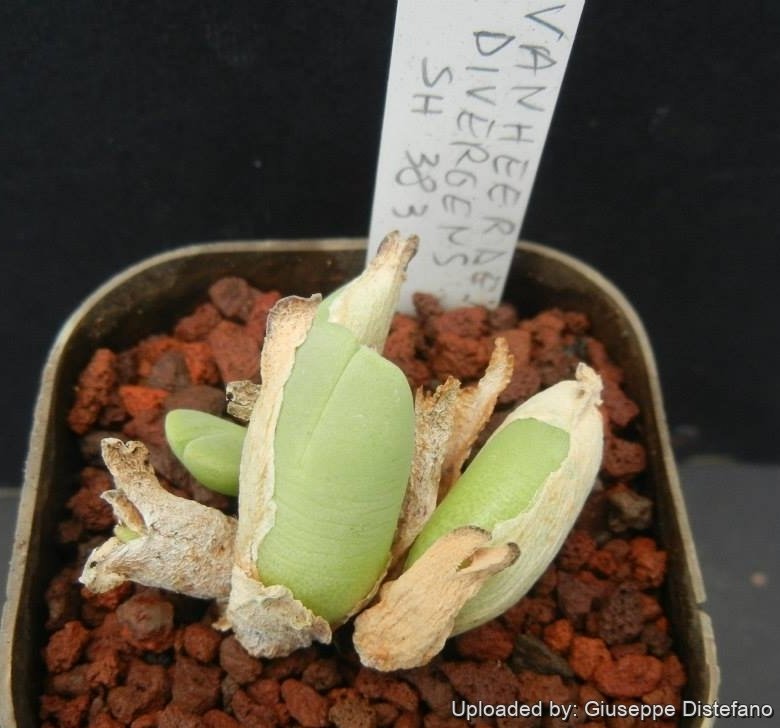
Vanheerdea divergens is a dwarf compact ground-cover perennial succulent. It is considered a larger form of Vanheerdea roodiae with purplish bodies and sharp serrate keels. It is not sunken or partly sunken and grows in tight mats or clusters of 20-40 branches. It is the larger species in the genus.
Stem: Internodes very short.
Bodies (Paired leaves): Crowded, ovoid 4-6 cm long, 2,5-3 cm wide, leaves more or less hemispherical at the base then 3-angled and flattened above, joined below two third of their length, greysh-green to purplish-red, undotted and non-windowed; keel and angles with several fine teeth. The bodies are sheathed in the summer with new leaves emerging in the autumn, with full development in late winter. In early spring they bear one to three flowers per body and then begin their annual retreat.
Flowers: 2-4 cm in diameter, petals in three rows, dull yellow. Staminodes absent.
Blooming season: Early spring.
Fruit: Capsules 8-12 loculled.
Seeds: Many, very small, brown, spherical and pointed.
Origin and Habitat
Uitenhage, Eastern Cape, South Africa.
Habitat: Vanheerdea is found where winter and summer rain occurs.
Cultivation and Propagation
Vanheerdea divergens are opportunistic, will grow anytime from autumn to spring when moisture is given. Grow and water them when you have periods of sunshine, and they go dormant in the heat of summer when less water is needed, but in favourable growing conditions they keep going over the summer too and don’t need particular care.
Soil: Requires good drainage as it it is prone to root rot. It can grows outdoor in sunny, dry, rock crevices (protection against winter wet is required) It can also be cultivated in alpine house, in poor, drained soil.
Fertilization: Feed it once during the growing season with a fertilizer specifically formulated for cactus succulents (poor in nitrogen), including all micro nutrients and trace elements diluted to ½ the strength recommended on the label. It thrives in poor soils and need a limited supplies of fertilizer to avoid the plants developing excess vegetation, which is easily attacked by fungal diseases.
Watering: Water minimally in summer, water more abundantly when they are growing in the autumn and spring. Requires little water otherwise its epidermis breaks (resulting in unsightly scars).
Light: It needs a bright sunny or light shade exposure in winter, but keep cool and shaded in summer. However, it only reveal its beauty in good light.
Hardiness: It prefer a very bright situation and will take a some frost (Hardy to -12°C) if it is in dry soil. USDA zones 8 – 11.
Uses: Container, rock garden.
Pests & diseases: Vanheerdea divergens may be attractive to a variety of insects, but plants in good condition should be nearly pest-free, particularly if they are grown in a mineral potting-mix, with good exposure and ventilation. Nonetheless, there are several pests to watch for:
- Red spiders: Red spiders may be effectively rubbed up by misting the vulnerable plants every day
- Mealy bugs: Mealy-bugs occasianlly they develop aerial into the new leaves and flowers with disfiguring results, but the worst types develop underground on the roots and are invisible except by their effects.
- Sciara Flies: Sciara-flies are one of the major problems for seedlings. It is a good practice to mulch your seedlings with a layer of grit, which will strongly discourage the flies.
- Scales, thrips and aphids: This insects are rarely a problem.
- Rot: it is only a minor problem with mesembs if the plants are watered and “aired” correctly. If they are not, fungicides won’t help all that much.
Propagation: It is very quick and easy to start from seed or (rarely) cuttings. Seeds germinate in 7-14 days at 21°C in spring or autumn. To make a cutting twist off a branch with at least a part of roots and permit it to dry out a couple of days, lay it on the soil and insert the stem end partially into the soil. Try to keep the cutting somewhat upright so that the roots are able to grow downward. Vanheerdea divergens can be hybridized with Titanopsis schwantesii.
Bibliography
Major references and further lectures
-
Klaus Kubitzki, Jens G. Rohwer, Volker Bittrich “Flowering Plants. Dicotyledons: Magnoliid, Hamamelid and Caryophyllid Families” Springer, 30/lug/1993
-
Heidrun E. K. Hartmann “Aizoaceae F – Z” Springer, 2002
-
James Cullen, Sabina G. Knees, H. Suzanne Cubey “The European Garden Flora Flowering Plants: A Manual for the Identification of Plants Cultivated in Europe, Both Out-of-Doors and Under Glass - Casuarinaceae to Aristolochiaceae” Cambridge University Press, 11/ago/2011
Source: Rimaria divergens, LLIFLE - Encyclopedia of living forms, CC-BY-SA, retrieved 2026-10-26.
Gallery