Description
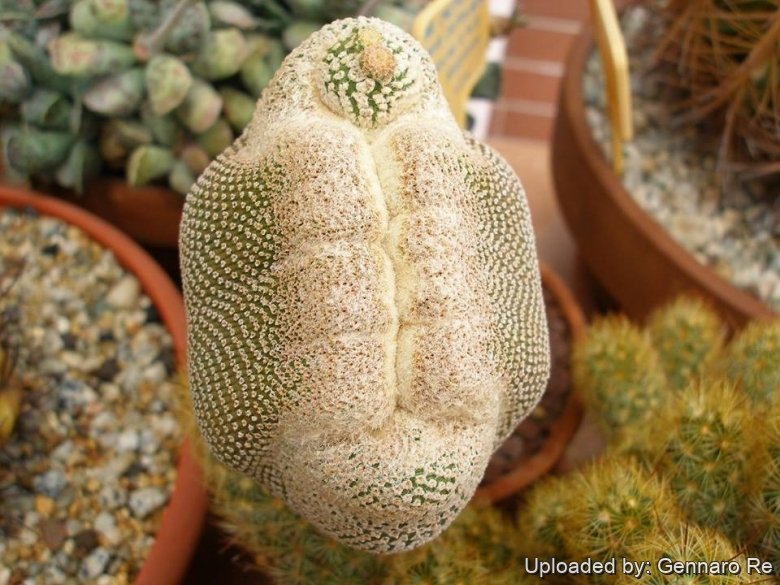
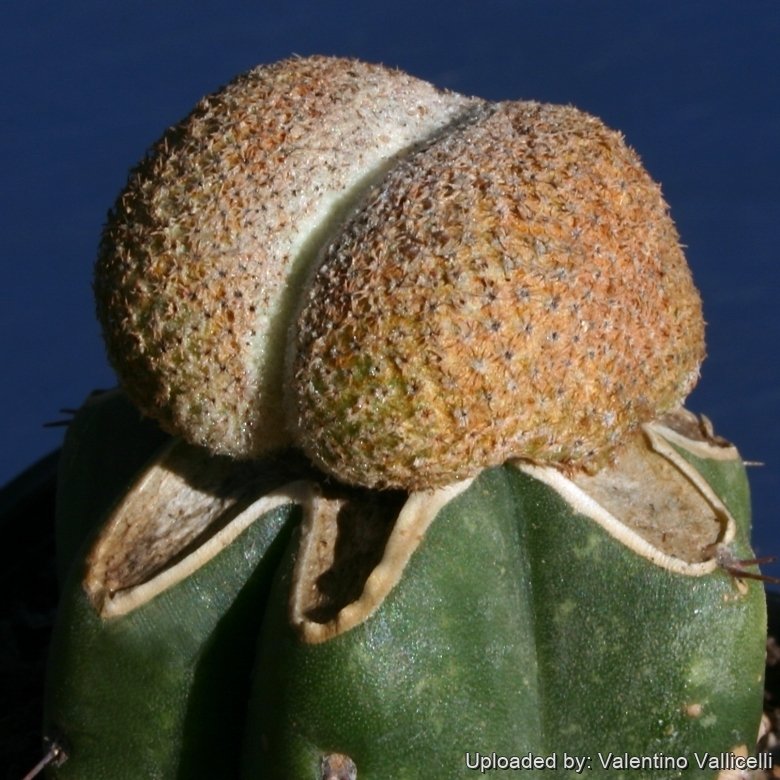
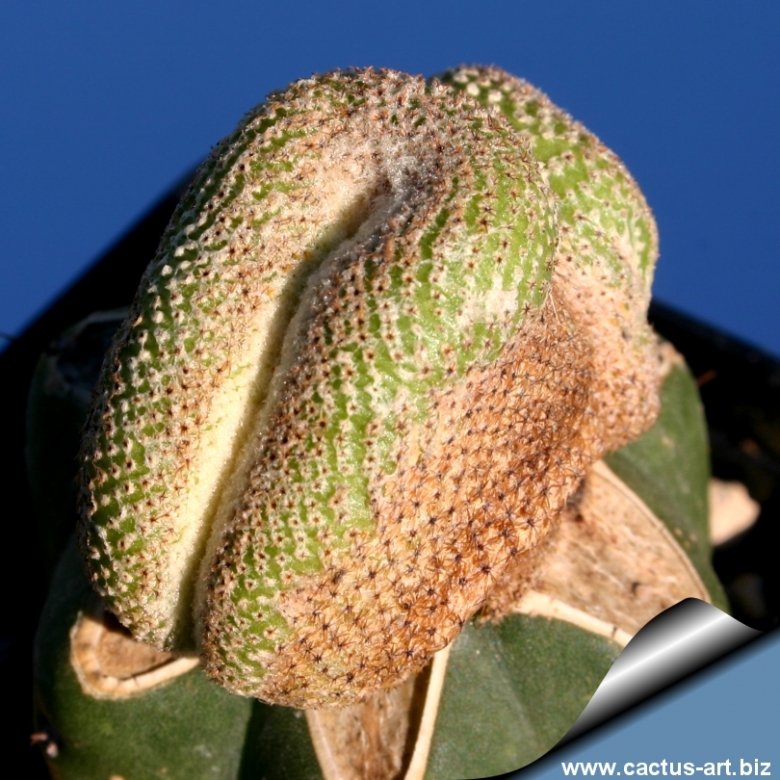
Yavia cryptocarpa is a small-sized, mostly underground cactus with strongly camouflaged aspect vaguely remembering of Epithelantha micromeris. And most of it is a tuberous root! The crested form Yavia cryptocarpa f. cristata - despite to its beauty - is still very rare and sought after by collectors, for its unique features.
Root: Has a large tap root below the surface of the compost.
Stem: Fan shaped, variously convoluted, flattened on top, depressed centrally along the line meristem, very small.
Areoles: Ordered in several lines that are not really ribs, just small undulations for which the term tubercles is perhaps too much. In cultivation areoles are whitish and hairy.
Spines: Small, inconspicuous, at top of the plant 0,3-0,7 mm long, and barely visible without the aid of a magnifying lens. The older spines soon become decrepit, more or less destroyed.
Flowers: Yellow to lime green buds appear in late spring and are followed by beautiful pink flowers (about 20 mm in diameter).
Flowers and fruit: One or more flowers are produced from the centre of the plant at one time. This deep centre, which is full of hairs that protect the fruit during its development over several months, is where the fruit dries and dehisces and where the new buds expel the fruits and seeds for dispersal.
The fruit splits from the base. The very thin wall of the fruit looks like thin, brown translucent paper.
Seeds: The number of seeds produced in each fruit vary from 1 to 7 seeds or occasionally more (up to 25)
Origin and Habitat
Garden origin (Nursery produced cultivar)
Cultivation and Propagation
Although regarded as a choice and difficult plant is not too difficult in a greenhouse, although grows quite slowly.
Soil: Use mineral well permeable mineral soil with little organic matter (peat, humus).
Exposure: They need a good amount of light shade to full sun this help to keep the plants healthy, although slow growth.
Watering: Water sparingly from March till October (weekly during summertime, if the weather is sunny enough) , with a little fertilizer added. Less or no water during cold winter months to prevent root loss. It is sensitive to overwatering (rot prone).
Hardiness: Keep perfectly dry in winter at temperatures from 5 to 15 degrees centigrade. (but it is relatively cold resistant and hardy to -7° C for short periods) In the rest period no high atmospheric humidity!! (Temperature Zone: USDA 9-11)
Propagation: Grafting since cutting root hardly. Plants are usually grafted onto column-shaped cacti but proved to be able to produce their own roots if degrafted.
Notes
Yavia is a very strange cactus that might be related with Cintia, Blossfeldia, Weingartia and Neowerdermannia.
The cause of cresting: The cause of cresting is not fully explained, biologists disagree as to why some cacti grow in this unusual form. Some speculate that it is a genetic mutation. Others say it is the result of a lightning strike or freeze damage, but whatever the stimulus, the growth point of the stem has switched from a geometric point, to a line, which folds and undulates as the crest expands. Crested Yavia are very rare, cresting occurs naturally and can be encountered in many other cactus species.
Bibliography
Major references and further lectures
-
James Cullen, Sabina G. Knees, H. Suzanne Cubey “The European Garden Flora Flowering Plants: A Manual for the Identification of Plants Cultivated in Europe, Both Out-of-Doors and Under Glass” Cambridge University Press, 11/Aug./2011
-
David Hunt, Nigel Taylor “The New Cactus Lexicon” DH Books, 2006
-
Edward F. Anderson “The Cactus Family” Timber Press, 2001