Publication: Sp. Pl., ed. 2. 2: 1659. 1763 [Jul-Aug 1763]
Description
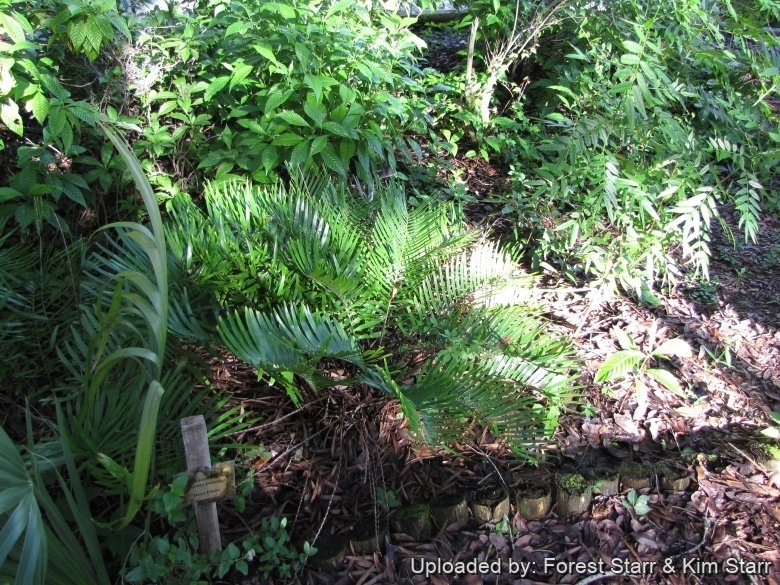
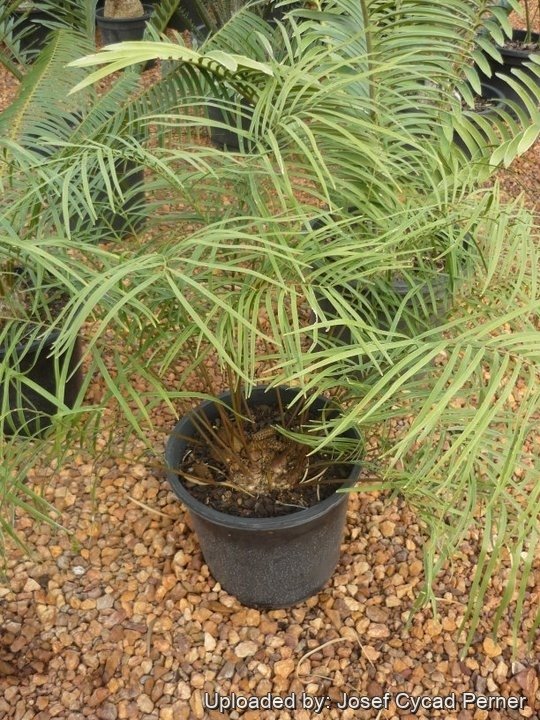
Zamia pumila is a small clumping, tough, woody cycad. It is similar in many respects to Zamia furfuracea, but with slightly narrower leaflets, and to Zamia integrifolia.
Stem: 3–25 cm high and diameter, but is often subterranean and tuberous. At first solitary, but over time it will divide dichotomously or branch from the side forming a multi-branched cluster, with a large, tuberous root system, which is actually an extension of the above-ground stems.
Crown: Leaves 2-15 in terminal rosettes up to 2 m in diameter. The leaflets with distinct apical teeth serve to distinguish Zamia pumila from Zamia integrifolia.
Cataphylls 1-2 cm long, sheathing at first, with a pair of inconspicuous stipules.
Leaves: 1-pinnately compound, somewhat palm-like, 60–120 cm long, evergreen, upright, herbaceous, rachis smooth, bearing 10-30 pairs of leaflets (pinnae). Each leaflet is linear to lanceolate or oblong-obovate to somewhat rounded apically, median ones 8–25 cm long and 0,5–2 cm broad, often deeply cleft, with 10-15 distinct teeth in upper fourth. They are often revolute; petioles with stipules and smooth.
Flowers (cones): Zamia pumila is dioecious, having male or female cones that emerge from the centre of the apex of the trunk. Male cones (pollen bearing) 1-30-clustered, pedunculate, dark reddish brown, cylindrical to ovoid-cylindrical, apex acute, growing to 3–15 cm long and 8-20 mm in diameter. Female cones (seed bearing) solitary or up to 5-clustered, pedunculate, dark reddish brown, elongate-ovoid with a distinct acuminate tip 6–15 cm long and 4–6 cm in diameter.
Seeds: Red to orange-red, ovoid, 1-2 cm long.
Origin and Habitat
Cuba (Isle of Pines off of the southwestern coast and east of Havana) and the Dominican Republic (now extinct in southern Puerto Rico, Hispaniola and Haiti). Population numbers estimated to be several thousand, probably 5.000-10.000. The number of subpopulations is uncertain.
Habitat: It grows in the beach under coconut palms (Cocos nucifera) or away from the shore line but very near to the coast on well-drained sands or sandy loam soils. During bad storms, the salt water had to be washing over them.
Ecology: Like other cycads, Pollination is by certain insects, namely the belid weevil Rhopalotria slossoni. It seems that during hurricanes, seeds get washed out to sea and sometimes end up on other islands.
Cultivation and Propagation
Zamia pumila is easy to grow and a very popular plant in cultivation. Because of its ruggedness, low maintenance and drought tolerance it is commonly grown in tropical and subtropical regions. This species is rather fast and in good conditions can speed it up considerably and could go from seed to coning size plants in 3-4 years. This plant may be cultivated as an indoor plant in temperate countries.
Exposition: It prefers filtered sunlight to partial shade as colour bleaches when in full sun; best with some protection from afternoon heat but not in constant deep shade. Generally speaking the plants that are in a situation under shrubs are more vigorous.
Soil: Needs a well drained sandy or sandy loam spot, with deep soil, neutral or basic (tolerate limestone) but will still thrive in less than ideal conditions. Mulch with organic materials (bark or leaf mould).
Moisture: Water when dry. Drought tolerant.
Fertilization. Because of its growth habit, fertilize only when terminal bud begins to swell, indicating the start of the annual growth cycle.
Hardiness: It should be protected from extreme cold. (USDA Zones 9-11) Sustains leaf damage at -2° C.
Salt aerosol tolerance: It is salt resistant and is even happy living out on seaside condominium balconies.
Maintenance: Minimal; removal of offsets if desired, removal of spent fronds
Use: Landscape as cultivated perennial in warm, coastal areas, it makes a great accent or specimen plant and can be used in beachside plantings. Several can be planted together for a lush, tropical effect. Plant on three to five-foot-centers to create a mass planting. Use near the patio, in mixed foundation plantings or in perennial beds. It is a spectacular house-plant or interior-scape specimen in cool areas tough enough to survive occasional neglect and harsh indoor environments. It is very well suited to bonsai culture.
Warning: This plant is poisonous, producing a toxin called cycasin that affects the gastrointestinal tract and nervous system. Poisonous Parts: Fleshy seeds, stems, roots, leaves. Protect pets and instruct children to never eat or chew any plant material without permission.
Edibility: Processed flour, toxic if large quantities eaten. The stems and half-buried stems are edible and were used by Native American people for their yield of a starch, but only after removing the toxin by careful leaching. The original inhabitants of Hispaniola (Taino Indians) used the plants for food. They ground the tubers and made a paste out of them, which they wrapped in leaves, and then let them sit for several days until they turned black and got worms in them. Then they made tortillas out of them, worms and all.
Propagation: Seeds. The germination process is slow and difficult to achieve in cultivation, after fertile seeds are collected, they usually need several months of storage before the inner embryo is ready to germinate. Therefore, it is best to clean the seeds of external fruit and set them aside before attempting to propagate the seeds. Seeds should be sown in shallow container, lightly covered with sand, and after germination, potted off in small pots of moderately rich, light soil. The growing plants do best in partial shade. The old plants frequently send up suckers around the base of the trunk. These may be taken off when in a dormant state and rooted, care being taken to remove the leaves to guard against excessive transpiration. The advantage of the “pups” is that you will know its sex, for seedlings you will have to wait several years until the plant flowers to find out.
Notes
Zamia pumila was the first species described for the genus and hence is the type species for the genus Zamia and the family Zamiaceae. Historically there has been much confusion as to the identity of this species and as consequent there are numerous synonyms and redescriptions in the older literature. At one extreme some authors included all these plants in a single broadly defined species, Zamia pumila, while other botanists have recognized several more narrowly defined species. The Flora of North America treats the American plants as Zamia integrifolia which is native to Florida and differs in the smaller, more commonly entire (untoothed or only slightly so) leaves usually less than 25 cm long than the true Zamia pumila from the Carribbean islands, although some references continue to refer to these populations as Zamia pumila.
Bibliography
Major references and further lectures
-
Forest & Kim Starr Zamia pumila (Coontie). Plants of Hawaii. <http://www.starrenvironmental.com\>. Downloaded on 22 September 2014.
-
Whitelock, Loran M. “The Cycads.” Timber press 2002
-
Stevenson, D.W. 2010. Zamia pumila. The IUCN Red List of Threatened Species. Version 2014.2. <www.iucnredlist.org>. Downloaded on 22 September 2014.
-
Haynes J.L, “World List of Cycads: A Historical Review” IUCN/SSC Cycad Specialist Group, 2011
-
Wikipedia contributors. “Zamia pumila.” Wikipedia, The Free Encyclopedia. Wikipedia, The Free Encyclopedia, 15 Mar. 2013. Web. 22 Sep. 2014.
-
Terrence Walters, Roy Osborne “Cycad Classification: Concepts and Recommendations“ CABI, 12/Jan/2004
-
Zamia pumila PACSOA Palms and Cycads wiki , <http://www.pacsoa.org.au\> Accessed on 22 Sep. 2014
-
K.U. Kramer, Klaus Kubitzki, P.S. Green “Pteridophytes and Gymnosperms” Springer Science & Business Media, 28/Sep/1990
From llifle page Palmifolium debile
Origin and Habitat
West Indies
Source: Palmifolium debile, LLIFLE - Encyclopedia of living forms, CC-BY-SA, retrieved 2026-10-26.
From llifle page Zamia allison-armourii
Origin and Habitat
San Domingo
Source: Zamia allison-armourii, LLIFLE - Encyclopedia of living forms, CC-BY-SA, retrieved 2026-10-26.
From llifle page Zamia gutierrezii var. portoricensis
Description
Zamia portoricensis is a small understorey cycad with a short tuberous caudex mostly subterranean (acaulescent). The fronds are rather dainty and delicate with very thin, pale green, long individual leaflets and a rather petite habit look. Zamia portoricensis is known in Puerto Rico as “marunguey”.
Derivation of specific name: The epithet “portoricensis” refers to the occurrence of the species from Puerto Rico.
Similar species: Zamia portoricensis is similar in appearance to Zamia angustifolia and sometime confounded with it in cultivation by the growers.
Stem (caudex): Subterranean and tuberous, up to 15 cm in diameter, often dichotomously branched.
Leaves: 2-10, compound, 0.5 1.5 m long with 17 to 125 leaflets. Leaflets 5-30 pairs, entire, opposite to subopposite, papyraceous to coriaceous, pale green, long and narrow, linear, 8 to 25 cm long and 5-8(-10) mm wide, often channelled above with entire margins and tips acute but not sharp. Petioles with stipules, spineless.
Cataphylls: The cataphylls (Modified leaf, much reduced and thickened, serving to protect the apical meristem in cycads produced in flushes preceding the emergence of cones or leaves.) are 1-2 cm long, sheathing at first, with a pair of inconspicuous stipules.
Female cones: 6-13.3 cm long and 4-5 cm in diameter, usually solitary but occasionally up to 3, reddish or reddish brown densely hairy, ovoid, with a blunt or acuminate apical tail; megasporophylls hexagonal with a flat center.
Male cones: Cylindrical somewhat tapering towards acute apex, pedunculate, reddish or reddish-brown up to 3-15 cm long and 0.8-2 cm in diameter.
Seeds: Ovoid and elongated 1-2 cm long, with a bright red sarcotesta
Chromosome number: 2n = 16.
Taxonomy notes: Historically Zamia portoricensis has been confused by Schuster (1932) as a variety of Zamia media Zamia pumilaSN’>23872] or of Zamia floridana. It is clear now that plants in the field and cultivation maintain their morphological characters.
Origin and Habitat
Zamia portoricensis is one of the Caribbean species of Zamia endemic of Puerto Rico. It is found only in Western Puerto Rico (main island) in the region of the Susua State Forest, where it is known from only three extant populations (extent of occurrence 220 km²). Number of mature individuals 400-500. Three distinctive Zamia taxa occur on the Puerto Rico island: Zamia erosa on the north coast, Zamia portoricensis on the South-west and Zamia pumila on the South. Overall, the taxa are slightly inbred. Zamia erosa exhibits a more than threefold greater degree of population differentiation than the other two taxa. Admixture is evident only between Z. portoricensis and Zamia pumila. Zamia erosa may represent an independent introduction into Puerto Rico.
Habitat and Ecology: Zamia portoricensis grows in very dry areas thickets at lower elevations (arid coastal plain) on limestone soils that often contain an element of serpentine. The vegetaion is subtropical moist forest. Zamia portoricensis has become very rare in Puerto Rico in part due to development but also as a result over collection for nursery , as well as lack of regeneration. The pollinators, mostly Pharaxonotha portophylla (Coleoptera: Erotylidae) seem to have been eradicated from one of the localities (possibly due to aerial insecticide spraying for local agriculture), and so no seed is being set. Older pollen cones do not have the indicator weevil exit holes. However, the species is easily raised from seed and young plants have begun to appear on the market and artificial propagation appears to be in place.
Cultivation and Propagation
Zamia portoricensis is a good versatile cycad for smaller gardens, because of its ruggedness, low maintenance it is easy to grow in tropical and subtropical regions. Has a subterranean stem, but in cultivation, stem is usually exposed a bit for looks. It is tolerant of dry soils and high pH. This plant would make a rather nice house plant in temperate countries.. It should tolerate a range of conditions as well as or better than the more commonly grown parlour palms (Chamaedorea elegans) and it looks nicer.
Growth rate: This species is rather fast and in good conditions can speed it up considerably and could go from seed to coning size plants in a few years.
Exposition: It prefers filtered sunlight to partial shade but tolerates full sun too; best with some protection from afternoon heat but not in constant deep shade. Generally speaking the plants that are in a situation under shrubs are more vigorous.
Soil: Needs a well drained sandy or sandy loam spot, with deep soil, neutral or basic (tolerate limestone) but will still thrive in less than ideal conditions. Mulch with organic materials (bark or leaf mould).
Moisture: Water when dry. Drought tolerant.
Fertilization. Because of its growth habit, fertilize only when terminal bud begins to swell, indicating the start of the annual growth cycle.
Hardiness: It should be protected from extreme cold. (USDA Zones 9-11) Sustains leaf damage at -2° C.
Salt aerosol tolerance: It is salt resistant and is even happy living out on seaside condominium balconies.
Maintenance: Minimal; removal of offsets if desired, removal of spent fronds
Use: Landscape as cultivated perennial in warm, coastal areas, it makes a great accent or specimen plant and can be used in beachside plantings. Several can be planted together for a lush, tropical effect. Plant on three to five-foot-centers to create a mass planting. Use near the patio, in mixed foundation plantings or in perennial beds. It is a spectacular house-plant or interior-scape specimen in cool areas tough enough to survive occasional neglect and harsh indoor environments. It is very well suited to bonsai culture.
Warning: This plant is poisonous, producing a toxin called cycasin that affects the gastrointestinal tract and nervous system. Poisonous Parts: Fleshy seeds, stems, roots, leaves. Protect pets and instruct children to never eat or chew any plant material without permission.
Edibility: Processed flour, toxic if large quantities eaten. The half-buried stems are edible and were used by Native American people for their yield of a starch, but only after removing the toxin by a careful and complex set of procedures to eliminate the toxins.
Propagation: Seeds. The germination process is slow and difficult to achieve in cultivation, after fertile seeds are collected, they usually need several months of storage before the inner embryo is ready to germinate. Therefore, it is best to clean the seeds of external fruit and set them aside before attempting to propagate the seeds. Seeds should be sown in shallow container, lightly covered with sand, and after germination, potted off in small pots of moderately rich, light soil. The growing plants do best in partial shade. The old plants frequently send up suckers around the base of the trunk. These may be taken off when in a dormant state and rooted, care being taken to remove the leaves to guard against excessive transpiration. The advantage of the “pups” is that you will know its sex, for seedlings you will have to wait several years until the plant flowers to find out.
Bibliography
Major references and further lectures
-
Wikipedia contributors. “Zamia portoricensis.” Wikipedia, The Free Encyclopedia. Wikipedia, The Free Encyclopedia, 10 Aug. 2015. Web. 9 Oct. 2015.
-
Stevenson, D.W. 2010. Zamia portoricensis. The IUCN Red List of Threatened Species 2010: e.T42117A10653088. http://dx.doi.org/10.2305/IUCN.UK.2010-3.RLTS.T42117A10653088.en . Downloaded on 09 October 2015.
-
Osborne, R., Calonje, M.A., Hill, K.D., Stanberg, L. & Stevenson, D.W. “The world list of Cycads”. Memoirs of the New York Botanical Garden 106: 480-510. 2012.
-
Acevedo-Rodríguez, P. & Strong, M.T. “Catalogue of seed plants of the West Indies.” Smithsonian Contributions to Botany 98: 1-1192. 2012.
-
Jose R Oliver “Caciques and Cemi Idols: The Web Spun by Taino Rulers Between Hispaniola and Puerto Rico” University of Alabama Press, 10 May 2009
-
V.P. Singh “Gymnosperm (naked seeds plant): structure and development” Sarup & Sons, 01 January 2006
-
Alain H. Liogier, Luis F. Martorell “Flora of Puerto Rico and Adjacent Islands: A Systematic Synopsis” La Editorial, UPR, 2000
-
K. N. Ganeshaiah, R. Uma Shaanker, Kamaljit S. Bawa “Tropical Ecosystems: Structure, Diversity, and Human Welfare : Proceedings of the International Conference on Tropical Ecosystems” Structure, Diversity, and Human Welfare : 15-18 July 2001, Bangalore, Volume 1 Science Publishers, 01 January 2001
-
Andrew P. Vovides, Dennis William Stevenson, Roy Osborne “Proceedings of Cycad 2005: The 7th International Conference on Cycad Biology, 8-12 January 2005, Jardín Botánico Fco. J. Clavijero, Instituto de Ecología, A.C., Xalapa, Veracruz, Mexico” New York Botanical Garden Press, 01 January 2007
-
The Cycad Pages: “Zamia portoricensis” Royal Botanic Gardens Sydney Written and maintained by Ken Hill 1998-2010 Maintained by Leonie Stanberg and Dennis Stevenson 2010-2012 <http://plantnet.rbgsyd.nsw.gov.au/cgi-bin/cycadpg?taxname=Zamia+portoricensis\> Downloaded on 21 September 2015.
-
Meerow AW, Francisco-Ortega J, Calonje M, Griffith MP, Ayala-Silva T, Stevenson DW, Nakamura K. “Zamia (Cycadales: Zamiaceae) on Puerto Rico: asymmetric genetic differentiation and the hypothesis of multiple introductions.” Am J Bot. 2012 Nov;99(11):1828-39. doi: 10.3732/ajb.1200494. Epub 2012 Nov 1.
-
PACSOA contributors “Zamia portoricensis”. In: Cycads. Palm and Cycad Societies of Australia (PACSOA). <http://www.pacsoa.org.au/wiki/Zamia\_portoricensis\> 25 November 2013 Web. 28 August 2015.
-
Calonje, M. et al. “The typification of Zamia erosa and the priority of that name over Z. amblyphyllidia.” Taxon 59:637–642. 2010.
-
Jones, D. L. “Cycads of the world, ancient plants in today’s landscapes.” 1993
-
Meerow, A. W. et al. “Zamia (Cycadales: Zamiaceae) on Puerto Rico: asymmetric genetic differentiation and the hypothesis of multiple introductions.” Amer. J. Bot. 99:1828–1839. 2012.
-
Acevedo-Rodríguez, P. & M. T. Strong. “Monocotyledons and gymnosperms of Puerto Rico and the Virgin Islands”. Contr. U.S. Natl. Herb. 52:16. 2005.
-
Nico M. Franz & Paul E. Skelley “Pharaxonotha portophylla (Coleoptera: Erotylidae), new species and pollinator of Zamia (Zamiaceae) in Puerto Rico” Caribbean Journal of Science, Vol. 44, No. 3, 321-333, 2008
Source: Zamia gutierrezii var. portoricensis, LLIFLE - Encyclopedia of living forms, CC-BY-SA, retrieved 2026-10-26.
From llifle page Zamia latifoliolata
Origin and Habitat
Dominican Republic (Caribbean, Southern America)
Source: Zamia latifoliolata, LLIFLE - Encyclopedia of living forms, CC-BY-SA, retrieved 2026-10-26.
Gallery