Publication: Repert. Pl. Succ. (I.O.S.) 29: 3 (1978 publ. 1980). Notes: A. oleifolium
Description
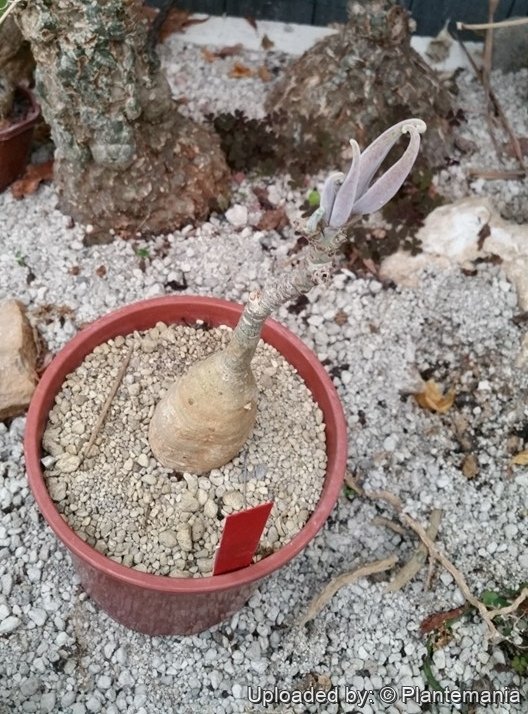
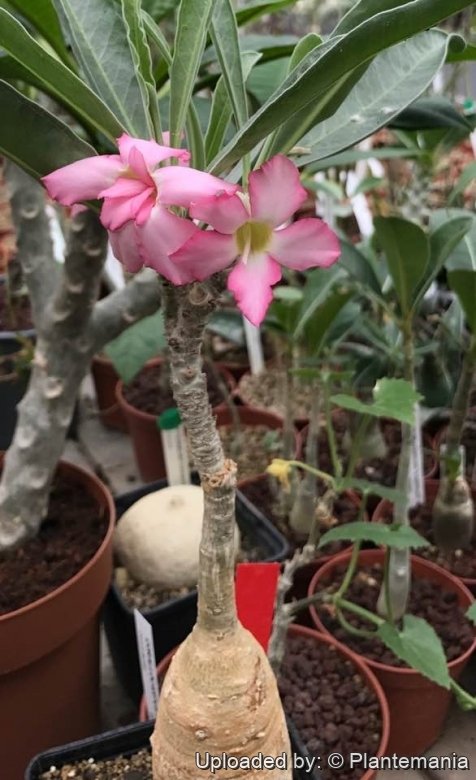
Adenium obesum subsp. oleifolium (Adenium oleifolium) of the periwinkle family, Apocinaceae, is a softly-pubescent, succulent shrublet 12-40 cm high, with white latex in all parts, forming a dense mass of rather fleshy leaves and stems, with a subterraneous carrot-like very bitter-tasting rootstock. The inflorescence is a terminal cyme with few pink flowers with deeper red margins, followed by cylindrical follicles (pods) spreading or recurved when mature. This small species can be distinguished by its long, narrow leaves frequently folded along the midrib.
Rootstock (Caudex or bole): Swollen, tuberous, brown-skinned, largely submerged 50–80 long, 15–30 cm wide, bearing 1-several branches.
Branches: From the upper portion of the bole, erect, fleshy, rapidly tapering, sparingly branched, 20 cm long, 1-2 cm in diameter, pubescent when young, glabrous with age. Bark greyish-white to pale brown, sometimes corky or wrinkled.
Leaves: Clustered at the ends of the branches, linear to very narrowly obovate, 8-21 times as long as wide, obtuse, more or less narrowed at the base, sessile or almost so, 4.5–14.5 cm long, 3–14 mm broad, rather thick, frequently folded along the midrib, semi-succulent when fresh, above shiny, glaucous, or pale green, and pubescent to glabrous. Softly pubescent to subtomentose especially on the underside. Surface wrinkled when dry, secondary nerves quite obscure.
Inflorescences (cymes): Terminal, subsessile, 5–10 mm 5–10 mm, few-flowered, whitish tomentose. Bracts linear, about 4-6(-6) mm long, 1–1.5 mm wide.
Flowers: Flowers showy, ranging in colours from pale pink to red, more intense towards the margin, appearing with the leaves. The shapes, and size is also variable. Pedicels very short (5–8 mm) densely pubescent to pilose. Calyx 6-7 mm long, whitish tomentose. Sepals lanceolate, subacute, to narrowly ovate, 6.5–9(-12) mm long, 3.0–4 mm broad. Corolla bright scarlet or red to pink, pubescent without. Tube yellowish especially towards the base, 5–8 times as long as the calyx, 4–6.6 cm long, 0.9–1.4 cm in diameter, basal infrastaminal part of the tube (1–2 times as long as the calyx), narrowly cylindrical, 8-17 mm long, 3-5 mm in diameter, with 5 hairy lines descending to the middle, glabrous below, upper part of the tube wide funnel-shaped-campanulate, 18-23 mm long, 8-15 mm broad at the throat, mealy-papillose within. Lobes spreading, broad-ovate, cuspidate-acuminate, 12–28 mm long, 8–18 mm broad, with a puberulous scale at the base, 3-15 mm. Stamens 5, filaments 2-4 mm long, barely included or slightly exserted, anthers 5-8 mm long. Ovary of 2 free carpels, glabrous. Style 11–21 mm long; stigma capitate with a narrow basal rim.
Fruit: Two follicular mericarps eventually spreading to reflexed, pale grey to pale grey-brown, 8–11.5 cm long 1 cm in diameter, subcylindrical, tapering at each end, finely pubescent.
Seeds: Numerous, linear-oblong, pale brown, pubescent, 10–15 x 20 mm, with tufts of dirty white hairs 2–3.5 cm long at each end.
Origin and Habitat
Botswana (S. of Artesia), Namibia and S. Africa (Transvaal and Cape Prov.)
Altitude range: 120–1200 metres above sea level.
Habitat and ecology: This species grows on loose white or red sandy or sometimes, limestone outcrop in bushland and on stony ridges.
Cultivation and Propagation
Adenium obesum subs. oleifolium is easy to grow but is especially susceptible to spider mite infestation. It is nearly evergreen if grown in a warm greenhouse or tropical conditions a and watered, but can loose its leaves and forced into a long winter dormancy in cooler climate. New growth begins early in spring.
It like pots with generous drain holes on sides and bottom, need a very porous potting medium media (add pumice, vulcanite, and perlite) seeing that the main trunk is planted with the majority of the roots below the caudex line. Its rare that adeniums will use the upper third of their soil and often this area serves like a mulch or support for the stem.
To make plants develop a large swollen subterranean tuberous base and to increase flowering, they require a fertilizer rich in potassium and phosphorus without a too high nitrogen content.
Bright filtered light is best but in areas where light is not as burning, plants may be kept outdoors in full sun unprotected but remember that caudex is very susceptible to sun scalding.
Water plants preferably in the early mornings until the soil is well wetted and let excess water drains from the pot base. Watering can be done as they become drier even daily or to every few days during active growth season Never allow plants to dry out too often as this causes them to go into early dormancy. Many plants simply never get enough water to grow and flower adequately so keep them active and growing by providing them with all the essential necessities.
Reproduction: Seed, grafting or cuttings that develop the same characteristics in a few years.
Bibliography
Major references and further lectures
-
Otto Stapf “Flora Capensis”, Vol 4 1909
-
A. J. M. Leeuwenberg and F. K. Kupicha et al. “Flora Zambesica” FZ, Vol 7, Part 2, 1985
-
J.P. Roux “Flora of South Africa”, 2003
-
Urs Eggli “Illustrated Handbook of Succulent Plants: Dicotyledons” Springer Science & Business Media, 2002
-
Umberto Quattrocchi “CRC World Dictionary of Medicinal and Poisonous Plants: Common Names, Scientific Names, Eponyms, Synonyms, and Etymology” (5 Volume Set)
CRC Press, 19 April 2016
-
Doreen Court “Succulent Flora of Southern Africa” CRC Press, 01 June 2000
-
Keith Grantham, Paul Klaassen “The plantfinder’s guide to cacti & other succulents” Timber Press, 18 May 1999
-
Hermann Jacobsen “Abromeitiella to Euphorbia” Blandford Press, 1960
-
Clive Innes “Complete Handbook of Cacti and Succulents” Van Nostrand Reinhold Company, 01 December 1981