Publication: Syst. Veg., ed. 15 bis [Roemer & Schultes] 4: 411. 1819
Description
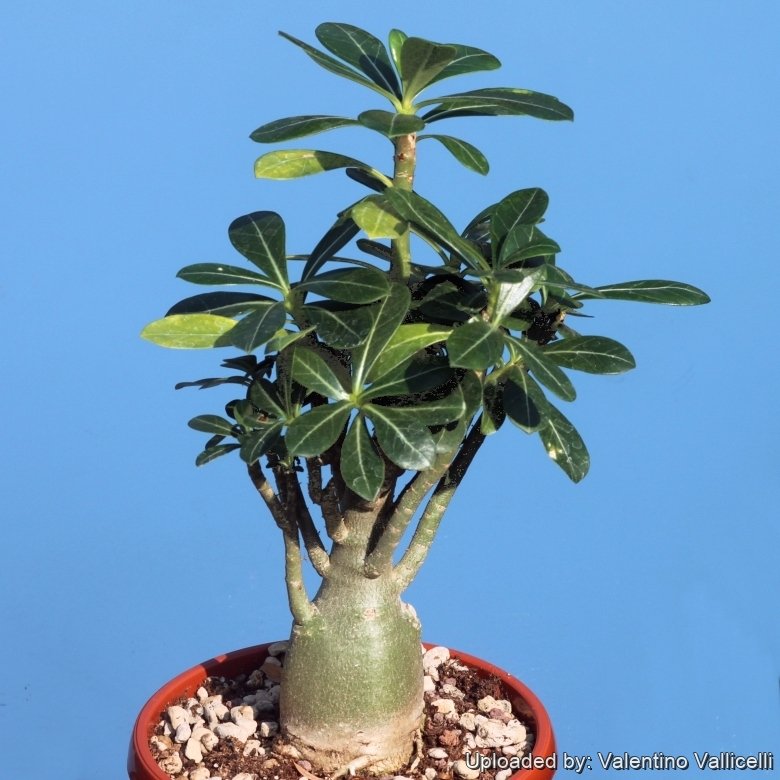
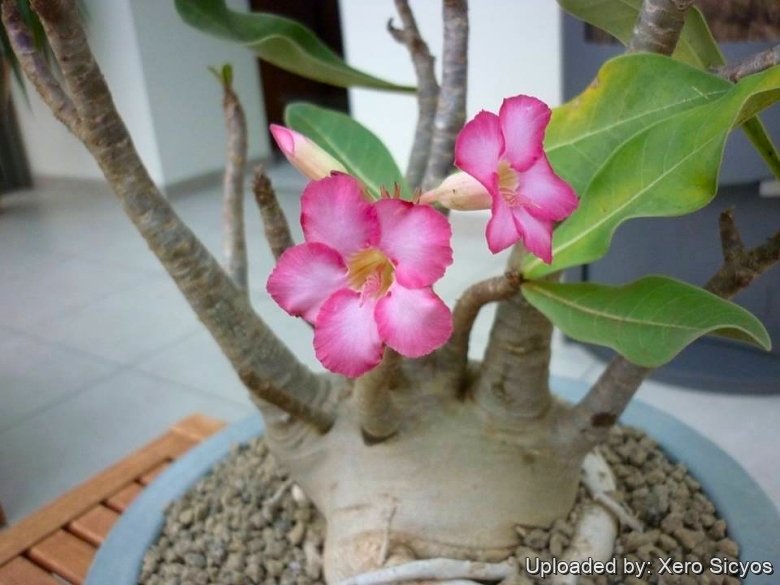
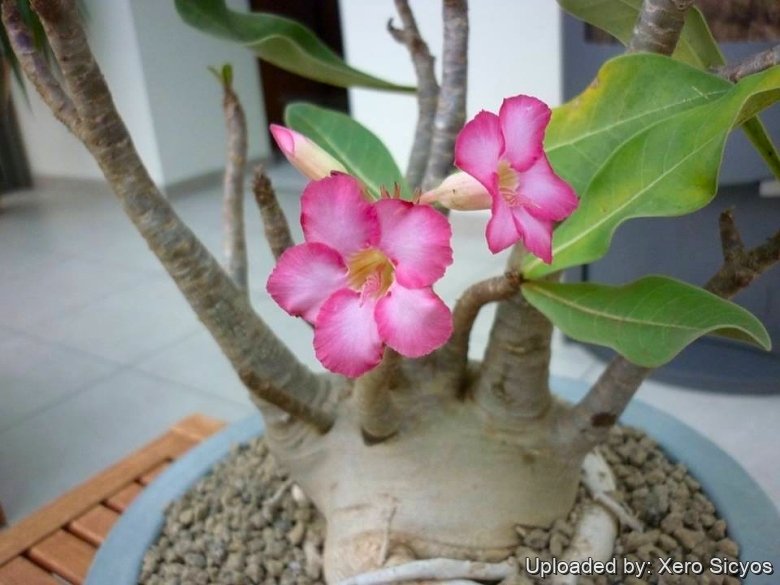
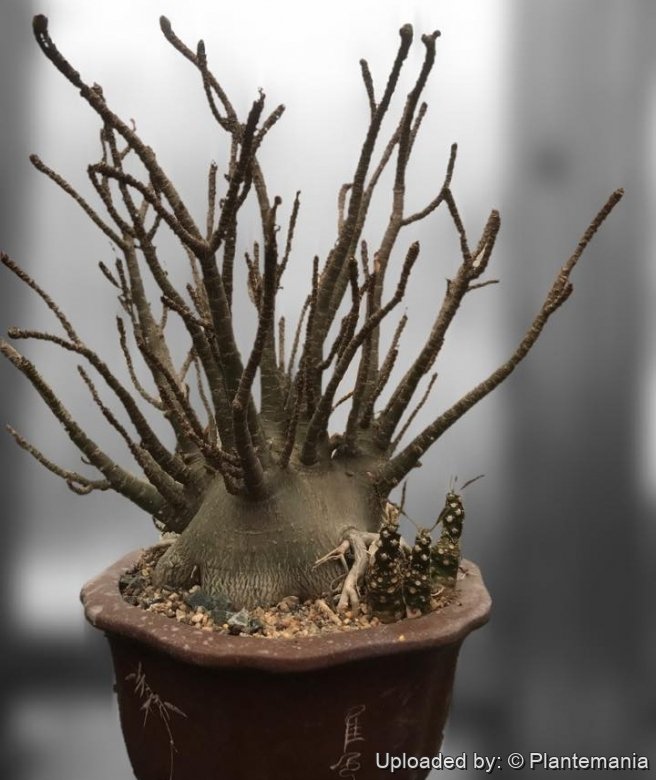
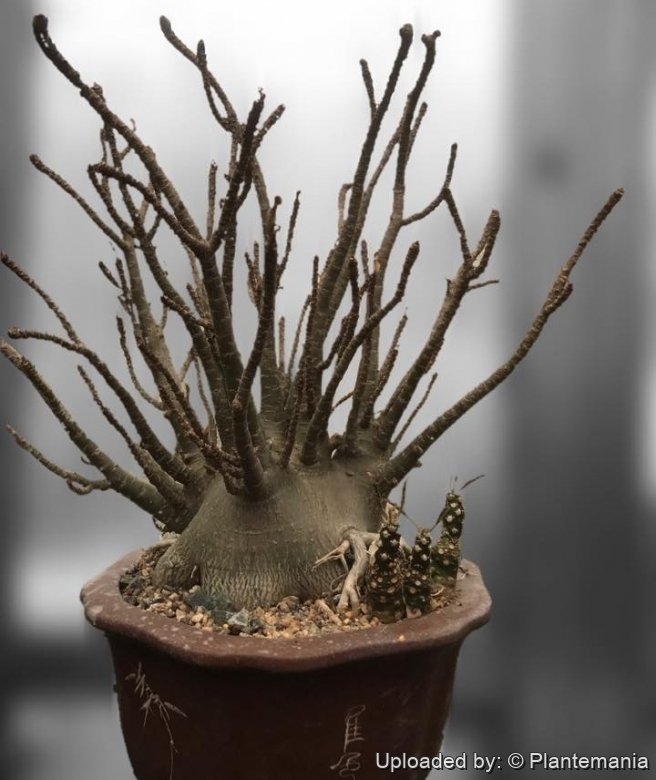
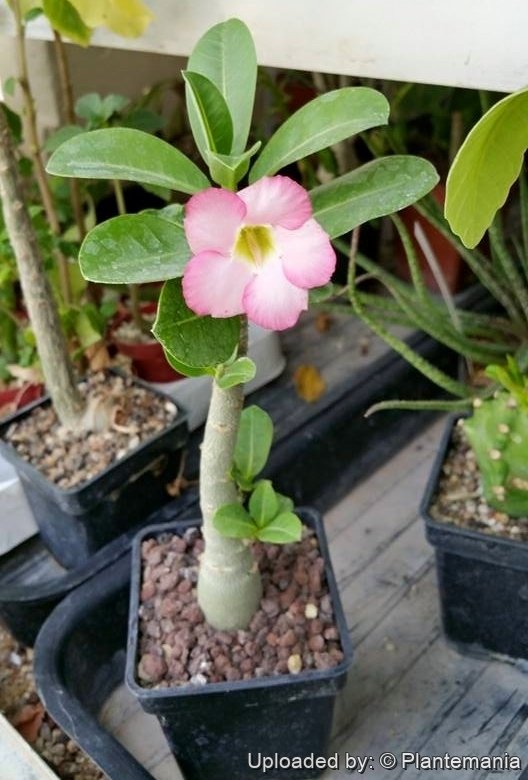
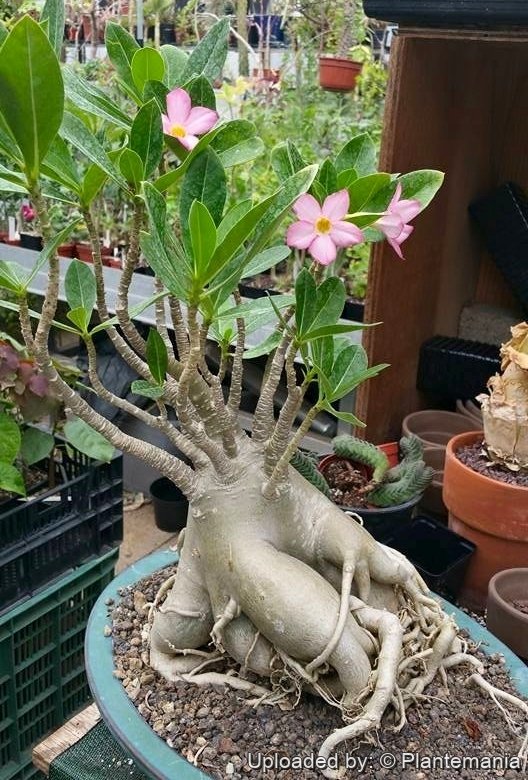
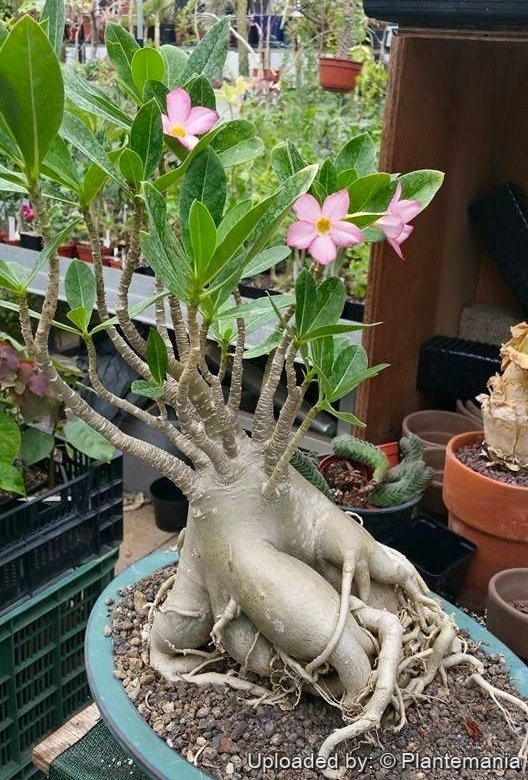
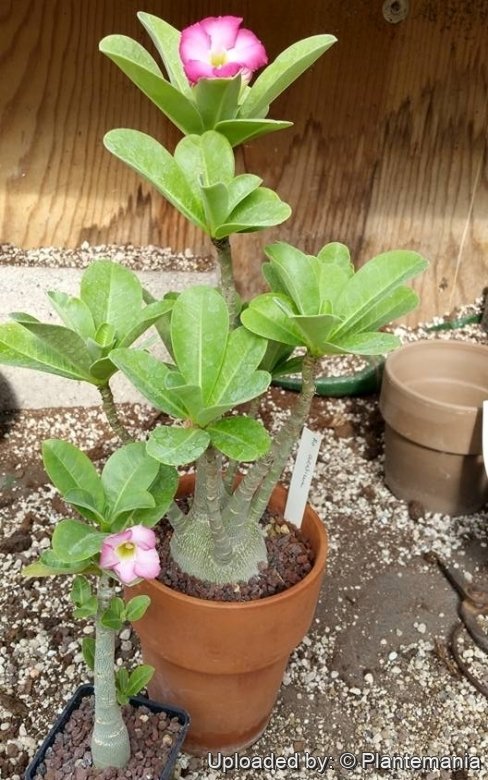
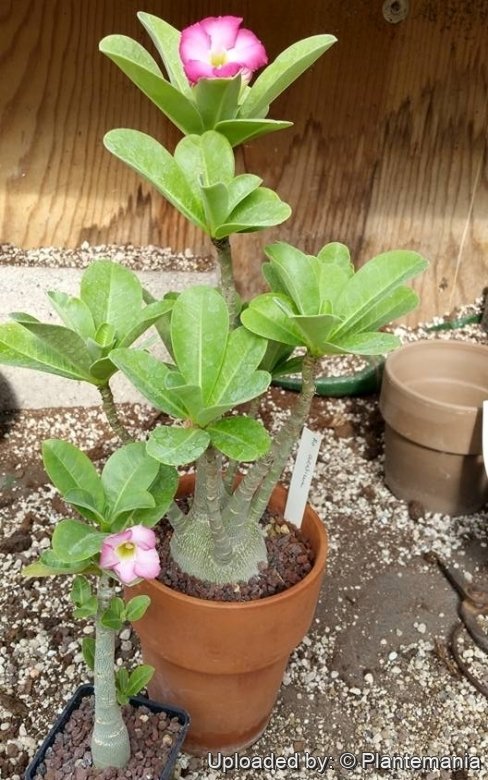
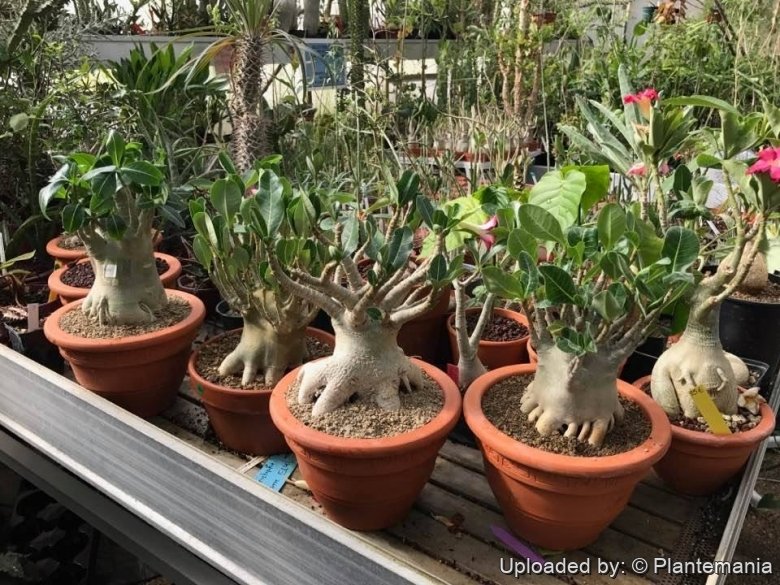
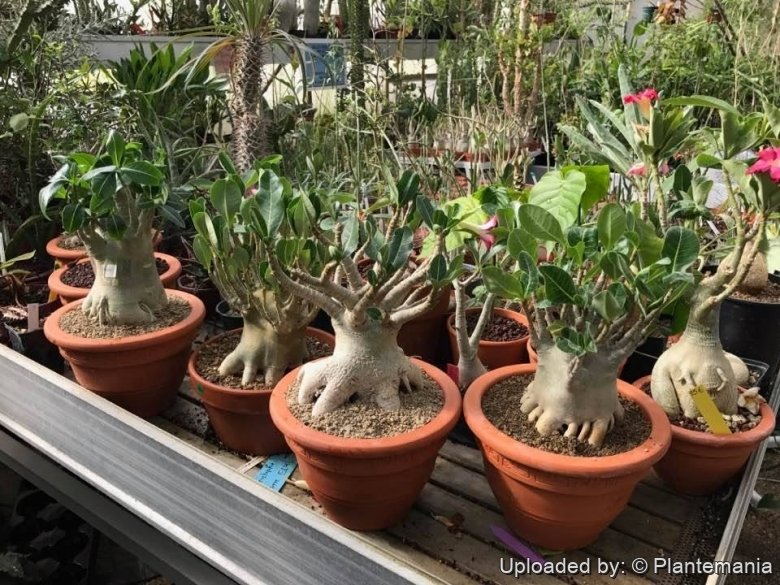
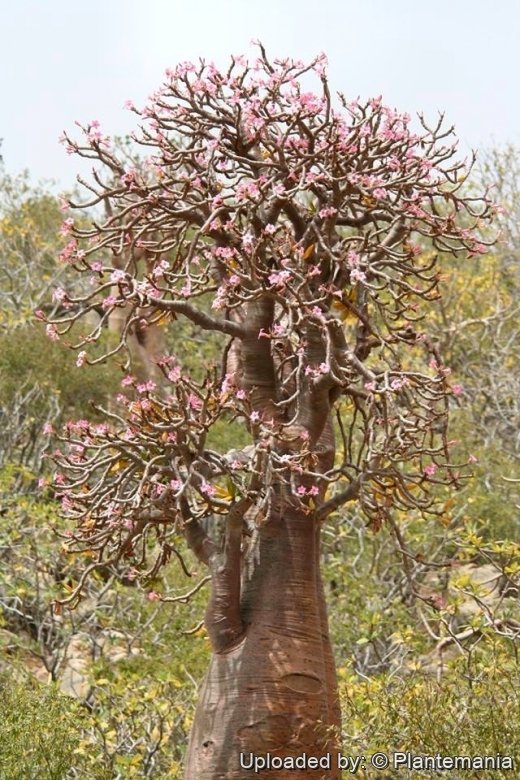
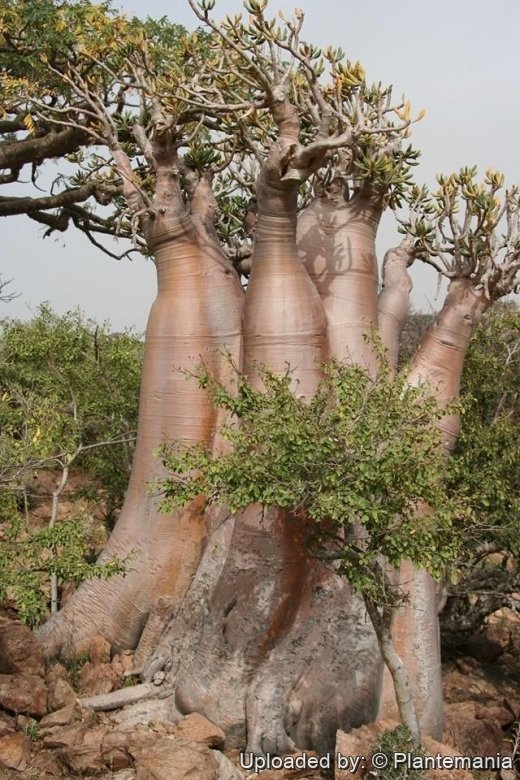
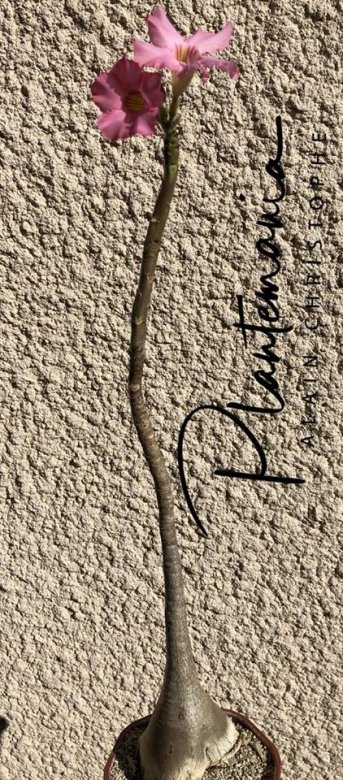
Adenium obesum is a succulent shrub or small tree belonging to the the oleander family. It has a pachycaul stems and a stout, swollen basal caudex with an opened crown becoming denser with age. It is evergreen or drought-deciduous and can also lose its leaves during cold spells. It is quite variable in habit and most plants in cultivation are hybrids, yet only a few cultivar names have a valid description. It is monoecious and self-sterile.
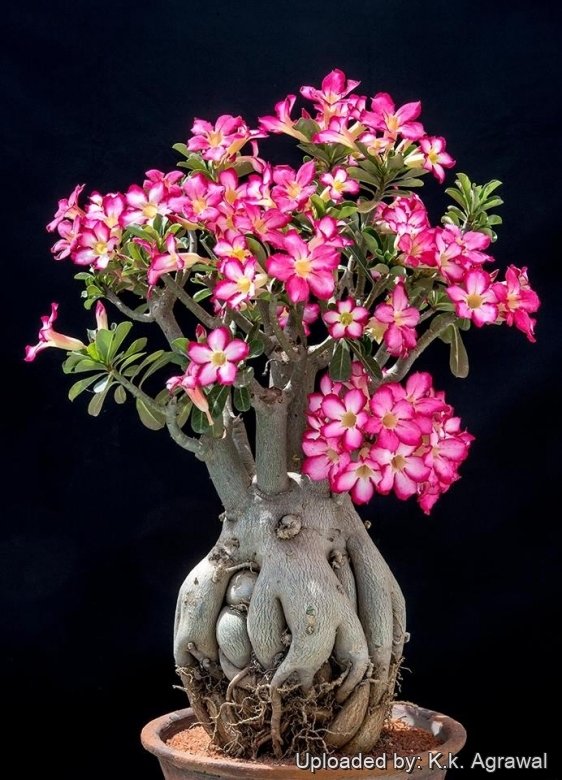
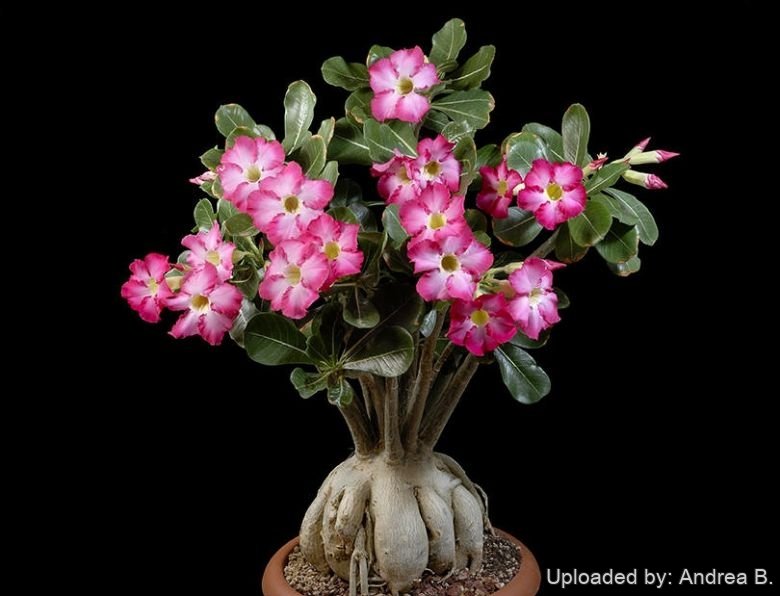
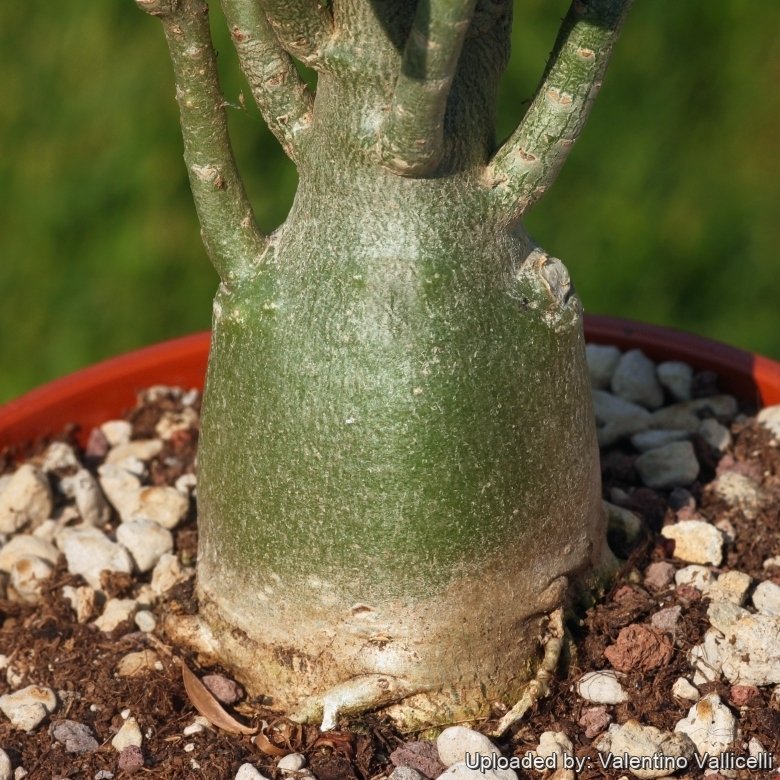
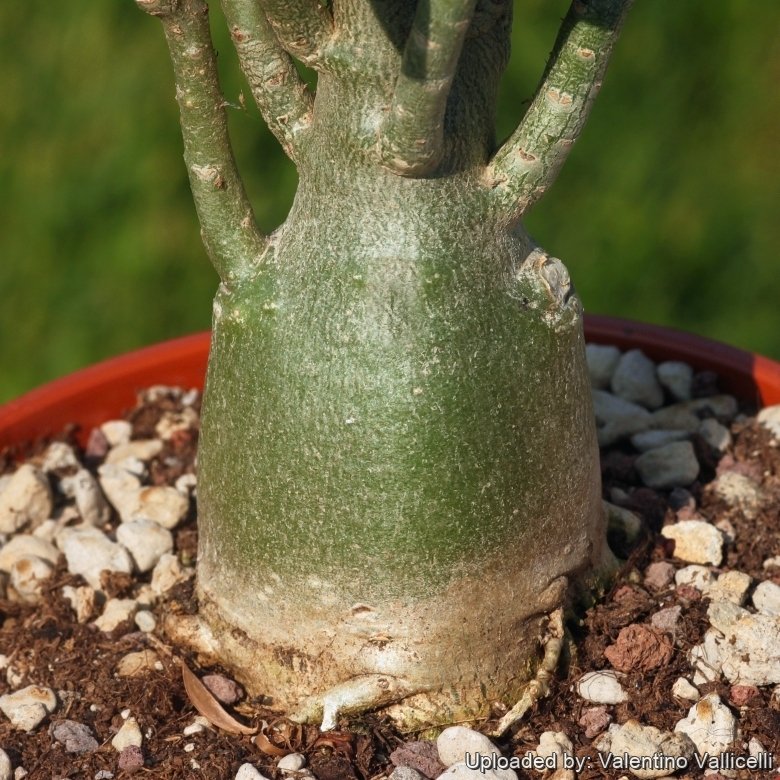
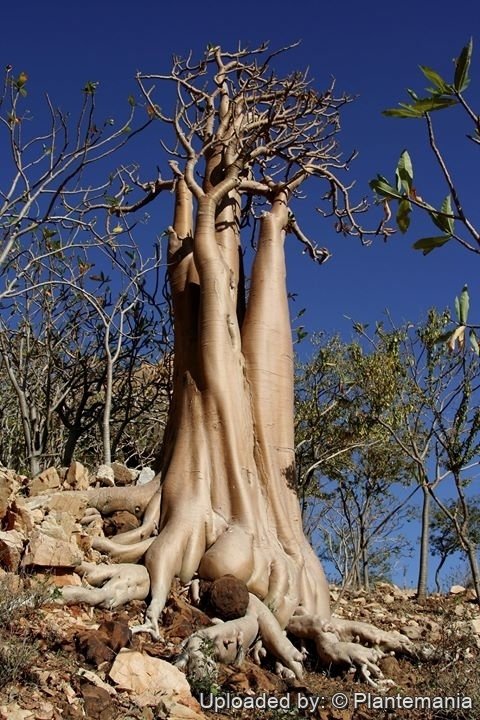
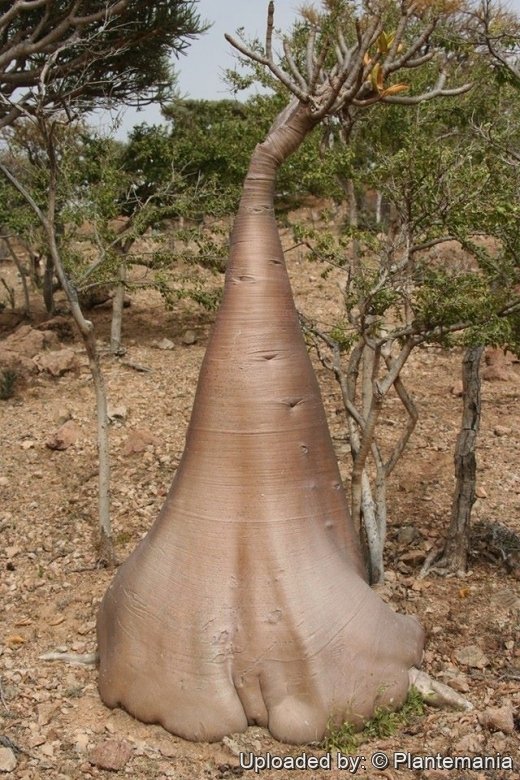
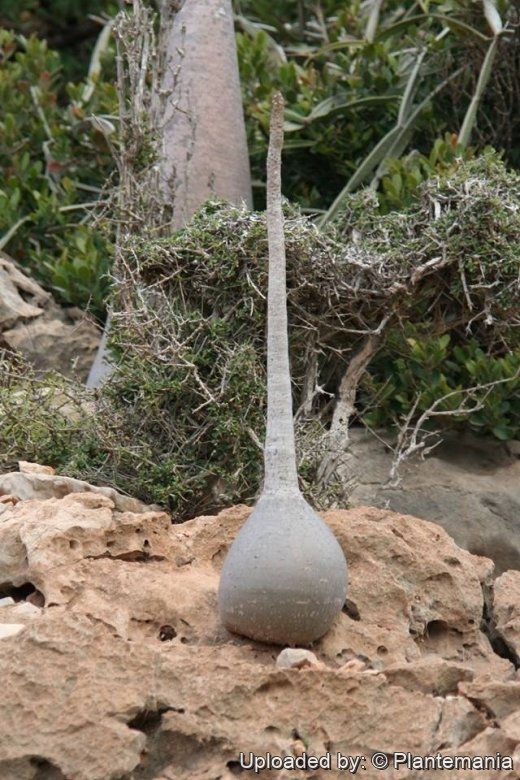
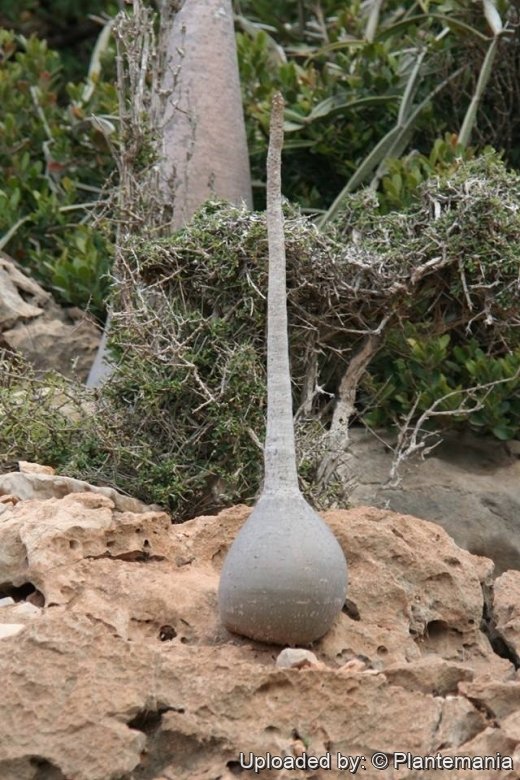
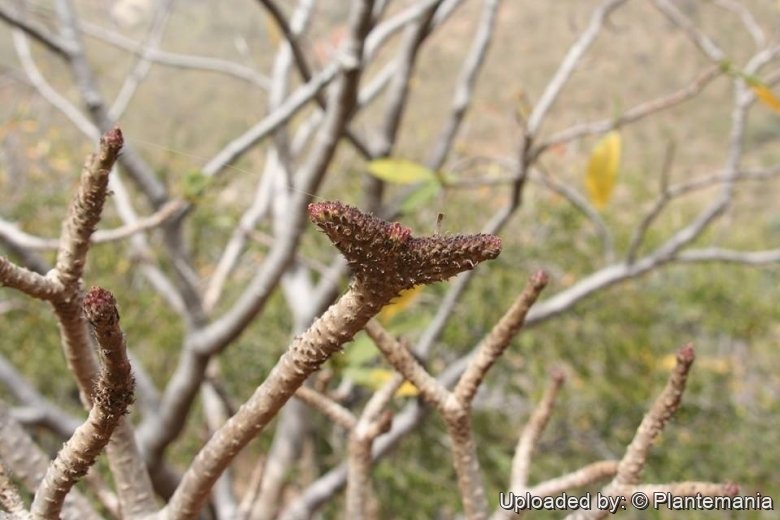
Stem: 2–4 (-6) m tall, but usually much smaller, fleshy, with a distinct irregular swollen base, or caudex up to 1 (-2) m in diameter, much of which is underground. Above ground the caudex can be globose to conical with smooth, pale greyish-green to brown bark. In mature specimens a definite caudex may no longer be recognizable as the it forms a swollen trunk with few irregularly thickened branches. The branches are smooth, greyish-green, pubescent at apex and usually upright, tortuous and irregularly spaced but sometime they are weak and spreading. The plant contains a copious sticky watery or white sap that flows from broken stem as well as from other plant parts like leaves, roots etc.
Roots: Fleshy taproot.
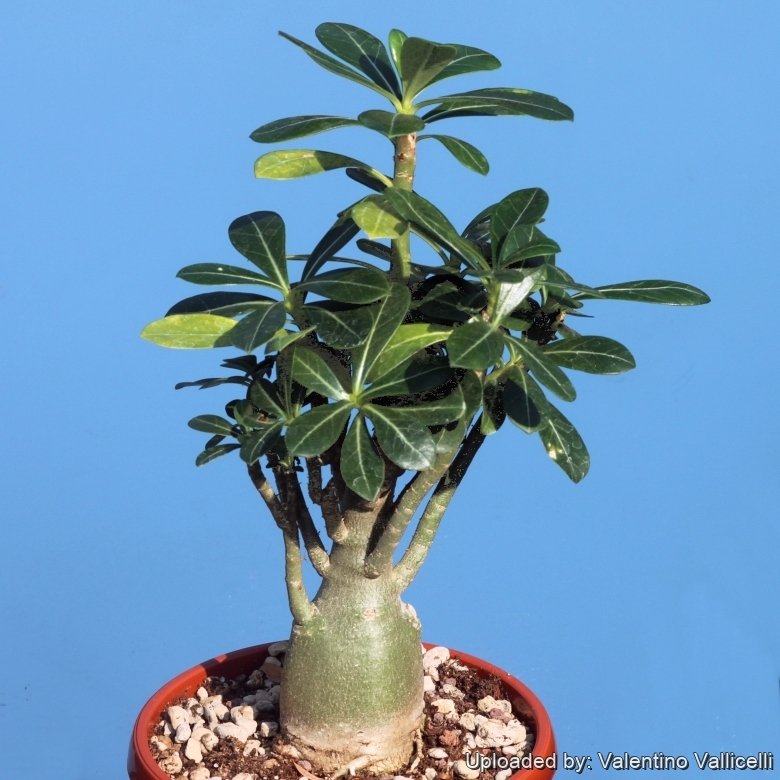
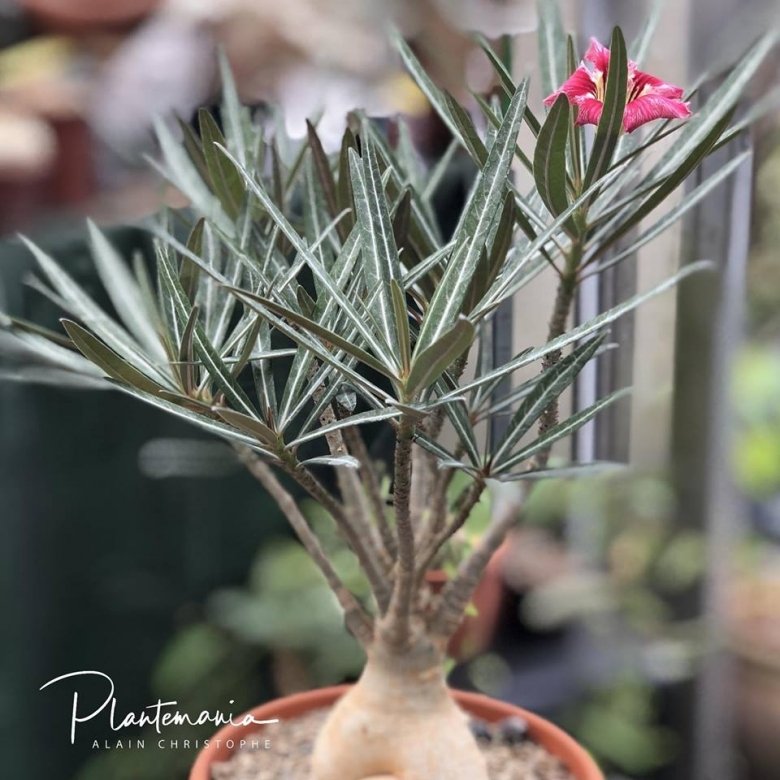
Leaves: Spirally arranged, clustered toward the tips of the shoots, scentless, simple entire, spathulate to obovate, fleshy, leathery in texture, hairless, shiny dark green to bluish-green above, paler green and dull below, (3-)5–12(-17) cm long and (0,5-)1–6(-8) cm broad. The apex is rounded and the base tapers into a very short petiole usually less than 2 mm long.
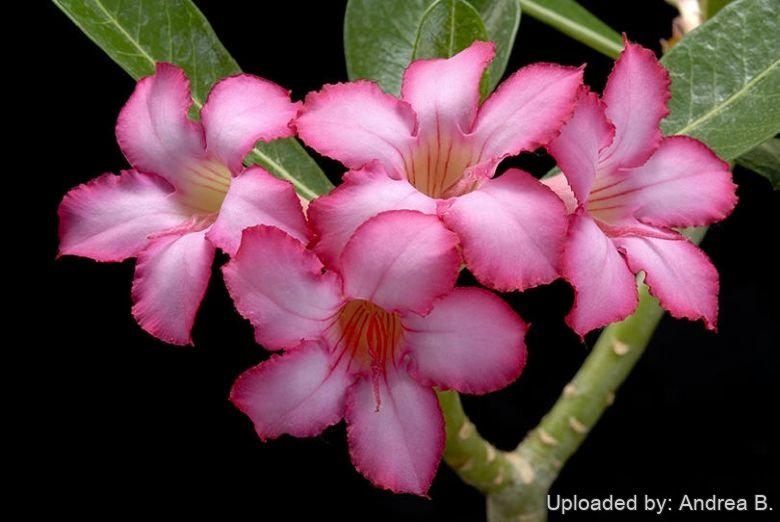
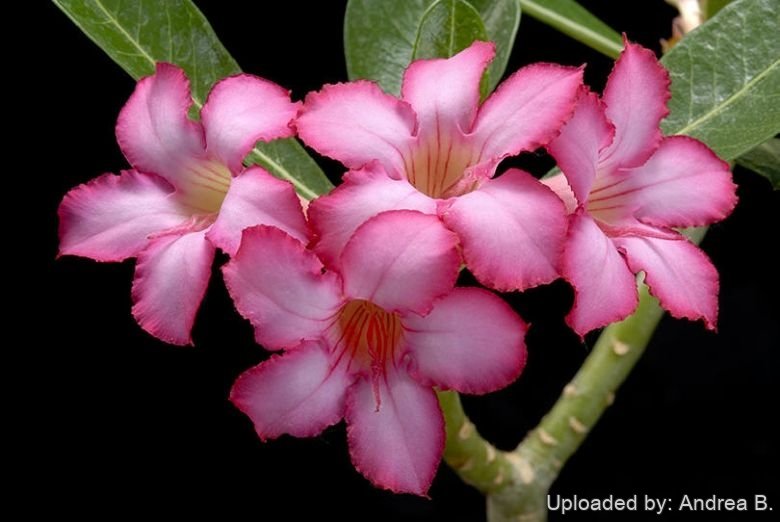
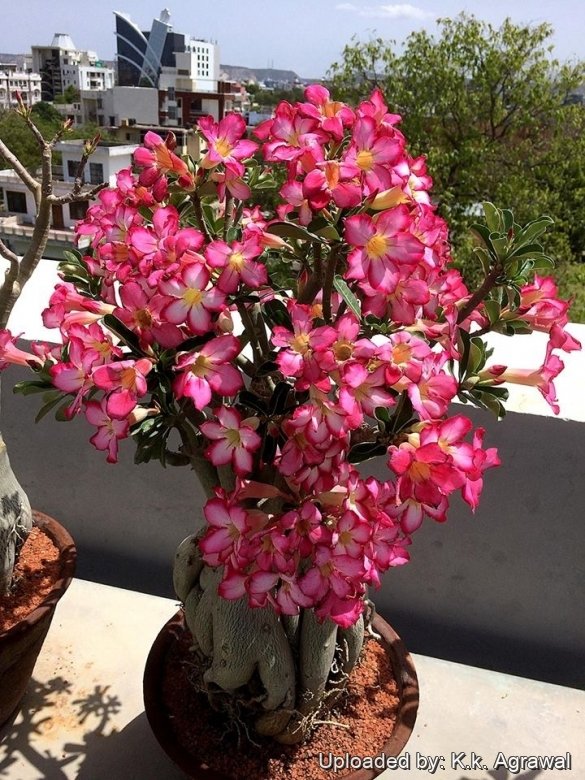
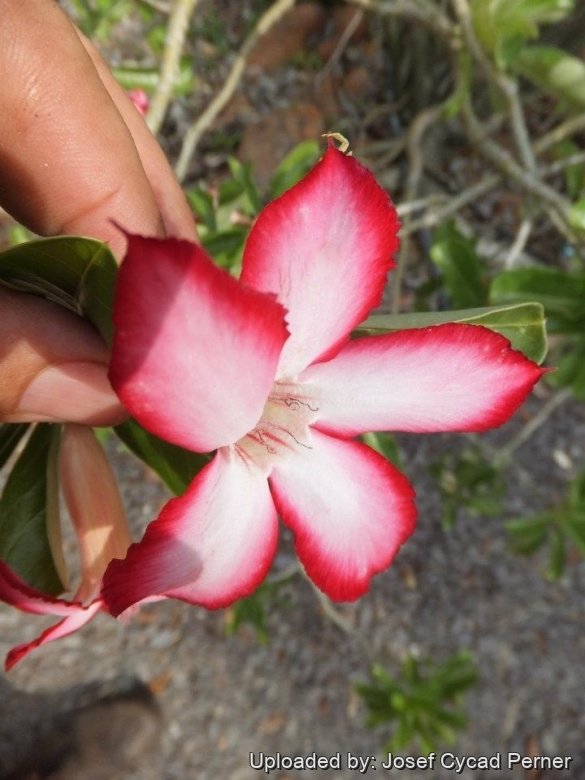
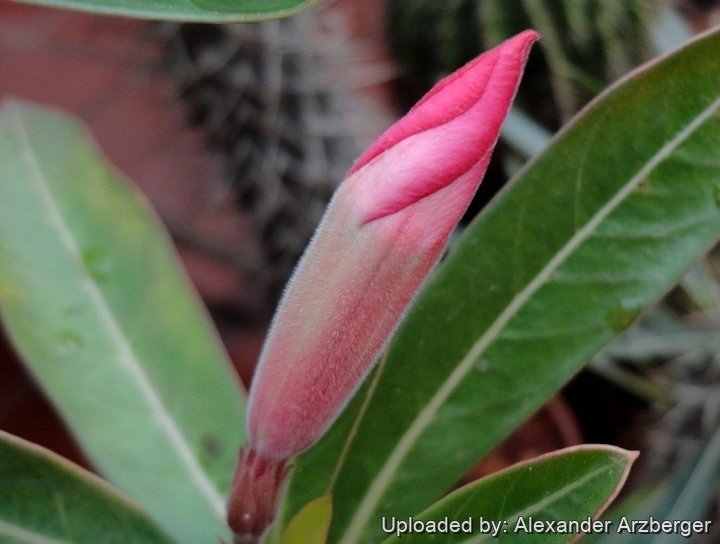
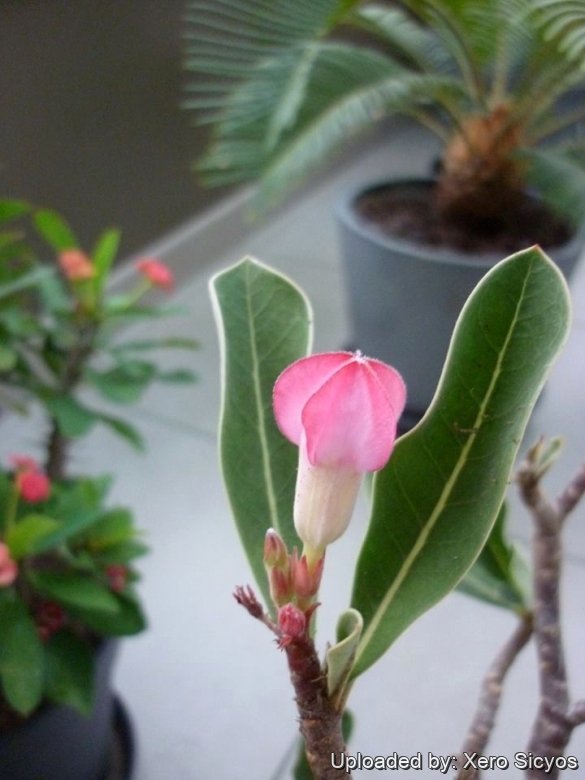
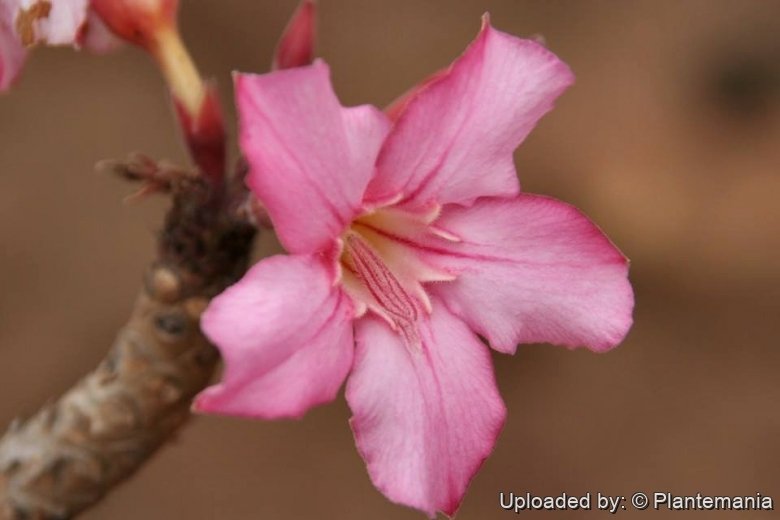
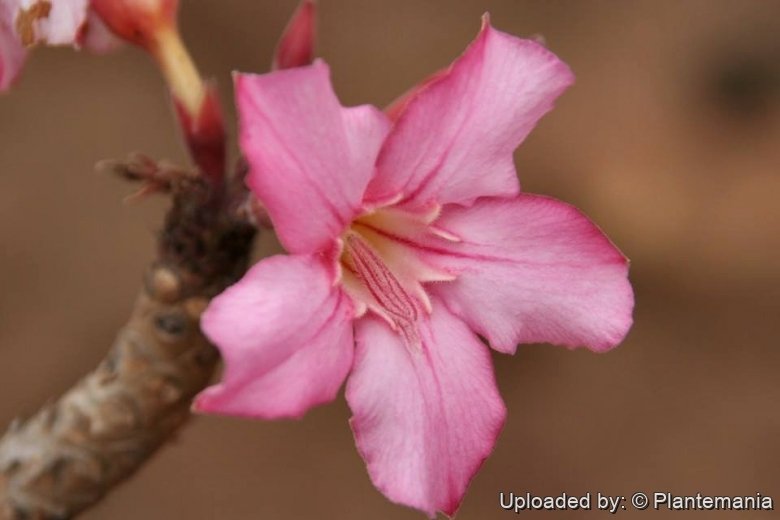
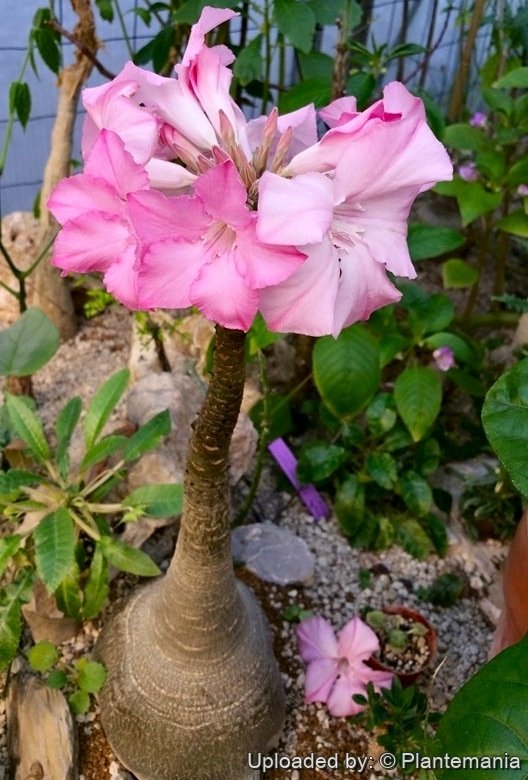
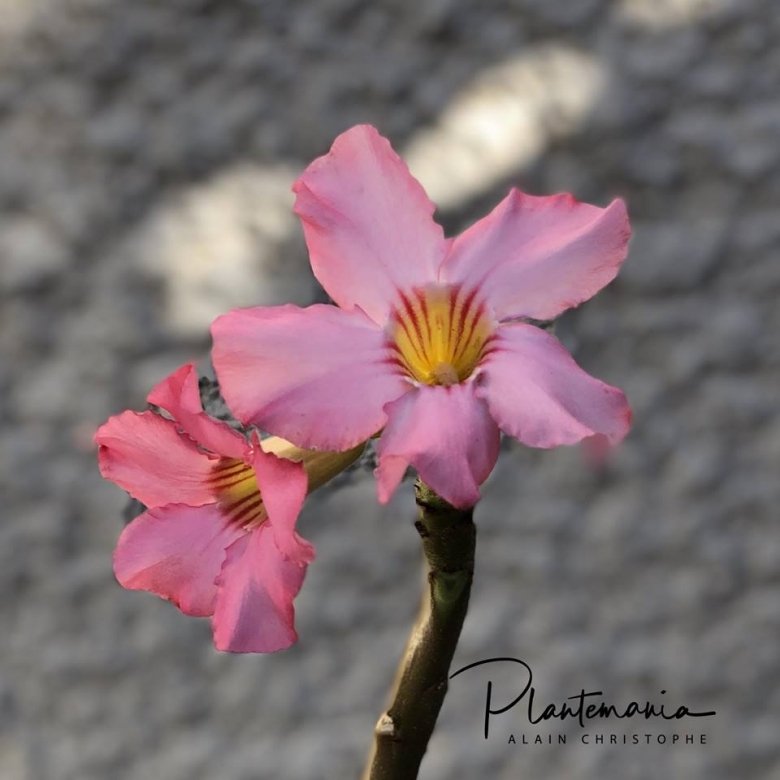
Flowers: Bisexual, regular, very showy and arranged in - more or less - dense, cymes that stay above the leaves, tubular with flared lips 2–5 cm long, with the outer portion 4–6 cm diameter with five petals and wavy or crinkled margins. The flowers range from red through pink to white, often with a whitish blush outward of the throat. Sepals oval 6-12 mm long, pedicel 5-9 mm long.
Blooming time: It is capable of flowering all year, even sparingly during the winter, but it is more floriferous during the dry periods of Spring and Autumn. Flowers appear often before leaves on deciduous branches, and for a time the crown is adorned only with flowers as new leaves emerge below the flowers. The flowers opening for 2-3 days.
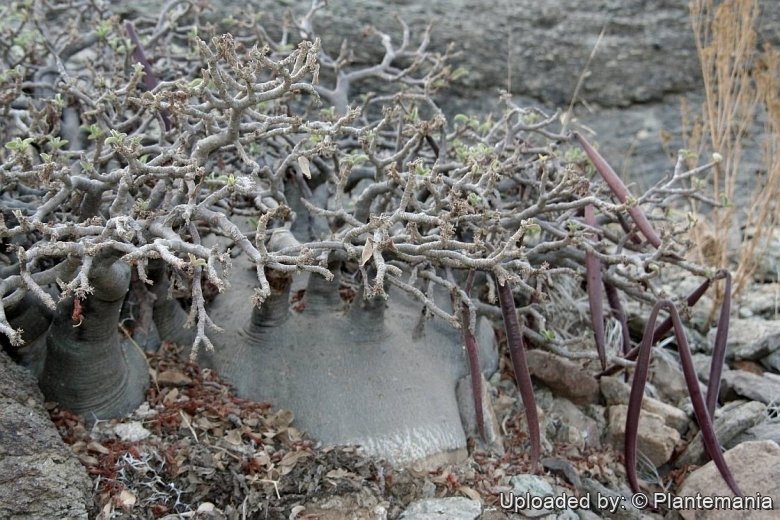
Fruit: The fruit is a twin follicle about 10-22 cm long resembling the horns of a steer. The two follicles are united at the base, narrowly oblong, slightly recurved, pale grey-green to grey-brown, and tapering at both ends. When matured, the follicles dehisce (split) along one side to release the seeds.
Seeds: Long narrow cylindric, 10-14 mm long, brown slightly scabrid, with long silky dirty-white to golden-brown hairy tuffs (pappus) at each end so that the seed is blown along the ground like an axle with two wheels.
Chromosome number: 2n = 22
Origin and Habitat
East Africa; Northeast Africa (Senegal, Ethiopia, Somalia and Tanzania); Arabian Peninsula ( Aden, Saudi Arabia, Oman and Yemen including Socotra) and naturalized in South Eastern Asia (Sri Lanka and Thailand). It is widely cultivated worldwide as ornamental.
Habitat: From regions where it rains frequently in the summer, but is very dry in winter.
Cultivation and Propagation
Originally from arid to semi-arid regions, Adenium obesum is nonetheless frequently cultivated in humid tropical or semi-tropical areas. It is nearly evergreen if grown in a warm greenhouse or tropical conditions a and watered, but can loose its leaves and forced into a long winter dormancy in cooler climate. New growth begins early in spring. Outdoors it thrives on a xeric watering regime as required by cacti. Under ideal conditions, it can live for hundreds of years.
Pots and soils: It like pots with generous drain holes on sides and bottom, need a very porous potting medium media (add pumice, vulcanite, perlite, sand or brick chips into regular soil, or a cactus mix) seeing that the main trunk is planted with the majority of the roots below the caudex line. Its rare that adeniums will use the upper third of their soil and often this area serves like a mulch or support for the stem. Avoid choosing a very deep pot as this might encourage an oblong (carrot-shaped) underground caudex. Outdoors they adapt to a wide range drained soils.
Fertilization: To make plants develop a large swollen base/trunk and to increase flowering, they require a fertilizer rich in potassium, phosphorus and micronutrient without a too high nitrogen content. Fertilize regularly while the plant is growing.
Exposition: Bright filtered light is best but in areas where light is not as burning, plants may be kept outdoors in full sun unprotected but remember that caudex is very susceptible to sun scalding. Plant becomes leggy in the shade and its flowering reduced.
Water: Water plants preferably in the early mornings until the soil is well wetted and let excess water drains from the pot base. Watering can be done as they become drier during active growth season. Never allow plants to dry out too often as this causes them to go into early dormancy. Many plants simply never get enough water to grow and flower adequately so keep them active and growing by providing them with all the essential necessities. Water sparingly during winter months.
Drought Tolerance: High.
Hardiness: It is frost sensitive and cannot endure freezing temperatures (U.S.D.A. Zone: 10a-12). If temperatures regularly fall below 2° C, the plant should be grown in a container for moving into a cold protected area. Partial defoliation may also occur at other times in response to weather change. As an indoor plant ensures a minimum temperature in winter of 10 °C. Where year-round temperature is sufficiently warm, desert rose will not become dormant and deciduous and may be ever-blooming.
Salt Tolerance: Medium.
Maintenance: They should be re-potted frequently until they attain their desired size. Plant appearance varies from plant to plant so prune accordingly. Pruning above the leaves is more likely
to produce multiple branching than pruning further down on the plant on bare stem. Pinching or pruning should be done once a year during the growing season. Pruning during winter often fails to generate robust branching.
Uses: Specimen plant; patio; flowering container plant; Bonsai, rock gardens, pool side.
Bonsai: Adenium obesum is suitable for most bonsai styles, it is a relatively fast grower: a seedling can develop into a rewarding bonsai in as little as five years. Many specimens develop interesting large, twisted bases and roots. Branches can be wired and growing tips pruned or pinched to encourage branching and compact. Keeping a plant root-bound is one method of achieving a bonsai plant. After the first 3 year’s of the plant’s life, raise the plant at each re-potting, exposing more and more of the underground caudex and roots.
Pests & diseases: Occasional aphids, mealybugs, scales and leaf spots. It is especially susceptible to spider mite infestation.
Warning: All parts of Desert Rose are potentially very poisonous and should be kept out of reach of children and animals. It must be handled with care. avoiding direct contact by always using gloves or covering your hands with plastic bags when handling it.
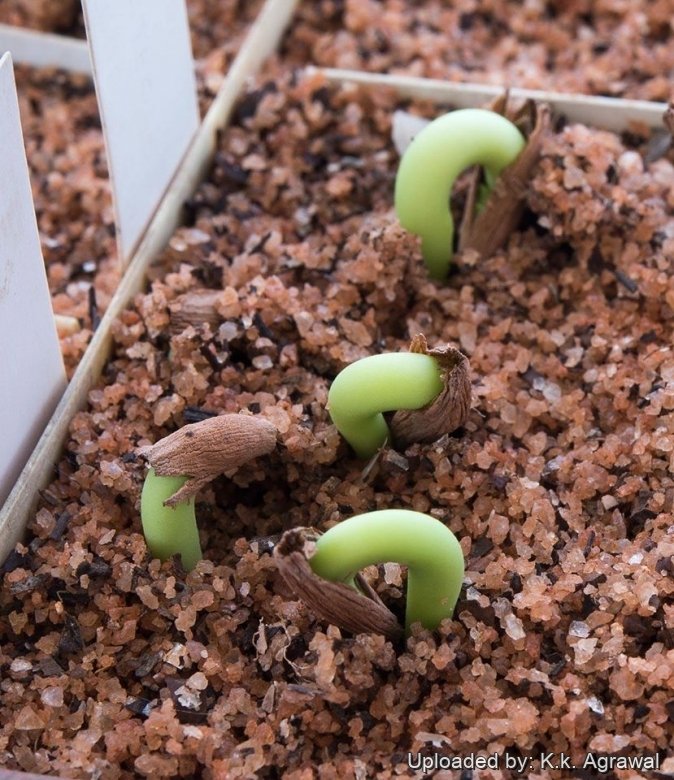
Propagation: Seed, grafting or cuttings. Seeds are placed on the surface of the soil mixture for germination. Seeds germinate easily, and seedlings grow without any special attention. Seedlings are also grown as the rootstock for grafted plants. The numerous hybrids are propagated mainly by grafting on to seedling rootstock. While plants grown from seed are more likely to have the swollen caudex at a young age, with time many cutting-grown plants cannot be distinguished from seedlings. Propagation by cutting is also possible, cut end shoots and let dry for a day or two. Be careful of the toxic sap. Stick shoots into a pot of moist soil, and provide bottom heat. Keep soil moist. The best time for either method is in the spring.
Bibliography
Major references and further lectures
-
Werner Rauh “The Wonderful World of Succulents: Cultivation and Description of Selected Succulent Plants Other Than Cacti” Smithsonian Institution Press, 1984
-
Urs Eggli “Illustrated Handbook of Succulent Plants: Dicotyledons” Springer Science & Business Media, 2002
-
Guides and Handbooks of Africa Publishing Company “Welcome to Aden: A Comprehensive Guidebook” Guides and handbooks of Africa publishing Company, 1963
-
Gordon D. Rowley “Pachypodium and Adenium” Cactus File, Cirio Pub. Services, 1999
-
Umberto Quattrocchi “CRC World Dictionary of Medicinal and Poisonous Plants: Common Names, Scientific Names, Eponyms, Synonyms, and Etymology” (5 Volume Set) CRC Press, 03 May 2012
-
Shahina A. Ghazanfar “Handbook of Arabian Medicinal Plants” CRC Press, 24 August 1994
-
Wikipedia contributors. “Adenium obesum.” Wikipedia, The Free Encyclopedia. Wikipedia, The Free Encyclopedia, 12 Sep. 2015. Web. 13 Sep. 2015.
-
Berhaut, J. “Flore illustrée du Senegal.” 1971.
-
Compton, R. H. “The flora of Swaziland.” 1976.
-
Eggli, U. “Sukkulenten.” 1994.
-
Hedberg, I. & S. Edwards. “Flora of Ethiopia.” 1989 (and Eritrea. 2000)
-
Keay, R. W. J. & F. N. Hepper. “Flora of west tropical Africa”, ed. 2.1953–1972.
-
Ross, J. “The flora of Natal.” 1972.
-
Smitinand, T. & K. Larsen, eds. “Flora of Thailand.” 1970.
-
Thulin, M., ed. “Flora of Somalia.” 1993.
-
Turrill, W. B. et al., eds. “Flora of tropical East Africa.” 1952
-
Wood, J. R. I. “A handbook of the flora of Yemen.” 1997.
-
Otto Stapf. “Flora of Tropical Africa”, Vol 4, Part 1, page 24, 1904.
-
Dr J.P. Roux “Flora of South Africa” 2003.
-
Schmelzer, G.H.; A. Gurib-Fakim . “Medicinal Plants. Plant Resources of Tropical Africa.” 2008
From llifle page Adenium arabicum
Description
Adenium arabicum ia a remarkable succulent plant with a grotesquely swollen trunk which resembles a miniature baobab tree. It is a local or morphological form of Adenium obesum, but commonly used to be know as a separate species and very popular with ‘fat plant’ collectors. Adenium arabicum is similar in appearance to Adenium obesum, but creates a massive, more squat and fat caudex without much differentiation between trunk and branches and is the most succulent and “desert like” species. The fleshy trunks and short naked branches are also somewhat more coloured in purple to dark brown. It also has larger thick fleshy leaves shiny on the upper and lower surface, unlike Adenium obesum and is an extremely drought tolerant plant. Flowers, similar in many ways to those of Frangipani, range from pink to red and sparkles when sunlight shines on them. The form of the plant varies in habit and most plants in cultivation are hybrids, yet only a few cultivar names have a valid description. Plants grown from seed produce the most amazing shapes of caudex on just 10 years. It is monoecious and self-sterile.
Stem: 2–5 m tall, but usually much smaller, very fleshy, with a distinct irregular swollen base, or caudex up to 1 (-2) m in diameter. The caudex can be globose to conical with smooth, pale greyish-green, brown or black smooth epidermis. The branches are short, usually upright, tortuous and irregularly spaced . The plant contains a copious sticky watery or white sap that flows from broken stem as well as from other plant parts like leaves, roots etc.
Roots: Fleshy taproot.
Leaves: Spirally arranged in a terminal rosette on the ends of the branches, falling during the dry season, simple entire, spathulate to obovate, fleshy, leathery in texture, hairless, shiny dark green to bluish-green above, paler green and dull below, 5–12(-17) cm long and 2–6(-8) cm broad. The apex is rounded and the base tapers into a very short petiole usually less than 2 mm long.
Flowers: Bisexual, regular, very showy and found in multiples in short-stalked, terminal inflorescences . The flowers are tubular with flared lips 2–5 cm long, with the outer portion 4–6 cm diameter with five petals and wavy or crinkled margins. The flowers range from carmine-red to pinkish, often with a whitish blush outward of the throat. Sepals oval 6-12 mm long, pedicel 5-9 mm long.
Blooming time: It is capable of flowering all year, even sparingly during the winter, but it is more floriferous during the dry periods of Spring and Autumn. Flowers appear often before leaves on deciduous branches, and for a time the crown is adorned only with flowers as new leaves emerge below the flowers. The flowers opening for 2-3 days.
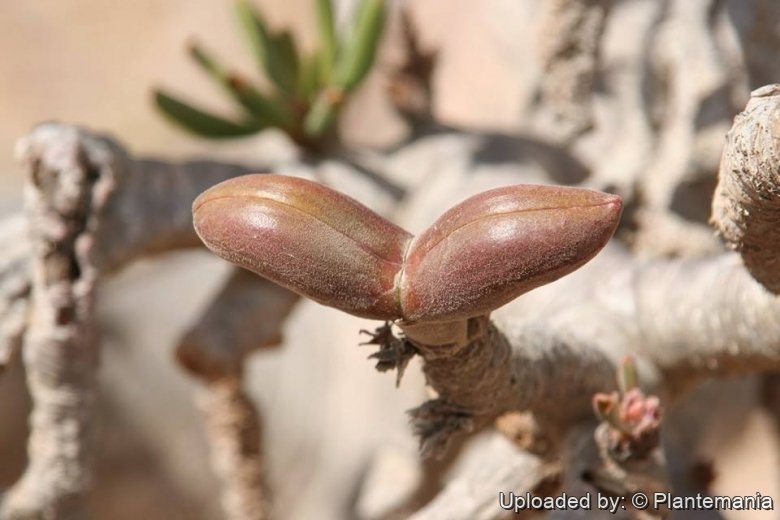
Fruit (capsules): The fruit is a twin follicle about 10-22 cm long resembling the horns of a steer, which release hundreds of seeds. The two follicles are united at the base, narrowly oblong, slightly recurved, pale grey-green to grey-brown, and tapering at both ends. When matured, the follicles dehisce (split) along one side to release the seeds.
Seeds: Long narrow cylindrical, 10-14 mm long, brown slightly scabrid, with a long silky dirty-white to golden-brown hairy tuft (pappus) at each end so that the seed is blown along the ground like an axle with two wheels.
Chromosome number: 2n = 22
Origin and Habitat
Adenium arabicum is native to a narrow strip near the coast on the western half of the southern Arabian peninsula (in Yemen and Saudi Arabia).
Habitat and ecology: It grows in an extremely arid environments squeezed in among granite rocks and cliffs together with several species of Euphorbia and many wild flowers.
Bibliography
Major references and further lectures
-
Werner Rauh “The Wonderful World of Succulents: Cultivation and Description of Selected Succulent Plants Other Than Cacti” Smithsonian Institution Press, 1984
-
Urs Eggli “Illustrated Handbook of Succulent Plants: Dicotyledons” Springer Science & Business Media, 2002
-
Guides and Handbooks of Africa Publishing Company “Welcome to Aden: A Comprehensive Guidebook” Guides and handbooks of Africa publishing Company, 1963
Source: Adenium arabicum, LLIFLE - Encyclopedia of living forms, CC-BY-SA, retrieved 2026-10-25.
From llifle page Adenium socotranum
Description
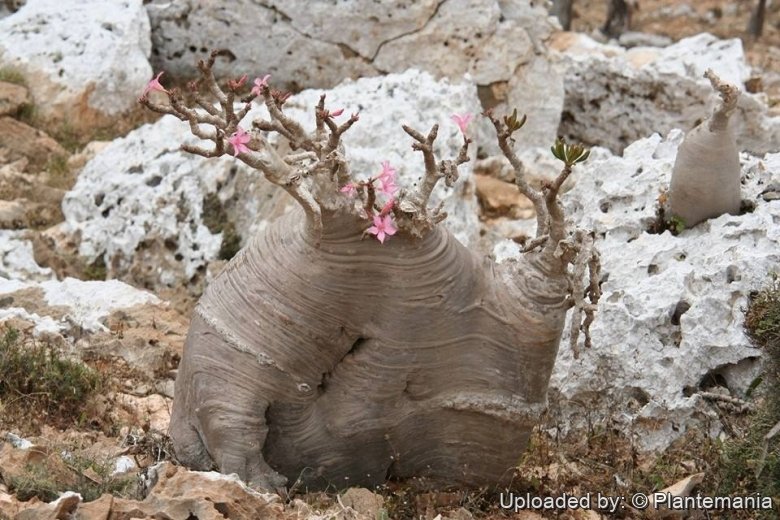
Adenium obesum subs. socotranum (Adenium socotranum) of the periwinkle family, Apocinaceae, is the giant of the genus, forming a massive conical trunk/caudex several metres tall and up to 2.4 m in diameter, the whole plant up to 3,5 meter in height. It resembles a miniature baobab with surrealistic forms. Some turn into tall trees while some may grow with their swollen bases more flat on the soil. This species - virtually unknown in cultivation - is frequently indicated to be a winter grower but the few plant observed in European collection are in leaf only during the summer months, leafing out even later than Adenium boehmianum.
Stem: Solitary or multiple bottle-shaped trunk/caudex, swollen, vertical, conical more or less distinctly striated (a unique character in the genus) the twiggy branches are few short and thin.
Leaves: About 12 cm long, usually widest near the tip, dark green with a white midrib and light major veins. They are glabrous in dense terminal rosettes.
Flowers: The plants flower in late spring, with blossoms pale to medium pink with pink or yellow throats. Some specimens in the wild have deep pink to nearly red flowers. Flowers are 10-13 cm in diameter. Very rarely seen flowered in collection.
Seeds: Big, about 1.5-2 centimeter.
Remarks: If placed in a large container the differences between species will become more obvious. A. socotranum develop a swollen base while the plant is still quite young more rapidly than it strictly relatives (such as Adenium arabicum and Adenium multiflorum) that branch more freely but stay thinner, while some (Adenium obesum ssp. boehmianum) don’t develop much of a caudex at all.
Origin and Habitat
Adenium obesum ssp. socotranum (Adenium socotranum) is endemic from from the isolated island of Socotra in the Indian Ocean south of the Arabian peninsula and east of the Horn of Africa. For many years Socotra hosted a Soviet naval port and was off limits to most everyone, restricting the availability of plants and seeds. In recent years it is accessible, but the authorities are very protective of the natural resources and it is illegal to collect plant material of any type.
Habitat and ecology: A. socotranum, is the characteristic plant of rocky slopes, forming extensive patches of succulent shrubland in favourable locations. Ot grows among stones in grit or on other well drained soil. It displays several morphological and physiological adaptations to cope with the dry climate and fierce monsoonal winds. A. socotranum has a special cell sap cycling within the caudex which prevents overheating. Plant bodies are globular or columnar, with reduced surface areas that decrease transpiration. Glaucous wax surfaces and micro-anatomical epidermal emergences reflect radiation. The cycles of flowering and growth of A. socotranum are well adapted to the arid climate, in that it blooms after the rainy season in March-April and only when they are well past flowering do the fruits release their air-borne seeds, leaving them to be dispersed by the heavy monsoon storms. Then the dry season begins with (perhaps) a million adenium seedlings waiting for the next rainy season. The most common and regular associate in the Adenium shrub layer is the endemic Jatropha unicostata. This shrub is perhaps one of the most common species on Socotra. The close association between the two species is probably due to their apparent preference for, or ability to cope with, coarse rocky substrates. Numerous regeneration niches exist in such substrates, offering the seedlings protection from trampling and affording them some degree of shade. The seeds of both species germinate readily after rainfall. Furthermore both species are highly toxic to domestic livestock and as such are rarely browsed.
Cultivation and Propagation
It is a beautiful container plant, and it seems to like the container as much as being planted in the ground. It will be an indoor bonsai in all but the warmest climates. In habitat the species is characterized by a long dormant period; the plants
don’t usually leaf out until mid-summer. October to December is the normal rainy season on Socotra, but plants in cultivation, some watered all year around, show
different growth patterns. It very slow growing and even a young collector will not live long enough to grow a specimen resembling the wild plants.
Light requirements. Needs lots of light and fresh air.
Water requirements. Keep warm and moist at winter, as the winters on Socotra. But reduce water, especially when kept cool. Increase water during growing and blooming periods. The total watering needed is similar to other succulents, and it will lose leaves if overwatered.
Fertilization: Feed monthly during spring and summer with liquid bonsai fertilizer.
Temperature requirements: Keep in a bright location in winter (minimum temperature 12-15° C). However, in the winter, keeping it cool gives the plant a needed rest. In summer, if possible, move outdoors to a sunny or partly shaded location.
Maintenance: It has a large caudex with few short thin branches and do not need a heavy pruning after the plant’s rest period as requested by other species. Eventually pruning should be kept to a minimum.
Repotting: Root prune and repot every two years, after the winter rest period, in a mix of 2 parts bonsai soil, 2 parts peat, and one part sand. Can tolerate being pot-bound.
Propagation: It is possible to root cuttings.
Propagation: Usually by seeds. It can also propagated by cutting of branch or stem rooted in a sand-peat mix. (Wait until 2-3 day before you plant. It will reduce rot.)
Notes
Some individual trees seem to suggest the human form — an impression that is reinforced by the frequent small depressions in the smooth bark, which look like navels in a pale unhealthy human skin.
Bibliography
Major references and further lectures
-
Werner Rauh “The Wonderful World of Succulents: Cultivation and Description of Selected Succulent Plants Other Than Cacti” Smithsonian Institution Press, 1984
-
Urs Eggli “Illustrated Handbook of Succulent Plants: Dicotyledons” Springer Science & Business Media, 2002
-
Ahmad Hegazy, Jonathan Lovett-Doust “Plant Ecology in the Middle East” Oxford University Press, 14 Jan 2016
-
Heinrich Walter “Vegetation of the Earth and Ecological Systems of the Geo-biosphere” Springer Science & Business Media, 06 December 2012
-
Gary Brown, Bruno Mies “Vegetation Ecology of Socotra” Springer Science & Business Media, 22 May 2012
-
J. Edward Milner “The Tree Book: The Indispensable Guide to Tree Facts, Crafts and Lore” Collins & Brown, 1992
-
Sue Haffner “Adenium socotranum” retrieved from http://www.fresnocss.com/plantdocs/adeniumsocotranum.pdf on 20 December 2016
-
Jean Robert “Socotra : les “Galapagos” de l’Océan Indien.” retrieved from http://www.lightmediation.net/blog/podcast/2007/october/socotra.pdf on 20 December 2016
Source: Adenium socotranum, LLIFLE - Encyclopedia of living forms, CC-BY-SA, retrieved 2026-10-25.
From llifle page Adenium somalense var. crispum
Description
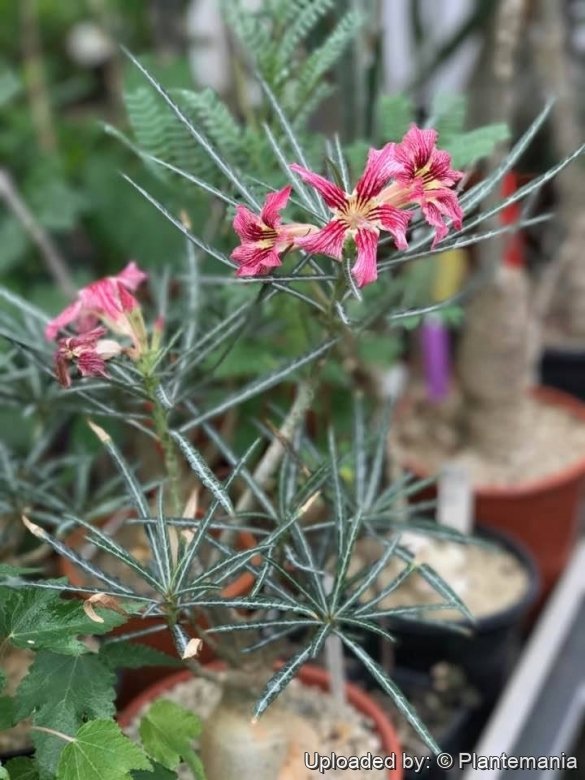
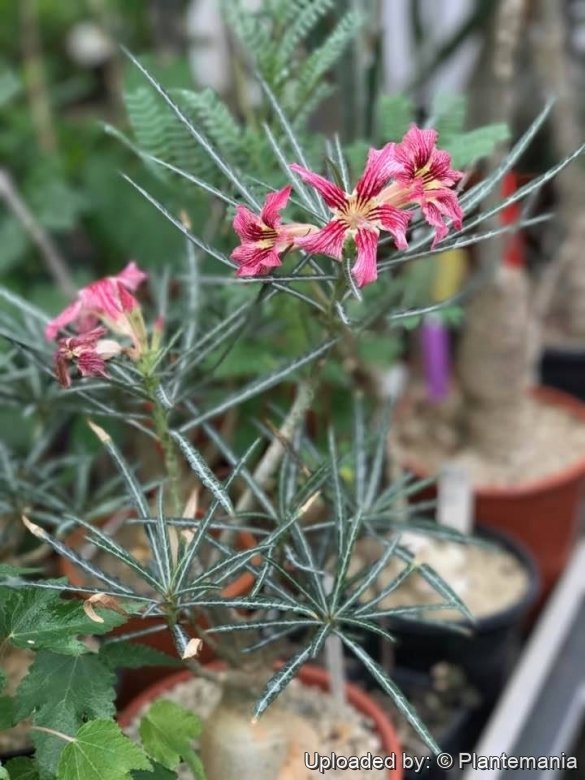
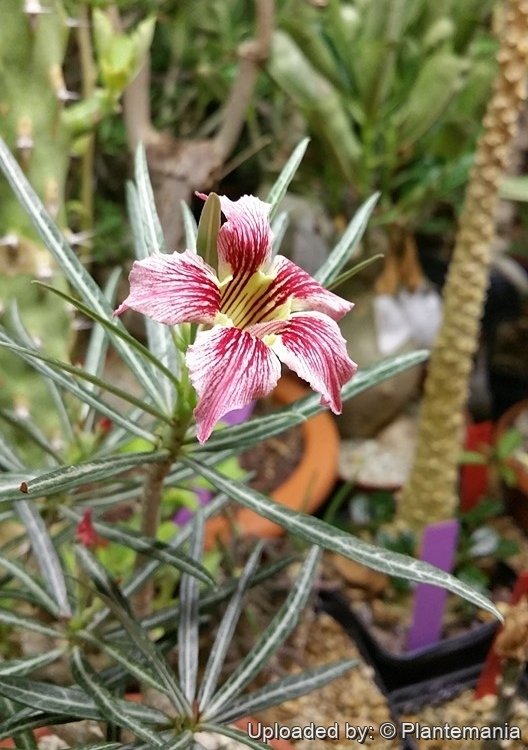
Adenium somalense var. crispum, described by Emilio Chiovenda, is a dwarf, more compact variety of Adenium somalens with distinctive flowers and a large underground caudex for the plant size. The flowers are white with quilled petals heavily striped with red or completely red. They are often sold as “Adenium crispum”. This species is notoriously slow growing. A. somalense var. crispum is very different from the treelike nominate variety and intergrades with Adenium obesum. Interesting marbled foliage and compact growth make this an attractive plant even when totally vegetative. It is very different from most other Adeniums.
Caudex: In nature the caudex is subterranean (just below the soil surface), fusiform or napiform (turnip-shaped). Most of the thin roots of this species originate from the upper part of the caudex nearly at ground level, very unlike the arborescent Adenium somalens thick, succulent roots that radiate from the base of the larger, above-ground caudex. In cultivation the caudex is often raised above soil level.
Stem: The few above-ground branches are thin, erect to ascending, hardly succulent, and seldom more than 30 cm tall
Leaves: Long narrowly linear, reddish green with prominent white midrib and veins with silvery highlight, usually strongly crisped (wavy-margined).
Flowers. Small, but very elegant and distinctive. Compared to the arborescent variety, they have larger throats, narrower, white to pinkish petals twisted and curled and heavily striped with red or completely red. Throat cream with bold red lines. The margins of the squarish petals are often curled downward (quilled). Nevertheless it is quite variable some clones have flat petals, while some have solid red petals.
Blooming season: A. somalense var. crispum flowers occasionally through the year, but more profusely during winter dormancy. Seedlings can flower in less than two years when only 15 cm tall.
Cultivation and Propagation
Originally from arid regions, Adenium somalense var. crispum is as sensitive to cold as Adenium somalense, and is also intolerant of hot, humid conditions. For these reasons it is not widely cultivated despite the beautiful flowers and compact size. The caudex can be exposed above the potting medium to create charismatic bonsai-like tree (the base can produce roots in cultivation). Most of the root system arises from near the top of this caudex; fortunately the caudex is capable of rerooting from the bottom. It is nearly evergreen if grown in a warm greenhouse or tropical conditions a and watered, but can loose its leaves and forced into a long winter dormancy in cooler climate. New growth begins early in spring. Outdoors it thrives on a xeric watering regime as required by cacti. Under ideal conditions, it can live for hundreds of years.
Growth rate: The variety crispum grows slowly in cultivation; it takes about five years to produce a specimen with its characteristic, though still small, caudex.
Pots and soils: It like pots with generous drain holes on sides and bottom, need a very porous potting medium media (add pumice, vulcanite, perlite, sand or brick chips into regular soil, or a cactus mix) seeing that the main trunk is planted with the majority of the roots below the caudex line.
Fertilization: To make plants develop a large swollen base/trunk and to increase flowering, they require a fertilizer rich in potassium, phosphorus and micronutrient without a too high nitrogen content. Fertilize regularly while the plant is growing.
Exposition: Bright filtered light is best but in areas where light is not as burning, plants may be kept outdoors in full sun unprotected but remember that caudex is very susceptible to sun scalding. Plant becomes leggy in the shade and its flowering reduced.
Water: Water plants preferably in the early mornings until the soil is well wetted and let excess water drains from the pot base. Watering can be done as they become drier during active growth season. Never allow plants to dry out too often as this causes them to go into early dormancy. Many plants simply never get enough water to grow and flower adequately so keep them active and growing by providing them with all the essential necessities. Water sparingly during winter months.
Drought Tolerance: High.
Hardiness: It is frost sensitive and cannot endure freezing temperatures (U.S.D.A. Zone: 10a-12). If temperatures regularly fall below 10° C, the plant should be grown in a container for moving into a cold protected area. Partial defoliation may also occur at other times in response to weather change. As an indoor plant ensures a minimum temperature in winter of 10 °C. Where year-round temperature is sufficiently warm, desert rose will not become dormant and deciduous and may be ever-blooming.
Salt Tolerance: Medium
Maintenance: They should be re-potted frequently until they attain their desired size.
Uses: Specimen plant; patio; flowering container plant; Bonsai, rock gardens, pool side.
Pests & diseases: Occasional aphids, mealybugs, scales and leaf spots. It is especially susceptible to spider mite infestation.
Warning: All parts of Desert Rose are potentially very poisonous and should be kept out of reach of children and animals. It must be handled with care. avoiding direct contact by always using gloves or covering your hands with plastic bags when handling it.
Propagation: Seed, grafting or cuttings. Seeds are placed on the surface of the soil mixture for germination. Seeds germinate easily, and seedlings grow without any special attention. Seedlings are also grown as the rootstock for grafted plants. The numerous hybrids are propagated mainly by grafting on to seedling rootstock. While plants grown from seed are more likely to have the swollen caudex at a young age, with time many cutting-grown plants cannot be distinguished from seedlings. Propagation by cutting is also possible, cut end shoots and let dry for a day or two. Be careful of the toxic sap. Stick shoots into a pot of moist soil, and provide bottom heat. Keep soil moist. The best time for either method is in the spring. A grafted adenium, can become gigantic more than 2 meters tall in just 5 years.
Bibliography
Major references and further lectures
-
Mark A. Dimmitt & Chuck Hanson “The genus Adenium in cultivation. Part. 3: A.somalense” Arizona-Sonora Desert Museum, Arid Lands Greenhouses web: http://adenium.tucsoncactus.org/part3.html
-
Adenium somalense var. crispum, Tropica Nursery 2004. web: http://www.tropicanursery.com/adenium/cultivars/64.htm
-
Adenium somalense var. crispum, Arid Lands Greenhouses http://aridlandswholesale.com/oscommerce/product\_info.php?products\_id=7432
-
Adenium somalense var. crispum, Tropica Nursery 2004. web: http://www.tropicanursery.com/adenium/species.htm
-
Adenium crispum Chiov. http://adenium.tucsoncactus.org/cultivat.html
Source: Adenium somalense var. crispum, LLIFLE - Encyclopedia of living forms, CC-BY-SA, retrieved 2026-10-25.
From llifle page Adenium socotranum f. cristata
Description
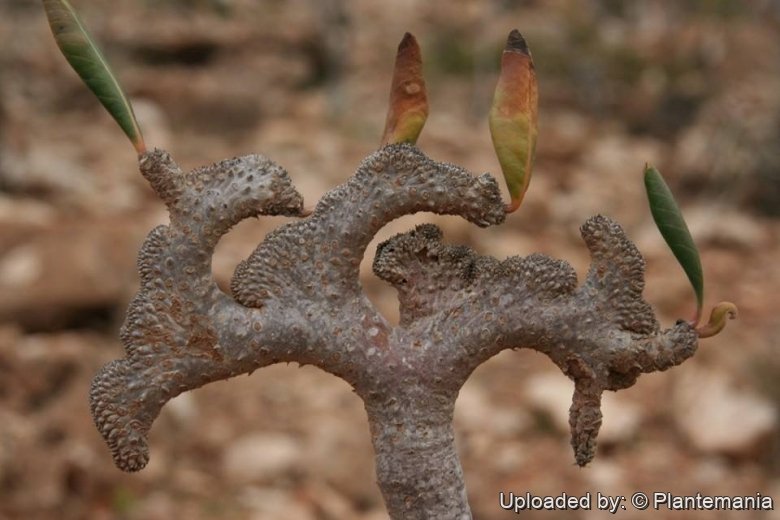
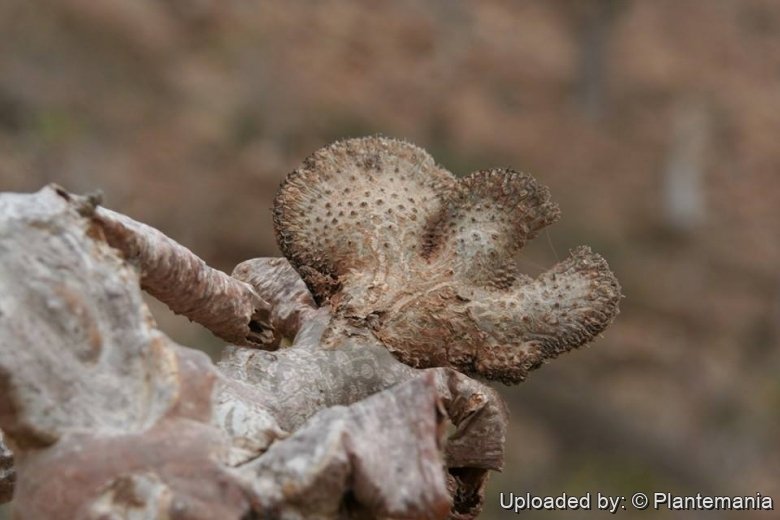
The standard Socotran desert rose, Adenium obesum subs. socotranum, long popular because of its large size and unique architecture is, perhaps, the more famous of all adeniums. It is the giant of the genus, forming a massive conical trunk/caudex several metres tall and up to 2.4 m in diameter, the whole plant up to 3,5 meter in height. It resembles a miniature baobab with surrealistic forms. Some turn into tall trees while some may grow with their swollen bases more flat on the soil. These beautiful crested forms (Adenium obesum subs. socotranum f. cristata) are very rare in collection and highly priced for their odd shape and size.
Origin and Habitat
Adenium obesum ssp. socotranum (Adenium socotranum) is endemic from from the isolated island of Socotra in the Indian Ocean south of the Arabian peninsula and east of the Horn of Africa.
Cultivation and Propagation
The crested desert rose grow very slowly and are cold intolerant. Make sure that your desert rose are not exposed to cool temperatures, or they may die. The plant needs a well drained soil mix. Water regularly in summer, but allow to dry fully before watering again. The total watering needed is similar to other succulents, and it will lose leaves if overwatered. During the winter months they should be dry. Since they are big sized plants, they need plenty of space for their roots. Repotting should be done every other year, or when the plant has outgrown its pot. Needs lots of fresh air.
Exposure: Light shade when young, full sun later.
Temperature requirements: Keep in a bright location in winter (minimum temperature 12-15° C). However, in the winter, keeping it cool gives the plant a needed rest. In summer, if possible, move outdoors to a sunny or partly shaded location.
Propagation: Grafting, since cutting root hardly.
Notes
The cause of cresting is not fully explained; biologists disagree as to why some saguaros grow in this unusual form. Some speculate that it is a genetic mutation. Others say it is the result of lightning strike or freeze damage, but whatever the stimulus, the growth point of the stem has switched from a geometric point, to a line, which folds and undulates as the crest expands. Though these crested saguaros are somewhat rare (1 in 250,000), cresting occurs naturally throughout the range of the Saguaro, and can be encountered in many other cactus species.
In the ontogenesis a crest can appear any time, but development of crests on large species (such as the desert rose Adenium obesum) in the early stages of ontogenesis is unlikely and crested stems form occasionally only on the terminal branches of older specimens.
Source: Adenium socotranum f. cristata, LLIFLE - Encyclopedia of living forms, CC-BY-SA, retrieved 2026-10-25.
From llifle page Adenium dhofarense
Description
Adenium dhofarense is a local or morphological form of Adenium obesum, but commonly used to be know as a separate species. It is a succulent shrub or shrubby tree up to 3 m high, the shape resembling a dwarf baobab. The stems arise from a large thickened rootstock and have peculiar characteristics that reflect the harsh environment in which it lives. A. dhofarense forms one of the nicest caudex of the genus, and each individual plant is unique in it own right. However some common characteristics have been highlighted: some plants are tree-like up to 3 m tall with a densely branched crown; other plants have long branches, even up to 3 meters long, forming a large crown that usually branches from a single robust root. Most of the plants, however, are 1-1,5 m tall and have an irregular globose crown, surmounted by a few often long branches. A characteristic often observed in the species is the ability of some of the longest branches to produce roots at the point where they touch the ground and thus give rise to a new plant. It has extremely large, leathery and glossy leaves with more substance than those of most other adeniums and very small flowers that are usually produced when the plants are leafless. It grows very slowly.
Stems: Branches are often decumbent to trailing and tend to root when they touch the ground.
Flowers: Very small pink, produced in one brief flush in early summer, just before the plants leaf out.
Origin and Habitat
Adenium dhofarense is endemic to the Dhofar coast (Oman) and adjacent mountains of Yemen. (Arabian Peninsula)
Altitude range: Around 960 metres above sea level.
Habitat and ecology: Tropical woodland. Adenium dhofarense is in leaf for about three months in summer, when its habitat is bathed in almost continuous heavy mist from the edge of the Asian monsoon. The rest of the year is hot and dry. The huge leaves appear in mid summer and fall off by late autumn.
Bibliography
Major references and further lectures
-
Sundaram Adeniums “Speices & Hybrids - Adenium Plants” Web: http://abenaplants.com/ad\_species.php
-
Rzepecky, “Adenium dhofarense Rzepecky sp. nov. A Long-Overlooked Species from the Central-Southern Part of the Arabian Peninsula”, Cact. Succ. J. (Los Angeles) 87(3): 131. 2015 [1 Jun 2015]
Source: Adenium dhofarense, LLIFLE - Encyclopedia of living forms, CC-BY-SA, retrieved 2026-10-25.
Cultivars and forms (6)
Gallery