Publication: Agaves Cont. N. Amer. 44: 74. 1982 (nom. inval. Art. 36.1 - 37.1)
Description
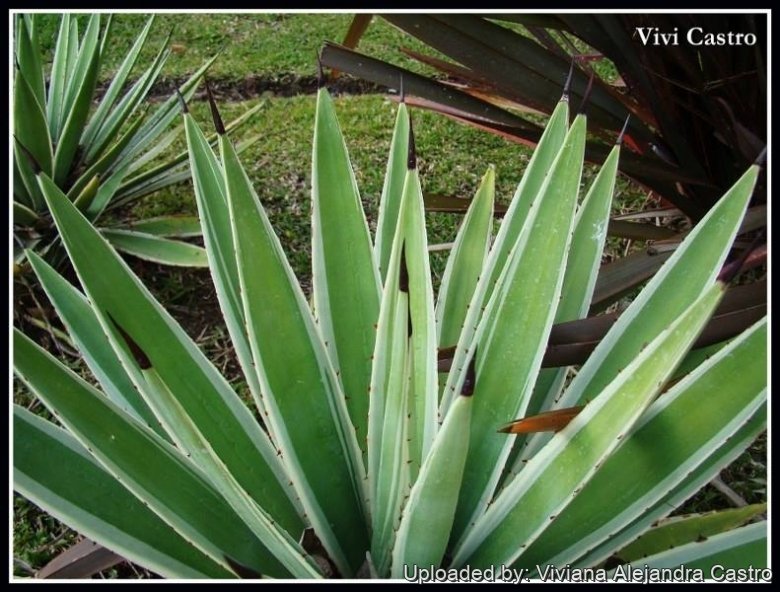
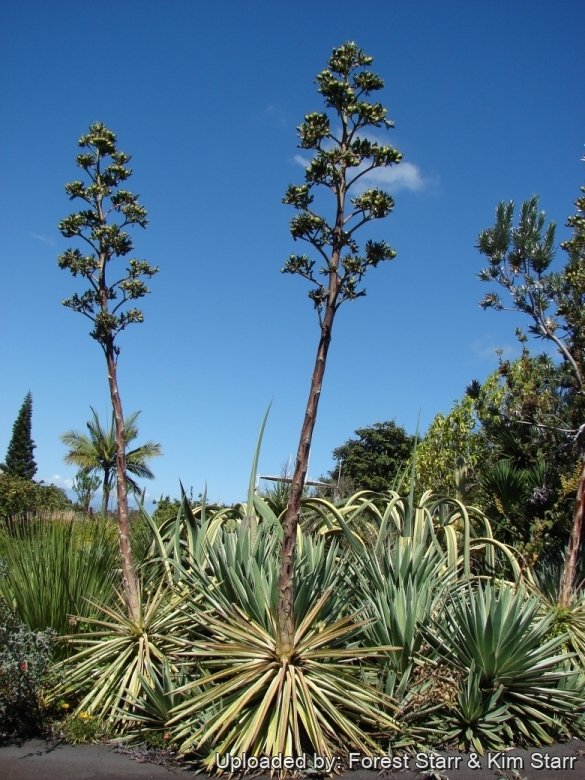
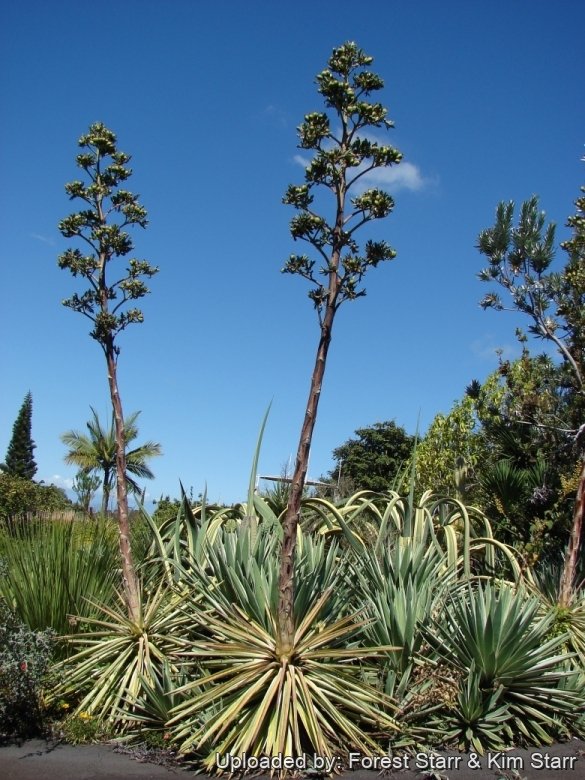
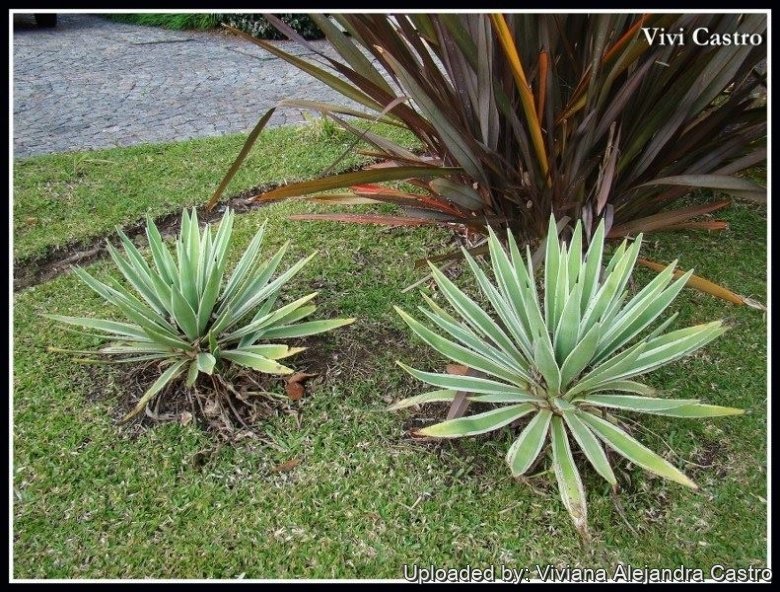
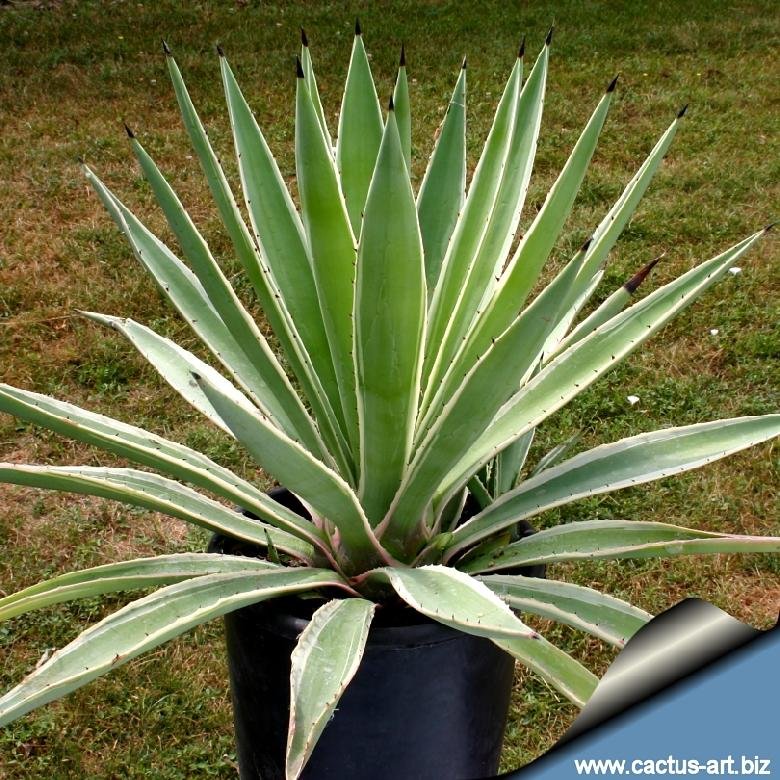
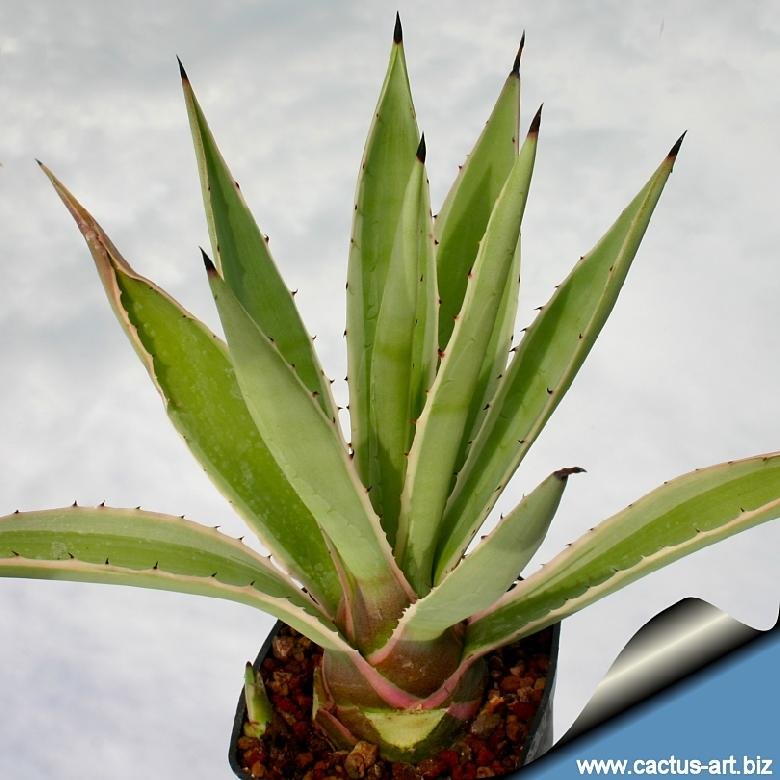
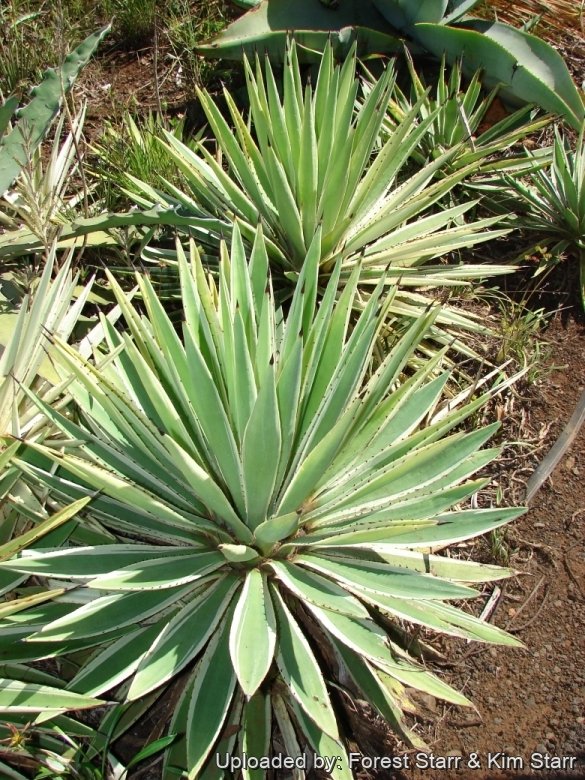
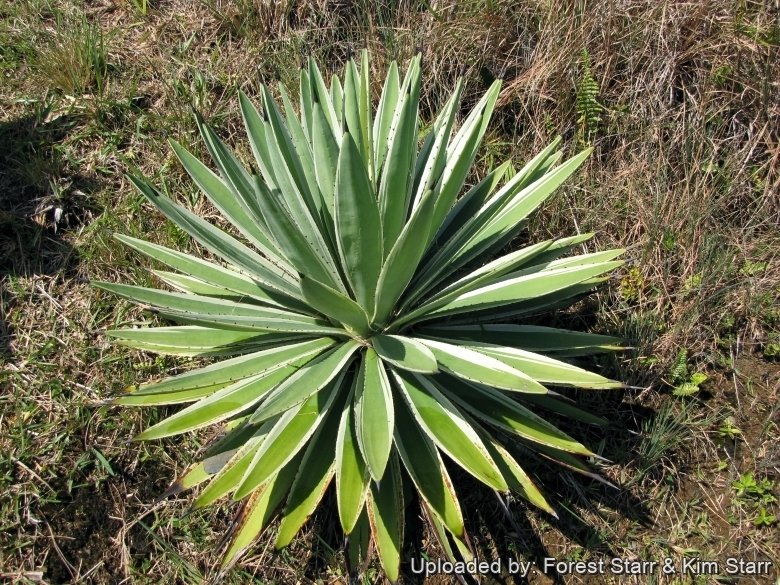
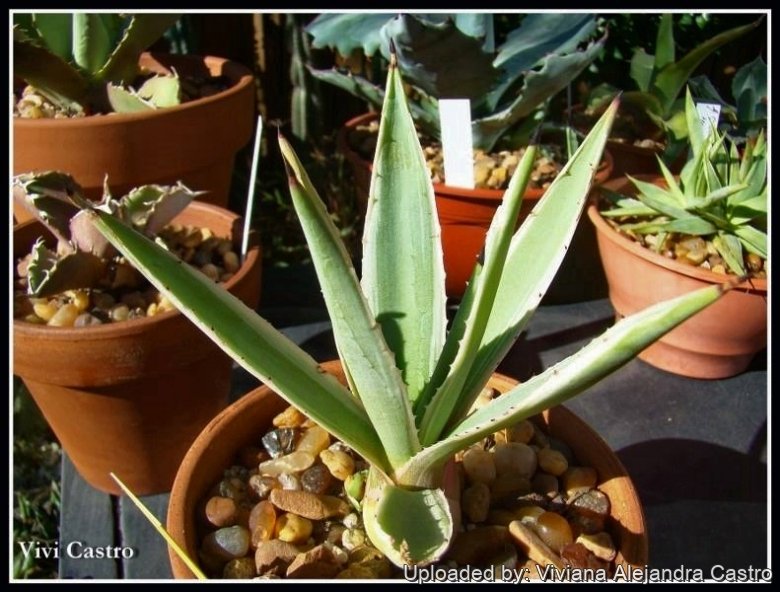
Agave vivipara cv. marginata, best known in cultivation as Agave angustifolia var. marginata, is a handsome, neatly growin, small-medium sized Agave with a dense round rosette of leaves borne from a very short trunk 3-6 dm tall. It forms clumps. Height: 50 cm to 90 cm, Spread: 50 cm to 1,20 cm.
Leaves: The leaves vary considerably in length depending on growing condition, but can reach up to 60 cm (or more) They are stiff, sword-shaped, concave and revolute or plicate, blue or blue-greenish 5-10 cm wide at their widest point and have a distinct narrowing in their lower third and are furnished with thin marginal teeth and a subulate-conical terminal spine. Leaves have marginal bands of bright white, with occasional cream stripes to the inside.
Flowers: Greenish-yellow to white in terminal panicles and approximately 5 cm long. The flower stalks will reach up to 2.5 m in height.
Blooming season: Blooms after 10 years or more years (though not a century) in spring, die after flowering, but new plants may develop from suckers at their base and from bulbils along the flower stalk.
Agave angustifolia Haw., var. marginata Hort. This is a handsome, neatly growing plant developing a trunk 3-6 dm tall with numerous leaves margined with white or yellow (Fig.
Origin and Habitat
Horticultural origin, now widely cultivated and naturalized around the world.
Cultivation and Propagation
They are great Agaves for containers because of their small size, They need full sun to partial shade or very high interior lighting. Plants are not so drought tolerant and requires more water than most agave species. Plants should be watered and allowed to dry before watering again. Fertilize only once during the growing season with a balanced fertilizer. When grown as a houseplant, the temperature should never drop below 10° C. Not too frost tolerant, during the winter months, only water enough to keep the leaves from shriveling.
Ground cultivated plant are tollerant to drought, and salty seaside conditions. Little if any irrigation is needed to maintain the plant once established. The sharp spine at the tip of its toothed leaves is sometime removed to protect people and
Propagation::Agave angustifolia ‘Marginata’ is propagated by using suckers, which often are found growing around the base of the plant. Fortunately, many plantlets will form from the inflorescence, offering good opportunities for propagation.
Uses:
A) It is used to make mezcal (tequila), rope, food, soap and other products are also made from the fibers and pulp.
B) As an ornamental plant it makes a dramatic statement in the landscape and is much favored for use in rock gardens.
Bibliography
Major references and further lectures.
-
William Trelease: “Agave in the West Indies.” In: Memoirs of the National Academy of Sciences. volume 11, 1913, page 21, tab. 11–13
-
J. Thiede: Agavaceae. In: Urs Eggli “Illustrated Handbook of Succulent Plants: Monocotyledons: Monocotyledons” Springer Science & Business Media, 17/Jul/2001
-
A. Berger: “Die Agaven” Gustav Fischer Verlag Stuttgart. 1915, page 225–226.
-
P. W. Hummelinck: “Notes on Agave in the Netherlands West Indies and North Venezuela.” Recueil Trav. Bot. Neerl. volume 35: 14–28. 1938
-
Wikipedia contributors. “Agave angustifolia.” Wikipedia, The Free Encyclopedia. Wikipedia, The Free Encyclopedia, 28 Jun. 2014. Web. 5 Nov. 2014
-
I. Richter: “Die Gattung Agave” A.I.A.S. 2011, page 96.
-
- Gentry, Howard Scott. “Agaves of Continental North America”. University of Arizona Press, Tucson, 1992.
-
San Marcos Growers contributors “Agave angustifolia ‘Marginata’ - Caribbean Agave” San Marcos Growers <http://www.smgrowers.com\>. Web. 27 Sep. 2014.
-
Abisaí García-Mendoza, Fernando Chiang: “The confusion of Agave vivipara L. and A. angustifolia Haw., two distinct taxa.” In: Brittonia. Band 55, Nr. 1, Springer, New York 2003
-
Smith, G.F.; Steyn, E.M.A. «Agave vivipara: the correct name for Agave angustifolia», Bothalia 29 (1): 100 1999
-
Steyn, E.M.A.; Smith, G.F. «Agavaceae. Agave vivipara: a naturalised alien in Southern Africa», Bothalia 30 (1): 43–46 2000
-
Foxcroft, L.C.; Richardson, D.M.; Wilson, J.R.U., «Ornamental Plants as Invasive Aliens: Problems and Solutions in Kruger National Park, South Africa», Environmental Management 41 (1): 32–51 2008
-
Smith, G.F.; Figueiredo, E., «Naturalized Species of Agave L.(agavaceae) on the Southeastern Coast of Portugal», Haseltonia 13 (1): 52–60 2007
-
Royal Horticultural Society, Kew. A detailed checklist for Agave vivipara.
Forster, P.I. «New varietal combinations in Agave vivipara(Agavaceae)», Brittonia 44 (1): 74–75, 1992
Gallery