Publication: Syn. Pl. Succ. 1: 72. 1812
Description
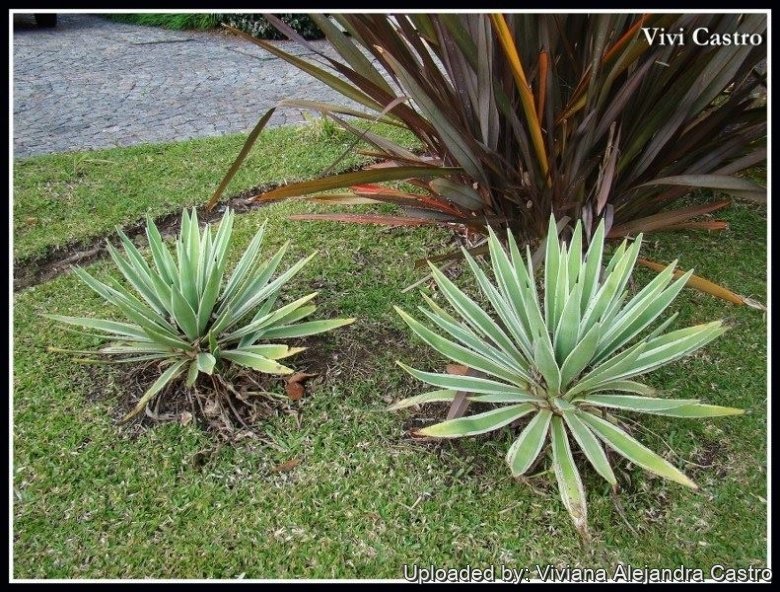
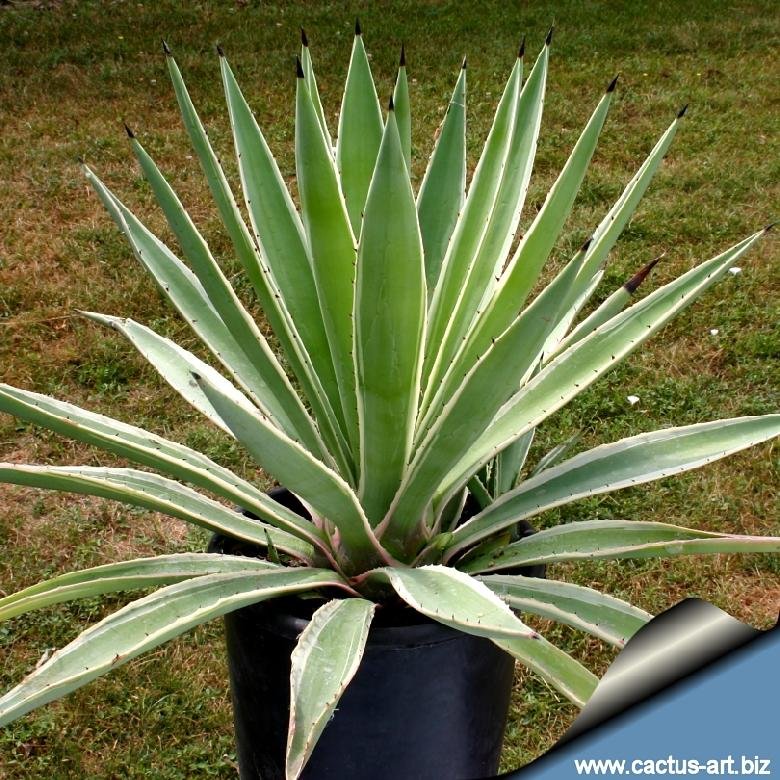
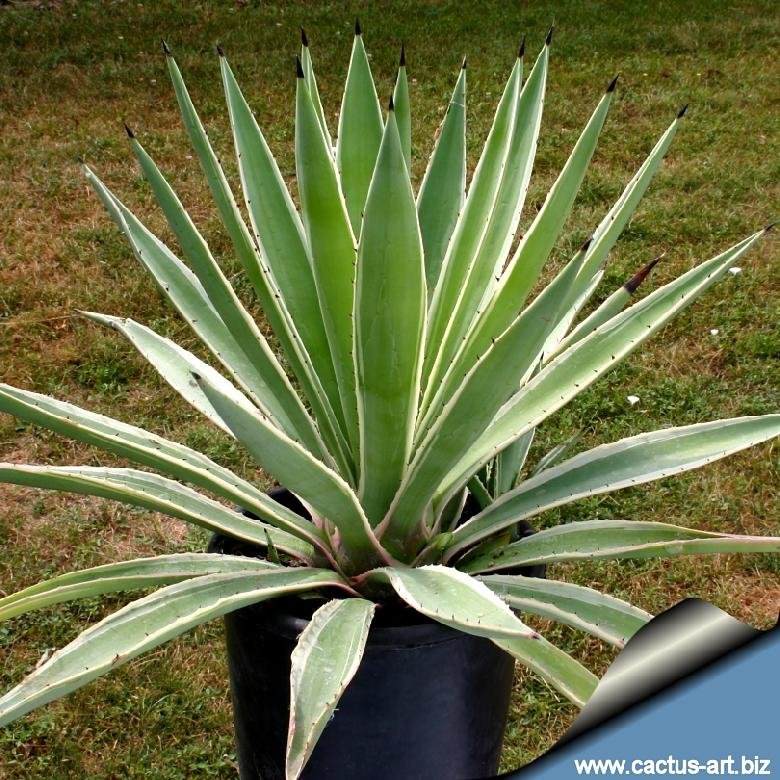
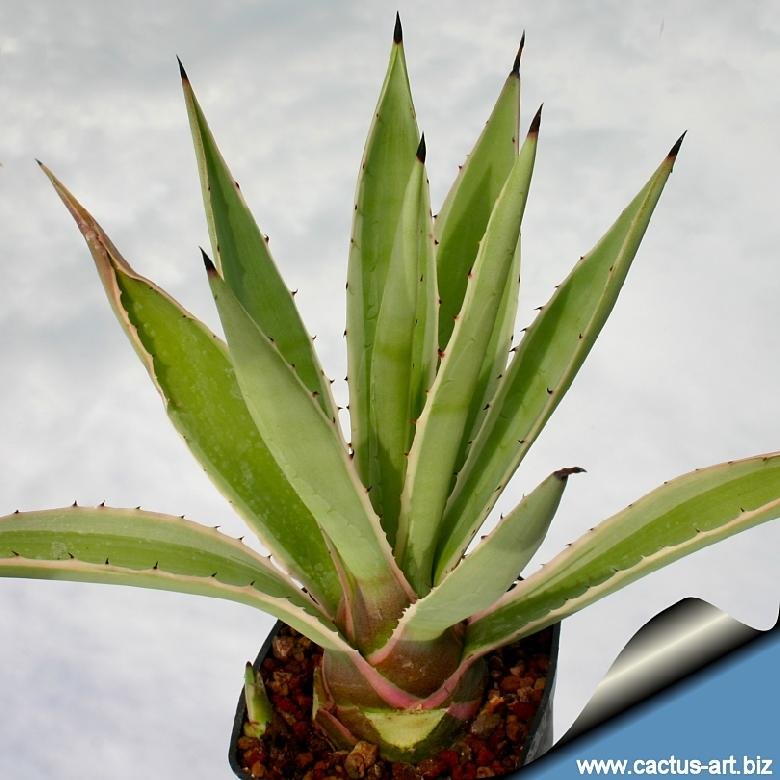
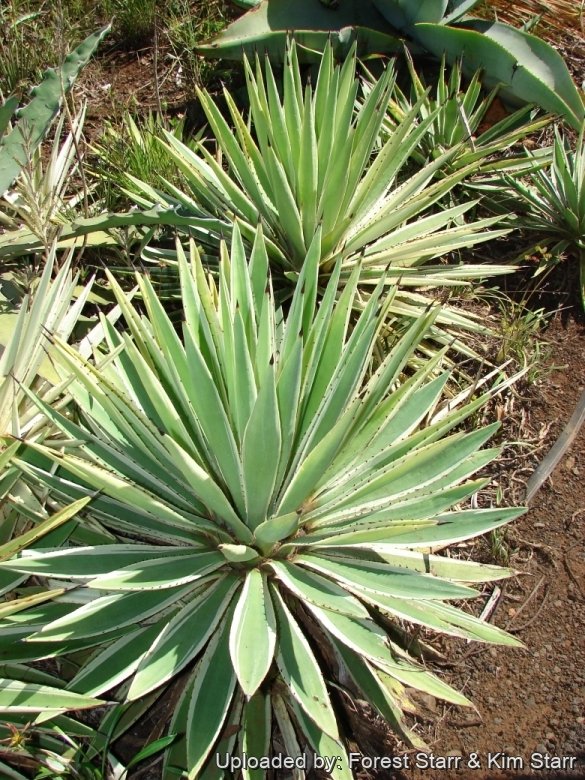
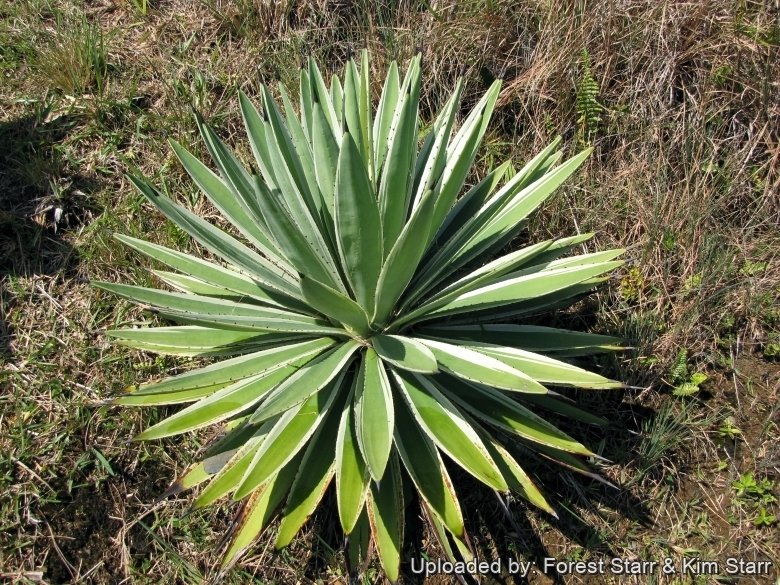
Agave tequilana (also known with the misapplied synonyms Agave cantala), is a narrow-leaved agave with yellow to green flowers. It is by far one the most wide-ranging species of the family and exhibits an extensive range of variation from which many cultivated varieties have been derived. Stems may be very short or up to 20 - 60 (-90) cm long. Leaves may be few or many, variable in colour from green to yellowish green to nearly white glaucous grey or bluish. Generally they are narrow sword shaped leaves, but atypical broadened forms are also reported. Teeth are small and up-curved, but quite variable in size and spacing. Terminal spines may be long and thin or very short and broad, decurrent or non-decurrent. Flowers varies in size too. On the whole they are weak flowers, quickly passing, the sepals drying reflexed. Altogether, these variations illustrate that Agave angustifolia is a freely seeding outbreeding complex, that has been widely assorted by circumstances of habitat, changing climates over a long period of time, and man’s interventions. Suckering is very prevalent, but it may be early or late in the life cycle.
Taxonomy: The name Agave angustifolia, under which the widespread Mexican /Central American taxon was since long known, seems to represents a homotypic synonym of Agave vivipara and is also considered taxonomically identical by some authors (Wijnands 1983, and Forster 1992). Other sources maintain them as distinct species with non-overlapping native distributions (García-Mendoza and Fernando Chiang 2003). In general A. angustifolia should have narrower, stiffly erect leaves with moderately-spaced spines, producing capsules, not bulibiferous; whereas A. vivipara is described as having shorter, recurved leaves with short-spaced spines and bulbiferous. A. vivipara is likely similar to Agave karatto. The A. vivipara of Miller (1768) and Smith et al. (2008) seem different, of a much smaller habit and narrower leaves, from the A. vivipara of Trelease (1913) and García-Mendoza and Fernando Chiang (2003), of a much larger habit. Recent biotechnology literature (such as Simpson et al, 2011) seems to have accepted them as two separate species. AG Valensuela Zapata & GP Nabhan (2003) also stated in their book that it has been generally accepted that A. vivipara L. has priority over Agave cantala. Also the widely grown Agave tequilana, which is differentiated as its own species, is regarded by many botanists as nothing else than a form of A. angustifolia and they consider this separation to be nominal only.
Rosettes: Radiately spreading, surculose.
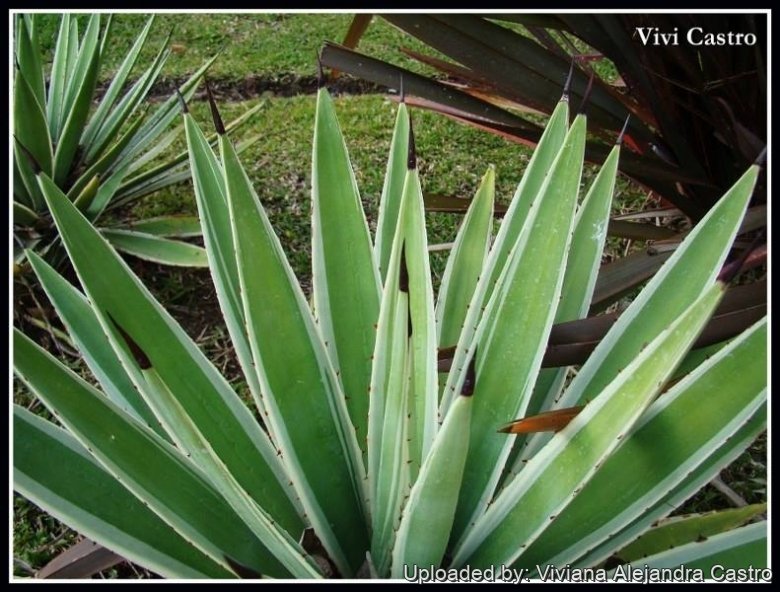
Leaves: Linear to (very broadly) lanceolate, ascending to horizontal, mostly rigid, hard-fleshy, fibrous, narrowed and thickened towards the base, full-grown generally (40-) 60 - 120 x 3.5 - 10 (-20) cm wide, light green to glaucous-grey, margins straight to undulate, sometimes thinly cartilaginous; marginal teeth generally small, 2-5 mm, rarely longer, commonly reddish-brown or dark brown, evenly and closely spaced or remote. Terminal spines variable, conical to subulate, flat to shallowly grooved above, 1.5 - 3.5 cm long, dark brown, greying with age, not or thinly decurrent.
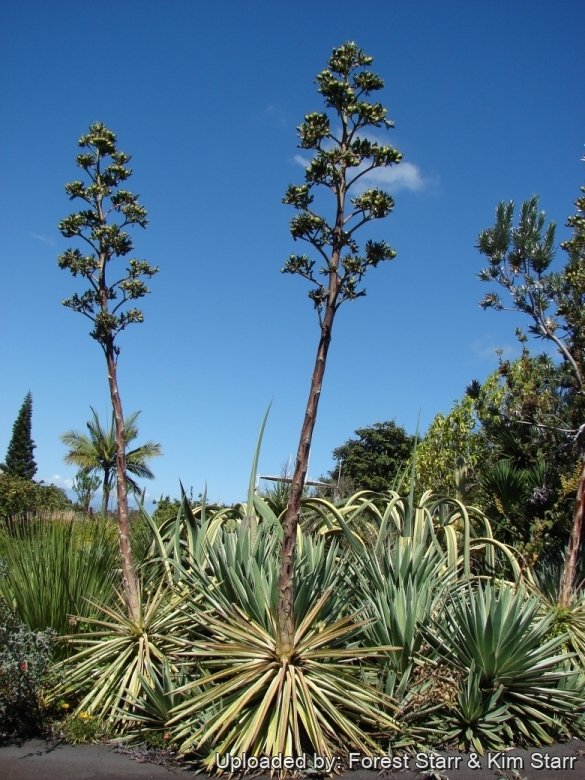
Inflorescence: Mostly 3 - 5 m tall growing or arranged in a panicle, open, part-inflorescences horizontally spreading to ascending, 10-20. While few or profuse bulbils have been observed, vivipary is generally uncommon, even on panicles where seed does not develop.
Flowers: (40-) 50 - 65 mm. Perianth (outer part of the flower) consisting of segments (tepals) that distinctly unite below forming a tube. Ovary small, tapering at the base, 20 - 30 mm, neck short; Tepals green to yellow, quickly wilting, drying reflexed along the tube, tube (4-) 8 - 16 mm, lobes unequal, (15-) 18 -24 mm long.
Chromosome number: 2n = 60, 120, 180.
Origin and Habitat
Mexico (widespread from Sonora and Chihuahua to the South), Belize, Costa Rica, Honduras, Nicaragua. El Salvador, Panama. Agave angustifolia has escaped from cultivation as a garden ornamental and become an environmental weed in Republic of South Africa, Mauritius and Reunion (Western Indian Ocean:) and in Queensland (Australia). It is cultivated elsewhere.
Altitude range: This specie grows at low to middle elevations (to 1500 m, rarely more)
Habitat and ecology: This is a sun-loving taxon (although also not rarely found with etiolated growth in light shade) occuring in nearly all vegetation types mainly in tropical savannas, thorn forest, and tropical deciduous forests. It depends on bees, wasps, hummingbirds, woodpeckers, orioles, sphingids and nectar-feeding bats pollinators. The plant species produces greater nocturnal nectar secretions than during the day, when the bat is most active. In addition, flower maturation occurs when the bat is present during spring and summer months. Agave angustifolia flowers January to May. Fruits start developing in February to April and are mature May to July.
Cultivation and Propagation
Agave angustifolia is a great Agaves for containers because of its usually small size, it is often
offered for sale at nurseries and is frequently grown as a garden ornamental, as a hedge plant or as a barrier plant (especially the variegated forms).
Exposure:They need full sun to partial shade or very high interior lighting.
Watering: Plants are not so drought tolerant and requires more water than most agave species. Plants should be watered and allowed to dry before watering again. Ground cultivated plant are more tollerant to drought, and salty seaside conditions. Little if any irrigation is needed to maintain the plant once established.
Fertilization: Fertilize only once during the growing season with a balanced fertilizer.
Hardiness: When grown as a houseplant, the temperature should never drop below 10° C. Not too frost tolerant, during the winter months, only water enough to keep the leaves from shriveling.
Traditional uses: Agave angustifolia provides many products and has been used to provide food and daily use objects since Aztec times. It is traditionally used by the indigenous groups in Mexico as a source of fiber to make ropes and ties. Spines at the ends of leaves have traditionally been used to make pins and needles. The woody inflorescence stems continue to be used as posts, rafters and fences and leaves are used for thatching or to provide forage, fuel and forage.The flower buds, flowers, stems, leaf bases, peduncles of young flowers and fruits can all be eaten and continue to be eaten as traditional foods in some parts of western Mexico. The stems are cooked and their juice extracted fermented and distilled to make a variety of alcoholic beverages. Soap and other products are also made from the fibres and pulp. Additionally, many traditional medicines can be derived from this plant. The juice of the leaves and stems as well as root infusions and teas can be taken internally or used as poultices for both internal and external swelling, bruises, liver and kidney disease, arthritis and dysentery.
Warning: The sharp spine at the tip of its toothed leaves is sometime removed to protect people.
Bibliography
Major references and further lectures
-
Smith, G. F. & E. M. A. Steyn. “Agave vivipara: the correct name for Agave angustifolia.” Bothalia 29:100. [= A. vivipara L.].1999.
-
FORSTER, PI. “New varietal combinations in Agave vivipara(Agavaceae).” Brittonia 44: 74-75. 1992.
-
Urs Eggli “Illustrated Handbook of Succulent Plants: Monocotyledons” Springer Science & Business Media, 06 December 2012
-
Howard Scott Gentry “Agaves of Continental North America” University of Arizona Press, 01 February 2004
-
WIJNANDS, O. “The botany of the Commelins”. Balkema, Rotterdam.1983.
-
Abisaí García-Mendoza and Fernando Chiang “The Confusion of Agave vivipara L. and A. angustifolia Haw., Two Distinct Taxa” Brittonia Vol. 55, No. 1 (Jan. - Mar., 2003), pp. 82-87
-
Molina-Freaner, F. & Eguiarte, L. E. 2003. “The pollination biology of two paniculate agaves (Agavaceae) from northwestern Mexico: contrasting roles of bats as pollinators.” American Journal of Botany 90: 1016-1024. available at: http://www.amjbot.org/content/90/7/1016.full#cited-by; accessed on: Oct 9, 2015.
-
R.P and B.F. Hansen. 2003. “Guide to the vascular plants of Florida,” 2nd edition. University Press of Florida. Gainesville. Wyatt, R. 1983
-
Gentry, H. S. “The agave family in Sonora.” U.S.D.A. Agric. Handb. 399:143, 147. [mentions]. 1972.
-
Valenzuela-Zapata, A. G., Lopez-Muraira, I. & Gaytan, M. S. “Traditional Knowledge, Agave inaequidens(Koch) Conservation, and the Charro Lariat Articans of San Miguel Cuyután,” Mexico. Society of Ethnobiology 2: 72-80. 2011.
-
Amy Chang “Overview of Uses and Cultivation of A. angustifolia” <http://eol.org/data\_objects/25279753\> Web. 18 Nov. 2015.
-
Wikipedia contributors. “Agave angustifolia.” Wikipedia, The Free Encyclopedia. Wikipedia, The Free Encyclopedia, 30 Oct. 2015. Web. 18 Nov. 2015.
-
Bosser, J. M. et al., “Flores des Mascareignes.” 1976.
-
Davidse, G. et al., “Flora mesoamericana.” 1994.
-
Encke, F. et al. “Zander: Handwörterbuch der Pflanzennamen” 13 edition 1984.
-
Facciola, S. “Cornucopia II: a source book of edible plants”.1998.
-
Mohr, Gary M. Jr. (1999) “Blue Agave and Its Importance in the Tequila Industry,” Ethnobotanical Leaflets: Vol. 1999: Iss. 3, Article 2.
Available at: http://opensiuc.lib.siu.edu/ebl/vol1999/iss3/2
-
García-Mendoza, A. & F. Chiang. “The confusion of Agave vivipara L. and A. angustifolia Haw., two distinct taxa.” Brittonia 55:82–87. 2003.
-
Vargas-Ponce, O. et al. “Diversity and structure of landraces of Agave grown by spirits under traditional agricultural: A comparison with wild populations of A. angustifolia (Agavaceae) and commercial plantations of A. tequilana.” Amer. J. Bot. 96:448–457. 2009.
-
Vázquez-García et al. “Flora del norte de Jalisco y etnobotánica Huichola.” Serie Fronteras de Biodivesidad. 1:58. 2004.
-
Steyn, E. M. A. & G. F. Smith. “Agave vivipara: a naturalized alien in Southern Africa.” Bothalia 30:43–55. [= A. vivipara L.]. 2000.
-
George, A. S., ed. “Flora of Australia. [= A. vivipara L.].” 1980.
-
Liberty Hyde Bailey Hortorium. “Hortus third.” 1976.
-
McVaugh, R. “Flora Novo-Galiciana.” 1983.
From llifle page Agave aboriginum
Cultivation and Propagation
They are usually cultivated outdoors in rock gardens, in cactus and succulent gardens, in Mediterranean-style landscapes, in borders, or as a specimen.
Growth rate: It is a relatively rapidly growing given the best conditions.
Exposure: They do well in full sun or a lightly shaded area with afternoon shade..
Soil: They do best in very well-drained, sandy or gravely soil. As an ornamental it is also grown in containers where it stays much smaller than its outdoor brethren. In pots they need a very porous mix soil (e.g. 2 parts peat moss to 1 part loam to 1 part of pumice).
Repotting: Use pot with good drainage.
Fertilization: They grows quickly if kept well nourished with a slow release fertilizer specifically formulated for cactus and succulents applied once or twice a year (poor in nitrogen), including all micro nutrients and trace elements.
Hardiness: Keep it in a cool, frost-free area in winter and put it out on the balcony or patio in summer. It grows fairly fast in summer if provided with copious water but allows to dry thoroughly before watering again. During the winter months, one should only water enough to keep the leaves from shriveling.
Scenography: These striking plants are wonderful when used for accent or simply to provide some all year round foliage and often used in a pot as a patio plant, can be moved around to change the scenery or position to give more shelter.
Warning: It can get large, and it is armed with needle-sharp spines.
Propagation: Seeds or suckers which often are found growing around the base of the plant, Remove the basal suckers (if available) in spring or summer and let the cuttings dry for a few days before inserting in compost.
Source: Agave aboriginum, LLIFLE - Encyclopedia of living forms, CC-BY-SA, retrieved 2026-10-25.
From llifle page Agave costaricana
Description
It is a small-medim sized Agave with a dense round rosette of leaves borne from a very short trunk. It forms clumps. Height: 50 cm to 90 cm, Spread: 50 cm to 1,20 cm.
Leaves: The leaves vary considerably in length depending on growing condition, but can reach up to 60 cm (or more) They are stiff, sword-shaped, concave and revolute or plicate, , blue or blue-greenish 5-10 cm wide at their widest point and have a distinct narrowing in their lower third and are furnished with thin marginal teeth and a subulate-conical terminal spine. Leaves have marginal bands of bright white, with occasional cream stripes to the inside.
Flowers: Greenish-yellow to white in terminal panicles and approximately 5 cm long. The flower stalks will reach up to 2.5 m in height.
Blooming season: Blooms after 10 years or more years (though not a century) in spring, die after flowering, but new plants may develop from suckers at their base and from bulbils along the flower stalk.
Origin and Habitat
Horticultural origin, now widely cultivated and naturalized around the world.
Cultivation and Propagation
They are great Agaves for containers because of their small size, They need full sun to partial shade or very high interior lighting. Plants are not so drought tolerant and requires more water than most agave species. Plants should be watered and allowed to dry before watering again. Fertilize only once during the growing season with a balanced fertilizer. When grown as a houseplant, the temperature should never drop below 10° C. Not too frost tolerant, during the winter months, only water enough to keep the leaves from shriveling.
Ground cultivated plant are tollerant to drought, and salty seaside conditions. Little if any irrigation is needed to maintain the plant once established. The sharp spine at the tip of its toothed leaves is sometime removed to protect people and
Propagation::Agave angustifolia ‘Marginata’ is propagated by using suckers, which often are found growing around the base of the plant. Fortunately, many plantlets will form from the inflorescence, offering good opportunities for propagation.
Uses:
A) It is used to make mezcal (tequila), rope, food, soap and other products are also made from the fibers and pulp.
B) As an ornamental plant it makes a dramatic statement in the landscape and is much favored for use in rock gardens.
Source: Agave costaricana, LLIFLE - Encyclopedia of living forms, CC-BY-SA, retrieved 2026-10-25.
From llifle page Agave cuspidata
Description
No description available yet:
Please help us compiling a detailed article on this species and share all you know about it.
Cultivation and Propagation
It is a stunning specimen plant for containers or a well drained spot in the garden. It tend to be slow grower, but worth the effort. Grow it in porous soil with adequate drainage. Itdo well in full sun or a lightly shaded area. Water thoroughly when soil is dry to the touch. In winter watering this plant can be done once every 1-2 months, there is no need to mist the leaves. It is theoretically hardy to -3° C, particularly when dry but it is best to avoid severe freezing temperatures. Heat Tolerance: good
Propagation: Relatively easy to propagate by seeds or by suckers (if available) Remove the basal suckers in spring or summer and let the cuttings dry for a few days before inserting in compost.. only problem is the logistics of getting to the suckers - very sharp spines and suckers usually right up against, or underneath the mother plant.
Uses: These striking plants are wonderful when used for accent or simply to provide some all year round foliage colour and often used in a pot as a patio plant, they make an eye-catching statement and along with other evergreen plants in pots, can be moved around to change the scenery or position to give more shelter.Uses: These striking plants are wonderful when used for accent or simply to provide some all year round foliage colour and often used in a pot as a patio plant, they make an eye-catching statement and along with other evergreen plants in pots, can be moved around to change the scenery or position to give more shelter.
Source: Agave cuspidata, LLIFLE - Encyclopedia of living forms, CC-BY-SA, retrieved 2026-10-25.
From llifle page Agave deweyana
Description
The plant was named after Lyster H. Dewey, fiber specialist with the U.S. Department of Agriculture early in the century.
Origin and Habitat
Cultivated in fiber plantations, mainly in the state of Tamaulipas, but Trelease also lists it from Veracruz.
Bibliography
Major references and further lectures
- Howard Scott Gentry “Agaves of Continental North America” University of Arizona Press, 01 February 2004
Source: Agave deweyana, LLIFLE - Encyclopedia of living forms, CC-BY-SA, retrieved 2026-10-25.
From llifle page Agave letonae
Origin and Habitat
It has been of considerable economic importance for fiber production in Salvador and has been noted in minor cultivation in Guatemala.
Source: Agave letonae, LLIFLE - Encyclopedia of living forms, CC-BY-SA, retrieved 2026-10-25.
From llifle page Agave spectabilis
Description
Solitary or slowly clumping large leaf succulent with a basal rosette (up to 4 m wide)
Leaves: Thick and massive grey-blue up to 150-200 cm long and 25 cm wide, and have sharp spines on the margins and tips. The margin spines are recurved like fishhooks and the tip spines can be more than 2,5 cm long.
Flowers: The inflorescence of the Agave americana is branched can reach epic proportions, soaring 3 -7 m or more, and bears large (6-10cm) yellow-green flowers. Inflorescences look like asparagus spears as they grow.
The “Century plant” doesn’t really take a century to bloom, but it does take 10 years or so in warm regions and as much as 60 years in colder climates. It dies after blooming (a condition called monocarpic), but produces offsets or “pups” throughout its life and these remain to continue the lineage.
Origin and Habitat
This species is probably the Agave most commonly grown as an ornamental plant cultivated worldwide. Because of extensive propagation, its exact origin is uncertain although it probably came from arid areas of Mexico. It also has escaped cultivation and become established in the Mediterranean region of Africa and Europe.
Cultivation and Propagation
Specimens even survive in pots or in the ground in the wet winters of the south coast of England. At the other extreme it may be seen planted out in southern Arizona and Texas. They are usually cultivated outdoors in rock gardens, in cactus and succulent gardens, in Mediterranean-style landscapes, in borders, or as a specimen. Need full sun and a very well-drained, slightly acidic, sandy or gravely soil. As an ornamental it is also grown in containers where it stays much smaller than its outdoor brethren. Agave americana is theoretically hardy to -9° C, particularly when dry and it is best to avoid severe freezing temperatures. Keep it in a cool, frost-free area in winter and put it out on the balcony or patio in summer. The Agave americana grows fairly fast in summer if provided with copious water but allows to dry thoroughly before watering again. During the winter months, one should only water enough to keep the leaves from shriveling. They do well in full sun or a lightly shaded area.
Warning:: It can get very large, and it is armed with needle-sharp spines.
Propagation:: Exclusively by suckers which often are found growing around the base of the plant, Remove the basal suckers (if available) in spring or summer and let the cuttings dry for a few days before inserting in compost.
Uses::
Scenography: These striking plants are wonderful when used for accent or simply to provide some all year round foliage and often used in a pot as a patio plant, can be moved around to change the scenery or position to give more shelter
Medicine:: The sap of century plant is used as a diuretic and a laxative. The juice of the leaves is applied to bruises and taken internally for indigestion, flatulence, constipation, jaundice and dysentery
Food:: The flower stalk and heart of century plant are sweet and can be roasted and eaten. The seeds are ground into flour to make bread and to use as a thickener for soups.
Alcoholic drinks:: If the flower stem is cut without flowering, a sweet liquid called agua miel (“honey water”) gathers in the heart of the plant. This may be fermented to produce a beer-like drink called pulque, which may then be distilled to produce mezcal.
Fibres:: The leaves also yield fibres, known as pita, which are suitable for making rope, matting, coarse cloth and are used for embroidery of leather in a technique known as piteado.
Source: Agave spectabilis, LLIFLE - Encyclopedia of living forms, CC-BY-SA, retrieved 2026-10-25.
From llifle page Agave vivipara cv. marginata
Description
Agave vivipara cv. marginata, best known in cultivation as Agave angustifolia var. marginata, is a handsome, neatly growin, small-medium sized Agave with a dense round rosette of leaves borne from a very short trunk 3-6 dm tall. It forms clumps. Height: 50 cm to 90 cm, Spread: 50 cm to 1,20 cm.
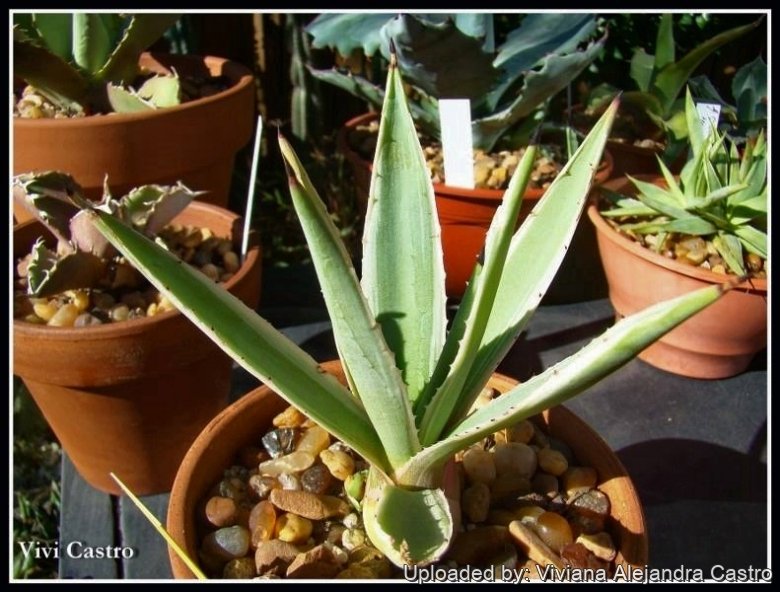
Leaves: The leaves vary considerably in length depending on growing condition, but can reach up to 60 cm (or more) They are stiff, sword-shaped, concave and revolute or plicate, blue or blue-greenish 5-10 cm wide at their widest point and have a distinct narrowing in their lower third and are furnished with thin marginal teeth and a subulate-conical terminal spine. Leaves have marginal bands of bright white, with occasional cream stripes to the inside.
Flowers: Greenish-yellow to white in terminal panicles and approximately 5 cm long. The flower stalks will reach up to 2.5 m in height.
Blooming season: Blooms after 10 years or more years (though not a century) in spring, die after flowering, but new plants may develop from suckers at their base and from bulbils along the flower stalk.
Agave angustifolia Haw., var. marginata Hort. This is a handsome, neatly growing plant developing a trunk 3-6 dm tall with numerous leaves margined with white or yellow (Fig.
Bibliography
Major references and further lectures.
-
William Trelease: “Agave in the West Indies.” In: Memoirs of the National Academy of Sciences. volume 11, 1913, page 21, tab. 11–13
-
J. Thiede: Agavaceae. In: Urs Eggli “Illustrated Handbook of Succulent Plants: Monocotyledons: Monocotyledons” Springer Science & Business Media, 17/Jul/2001
-
A. Berger: “Die Agaven” Gustav Fischer Verlag Stuttgart. 1915, page 225–226.
-
P. W. Hummelinck: “Notes on Agave in the Netherlands West Indies and North Venezuela.” Recueil Trav. Bot. Neerl. volume 35: 14–28. 1938
-
Wikipedia contributors. “Agave angustifolia.” Wikipedia, The Free Encyclopedia. Wikipedia, The Free Encyclopedia, 28 Jun. 2014. Web. 5 Nov. 2014
-
I. Richter: “Die Gattung Agave” A.I.A.S. 2011, page 96.
-
- Gentry, Howard Scott. “Agaves of Continental North America”. University of Arizona Press, Tucson, 1992.
-
San Marcos Growers contributors “Agave angustifolia ‘Marginata’ - Caribbean Agave” San Marcos Growers <http://www.smgrowers.com\>. Web. 27 Sep. 2014.
-
Abisaí García-Mendoza, Fernando Chiang: “The confusion of Agave vivipara L. and A. angustifolia Haw., two distinct taxa.” In: Brittonia. Band 55, Nr. 1, Springer, New York 2003
-
Smith, G.F.; Steyn, E.M.A. «Agave vivipara: the correct name for Agave angustifolia», Bothalia 29 (1): 100 1999
-
Steyn, E.M.A.; Smith, G.F. «Agavaceae. Agave vivipara: a naturalised alien in Southern Africa», Bothalia 30 (1): 43–46 2000
-
Foxcroft, L.C.; Richardson, D.M.; Wilson, J.R.U., «Ornamental Plants as Invasive Aliens: Problems and Solutions in Kruger National Park, South Africa», Environmental Management 41 (1): 32–51 2008
-
Smith, G.F.; Figueiredo, E., «Naturalized Species of Agave L.(agavaceae) on the Southeastern Coast of Portugal», Haseltonia 13 (1): 52–60 2007
-
Royal Horticultural Society, Kew. A detailed checklist for Agave vivipara.
Forster, P.I. «New varietal combinations in Agave vivipara(Agavaceae)», Brittonia 44 (1): 74–75, 1992
Source: Agave vivipara cv. marginata, LLIFLE - Encyclopedia of living forms, CC-BY-SA, retrieved 2026-10-25.
From llifle page Agave vivipara cv. variegata
Description
Has broad white marginal strips.
Origin and Habitat
Garden origin (Botanical Garden of College of Science, Poona, India about 1895)
Source: Agave vivipara cv. variegata, LLIFLE - Encyclopedia of living forms, CC-BY-SA, retrieved 2026-10-25.
Cultivars and forms (4)
Gallery