Description
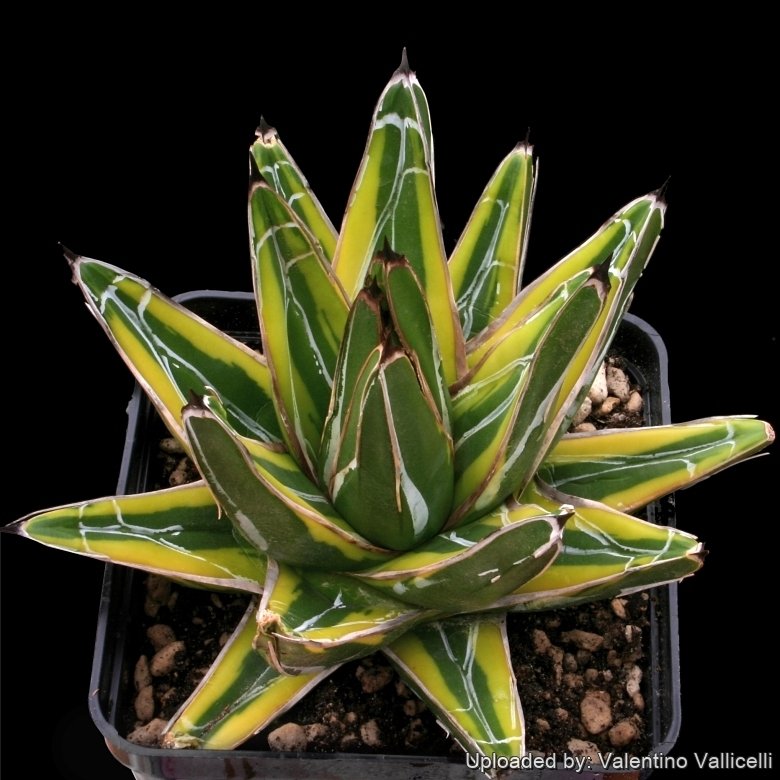
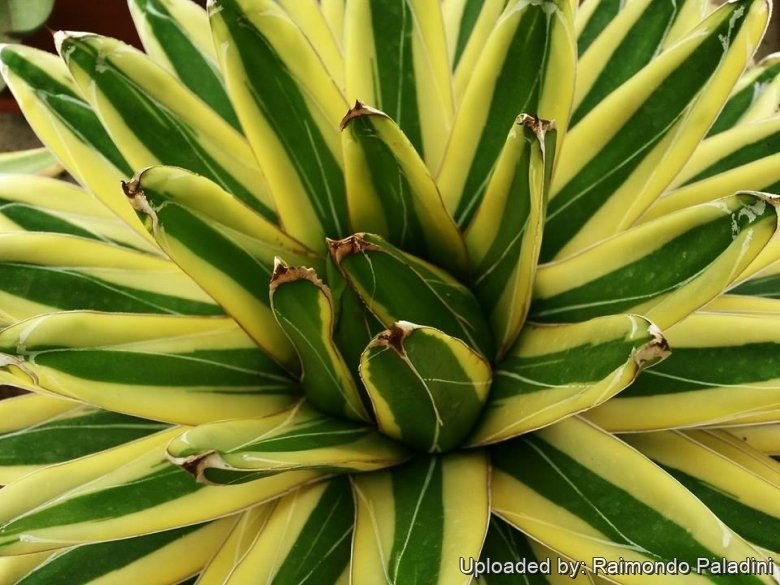
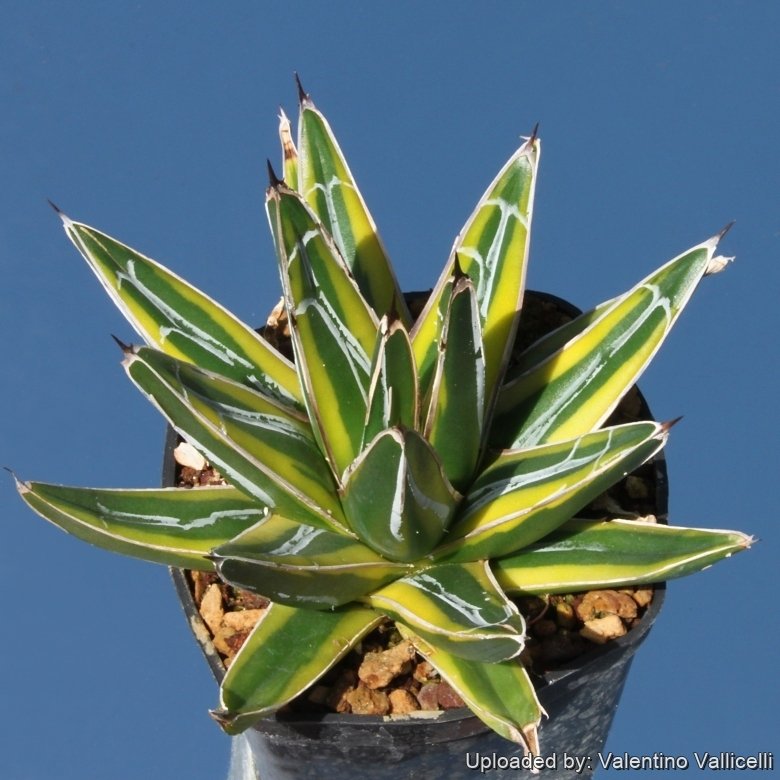
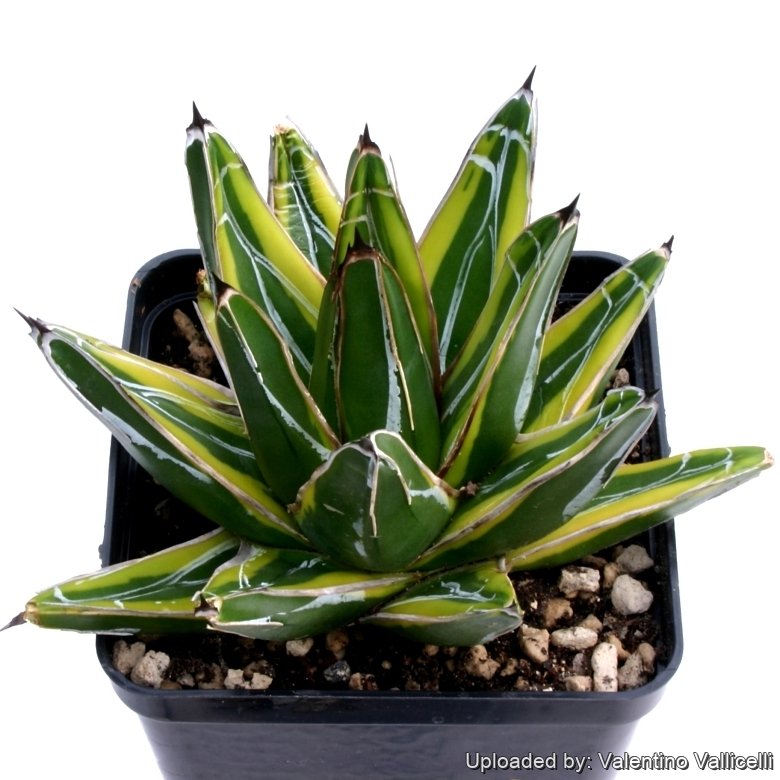
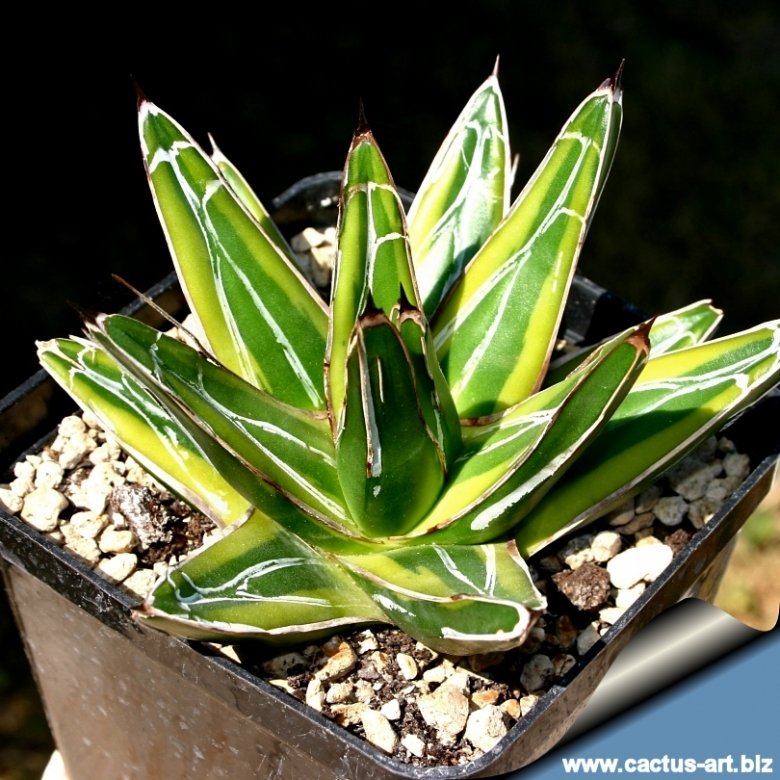
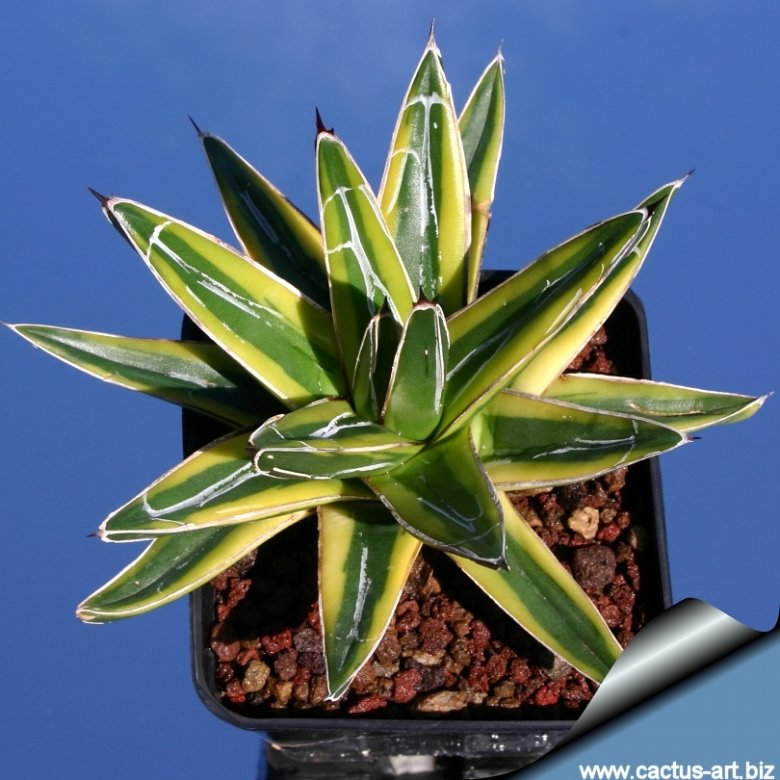
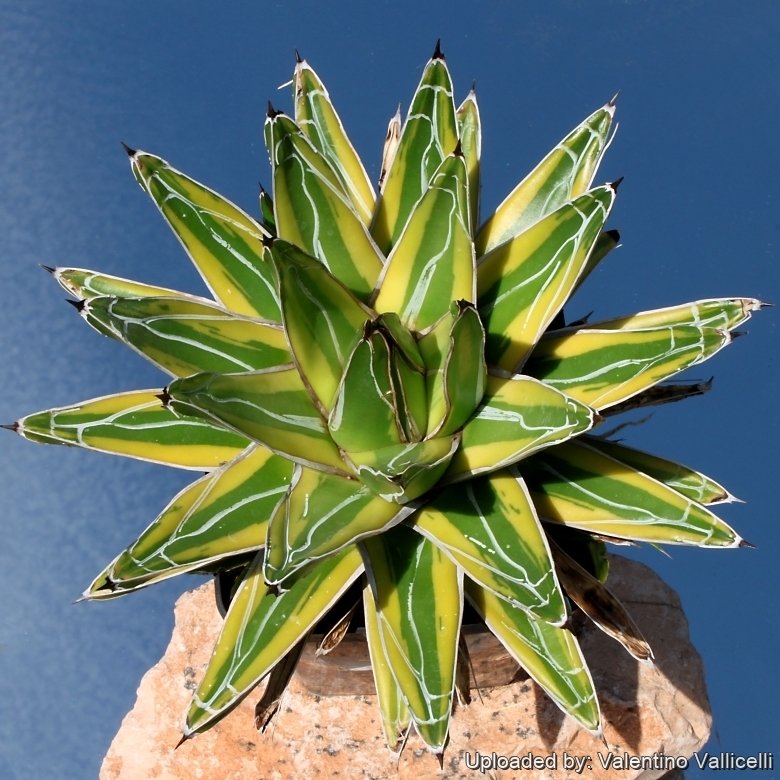
Agave victoriae-reginae ‘Golden Princess’ is a very slow growing but tough and nice variegated form of the Queen Victoria Agave (Agave victoriae-reginae). It is considered to be one of the most beautiful and desirable species. Variegation is yellow striping along the margins of each leaf.
Rosettes: Dense, globose, regular, slow growing, eventually growing up to 30 cm tall diameter and 30-40 cm across. (but usually rarely grows taller than 22 cm). Most plant are solitary, but some offset heavily.
Leaves: Tight-fitting, thick, rigid, trigonous, 15-20 cm long and up to 3 cm broad, tapered ending in a small terminal spine with the leaf margins smooth and spineless. This cultivar has broad yellow margins which, in addition to the already brilliant silver markings on the margins and center of the leaf, give this plant a tricoloured look (The distinct longitudinal white markings are unique, slightly raised, like mini-variegation bordering each leaf).
Flower: The inflorescence takes the form of a spike, from 2 to 4 metres high, containing many paired flowers of various colours, often with shades of purple red.
Blooming season: Summer. As with all types of Agave it have a long life cycle and sets flowers after approximately 20 to 30 years of vegetative growth, and the effort to produce the flowers exhausts the plant which dies within a short time.
Remarks: This plant is sometimes listed with cultivar names such as ‘Aurea Marginata’, Aureo-Marginata’ or ‘Variegata’. Mary Irish proposed the name ‘Golden Princess’ in the Summer 2002 CSSA Journal (74:4) because latinized cultivar names given after January 1, 1959 are deemed not valid.
Origin and Habitat
Garden origin (Nursery produced cultivar)
Cultivation and Propagation
It seems to look nicer under a bit of shade cloth instead of in full, hot, blazing sun.
Propagation: It grows well from suckers (if available) and forms attractive specimens. It will tolerate quite low temperatures ( -4° C), particularly when dry
Bibliography
Major references and further lectures.
-
J. Thiede: Agavaceae. In: Urs Eggli “Illustrated Handbook of Succulent Plants: Monocotyledons: Monocotyledons” Springer Science & Business Media, 17/Jul/2001
-
A. Berger: “Die Agaven” Gustav Fischer Verlag Stuttgart. 1915
-
Wikipedia contributors. “Agave victoriae-reginae” Wikipedia, The Free Encyclopedia. Wikipedia, The Free Encyclopedia, 30 Jan. 2014. Web. 4 Nov. 2014.
-
San Marcos Growers contributors “Agave victoriae-reginae ‘Golden Princess’ ” San Marcos Growers <http://www.smgrowers.com\>. Web. 27 Sep. 2014.
-
Howard Scott Gentry, “Agaves of Continental North America” (University of Arizona Press, 1982) pp. 183–185
-
“Agave victoriae-reginae” in: Moore, Thomas. Gardeners’ Chronicle, new series 4: 485. 1875.
-
August J. Breitung: “Agave victoriae-reginae.” In: “The Agaves.” The Cactus & Succulent Journal Yearbook, pp 26–27.1968,
-
Thomas Heller: “Agave victoriae-reginae.” In: “Agaven.” 2. erweiterte Auflage, Münster 2006.
-
Mary Irish, Gary Irish: “Agave victoriae-reginae.” In: “Agaves, Yuccas, and Related Plants: A Gardener’s Guide.” Timber Press, 2000,
-
Bernd Ullrich: “Agave victoriae-reginae T. Moore”. In: Kakteen und andere Sukkulenten. 41:7 plate 22.1990
-
Mary Irish “Agave victoriae-reginae.” In: CSSA Journal 74:4 2002
Gallery