Publication: Gard. Chron. n.s., 4(2) 485 1875
Description
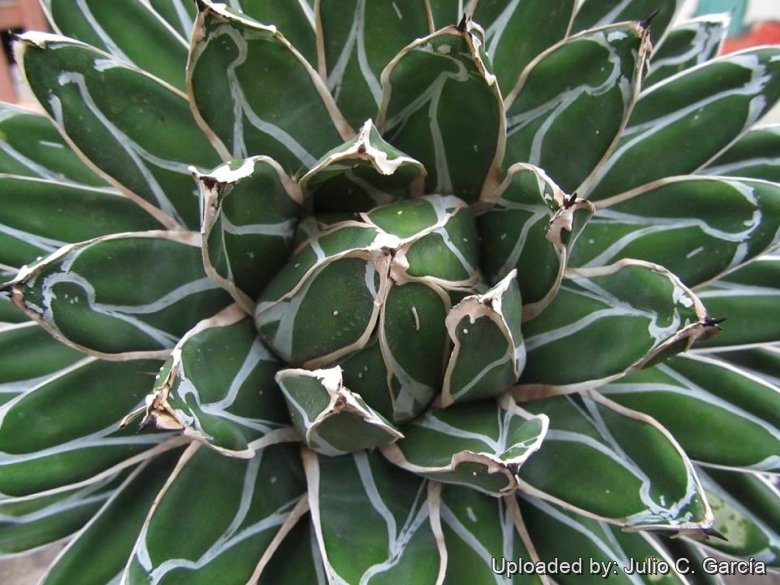
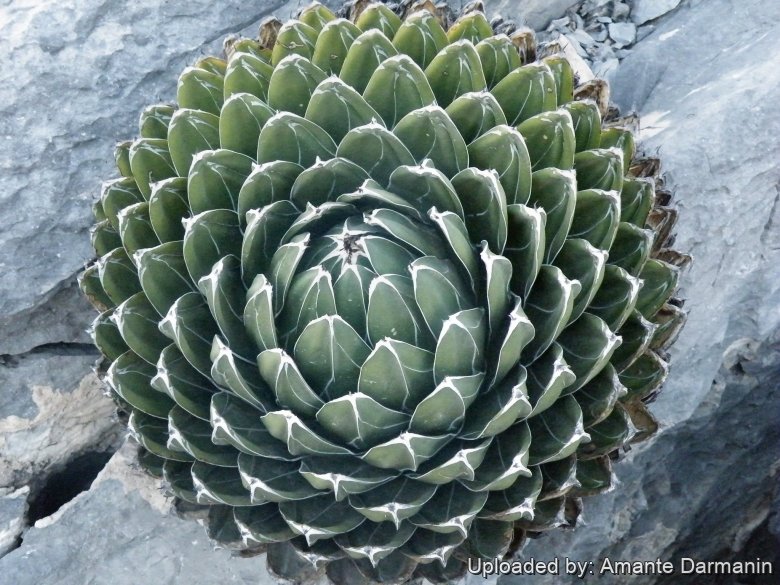
A. Victoria-reginae is a very slow growing but tough and beautiful Agave. It is consider the to be one of the most beautiful and desirable species. It is extremely variable with the very open black-edged form sporting a distinct name (King Ferdinand’s agave, Agave ferdinandi-regis) and several forms that are the more common white-edged form. Several cultivars have been named with different patterns of white leaf markings or no white markings (var. viridis) or white or yellow variegation.
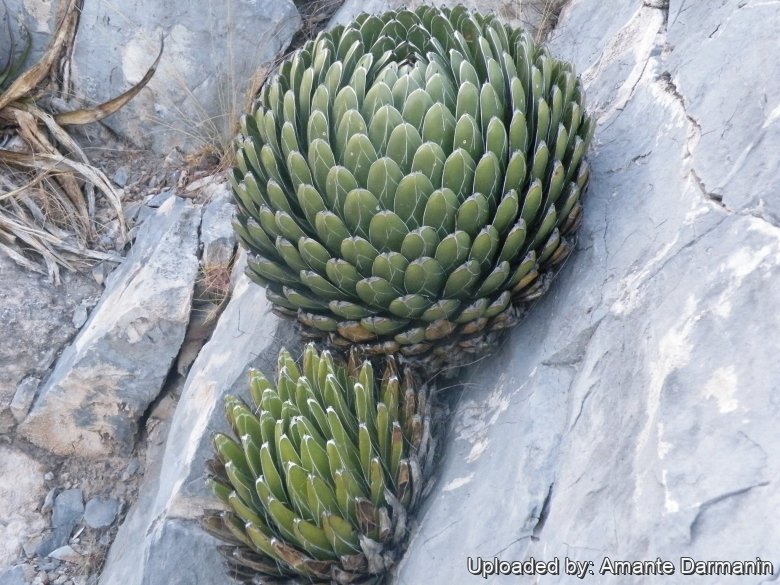
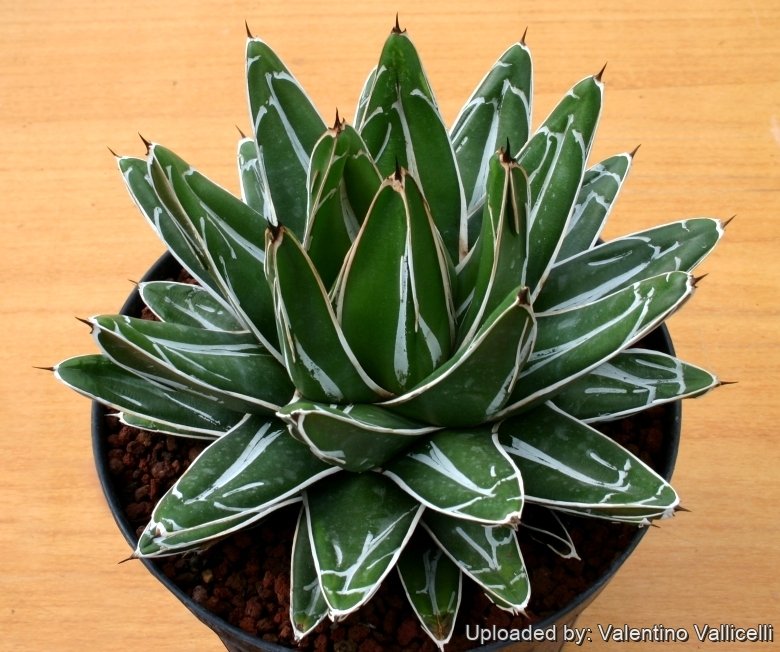
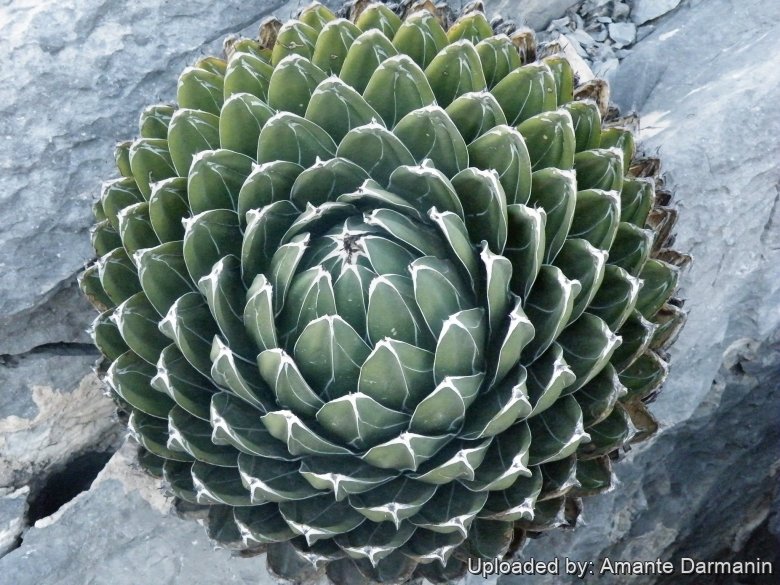
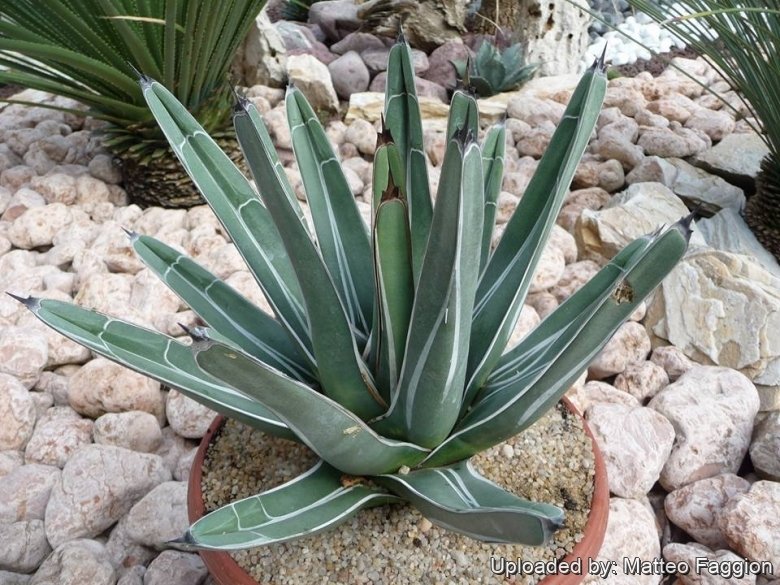
Rosettes: Individual or sukering, slow growing, dense, up to 45 cm in diameter (but usually rarely grows taller than 22 cm), most populations are solitary, but some offset heavily (forma caespitosa and forma stolonifera).
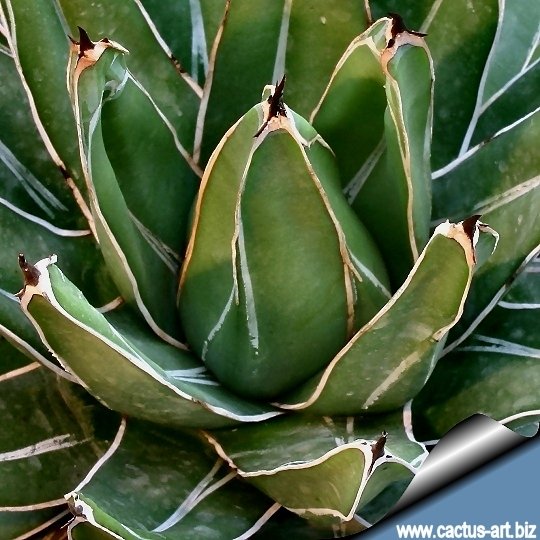
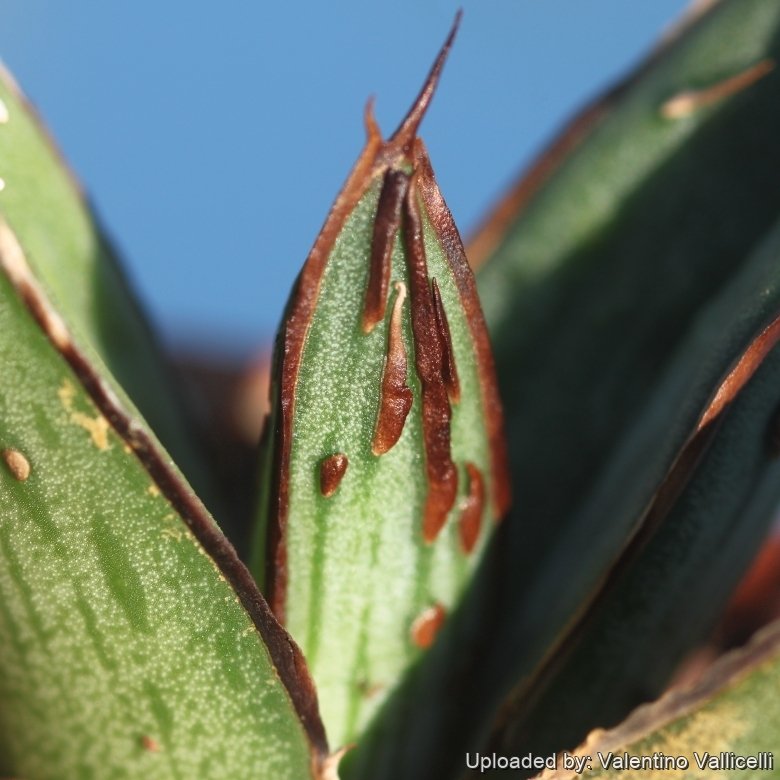
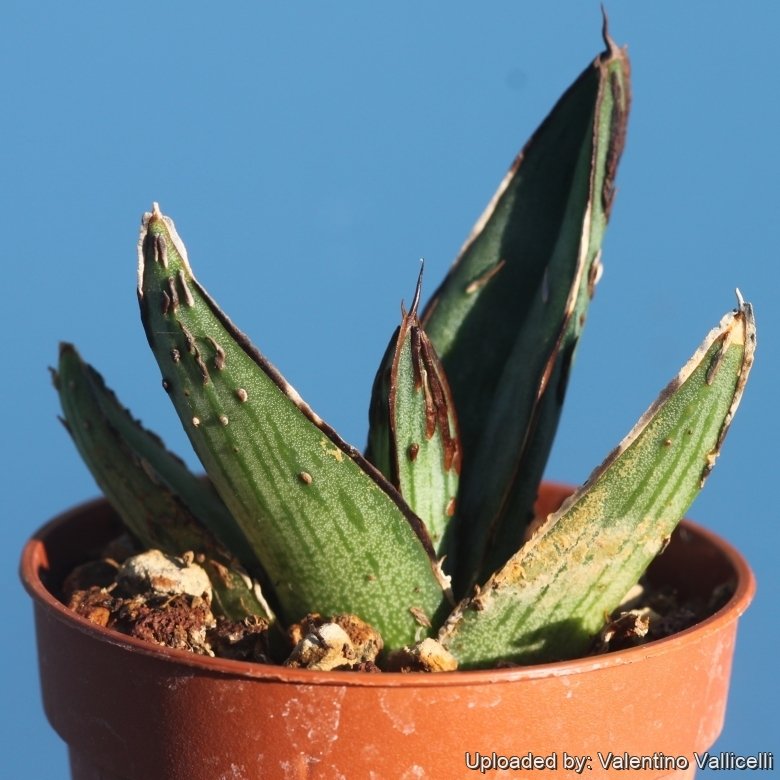
Leaves: Short,15-20 cm long and up to 3 cm broad, rigid and thick, trigonous, dark green, and beautifully marked with brilliant white-margins (The distinct longitudinal white markings are unique, slightly raised, like mini-variegation bordering each leaf) They are toothless, with only a short black, terminal spine. Leaves grow close together and are arranged in globose regular rosettes.
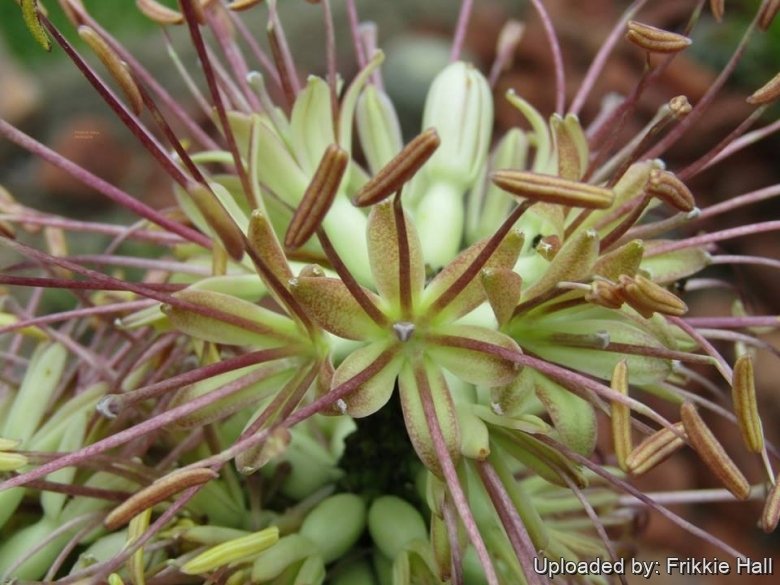
Flower: The inflorescence takes the form of a spike, from 2 to 4 metres high, containing many paired flowers of various colours, often with shades of purple red.
Blooming season: Summer. As with all types of Agave it have a long life cycle and sets flowers after approximately 20 to 30 years of vegetative growth, and the effort to produce the flowers exhausts the plant which dies within a short time.
Origin and Habitat
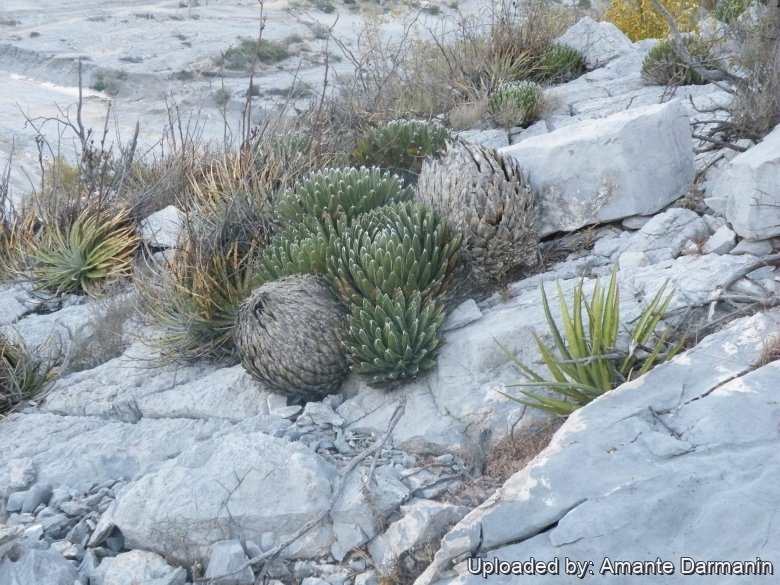
It is endemic to the arid lower elevations of the Sierra Madre Oriental Mountains in the state of Coahuila and south of Nuevo Leon in north-eastern Mexico (Huasteca canyon, Sierras de las Noas, Viesca, and adjacent areas just south of Saltillo).
Habitat: It grows mainly in calcareous soil characterised by a desert or semi-desert environment and is found in profusion on the steep slopes and near vertical cliffs of the canyon walls where forms large colonies. It is often associated with Hechtia sp. a genus of bromeliads which we often found growing with cacti.
While Agave victoria-reginae remains endangered in its native habitat, it has become very common in cultivation.
Cultivation and Propagation
It requires well-drained soil and light shade to full sun exposure, but they prefer some afternoon shade during the hottest summer month to avoid being fried by sun. It should be kept rather dry in winter or dormant season with minimum temperatures above zero in order to obtain good results, but it will tolerate quite low temperatures ( -10° C), particularly when dry. To give this marvellous plant vigour and life, water well during spring and summer and let it become barely moist between waterings. Along the coast or in areas where there are no frosts, these plants may be cultivated with success outdoors where their beauty is better observed. In cold climates it is adviseable to cultivate these plants in pots in order to protect them during the winter in dry, fresh rooms. Requires good ventilation and avoid over-watering.
Fertilizer: Feed only twice a year, once in April and once in July with a water-soluble potassium-rich fertilizer.
Plant Pests: Prone to mealy bugs and scale. Always inspect any new plant for pests before introducing it to your home or greenhouse.
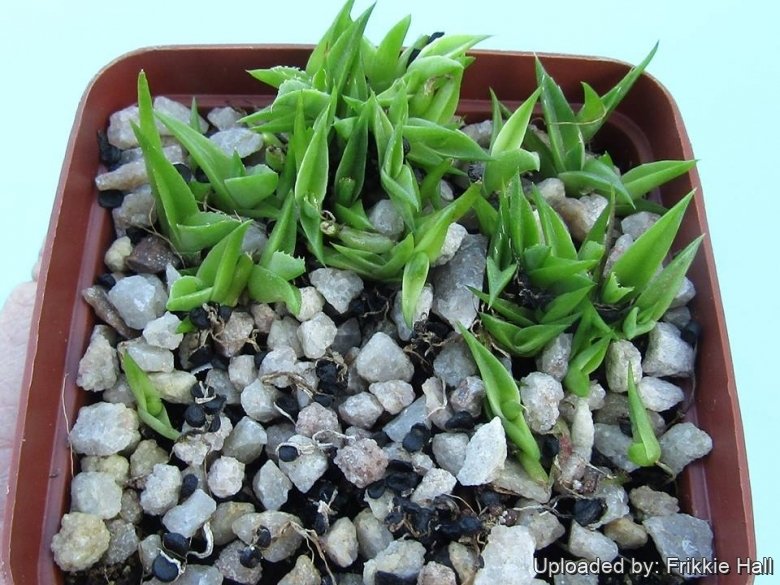
Propagation: It reproduces thanks to the seeds or by the suckers produced at the base of the stems in the spring. Propagate them in evenly moist soil, mist occasionally and keep in filtered sunlight until they are growing.
Uses: These plants were discovered by the Spaniards in the 17th century where the local Indians used them for fibres, food and to make an alcoholic drink like Tequila. The fibres were used to make clothing and ropes. Most of the plant was used for food, raw and cooked. Flowering stems and flowers are edible and were roasted or boiled.
Bibliography
Major references and further lectures.
-
J. Thiede: Agavaceae. In: Urs Eggli “Illustrated Handbook of Succulent Plants: Monocotyledons: Monocotyledons” Springer Science & Business Media, 17/Jul/2001
-
A. Berger: “Die Agaven” Gustav Fischer Verlag Stuttgart. 1915
-
Wikipedia contributors. “Agave victoriae-reginae” Wikipedia, The Free Encyclopedia. Wikipedia, The Free Encyclopedia, 30 Jan. 2014. Web. 4 Nov. 2014.
-
San Marcos Growers contributors “Agave victoriae-reginae - Queen Victoria Agave ” San Marcos Growers <http://www.smgrowers.com\>. Web. 27 Sep. 2014.
-
Howard Scott Gentry, “Agaves of Continental North America” (University of Arizona Press, 1982) pp. 183–185
-
“Agave victoriae-reginae” in: Moore, Thomas. Gardeners’ Chronicle, new series 4: 485. 1875.
-
August J. Breitung: “Agave victoriae-reginae.” In: “The Agaves.” The Cactus & Succulent Journal Yearbook, pp 26–27.1968,
-
Thomas Heller: “Agave victoriae-reginae.” In: “Agaven.” 2. erweiterte Auflage, Münster 2006.
-
Mary Irish, Gary Irish: “Agave victoriae-reginae.” In: “Agaves, Yuccas, and Related Plants: A Gardener’s Guide.” Timber Press, 2000,
-
Bernd Ullrich: “Agave victoriae-reginae T. Moore”. In: Kakteen und andere Sukkulenten. 41:7 plate 22.1990
From llifle page Agave consideranti
Description
A. Victoria-reginae is a very slow growing but tough and beautiful Agave. It is consider the to be one of the most beautiful and desirable species. Forms individual slow growing dense rosettes up to 45 cm in diameter (but usually rarely grows taller than 22 cm), most populations are solitary, but some offset heavily (forma caespitosa). It is extremely variable with the very open black-edged form sporting a distinct name (King Ferdinand’s agave, Agave ferdinandi-regis) and several forms that are the more common white-edged form. Several cultivars have been named with different patterns of white leaf markings or no white markings (var. viridis) or variegation.
Leaves: Short,15-20 cm long and up to 3 cm broad, rigid and thick, trigonous, dark green, and beautifully marked with brilliant white-margins (The distinct longitudinal white markings are unique, slightly raised, like mini-variegation bordering each leaf) They are toothless, with only a short black, terminal spine. Leaves grow close together and are arranged in globose regular rosettes.
Flower: The inflorescence takes the form of a spike, from 2 to 4 metres high, containing many paired flowers of various colours, often with shades of purple red.
Blooming season: Summer. As with all types of Agave it have a long life cycle and sets flowers after approximately 20 to 30 years of vegetative growth, and the effort to produce the flowers exhausts the plant which dies within a short time.
Cultivation and Propagation
It requires well-drained soil and light shade to full sun exposure, but they prefer some afternoon shade during the hottest summer month to avoid being fried by sun. It should be kept rather dry in winter or dormant season with minimum temperatures above zero in order to obtain good results,but it will tolerate quite low temperatures ( -10° C), particularly when dry. To give this marvellous plant vigour and life, water well during spring and summe and let it become barely moist between waterings.
Fertilizer: Feed only twice a year, once in April and once in July with a water solublepotassium-rich fertilizer. Along the coast or in areas where there are no frosts, these plants may be cultivated with success outdoors where their beauty is better observed. In cold climates it is adviseable to cultivate these plants in pots in order to protect them during the winter in dry, fresh rooms. Plant Pests: Prone to mealy bugs and scale. Always inspect any new plant for pests before introducing it to your home or greenhouse. Requires good ventilation and avoid over-watering.
Propagation: It reproduces thanks to the seeds or by the suckers produced at the base of the stems in the spring. Propagate them in evenly moist soil, mist occasionally and keep in filtered sunlight until they are growing.
Uses: These plants were discovered by the Spaniards in the 17th century where the local Indians used them for fibres, food and to make an alcoholic drink like Tequila. The fibres were used to make clothing and ropes. Most of the plant was used for food, raw and cooked. Flowering stems and flowers are edible and were roasted or boiled.
Source: Agave consideranti, LLIFLE - Encyclopedia of living forms, CC-BY-SA, retrieved 2026-10-25.
From llifle page Agave ferdinandi-regis
Description
The shapely, very beautiful Agave ferdinandi-regis (a.k.a King agave) is closely allied to the other ‘royal’ agave, namely the beautiful Agave victoria-reginae and often confused with it, but instead of silver colored margins has dark reddish brown edges. This small slow-growing agave is also known as Agave victoriae-reginae var. laxior or Agave victoriae-regina var. nickelsii, it is now considered by some authors (lumpers) only a variant of Agave victoria-reginae and fully synonymized with it, but these two plants looks quite distinct, there does not appear to be any ‘transition’ forms in nature, which one would expect to see if these two were really the same. Also this plant grows to nearly twice the size of the other.
Derivation of specific name: This plant was named in honor of King Ferdinand of Bulgaria.
Rosette: Solitary or very slow to sucker, globose, slow growing up to 45 cm tall by as width; less compact than victoriae-reginae with fewer leaves more loosely arranged, more tapering, wider and a little heavier in outline.
Leaves: About 13 cm. long, triangular, firm, very stiff, slanting upwards, deeply hollow on the upper surface, almost folded, dark green or blue green with prominent converging white lines (bud imprints) that usually form a triangle shape. The margins of the leaves are dark reddish brown and spineless tapering gradually and terminating at the blunt leaf tip in 1 or 3 (or more) dark stout spine(s) of the same colour subtending the large terminal spine, a feature never seen on Agave victoriae-reginae.
Flower: The inflorescence takes the form of a spike, from 2 to 4 metres high, containing many paired flowers of various colours, often with shades of purple red.
Blooming season: Summer. As with all types of Agave it have a long life cycle and sets flowers after approximately 20 to 30 years of vegetative growth, and the effort to produce the flowers exhausts the plant which dies within a short time.
Origin and Habitat
This little century plant comes from a series of mountains north-east of Saltillo in north-western Mexico.
Cultivation and Propagation
It requires well-drained soil and light shade to full sun exposure, but they prefer some afternoon shade during the hottest summer month to avoid being fried by sun. It should be kept rather dry in winter or dormant season with minimum temperatures above zero in order to obtain good results,but it will tolerate quite low temperatures ( -10° C), particularly when dry. To give this marvellous plant vigour and life, water well during spring and summer and let it become barely moist between waterings.
Fertilizer: Feed only twice a year, once in April and once in July with a water-soluble potassium-rich fertilizer. Along the coast or in areas where there are no frosts, these plants may be cultivated with success outdoors where their beauty is better observed. In cold climates it is adviseable to cultivate these plants in pots in order to protect them during the winter in dry, fresh rooms. Plant Pests: Prone to mealy bugs and scale. Always inspect any new plant for pests before introducing it to your home or greenhouse. Requires good ventilation and avoid over-watering.
Propagation: It reproduces thanks to the seeds or by the suckers produced at the base of the stems in the spring. Propagate them in evenly moist soil, mist occasionally and keep in filtered sunlight until they are growing.
Uses: These plants were discovered by the Spaniards in the 17th century where the local Indians used them for fibres, food and to make an alcoholic drink like Tequila. The fibres were used to make clothing and ropes. Most of the plant was used for food, raw and cooked. Flowering stems and flowers are edible and were roasted or boiled.
Bibliography
Major references and further lectures.
-
J. Thiede: Agavaceae. In: Urs Eggli “Illustrated Handbook of Succulent Plants: Monocotyledons: Monocotyledons” Springer Science & Business Media, 17/Jul/2001
-
A. Berger: “Die Agaven” Gustav Fischer Verlag Stuttgart. 1915
-
Wikipedia contributors. “Agave victoriae-reginae” Wikipedia, The Free Encyclopedia. Wikipedia, The Free Encyclopedia, 30 Jan. 2014. Web. 4 Nov. 2014.
-
- San Marcos Growers contributors “Agave ferdinandi-regis - King of the Agaves” San Marcos Growers <http://www.smgrowers.com\>. Web. 27 Sep. 2014.
-
Howard Scott Gentry, “Agaves of Continental North America” (University of Arizona Press, 1982) pp. 183–185
-
“Agave victoriae-reginae” in: Moore, Thomas. Gardeners’ Chronicle, new series 4: 485. 1875.
-
August J. Breitung: “Agave victoriae-reginae.” In: “The Agaves.” The Cactus & Succulent Journal Yearbook, pp 26–27.1968,
-
Thomas Heller “Agaven.” 2. erweiterte Auflage, Münster 2006.
-
Mary Irish, Gary Irish “Agaves, Yuccas, and Related Plants: A Gardener’s Guide.” Timber Press, 2000,
-
Bernd Ullrich: “Agave victoriae-reginae T. Moore”. In: Kakteen und andere Sukkulenten. 41:7 plate 22.1990
Source: Agave ferdinandi-regis, LLIFLE - Encyclopedia of living forms, CC-BY-SA, retrieved 2026-10-25.
Cultivars and forms (10)
Subspecies (1)
Varieties (1)
Forms (5)
Gallery