Publication: Haseltonia 5: 18. 1998 [1997 publ. 1998]
Description
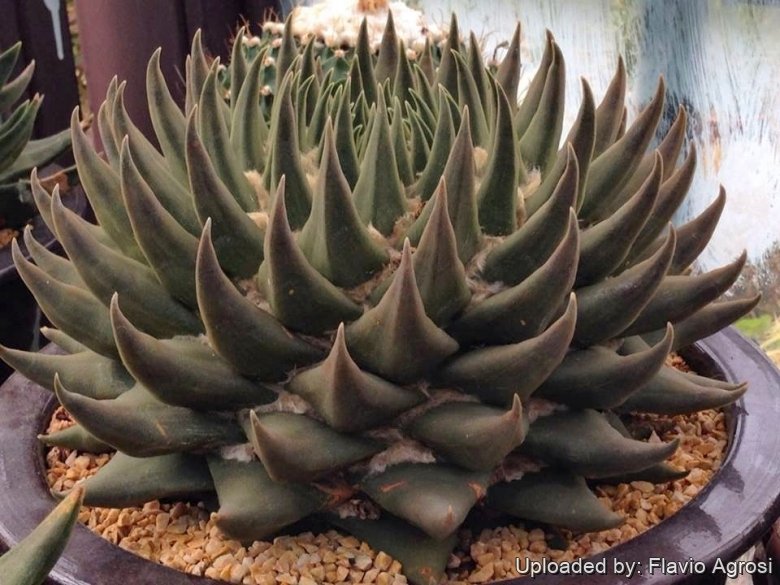
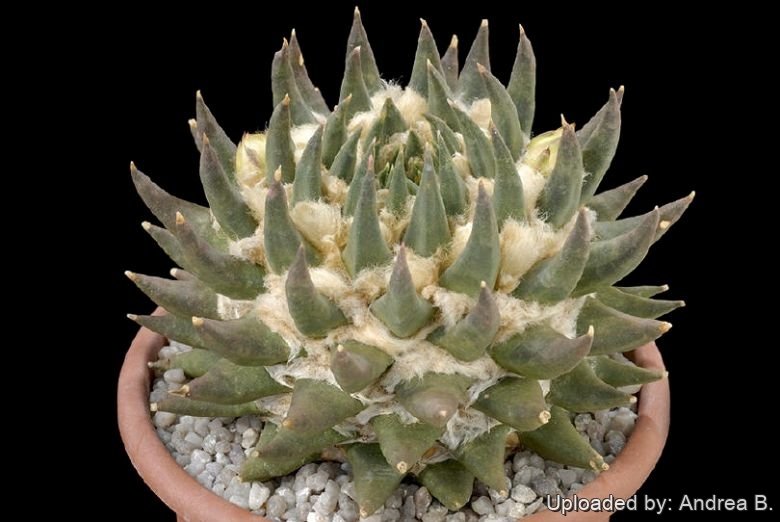
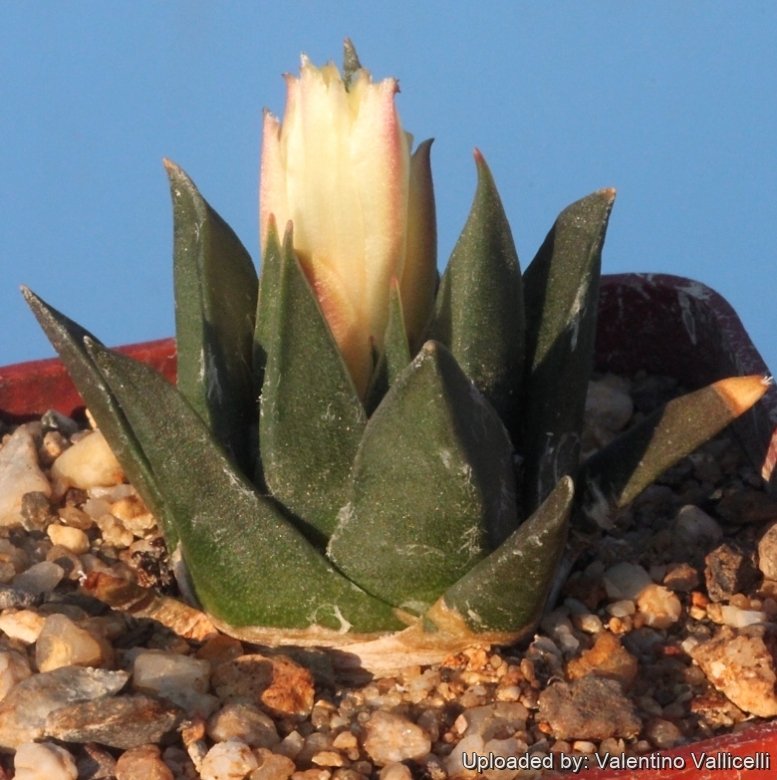
Ariocarpus trigonus is one of the largest species that distinguishes for the long leaf-like triangular tubercles and peculiar yellow flowers. It is quite variable in tubercle shape and size and has received numerous unnecessary names of no botanical value, representing no more than local phenotypes
Habit: Solitary rosette-forming, geophytic cactus rising slightly above ground level.
Stem: 5 to 30 cm in diameter, 4 to 25 cm tall, globose, more or less depressed, rounded on top, mostly yellowish-green.
Tubercles: Upright yellow/brownish grey, divergent, not closely set or basally compressed, acute at the apices, flattened and smooth adaxially, not fissured, strongly incurved, 3-8cm long, 1-2.5cm broad, usually twice as long as wide, but variable from long and thin to short and broad.
Areoles: Ariocarpus trigonus bears only small basal areoles, whose meristem do not divide, monomorphic. On the contrary Ariocarpus retusus has floral and spinous parts separate, dimorphic. However spine-bearing portions of the areoles are present at the tips of the tubercles of tubercles only in very small specimens.
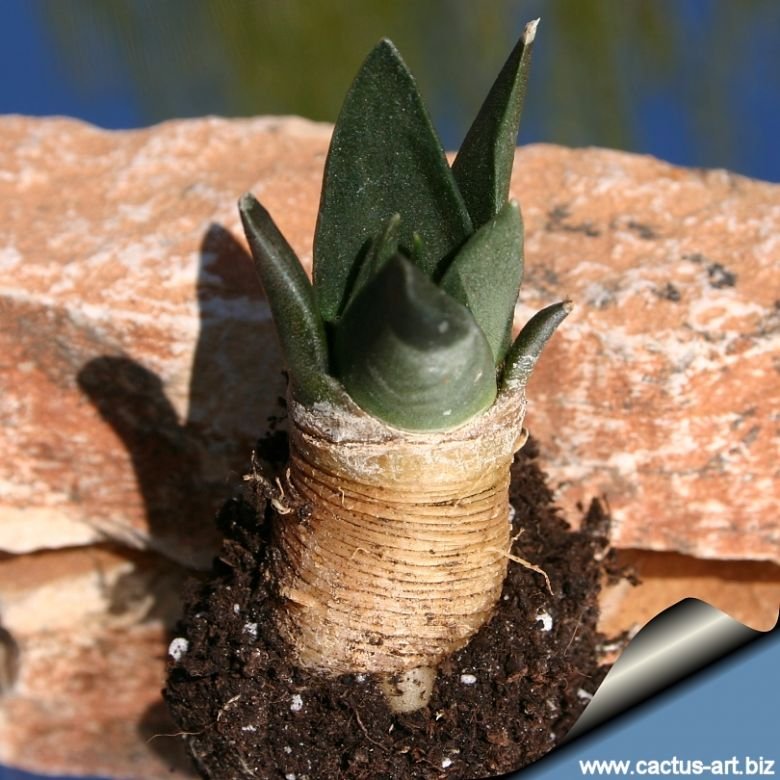
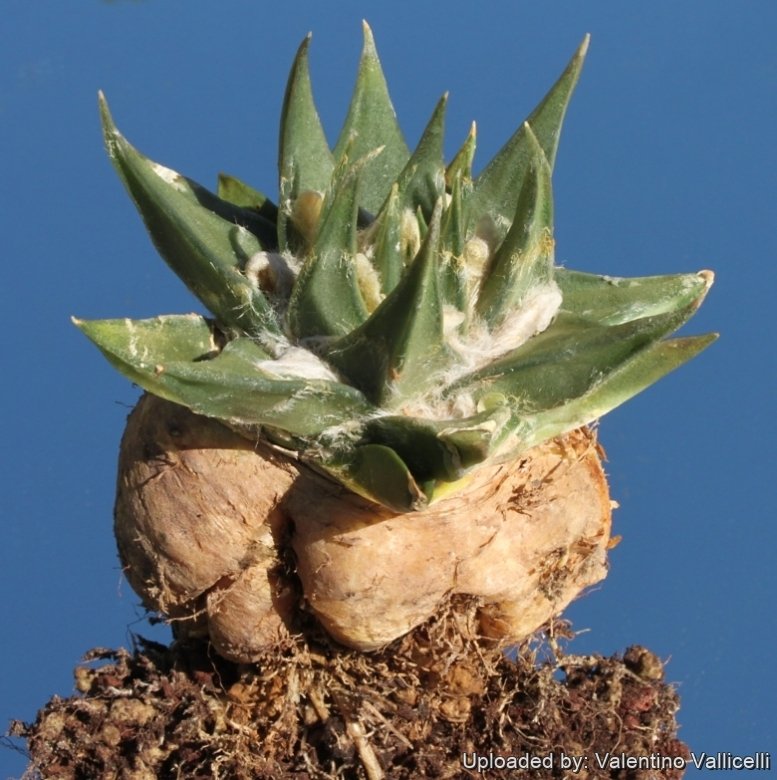
Roots: Tap root.
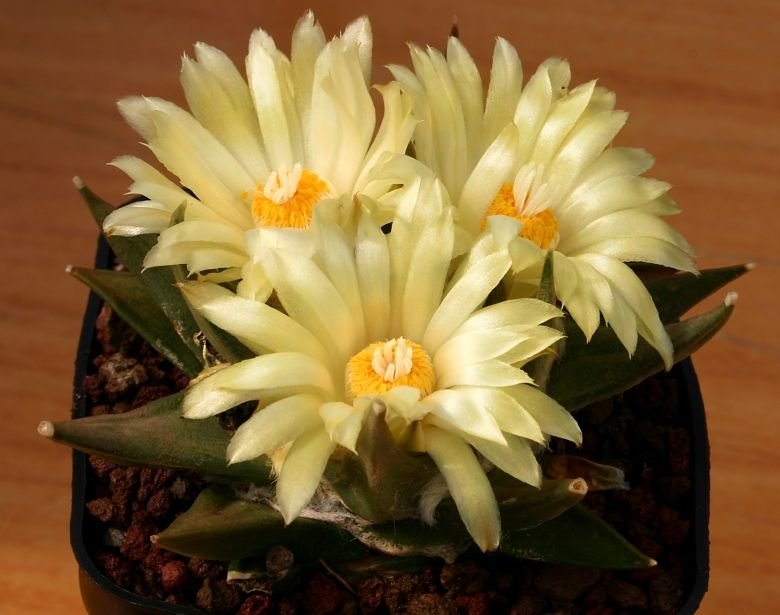
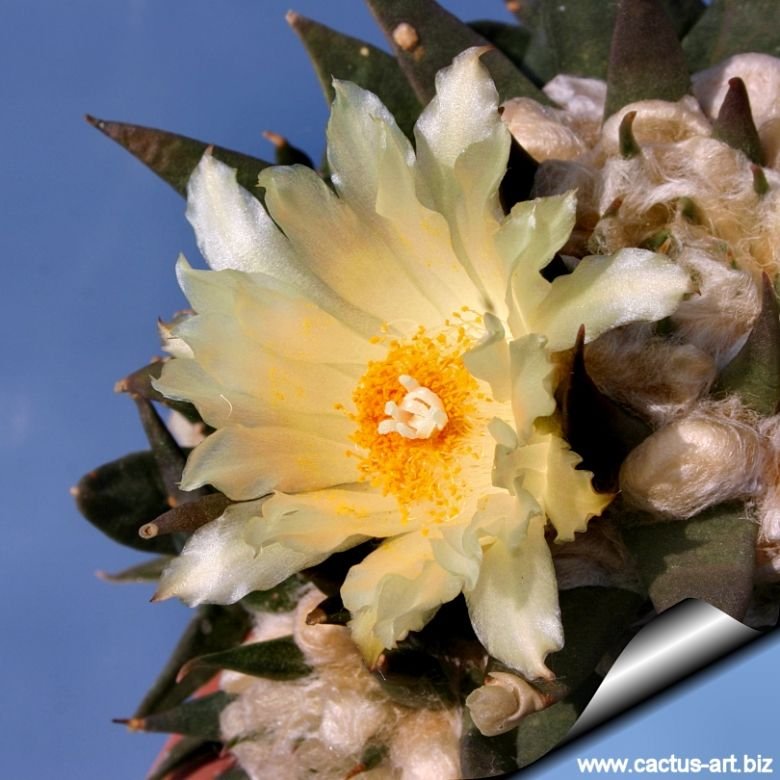
Flowers: Cream-white to yellowish-white or yellow (occasionally with reddish mid-ribs) with a satin sheen, 3 to 5 cm in diameter up to 4 cm long.
Blooming season: They come in late autumn or early winter.
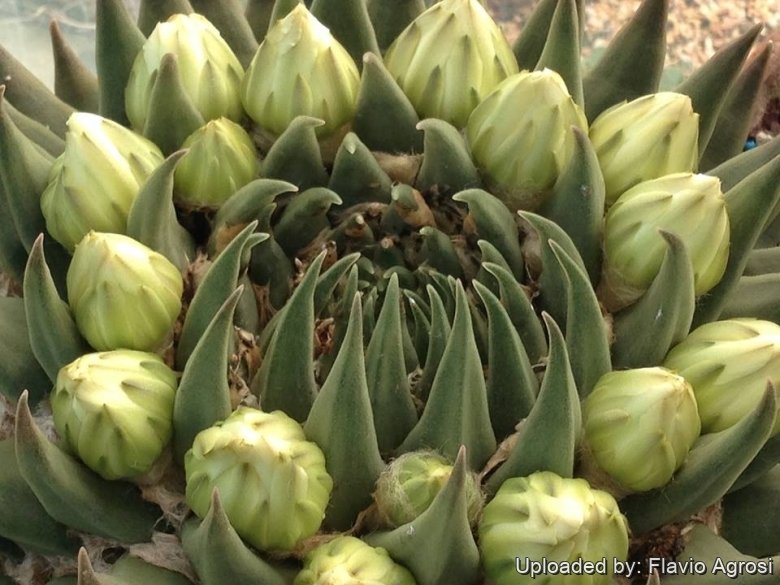
Fruit: Whitish or greenish, 7-20 mm long, 5-10 mm across.
Remarks: In the area of Aramberri Ariocarpus trigonus intergrades with Ariocarpus retusus giving rise to a an hybrid population known as Ariocarpus confusus
Origin and Habitat
Mexico (Tamaulipas, Nuevo Leon)
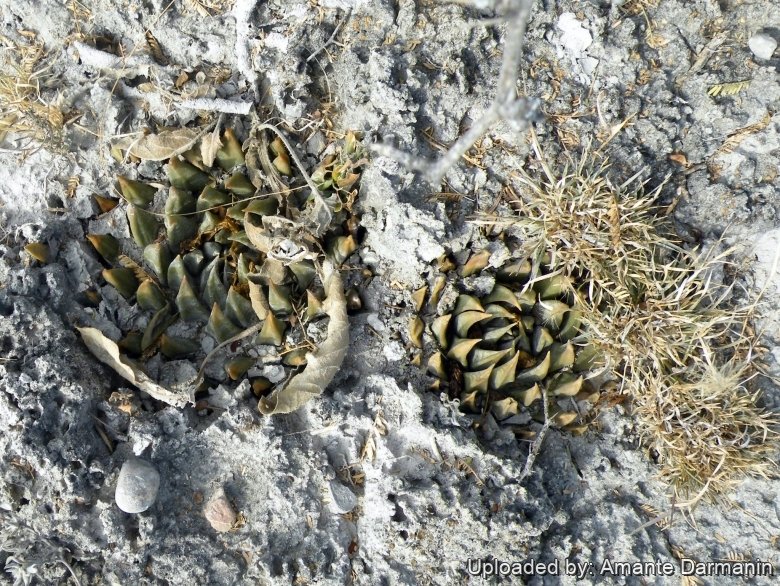
Habitat: Grows in limestone at 600-1200 m of elevation, mostly found in colonies of considerable size, the habitat length is over 400km.
Cultivation and Propagation
This species is slow-growing, but certainly not as slow as some other types of cacti. It is of easy cultivation in a well drained, non-organic, free-draining soil compost, with ample water during the growing season. Use of a weak low-nitrogen fertilizer during the growing season can encourage growth. The main threat to their development is root rot. Ariocarpus should be kept dry whenever there is a threat of cold. The appearance of Ariocarpus can benefit greatly by watering the plants from the bottom. This practice will help to keep the “wool” on the top of the plant from becoming matted or discoloured. Needs light shade to full sun. Frost Tolerance: Hardy to -10° C.
Propagation: It is probably the easiest species of the genus to raise from seed, but will generally take about 7-10 years to reach flowering size, occasionally grafted.
Bibliography
Major references and further lectures
-
Edward Anderson “The Cactus family” Timber Press, Incorporated, 2001
-
Del Weniger “Cacti of the Southwest: Texas, New Mexico, Oklahoma, Arkansas, and Louisiana” University of Texas Press, 1969
-
James Cullen, Sabina G. Knees, H. Suzanne Cubey “The European Garden Flora Flowering Plants: A Manual for the Identification of Plants Cultivated in Europe, Both Out-of-Doors and Under Glass” Cambridge University Press, 11/Aug/2011
-
David R Hunt; Nigel P Taylor; Graham Charles; International Cactaceae Systematics Group. “The New Cactus Lexicon” dh books, 2006
-
Urs Eggli, Leonard E. Newton: “Etymological Dictionary of Succulent Plant Names” Springer, Berlin/Heidelberg 2010
-
N. L. Britton, J. N. Rose: “The Cactaceae. Descriptions and Illustrations of Plants of the Cactus Family.” Volume III, The Carnegie Institution of Washington, Washington 1922
-
E. F. Anderson and W. A. Fitz Maurice “Ariocarpus revisited.” Haseltonia 5: 1-20. 1997).
-
Anderson, E. F. “Ariocarpus: Some reminiscences.” Cart. Succ. J. (US) 71:180-190, 1999)
-
Stuart Max Walters “The European garden flora. 3.[Angiospermae], Dicotyledons. [Casuarinaceae to Aristolochiaceae]” Cambridge University Press, 1989
From llifle page Ariocarpus elongatus subs. horacekii
Description
Ariocarpus retusus subs. horacekii differs from the standard Ariocarpus retusus subs. trigonus only for its smaller body, all the other characteristics, namely tubercles shape and flowers colour clearly show that they are conspecific.
Ariocarpus trigonus is quite variable and has received numerous unnecessary names of no botanical value, representing no more than local phenotypes: Ariocarpus retusus subs. horacekii one of them.
Habit: Solitary rosette-forming, geophytic cactus rising slightly above ground level.
Stem: Globose, more or less depressed, rounded on top, mostly yellowish-green.
Tubercles: Upright yellow/brownish grey, divergent, not closely set or basally compressed, acute at the apices, flattened and smooth adaxially, not fissured, strongly incurved, usually twice as long as wide.
Areoles: It bears only small basal areoles.
Roots: Tap root.
Flowers: Cream-white to yellowish-white or yellow (occasionally with reddish mid-ribs) with a satin sheen, 3 to 5 cm in diameter up to 4 cm long.
Blooming season: Flowers come in late autumn or early winter.
Fruit: Whitish or greenish, 7-20 mm long, 5-10 mm across.
Origin and Habitat
South of Matehuala, San Luis Potosí, Mexico.
Cultivation and Propagation
Ariocarpus retusus subs. horacekii is not too difficult in a greenhouse, although it grows extremely slowly (it starts blooming at the age of 8-12 years).
Soil: Use a loose mineral cactus mix with extra perlite or pumice and clay pots help the plants to dry out between watering.
Repotting: The plants need deep pots to accommodate the napiform unit formed by the stem base and the rootstock (or they will often simply crack your pots). Generally, they should be repotted frequently at least every other year in order to provide fresh soil. However, old plants become senile and have a tendency to succumb to disease and a weak root system. At this stage, as is well known, they die suddenly. So, after they reach 10-15 cm in diameter grow them slowly, and adopt a new repotting period, using intervals of every 3 years. Additionally grow them under drier conditions or with stronger sunlight. However, repotting doesn’t necessarily mean they’ll need larger containers.
Sun Exposure: Partial sun or light shade. They need a good amount of light, a place near the roof of the greenhouse helps drying the pot after watering.
Watering: They require moderately watering through the growing season. This can be done weekly during the summertime, if the weather is sunny enough, with a little fertilizer added. Kept this way, plants will show a healthy, although slow growth. Keep dry as soon as the temperature starts dropping in October and keep it perfectly dry in winter at temperatures from 5 to 15 degrees centigrade.
Hardiness: Winter care presents no problems at 5°C with plenty of light., but frost hardy to -10°C.
Pest and diseases: They are generally fairly easy to grow, especially if kept pest-free. They are susceptible to stem and root mealy bugs, and damage from these may well initiate fungal attack.
Propagation: By seeds, remembering that seedlings dislike strong light and dry conditions, but the grafted plants are typically rather tall- growing, compared with plants on their own roots, that are usually flatter to the ground.
Source: Ariocarpus elongatus subs. horacekii, LLIFLE - Encyclopedia of living forms, CC-BY-SA, retrieved 2026-10-25.
From llifle page Ariocarpus trigonus var. minor
Description
Solitary yellowish-green globose plant, rising slightly above ground level., rounded on top Stem: 5 to 30 cm in diameter, 4 to 25 cm tall.
Tubercles: Upright yellow/brownish grey divergent, not crowded or basally compressed, acute at the apices, flattened and smooth adaxially, not fissured, strongly incurved, 3-8cm long, 1-2.5cm broad, usually twice as long as wide;
Roots: Tap root
Flowers: Cream-white to yellowish_white (occasionally with reddish mid-ribs) with a satin sheen, 3 to 5 cm in diameter up to 4 cm long .
Blooming season: They come in late autumn or early winter.
Remarks: Ariocarpus retusus is an extremely variable species,. Tubercle size and shape vary widely, a terminal areole is sometimes present at the tip. The vast amount of phenotypic variation in the species has led to the erection of several variants:
Bibliography
Major references and further lectures
-
Edward F. Anderson “The Cactus Family” Timber Press, 2001
-
Curt Backeberg “Cactus Lexicon” Sterling Publishing Company, Incorporated, 1978
-
Hiroshi Hirao “Colour encyclopaedia of cacti” Japan 1979 (Japanese language and script)
-
Willy Cullmann, Erich Götz (Dozent Dr.), Gerhard Gröner “The encyclopedia of cacti” Portland, OR: Timber Press, 1986
-
David Hunt, Nigel Taylor “The New Cactus Lexicon” DH Books, 2006 ISBN 0953813444, 9780953813445
-
James Cullen, Sabina G. Knees, H. Suzanne Cubey “The European Garden Flora Flowering Plants: A Manual for the Identification of Plants Cultivated in Europe, Both Out-of-Doors and Under Glass” Cambridge University Press, 11/Aug./2011
Source: Ariocarpus trigonus var. minor, LLIFLE - Encyclopedia of living forms, CC-BY-SA, retrieved 2026-10-25.
Gallery