Publication: Astrophytum handbook v. 2 myriostigma family 1994
Description
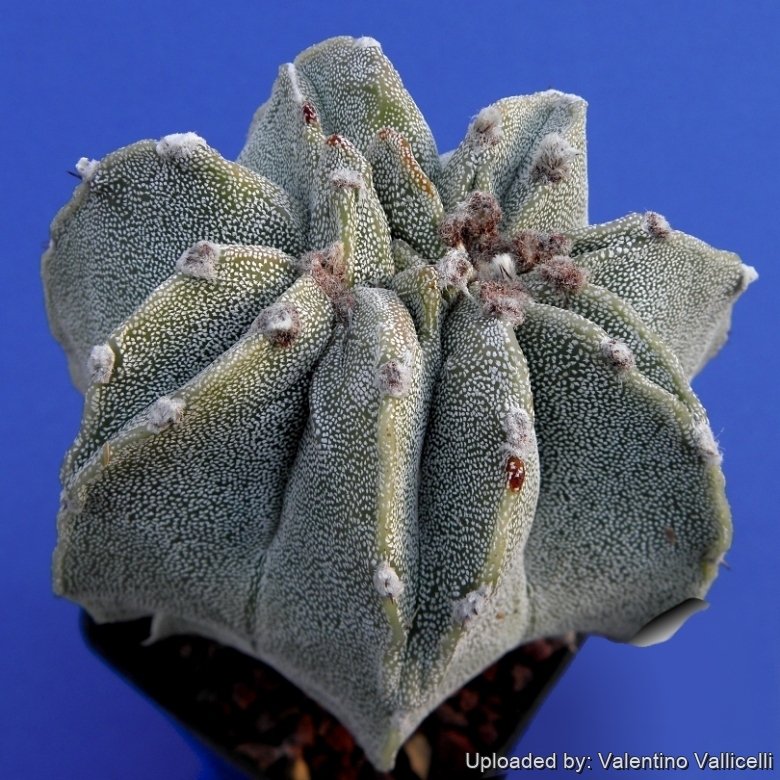
Astrophytum myriostigma (a.k.a. Bishop’s cap) is a spineless succulent plant, usually solitary or with very few basal branches. A transverse section of the stem reveal a perfect star shaped form (like the common star-fish) giving the plant the appearance of five pointed star.
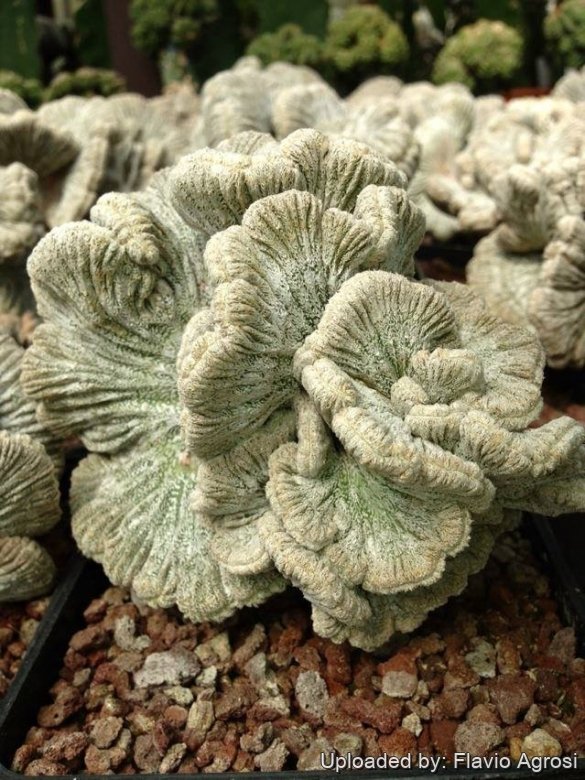
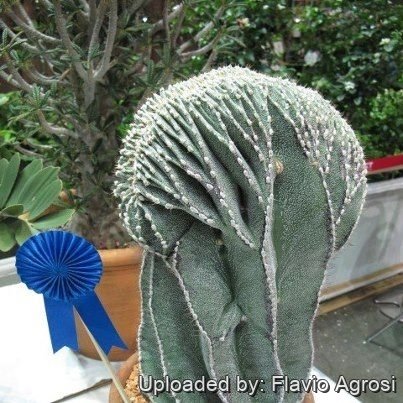
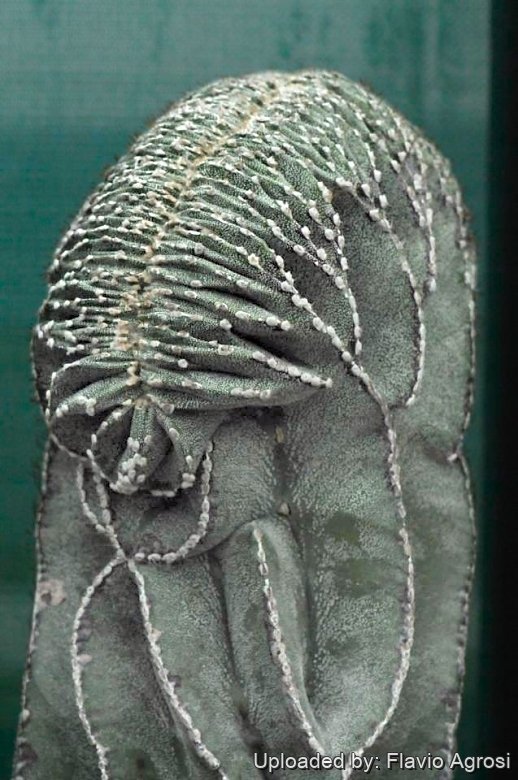
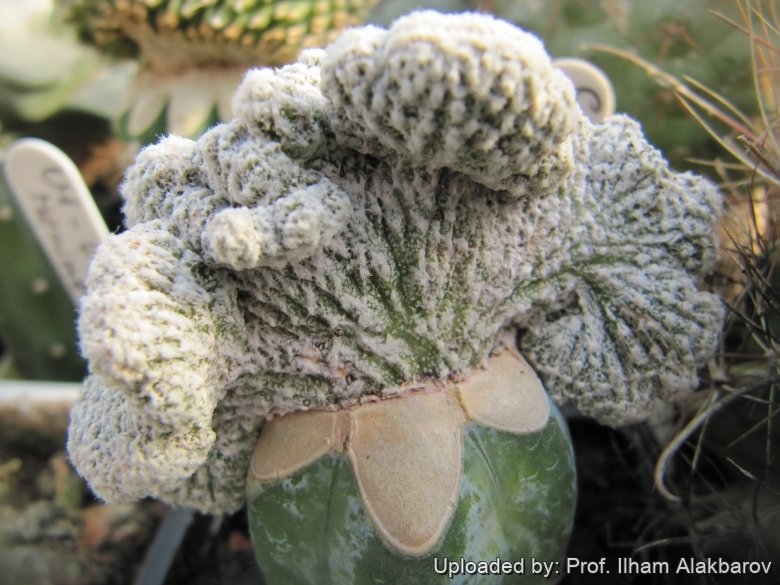
Crested form: The crested form Astrophytum myriostigma f. cristatum is very rare and sought after by collectors, for its unique features. Though these crested myriostigma specimens are somewhat rare (about 1 in 100.000 seddlings), cresting occurs naturally, and can be encountered in many other cactus species. The cause of cresting is not fully explained and some speculate that it is a genetic mutation, but whatever the stimulus, the growth point of the stem has switched from a geometric point, to a line, which folds and undulates as the crest expands. There are several crested forms mainly selected by Asian growers, mainly propagated by grafting.
Stem: Fan shaped, bright green, covered with many minute white hairy scales that give it a characteristic chalk-white or silvery-grey appearance, but sometime naked (Astrophytum myriostigma var. nudum f. cristatum). The scales are composed of very fine interwoven hairs, which, under a microscope, are very pretty object.
Roots: Fine, fibrous.
Areoles: Closed together
Spines: Wanting.
Ribs: Vertical, regular, deep, prominent and acute.
Flowers: Funnelform, 4-7 cm long glossy yellow and sweet scented from the areole at the tip of the stem on mature plant.
Blooming season: Flowers appear intermittently throughout the warm months from April to September.
Fruit: 2-2,5 cm in diameter, greenish to tannish-red, covered with brown, overlapping scales, with long wool in their axil.
Seeds: Dark brown, helmet-shaped, shining, with a large depressed hilum, the margins being turned in.
Origin and Habitat
Garden origin (Nursery produced cultivar)
Cultivation and Propagation
It is not too difficult in a greenhouse, although grows quite slowly. It is usually seen as a grafted plant but can grow on its own roots too.
Soil: Use a mineral well permeable soil with little organic matter (peat, humus).
Exposure: They need a good amount of light shade to full sun this help to keep the plants healthy, although slow growth.
Watering: Water sparingly from March till October (weekly during summertime, if the weather is sunny enough), with a little fertilizer added. Less or no water during cold winter months, or when night temperatures remain below 10° to prevent root loss. It is sensitive to overwatering (rot prone).
Fertilization: Feeding may not be necessary at all if the compost is fresh then, feed in summer only if the plant hasn’t been repotted recently. Do not feed the plants from September onwards as this can cause lush growth which can be fatal during the darker cold months.
Hardiness: Keep perfectly dry in winter at temperatures from 5 to 15 degrees centigrade. (but it is relatively cold resistant and hardy to -5° C, or possibly colder for short periods) In the rest period no high atmospheric humidity!! (Temperature Zone: USDA 9-11)
Crested growth: Unlike ‘monstrose’ varieties of plants, where the variation from normal growth is due to genetic mutation, crested growth can occur on normal plants. Sometimes it’s due to variances in light intensity, or damage, but generally the causes are unknown. A crested plant may have some areas growing normally, and a cresting plant that looks like a brain, may revert to normal growth for no apparent reason. If you have any of the crested part left you need to remove the normal growth and leave the crested part behind this will need to be done regularly.
Propagation: Grafting or cuttings. Plants are usually grafted onto column-shaped cacti but proved to be able to produce their own roots if degrafted. Cuttings will take root in a minimum temperature of 20° C (but better in hot weather). Cuttings of healthy shoots can be taken in the spring and summer. Cut the stem with a sharp, sterile knife, leave the cutting in a warm, dry place for a week or weeks (depending on how thick the cutting is) until a callus forms over the wound. Once the callus forms, the cutting may be inserted in a container filled with firmed cactus potting mix topped with a surface layer of coarse grit. They should be placed in the coarse grit only; this prevents the cut end from becoming too wet and allows the roots to penetrate the rich compost underneath. The cuttings should root in 2 to 6 weeks. Large crested piece must be placed on the soil surface without burying the plant base down in the soil.
Gallery