Publication: Cact. Gen. Sp. Nov. 4 (-6). 1839 [Feb 1839]
Description
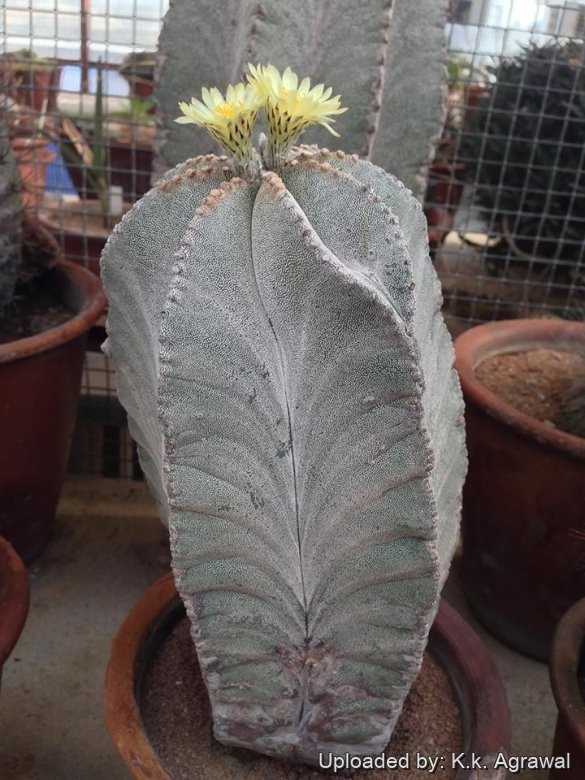
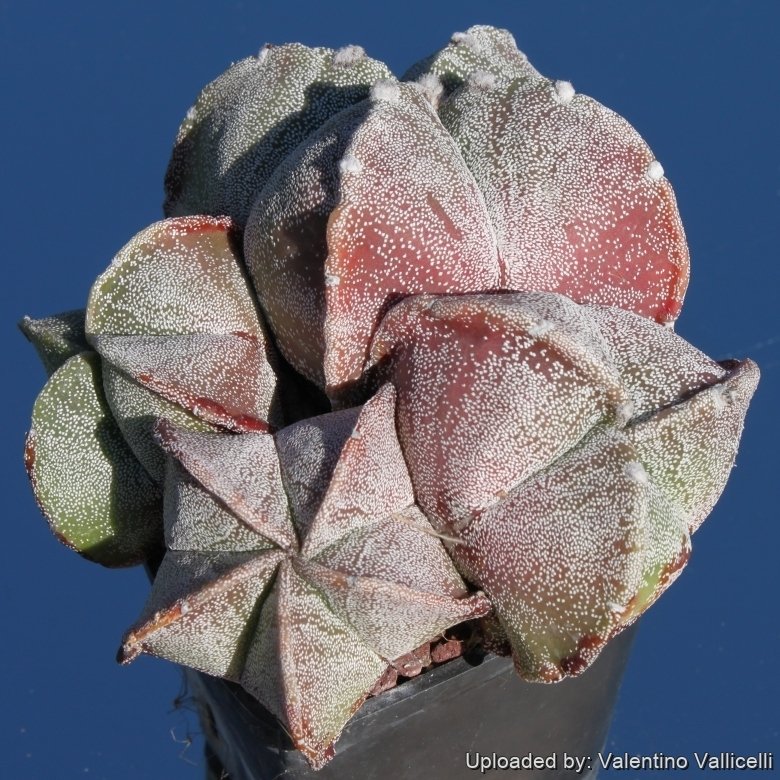
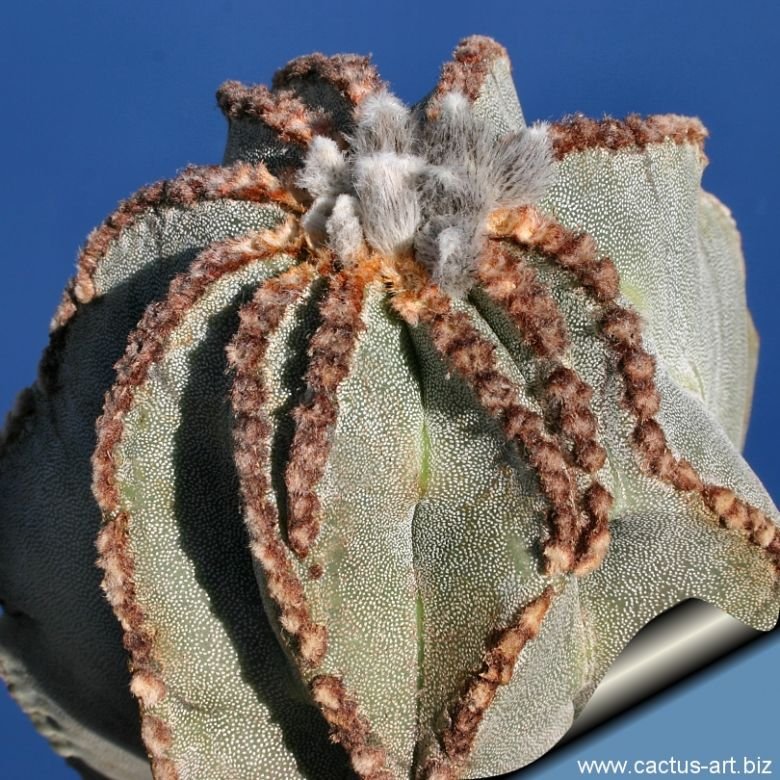
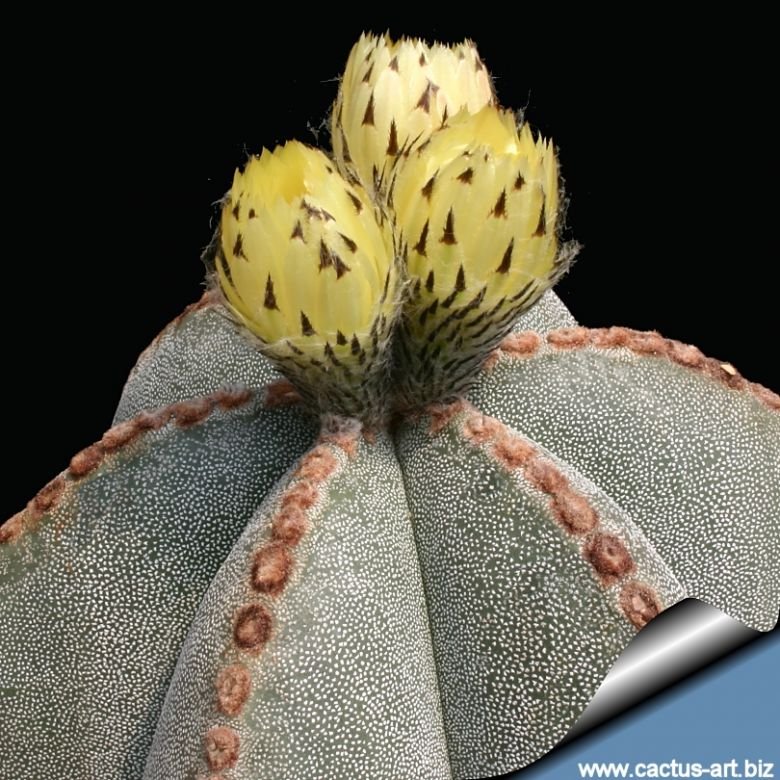
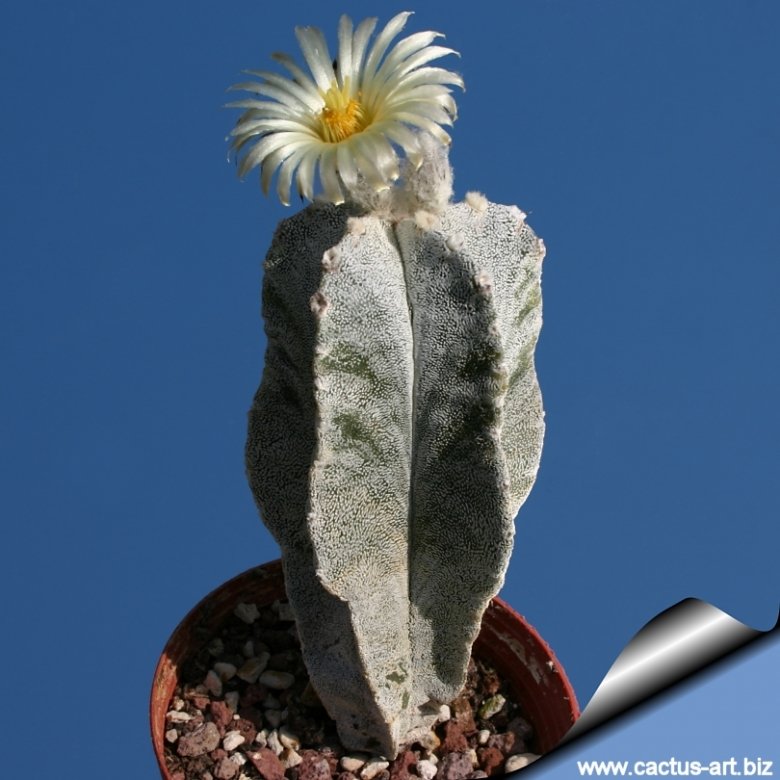
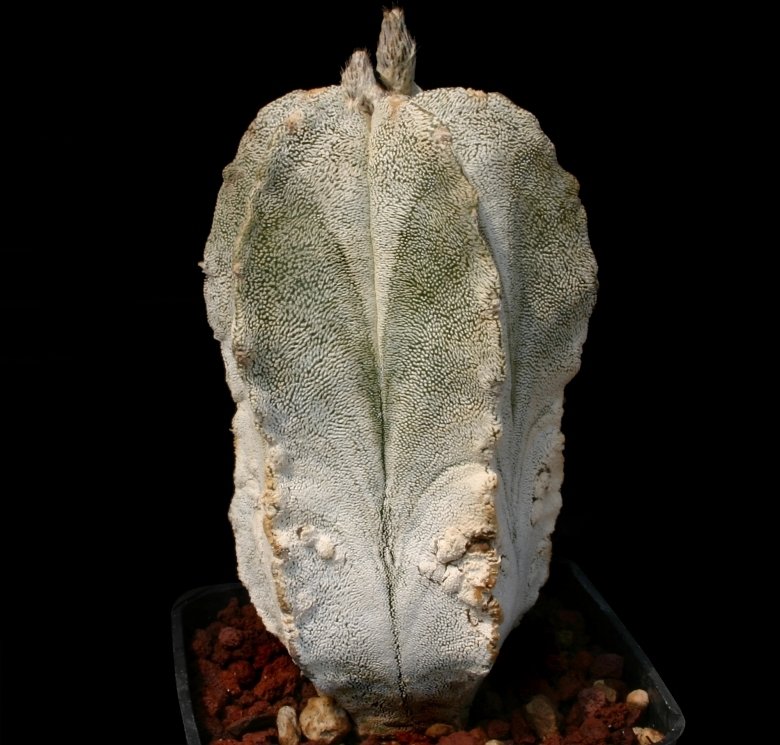
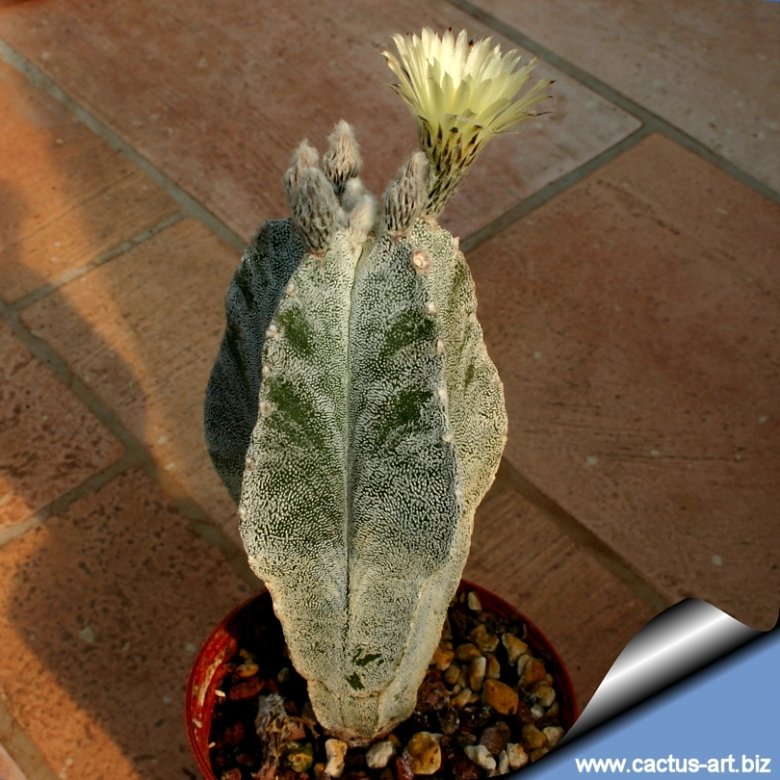
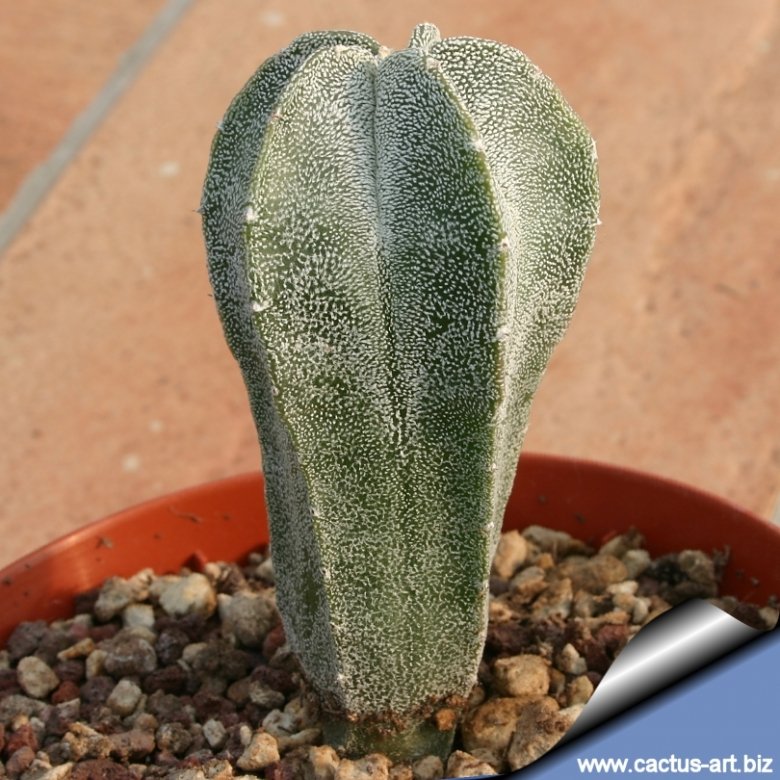
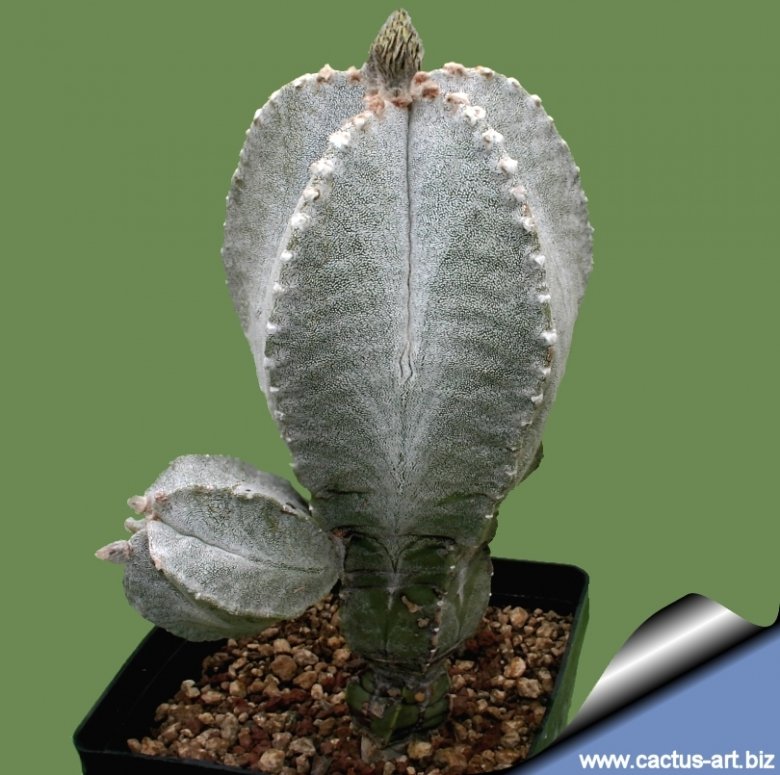
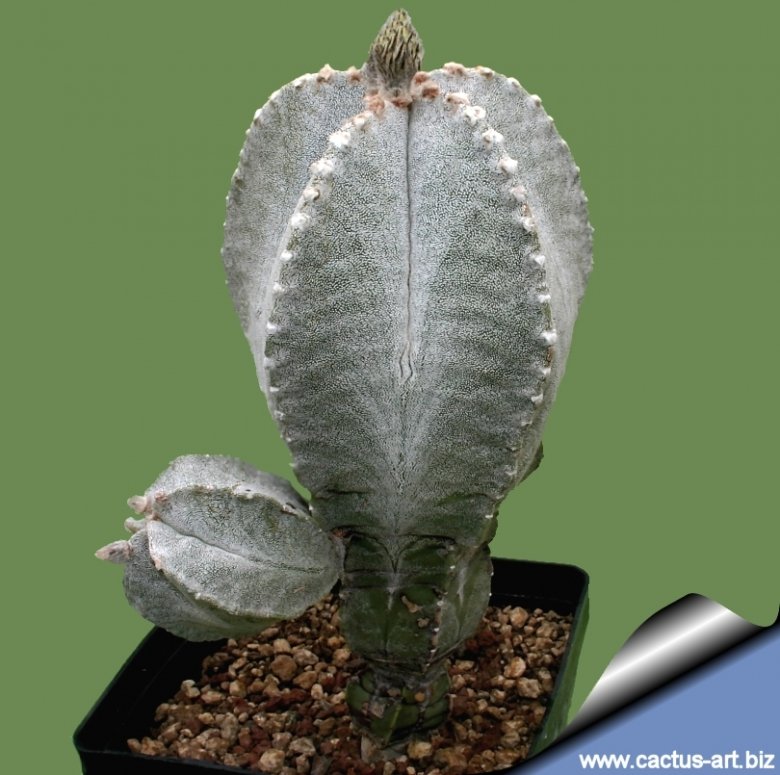
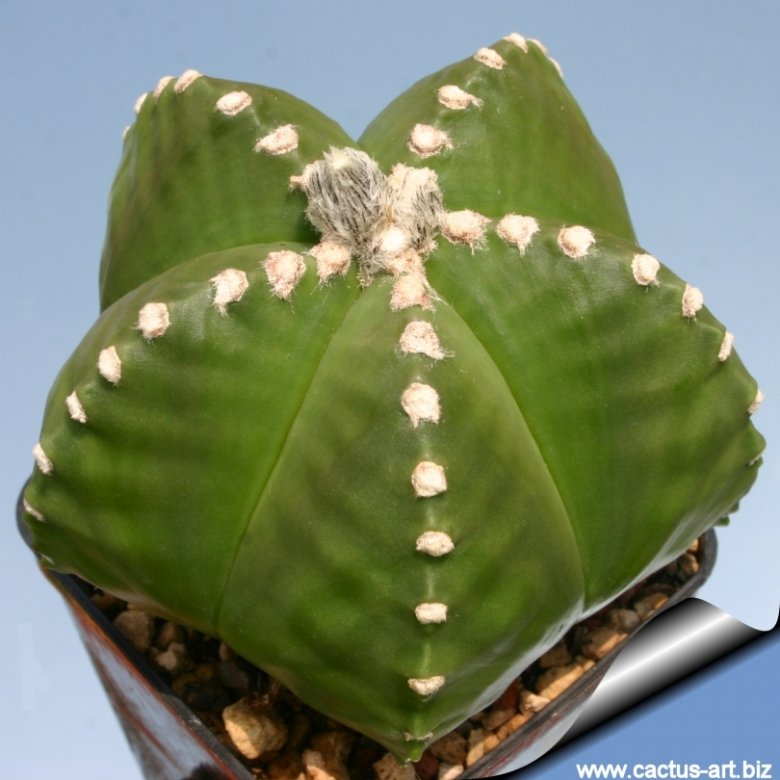
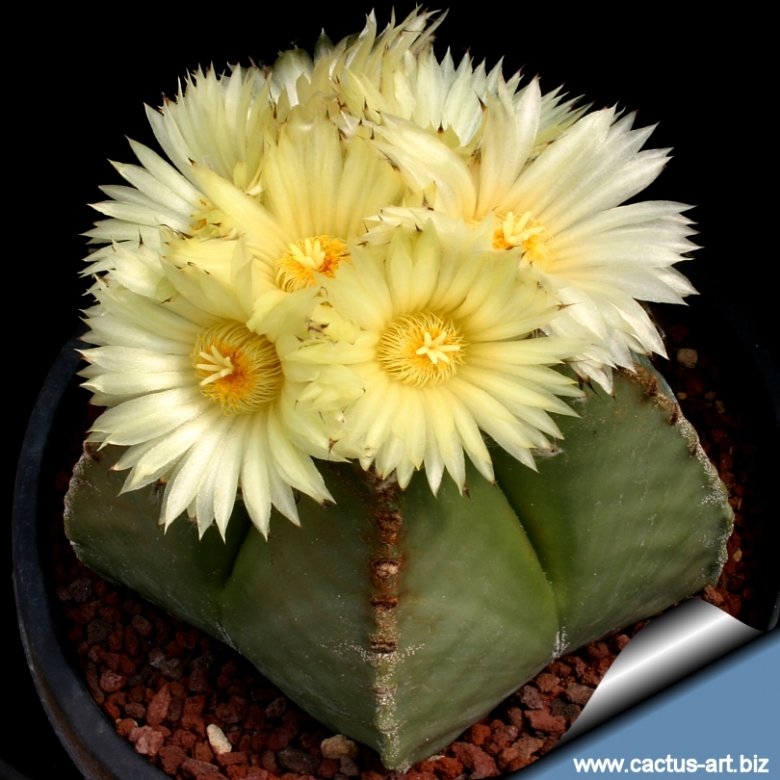
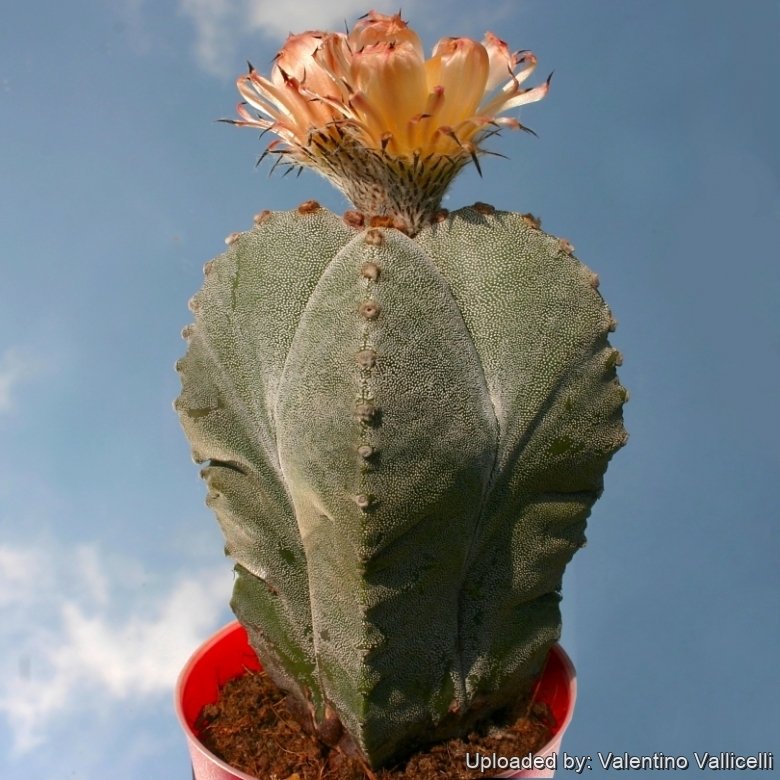
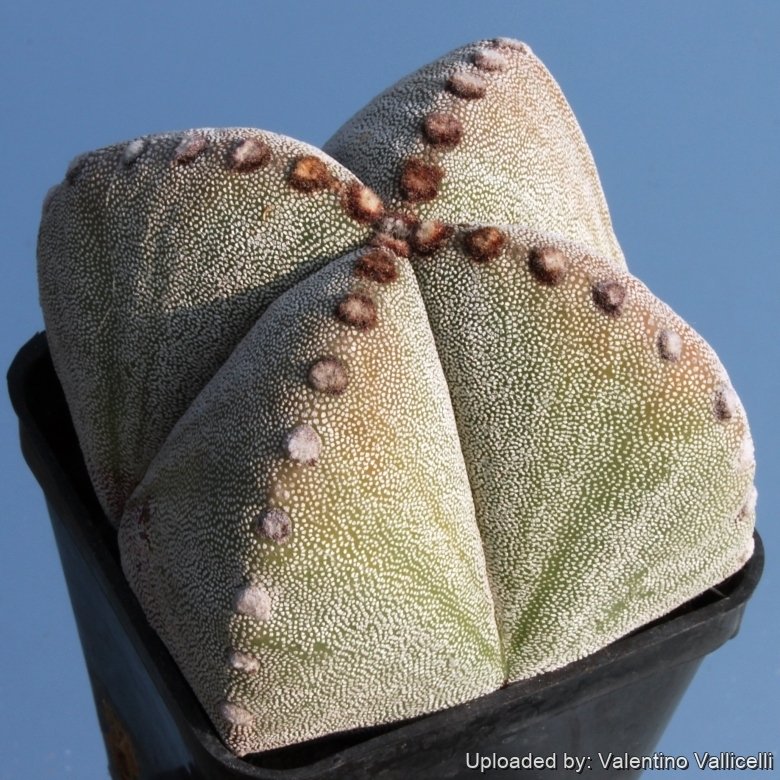
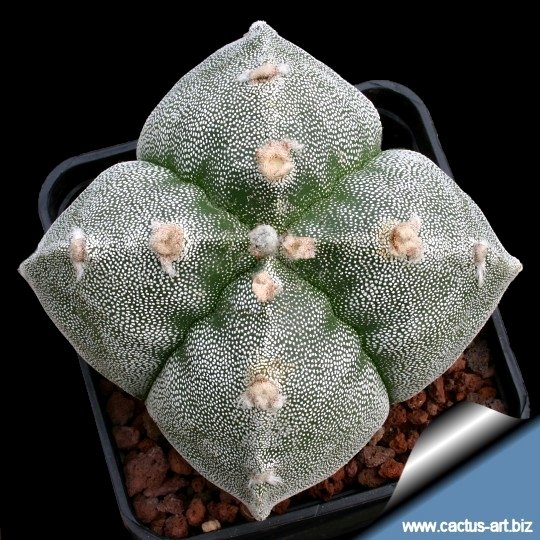
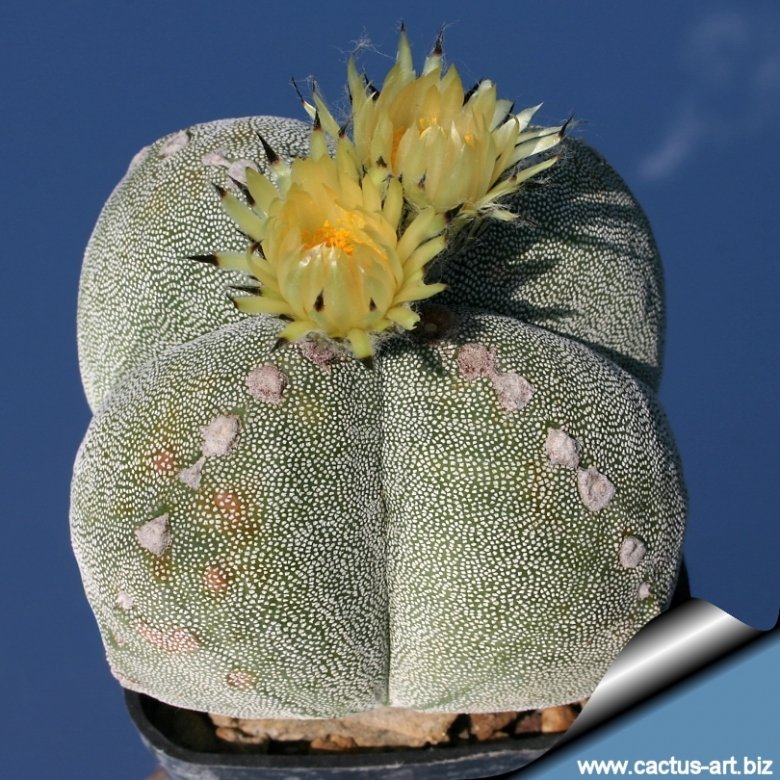
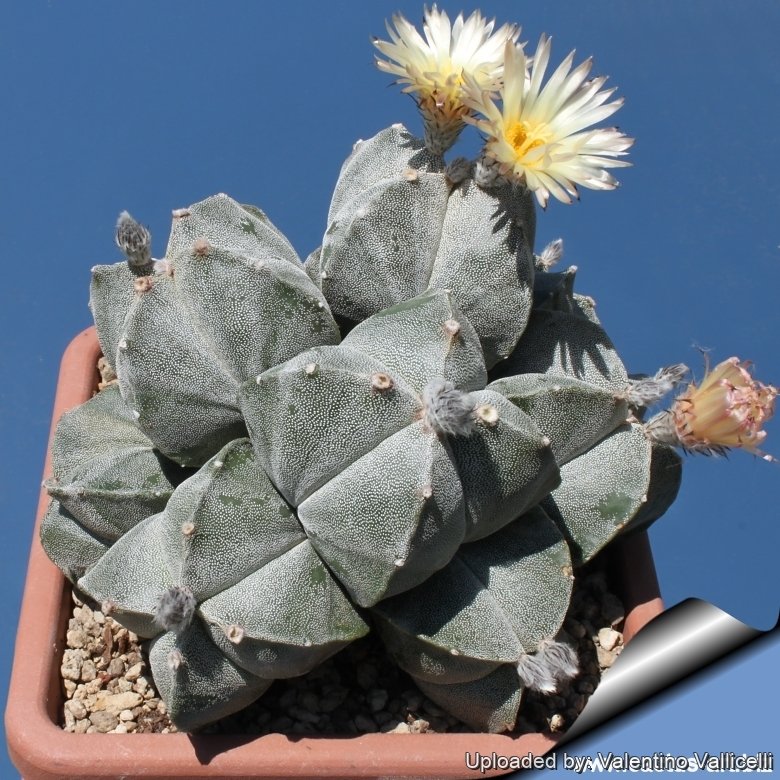
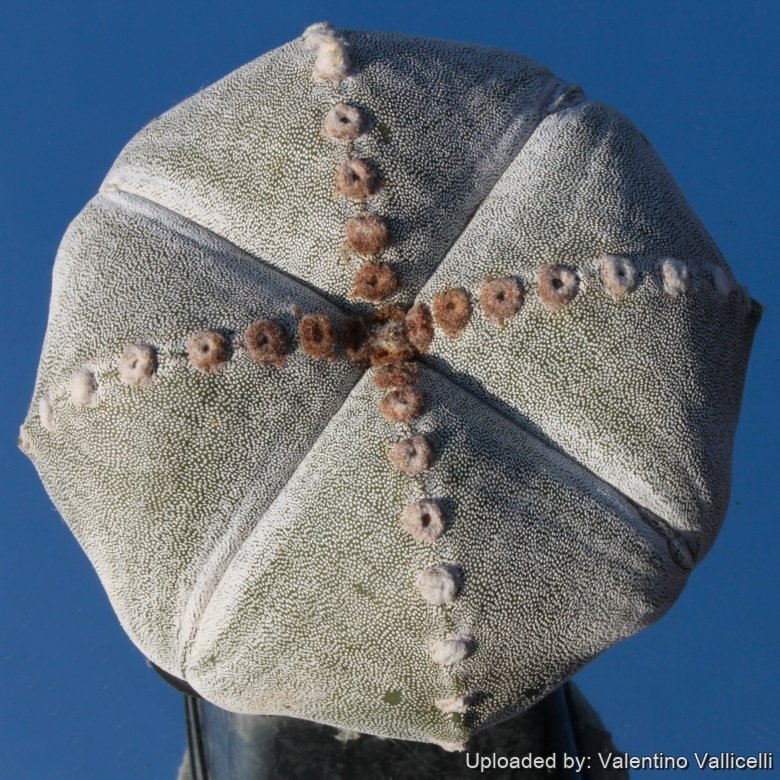
Astrophytum myriostigma (many dotted) is a spineless succulent plant, usually solitary or with very few basal branches. A transverse section of the stem reveal a perfect star shaped form (like the common star-fish) giving the plant the appearance of a bishop’s mitre (hence the common name Bishop’s cap)
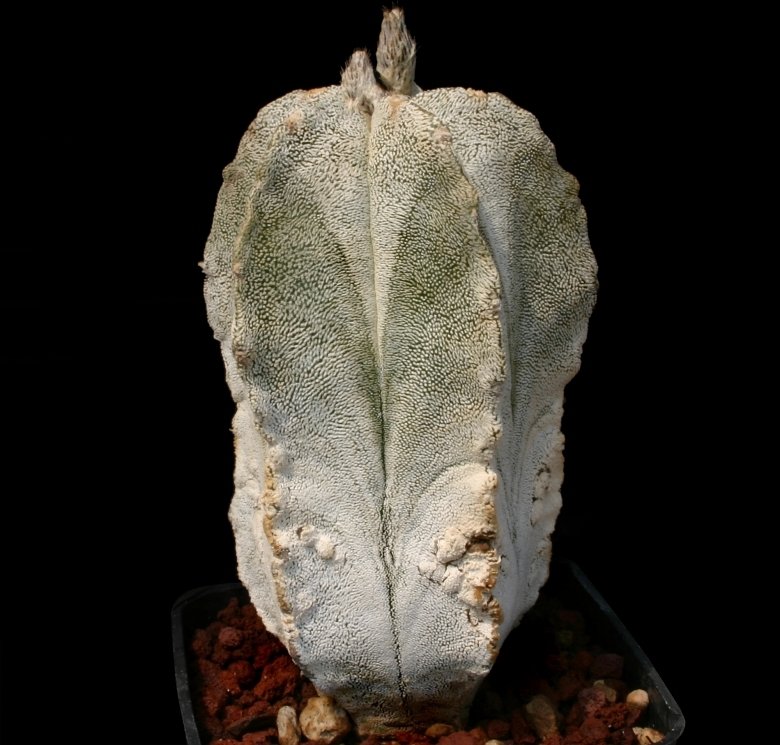
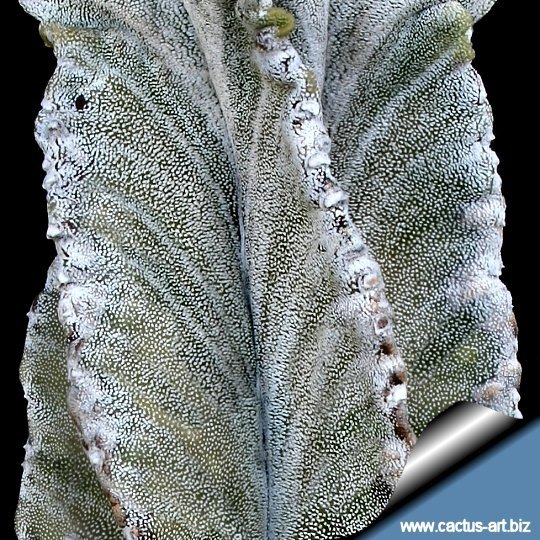
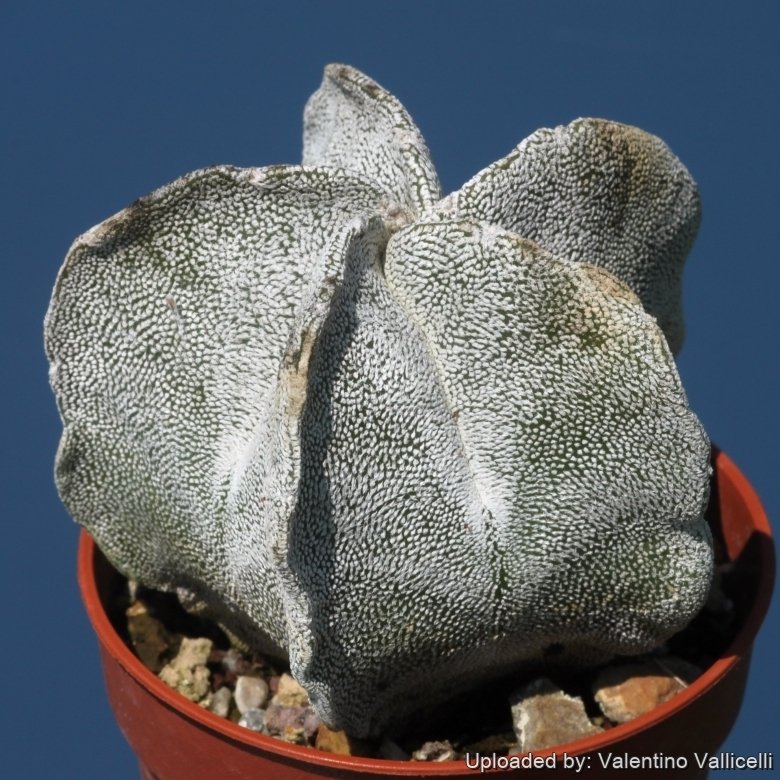
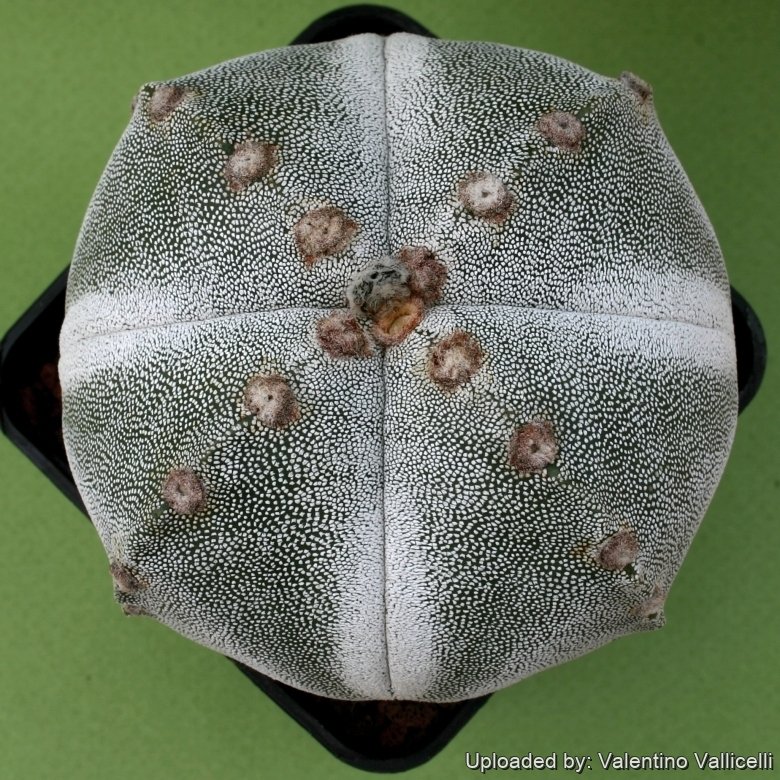
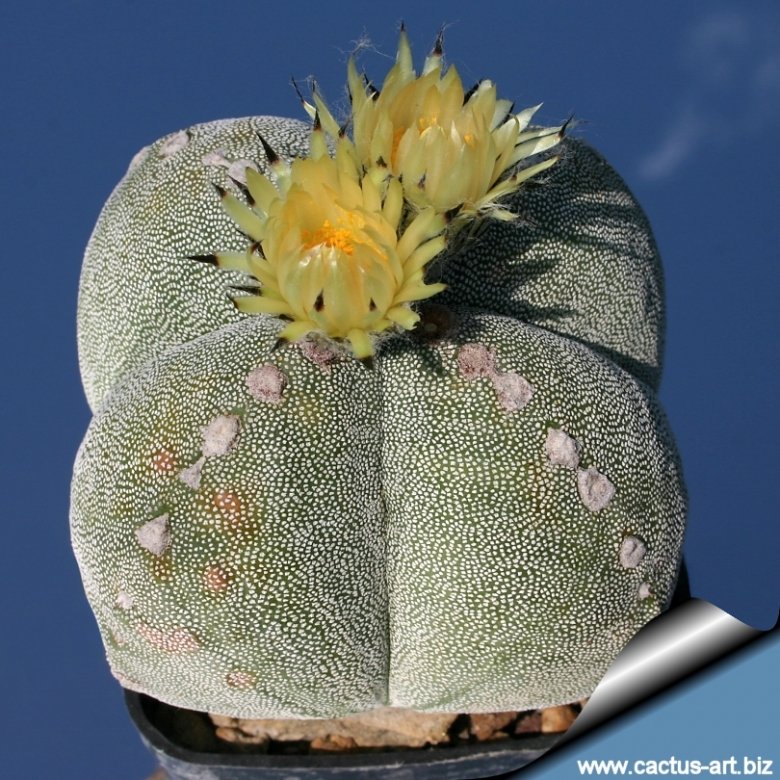
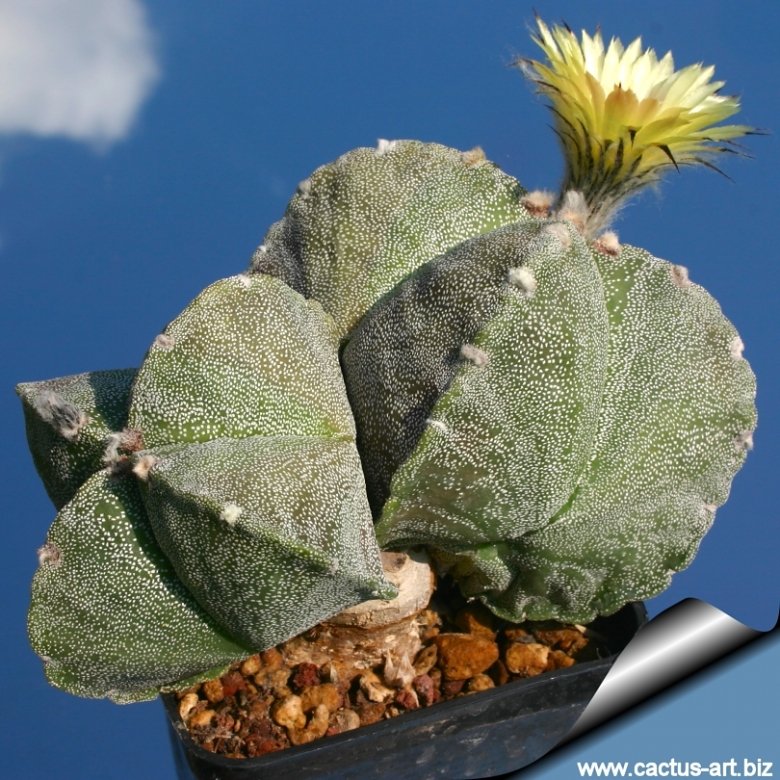
Stem: Globular to cylindric up to 60(-100) cm tall (but occasionally up 150 cm tall) and 10-20 cm in diameter, bright green, covered with many minute white hairy scales that give it a characteristic chalk-white or silvery-grey appearance, but sometime naked. The scales are composed of very fine interwoven hairs, which, under a microscope, are very pretty object.
Roots: Fine, fibrous.
Areoles: Closed together
Spines: Wanting.
Ribs: Usually 5, sometimes 4(or 3) that increase to eight or more with age ( rarely even 10), vertical, regular, deep, prominent, very broad and acute.
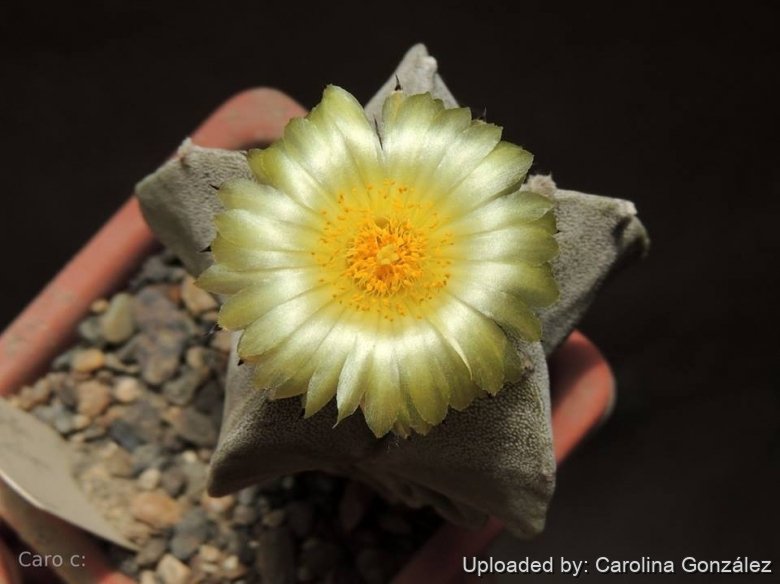
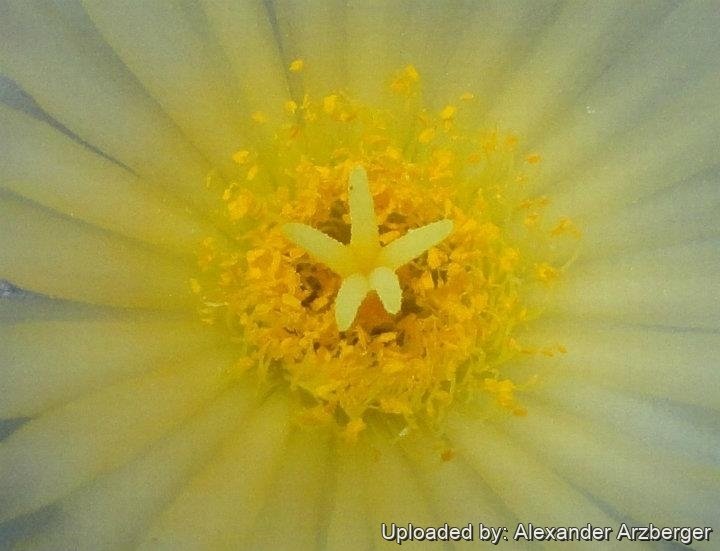
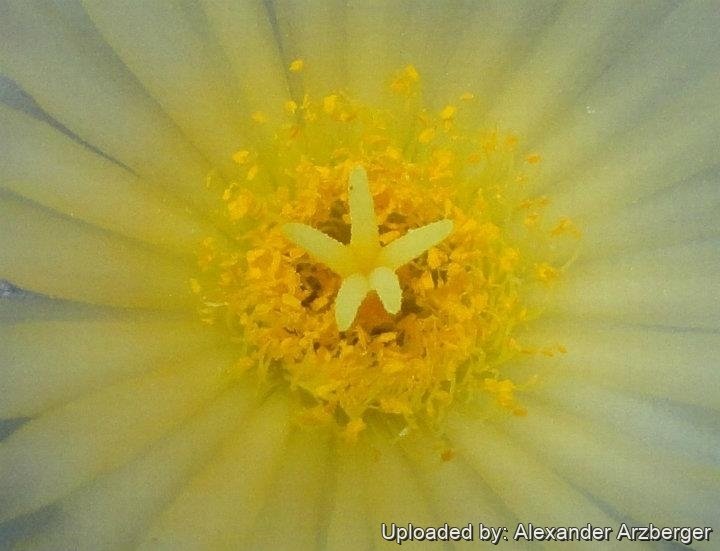
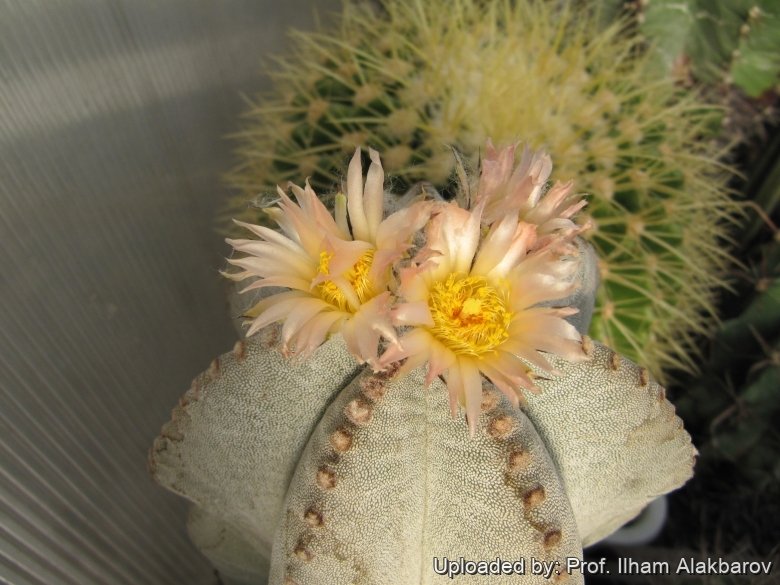
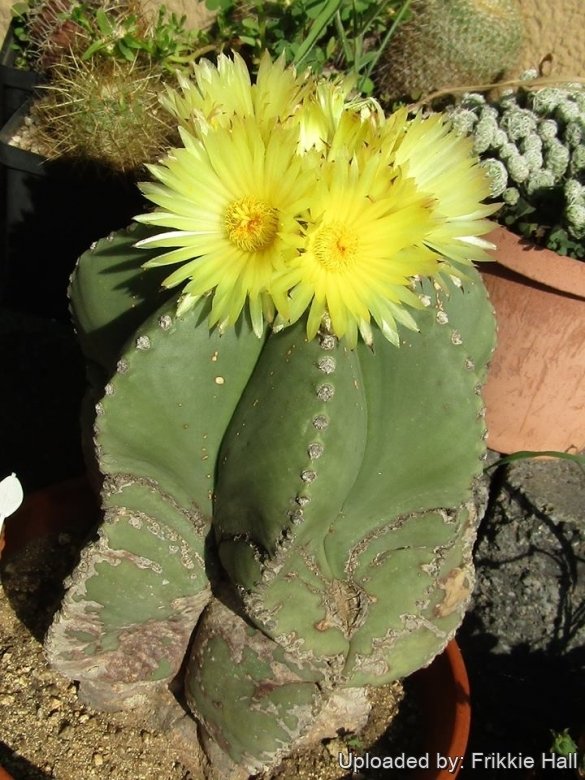
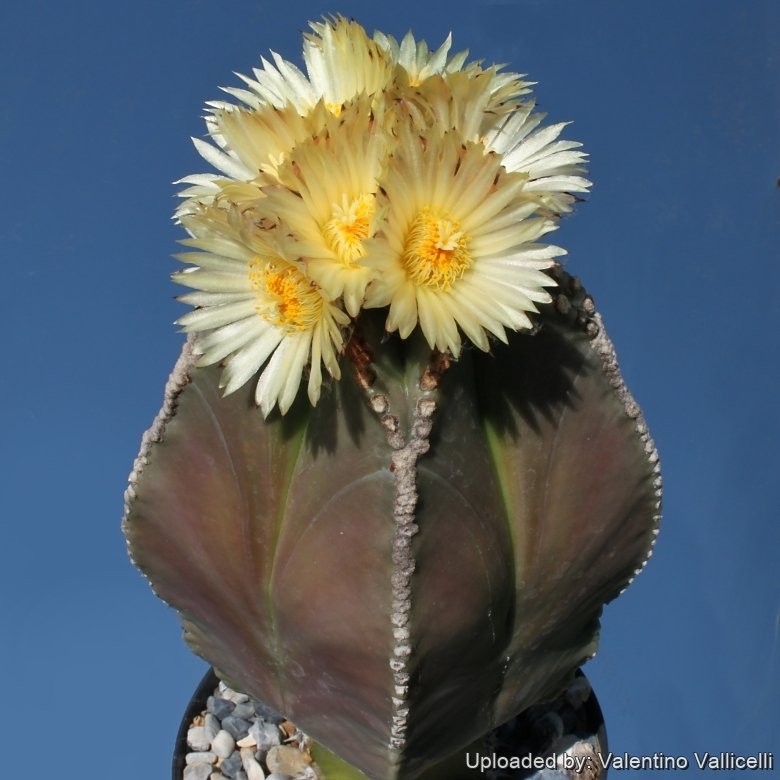
Flowers: Funnelform, 4-7 cm long glossy yellow and sweet scented from the areole at the tip of the stem on mature plant. Outer perianth segments narrow, with brown scarious tips. Inner perianth segments numerous, oblong yellow with a silky shine. Scales on ovary tube scaroious, imbricated, very narrow often bristly tipped, with long wool in their axil.
Blooming season: A. myriostigma seems to flower independently of day length, flowering asynchronously and intermittently throughout the warm months from the end of winter to the start of autumn. Plants may take up to six years to flower.
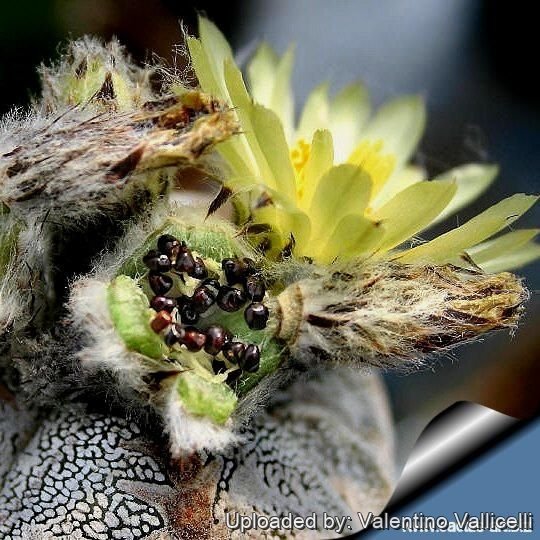
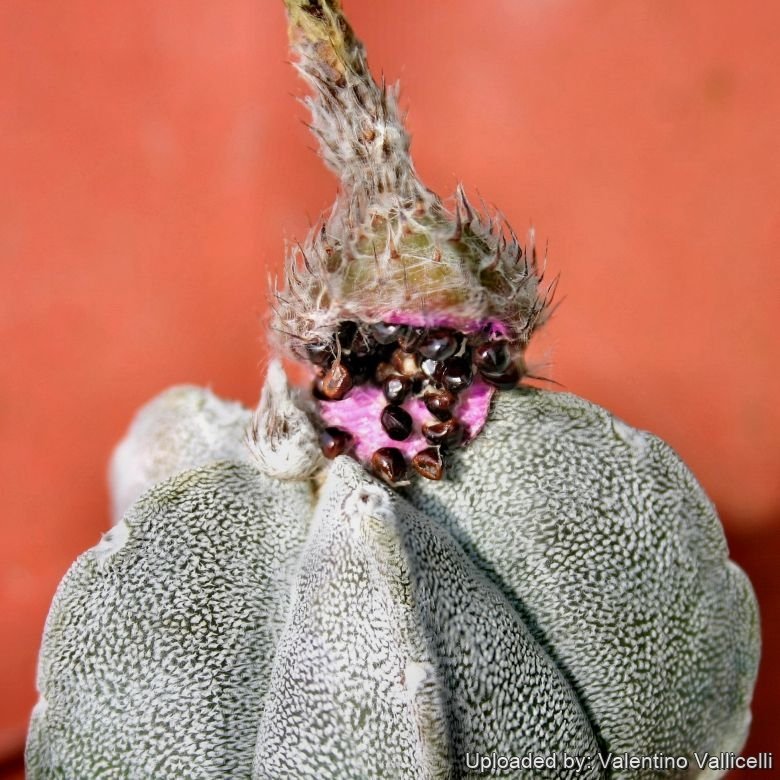
Fruit: 2-2,5 cm in diameter, greenish to tannish-red, covered with brown, overlapping scales, with long wool in their axil.
Seeds: Dark brown, helmet-shaped, shining, with a large depressed hilum, the margins being turned in.
Origin and Habitat
Highlands of central and northern Mexico (states of Nuevo León, San Luis Potosí and Tamaulipas).
Altitude: It grows at elevations ranging from 750 to 1500 metres above sea level.
Habitat and Ecology: It grows on stony, calcareous soils on scrubby alluvial plains on steep, east or west (and southwest) facing slopes, and prefers low densities. It is also found in thin layers in the foothills of mountain ranges. Its distribution is limited by its need for stony, calcareous or lime soils. This calcicole also needs carbonates to integrate calcium and make itself more rigid. This species is found in habitat dominated by Agave lecheguilla, which acts as the main nurse plant to A. myriostigma. This species has a wide range and is extremely abundant, but extraction of individuals from natural populations and destruction of habitat from mining activities can threat the species. The habitat is also overgrazed by livestock (goats and cattle), and some subpopulations have been impacted by the building of roads. The same area harbour a rich succulent flora comprising: Gymnocactus viereckii, Neolloydia conoidea, Mammillaria candida, Mammillaria klissingiana, Obregonia denegrii, Thelocactus hexaedrophorus, Turbinicarpus lophophoroides, Ariocarpus retusus, Coryphantha maiz-tablasensis, Ferocactus echidne, Echinocereus blanckii, Echinocactus ingens and Opuntia microdasys.
Cultivation and Propagation
Astrophytum myriostigma is a summer grower species relatively easy to grow. It is sometime seen as a grafted plant but grows very well on its own roots too.
Growth rate: It is a slow growing and easily flowering species.
Soil: Use mineral well permeable substratum with little organic matter (peat, humus), plants may become too elongated if compost is too rich.
Repotting: Re-pot every 2 years. Use pot with good drainage.
Fertilization: It grows much faster with a low nitrogen content fertilizer in spring and summer. Potassium helps maintaining the plants compact and healthy.
Watering: Requires careful watering to keep plant compact. Water sparingly from March till October, the thin, fibrous roots suffer if there is humidity, therefore the plant should be watered only when the surrounding terrain is dry. Keep dry as soon as the temperature starts dropping in October and keep it perfectly dry in winter at temperatures from 5 to 15 degrees centigrade.
Hardiness: They need to be kept in a cool place during winter rest and are somewhat resistant to frost if kept on the dry side prior to, and during, cold weather (due to the altitude they are hardy to -5 C ° C, or less for short periods). Although it is one of the easier Astrophytum to grow, it tends to rot in winter during the resting phase, if kept wet. In the rest period no high atmospheric humidity!!
Sun Exposure: Light shade to full sun, its colour tends to richer and darker when grown in light shade.
Uses: It is an excellent plant for container growing. It always looks good and stays small.
Pests & diseases: It may be attractive to a variety of insects, but plants in good condition should be nearly pest-free, particularly if they are grown in a mineral potting-mix, with good exposure and ventilation. Nonetheless, there are several pests to watch for:
- Red spiders: Red spiders may be effectively rubbed up by watering the infested plants from above.
- Mealy bugs: Mealy bugs occasionally develop aerial into the new growth among the wool with disfiguring results, but the worst types develop underground on the roots and are invisible except by their effects.
- Scales: Scales are rarely a problem.
- Rot: Rot is only a minor problem with cacti if the plants are watered and “aired” correctly. If they are not, fungicides won’t help all that much. To prevent rottenness it is also advisable to surround its root neck by very rough sand or grit, this help a fast water drainage.
Propagation: Almost exclusively by seed. Plants are sometimes grafted onto column-shaped cacti. Cutting scions from a flourishing plant is almost a crime because the scions do not root easily.
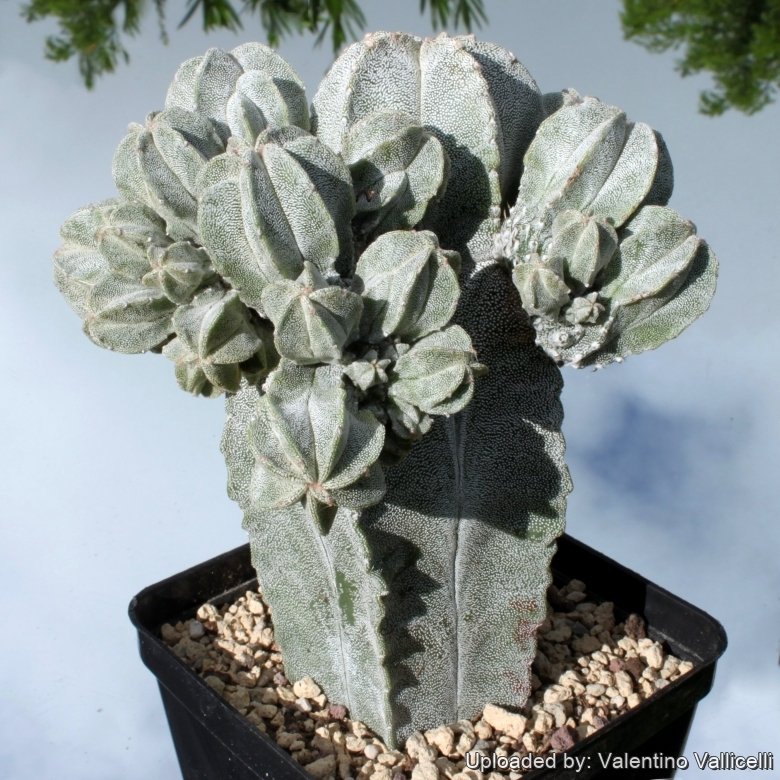
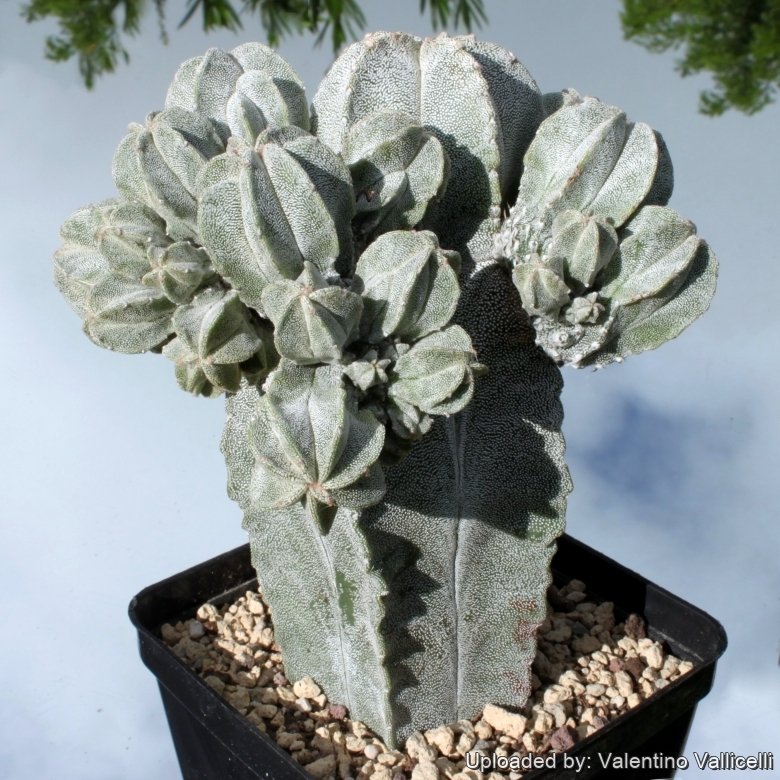
Remarks: This quite variable plant has been widely grown for years and is now available in several cultivated variety and several breeds do exist. The famouse “Onzuka” is only one of these and though maybe the most beautiful, but a lot of other forms are represented in many collections.
Bibliography
Major references and further lectures
1)James Cullen, Sabina G. Knees, H. Suzanne Cubey “The European Garden Flora Flowering Plants: A Manual for the Identification of Plants Cultivated in Europe, Both Out-of-Doors and Under Glass” Cambridge University Press, 11/Aug./2011
-
Edward F. Anderson “Das große Kakteen-Lexikon.” Eugen Ulmer KG, Stuttgart 2005
-
Keith Grantham, Paul Klaassen “The plantfinder’s guide to cacti & other succulents” Timber Press, 18/mag/1999
-
Britton & Rose “The Cactaceae” 4: 273, 1923
-
Hiroshi Hirao “Colour encyclopaedia of cacti” Japan 1979 (Japanese language and script)
-
Willy Cullmann, Erich Götz (Dozent Dr.), Gerhard Gröner “The encyclopedia of cacti” Portland, OR: Timber Press, 1986
-
David Hunt, Nigel Taylor “The New Cactus Lexicon” DH Books, 2006
-
Curt Backeberg “Cactus Lexicon” Sterling Publishing Company, Incorporated, 1978
-
Del Weniger “Cacti of the Southwest: Texas, New Mexico, Oklahoma, Arkansas, and Louisiana” University of Texas Press, 1969
-
Del Weniger “Cacti of Texas and Neighboring States: A Field Guide” University of Texas Press, 1984
-
Fitz Maurice, B, Sotomayor, M., Fitz Maurice, W.A., Hernández, H.M. & Smith, M. 2013. Astrophytum myriostigma. In: IUCN 2013. “IUCN Red List of Threatened Species.” Version 2013.2. <www.iucnredlist.org>. Downloaded on 23 February 2014.
From llifle page Astrophytum columnare
Description
This questionable variety is very similar to the other myriostigmas, it only deviate from the well-known typical form for its more columnar growth and smaller flowers size.
Stem: Slender and more thin, already in the youth phase. Dimension 25-50(-100) cm tall, only 5-8 cm in diameter shaped like a bishop’s headpiece or a star.
Ribs: Few (usually 5).
Flowers: Absolutely smaller than those of A. myriostigma, hardly 2,5 cm in length, pale-yellow, silk-shining, occasionally with an orange gloom.
Origin and Habitat
Mexico. Villar, Cerritos and far north in the area of Tula and Miquihuana in the State of Tamaulipas, Dr. Arroyo in the State of Nuevo Leon.
Habitat: Prefers stony conditions in humus enriched soil, at approximately 1600 m of height of over the sea. I grows often under trees or protected by Hechtia clumps.
Cultivation and Propagation
Although regarded as a choice and difficult plant in cultivation it is relatively easy to grow. It is sometime seen as a grafted plant but grows very well on its own roots too. Use mineral well permeable substratum with little organic matter (peat, humus). Water sparingly from March till October and keep perfectly dry in winter at temperatures from 5 to 15 degrees centigrade. (but it is Hardy to -7°C for short periods) In the rest period no high atmospheric humidity!!
Sun Exposure: Light shade to full sun.
Propagation: Almost exclusively by seed. Plants are sometimes grafted onto column-shaped cacti.
Source: Astrophytum columnare, LLIFLE - Encyclopedia of living forms, CC-BY-SA, retrieved 2026-10-25.
From llifle page Astrophytum tulense
Description
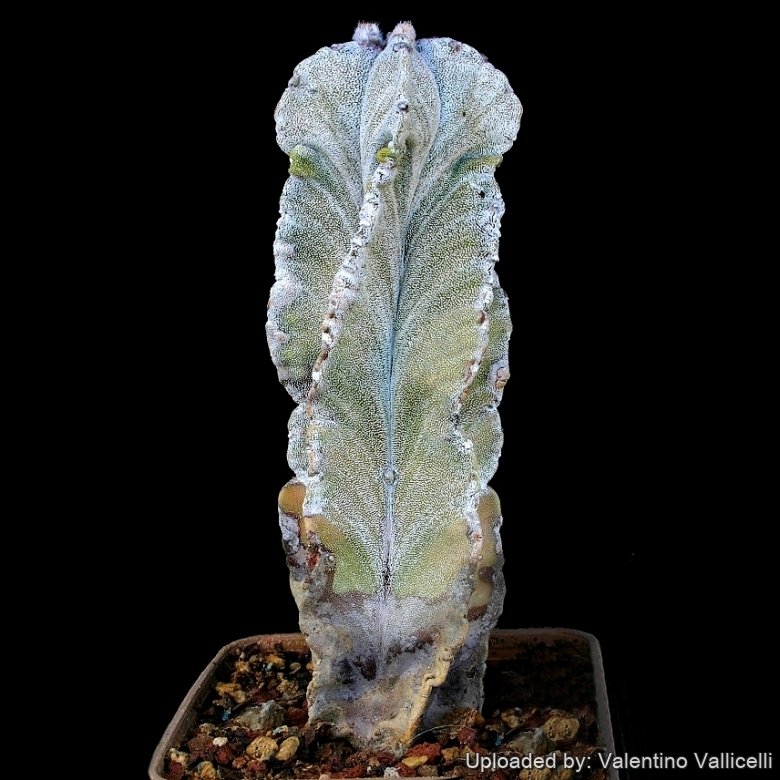
Astrophytum myriostigma var. tulense , is a naturally occurring form of Astrophytum myriostigma distinguished by very columnar stems up to 90 cm tall. This plant has 5 twisted ribs and is covered with denser white flock, however the number of ribs is not a stable feature; plants typically add additional ribs as the plant matures, increasing to as many as 10. The tulense variety also has smaller yellow flowers. This taxon is self-sterile. It produces viable seeds only with extra pollination.
Habit: It is a spineless columnar succulent plant, usually solitary. A transverse section of the stem reveal a perfect star shaped form (like the common star-fish) giving the plant the appearance of a bishop’s mitre (hence the common name Bishop’s cap)
Stem: Globular to cylindric up to 90 cm tall (but occasionally up 150 cm tall) and 10-20 cm in diameter, bright green, covered with many minute white hairy scales that give it a characteristic chalk-white or silvery-grey appearance. The scales are composed of very fine interwoven hairs, which, under a microscope, are very pretty object.
Roots: Fine, fibrous.
Areoles: Closed together
Spines: Wanting.
Ribs: Usually 5 increasing to as many as 10 as the plant matures, vertical or twisted, regular, deep, prominent, very broad and sharp to rounded .
Flowers: Funnelform, usually less than 5 in diameter cm long glossy yellow and sweet scented from the areole at the tip of the stem on mature plant. Outer perianth segments narrow, with brown scarious tips. Inner perianth segments numerous, oblong yellow with a silky shine. Scales on ovary tube scaroious, imbricated, very narrow often bristly tipped, with long wool in their axil.
Blooming season: Flowers appear intermittently throughout the warm months from April to September. Plants may take up to six years to flower.
Fruit: 2-2,5 cm in diameter, greenish to tannish-red, covered with brown, overlapping scales, with long wool in their axil.
Seeds: Dark brown, helmet-shaped, shining, with a large depressed hilum, the margins being turned in.
Origin and Habitat
Tula and adjacent areas, Tamaulipas and San Luis Potosí, Mexico.
Habitat and Ecology: It grows on stony, calcareous soils and prefers low densities. Its distribution is limited by its need for stony, calcareous or lime soils. This calcicole also needs carbonates to integrate calcium and make itself more rigid. This species is found in habitat dominated by Agave lecheguilla, which acts as the main nurse plant to Astrophytum myriostigma var. tulense.
Notes
Astrophytum myriostigma var columnare, also from Tula region, is an extreme and even more columnar form of Astrophytum myriostigma var. tulense. The columnar shape of the cv. Onzuka comes almost certainly from the tulense variety, a character that should be present in one of its parents.
Source: Astrophytum tulense, LLIFLE - Encyclopedia of living forms, CC-BY-SA, retrieved 2026-10-25.
From llifle page Echinocactus myriostigma var. nudus
Description
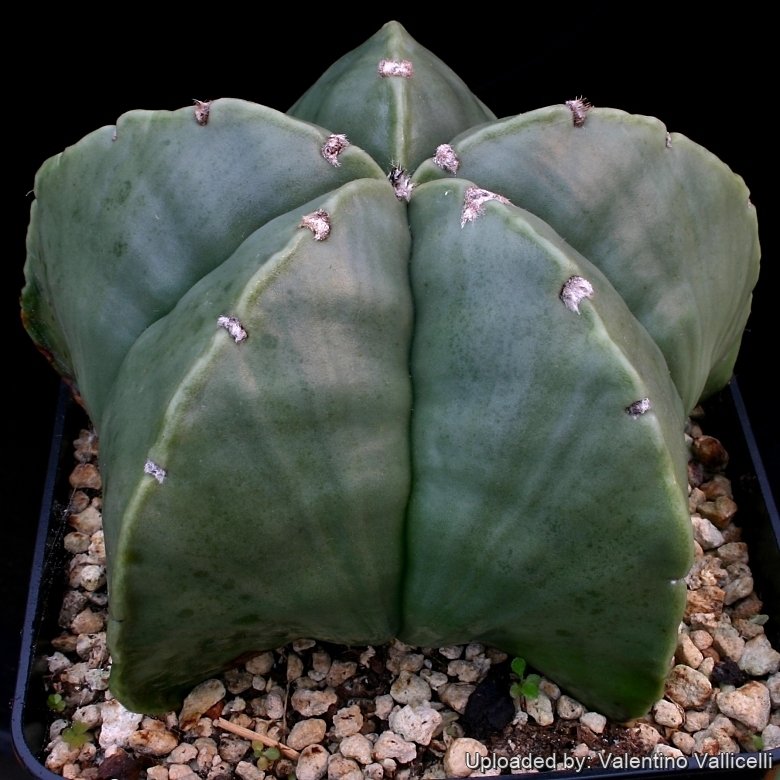
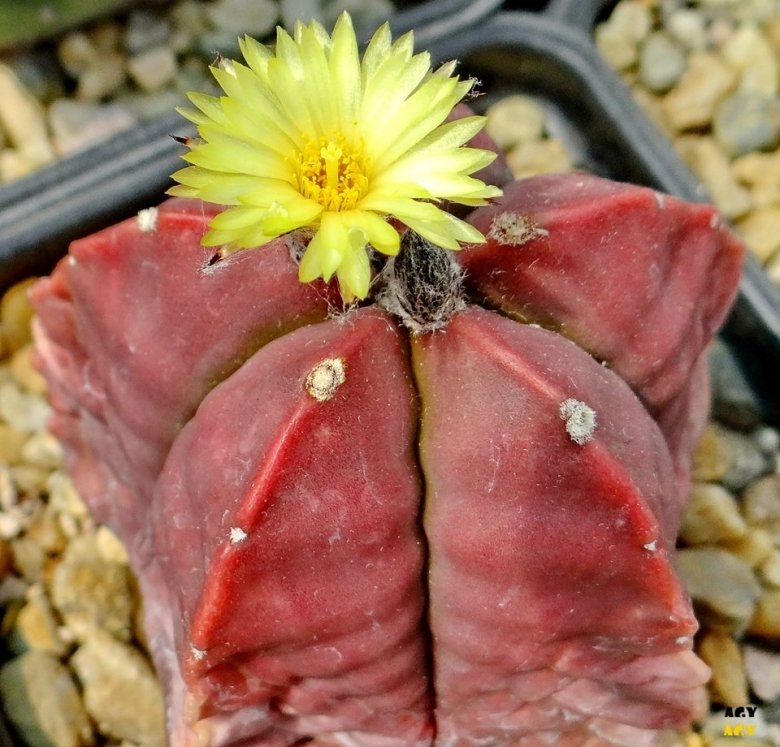
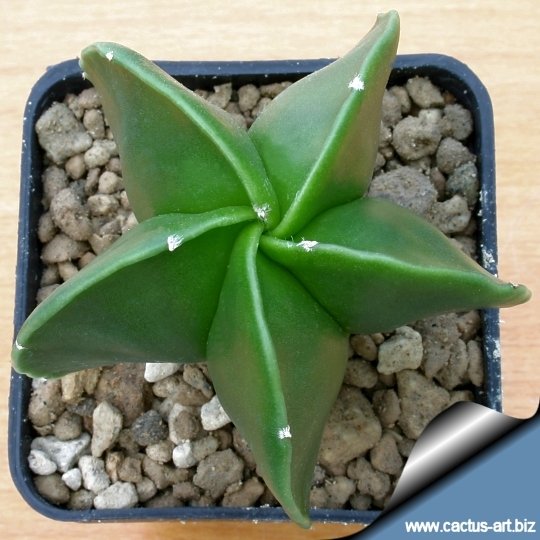
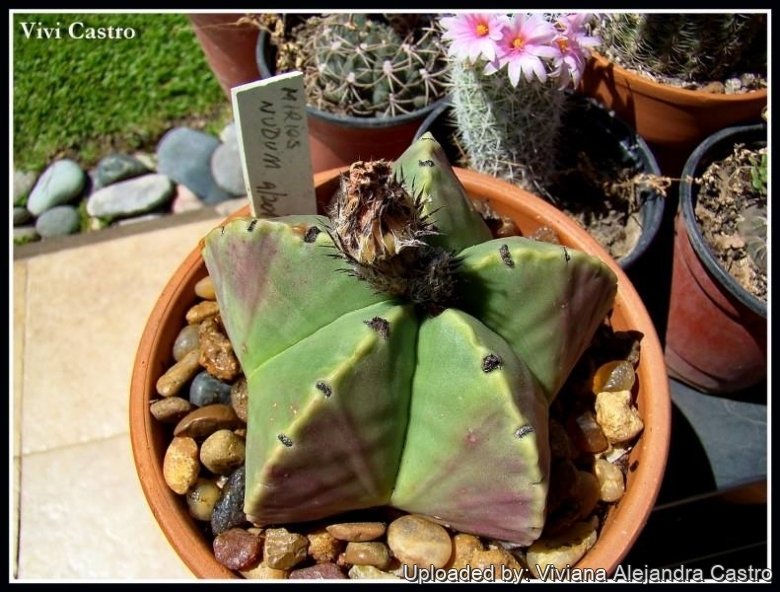
Astrophytum myriostigma var. nudum (nude form also known as “Hekiran” in Japanese speech) is very similar to the other myriostigma, it only deviate from the well-known typical form for lacking or mostly lacking white flecks, giving a bright green, blue-green, gray-green or mauve-green color overall depending on clones.
It is by some considered an extreme form of the subspecies potosinus.
Stem: Spherical to shortly columnar with age. The stems is smooth and can be over 120 cm tall and 5-10 cm in diameter and are shaped like a bishop’s headpiece or a star.
Spines: None.
Ribs: The number of ribs vary from 3 to 8 (usually 5).
Flowers: 5 cm in length, pale-yellow, silk-shining unlike the white-spotted plant, occasionally with an orange gloom.
Blooming season: Spring or early summer, They take up to 6 years to bloom.
Fruits: Dry, dehisces towards the apex forming about 5 star shaped lobes. With few seeds.
Origin and Habitat
Garden origin (Nursery produced cultivar)
Cultivation and Propagation
Astrophytum myriostigma is a summer grower species relatively easy to grow. It is sometime seen as a grafted plant but grows very well on its own roots too.
Growth rate: It is a slow growing and easily flowering species.
Soil: Use mineral well permeable substratum with little organic matter (peat, humus), plants may become too elongated if compost is too rich.
Repotting: Re-pot every 2 years. Use pot with good drainage.
Fertilization: It grows much faster with a low nitrogen content fertilizer in spring and summer. Potassium helps maintaining the plants compact and healthy.
Watering: Requires careful watering to keep plant compact. Water sparingly from March till October, the thin, fibrous roots suffer if there is humidity, therefore the plant should be watered only when the surrounding terrain is dry. Keep dry as soon as the temperature starts dropping in October and keep it perfectly dry in winter at temperatures from 5 to 15 degrees centigrade.
Hardiness: They need to be kept in a cool place during winter rest and are somewhat resistant to frost if kept on the dry side prior to, and during, cold weather (due to the altitude they are hardy to -5 C ° C, or less for short periods). Although it is one of the easier Astrophytum to grow, it tends to rot in winter during the resting phase, if kept wet. In the rest period no high atmospheric humidity!!
Sun Exposure: Light shade to full sun, its colour tends to richer and darker when grown in light shade.
Uses: It is an excellent plant for container growing. It always looks good and stays small.
Pests & diseases: It may be attractive to a variety of insects, but plants in good condition should be nearly pest-free, particularly if they are grown in a mineral potting-mix, with good exposure and ventilation. Nonetheless, there are several pests to watch for:
- Red spiders: Red spiders may be effectively rubbed up by watering the infested plants from above.
- Mealy bugs: Mealy bugs occasionally develop aerial into the new growth among the wool with disfiguring results, but the worst types develop underground on the roots and are invisible except by their effects.
- Scales: Scales are rarely a problem.
- Rot: Rot is only a minor problem with cacti if the plants are watered and “aired” correctly. If they are not, fungicides won’t help all that much. To prevent rottenness it is also advisable to surround its root neck by very rough sand or grit, this help a fast water drainage.
Propagation: Almost exclusively by seed. Plants are sometimes grafted onto column-shaped cacti. Cutting scions from a flourishing plant is almost a crime because the scions do not root easily.
Remarks: This quite variable plant has been widely grown for years and is now available in several cultivated variety and several breeds do exist. The famous “Onzuka” is only one of these and though maybe the most beautiful, but a lot of other forms are represented in many collections.
Source: Echinocactus myriostigma var. nudus, LLIFLE - Encyclopedia of living forms, CC-BY-SA, retrieved 2026-10-25.
From llifle page Echinocactus myriostigma subs. quadricostatus
Description
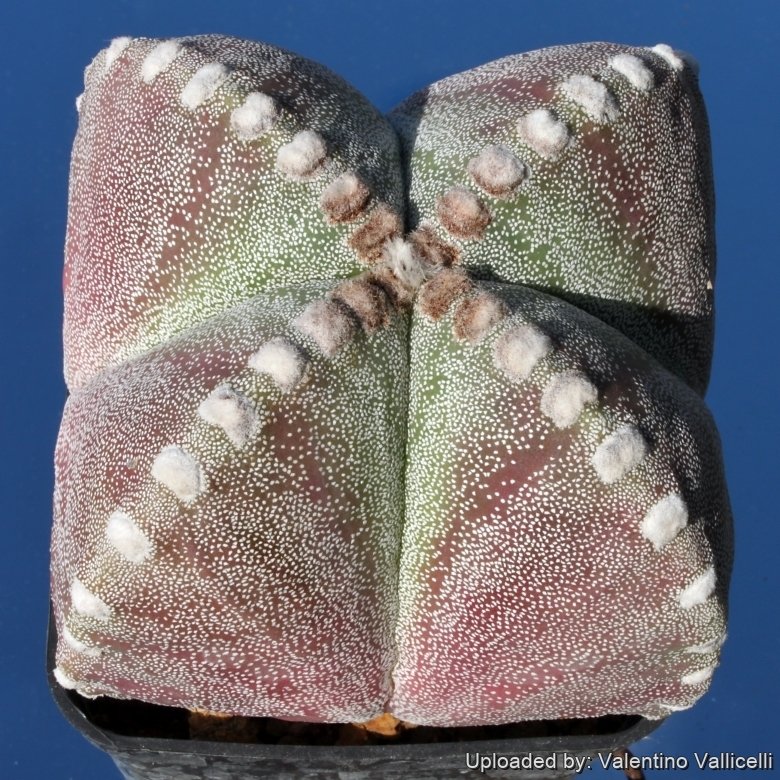
Astrophytum myriostigma var. quadricostatum was first described in 1841 by M. Mittler who wrote “The body of the plant is of elongated round form and has four ribs”.
This form deviates from the well-known typical form for having four ribs instead of five.
Stem: Quadrangular to almost spherical, the plants become shortly columnar with age. The stems are smooth and can be over 90 cm tall and 5-10 (-20) cm in diameter.
Spines: None.
Ribs: 4.
Flowers: Arise from the areole at the tip of the stem on mature plant. up to 5 cm wide (or more), pale-yellow, shining-silk, unlike the 5-ribbed plant.
Blooming season: Spring or late summer, They take up to 6 years to bloom.
Origin and Habitat
Garden origin. Four ribbed plants of Astrophytum myriostigma are occasionally found in a natural habitat, but the clones actually in cultivation are of garden origin (Nursery produced cultivars).
Cultivation and Propagation
It is not too difficult in a greenhouse, although grows quite slowly. The plants need a loose well-drained mineral soil. They need a good amount of light. Watering can be done weekly during summertime, if the weather is sunny enough, with a little fertilizer added. Kept this way, plants will show a healthy, although slow growth. They are frost hardy to -4° (-10°) C.
Propagation: Almost exclusively by seed. Plants are sometimes grafted onto column-shaped cacti.
Source: Echinocactus myriostigma subs. quadricostatus, LLIFLE - Encyclopedia of living forms, CC-BY-SA, retrieved 2026-10-25.
Cultivars and forms (130)
Subspecies (3)
Varieties (16)
- Astrophytum myriostigma subvar. nudum
- Astrophytum myriostigma var. bicostatum
- Astrophytum myriostigma var. caespitosum
- Astrophytum myriostigma var. cereiforme
- Astrophytum myriostigma var. columare-octogonum
- Astrophytum myriostigma var. columnare
- Astrophytum myriostigma var. fjordherst
- Astrophytum myriostigma var. grandiflorum
- Astrophytum myriostigma var. minimiflorum
- Astrophytum myriostigma var. nudicarpa
- Astrophytum myriostigma var. nudum
- Astrophytum myriostigma var. quadricostatum
- Astrophytum myriostigma var. quadricostatum-pubesente
- Astrophytum myriostigma var. strongylogonum
- Astrophytum myriostigma var. tricostatum
- Astrophytum myriostigma var. tulense
Forms (17)
- Astrophytum myriostigma f. aurata
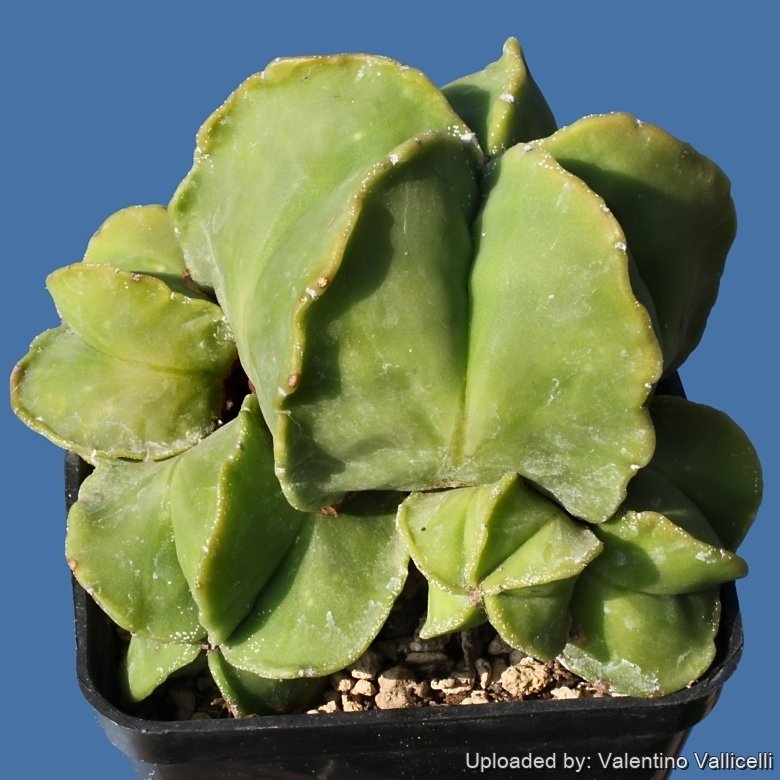
- Astrophytum myriostigma f. cristatum
- Astrophytum myriostigma f. multicostatum
- Astrophytum myriostigma f. nuda Fjordhest
- Astrophytum myriostigma f. picta
- Astrophytum myriostigma f. rubra
- Astrophytum myriostigma f. tricostatum
- Astrophytum myriostigma f. variegatum
- Astrophytum myriostigma var. columnare f. minima
- Astrophytum myriostigma var. nudum f. colorata
- Astrophytum myriostigma var. nudum f. cristatum
- Astrophytum myriostigma var. nudum f. picta
- Astrophytum myriostigma var. nudum f. variegatum
- Astrophytum myriostigma var. quadricostatum f. nudum
- Astrophytum myriostigma var. tricostatum f. nudum
- Astrophytum myriostigma var. tricostatum f. nudum variegatum
- Astrophytum myriostigma var. tricostatum f. proliferum
Cultivars (94)
- Astrophytum myriostigma cv. Abekobe
- Astrophytum myriostigma cv. Ball nudum Ligthtnig
- Astrophytum myriostigma cv. Big Areole
- Astrophytum myriostigma cv. Costa
- Astrophytum myriostigma cv. Cristata
- Astrophytum myriostigma cv. Double Ribs Nudum
- Astrophytum myriostigma cv. Double Ribs Nudum cristata
- Astrophytum myriostigma cv. Dragon
- Astrophytum myriostigma cv. Fire Works
- Astrophytum myriostigma cv. Fjordhest
- Astrophytum myriostigma cv. Fucuriyo
- Astrophytum myriostigma cv. Fukuryu (type A)
- Astrophytum myriostigma cv. Fukuryu (type A) tricostatum
- Astrophytum myriostigma cv. Fukuryu (type B)
- Astrophytum myriostigma cv. Fukuryu (type B) nudum
- Astrophytum myriostigma cv. Fukuryu (type B) nudum variegatum
- Astrophytum myriostigma cv. Fukuryu (type B) variegatum
- Astrophytum myriostigma cv. Fukuryu reticulatus
- Astrophytum myriostigma cv. Hakujo Fukuryu
- Astrophytum myriostigma cv. Hakujo Fukuryu cristatum
- Astrophytum myriostigma cv. Hakujo Hakuun
- Astrophytum myriostigma cv. Hakuun
- Astrophytum myriostigma cv. Hakuun Ball Form
- Astrophytum myriostigma cv. Hakuun Fukuryu
- Astrophytum myriostigma cv. Hakuun nudum
- Astrophytum myriostigma cv. Hakuun nudum cristatum (Thick form)
- Astrophytum myriostigma cv. Hakuun nudum cristatum (Thin form)
- Astrophytum myriostigma cv. Hakuun nudum cristatum variegatum
- Astrophytum myriostigma cv. Hakuun tricostatum
- Astrophytum myriostigma cv. Hanabi
- Astrophytum myriostigma cv. Hanakago
- Astrophytum myriostigma cv. Hanakago Hakuun
- Astrophytum myriostigma cv. Hekiho-gyoku
- Astrophytum myriostigma cv. Hekiran
- Astrophytum myriostigma cv. Huboki
- Astrophytum myriostigma cv. Hubuki
- Astrophytum myriostigma cv. Irregular Ribs
- Astrophytum myriostigma cv. Karina Keel Crested Fukuryu
- Astrophytum myriostigma cv. Kiganjyo
- Astrophytum myriostigma cv. Kikko
- Astrophytum myriostigma cv. Kikko Alien
- Astrophytum myriostigma cv. Kikko Ball
- Astrophytum myriostigma cv. Kikko Ball nudum
- Astrophytum myriostigma cv. Kikko f. rubra
- Astrophytum myriostigma cv. Kikko Fukuryiu
- Astrophytum myriostigma cv. Kikko Hakuun
- Astrophytum myriostigma cv. Kikko nudum
- Astrophytum myriostigma cv. Kikko nudum f. cristata
- Astrophytum myriostigma cv. Kikko nudum f. variegata
- Astrophytum myriostigma cv. Kikko nudum fa.
- Astrophytum myriostigma cv. Kikko nudum Koh-yo
- Astrophytum myriostigma cv. Kikko quadricostatum
- Astrophytum myriostigma cv. Kikko Swarovski
- Astrophytum myriostigma cv. Kikkohekiruriranpogyoku
- Astrophytum myriostigma cv. Kitsukou
- Astrophytum myriostigma cv. Koh-yo
- Astrophytum myriostigma cv. Koh-yo f. cristata
- Astrophytum myriostigma cv. Laimake
- Astrophytum myriostigma cv. Lin Pin Gata
- Astrophytum myriostigma cv. Lotusland
- Astrophytum myriostigma cv. multicostatum
- Astrophytum myriostigma cv. Onzuka
- Astrophytum myriostigma cv. Onzuka Blind form
- Astrophytum myriostigma cv. Onzuka columnare
- Astrophytum myriostigma cv. Onzuka cristata
- Astrophytum myriostigma cv. Onzuka cristata (monstruosa)
- Astrophytum myriostigma cv. Onzuka Fukuryu tricostatum
- Astrophytum myriostigma cv. Onzuka Hakuun
- Astrophytum myriostigma cv. Onzuka Kikko
- Astrophytum myriostigma cv. Onzuka Kikko Ball
- Astrophytum myriostigma cv. Onzuka Line Areoles
- Astrophytum myriostigma cv. Onzuka quadricostatum
- Astrophytum myriostigma cv. Onzuka Ranpo-gyoku
- Astrophytum myriostigma cv. Onzuka tricostatum
- Astrophytum myriostigma cv. Onzuka tricostatum columnare
- Astrophytum myriostigma cv. Onzuka V-Type
- Astrophytum myriostigma cv. Onzuka White Form
- Astrophytum myriostigma cv. Ooibo
- Astrophytum myriostigma cv. Ooibo nudum
- Astrophytum myriostigma cv. Rensei
- Astrophytum myriostigma cv. Sankaku Ranpo-gyoku
- Astrophytum myriostigma cv. Sazanami
- Astrophytum myriostigma cv. Spiral Ribs
- Astrophytum myriostigma cv. Star & Stripes
- Astrophytum myriostigma cv. Sumifu
- Astrophytum myriostigma cv. Suminagashi
- Astrophytum myriostigma cv. Trescostatum
- Astrophytum myriostigma cv. Tukae
- Astrophytum myriostigma cv. Variegata
- Astrophytum myriostigma cv. Yaribusana
- Astrophytum myriostigma cv. Yoroi
- Astrophytum myriostigma var. nudum cv. Maiden's Blush
- Astrophytum myriostigma var. nudum cv. Rainbow
- Astrophytum myriostigma var. strongylogonum f. nudum cv. Costa
Gallery