Description
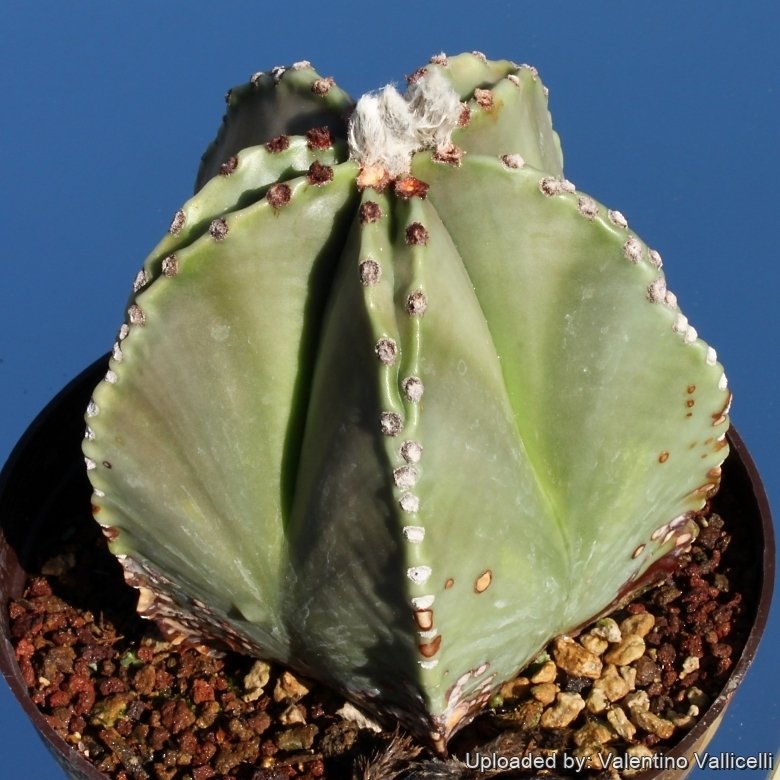
Astrophytum myriostigma cv. Double Ribs Nudum is a very rare cultivar that differs from the common Astrophytum myriostigma var. nudum for its ribs forming two parallel lines of areoles on each crest.
Stem: Spherical to shortly columnar with age. The stems is smooth bright green, blue-green or mauve-green color overall depending on clones and can be over 120 cm tall and 5-10 cm in diameter and are shaped like a bishop’s headpiece or a star.
Spines: None.
Ribs: Vertical, regular, deep, prominent and acute. The number of ribs vary from 3 to 8 (usually 5).
Areoles: Closed together and forming a line that splits giving rise to two contiguous vertical lines of areoles along the each ribs. Sometime the two parallel rows of areoles are separated by a more or less V shaped furrow. Sometime two parallel rows of areoles separate from one other and generate two new ribs.
Flowers: Funnelform, 4-7 cm long glossy yellow and sweet scented from the areole at the tip of the stem on mature plant.
Blooming season: Flowers appear intermittently throughout the warm months from April to September.
Fruit: 2-2,5 cm in diameter, greenish to tannish-red, covered with brown, overlapping scales, with long wool in their axil.
Seeds: Dark brown, helmet-shaped, shining, with a large depressed hilum, the margins being turned in.
Origin and Habitat
Garden origin (Nursery produced cultivar)
Cultivation and Propagation
Astrophytum myriostigma is a summer grower species relatively easy to grow. It is sometime seen as a grafted plant but grows very well on its own roots too.
Growth rate: It is a slow growing and easily flowering species.
Soil: Use mineral well permeable substratum with little organic matter (peat, humus), plants may become too elongated if compost is too rich.
Repotting: Re-pot every 2 years. Use pot with good drainage.
Fertilization: It grows much faster with a low nitrogen content fertilizer in spring and summer. Potassium helps maintaining the plants compact and healthy.
Watering: Requires careful watering to keep plant compact. Water sparingly from March till October, the thin, fibrous roots suffer if there is humidity, therefore the plant should be watered only when the surrounding terrain is dry. Keep dry as soon as the temperature starts dropping in October and keep it perfectly dry in winter at temperatures from 5 to 15 degrees centigrade.
Hardiness: They need to be kept in a cool place during winter rest and are somewhat resistant to frost if kept on the dry side prior to, and during, cold weather (due to the altitude they are hardy to -5 C ° C, or less for short periods). Although it is one of the easier Astrophytum to grow, it tends to rot in winter during the resting phase, if kept wet. In the rest period no high atmospheric humidity!!
Sun Exposure: Light shade to full sun, its colour tends to richer and darker when grown in light shade.
Uses: It is an excellent plant for container growing. It always looks good and stays small.
Pests & diseases: It may be attractive to a variety of insects, but plants in good condition should be nearly pest-free, particularly if they are grown in a mineral potting-mix, with good exposure and ventilation. Nonetheless, there are several pests to watch for:
- Red spiders: Red spiders may be effectively rubbed up by watering the infested plants from above.
- Mealy bugs: Mealy bugs occasionally develop aerial into the new growth among the wool with disfiguring results, but the worst types develop underground on the roots and are invisible except by their effects.
- Scales: Scales are rarely a problem.
- Rot: Rot is only a minor problem with cacti if the plants are watered and “aired” correctly. If they are not, fungicides won’t help all that much. To prevent rottenness it is also advisable to surround its root neck by very rough sand or grit, this help a fast water drainage.
Propagation: Almost exclusively by seed. Plants are sometimes grafted onto column-shaped cacti. Cutting scions from a flourishing plant is almost a crime because the scions do not root easily.
Remarks: This quite variable plant has been widely grown for years and is now available in several cultivated variety and several breeds do exist.
Gallery