Description
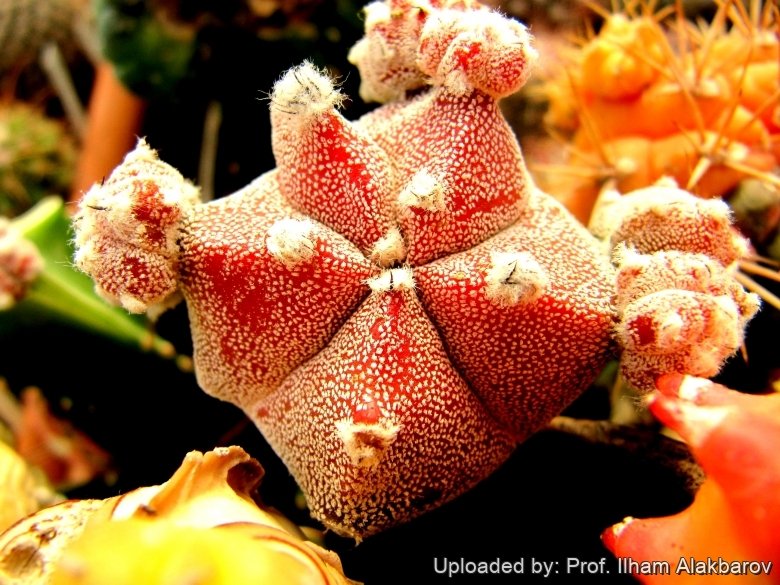
Astrophytum myriostigma (many dotted) is a spineless succulent plant, usually solitary or with very few basal branches. A transverse section of the stem reveal a perfect star shaped form (like the common star-fish) giving the plant the appearance of a bishop’s mitre (hence the common name Bishop’s cap)
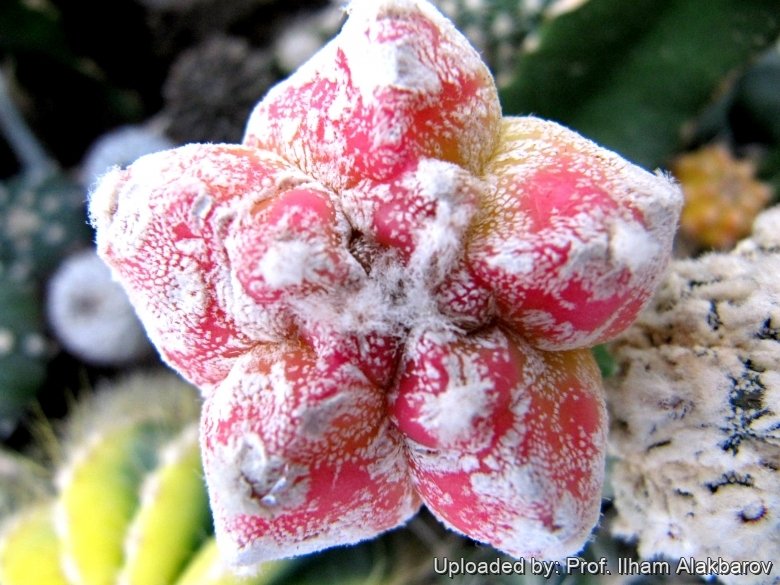
Forma rubra (red form): The red schizochromic form (Astrophytum myriostigma cv. Kikko f. rubra) has bright orange-red stems due to the absence (or reduced production) of chlorophyll pigments: every other pigment is present at normal levels, the dominant green colouration is lost, but will still more than likely have normal other pigments that give the yellow overall appearance of the stem. This form with red stems is very attractive and highly prized. This schizochromic form is almost always seen grafted on stronger columnar species, and cannot can be grown on its own roots. However some clones have enough chlorophyll in their tissues and can be grown on they own roots too, but very slow growing.
Stem: Pentagonal to almost spherical, dimension 22-40 cm tall, 5-10 cm in diameter.
Spines: None.
Ribs: Usually 5, sometimes 4(or 3) that increase to eight or more with age (rarely even 10), vertical, regular, deep, prominent, very broad and acute.
Flowers: Like those of the well known A. myriostigma, pale-yellow, shining-silk.
Blooming season: Spring to summer.
Blooming season: A. myriostigma seems to flower independently of day length, flowering asynchronously and intermittently throughout the warm months from the end of winter to the start of autumn. Plants may take up to six years to flower.
Fruit: 2-2,5 cm in diameter, greenish to tannish-red, covered with brown, overlapping scales, with long wool in their axil.
Seeds: Dark brown, helmet-shaped, shining, with a large depressed hilum, the margins being turned in.
Origin and Habitat
Japan, Garden origin (Nursery produced cultivar)
Cultivation and Propagation
Variegated and albinous cacti are regarded as choice and difficult in cultivation, but despite that many of them are relatively easy to grow. But be aware that they cannot tolerate prolonged exposure to direct sun light (especially during the hottest summer days), so grow them in half-shade or under filtered sun. They are sometime seen as grafted plants, but many grow well on their own roots, too.
On the contrary, the albinos can survive only if grafted on a strong green base.
Use mineral well-permeable substratum with little organic matter (peat, humus). Water sparingly from March till October and keep perfectly dry in winter at temperatures from 5 to 15 degrees centigrade. (In general these plants are more tender and cannot endure freezing temperatures) In the rest period no high atmospheric humidity!!
Propagation: Usually by seed. Plants are often grafted onto column-shaped cacti.