Description
Astrophytum myriostigma var. nudum (nude form) is very similar to the other myriostigma, it only deviate from the well-known typical form for lacking or mostly lacking white flecks, giving a bright green, blue-green, gray-green or mauve-green color overall depending on clones.
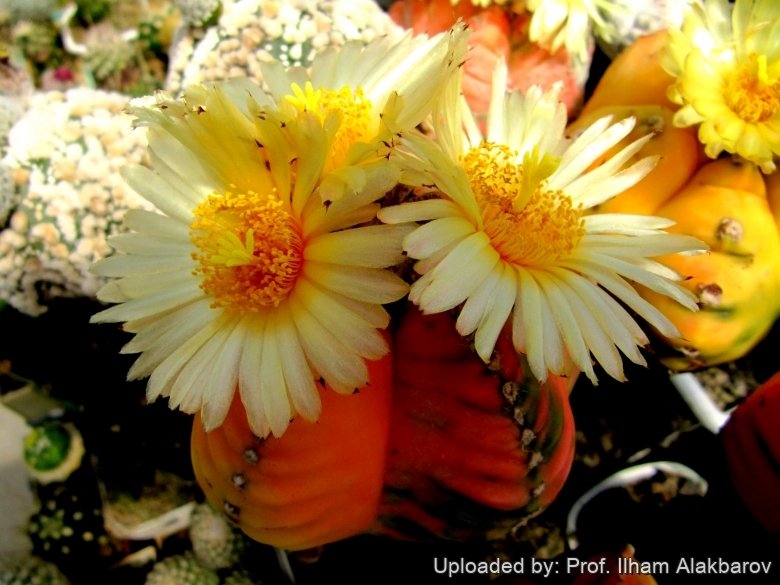
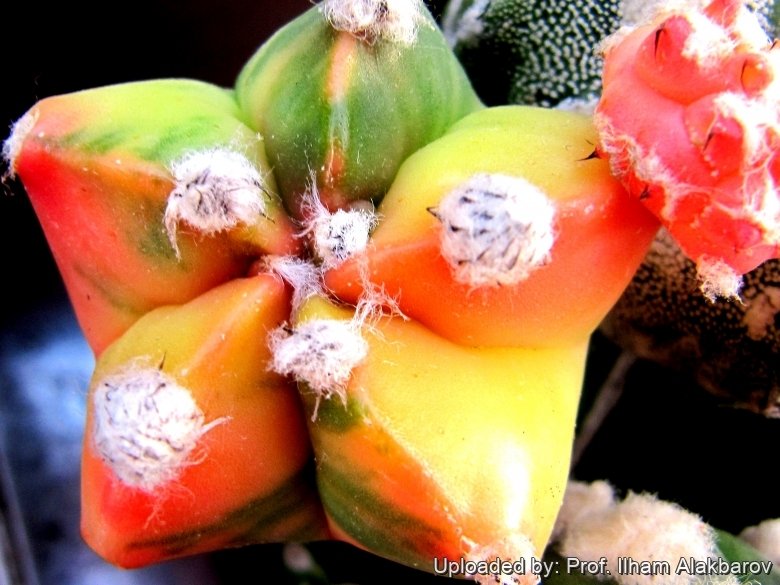
Pictured form: The pictured form Astrophytum myriostigma var. nudum f. picta (also known as cv. Rainbow) has stem variegated with yellow, orange, red and green. It seems to be a pretty variable plant with several and variously shaped clones. These pictured plants are very attractive and highly prized. They are often seen grafted on stronger columnar species, and cannot cannot be easily grown on their own roots. However some clones have enough chlorophyll in their tissues and can be grown on they own roots too, but very slow growing.
Stem: Spherical to shortly columnar with age. The stems is smooth and can be over 20 cm tall and 5-10 cm in diameter and are shaped like a bishop’s headpiece or a star.
Spines: None.
Ribs: The number of ribs vary from 3 to 8 (usually 5).
Flowers: 5 cm in length, pale-yellow, silk-shining unlike the white-spotted plant, occasionally with an orange gloom.
Blooming season: Spring or early summer, They take up to 6 years to bloom.
Fruits: Dry, dehisces towards the apex forming about 5 star shaped lobes. With few seeds.
Origin and Habitat
Garden origin (Nursery produced cultivar)
Cultivation and Propagation
Variegated and albinous cacti are regarded as choice and difficult in cultivation, but despite that many of them are relatively easy to grow. But be aware that they cannot tolerate prolonged exposure to direct sun light (especially during the hottest summer days), so grow them in half-shade or under filtered sun. They are sometime seen as grafted plants, but many grow well on their own roots, too.
On the contrary, the albinos can survive only if grafted on a strong green base.
Use mineral well-permeable substratum with little organic matter (peat, humus). Water sparingly from March till October and keep perfectly dry in winter at temperatures from 5 to 15 degrees centigrade. (In general these plants are more tender and cannot endure freezing temperatures ) In the rest period no high atmospheric humidity!!
Propagation: Usually by seed. Plants are often grafted onto column-shaped cacti.
Bibliography
Major references and further lectures
1)James Cullen, Sabina G. Knees, H. Suzanne Cubey “The European Garden Flora Flowering Plants: A Manual for the Identification of Plants Cultivated in Europe, Both Out-of-Doors and Under Glass” Cambridge University Press, 11/Aug./2011
-
Edward F. Anderson “Das große Kakteen-Lexikon.” Eugen Ulmer KG, Stuttgart 2005
-
Keith Grantham, Paul Klaassen “The plantfinder’s guide to cacti & other succulents” Timber Press, 18/mag/1999
-
Britton & Rose “The Cactaceae” 4: 273, 1923
-
Hiroshi Hirao “Colour encyclopaedia of cacti” Japan 1979 (Japanese language and script)
-
Willy Cullmann, Erich Götz (Dozent Dr.), Gerhard Gröner “The encyclopedia of cacti” Portland, OR: Timber Press, 1986
-
David Hunt, Nigel Taylor “The New Cactus Lexicon” DH Books, 2006
-
Curt Backeberg “Cactus Lexicon” Sterling Publishing Company, Incorporated, 1978
-
Del Weniger “Cacti of the Southwest: Texas, New Mexico, Oklahoma, Arkansas, and Louisiana” University of Texas Press, 1969
-
Del Weniger “Cacti of Texas and Neighboring States: A Field Guide” University of Texas Press, 1984