Publication: Succulenta (Netherlands) 74: 84. 1995
Description
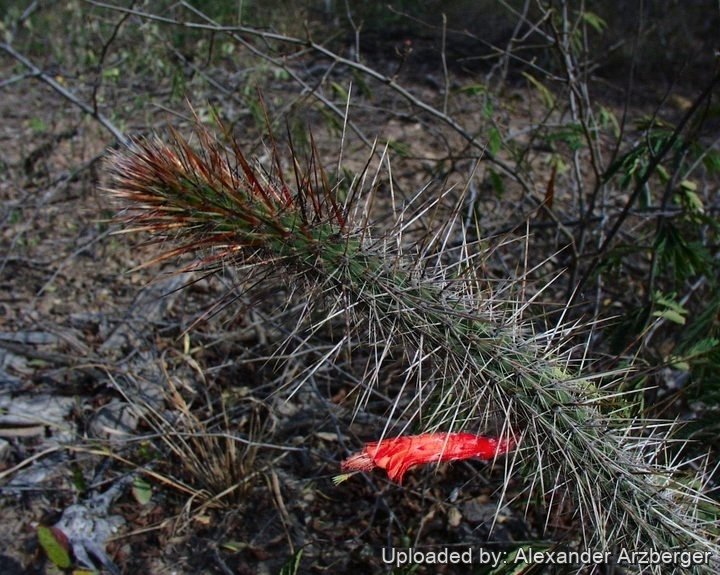
Cleistocactus baumannii subsp. chacoanus is one of the sprawling species with thin stems, this subspecies of the widespread Cleistocactus baumannii has the striking, tubular, S-shaped flowers characteristic of the species. It has thinner, rather upright stems and less ribs. As with many cleistocacti, the flowers are produced in profusion over several months on both new and old growth. It is one of the best of the sprawling cleistocactus forms. The dense thicket of dull green stems covered by long needle-like spines makes a dramatic landscape element. Sprawling cleistocacti typically produce more flowers than their columnar kin, even as young cuttings, and Cleistocactus baumannii subsp. chacoanus is no exception. It is similar to Cleistocactus baumannii subs. santacruzensis and sometime considered a synonym of the latter.
Derivation of specific name: ‘chacoanus -a -um’ for the occurrence in the Chaco (annually flooded flatlands) of Argentina, extending into Paraguay and Bolivia.
Stems: Cylindrical, branching basally, rather upright, then arching or creeping, but the tip of the shoot turned upwards (decumbent), green, 0,5-1,5 m tall, 1,5-3 cm thick.
Ribs: 8-12 ribs, slightly crenate (notched), 3-4 mm high.
Areoles: Almost round, 2-3 mm in diameter, blackish, 5-8 mm apart.
Spines: Acicular or setiform, quite variable, straight, white, yellowish or blackish, light tipped with dark base.
Radial spines: (6-)10-12(-15), the lowermost thin, 4-12 mm long, the uppermost, if any, more colourful and slightly stronger.
Central spines: 2-4 similar to radials but stronger (two of which noticeably longer), up to 3 cm long.
Flowers: Bilaterally symmetrical 55-65 mm long. Nectar-chamber 6-8 mm long, 3-4 mm wide. Tube almost cylindrical 5-7 mm in diameter, ca. 3 cm long, slightly or sharply bent upwards just above the ovary, dependending on position of the stem, reddish brown. Ovary and tube with bright scales and small white hairs in the axils. Corolla 7-12 mm wide very oblique, bent downward; petals 7-9 mm long, 4-7 mm wide, dark red. Filaments white below, and pink to purple above, rows, anthers dark lilac, protruding 5-10 mm. Style whitish, stigma lobes 6-8, green, yellow or reddish with him
Fruits: Globular or slightly elongated, crimson,1-2 cm in diameter, pulp juicy, white.
Seeds: About 1.2 mm long, 0.9 mm wide, 0.6 mm thick, ovoid to helmet shaped, keeled on the back, black, shiny, finely dotted; hilum more or less oblique.
Origin and Habitat
Gran Chaco region of Bolivia (Santa Cruz, Tarija), estending in western Paraguay (Alto Paraguay, Boquerón), and northern Argentina (Salta)
Type locality: Villa Montes, Tarija, Bolivia , Prov. Gran Chaco.
Habitat and ecology. Cleistocactus baumannii subsp. chacoanus is a common understory scrub also found in openings. The climate is dry tropical to semiarid.
Cultivation and Propagation
Cleistocactus baumannii subs. chacoanus is a a much decorative hardy cactus. It is very easy to grow but tends to look untidy in the collection if not staked. It is recommended as one of the best of the sprawling cleistocactus forms, with the added benefit of being reliably hardy.
Growth rate: It grows rapidly enough to need pruning.
Soil: Grow it in a rich and particularly draining substratum, as it is very sensitive to rottenness when in presence of humidity and low temperatures and let the soil dry out between waterings.
Water: It needs plenty of water in the summer (during the vegetative period) when it will flower for months, but allowing the substratum to completely dry up before irrigating again; in winter, it’s to be kept dry. Preferable not to water on overcast days, humid days or cold winter days.
Hardiness: This is one of hardiest of the woolly columnar cacti from Bolivia that grow at an altitude of up to 1000 meters. It is a frost resistant cactus, hardy to -7°(or even less if very dry). However in cultivation it is better not to expose it to temperatures lower than 0° C, even if in an aerated and protected location, in order to avoid the formation of anti-aesthetic spots on the epidermis. In presence of high atmospheric humidity avoid any frost as it is particularly sensitive to root rot.
Exposure: It need full sun exposures with ample airflow to produce dense hairs, but, as a former mountain dweller, does not care for extremely high temperatures in summer.
Maintenance: Repot in the spring, when their roots become cramped. Generally, they should be repotted every other year in order to provide fresh soil. After repotting, do not water for a week or more. As with many cleistocacti, the flowers are produced in profusion: the dead ones just fall off so need to be regularly tidied up. It will probably benefit from the occasional pruning to keep it in check and provide cuttings for propagation. Otdoors clumps need renewal after five to ten years, done by removing old growth.
Use: Excellent as landscape or patio plant. It is suitable for small “desert” gardens, in association with other xerophytes. Where the open air cultivation is not possible due to the climate, it is to be cultivated in pot in order to shelter it in winter.
Propagation: By seeds and by cuttings, provided left drying up well, in summer.
Bibliography
Major references and further lectures
-
Graham Charles “Cacti and Succulents: An illustrated guide to the plants and their cultivation” Crowood, 30 April 2014
-
“Dry Climate Gardening with Succulents” Pantheon Books, 1995
-
Christopher Cumo “Encyclopedia of Cultivated Plants: From Acacia to Zinnia [3 Volumes]: From Acacia to Zinnia” ABC-CLIO, 25 April 2013
-
Urs Eggli, Leonard E. Newton “Etymological Dictionary of Succulent Plant Names” Springer Science & Business Media, 29 June 2013
-
Friedrich Ritter “Kakteen in Südamerika - Ergebnisse meiner 20jährigen Feldforschungen: [Bolivien, Argentinen]”, Volume 2, 671 (-672), fig. Selbstverl., 1980
-
David Gledhill “The Names of Plants” 4th ed. Cambridge University Press 2008
-
Edward Anderson “The Cactus family” Timber Press, Incorporated, 2001
-
James Cullen, Sabina G. Knees, H. Suzanne Cubey “The European Garden Flora Flowering Plants: A Manual for the Identification of Plants Cultivated in Europe, Both Out-of-Doors and Under Glass” Cambridge University Press, 11/Aug/2011
-
David R Hunt; Nigel P Taylor; Graham Charles; International Cactaceae Systematics Group. “The New Cactus Lexicon” dh books, 2006
From llifle page Bolivicereus margaritanus
Description
Cleistocactus margaritanus a shrubby columnar cactus, branching basally with several stems. It has attractive yellowish bristly soft spines and orange-red S-shaped blooms, and seems related to Cleistocactus baumannii subs. chacoanus. The most striking feature is the dense, golden yellow spination it possesses, which serve to protect it from the harsh sun common to its native habitat. More precisely the spines benefit the plant by reducing sun exposure and by trapping a layer of air next to the cactus body. This helps to cool the plant in the summer and keep it warm in the winter.
Stems: Fairly stiff, erect or arching, to 2 m or more long, about 3,5 cm in diameter.
Ribs: About 16.
Areoles: Close set.
Spines: Several, golden yellow not differentiated as centrals and radials, straight, soft, and bristly.
Flowers: Tubular, bilaterally symmetrical, curving upward, then narrowly S-haped above the pericarpels, orange-red 5-7 cm long, to 1 cm in diameter; perianth parts oblique; stamens red; stamens and style exserted. Stigma lobes green.
Fruits: Globose, red.
Origin and Habitat
Margarita and adjacent areas, Tarija, Bolivia
Altitude: Around 1800 metres above sea level.
Cultivation and Propagation
Cleistocactus margaritanus is of easy culture, which makes it a good cactus for beginners. It suited to hanging baskets as well as pots.
Soil: Use a loose well drained cactus mix.
Repotting: Since they are rapid growers need plenty of space for their roots, repotting with fresh potting-mix should be done every other year or when the plant has outgrown its pot. However, repotting doesn’t necessarily mean they’ll need larger containers.
Sun Exposure: Require filtered bright light, partial sun or light shade, but not in full sun that will sunscald it.
Watering: They require moderately watering through the growing season. This can be done weekly or more frequently during the summertime, if the weather is sunny enough, but allow to dry fully before watering again. Kept this way, plants will show a healthy growth. Keep rather dry as soon as the temperature starts dropping in October and keep it dry in winter. The plant survives outside without protection in winter (cold hardy to -2° ) but is then somewhat prone to rot, too.
Fertilization: Give an occasional high potassium liquid feed during the active growing period.
Hardiness: Winter care presents no problems at temperatures from 5 to 15 degrees centigrade with plenty of light, but frost hardy to -2°C for short periods if very dry. This plant needs a period of cool rest in winter to produce flowers abundantly. It flowers freely indoors too if conditions suit it.
Pest and diseases: They are generally fairly easy to grow, especially if kept pest-free. They are susceptible to, scale insects and spider mite. Watch carefully for infestations of stem and root mealy bugs, and damage from these may well initiate fungal attack.
Propagation: Easy to propagate from cuttings or seeds. Take cuttings spring or summer, let them dry till the ends callous well. Then replant them in fresh cactus soil that is ever so slightly moist, and keep it that way till they root. Surface sowing is the best; seeds germinate in 14-28 days at 20° C , remembering that seedlings dislike strong light and dry conditions.
Bibliography
Major references and further lectures
-
Edward Anderson “The Cactus family” Timber Press, Incorporated, 2001
-
James Cullen, Sabina G. Knees, H. Suzanne Cubey “The European Garden Flora Flowering Plants: A Manual for the Identification of Plants Cultivated in Europe, Both Out-of-Doors and Under Glass” Cambridge University Press, 11/Aug/2011
-
David R Hunt; Nigel P Taylor; Graham Charles; International Cactaceae Systematics Group. “The New Cactus Lexicon” dh books, 2006
Source: Bolivicereus margaritanus, LLIFLE - Encyclopedia of living forms, CC-BY-SA, retrieved 2026-10-25.
From llifle page Bolivicereus margaritanus f. cristatus
Description
This is a very nice crested cactus, easily recognizable for its yellowish bristly soft spines. The standard C. margaritanus is a columnar tree-like cactus with many branches, up to 3 m tall (Or more), the beautiful crested form, here described, is rare in collection and highly priced for its dense covering of spines and the large growing green fan-like stem.
Stem: Fat, it can form in age a large convoluted mound and can reach a considerable size (up to 50 cm tall and in diameter, or more )
Areoles: Small, roundish, orange-yellow.
Spines: It has many short bristly pale-yellowhis spines all quite similar in shape, that literally cover the surface of the stems.
Origin and Habitat
Garden origin (Nursery produced cultivar) The Original non crested forms comes from Margarita, O’Connor province, Department of Tarija. Bolivia. Altitude around 1800m
Cultivation and Propagation
It is of easy cultivation. Require full sun or half shade. The plants on their own roots should be kept in a deep pot with a very draining mineral substrate. But be particularly careful with watering, which all crested plant require (rot sensitive). Keep dry during the winter rest. Since they are rapid growers, and need plenty of space for their roots, repotting should be done every other year or when the plant has outgrown its pot.
The grafted plants are easy to grow and will form a large brain-like mounds with age. Watering during the active growing season (spring and summer); this will encourage steady growth, and prevent the crest from becoming flabby.
Source: Bolivicereus margaritanus f. cristatus, LLIFLE - Encyclopedia of living forms, CC-BY-SA, retrieved 2026-10-25.
Gallery