Publication: Ill. Hort. 8: Misc. 35. 1861 [Jun 1861]
Description
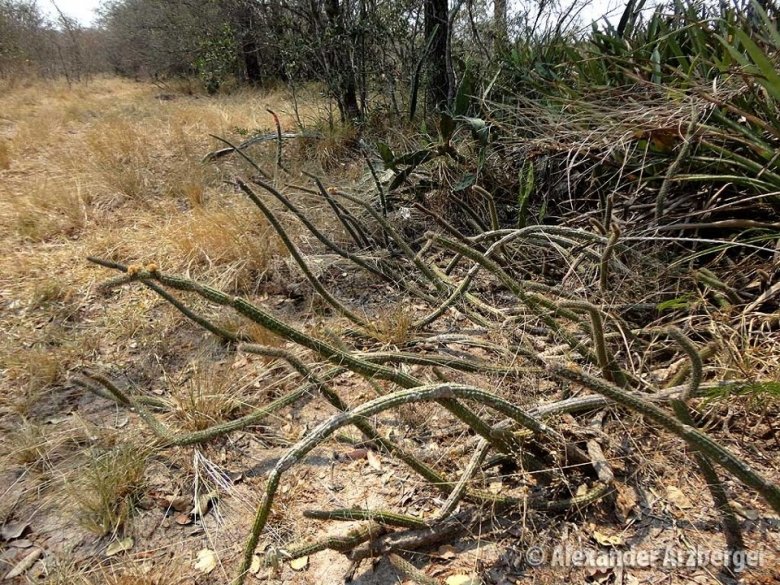
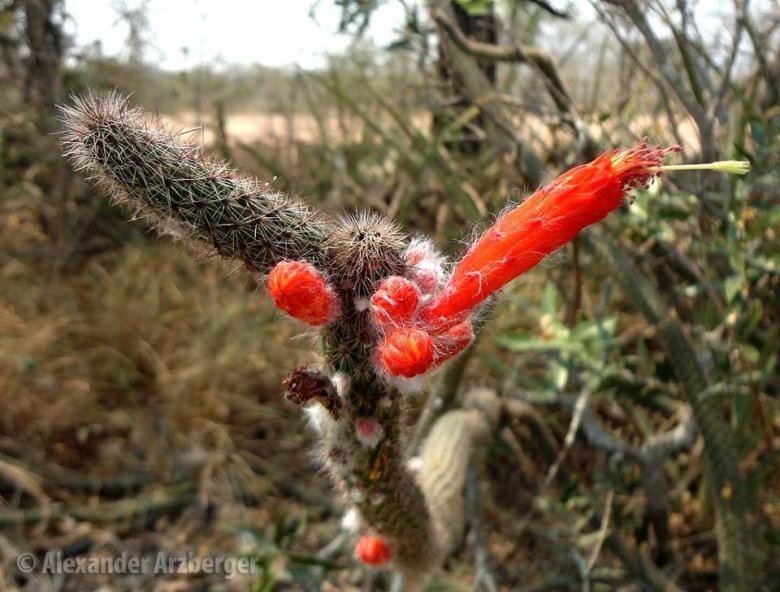
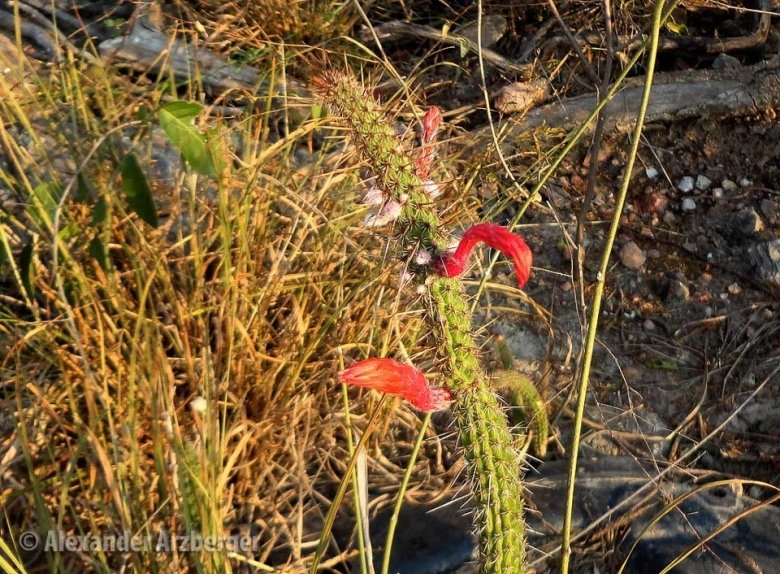
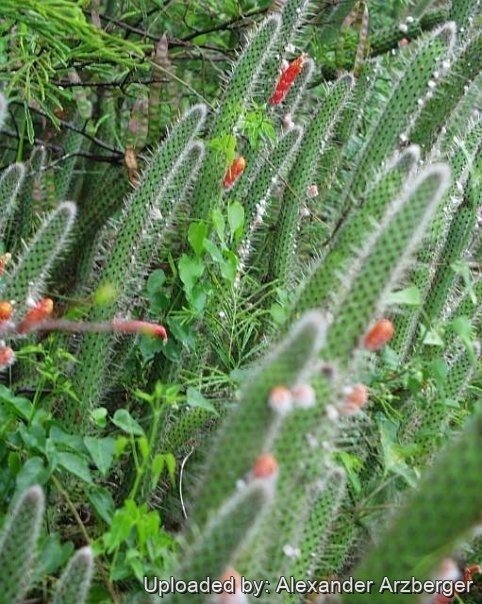
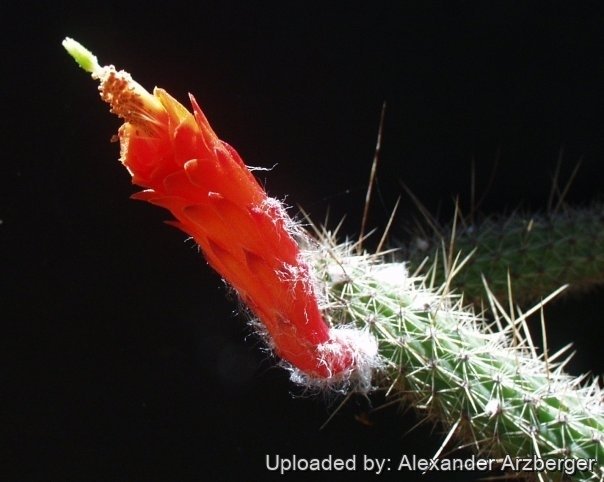
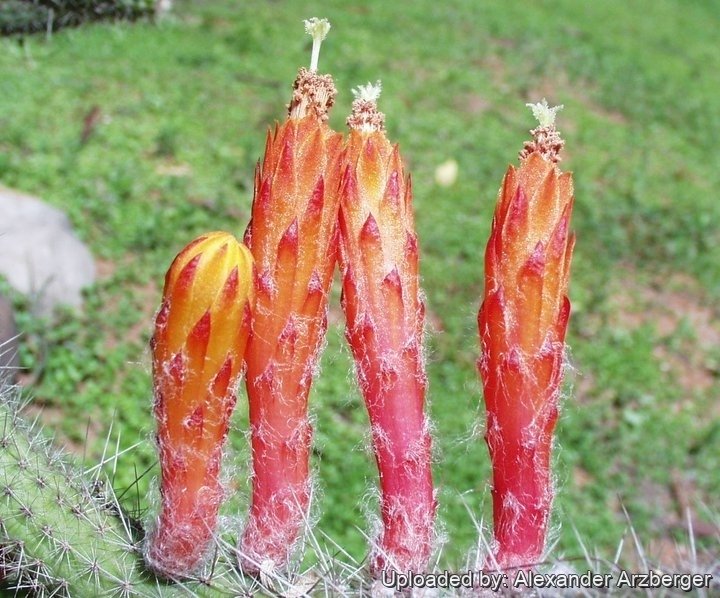
Cleistocactus baumannii is a columnar cactus with several thin ribbed stems branching at base, covered with whitish spines, sometimes yellow or brown. Flowers are tubular and orange-scarlet, slightly open showing only the style and stamens. Six subspecies are recognized, the nominate, subsp. horstii (P.J.Braun) N.P.Taylor, subsp. anguinus (Gurke) P.J.Braun&Esteves, subsp. croceiflorus (F. Ritter) P. J. Braun & Esteves, subsp. chacoanus (F. Ritter) P. J. Braun & Esteves and subsp. sanctacruzensis (Backeb.) Mottram.
Stems: Somewhat branching at base, fairly stiff, erect or arching, 2 meters high or more, 2.5 to 3.5 cm. in diameter, dark green.
Ribs: 12 to 16, low.
Areoles: Approximate, brown or black-felted.
Central spine: One, yellowish or dark brown, 4 cm or less long.
Radial spines: Needle-like, 8 to 20, white, yellow, or brown to 1.8 cm long.
Flowers: Born along the stem over several months in summer, yellow-orange to scarlet, 5 to 7 cm long, narrow, 1 cm in diameter, sharply upcurved, and then narrowly S-shaped beyond the pericarpel, with oblique corolla; scales on ovary and flower-tube ovate, acute; perianth-segments short and broad, acute. Stamens red numerous, appressed against the upper part of the flower-tube. Stamens and style exserted.
Fruit: Spherical, 1 to 1.5 cm in diameter, pink to red with white pulp, edible.
Origin and Habitat
Cleistocactus baumannii is widely distributed in the Chaco of Bolivia, western Argentina, Uruguay and Paraguay.
Altitude range: It occurs at elevations between 10 and 1,000 metres above sea level.
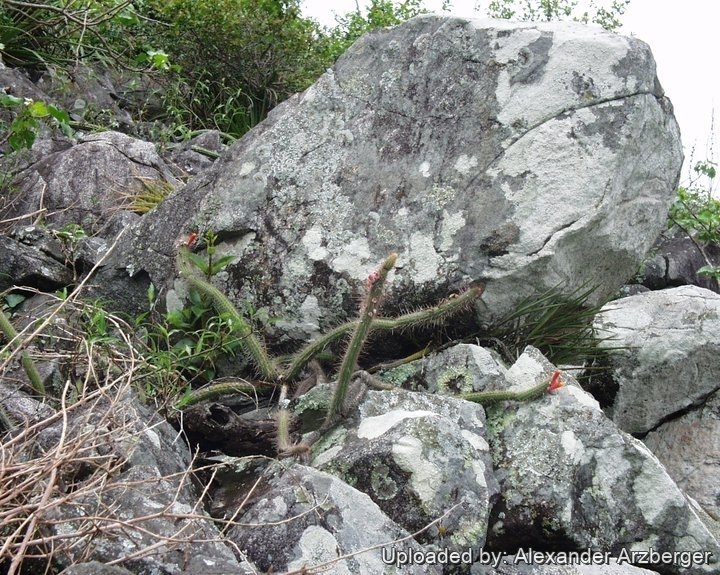
Habitat and Ecology: This cactus grows in sandy and clayey soils, in forest borders as well as within dense or open forests. It can also be found in the scrubs of the dry Chaco and in the eastern region of Paraguay. Furthermore, it grows in rocky areas and open sites. This species is locally abundant and favored by anthropogenic activities, and there are no major threats affecting it. It also occurs in many protected areas. The Chacoan peccary (Catagonus wagneri) eats this cactus mostly in the dry season.
Cultivation and Propagation
Cleistocactus baumannii is a a much decorative hardy cactus. It is very easy to grow but tends to look untidy in the collection if not staked. It is recommended as one of the best of the sprawling Cleistocactus forms, with the added benefit of being reliably hardy.
Growth rate: Cleistocactus baumannii grows rapidly enough to need pruning.
Soil: Grow it in a rich and particularly draining substratum, as it is very sensitive to rottenness when in presence of humidity and low temperatures and let the soil dry out between waterings.
Water: It needs plenty of water in the summer (during the vegetative period) when it will flower for months, but allowing the substratum to completely dry up before irrigating again; in winter, it’s to be kept dry. Preferable not to water on overcast days, humid days or cold winter days.
Hardiness: This is one of hardiest of the woolly columnar cacti from Bolivia that grow at an altitude of up to 1000 meters. It is a frost resistant cactus, hardy to -7°(or even less if very dry). However in cultivation it is better not to expose it to temperatures lower than 0° C, even if in an aerated and protected location, in order to avoid the formation of anti-aesthetic spots on the epidermis. In presence of high atmospheric humidity avoid any frost as it is particularly sensitive to root rot.
Exposure: It need full sun exposures with ample airflow to produce dense hairs, but, as a former mountain dweller, does not care for extremely high temperatures in summer.
Maintenance: Repot in the spring, when their roots become cramped. Generally, they should be repotted every other year in order to provide fresh soil. After repotting, do not water for a week or more. As with many cleistocacti, the flowers are produced in profusion: the dead ones just fall off so need to be regularly tidied up. It will probably benefit from the occasional pruning to keep it in check and provide cuttings for propagation. Otdoors clumps need renewal after five to ten years, done by removing old growth.
Use: Excellent as landscape or patio plant. It is suitable for small “desert” gardens, in association with other xerophytes. Where the open air cultivation is not possible due to the climate, it is to be cultivated in pot in order to shelter it in winter.
Propagation: By seeds and by cuttings, provided left drying up well, in summer.
Bibliography
Major references and further lectures
-
James Cullen, Sabina G. Knees, H. Suzanne Cubey “The European Garden Flora Flowering Plants: A Manual for the Identification of Plants Cultivated in Europe, Both Out-of-Doors and Under Glass” Cambridge University Press, 11/Aug./2011
-
David Hunt, Nigel Taylor “The New Cactus Lexicon” DH Books, 2006
-
Edward F. Anderson “The Cactus Family” Timber Press, 2001
-
Urs Eggli, Leonard E. Newton “Glossary of Botanical Terms with Special Reference to Succulent Plants.” British Cactus and Succulent Society, Richmond 1993
-
Gurcharan Singh Randhawa, Amitabha Mukhopadhyay “Floriculture in India” Allied Publishers, 01/Jan/1986
-
Oakley, L. & Pin, A. 2013. Cleistocactus baumannii. The IUCN Red List of Threatened Species. Version 2014.2. <www.iucnredlist.org>. Downloaded on 07 August 2014
-
N. L. Britton and J. N. Rose “The ‘Cactaceae’, Descriptions and Illustrations of Plants of the ‘Cactus’ Family” volume 2 Carnegie Institution, 1920
-
Navarro, G. “Catálago ecológico preliminar de las cactáceas de Bolivia.” Lazaroa 17: 33–84. 1996
-
Serrano, M. & J. Terán. “Identific. Esp. Veg. Chuquisaca” 1–129. PLAFOR, Intercooperación, Fundación Ceibo, Sucre. 1998 [2000].
-
Zuloaga, F.O., O. Morrone, M. J. Belgrano, C. Marticorena & E. Marchesi. (eds.). “Catálogo de las Plantas Vasculares del Cono Sur (Argentina, Sur de Brasil, Chile, Paraguay y Uruguay).” in Monogr. Syst. Bot. Missouri Bot. Gard. 107(1): i–xcvi, 1–983; 107(2): i–xx, 985–2286; 107(3): i–xxi, 2287–3348. 2008
From llifle page Cleistocactus aureispinus
Bibliography
Major references and further lectures
-
Edward Anderson “The Cactus family” Timber Press, Incorporated, 2001
-
James Cullen, Sabina G. Knees, H. Suzanne Cubey “The European Garden Flora Flowering Plants: A Manual for the Identification of Plants Cultivated in Europe, Both Out-of-Doors and Under Glass” Cambridge University Press, 11/Aug/2011
-
David R Hunt; Nigel P Taylor; Graham Charles; International Cactaceae Systematics Group. “The New Cactus Lexicon” dh books, 2006
Source: Cleistocactus aureispinus, LLIFLE - Encyclopedia of living forms, CC-BY-SA, retrieved 2026-10-25.
From llifle page Cleistocactus paraguariensis
Description
Cleistocactus paraguariensis is a shrubby, sprawling cactus forming low clumps that produces nice zygomorphic flowers. It is generally included within (as a synonym of) Cleistocactus baumannii, suggesting that there is not really a fundamental difference between the two, and hard to name accurately without knowing where they come from. The name paraguariensis, meaning “of Paraguay”, refers to the origin of this plant.
Stems: Green, 10-15 cm in diameter, 10-15 mm thick, basally branching. Branches break off easily.
Ribs: 10-11, notched, ca 2 mm high, a little crenate
Areoles: Ovate ca 1,5 mm in diameter, almost black, becoming grey, 3-6 mm apart.
Radial spines: 12-15, yellow to reddish yellow with darker tips, the upper ones 2-6 cm long, the lower ones (shorter), 2-4 mm long.
Central spines: 4-5, reddish brown, the longer to 2.5 cm long, sometime only a few mm long.
Flowers: Zygomorphic, double-curved, orange-red, to 5 cm long barely open. Nectar chamber 5 mm long, 3 mm wide. Tube purple almost cylindrical, reddish brown with narrow yellowish to red scales, ca 1 mm long, and small white wolly hairs. Filaments white red above, anthers lilac. Petals 9 mm long, 3 mm wide, red, erect, spreading out of the corolla about 8 mm. Style white, stigma lobes c. 7 yellowish-green.
Origin and Habitat
Paraguari department, Paraguay.
Habitat and ecology: This specie grows in rock mountain and is quite rare.
Cultivation and Propagation
Cleistocactus baumannii var. paraguariensis is a a much decorative hardy cactus.
Growth rate: This species grows rapidly enough to need pruning.
Soil: Grow it in a rich and particularly draining substratum, as it is very sensitive to rottenness when in presence of humidity and low temperatures and let the soil dry out between waterings.
Water: In summer, during the vegetative period, it must be regularly watered, but allowing the substratum to completely dry up before irrigating again; in winter, it’s to be kept dry. Preferable not to water on overcast days, humid days or cold winter days.
Hardiness: This is one of hardiest of the woolly columnar cacti from Bolivia that grow at an altitude of up to 1000 meters. It is a frost resistant cactus, hardy to -7°(or even less if very dry). However in cultivation it is better not to expose it to temperatures lower than 0° C, even if in an aerated and protected location, in order to avoid the formation of anti-aesthetic spots on the epidermis. In presence of high atmospheric humidity avoid any frost as it is particularly sensitive to root rot.
Exposure: It need full sun exposures with ample airflow to produce dense hairs, but, as a former mountain dweller, does not care for extremely high temperatures in summer.
Maintenance: Repot in the spring, when their roots become cramped. Generally, they should be repotted every other year in order to provide fresh soil. After repotting, do not water for a week or more.
Use: Excellent as landscape or patio plant. It is suitable for small “desert” gardens, in association with other xerophytes. Where the open air cultivation is not possible due to the climate, it is to be cultivated in pot in order to shelter it in winter.
Propagation: By seeds and by cuttings, provided left drying up well, in summer.
Bibliography
Major references and further lectures
-
Edward F. Anderson “The Cactus Family” Timber Press, 2001
-
Friedrich Ritter “Kakteen in Südamerika - Ergebnisse meiner 20jährigen Feldforschungen: Brasilien / Uruguay / Paraguay”, Volume 1 Selbstverl., 1979
Source: Cleistocactus paraguariensis, LLIFLE - Encyclopedia of living forms, CC-BY-SA, retrieved 2026-10-25.
Cultivars and forms (6)
Gallery