Publication: n. n., nov. comb. ined. [as: Conophytum lacteum L. Bolus 1967]
Description
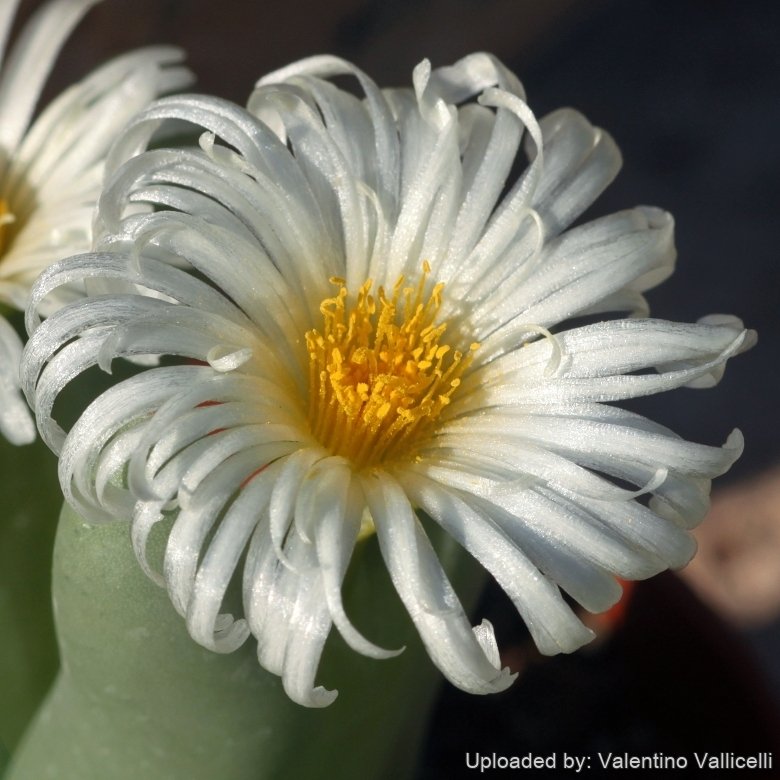
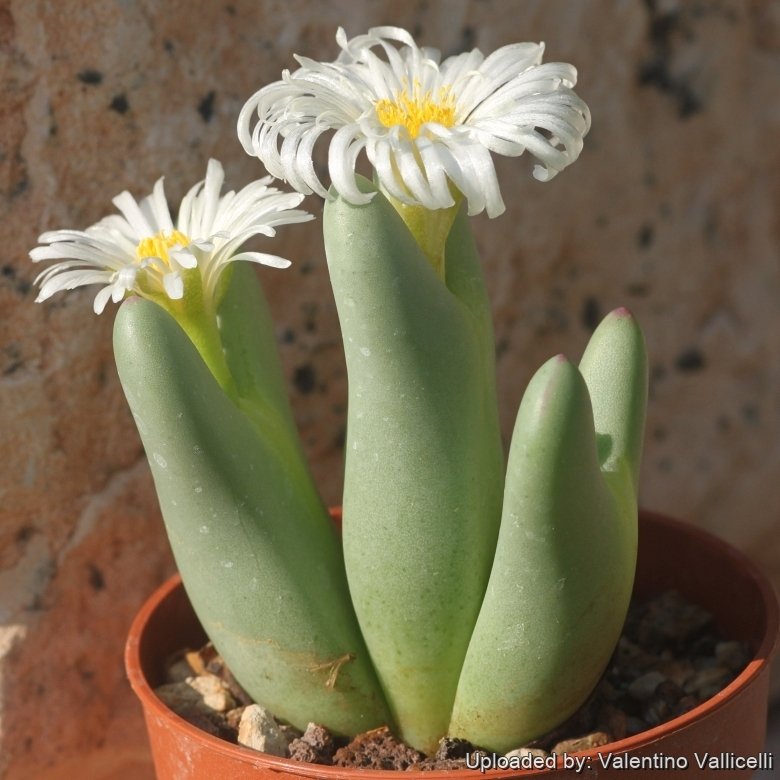
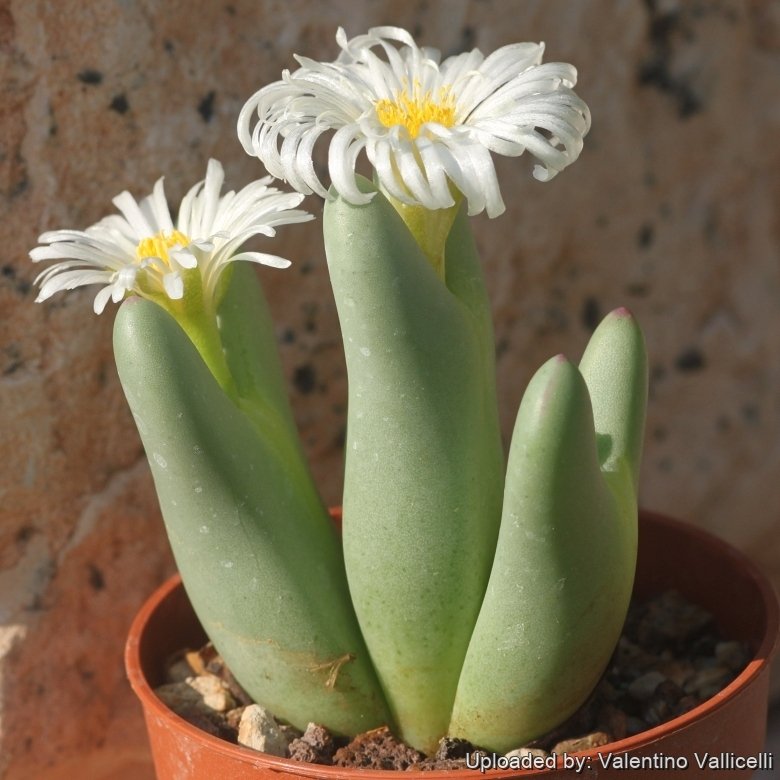
Conophytum bilobum lacteum (Conophytum lacteum) is a pure white flowering form of Conophytum bilobum, and the plants are not readily distinguishable, if not for the flower colour.
Habit: Robust caespitose (groundcover) plant, stemless or with short stems with time.
Bodies (paired leaves): Thickness: 3 centimetres Height: 7 centimetres, Profile: The leaf-tips (lobes) are free and are 10 mm long. Colours: The margins are green to red or deep purple in colour. The epidermis is glabrous whitish-green to glaucous-green.
Flowers: Scentless up to 3 cm pure white.
Blooming season: The flowers are autumnal (rarely in summer) and diurnal.
Origin and Habitat
Kosies (western part of South Africa)
Habitat: Growing in a well drained soil with some water in winter and some sun.
Cultivation and Propagation
It is easy to grow. These plants grow on winter rain and head for summer dormancy. They require little water; otherwise its epidermis breaks (resulting in unsightly scars). Water minimally in summer, (only when the plant starts shrivelling), but it will generally grow even in summer if given water. Water regularly in winter after the previous year’s leaves have dried up. Requires good drainage. Keep cool and shaded in summer, it needs full sun or light shade. Hardy to -2°C. Ensure a very good ventilation. Avoid to repot frequently. This plant may stay in the same pot for many years.
Propagation:: It can be reproduced both by cuttings and seeds. Take the cutting from a grown-up mother plant. Each cutting must contain one or more heads along with a fraction of root.
Notes
Plants of the genus Conophytum are also known as ‘living pebbles’. During the rest period (the summer months in Europe) a new body forms inside the old, gradually taking all the substances from it until all that remains is the skin, which dries and protects the young plant from the heat of the sun and excess evaporation of water. The resting Conophytum protected by this dry cover resembles a pebble and hence the name ‘living pebble’. The growth period of most species is from August to March. The temperature should be about 10 to 12°C.
Bibliography
Major references and further lectures
-
James Cullen, Sabina G. Knees, H. Suzanne Cubey “The European Garden Flora Flowering Plants: A Manual for the Identification of Plants Cultivated in Europe, Both Out-of-Doors” Cambridge University Press, 11/Aug./2011
-
Raimondo, D., von Staden, L., Foden, W., Victor, J.E., Helme, N.A., Turner, R.C., Kamundi, D.A. and Manyama, P.A. 2009. “Red List of South African Plants.” Strelitzia 25. South African National Biodiversity Institute, Pretoria.
-
Hammer, S. 1993. “The Genus Conophytum - A Conograph.” Succulent Plant Publications, Pretoria.
-
Hammer, S. 2002. “Dumpling and His Wife: New Views of the Genus Conophytum.” East Anglia Engraving Creative Colour Ltd, Norwich, England.