Publication: Gard. Chron. 1922, Ser. III. lxxii. 83.
Description
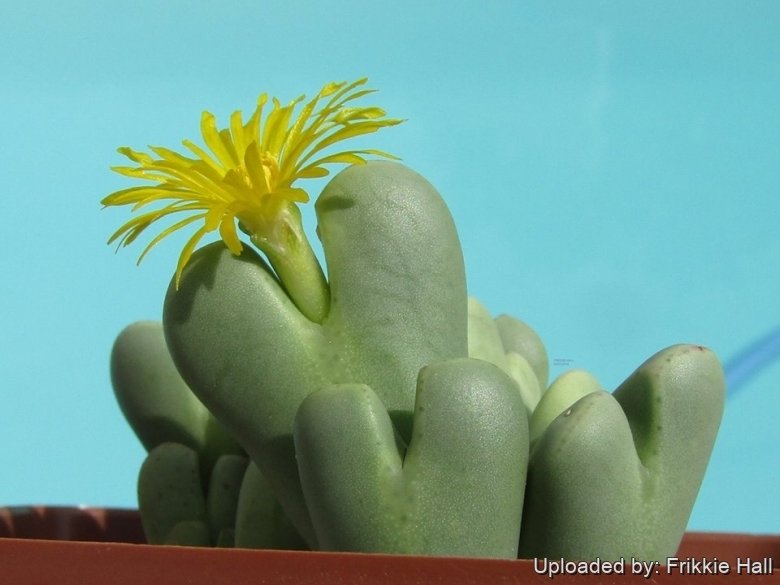
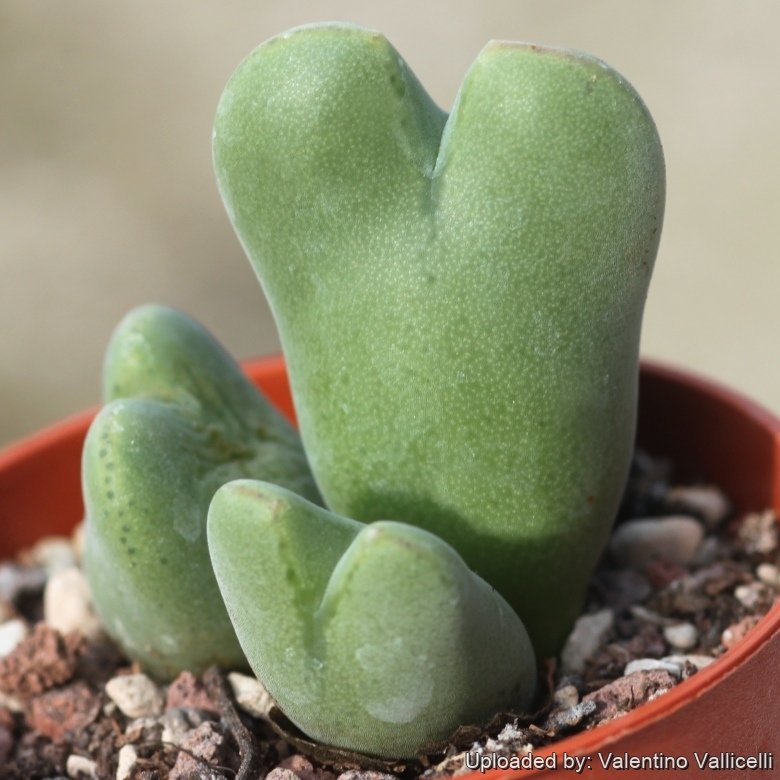
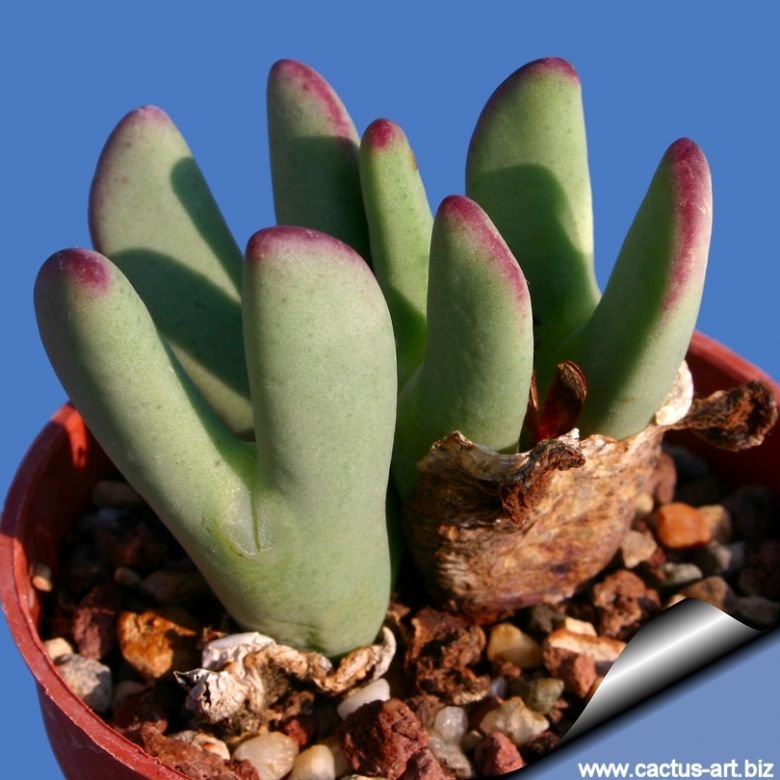
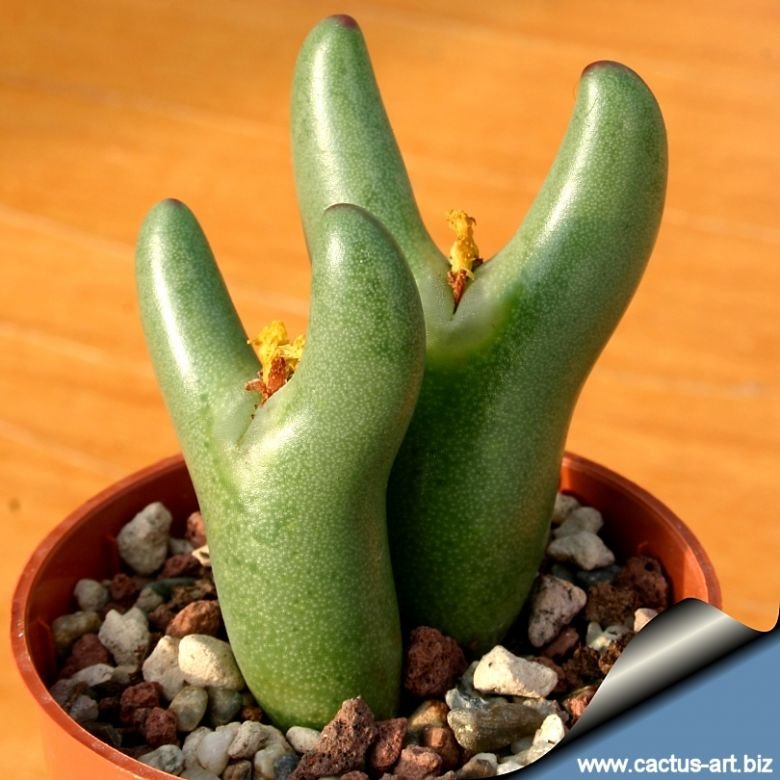
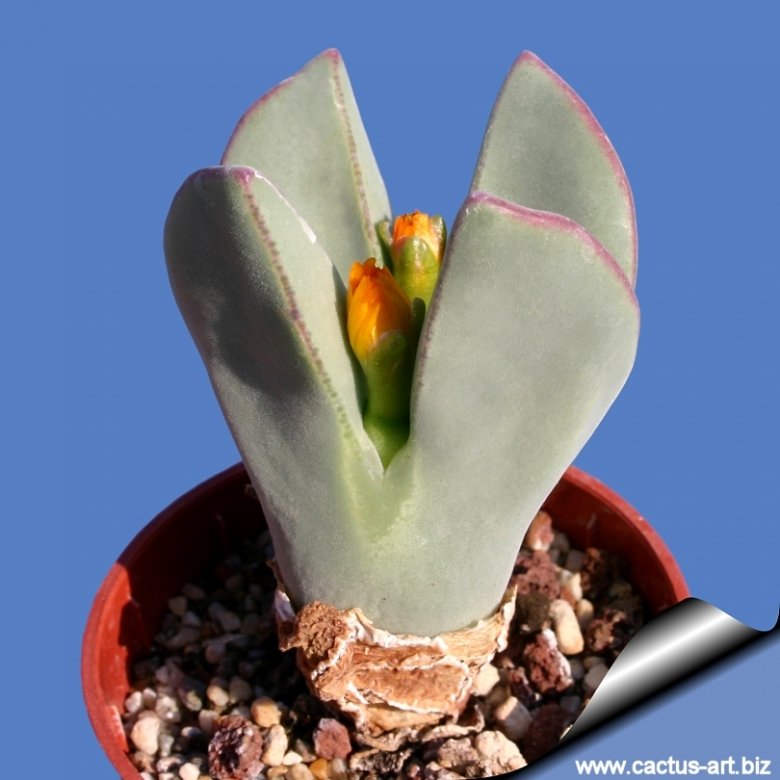
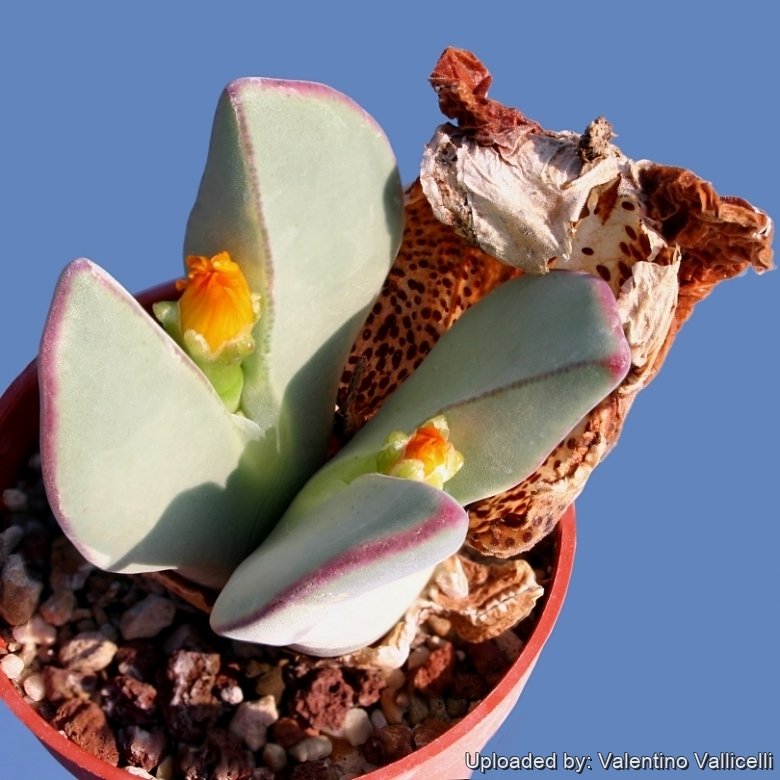
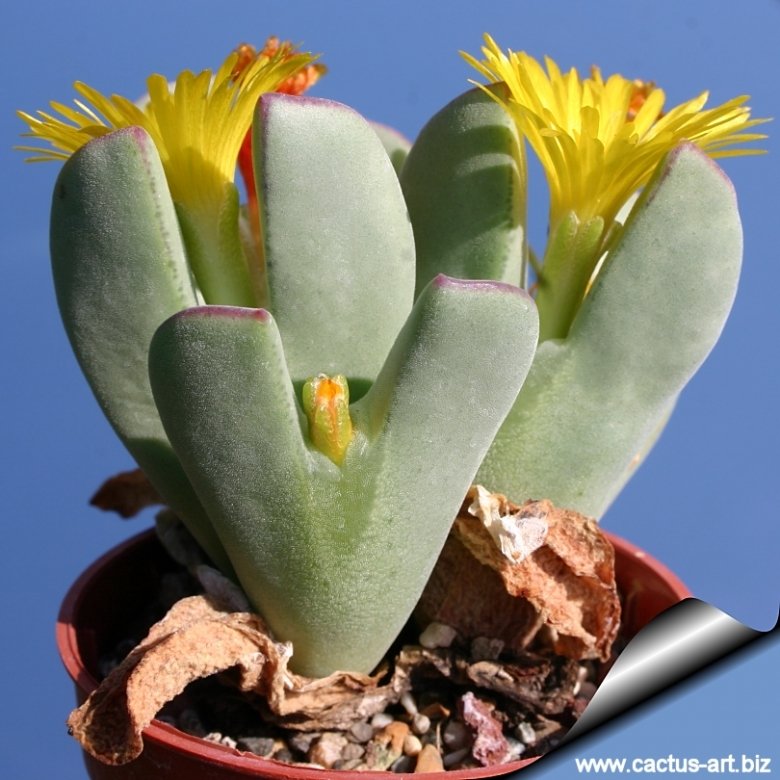
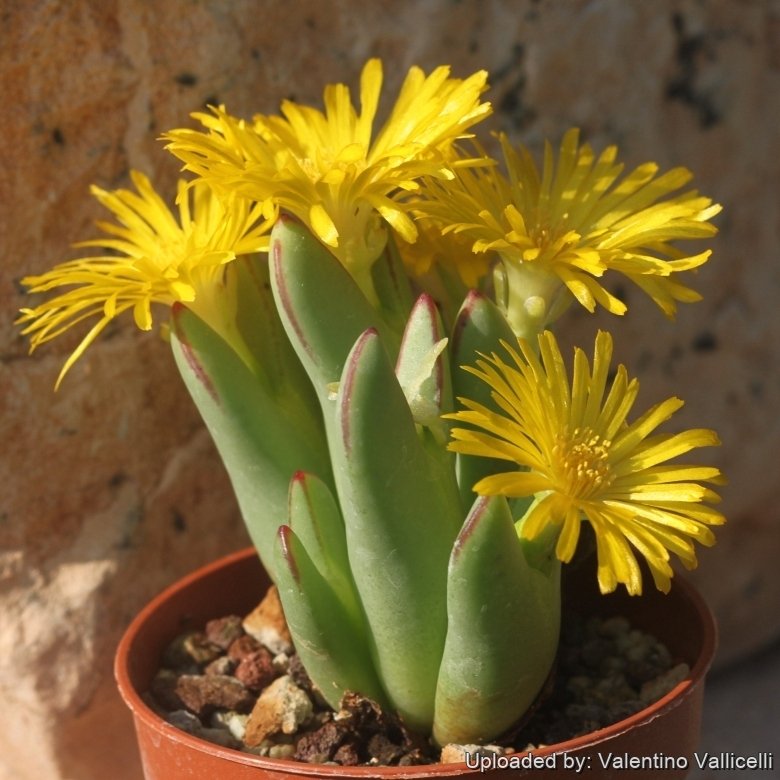
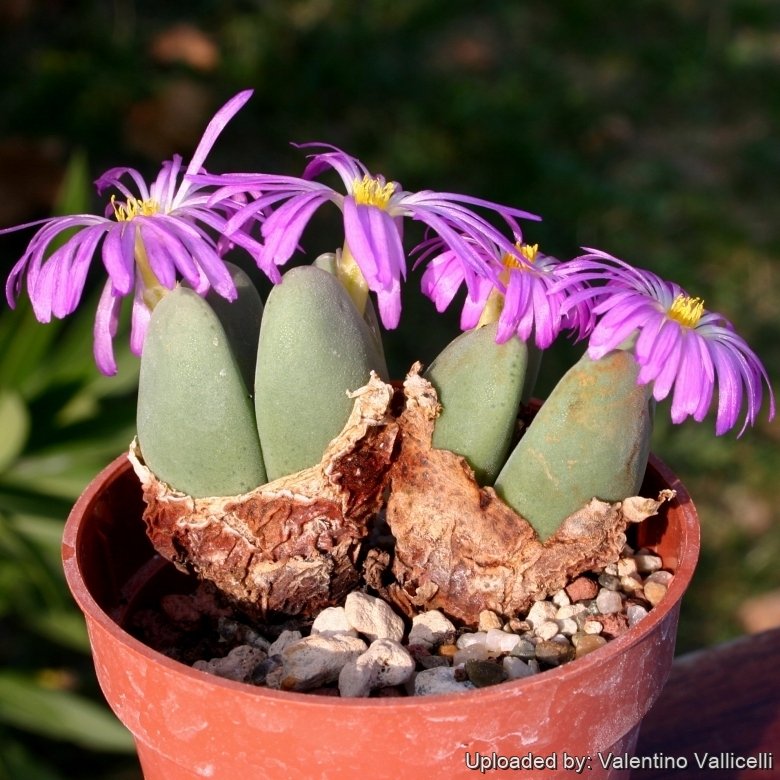
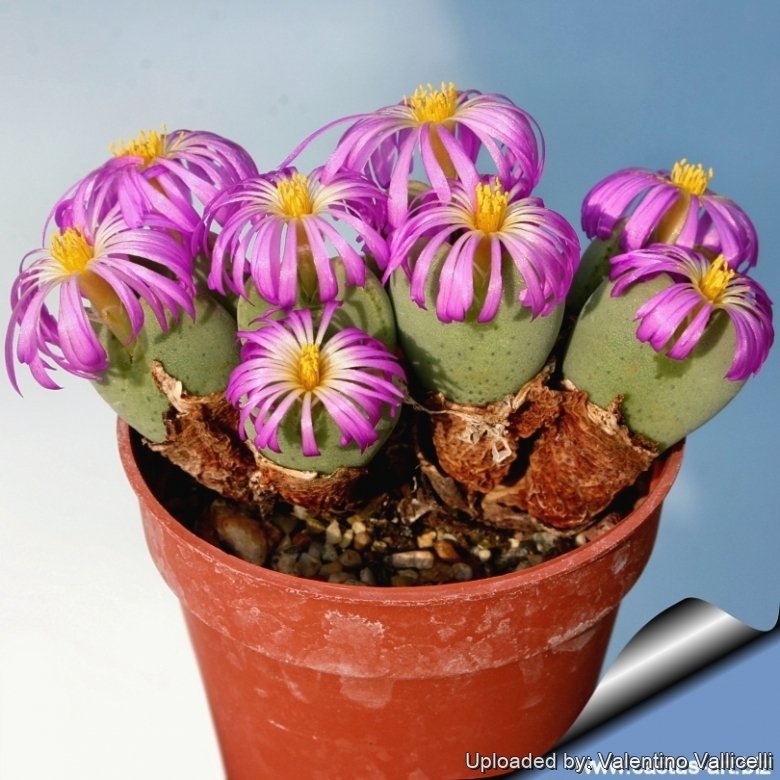
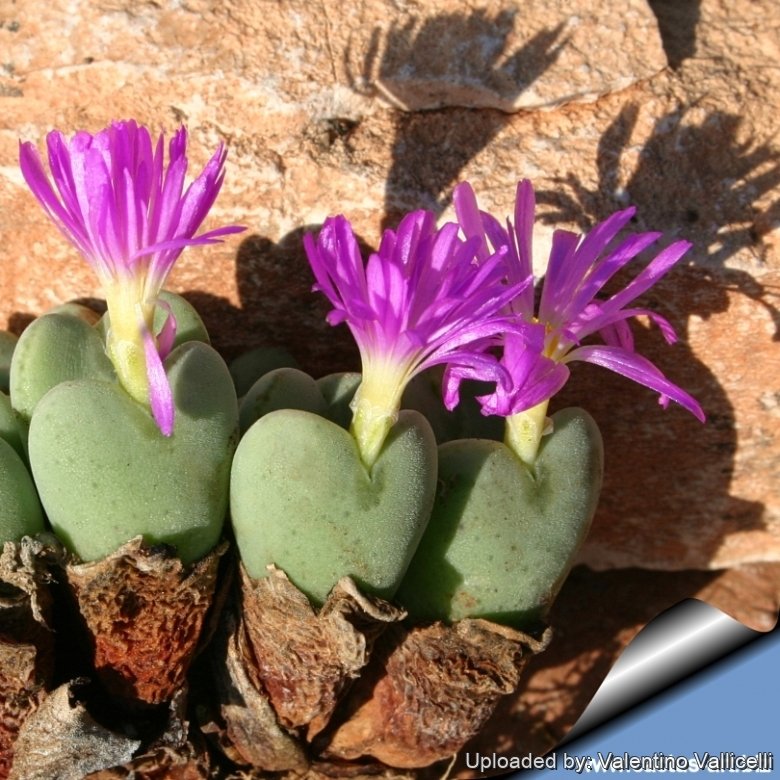
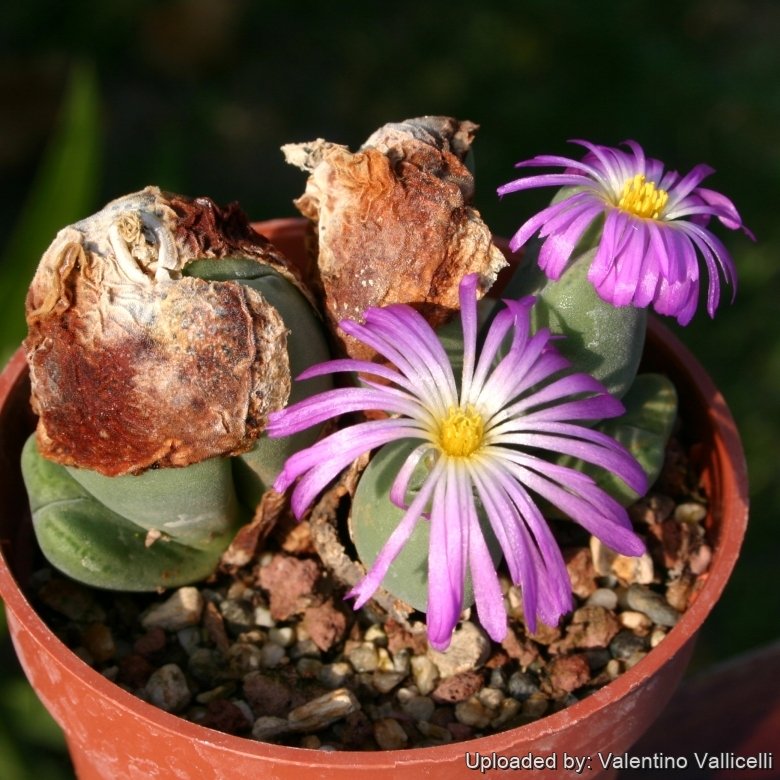
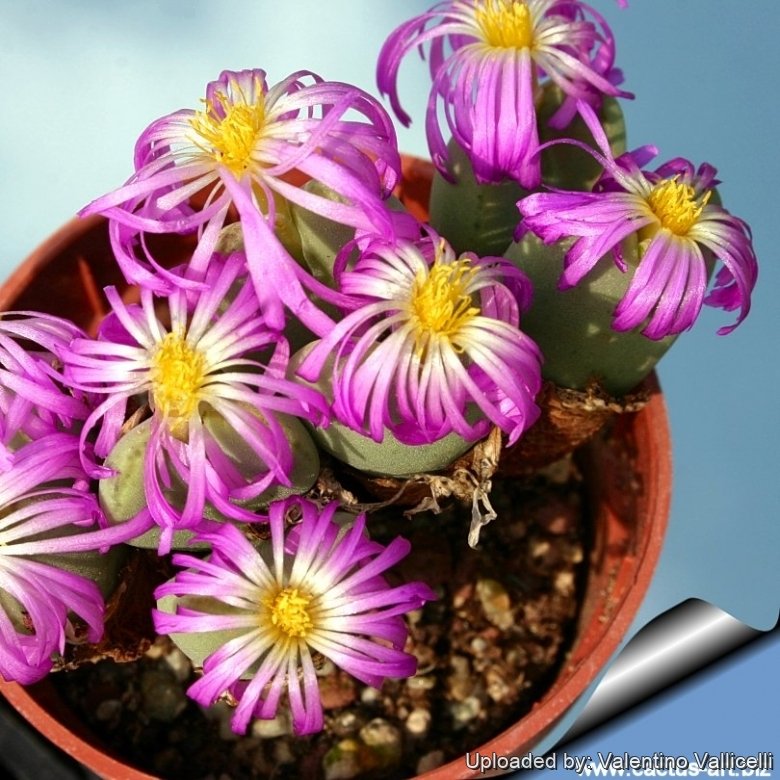
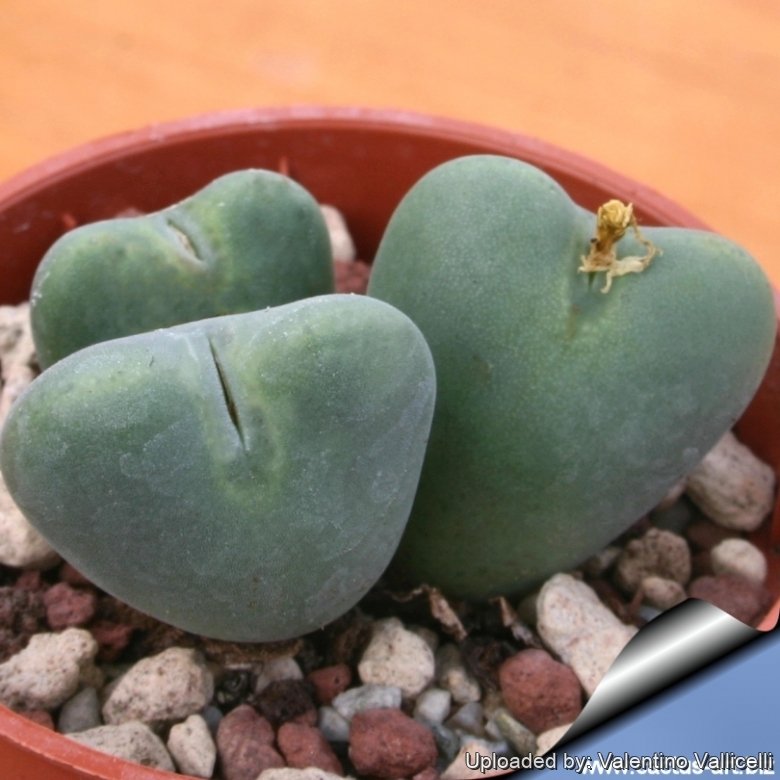
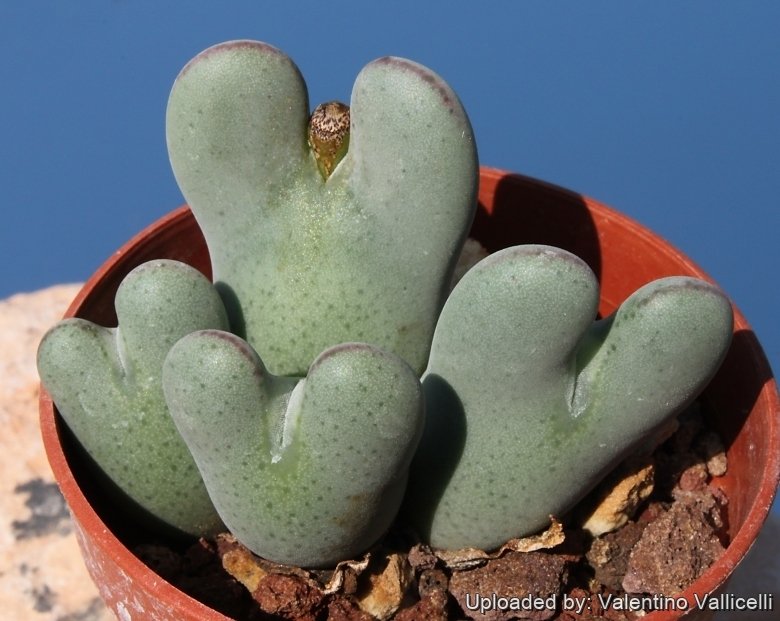
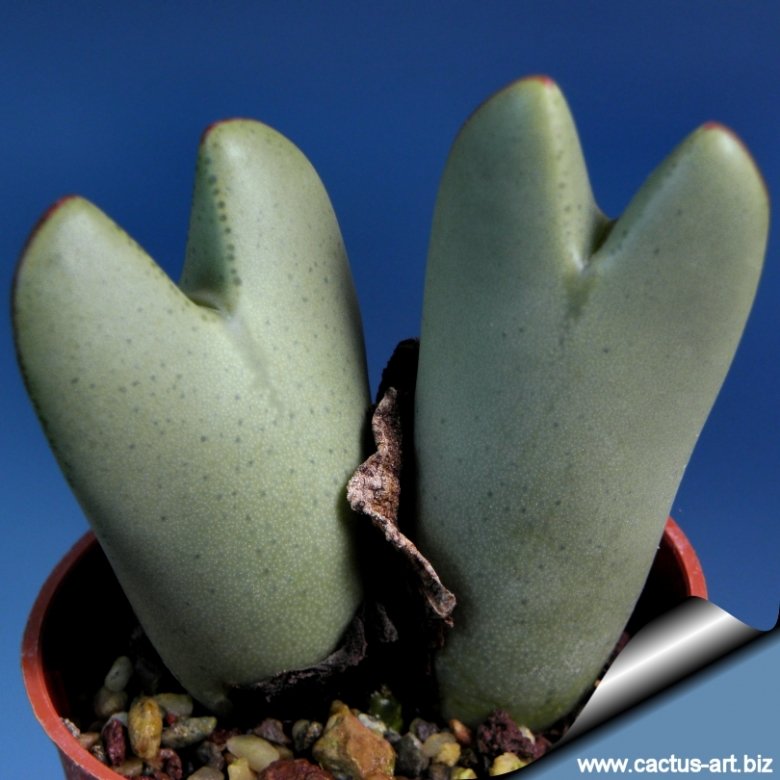
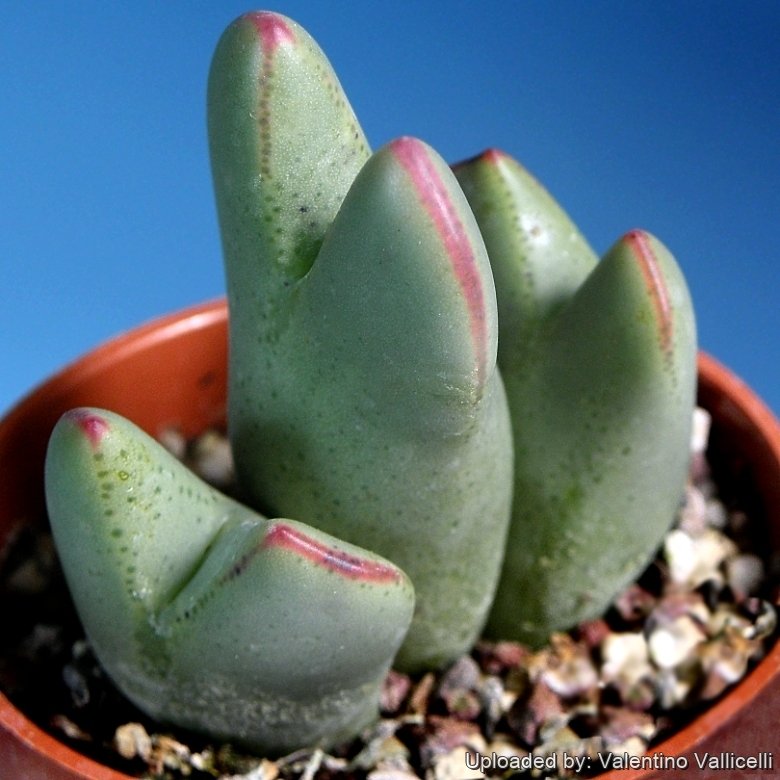
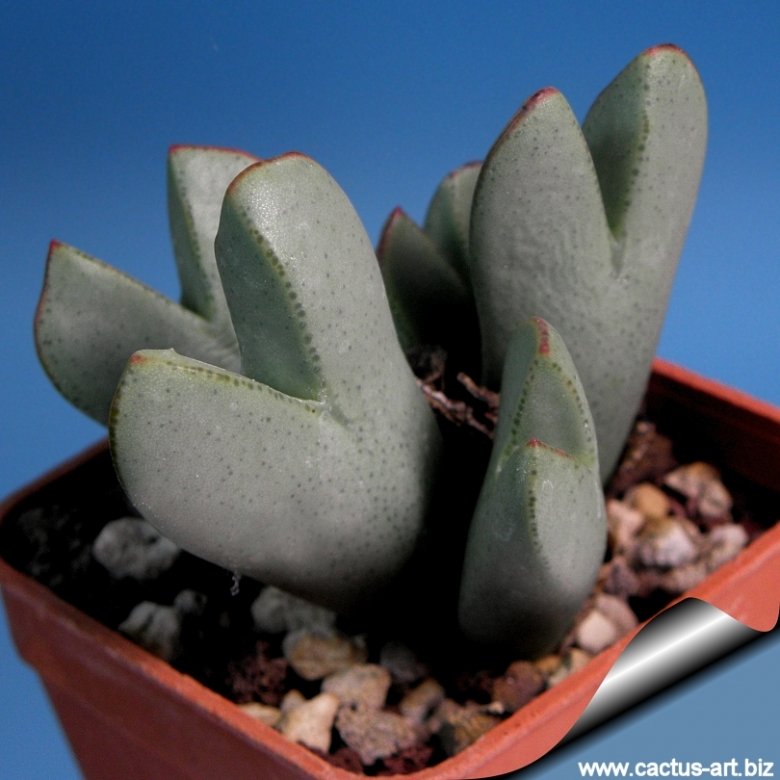
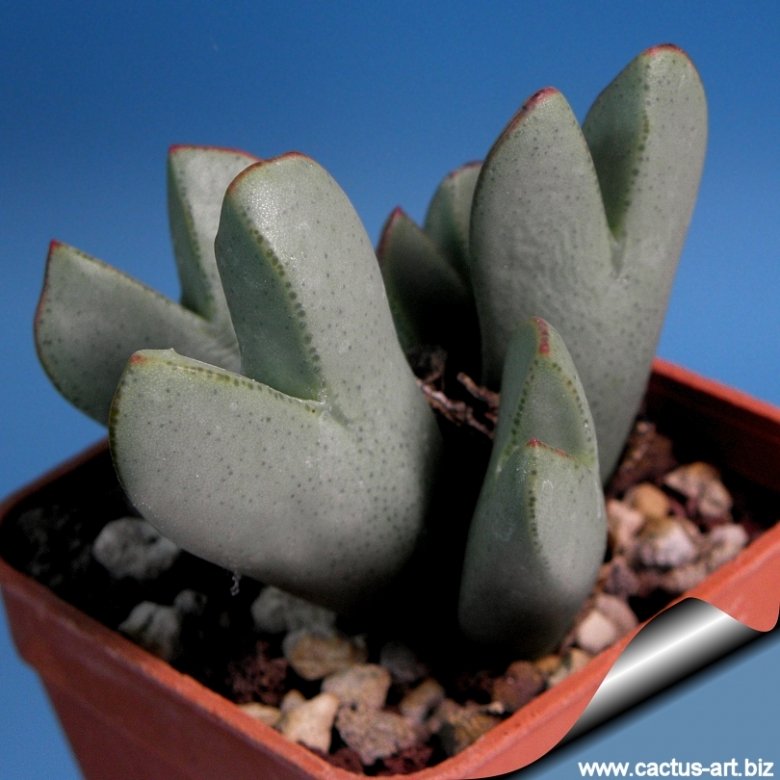
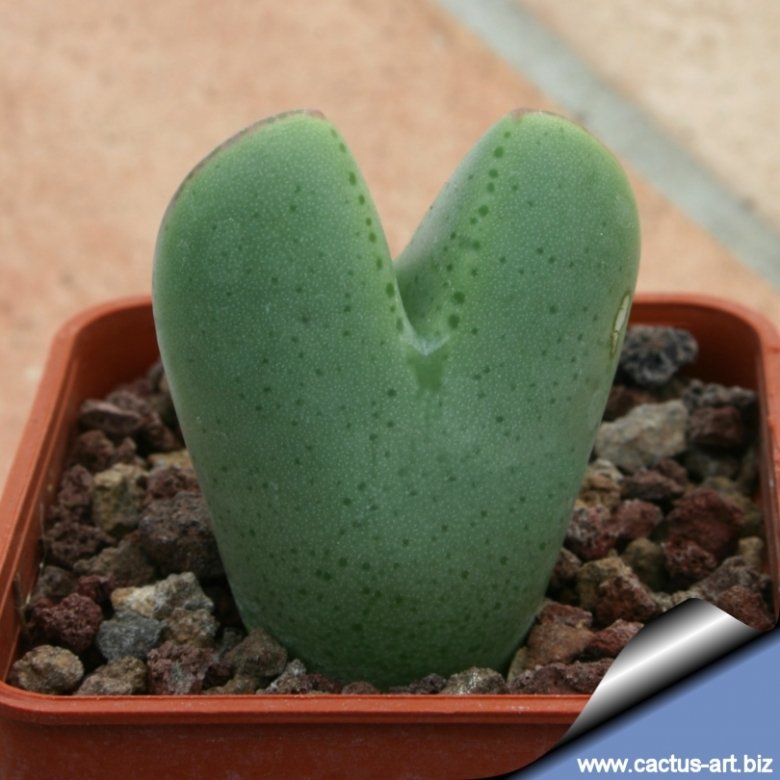
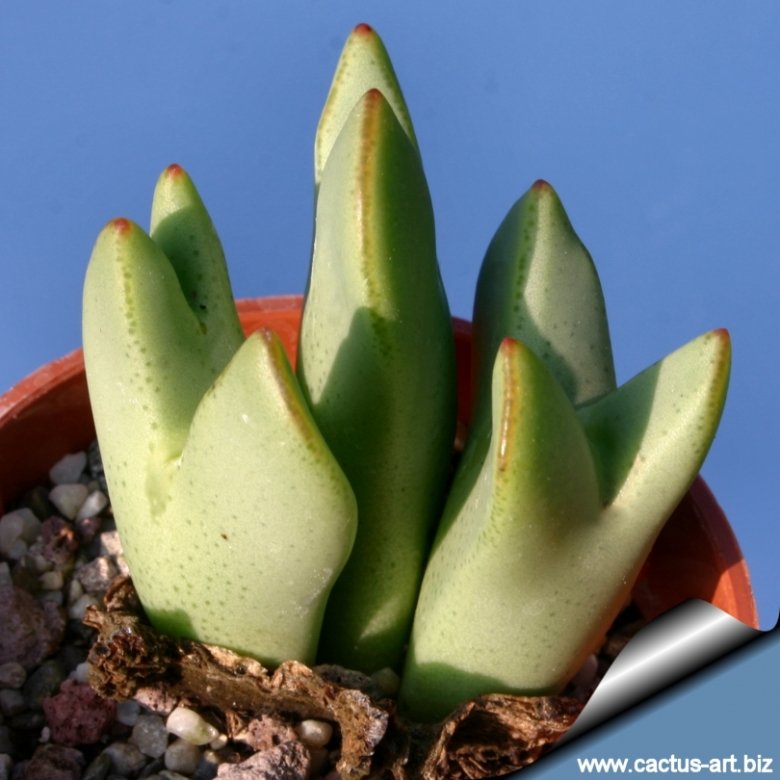
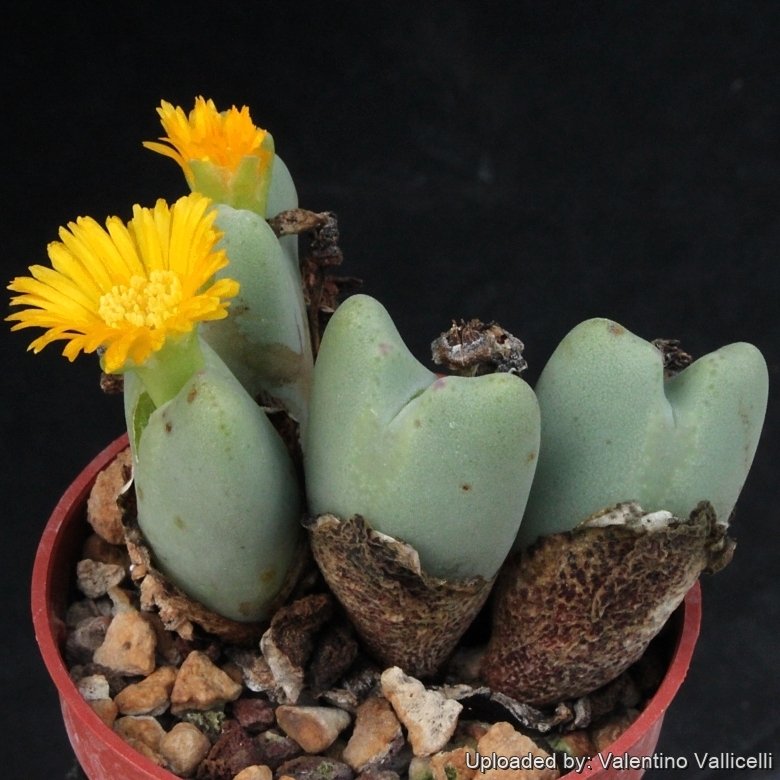
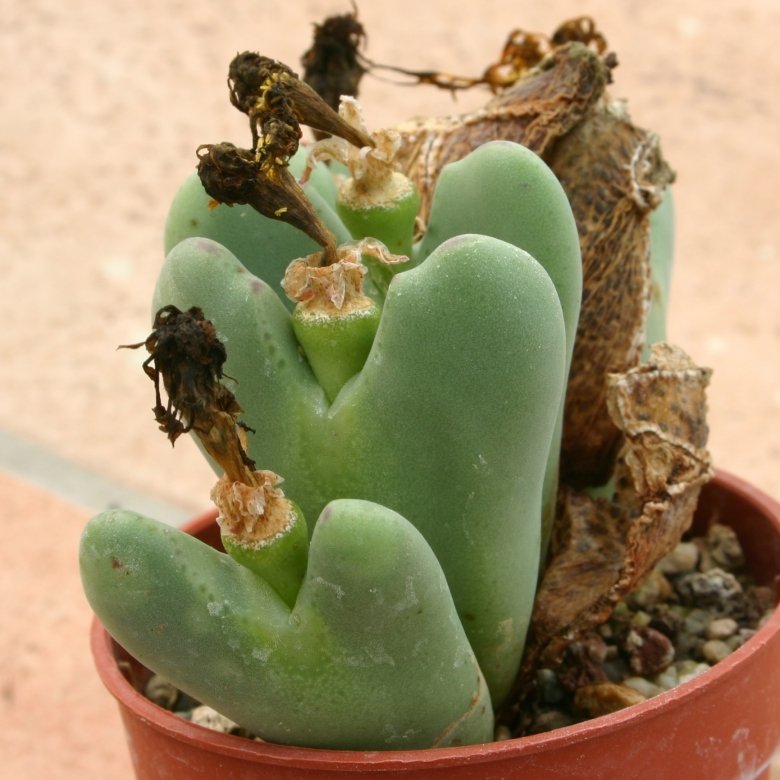
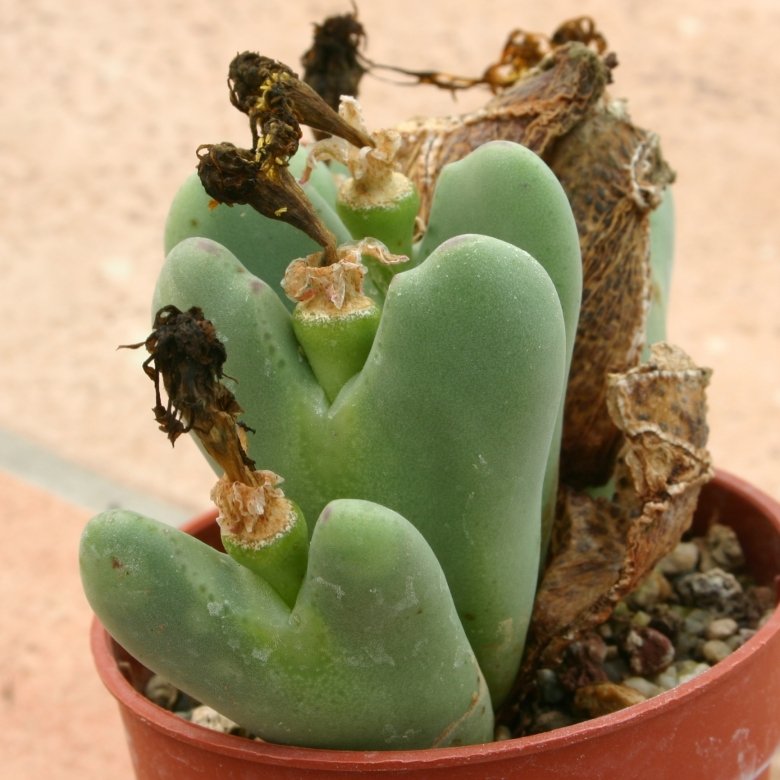
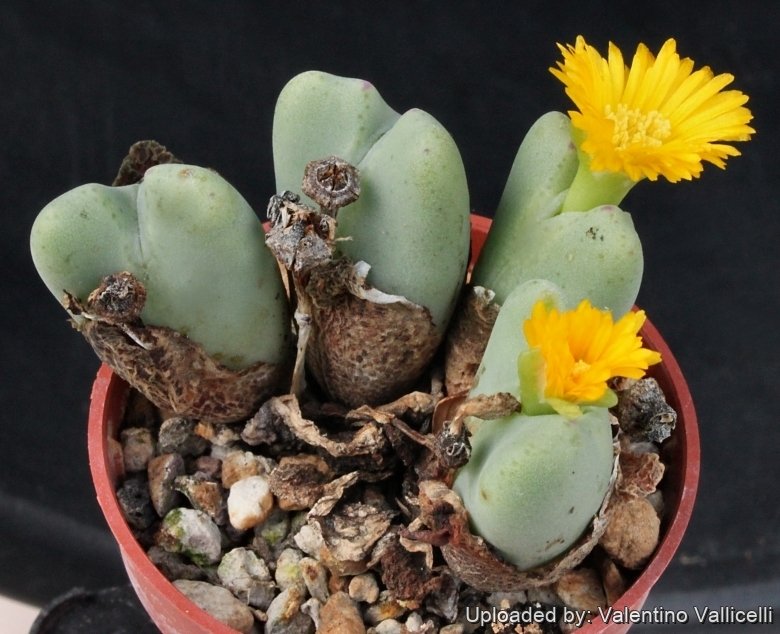
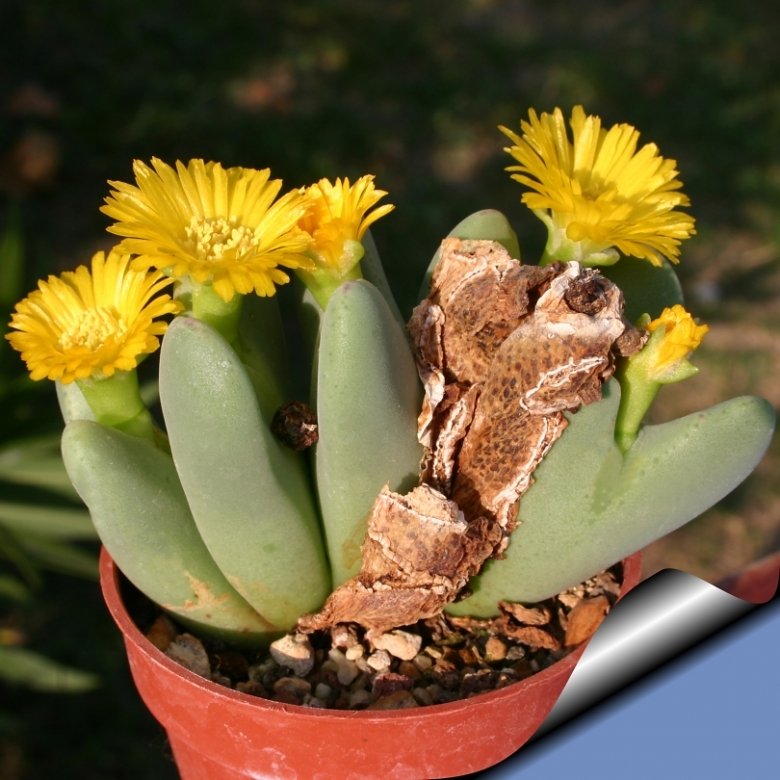
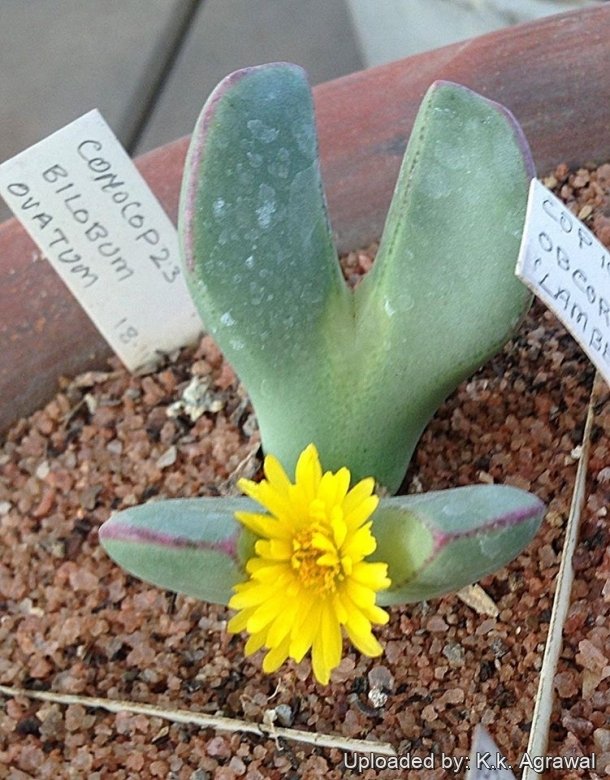
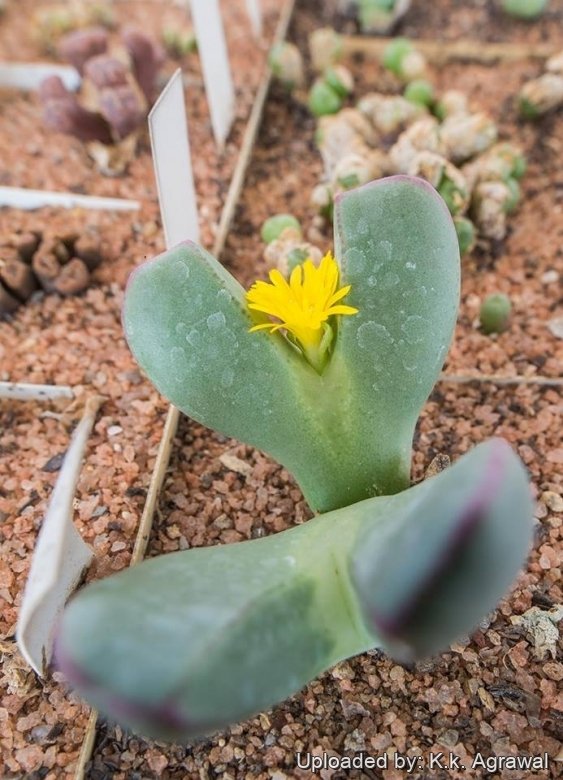
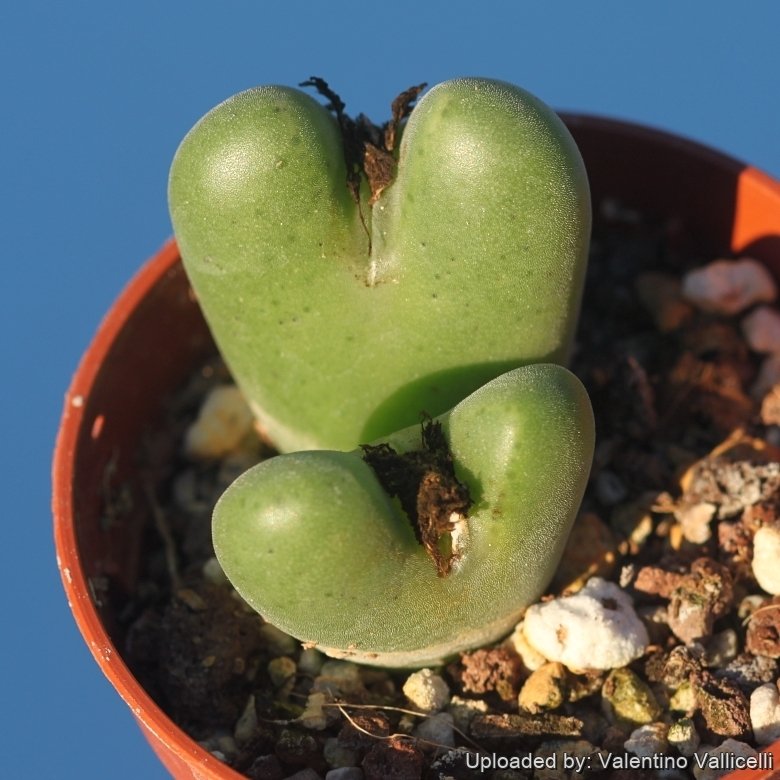
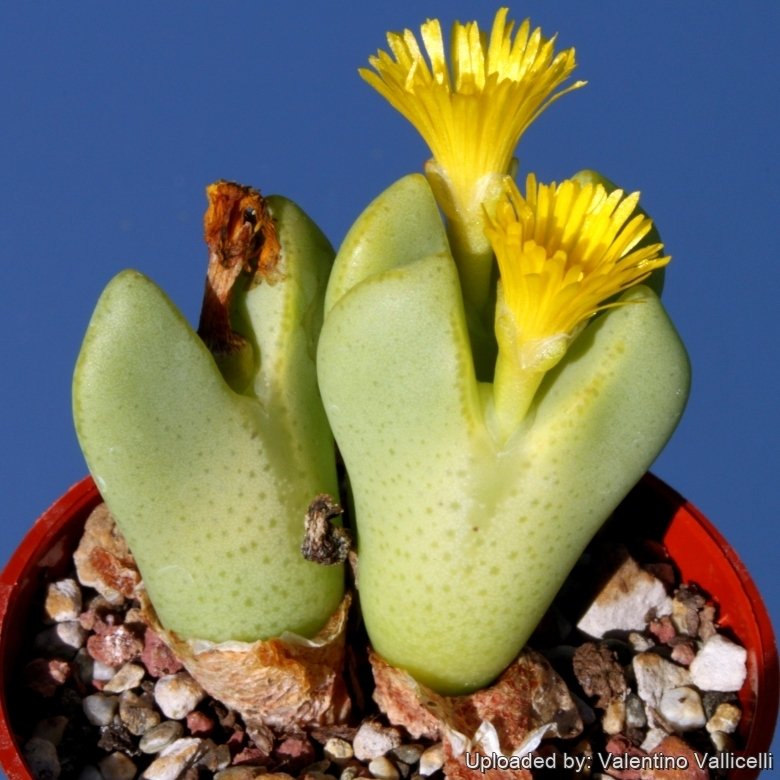
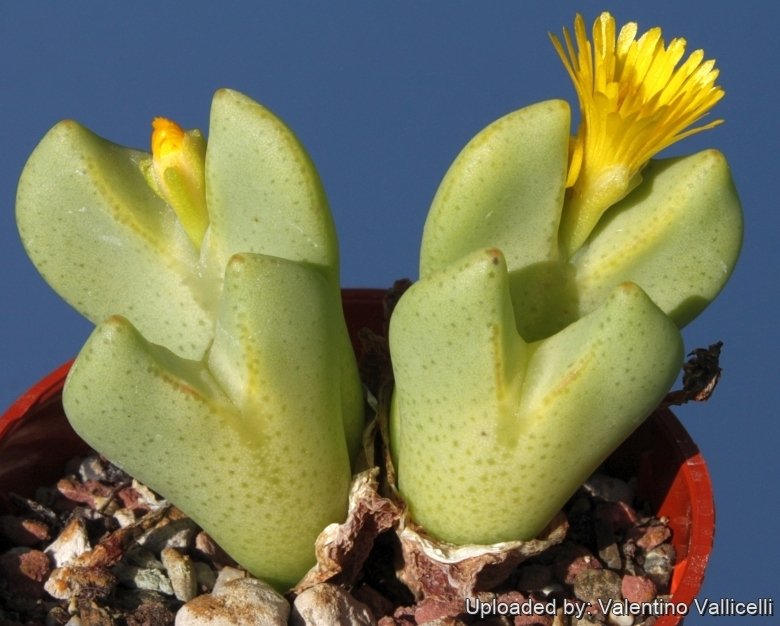
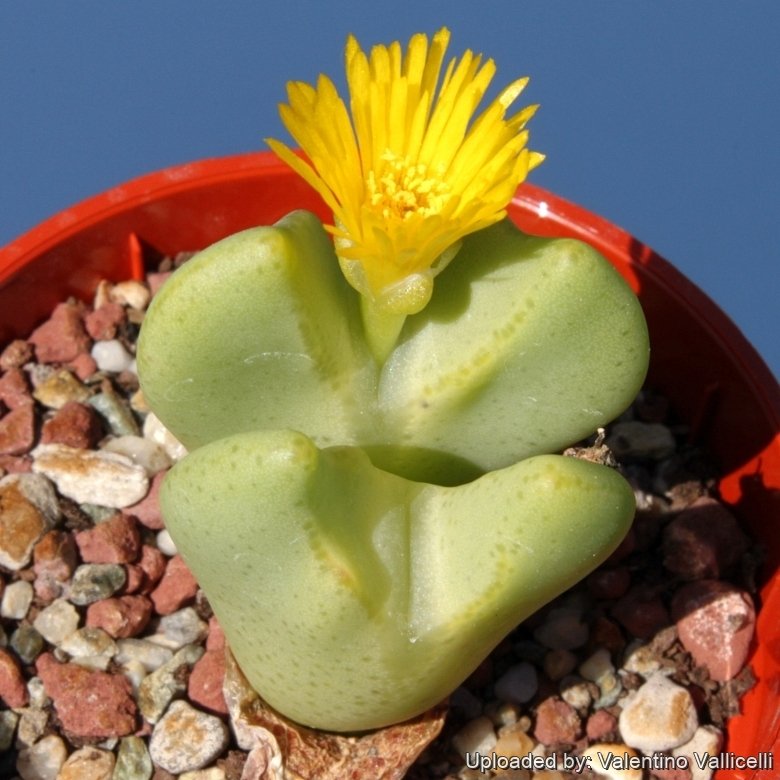
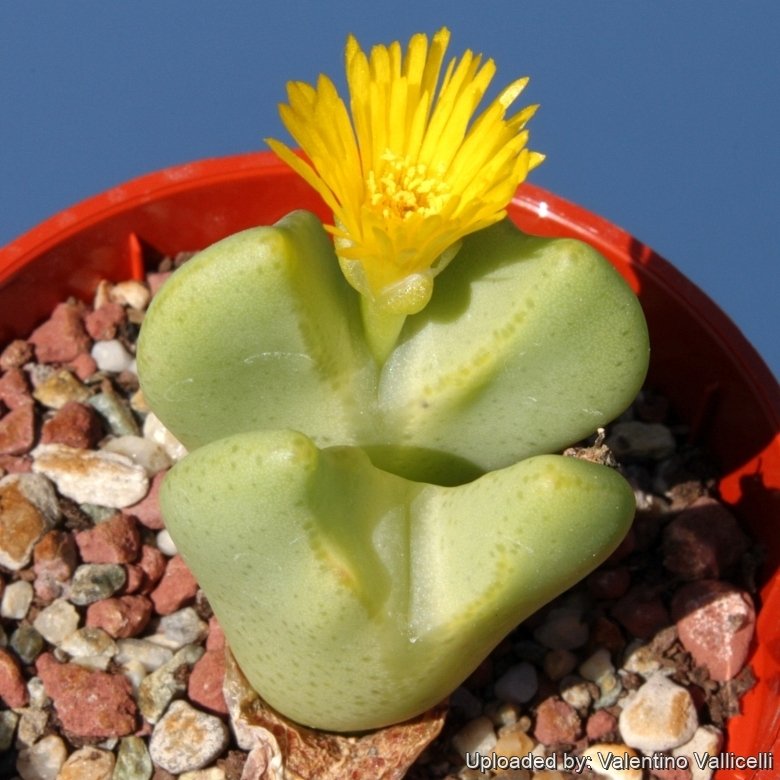
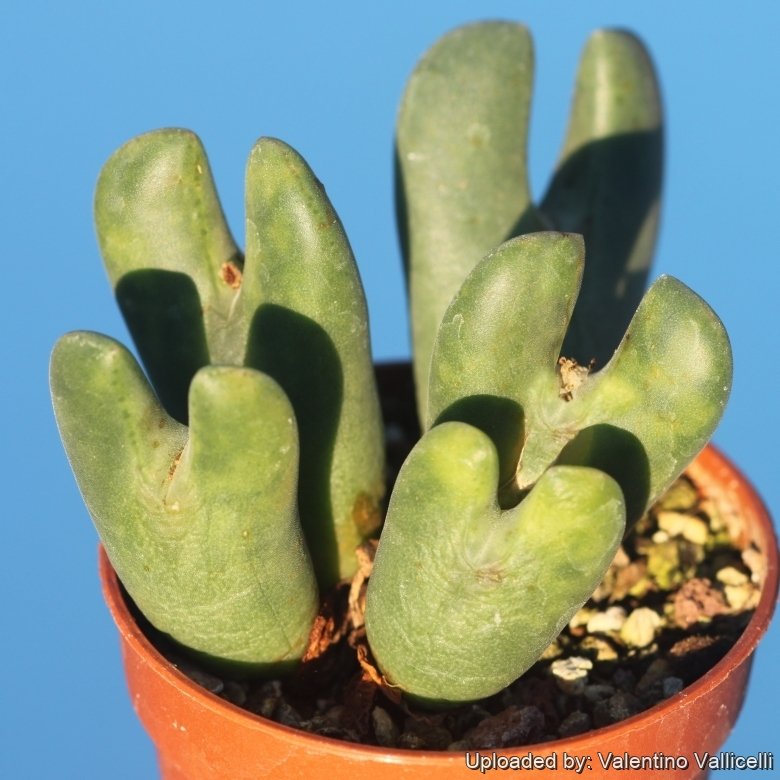
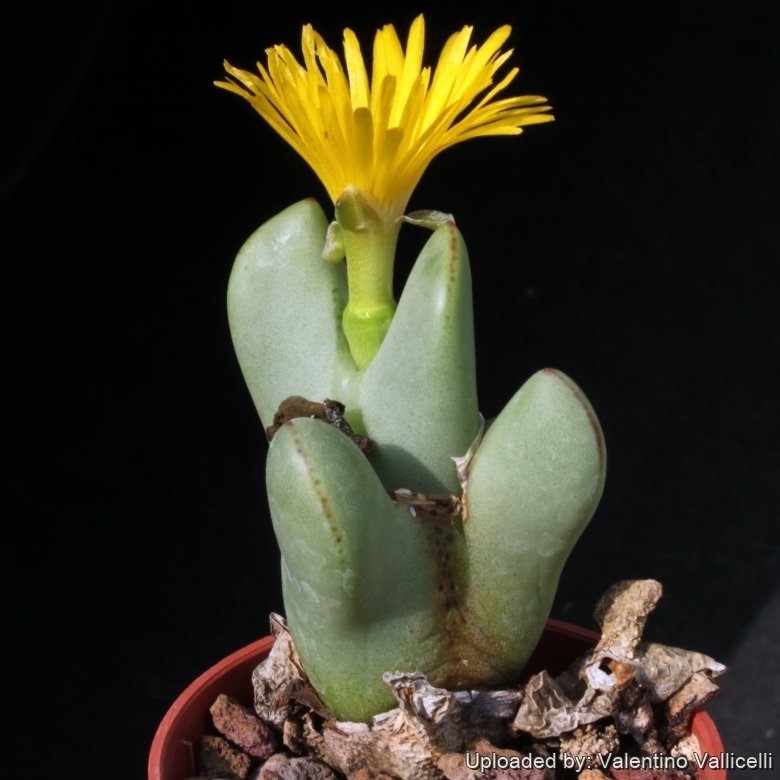
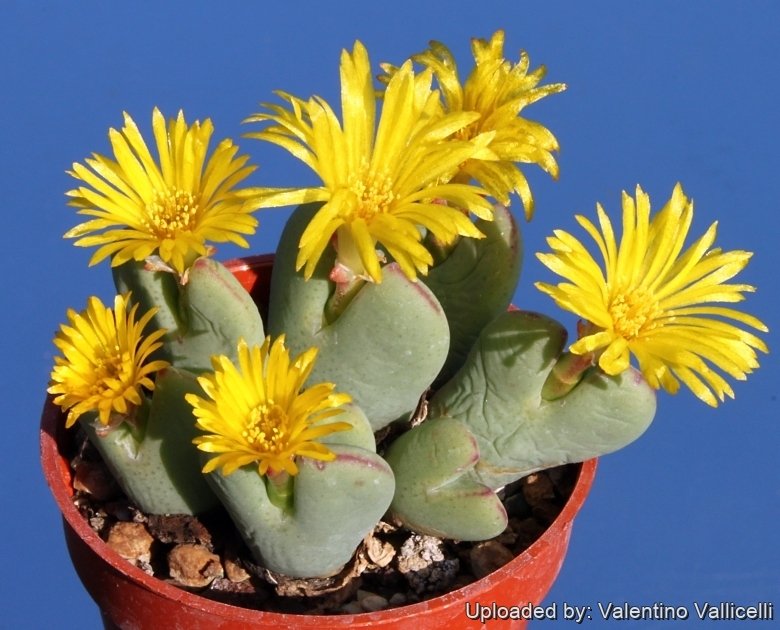
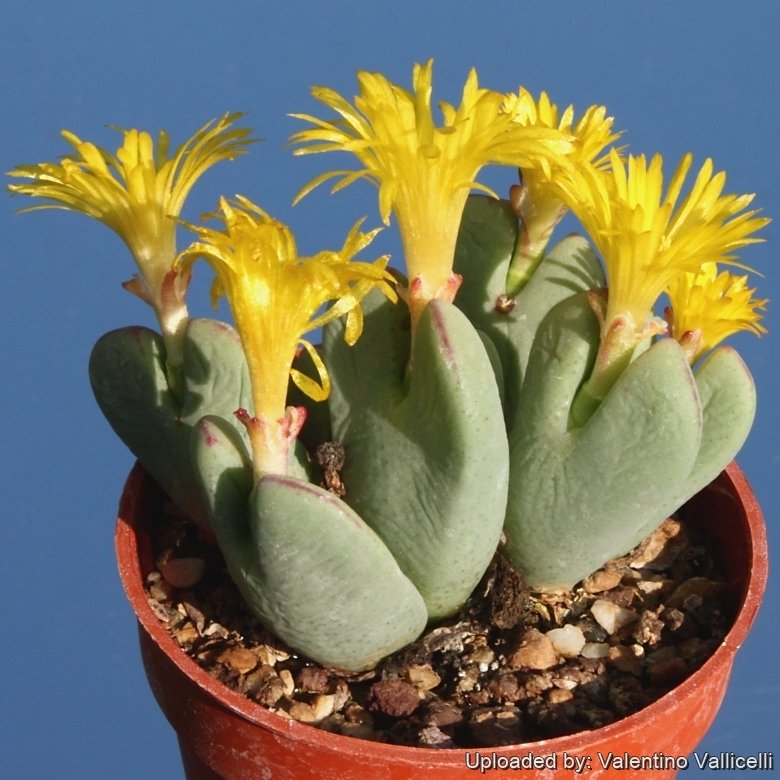
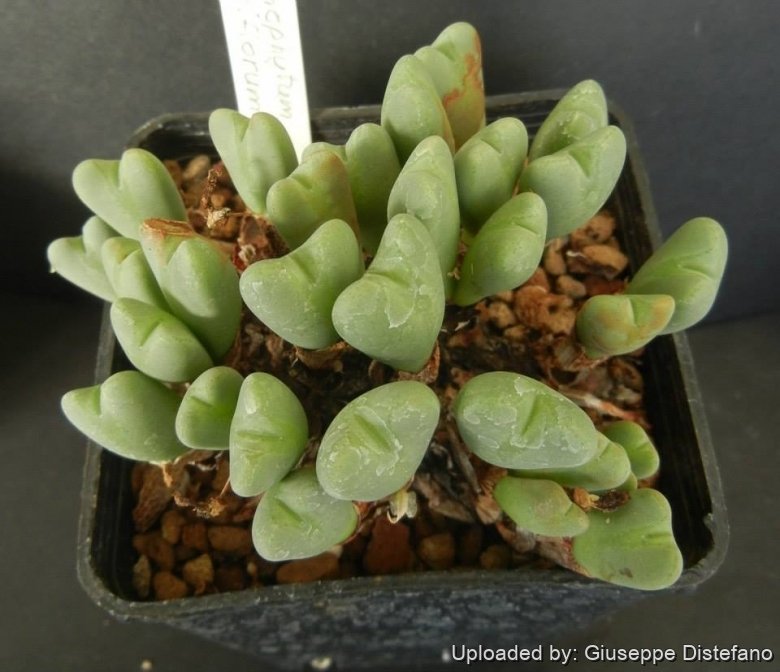
Conophytum bilobum (subs. bilobum) is a robust caespitose (groundcover) plant, stemless or with short stems with time. This plant is one of the most widespread and morphologically variable taxon of the genus. Many of its morphological and geographical variant was early classified as different independent species, but nowadays all this plant are considered part of a multiform species, where each form is linked to others by populations of plants with intermediate characteristics.
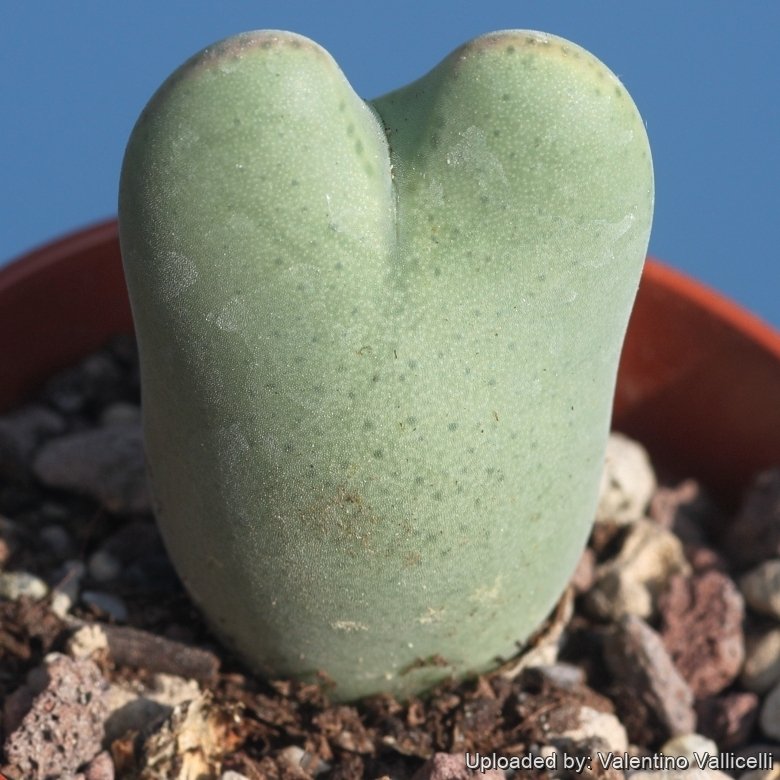
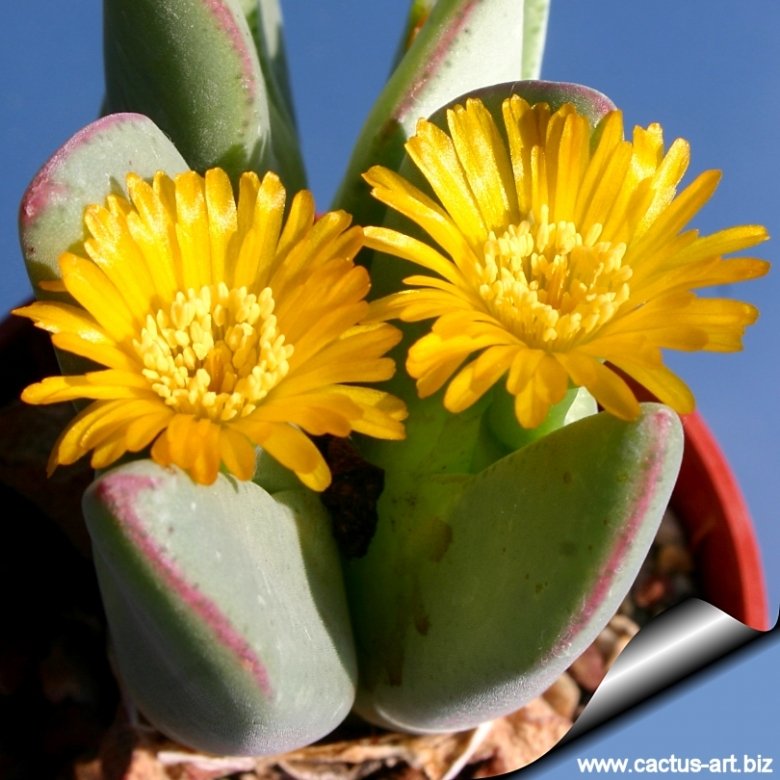
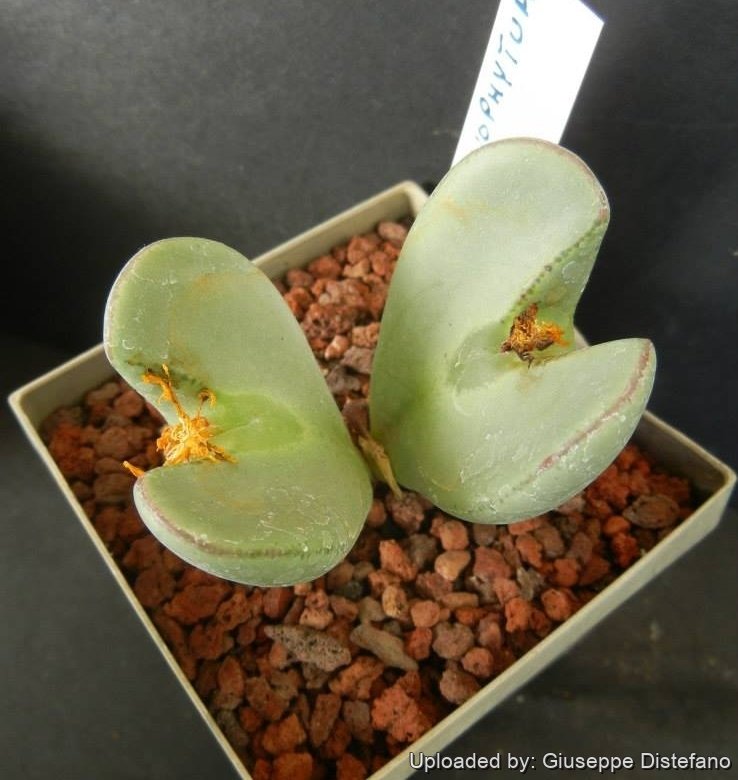
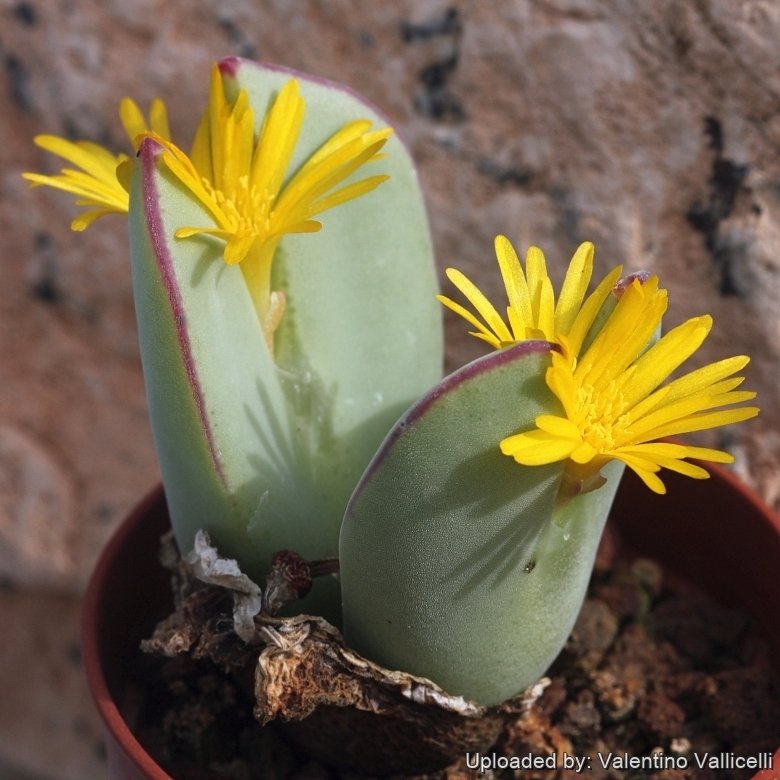
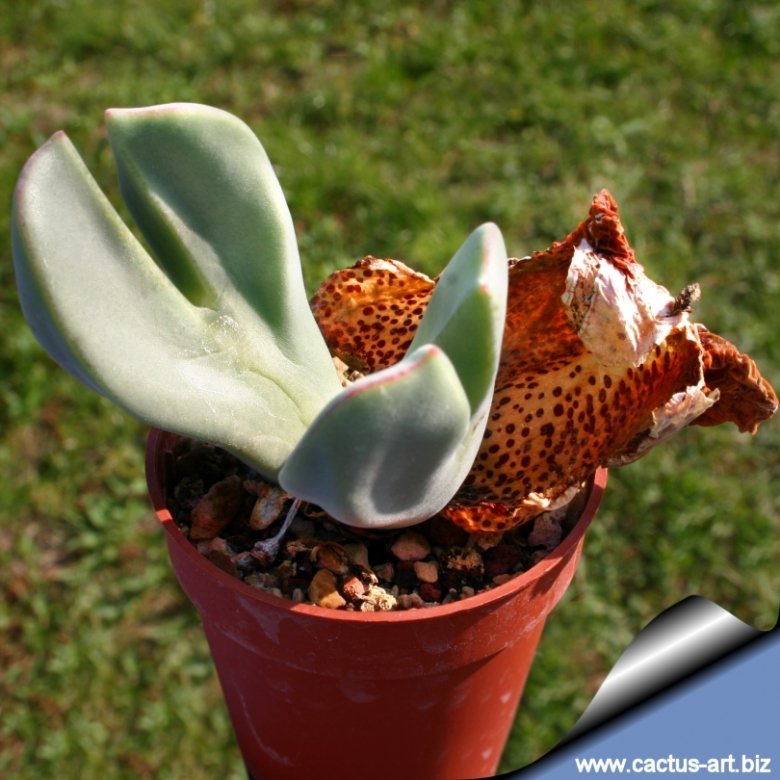
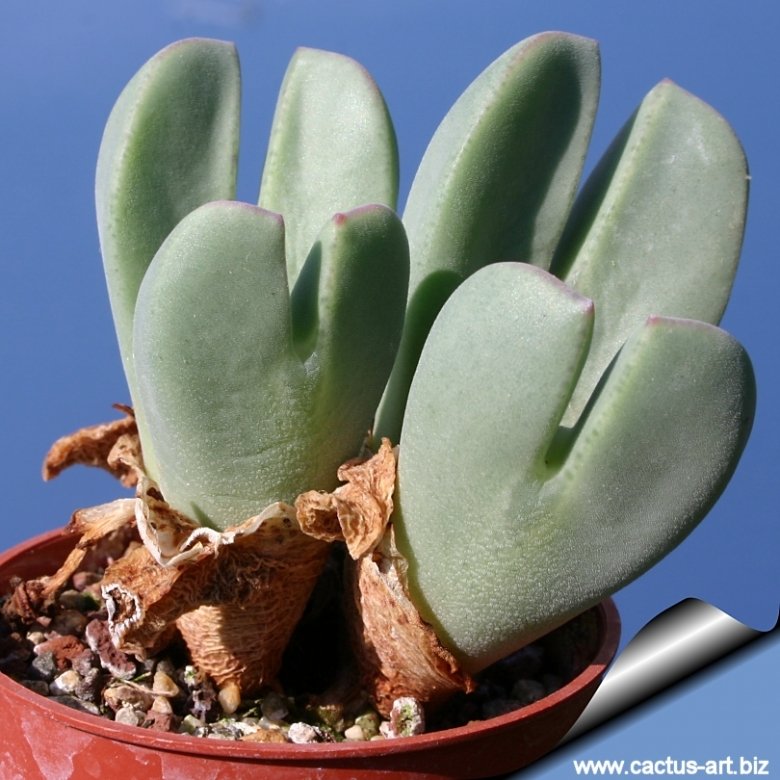
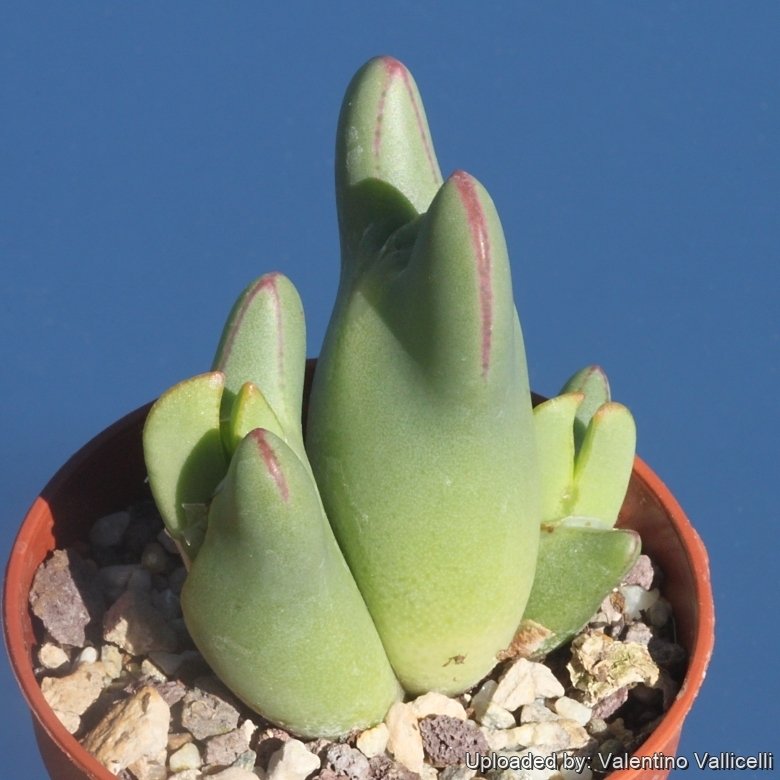
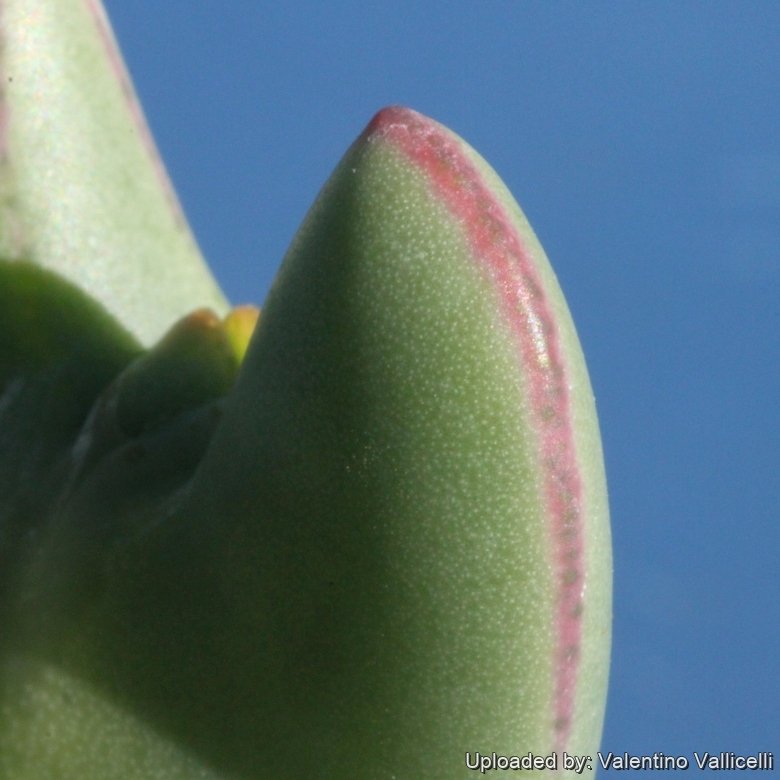
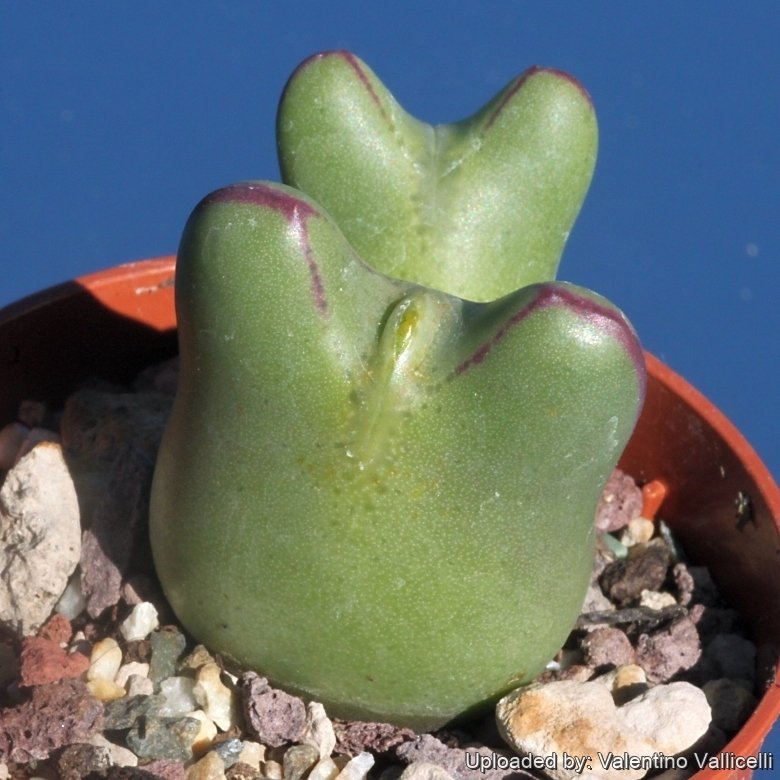
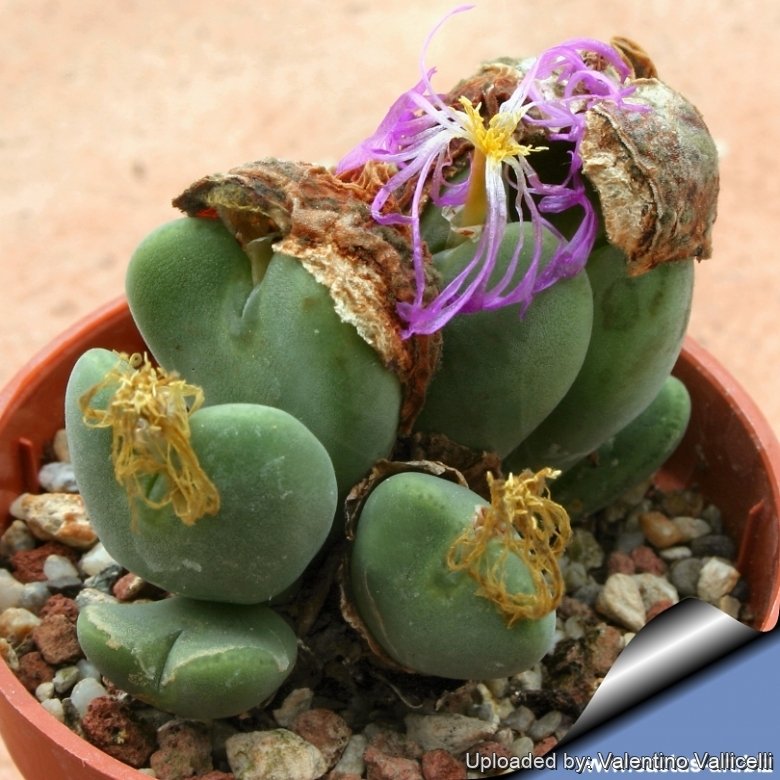
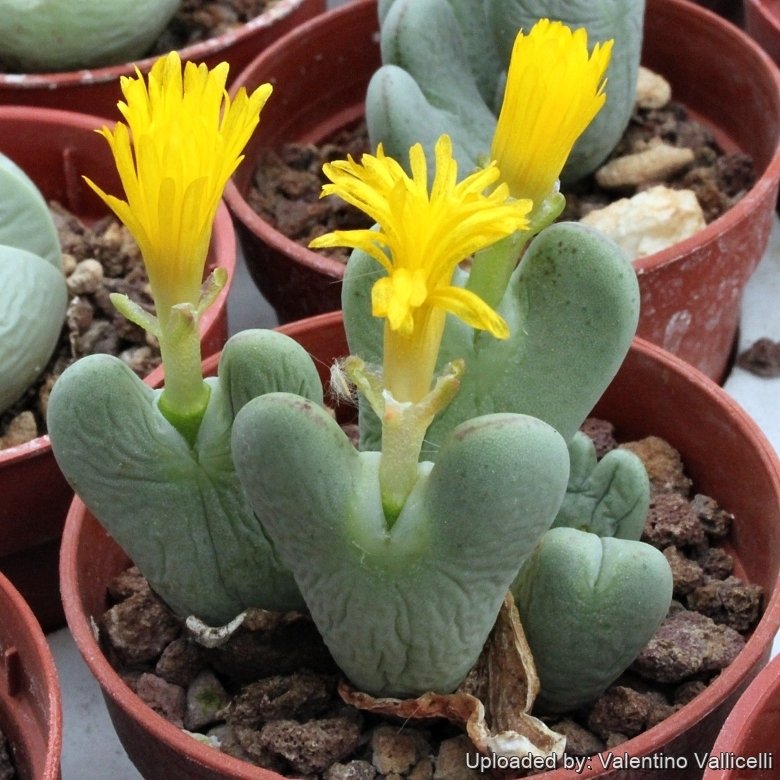
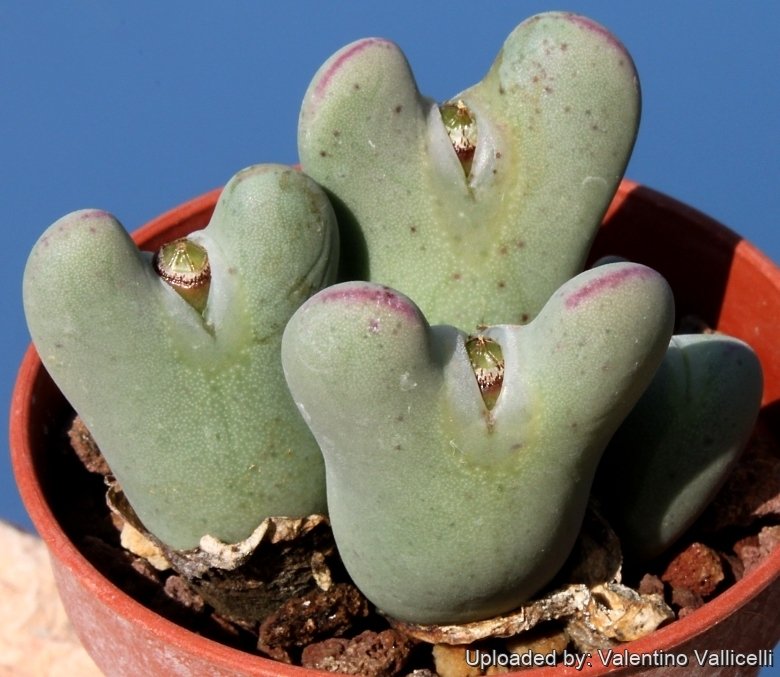
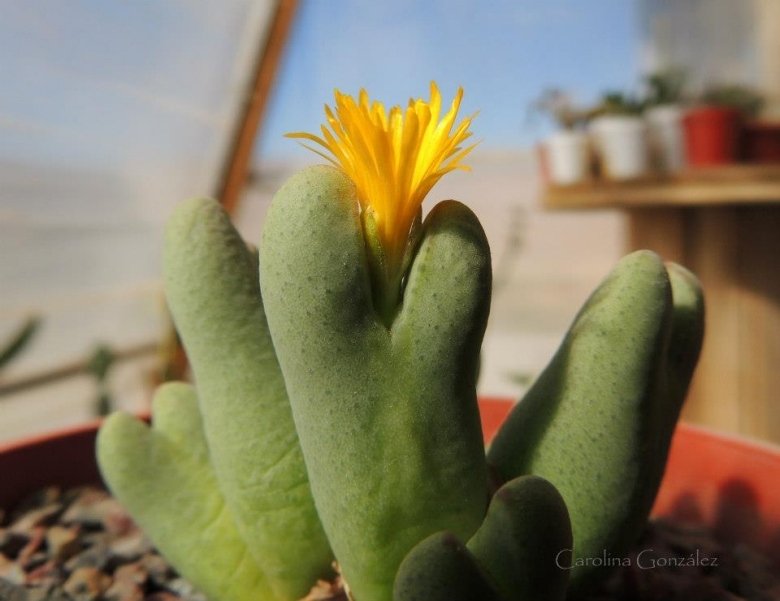
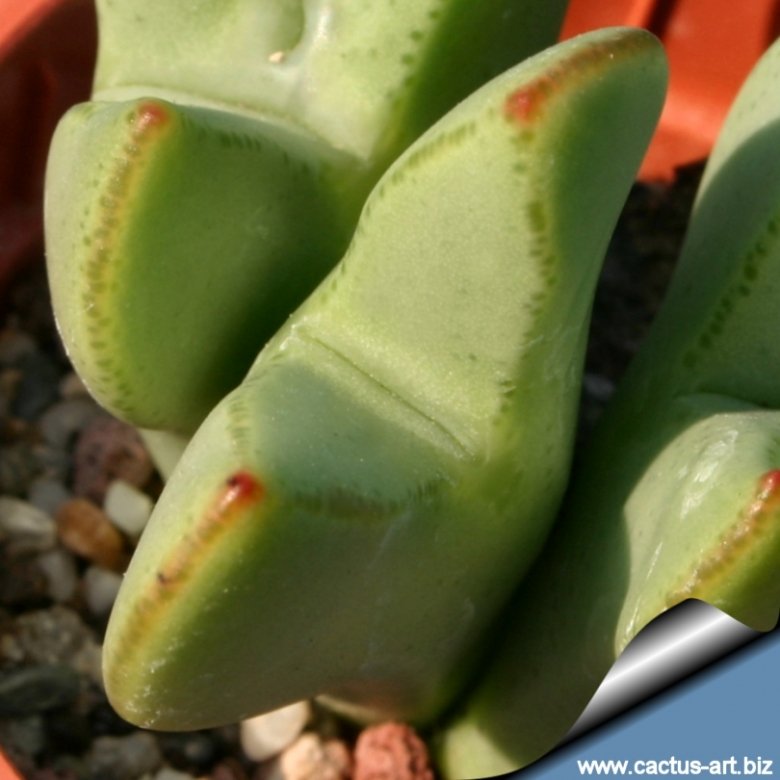
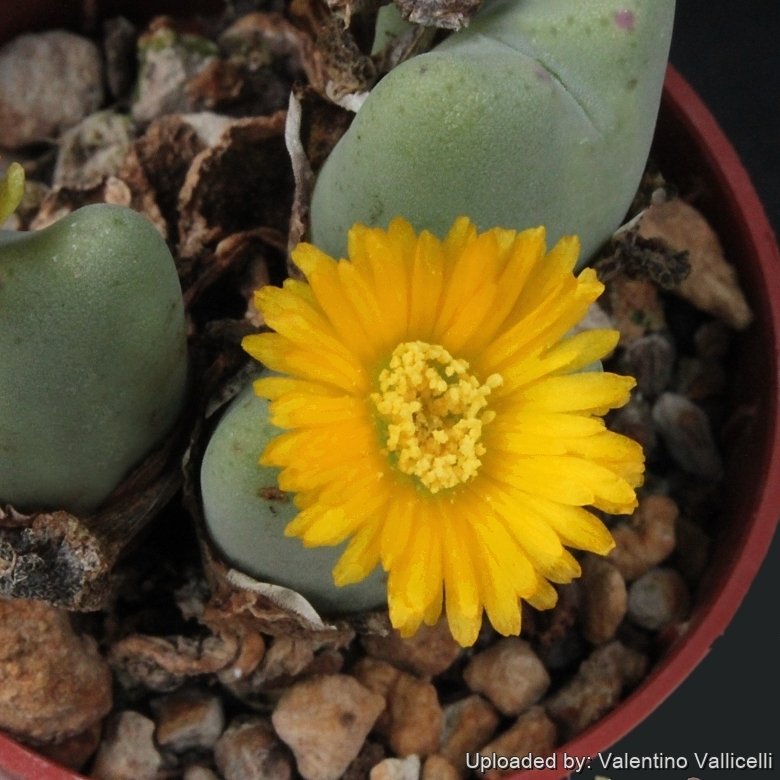
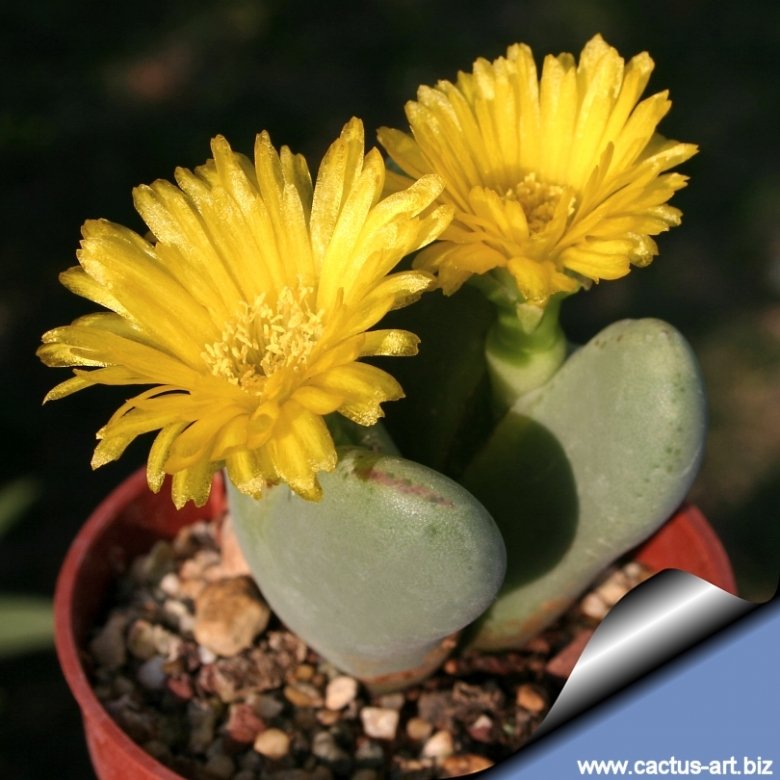
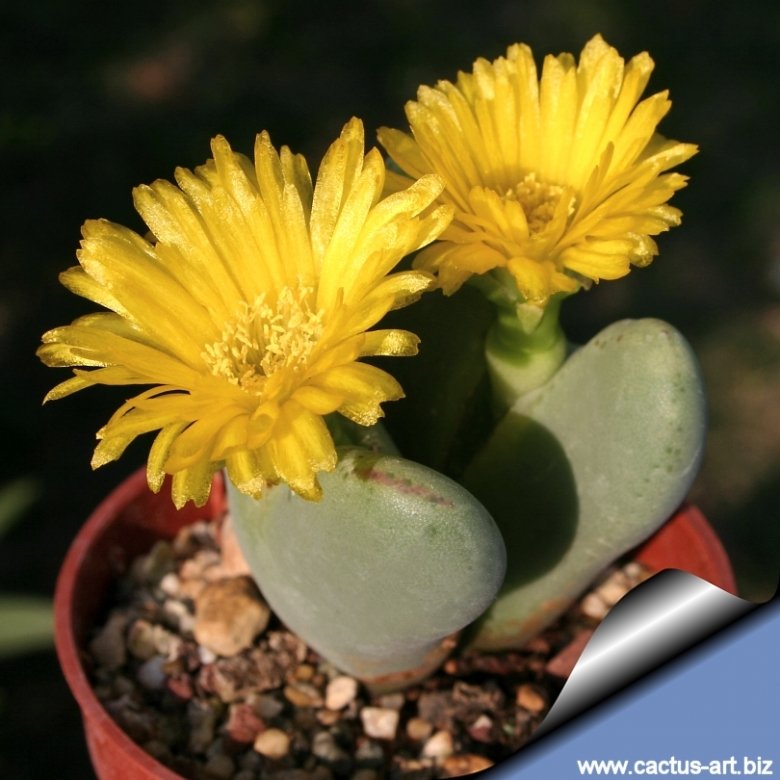
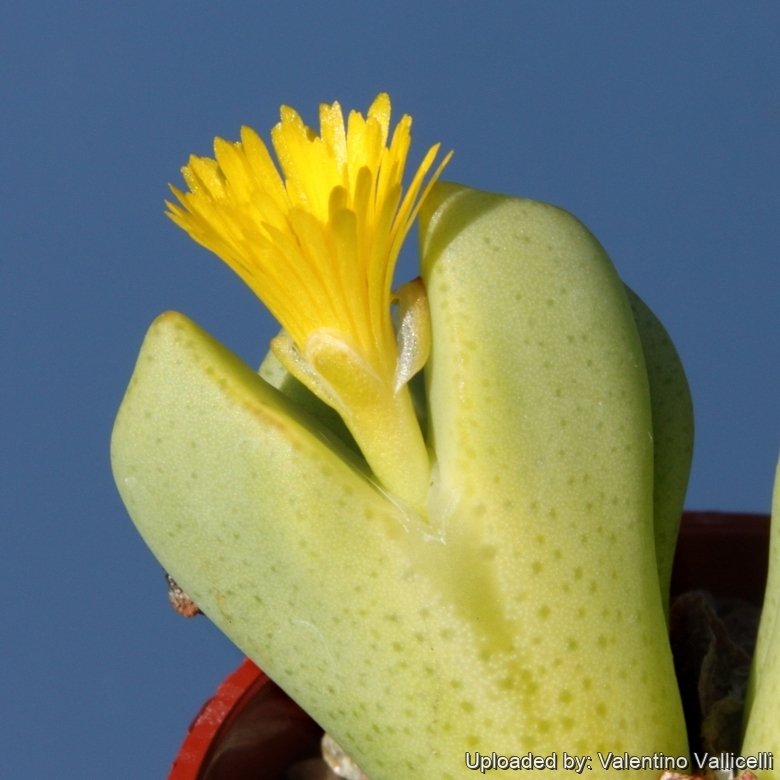
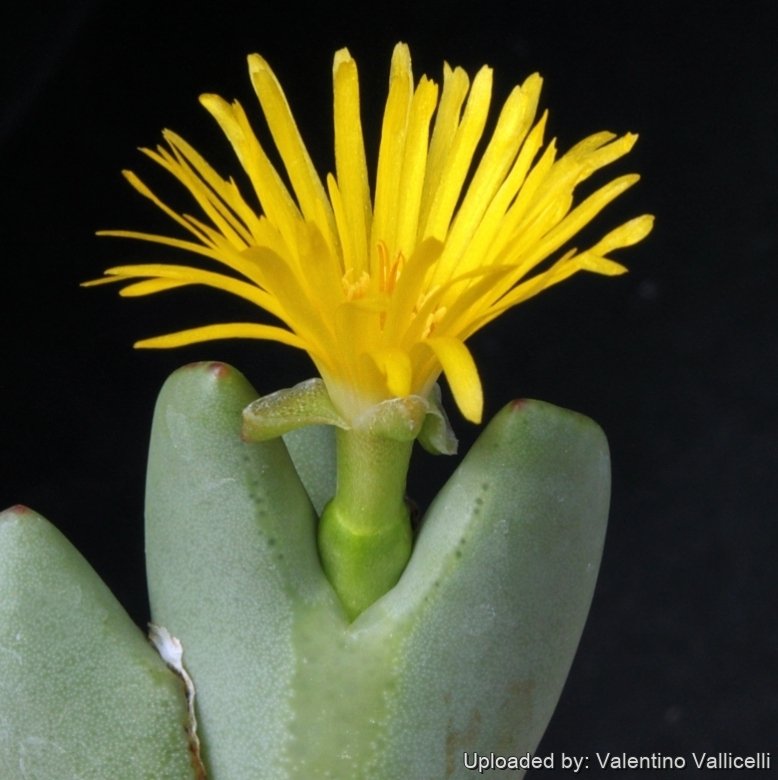
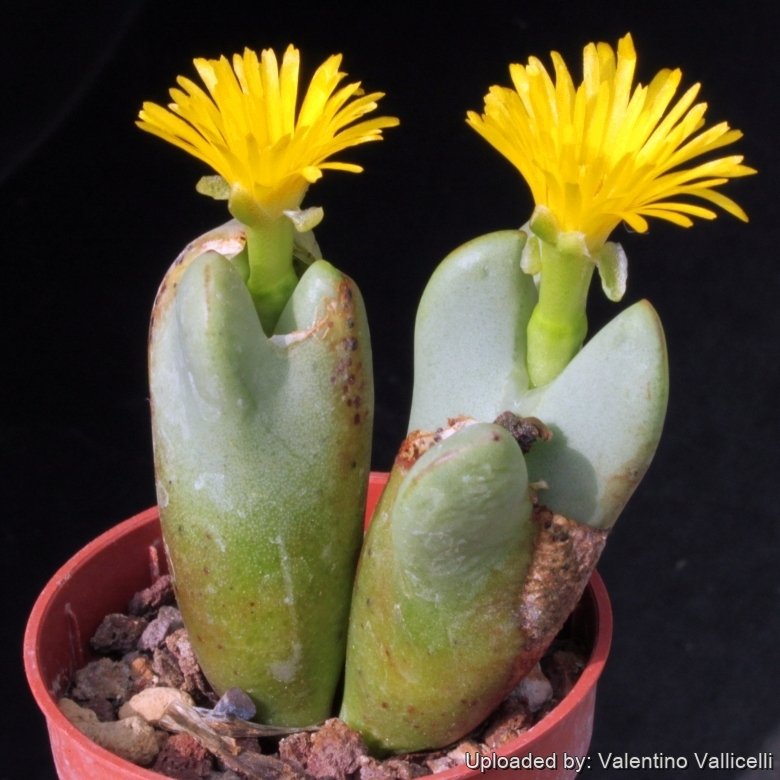
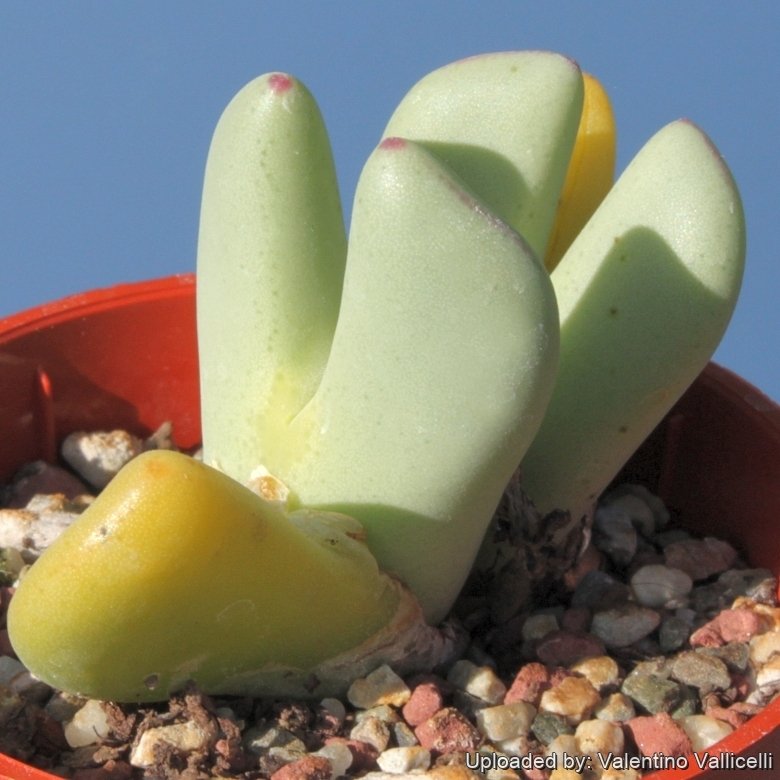
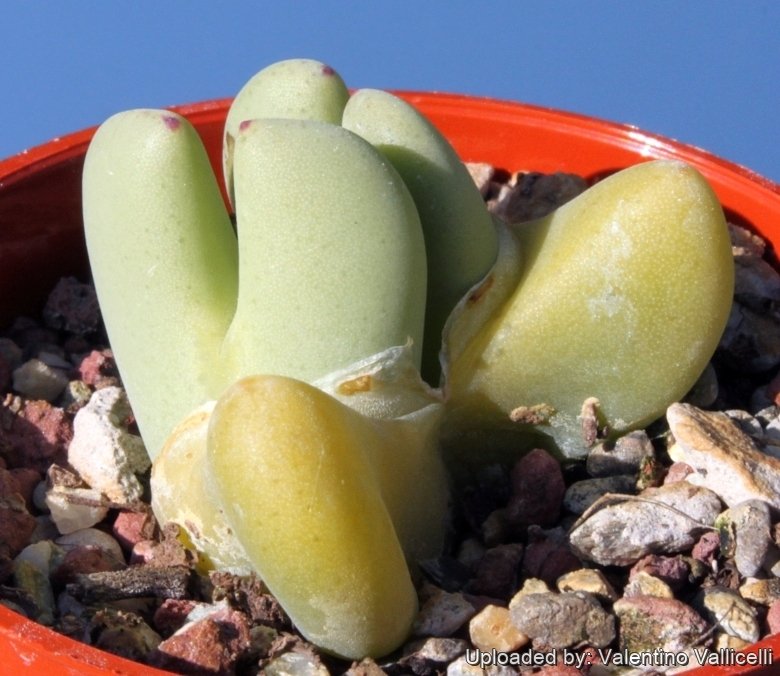
Bodies (paired leaves): Thickness: 3 centimetres Height: 7 centimetres, Profile: The leaf-tips (lobes) are free and are 10 mm long and triangular in shape and keeled. Colours: The margins are green to red or deep purple in colour. The epidermis is glabrous to velvety or quite asperulous, it is whitish-green to glaucous to deep blue green or brownish pink in colour. The epidermis could be heavily spotted or completey smooth.
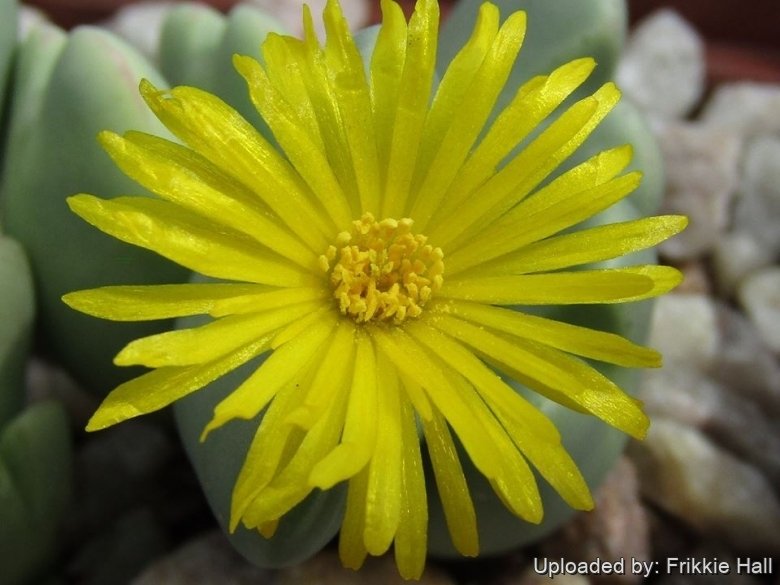
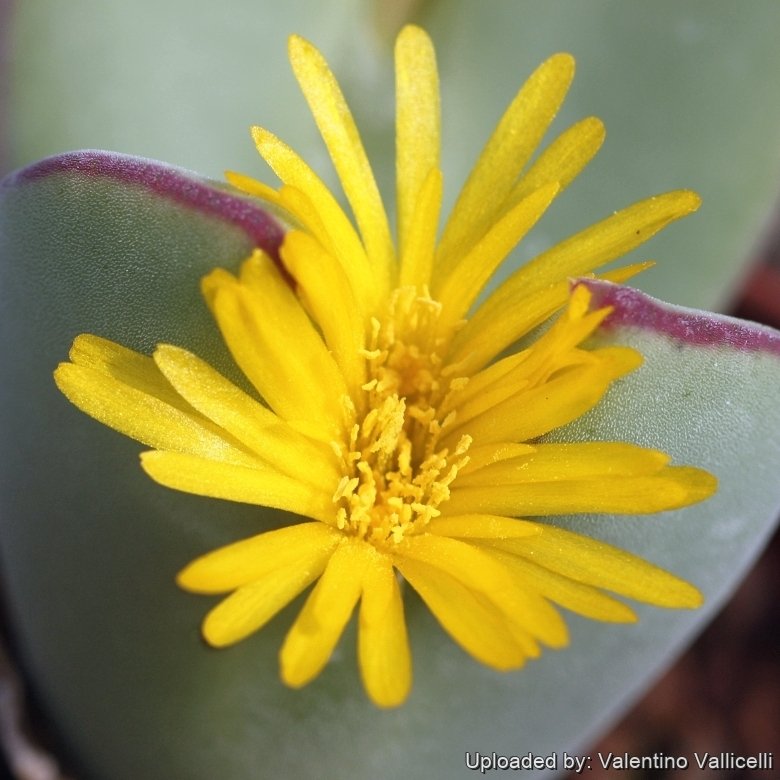
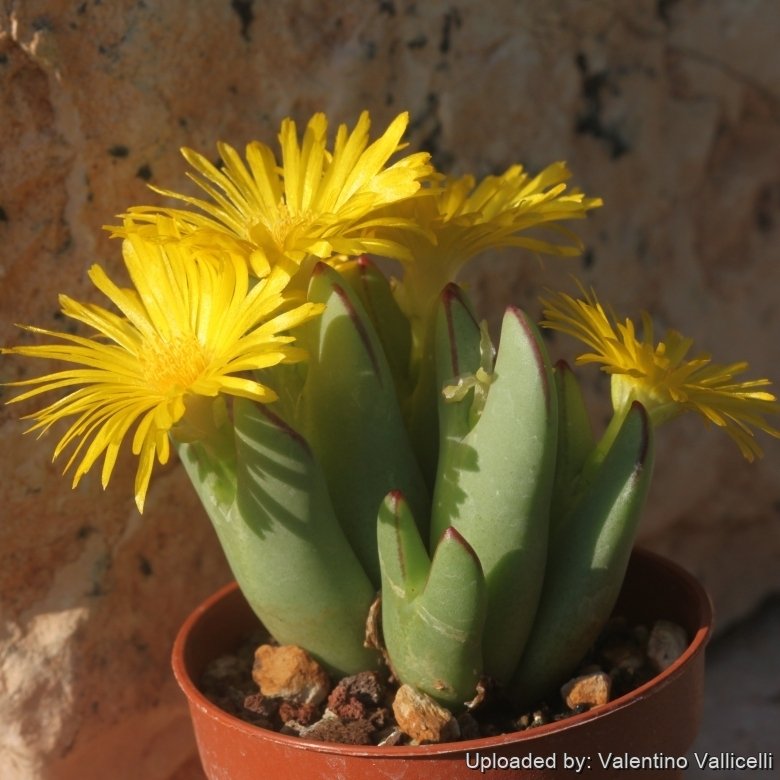
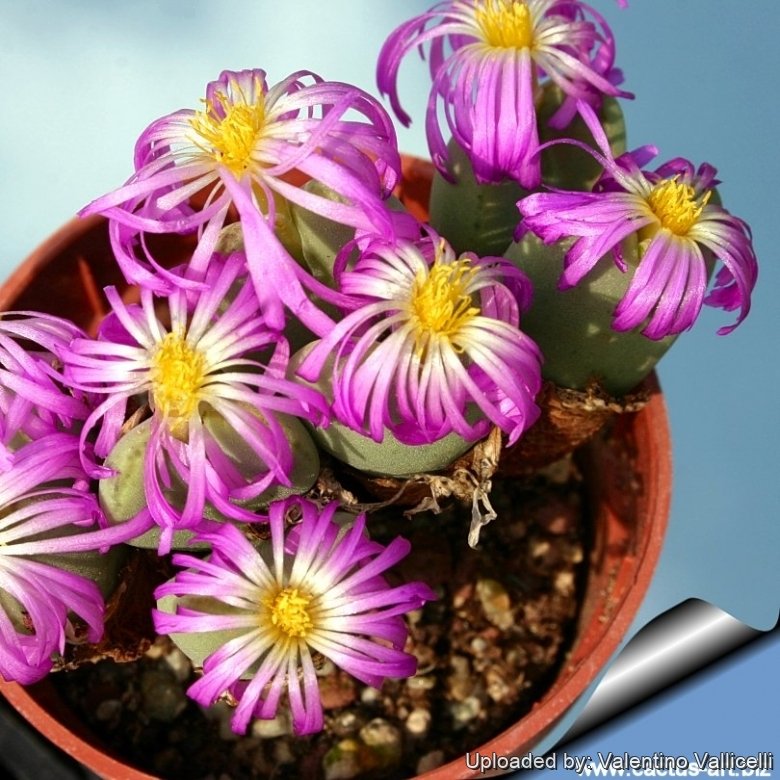
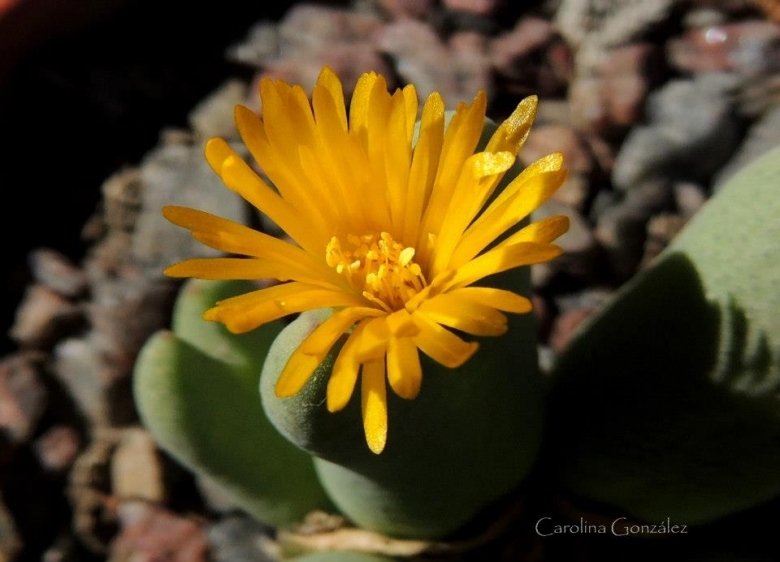
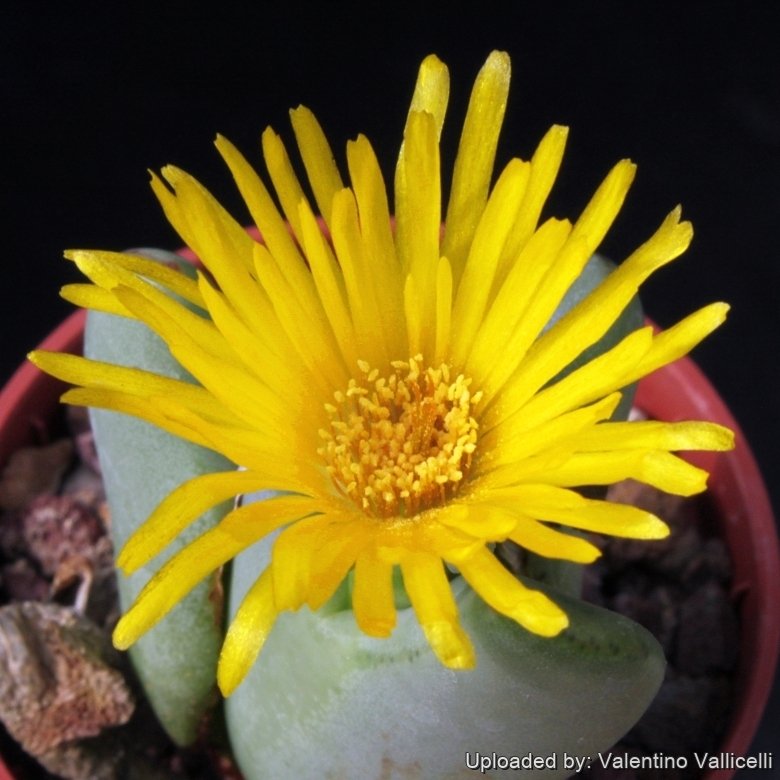
Flowers: Scentless up to 3 cm (The largest of the genus)
Blooming season: The flowers are autumnal (rarely in summer) and diurnal.
Origin and Habitat
It is found in the western part of South Africa (Northern Cape, from Wallekraal in the Sandveld to Swartpoort near the Orange River and Little Namaqualand)
Habitat: Growing in a well drained soil with some water in winter and some sun.
Cultivation and Propagation
Conophytum bilobum is a “winter” grower which is most active from late winter until later spring and heading for summer dormancy, but in favourable growing conditions it keeps going over the summer too and doesn’t need particular care. All the forms of Conophytum bilobum are easy to grow.
Soil: Requires good drainage as it it is prone to root rot. It can grows outdoor in sunny, dry, rock crevices (protection against winter wet is required) It can also be cultivated in alpine house, in poor, drained soil.
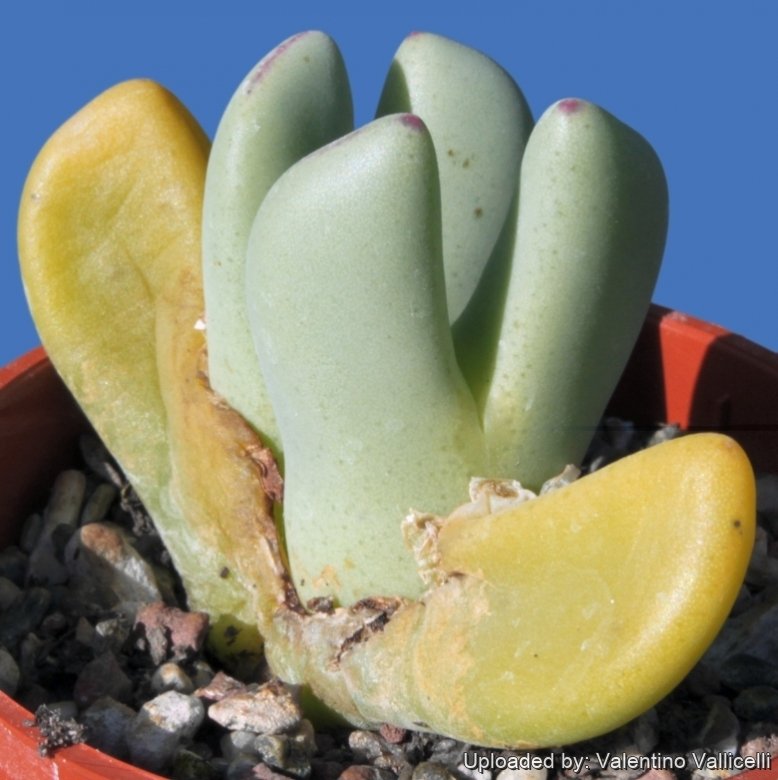
Watering: It requires little water; otherwise its epidermis breaks (resulting in unsightly scars). Water minimally in summer, (only when the plant starts shrivelling), but it will generally grow even in summer if given water. Water regularly in winter after the previous year’s leaves have dried up. Requires good drainage.
Fertilization: Feed it once during the growing season with a fertilizer specifically formulated for cactus succulents (poor in nitrogen), including all micro nutrients and trace elements diluted to ½ the strength recommended on the label. It thrives in poor soils and need a limited supplies of fertilizer to avoid the plants developing excess vegetation, which is easily attacked by fungal diseases.
Exposure: Keep cool and shaded in summer, it needs full sun or light shade.
Temperature: Hardy to -2°C. Ensure a very good ventilation.
Repotting: Avoid to repot frequently. This plant may stay in the same pot for many years.
Uses: Container, rock garden.
Pests and diseases: It is vulnerable to mealybugs and rarely scale.
Propagation: It can be reproduced both by cuttings and seeds. Take the cutting from a grown-up mother plant. Each cutting must contain one or more heads along with a fraction of root. It is easily propagated by seed. The small seeds can be sown in pots of fine, well-drained sand, any time during the spring and summer months when temperatures are warm. Cover the seeds with a very fine layer of grit and water from below with a fungicide to prevent damping off. For the first 3-4 days cover the pots with a sheet of glass/clear perspex to keep the humidity levels high. Remove the glass and replace it with light shadecloth and mist once or twice a day for the next two weeks after which most seeds should have germinated. From then on mistings can be reduced to every second and then every third day as the little plants grow.
Notes
Plants of the genus Conophytum are also known as ‘living pebbles’. During the rest period (the summer months in Europe) a new body forms inside the old, gradually taking all the substances from it until all that remains is the skin, which dries and protects the young plant from the heat of the sun and excess evaporation of water. The resting Conophytum protected by this dry cover resembles a pebble and hence the name ‘living pebble’. The growth period of most species is from August to March. The temperature should be about 10 to 12°C.
Bibliography
Major references and further lectures
-
James Cullen, Sabina G. Knees, H. Suzanne Cubey “The European Garden Flora Flowering Plants: A Manual for the Identification of Plants Cultivated in Europe, Both Out-of-Doors” Cambridge University Press, 11/ago/2011
-
Raimondo, D., von Staden, L., Foden, W., Victor, J.E., Helme, N.A., Turner, R.C., Kamundi, D.A. and Manyama, P.A. 2009. “Red List of South African Plants.” Strelitzia 25. South African National Biodiversity Institute, Pretoria.
-
Hammer, S. 1993. “The Genus Conophytum - A Conograph.” Succulent Plant Publications, Pretoria.
-
Hammer, S. 2002. “Dumpling and His Wife: New Views of the Genus Conophytum.” East Anglia Engraving Creative Colour Ltd, Norwich, England.
From llifle page Conophytum apiatum
Description
Conophytum apiatum is a medium-sized variant of Conophytum bilobum (Marloth) N.E.Br. distinguished for its prevailing grainy (papillate) surface. This is one the finest of all the bilobed Conophytum, and is easily recognised by the conspicuous dots upon its whitish-green surface.
Habit: It is a small but robust caespitose (groundcover) plant that resembles a cluster of pebbles often well camouflaged to resemble the surroundings.
Stem. Stemless or with short stems with time.
Bodies (paired leaves): Surface slightly harsh to the touch, chalky-green, very conspicuously dotted with darker green. The leaf-tips (lobes) are free in profile triangular in shape and keeled. The margins and tops of the lobes are green and often with a reddish or deep purple line.
Flowers: Somewhat funnel-shaped, about 25 mm. in diameter, yellow.
Blooming season: The flowers are autumnal (rarely in summer) and diurnal.
Remarks: This plant is part of the Conophytum bilobum complex which comprises many morphological and geographical variant, that was early classified as different independent species, but nowadays all this plant are considered part of a multiform species, where each form is linked to others by populations of plants with intermediate characteristics.
Origin and Habitat
Little Namaqualand, South Africa
Habitat: Driest regions of the winter rainfall area.
Cultivation and Propagation
It is a “winter” grower which is most active from late winter until later spring and heading for summer dormancy, but in favourable growing conditions it keeps going over the summer too and doesn’t need particular care. All the forms of Conophytum bilobum are easy to grow.
Soil: Requires good drainage as it it is prone to root rot. It can grows outdoor in sunny, dry, rock crevices (protection against winter wet is required) It can also be cultivated in alpine house, in poor, drained soil.
Watering: It requires little water; otherwise its epidermis breaks (resulting in unsightly scars). Water minimally in summer, (only when the plant starts shrivelling), but it will generally grow even in summer if given water. Water regularly in winter after the previous year’s leaves have dried up. Requires good drainage.
Fertilization: Feed it once during the growing season with a fertilizer specifically formulated for cactus succulents (poor in nitrogen), including all micro nutrients and trace elements diluted to ½ the strength recommended on the label. It thrives in poor soils and need a limited supplies of fertilizer to avoid the plants developing excess vegetation, which is easily attacked by fungal diseases.
Exposure: Keep cool and shaded in summer, it needs full sun or light shade.
Temperature: Hardy to -2°C. Ensure a very good ventilation.
Repotting: Avoid to repot frequently. This plant may stay in the same pot for many years.
Uses: Container, rock garden.
Pests and diseases: It is vulnerable to mealybugs and rarely scale.
Propagation: It can be reproduced both by cuttings and seeds. Take the cutting from a grown-up mother plant. Each cutting must contain one or more heads along with a fraction of root. It is easily propagated by seed. The small seeds can be sown in pots of fine, well-drained sand, any time during the spring and summer months when temperatures are warm. Cover the seeds with a very fine layer of grit and water from below with a fungicide to prevent damping off. For the first 3-4 days cover the pots with a sheet of glass/clear perspex to keep the humidity levels high. Remove the glass and replace it with light shadecloth and mist once or twice a day for the next two weeks after which most seeds should have germinated. From then on mistings can be reduced to every second and then every third day as the little plants grow.
Bibliography
Major references and further lectures
-
Kristo Pienaar “South African ‘What Flower Is That?” Struik, 01/ago/2003
-
Hammer, S. 1993. “The Genus Conophytum - A Conograph.” Succulent Plant Publications, Pretoria.
-
Hammer, S. 2002. “Dumpling and His Wife: New Views of the Genus Conophytum” East Anglia Engraving Creative Colour Ltd, Norwich, England.
Source: Conophytum apiatum, LLIFLE - Encyclopedia of living forms, CC-BY-SA, retrieved 2026-10-25.
From llifle page Conophytum beekenkampianum
Description
Robust caespitose (groundcover) plant, stemless or with short stems with time.
Bodies (paired leaves): Thickness: 3 centimetres Height: 7 centimetres, Profile: The leaf-tips (lobes) are free and are 10 mm long and triangular in shape and keeled. Colours: The margins are green to red or deep purple in colour. The epidermis is glabrous to velvety or quite asperulous, it is whitish-green to glaucous to deep blue green or brownish pink in colour. The epidermis could be heavily spotted or completey smooth.
Flowers: Scentless up to 3 cm (The largest of the genus)
Blooming season: The flowers are autumnal (rarely in summer) and diurnal.
Remarks: This plant is one of the most widespread and morphologically variable taxon of the genus. Many of its morphological and geographical variant was early classified as different independent species, but nowadays all this plant are considered part of a multiform species, where each form is linked to others by populations of plants with intermediate characteristics.
Cultivation and Propagation
It is easy to grow. These plants grow on winter rain and head for summer dormancy. They require little water; otherwise its epidermis breaks (resulting in unsightly scars). Water minimally in summer, (only when the plant starts shrivelling), but it will generally grow even in summer if given water. Water regularly in winter after the previous year’s leaves have dried up. Requires good drainage. Keep cool and shaded in summer, it needs full sun or light shade. Hardy to -2°C. Ensure a very good ventilation. Avoid to repot frequently. This plant may stay in the same pot for many years.
Propagation:: It can be reproduced both by cuttings and seeds. Take the cutting from a grown-up mother plant. Each cutting must contain one or more heads along with a fraction of root.
Source: Conophytum beekenkampianum, LLIFLE - Encyclopedia of living forms, CC-BY-SA, retrieved 2026-10-25.
From llifle page Conophytum christiansenianum
Description
Conophytum christiansenianum is one of the varieties of Conophytum bilobum which is a somewhat variable taxon with several collected extreme forms that were early published as full species or as varieties, but these were too weak botanically to stand, so they are all combined in Conophytum bilobum. Conophytum christiansenianum is a robust caespitose plant, distinguished by larger bodies up to 7 cm tall, 3 cm wide, leaf-tips free, 10-40 mm long, triangular and keeled. It is stemless or short stems develop with time.
Bodies (paired leaves): Thickness: 3 centimetres Height: 7 centimetres.
Profile: The leaf-tips (lobes) are free and are 10-40 mm long and triangular in shape and keeled.
Colours: The margins are green to red or deep purple in colour. The epidermis is slightly velvety, it is whitish-green to glaucous-blue green
Flower: Scentless up to 3 cm (The largest of the genus)
Blooming season: The flowers are autumnal (rarely in summer) and diurnal.
Remarks: This plant is one of the innumerable form of Conophytum bilobum which is one of the most widespread and morphologically variable taxon.
Origin and Habitat
Namaqualand.
Habitat: Growing in a well drained soil with some water in winter and some sun.
Cultivation and Propagation
Conophytum quaesitum is a “winter” grower which is most active from late winter until later spring and heading for summer dormancy, but in favourable growing conditions it keeps going over the summer too and doesn’t need particular care. It is relatively easy to grow.
Soil: Requires good drainage as it it is prone to root rot. It can grows outdoor in sunny, dry, rock crevices (protection against winter wet is required) It can also be cultivated in alpine house, in poor, drained soil.
Watering: It requires little water; otherwise its epidermis breaks (resulting in unsightly scars). Water minimally in summer, (only when the plant starts shrivelling), but it will generally grow even in summer if given water. Water regularly in winter after the previous year’s leaves have dried up. Requires good drainage.
Fertilization: Feed it once during the growing season with a fertilizer specifically formulated for cactus succulents (poor in nitrogen), including all micro nutrients and trace elements diluted to ½ the strength recommended on the label. It thrives in poor soils and need a limited supplies of fertilizer to avoid the plants developing excess vegetation, which is easily attacked by fungal diseases.
Exposure: Keep cool and shaded in summer, it needs full sun or light shade.
Temperature: Hardy to -2°C. Ensure a very good ventilation.
Repotting: Avoid to repot frequently. This plant may stay in the same pot for many years.Uses: Container, rock garden.
Pests and diseases: It is vulnerable to mealybugs and rarely scale.
Propagation:: It can be reproduced both by cuttings and seeds. Take the cutting from a grown-up mother plant. Each cutting must contain one or more heads along with a fraction of root. It is easily propagated by seed.
Bibliography
Major references and further lectures
-
James Cullen, Sabina G. Knees, H. Suzanne Cubey “The European Garden Flora Flowering Plants: A Manual for the Identification of Plants Cultivated in Europe, Both Out-of-Doors” Cambridge University Press, 11/Aug./2011
-
Raimondo, D., von Staden, L., Foden, W., Victor, J.E., Helme, N.A., Turner, R.C., Kamundi, D.A. and Manyama, P.A. 2009. “Red List of South African Plants.” Strelitzia 25. South African National Biodiversity Institute, Pretoria.
-
Hammer, S. 1993. “The Genus Conophytum - A Conograph.” Succulent Plant Publications, Pretoria.
-
Hammer, S. 2002. “Dumpling and His Wife: New Views of the Genus Conophytum.” East Anglia Engraving Creative Colour Ltd, Norwich, England.
Source: Conophytum christiansenianum, LLIFLE - Encyclopedia of living forms, CC-BY-SA, retrieved 2026-10-25.
From llifle page Conophytum conradii
Description
Conophytum conradii is a robust compact caespitose (groundcover) plant, stemless or with short stems with time.
Bodies (paired leaves): 3,5 centimetres long and 9 mm whide, deep green. The leaf-tips (lobes) are free and triangular in shape and keeled. The margins are green to deep purple in colour.
Flowers: Scentless up to 3 cm
Blooming season: The flowers are autumnal (rarely in summer) and diurnal.
Remarks: This plant is one of the several form of the most widespread and morphologically variable Conophytum bilobum. Many of its morphological and geographical variants was early classified as different independent species, but nowadays all this plants are ascribed to Conophytum bilobum, where each form is linked to others by populations of plants with intermediate characteristics.
Origin and Habitat
Cape Province, South Africa
Cultivation and Propagation
It is a “winter” grower which is most active from late winter until later spring and heading for summer dormancy, but in favourable growing conditions it keeps going over the summer too and doesn’t need particular care. It is relatively easy to grow.
Soil: Requires good drainage as it it is prone to root rot. It can grows outdoor in sunny, dry, rock crevices (protection against winter wet is required) It can also be cultivated in alpine house, in poor, drained soil.
Watering: It requires little water; otherwise its epidermis breaks (resulting in unsightly scars). Water minimally in summer, (only when the plant starts shrivelling), but it will generally grow even in summer if given water. Water regularly in winter after the previous year’s leaves have dried up. Requires good drainage.
Fertilization: Feed it once during the growing season with a fertilizer specifically formulated for cactus succulents (poor in nitrogen), including all micro nutrients and trace elements diluted to ½ the strength recommended on the label. It thrives in poor soils and need a limited supplies of fertilizer to avoid the plants developing excess vegetation, which is easily attacked by fungal diseases.
Exposure: Keep cool and shaded in summer, it needs full sun or light shade.
Temperature: Hardy to -2°C. Ensure a very good ventilation.
Repotting: Avoid to repot frequently. This plant may stay in the same pot for many years.Uses: Container, rock garden.
Pests and diseases: It is vulnerable to mealybugs and rarely scale.
Propagation:: It can be reproduced both by cuttings and seeds. Take the cutting from a grown-up mother plant. Each cutting must contain one or more heads along with a fraction of root. It is easily propagated by seed.
Source: Conophytum conradii, LLIFLE - Encyclopedia of living forms, CC-BY-SA, retrieved 2026-10-25.
From llifle page Conophytum cordatum
Description
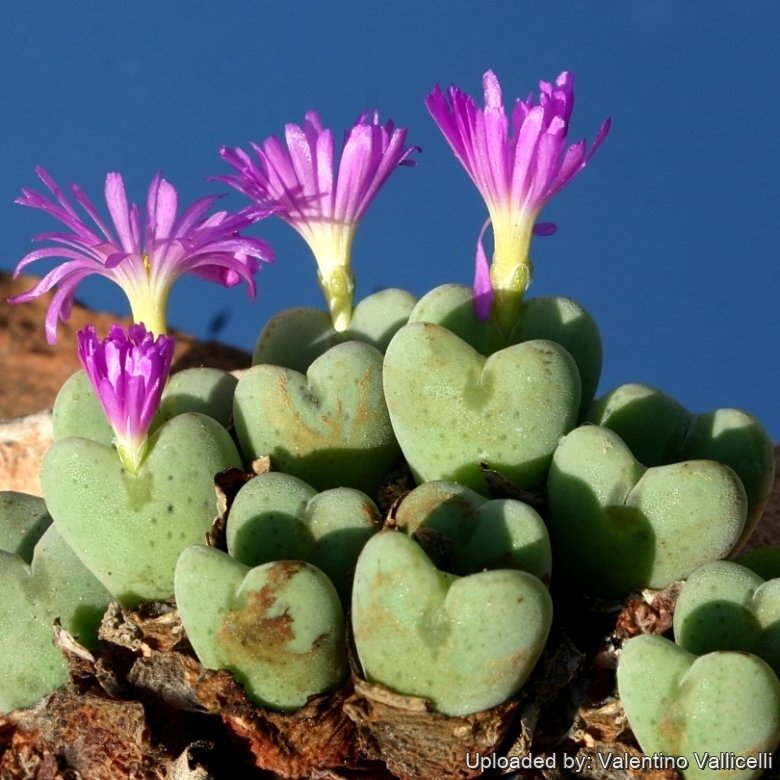
Conophytum cordatum is an unusual form of Conophytum bilobum with pink-violet blooms. It is a richly branched groundcover species that would appear to be very similar in form and size to Conophytum velutinum.
Stem: Branched with very short internodes, but sometime - especially plants grown well protected from strong sun light – can have relatively long internodes and form small shrubs 5-7 cm tall.
Bodies (paired leaves): 20-25 mm high, 12-15 mm broad, and 8-10 mm thick cordate (heart-shaped) in outline and keeled. Bluish green to hoary in appearance. The epidermis could be spotted or completey smooth.
Flower: Scentless, large (up to 3 cm), petals spreading, white to light violet at the base and violet or magenta toward the tips.
Blooming season: The flowers are autumnal (rarely in summer) and diurnal.
Remarks: This plant is one of the innumerable form of Conophytum bilobum which is one of the most widespread and morphologically variable taxon.
Origin and Habitat
It is found in the western part of South Africa
Habitat: Growing in a well drained soil with some water in winter and some sun.
Cultivation and Propagation
It is a “winter” grower which is most active from late winter until later spring and heading for summer dormancy, but in favourable growing conditions it keeps going over the summer too and doesn’t need particular care. All the forms of Conophytum bilobum are easy to grow.
Soil: Requires good drainage as it it is prone to root rot. It can grows outdoor in sunny, dry, rock crevices (protection against winter wet is required) It can also be cultivated in alpine house, in poor, drained soil.
Watering: It requires little water; otherwise its epidermis breaks (resulting in unsightly scars). Water minimally in summer, (only when the plant starts shrivelling), but it will generally grow even in summer if given water. Water regularly in winter after the previous year’s leaves have dried up. Requires good drainage.
Fertilization: Feed it once during the growing season with a fertilizer specifically formulated for cactus succulents (poor in nitrogen), including all micro nutrients and trace elements diluted to ½ the strength recommended on the label. It thrives in poor soils and need a limited supplies of fertilizer to avoid the plants developing excess vegetation, which is easily attacked by fungal diseases.
Exposure: Keep cool and shaded in summer, it needs full sun or light shade.
Temperature: Hardy to -2°C. Ensure a very good ventilation.
Repotting: Avoid to repot frequently. This plant may stay in the same pot for many years.Uses: Container, rock garden.
Pests and diseases: It is vulnerable to mealybugs and rarely scale.
Propagation:: It can be reproduced both by cuttings and seeds. Take the cutting from a grown-up mother plant. Each cutting must contain one or more heads along with a fraction of root. It is easily propagated by seed.
Source: Conophytum cordatum, LLIFLE - Encyclopedia of living forms, CC-BY-SA, retrieved 2026-10-25.
From llifle page Conophytum meyerae
Description
This is one of the largest and robust forms among the “bilobum”m” that branches from the base forming small cushion.
Stem: Stemless or with short stems with time.
Bodies (paired leaves): Thickness: up to 4 cm centimetres Height: up to 6 centimetres. Profile: The leaf-tips are heart-shaped and keeled. The lobes are free 10 to 25 mm long, with the inner side flat. Colours: The margins are green to red or deep purple in colour. The epidermis is glabrous (smooth), whitish-green, tender-green to glaucous-green in colour not spotted or with few darker points.
Flowers: Scentless up to 3 cm (The largest of the genus) yellow and their size gradually increases in the course of several days after blooming.
Blooming season: The flowers are autumnal (rarely in summer) and diurnal.
Remarks: Nowadays C. meyerae is considered nothing else than a form of C. bilobum which is one of the most morphologically variable taxon of the genus.
Origin and Habitat
It is found in the western part of South Africa (Little Namaqualand)
Habitat: Growing in a well drained soil with some water in winter and some sun.
Cultivation and Propagation
Conophytum meyerae is easy to grow. These plants grow on winter rain and head for summer dormancy. They require little water; otherwise its epidermis breaks (resulting in unsightly scars). Water minimally in summer, (only when the plant starts shrivelling), but it will generally grow even in summer if given water. Water regularly in winter after the previous year’s leaves have dried up. Requires good drainage. Keep cool and shaded in summer, it needs full sun or light shade. Hardy to -2°C. Ensure a very good ventilation. Avoid to repot frequently. This plant may stay in the same pot for many years.
Propagation: It can be reproduced both by cuttings and seeds. Take the cutting from a grown-up mother plant. Each cutting must contain one or more heads along with a fraction of root.
Source: Conophytum meyerae, LLIFLE - Encyclopedia of living forms, CC-BY-SA, retrieved 2026-10-25.
From llifle page Conophytum noisabisense
Description
Conophytum noisabisense is part of the Conophytum bilobum complex which comprises many morphological and geographical variant, that was early classified as different independent species, but nowadays all this plant are considered part of a multiform species, where each form is linked to others by populations of plants with intermediate characteristics. It is a small but robust caespitose (groundcover) plant that resembles a cluster of pebbles often well camouflaged to resemble the surroundings.
Stem: Stemless or with short stems with time.
Bodies (paired leaves): About 5 centimetres tall 2,5 centimetres broad greyish green. The leaf-tips (lobes) are free in profile and are 10 mm long and triangular in shape and keeled. The margins are green in colour.
Flowers: Scentless up to 3 cm.
Blooming season: The flowers are autumnal and diurnal.
Origin and Habitat
Little Namaqaland, South Africa.
Cultivation and Propagation
It is a “winter” grower which is most active from late winter until later spring and heading for summer dormancy, but in favourable growing conditions it keeps going over the summer too and doesn’t need particular care. All the forms of Conophytum bilobum are easy to grow.
Soil: Requires good drainage as it it is prone to root rot. It can grows outdoor in sunny, dry, rock crevices (protection against winter wet is required) It can also be cultivated in alpine house, in poor, drained soil.
Watering: It requires little water; otherwise its epidermis breaks (resulting in unsightly scars). Water minimally in summer, (only when the plant starts shrivelling), but it will generally grow even in summer if given water. Water regularly in winter after the previous year’s leaves have dried up. Requires good drainage.
Fertilization: Feed it once during the growing season with a fertilizer specifically formulated for cactus succulents (poor in nitrogen), including all micro nutrients and trace elements diluted to ½ the strength recommended on the label. It thrives in poor soils and need a limited supplies of fertilizer to avoid the plants developing excess vegetation, which is easily attacked by fungal diseases.
Exposure: Keep cool and shaded in summer, it needs full sun or light shade.
Temperature: Hardy to -2°C. Ensure a very good ventilation.
Repotting: Avoid to repot frequently. This plant may stay in the same pot for many years.
Uses: Container, rock garden.
Pests and diseases: It is vulnerable to mealybugs and rarely scale.
Propagation:: It can be reproduced both by cuttings and seeds. Take the cutting from a grown-up mother plant. Each cutting must contain one or more heads along with a fraction of root. It is easily propagated by seed. The small seeds can be sown in pots of fine, well-drained sand, any time during the spring and summer months when temperatures are warm. Cover the seeds with a very fine layer of grit and water from below with a fungicide to prevent damping off. For the first 3-4 days cover the pots with a sheet of glass/clear perspex to keep the humidity levels high. Remove the glass and replace it with light shadecloth and mist once or twice a day for the next two weeks after which most seeds should have germinated. From then on mistings can be reduced to every second and then every third day as the little plants grow.
Source: Conophytum noisabisense, LLIFLE - Encyclopedia of living forms, CC-BY-SA, retrieved 2026-10-25.
From llifle page Conophytum ovatum
Description
Conophytum ovatum (also known in cultivation as C. bilobum ‘ovatum’) is one of the morphological or local forms of Conophytum bilobum with somewhat broader paired leaves and smaller flowers, but the two plants are not readily distinguishable, if not for the geographical provenance, so now it is synonymized with C. bilobum var. bilobum.
Habit: Robust caespitose (groundcover) plant, stemless or with short stems with time.
Bodies (paired leaves): Up to 3 (or more) cm wide and 7 cm tall, Profile: The leaf-tips (lobes) are free and are 10-15 mm long and triangular in shape and keeled. Colours: The margins are green to red or deep purple in colour. The epidermis is glabrous whitish-green to glaucous to deep blue green in colour. The epidermis could be spotted or completey smooth.
Flowers: Scentless less than 3 cm long (usually shorter than in other bilobe).
Blooming season: The flowers are autumnal (rarely in summer) and diurnal.
Remarks: Conophytum bilobum is one of the most widespread and morphologically variable taxon of the genus. Many of its morphological and geographical variant was early classified as different independent species, but nowadays all this plant are considered part of a multiform species, where each form is linked to others by populations of plants with intermediate characteristics.
Origin and Habitat
It is found in the western part of South Africa (Namaqualand)
Habitat: It grows in a well drained soil with some water in winter and some sun.
Bibliography
Major references and further lectures
-
Heidrun E.K. Hartmann “Illustrated Handbook of Succulent Plants: Aizoaceae F-Z” Springer Science & Business Media, 2002
-
Gideon Smith u.a. “Mesembs of the World: Illustrated Guide to a Remarkable Succulent Group.” Briza Publications, 1998
-
Gideon Smith u.a. (Hrsg.) “Mesembs of the World: Illustrated Guide to a Remarkable Succulent Group.” Briza Publications, 1998
-
Hermann Jacobsen “A handbook of succulent plants: descriptions, synonyms, and cultural details for succulents other than Cactaceae, Volume 1” Blandford Press, 1960
-
Werner Rauh “The Wonderful World of Succulents:Cultivation and Description of Selected Succulent Plants Other Than Cacti” Smithsonian Institution Press, 1984
-
James Cullen, Sabina G. Knees, H. Suzanne Cubey “The European Garden Flora Flowering Plants: A Manual for the Identification of Plants Cultivated in Europe, Both Out-of-Doors and Under Glass” Cambridge University Press, 11/ago/2011
-
Steven A. Hammer “Dumpling and his wife: new views of the genus Conophytum” EAE Creative Colour Ltd., 2002
Source: Conophytum ovatum, LLIFLE - Encyclopedia of living forms, CC-BY-SA, retrieved 2026-10-25.
From llifle page Conophytum piriforme
Description
Conophytum piriforme is another large growing bi-lobed species of the Conophytum bilobum complex distinguished by robust piriform (pear-shaped) bodies narrowed toward the apex.
Note: Conophytum bilobum is a very variable species comprising many morphological and geographical variant that was early classified as different independent species. Nowadays all this plant are considered part of a multiform species, where each form is linked to others by populations of plants with intermediate characteristics.
Habit: It is a small but robust caespitose (groundcover) plant that resembles a cluster of pebbles often well camouflaged to resemble the surroundings. The species increases quickly and eventually forms an attractive clump.
Stem: Stemless or with short stems with time.
Bodies (paired leaves): About 2,5 centimetres tall, blue-green. The leaf-tips (lobes) are cleft (V-shaped free in profile) and keeled. A transparent zone can be seen just below the fissure and extends down-wards. The margins are green or purplish in colour.
Flowers: Bright yellow.
Blooming season: The flowers are autumnal and diurnal.
Origin and Habitat
Kuboos mountains, Richtersveld, Little Namaqualand, North-West Cape Province, South Africa
Cultivation and Propagation
It is easy to grow. These plants grow on winter rain and head for summer dormancy. They require little water; otherwise its epidermis breaks (resulting in unsightly scars). Water minimally in summer, (only when the plant starts shrivelling), but it will generally grow even in summer if given water. Water regularly in winter after the previous year’s leaves have dried up. Requires good drainage. Keep cool and shaded in summer, it needs full sun or light shade. Hardy to -2°C. Ensure a very good ventilation. Avoid to repot frequently. This plant may stay in the same pot for many years.
Propagation: It can be reproduced both by cuttings and seeds. Take the cutting from a grown-up mother plant. Each cutting must contain one or more heads along with a fraction of root.
Source: Conophytum piriforme, LLIFLE - Encyclopedia of living forms, CC-BY-SA, retrieved 2026-10-25.
From llifle page Conophytum pluriforme
Description
Conophytum pluriforme is part of the Conophytum bilobum complex which comprises many morphological and geographical variant, that was early classified as different independent species, but nowadays all this plant are considered part of a multiform species, where each form is linked to others by populations of plants with intermediate characteristics. It is a small but robust caespitose (groundcover) plant that resembles a cluster of pebbles often well camouflaged to resemble the surroundings.
Stem: Stemless or with short stems with time.
Bodies (paired leaves): About 5 centimetres tall, 2-2,5 centimetres (but variable in size) broad greyish green. The leaf-tips (lobes) are free in profile, V-shaped about, 2 cm long and keeled. The margins are green in colour.
Flowers: Scentless up to 3 cm.
Blooming season: The flowers are autumnal and diurnal.
Origin and Habitat
Little Namaqaland.
Source: Conophytum pluriforme, LLIFLE - Encyclopedia of living forms, CC-BY-SA, retrieved 2026-10-25.
From llifle page Conophytum simplum
Description
Conophytum simplum is one of the several varieties of the morphologically variable Conophytum bilobum, a taxon growing widespread in the western part of South Africa. It has several collected forms that were early published as full species or as varieties, but these were too weak botanically to stand, so they are all combined in Conophytum bilobum.
Distinguish features: Caespitose (groundcover) plant, stemless or with short stems with time. It is has small, almost cylindrical bodies 40-50 mm high, 10-12 mm thick lobes erect, 6 mm long and wide, with two slightly divaricated lobes, more or less stright insides, and rounded or the back, surface green, unspotted, very fine velvety.
Derivation of specific name: From the description, it is not clear what was ‘simple’ about this variant of C. Bilobum, but its papillae (as with all Conophytums, and unlike e.g. some Gibbaeums) are simple (are microscopic one-celled hairs), which might account for the epithet. These papillae are really microscopic, often being less in length than the thickness of a human hair.
Flowers: Yellow.
Blooming season: The flowers are autumnal (rarely in summer) and diurnal.
Origin and Habitat
Conophytum simplum is found in the western part of South Africa in the Little Namaqualand.
Habitat: This species grows in a well drained soil with some water in winter and some sun.
Bibliography
Major references and further lectures
-
Hermann Jacobsen “Handbuch der sukkulenten Pflanzen: Mesembryanthemaceae” G. Fischer, 1955
-
“Journal of the Cactus and Succulent Society of America”, Volume 2, page 426, The Society., 1930
Source: Conophytum simplum, LLIFLE - Encyclopedia of living forms, CC-BY-SA, retrieved 2026-10-25.
From llifle page Conophytum supremum
Description
Conophytum supremum, better known as Lobivia larae, is one of the many geographical or morphological form of Conophytum bilobum. Many variant of Conophytum bilobum was early classified as different independent species, but nowadays all this plants are considered part of a multiform species, where each form is linked to others by populations of plants with intermediate characteristics. Conophytum supremum has larger bodies (paired leaves) up to 3 cm thick and 7 cm tall. The leaf-tips are free, 10 mm long, triangular and keeled. The margins are green to purple.
Origin and Habitat
Northern Cape and Little Namaqualand.
Cultivation and Propagation
Conophytum supremum is a “winter” grower which is most active from late winter until later spring and heading for summer dormancy, but in favourable growing conditions it keeps going over the summer too and doesn’t need particular care. All the forms of Conophytum bilobum are easy to grow.
Soil: Requires good drainage as it it is prone to root rot. It can grows outdoor in sunny, dry, rock crevices (protection against winter wet is required) It can also be cultivated in alpine house, in poor, drained soil.
Watering: It requires little water; otherwise its epidermis breaks (resulting in unsightly scars). Water minimally in summer, (only when the plant starts shrivelling), but it will generally grow even in summer if given water. Water regularly in winter after the previous year’s leaves have dried up. Requires good drainage.
Fertilization: Feed it once during the growing season with a fertilizer specifically formulated for cactus succulents (poor in nitrogen), including all micro nutrients and trace elements diluted to ? the strength recommended on the label. It thrives in poor soils and need a limited supplies of fertilizer to avoid the plants developing excess vegetation, which is easily attacked by fungal diseases.
Exposure: Keep cool and shaded in summer, it needs full sun or light shade.
Temperature: Hardy to -2
Source: Conophytum supremum, LLIFLE - Encyclopedia of living forms, CC-BY-SA, retrieved 2026-10-25.
From llifle page Conophytum vlakmynense
Description
Conophytum vlakmynense is part of the Conophytum bilobum complex which comprises many morphological and geographical variant, that was early classified as different independent species, but nowadays all this plant are considered part of a multiform species, where each form is linked to others by populations of plants with intermediate characteristics. It is a small but robust caespitose (groundcover) plant that resembles a cluster of pebbles often well camouflaged to resemble the surroundings.
Stem: Stemless or with short stems with time.
Bodies (paired leaves): Big, fat, about 3-7 centimetres tall, 1,5-2,5 centimetres broad pale greyish green. The leaf-tips (lobes) are free in profile and are about 2 cm long and keeled. The margins are green or purplish in colour.
Flowers: Scentless up to 3 cm.
Blooming season: The flowers are autumnal and diurnal.
Origin and Habitat
Vlakmyn, Cape Province, South Africa.
Source: Conophytum vlakmynense, LLIFLE - Encyclopedia of living forms, CC-BY-SA, retrieved 2026-10-25.
From llifle page Conophytum igniflorum
Description
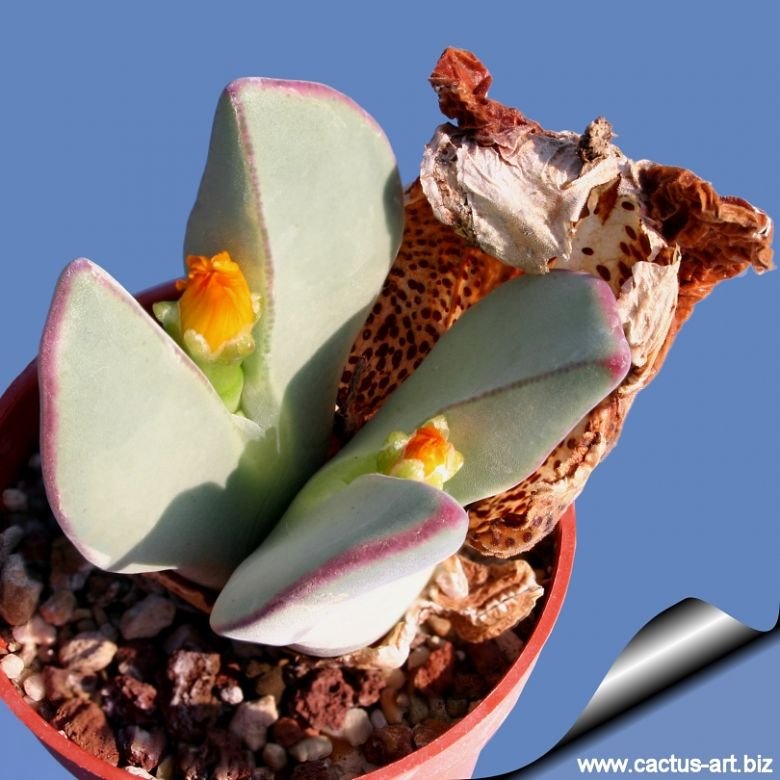
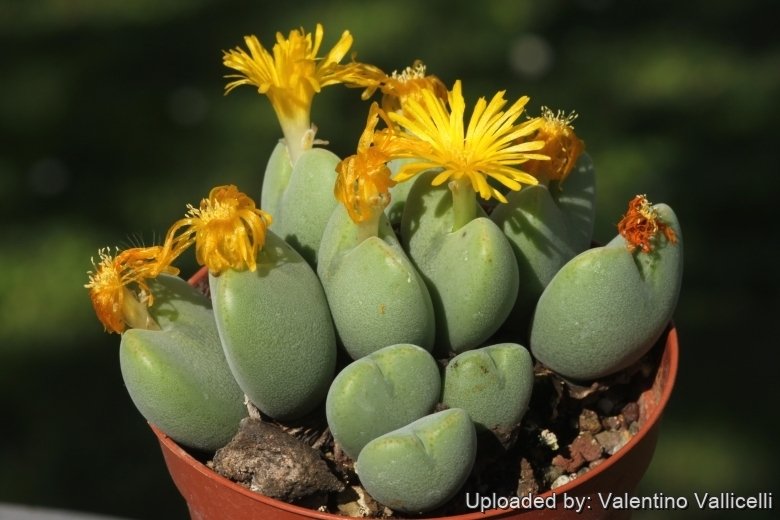
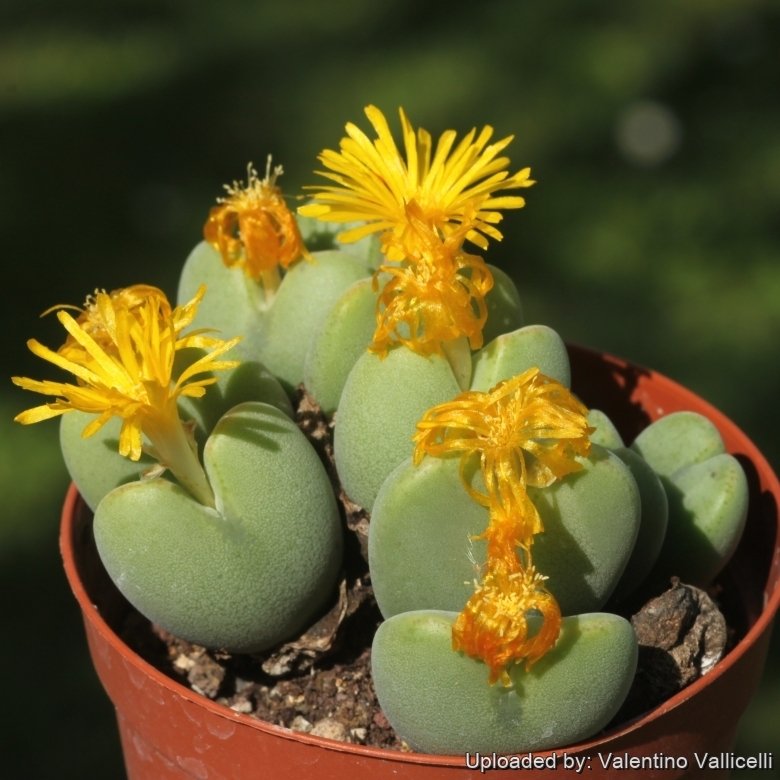
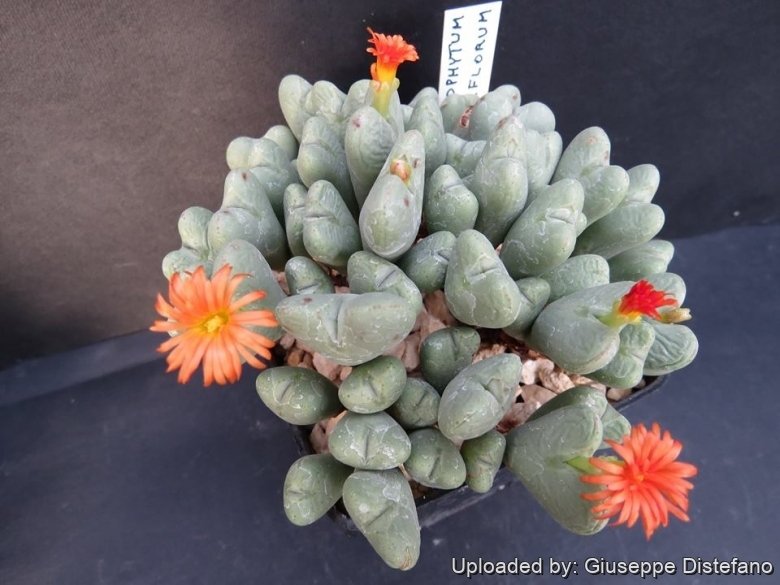
Conophytum igniflorum is a robust bilobed Conophytum distinguished by fiery orange flowers in autumn that set this species apart from other bilobed Conophytums. It could be a natural hybrid with bilobum as one parent. It’s a really old plant, been in cultivation for years. It seems originally cultivated by Herre from De Boer collected material (but never know for sure). It has some horticultural merit and the plant is spectacular in full flower.
Stem: Stemless or with short stems with time.
Bodies (paired leaves): Approx 1.5 centimetres broad and 4-5 centimetres tall. The leaf-tips (lobes) are free and are 10 mm long and triangular in shape and keeled. The epidermis is glabrous, whitish-green to glaucous. The epidermis is smooth, but could be spotted near the fissure.
Flowers: Scentless up to 3 cm bright orange with a yellow-orange throat.
Blooming season: The flowers are autumnal (rarely in summer) and diurnal.
Origin and Habitat
The origins of this plant is unknown exactly, except that it was distributed by De Boer under this name which was never published.
Cultivation and Propagation
Conophytum igniflorum is a “winter” grower which is most active from late winter until later spring and heading for summer dormancy, but in favourable growing conditions it keeps going over the summer too and doesn’t need particular care.
Soil: Requires good drainage as it it is prone to root rot. It can grows outdoor in sunny, dry, rock crevices (protection against winter wet is required) It can also be cultivated in alpine house, in poor, drained soil.
Watering: It requires little water; otherwise its epidermis breaks (resulting in unsightly scars). Water minimally in summer, (only when the plant starts shrivelling), but it will generally grow even in summer if given water. Water regularly in winter after the previous year’s leaves have dried up. Requires good drainage.
Fertilization: Feed it once during the growing season with a fertilizer specifically formulated for cactus succulents (poor in nitrogen), including all micro nutrients and trace elements diluted to ½ the strength recommended on the label. It thrives in poor soils and need a limited supplies of fertilizer to avoid the plants developing excess vegetation, which is easily attacked by fungal diseases.
Exposure: Keep cool and shaded in summer, it needs full sun or light shade.
Temperature: Hardy to -2°C. Ensure a very good ventilation.
Repotting: Avoid to repot frequently. This plant may stay in the same pot for many years.
Uses: Container, rock garden.
Pests and diseases: It is vulnerable to mealybugs and rarely scale.
Propagation: It can be reproduced both by cuttings and seeds. Take the cutting from a grown-up mother plant. Each cutting must contain one or more heads along with a fraction of root. It is easily propagated by seed. The small seeds can be sown in pots of fine, well-drained sand, any time during the spring and summer months when temperatures are warm. Cover the seeds with a very fine layer of grit and water from below with a fungicide to prevent damping off. For the first 3-4 days cover the pots with a sheet of glass/clear perspex to keep the humidity levels high. Remove the glass and replace it with light shadecloth and mist once or twice a day for the next two weeks after which most seeds should have germinated. From then on mistings can be reduced to every second and then every third day as the little plants grow.
Source: Conophytum igniflorum, LLIFLE - Encyclopedia of living forms, CC-BY-SA, retrieved 2026-10-25.
Cultivars and forms (6)
Subspecies (3)
Varieties (1)
Other names (1)
Gallery