Publication: Gen. Conophytum
Description
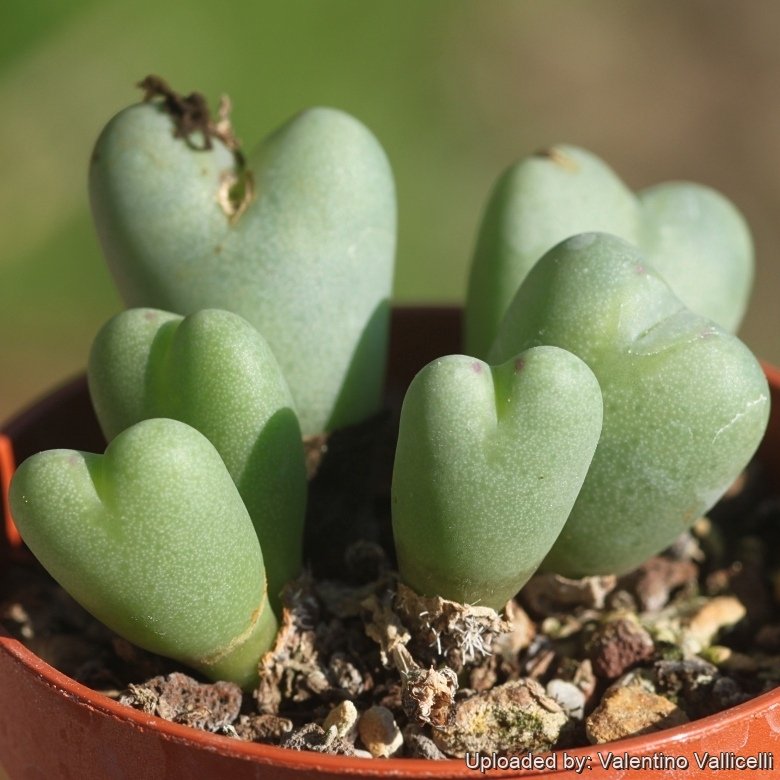
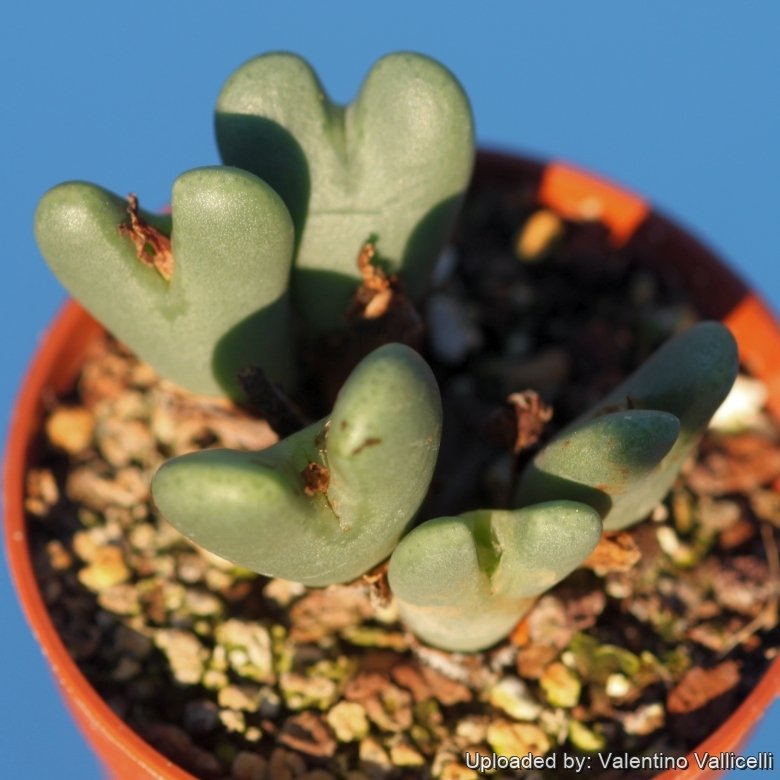
Conophytum bilobum subsp. altum is a bilobe, but forms slender upright stems with age, unlike other bilobes. Moreover it has a rather meagre number of petals as compared with the plenitude of the corolla of other bilobes.
Habit: It is a dwarf, cushion-forming plant. Dormant in summer.
Stems: Short but with internodes somewhat elongated.
Bodies (Paired leaves): The small, cone-shaped ‘heads’ or ‘bodies’ are actually pairs of leaves joined to their tips with only a small opening, through which the flower stalk appears in autumn. Individual body up to 30 mm tall and 12 mm wide, usually much smaller, lobed, dull green to greenish-orange or pinkish-green. Large clumps of these small heads develop through the years.
Flowers: Small, daisy-like. Petals always yellow.
Blooming season: Blooms mostly in autumn (in cultivation in Europe August-November). The flowers are numerous and diurnal.
Note: Separated from Conophytum bilobum ssp bilobum because of its long internodes and small, well-fused leaves. At some localities it appears to cross with stemless plants of Conophytum bilobum ssp bilobum and with Conophytum meyeri.
Origin and Habitat
Namaqualand, Northern Cape South Africa.
Habitat:It grows on exposed on quartzite hills.
Cultivation and Propagation
Conophytum bilobum subs. altum is a “winter” grower which is most active from late winter until later spring and heading for summer dormancy, but in favourable growing conditions it keeps going over the summer too and doesn’t need particular care. All the forms of Conophytum bilobum are easy to grow.
Soil: Requires good drainage as it it is prone to root rot. It can grows outdoor in sunny, dry, rock crevices (protection against winter wet is required) It can also be cultivated in alpine house, in poor, drained soil.
Watering: It requires little water; otherwise its epidermis breaks (resulting in unsightly scars). Water minimally in summer, (only when the plant starts shrivelling), but it will generally grow even in summer if given water. Water regularly in winter after the previous year’s leaves have dried up. Requires good drainage.
Fertilization: Feed it once during the growing season with a fertilizer specifically formulated for cactus succulents (poor in nitrogen), including all micro nutrients and trace elements diluted to ½ the strength recommended on the label. It thrives in poor soils and need a limited supplies of fertilizer to avoid the plants developing excess vegetation, which is easily attacked by fungal diseases.
Exposure: Keep cool and shaded in summer, it needs full sun or light shade.
Temperature: Hardy to -2°C. Ensure a very good ventilation.
Repotting: Avoid to repot frequently. This plant may stay in the same pot for many years.
Uses: Container, rock garden.
Pests and diseases: It is vulnerable to mealybugs and rarely scale.
Propagation: It can be reproduced both by cuttings and seeds. Take the cutting from a grown-up mother plant. Each cutting must contain one or more heads along with a fraction of root. It is easily propagated by seed. The small seeds can be sown in pots of fine, well-drained sand, any time during the spring and summer months when temperatures are warm. Cover the seeds with a very fine layer of grit and water from below with a fungicide to prevent damping off. For the first 3-4 days cover the pots with a sheet of glass/clear perspex to keep the humidity levels high. Remove the glass and replace it with light shadecloth and mist once or twice a day for the next two weeks after which most seeds should have germinated. From then on mistings can be reduced to every second and then every third day as the little plants grow.
Bibliography
Major references and further lectures
-
Hermann Jacobsen “Lexicon of Succulent Plants” Littlehampton Book Services Ltd. 1974
-
Gordon D. Rowley “The illustrated encyclopedia of succulents” Crown Publishers, 01/Aug/1978
-
James Cullen, Sabina G. Knees, H. Suzanne Cubey “The European Garden Flora Flowering Plants: A Manual for the Identification of Plants Cultivated in Europe, Both Out-of-Doors” Cambridge University Press, 11/Aug./2011
-
Burgoyne, P.M. 2006. Conophytum bilobum (Marloth) N.E.Br. subsp. altum (L.Bolus) S.A.Hammer. “National Assessment: Red List of South African Plants” version 2013.1. Accessed on 2014/01/28
-
Hammer, S. 1993. “The Genus Conophytum - A Conograph.” Succulent Plant Publications, Pretoria.
-
Hammer, S. 2002. “Dumpling and His Wife: New Views of the Genus Conophytum.” East Anglia Engraving Creative Colour Ltd, Norwich, England.
-
Ernst Van Jaarsveld, Ben-Erik Van Wyk, Gideon Smith “Succulents of South Africa: A Guide to the Regional Diversity” Tafelberg Publishers, Limited, 01/lug/2000
-
Heidrun E.K. Hartmann “Illustrated Handbook of Succulent Plants: Aizoaceae A-E” Springer, 2002
-
Werner Rauh “The Wonderful World of Succulents: Cultivation and Description of Selected Succulent Plants Other Than Cacti” Smithsonian Institution Press, 1984
From llifle page Conophytum apertum
Description
Conophytum apertum Tischer is a synonym of Conophytum bilobum subsp. altum (L.Bolus) S.A.Hammer. It is easily distinguished from the latter by its more gaping lobes. (“apertum” is Latin for wide open). It is a bilobe conos, but forms slender upright stems with age, unlike other bilobes. Moreover it has a rather meagre number of petals as compared with the plenitude of the corolla of other bilobes.
Habit: It is a dwarf, cushion-forming plant. Dormant in summer.
Stems: Short but with internodes somewhat elongated.
Bodies (Paired leaves): The small, cone-shaped ‘heads’ or ‘bodies’ are actually pairs of leaves joined to their tips with only a small opening, through which the flower stalk appears in autumn. Individual body up to 30 mm tall and 12 mm wide, usually much smaller, lobed wide open, dull green to pale bluish-green. Large clumps of these small heads develop through the years.
Flowers: Small, daisy-like. Petals always yellow.
Blooming season: Blooms mostly in autumn (in cultivation in Europe August-November). The flowers are numerous and diurnal.
Origin and Habitat
Namaqualand, Northern Cape South Africa.
Habitat: It grows on exposed on quartzite hills.
Cultivation and Propagation
Conophytum apertum is a “winter” grower which is most active from late winter until later spring and heading for summer dormancy, but in favourable growing conditions it keeps going over the summer too and doesn’t need particular care. All the forms of Conophytum bilobum are easy to grow.
Soil: Requires good drainage as it it is prone to root rot. It can grows outdoor in sunny, dry, rock crevices (protection against winter wet is required) It can also be cultivated in alpine house, in poor, drained soil.
Watering: It requires little water; otherwise its epidermis breaks (resulting in unsightly scars). Water minimally in summer, (only when the plant starts shrivelling), but it will generally grow even in summer if given water. Water regularly in winter after the previous year’s leaves have dried up. Requires good drainage.
Fertilization: Feed it once during the growing season with a fertilizer specifically formulated for cactus succulents (poor in nitrogen), including all micro nutrients and trace elements diluted to ½ the strength recommended on the label. It thrives in poor soils and need a limited supplies of fertilizer to avoid the plants developing excess vegetation, which is easily attacked by fungal diseases.
Exposure: Keep cool and shaded in summer, it needs full sun or light shade.
Temperature: Hardy to -2°C. Ensure a very good ventilation.
Repotting: Avoid to repot frequently. This plant may stay in the same pot for many years.
Uses: Container, rock garden.
Pests and diseases: It is vulnerable to mealybugs and rarely scale.
Propagation: It can be reproduced both by cuttings and seeds. Take the cutting from a grown-up mother plant. Each cutting must contain one or more heads along with a fraction of root. It is easily propagated by seed. The small seeds can be sown in pots of fine, well-drained sand, any time during the spring and summer months when temperatures are warm. Cover the seeds with a very fine layer of grit and water from below with a fungicide to prevent damping off. For the first 3-4 days cover the pots with a sheet of glass/clear perspex to keep the humidity levels high. Remove the glass and replace it with light shadecloth and mist once or twice a day for the next two weeks after which most seeds should have germinated. From then on mistings can be reduced to every second and then every third day as the little plants grow.
Source: Conophytum apertum, LLIFLE - Encyclopedia of living forms, CC-BY-SA, retrieved 2026-10-25.
From llifle page Conophytum corniferum
Description
Conophytum corniferum is is a dwarf, cushion-forming bilobe conophytum now fully synonymized with Conophytum bilobum subsp. altum. The shape of the bodies are as a normal altum and the internodes are somewhat elongated as expected for that subspecies. Conophytum corniferum is a bilobe, but forms slender upright stems with age, unlike other bilobes.
Habit: It is a dwarf, cushion-forming plant. Dormant in summer.
Stems: Short with internodes somewhat elongated.
Bodies (Paired leaves): The small, cone-shaped ‘heads’ or ‘bodies’ are actually pairs of leaves joined to their tips with only a small opening, through which the flower stalk appears in autumn. Individual body 5-20 mm. high, 6-8 mm. broad, and 5-7 mm. thick, , with lobes 3-4 mm. high of a peculiar light green, with a slightly darker mark on each side at the base of the notch, not dotted. Large clumps of these small heads develop through the years.
Flowers: Small, daisy-like. Petals always yellow.
Blooming season: Blooms mostly in autumn (in cultivation in Europe August-November). The flowers are numerous and diurnal.
Origin and Habitat
Little Namaqualand, Northern Cape, South Africa.
Habitat: It grows on exposed on quartzite hills.
Cultivation and Propagation
Conophytum corniferum (Conophytum bilobum subs. altum) is a “winter” grower which is most active from late winter until later spring and heading for summer dormancy, but in favourable growing conditions it keeps going over the summer too and doesn’t need particular care. All the forms of Conophytum bilobum are easy to grow.
Soil: Requires good drainage as it it is prone to root rot. It can grows outdoor in sunny, dry, rock crevices (protection against winter wet is required) It can also be cultivated in alpine house, in poor, drained soil.
Watering: It requires little water; otherwise its epidermis breaks (resulting in unsightly scars). Water minimally in summer, (only when the plant starts shrivelling), but it will generally grow even in summer if given water. Water regularly in winter after the previous year’s leaves have dried up. Requires good drainage.
Fertilization: Feed it once during the growing season with a fertilizer specifically formulated for cactus succulents (poor in nitrogen), including all micro nutrients and trace elements diluted to ½ the strength recommended on the label. It thrives in poor soils and need a limited supplies of fertilizer to avoid the plants developing excess vegetation, which is easily attacked by fungal diseases.
Exposure: Keep cool and shaded in summer, it needs full sun or light shade.
Temperature: Hardy to -2°C. Ensure a very good ventilation.
Repotting: Avoid to repot frequently. This plant may stay in the same pot for many years.
Uses: Container, rock garden.
Pests and diseases: It is vulnerable to mealybugs and rarely scale.
Propagation: It can be reproduced both by cuttings and seeds. Take the cutting from a grown-up mother plant. Each cutting must contain one or more heads along with a fraction of root. It is easily propagated by seed. The small seeds can be sown in pots of fine, well-drained sand, any time during the spring and summer months when temperatures are warm. Cover the seeds with a very fine layer of grit and water from below with a fungicide to prevent damping off. For the first 3-4 days cover the pots with a sheet of glass/clear perspex to keep the humidity levels high. Remove the glass and replace it with light shadecloth and mist once or twice a day for the next two weeks after which most seeds should have germinated. From then on mistings can be reduced to every second and then every third day as the little plants grow.
Bibliography
Major references and further lectures
-
Nicholas Edward Brown, A. Tischer, M. C. Karsten “Mesembryanthema; Descriptions: With Chapters on Cultivation and General Ecology” L. Reeve, 1931
-
Gordon D. Rowley “The illustrated encyclopedia of succulents” Crown Publishers, 01/Aug/1978
-
James Cullen, Sabina G. Knees, H. Suzanne Cubey “The European Garden Flora Flowering Plants: A Manual for the Identification of Plants Cultivated in Europe, Both Out-of-Doors” Cambridge University Press, 11/Aug./2011
-
Hammer, S. 1993. “The Genus Conophytum - A Conograph.” Succulent Plant Publications, Pretoria.
-
Hammer, S. 2002. “Dumpling and His Wife: New Views of the Genus Conophytum.” East Anglia Engraving Creative Colour Ltd, Norwich, England.
-
Ernst Van Jaarsveld, Ben-Erik Van Wyk, Gideon Smith “Succulents of South Africa: A Guide to the Regional Diversity” Tafelberg Publishers, Limited, 01/lug/2000
-
Heidrun E.K. Hartmann “Illustrated Handbook of Succulent Plants: Aizoaceae A-E” Springer, 2002
-
Werner Rauh “The Wonderful World of Succulents: Cultivation and Description of Selected Succulent Plants Other Than Cacti” Smithsonian Institution Press, 1984
-
Hermann Jacobsen “Lexicon of Succulent Plants” Littlehampton Book Services Ltd. 1974
-
Burgoyne, P.M. 2006. Conophytum bilobum (Marloth) N.E.Br. subsp. altum (L.Bolus) S.A.Hammer. “National Assessment: Red List of South African Plants” version 2013.1. Accessed on 2014/01/28
Source: Conophytum corniferum, LLIFLE - Encyclopedia of living forms, CC-BY-SA, retrieved 2026-10-25.
From llifle page Conophytum gracile
Description
Conophytum gracile is a small branched perennial, succulent, shrublet with short, erect stems which are covered with old leaf sheaths. This is one of the several varieties of the morphologically variable Conophytum bilobum subs. altum, a taxon growing widespread in Namaqualand (Northern Cape South Africa). It has several collected forms that were early published as full species or as varieties, but these were too weak botanically to stand, so they are all combined in Conophytum bilobum subs. altum.
Distinguish features: It is a small branched shrublents that unlike other “bilobe” forms slender upright stems with age. Moreover it has a rather meagre number of petals as compared with the plenitude of the corolla of other bilobes.
Bodies (paired leaves): The small, cone-shaped ‘heads’ or ‘bodies’ are actually pairs of leaves joined to their tips with only a small opening, through which the flower stalk appears in autumn. Individual bodies 20-25 mm long, 8-9 mm wide, compressed, 6 mm thick. Lobes 3-5 mm long and wide, rounded. Surface smooth, light green, dark green, finely velvety. Large clumps of these small heads develop through the years.
Flowers: Small, daisy-like. Petals always yellow.
Blooming season: Blooms mostly in autumn (in cultivation in Europe August-November). The flowers are numerous and diurnal.
Note: Conophytum bilobum subs. altum is separated from Conophytum bilobum ssp bilobum because of its long internodes and small, well-fused leaves. At some localities it appears to cross with stemless plants of Conophytum bilobum ssp bilobum and with Conophytum meyeri. Conophytum gracile had the same Maughan-Brown number as Conophytum plenus E.Br.; assuming that they were collected together, they might merely represent old and young plants.
Origin and Habitat
Cape province, Little Namaqualand.
Bibliography
Major references and further lectures
-
Hermann Jacobsen “Handbuch der sukkulenten Pflanzen: Mesembryanthemaceae” G. Fischer, 1955
-
“Bradleya”, Volumes 7-13, page 75, The Society, 1989
Source: Conophytum gracile, LLIFLE - Encyclopedia of living forms, CC-BY-SA, retrieved 2026-10-25.
From llifle page Conophytum luiseae
Description
Conophytum luiseae is a local or morphological form of Conophytum bilobum subsp. altum. It is a bilobe, but forms slender upright stems with age, unlike other bilobes. Moreover it has small pink-violet flowers with a rather meagre number of petals as compared with the plenitude of the corolla of other bilobes.
Habit: It is a dwarf, cushion-forming plant. Dormant in summer.
Stems: Short but with internodes somewhat elongated.
Bodies (Paired leaves): The small, cone-shaped ‘heads’ or ‘bodies’ are actually pairs of leaves joined to their tips with only a small opening, through which the flower stalk appears in autumn. Individual body up to 30 mm tall and 12 mm wide, usually much smaller, lobed, dull green to greenish-orange or pinkish-green. Large clumps of these small heads develop through the years.
Flowers: Small, daisy-like. Petals pink-violet.
Blooming season: Blooms mostly in autumn (in cultivation in Europe August-November). The flowers are numerous and diurnal.
Source: Conophytum luiseae, LLIFLE - Encyclopedia of living forms, CC-BY-SA, retrieved 2026-10-25.