Publication: Dumpling & His Wife: New Views of Gen. Conophytum 85 (2002). Remarks: Basionym not stated
Description
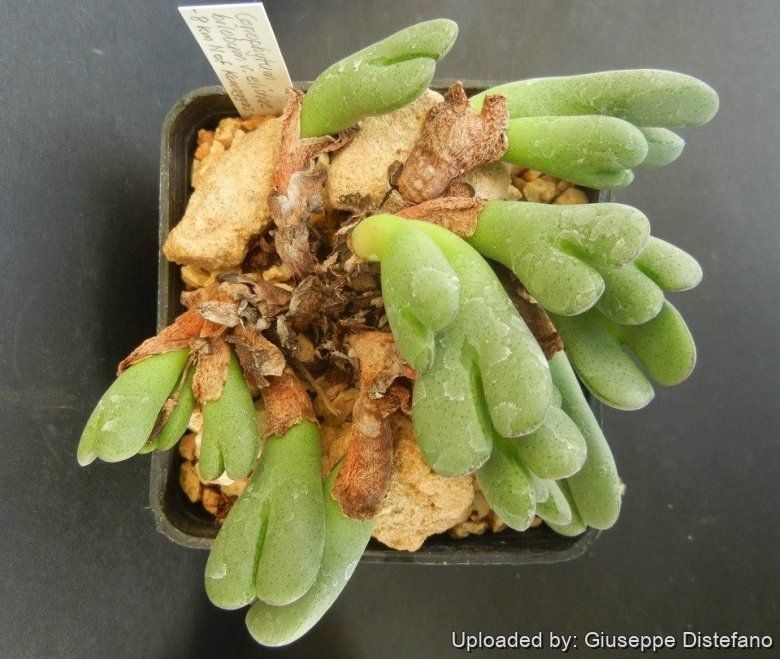
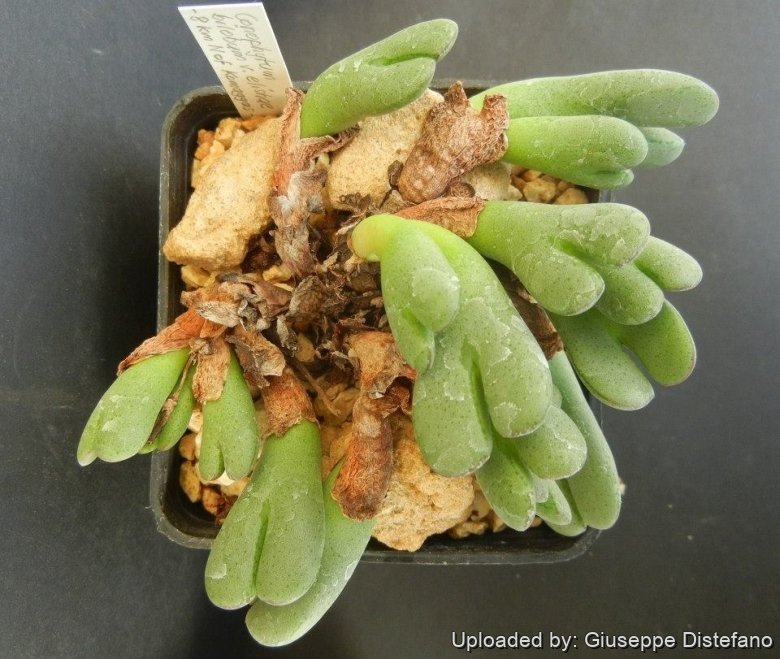
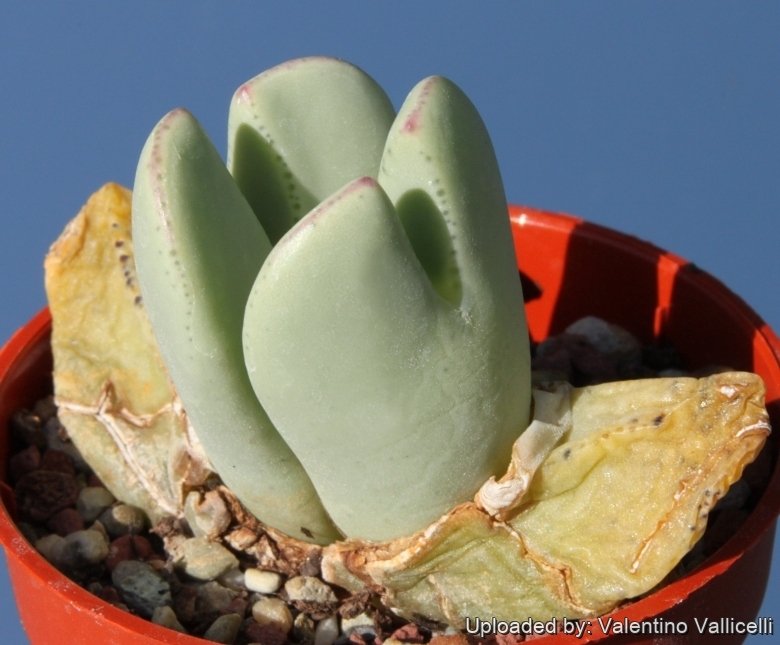
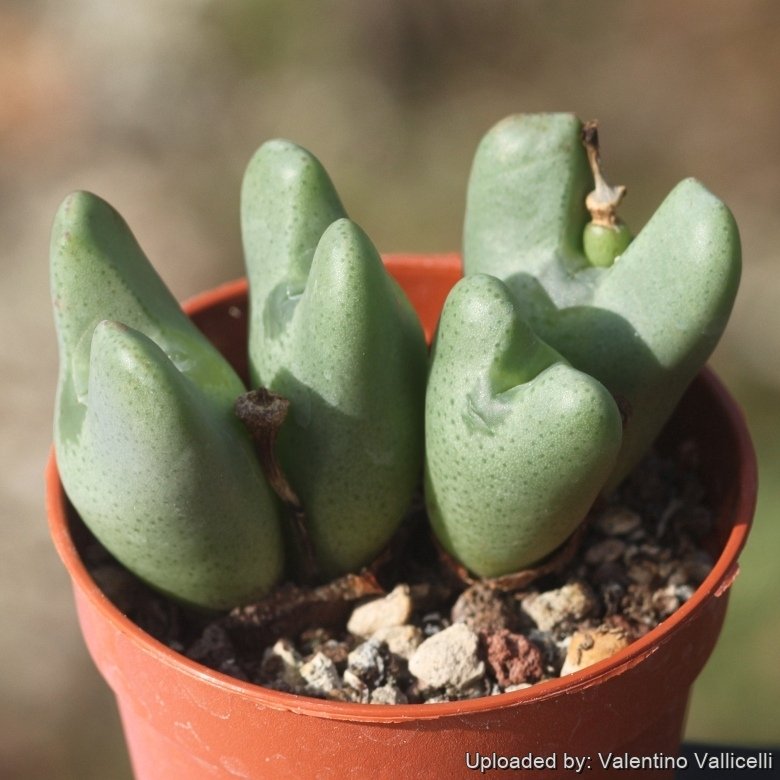
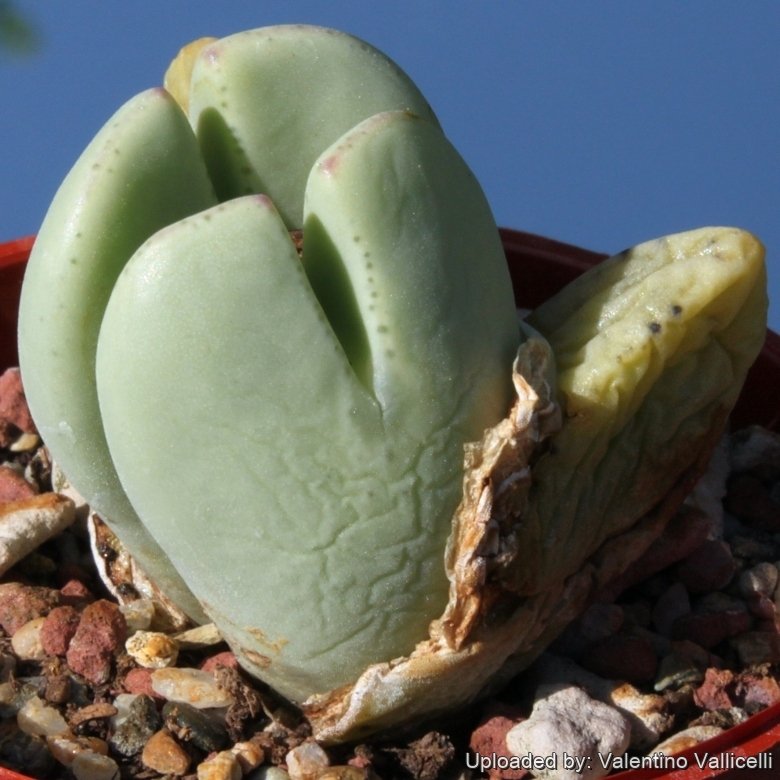
Conophytum bilobum var. elishae is another large growing bi-lobed species of the Conophytum bilobum complex which comprises many morphological and geographical variant that was early classified as different independent species. Nowadays all this plant are considered part of a multiform species, where each form is linked to others by populations of plants with intermediate characteristics. It is a small but robust caespitose (groundcover) plant that resembles a cluster of pebbles often well camouflaged to resemble the surroundings. Conophytum bilobum var. elishae distinguish for a transparent zone that can be seen just below the fissure and extends down-wards. The species increases quickly and eventually forms an attractive clump.
Stem: Stemless or with short stems with time.
Bodies (paired leaves): About 2,5 centimetres tall, blue-green. The leaf-tips (lobes) are cleft (V-shaped free in profile) and keeled. A transparent zone can be seen just below the fissure and extends down-wards. The margins are green or purplish in colour.
Flowers: Bright yellow.
Blooming season: The flowers are autumnal and diurnal.
Origin and Habitat
Cape Province, South Africa.
Cultivation and Propagation
It is a “winter” grower which is most active from late winter until later spring and heading for summer dormancy, but in favourable growing conditions it keeps going over the summer too and doesn’t need particular care. All the forms of Conophytum bilobum are easy to grow.
Soil: Requires good drainage as it it is prone to root rot. It can grows outdoor in sunny, dry, rock crevices (protection against winter wet is required) It can also be cultivated in alpine house, in poor, drained soil.
Watering: It requires little water; otherwise its epidermis breaks (resulting in unsightly scars). Water minimally in summer, (only when the plant starts shrivelling), but it will generally grow even in summer if given water. Water regularly in winter after the previous year’s leaves have dried up. Requires good drainage.
Fertilization: Feed it once during the growing season with a fertilizer specifically formulated for cactus succulents (poor in nitrogen), including all micro nutrients and trace elements diluted to ½ the strength recommended on the label. It thrives in poor soils and need a limited supplies of fertilizer to avoid the plants developing excess vegetation, which is easily attacked by fungal diseases.
Exposure: Keep cool and shaded in summer, it needs full sun or light shade.
Temperature: Hardy to -2°C. Ensure a very good ventilation.
Repotting: Avoid to repot frequently. This plant may stay in the same pot for many years.
Uses: Container, rock garden.
Pests and diseases: It is vulnerable to mealybugs and rarely scale.
Propagation: It can be reproduced both by cuttings and seeds. Take the cutting from a grown-up mother plant. Each cutting must contain one or more heads along with a fraction of root. It is easily propagated by seed. The small seeds can be sown in pots of fine, well-drained sand, any time during the spring and summer months when temperatures are warm. Cover the seeds with a very fine layer of grit and water from below with a fungicide to prevent damping off. For the first 3-4 days cover the pots with a sheet of glass/clear perspex to keep the humidity levels high. Remove the glass and replace it with light shadecloth and mist once or twice a day for the next two weeks after which most seeds should have germinated. From then on mistings can be reduced to every second and then every third day as the little plants grow.
Bibliography
Major references and further lectures
-
James Cullen, Sabina G. Knees, H. Suzanne Cubey “The European Garden Flora Flowering Plants: A Manual for the Identification of Plants Cultivated in Europe, Both Out-of-Doors” Cambridge University Press, 11/Aug./2011
-
Raimondo, D., von Staden, L., Foden, W., Victor, J.E., Helme, N.A., Turner, R.C., Kamundi, D.A. and Manyama, P.A. 2009. “Red List of South African Plants.” Strelitzia 25. South African National Biodiversity Institute, Pretoria.
-
Hammer, S. 1993. “The Genus Conophytum - A Conograph.” Succulent Plant Publications, Pretoria.
-
Hammer, S. 2002. “Dumpling and His Wife: New Views of the Genus Conophytum.” East Anglia Engraving Creative Colour Ltd, Norwich, England.
Gallery