Publication: Gen. Conophytum 263. 1993
Description
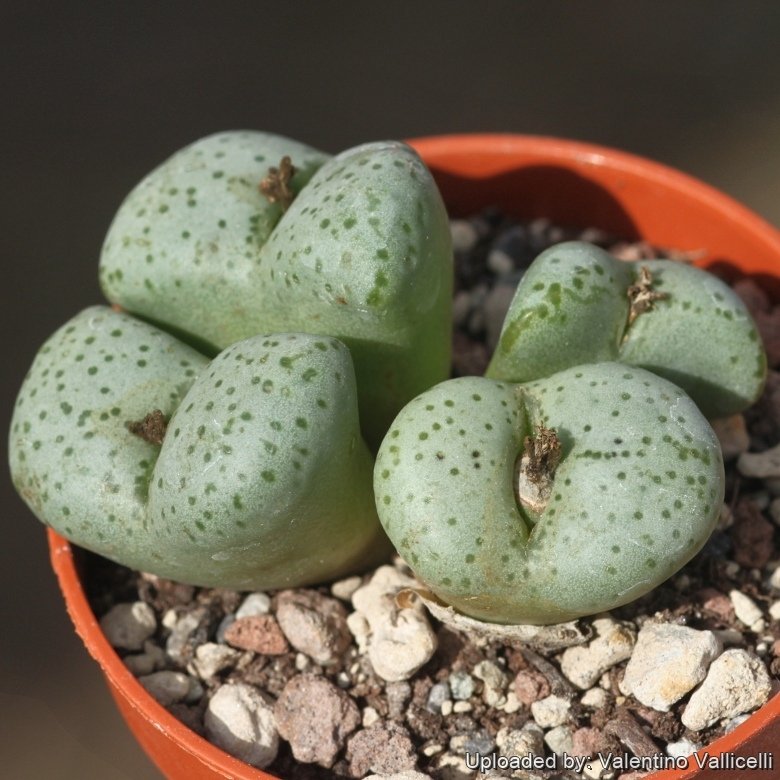
Conophytum obcordellum ssp. stenandrtun (L.Bolus) S.A.Hammer 1993 (Conophytum stenandrum L.Bolus 1961) has distinctively metallic greysh-green bodies with few branched fine lines and dots not extending down the sides.
Habit: It is sparsely branched.
Bodies (paired leaves): Rather small, pancake-shaped, convex at the apex, less than 1 cm in diameter with a small growing cleft that doesn’t reach right across the body.
Colours: Silvery-green or variably suffused with red, glabrous, marked with fine teardrop-shaped lines and dots, these often raised and reddish, and which often turn a beautiful bright ruby-red during the resting period. The unspotted sides are pink to a deep dark red.
Flowers: Never paired, pale creamy-yellow often tipped pink with a paler yellow centre. The thin petals form an almost star-like, spidery structure, they are faintly scented and very showy. Stamens 15-40, partially exserted, anthers slender (hence the name). Style minute with 4-6 stigmas 3 mm long.
Blooming season: Blooms mostly in autumn (in cultivation in Europe August-November). The flowers are numerous and open at night.
Fruits: 4-5 locular hygrochastic capsules.
Origin and Habitat
Western Cape (Vanrhynsdorp) and Northern Cape (Namaqualand). Republic of South Africa.
Habitat: Conophytum obcordellum subs. stenandrum grows on granite and quartz. It is sympatric with Conophytum rugosum subsp. sanguineum.
Cultivation and Propagation
Conophytum obcordellum subs. stenandrum is easy to grow. These plants grow on winter rain and head for summer dormancy. More or less dormant in summer. The plant requires little water; otherwise its epidermis breaks (resulting in unsightly scars). Water throughout the year although minimally in summer, (only when the plant starts shrivelling), but it will generally grow even in summer if given water. Water regularly in winter after the previous year’s leaves have dried up. Requires good drainage. Keep cool and shaded from hot sun in mid-summer; it needs full sun or light shade in the other seasons. Hardy to -2°C. Ensure a very good ventilation. Avoid to repot frequently. This plant may stay in the same pot for many years. Plants grown in larger containers have frequently relatively poor flowers. It might improve when the plants are given their own, small individual pots.
Propagation: It can be reproduced both by cuttings and seeds. Take the cutting from a grown-up mother plant. Each cutting must contain one or more heads, along with a fraction of root.
Bibliography
Major references and further lectures
-
Gordon D. Rowley “The illustrated encyclopedia of succulents” Crown Publishers, 01/Aug/1978
-
James Cullen, Sabina G. Knees, H. Suzanne Cubey “The European Garden Flora Flowering Plants: A Manual for the Identification of Plants Cultivated in Europe, Both Out-of-Doors” Cambridge University Press, 11/Aug./2011
-
Raimondo, D., von Staden, L., Foden, W., Victor, J.E., Helme, N.A., Turner, R.C., Kamundi, D.A. and Manyama, P.A. 2009. “Red List of South African Plants.” Strelitzia 25. South African National Biodiversity Institute, Pretoria.
-
Hammer, S. 1993. “The Genus Conophytum - A Conograph.” Succulent Plant Publications, Pretoria.
-
Hammer, S. 2002. “Dumpling and His Wife: New Views of the Genus Conophytum.” East Anglia Engraving Creative Colour Ltd, Norwich, England.
-
Ernst Van Jaarsveld, Ben-Erik Van Wyk, Gideon Smith “Succulents of South Africa: A Guide to the Regional Diversity” Tafelberg Publishers, Limited, 01/lug/2000
-
Heidrun E.K. Hartmann “Illustrated Handbook of Succulent Plants: Aizoaceae A-E” Springer, 2002
-
Werner Rauh “The Wonderful World of Succulents: Cultivation and Description of Selected Succulent Plants Other Than Cacti” Smithsonian Institution Press, 1984
-
Hermann Jacobsen “Lexicon of Succulent Plants” Littlehampton Book Services Ltd. 1974
Gallery