Publication: Gard. Chron. 1922, Ser. III. lxxi. 307.
Description
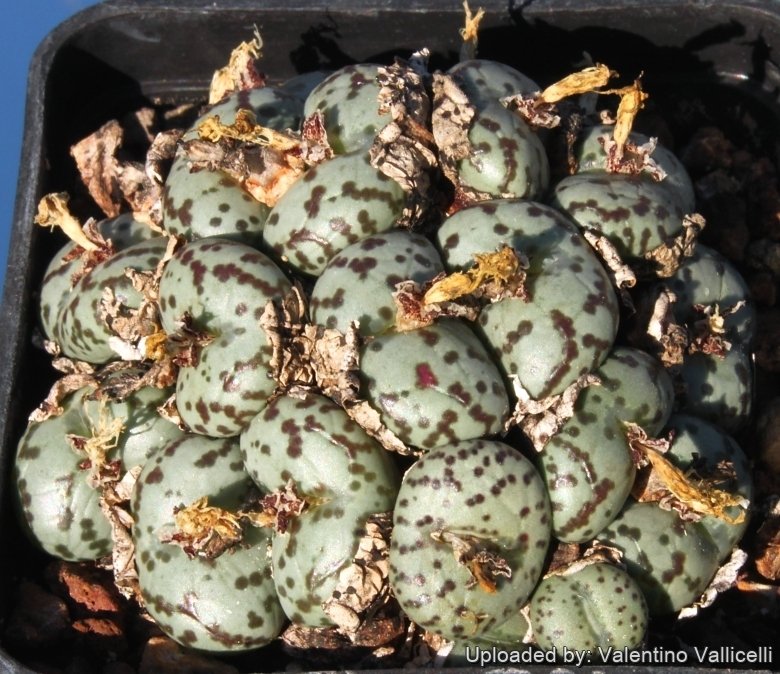
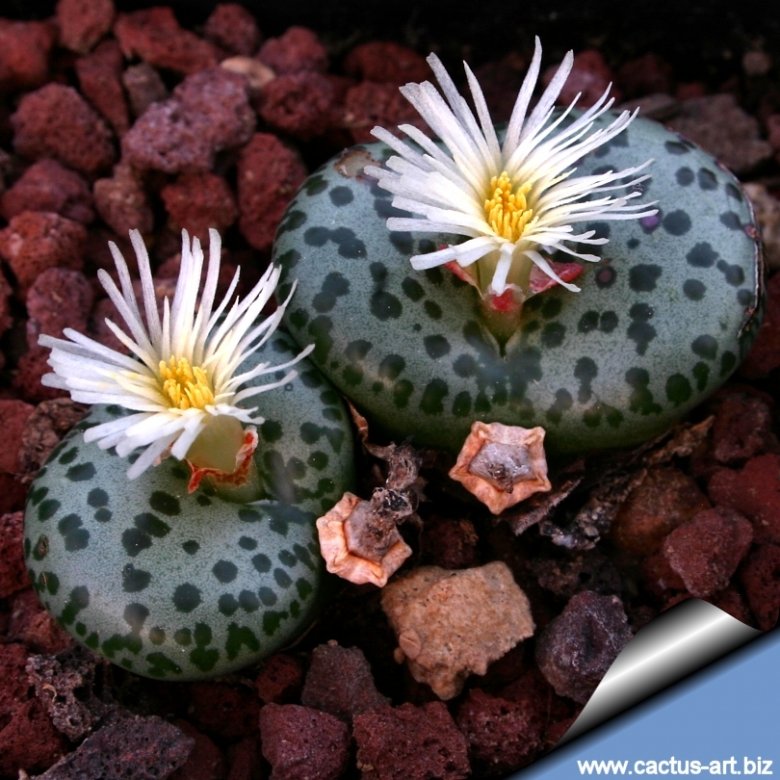
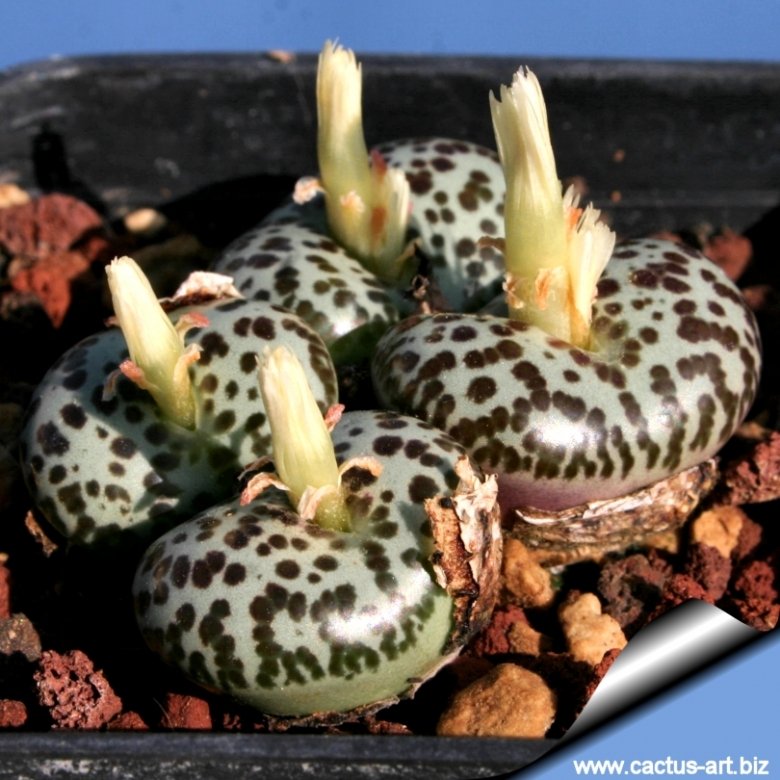
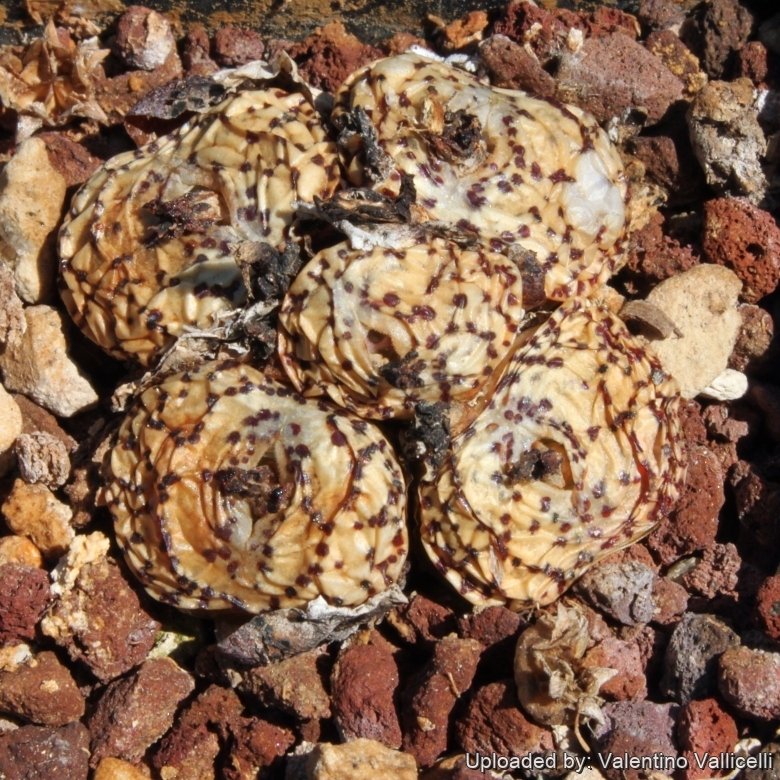
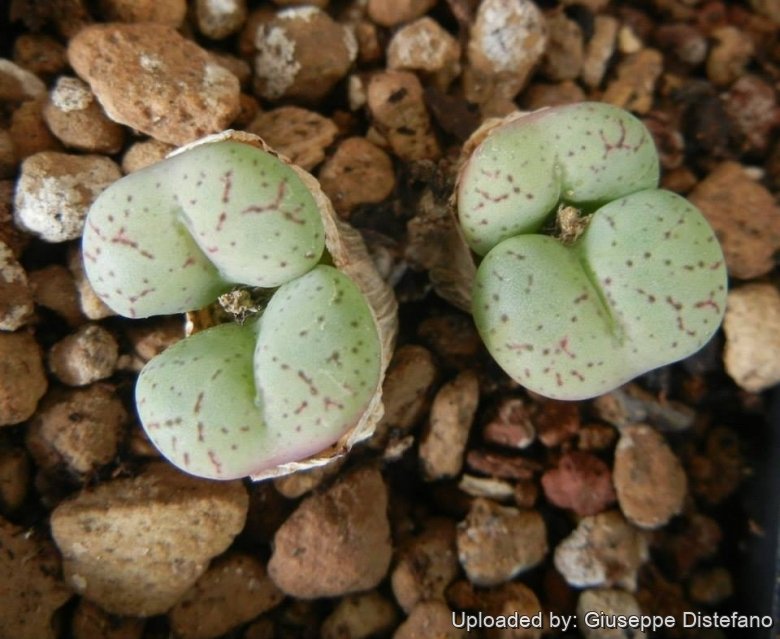
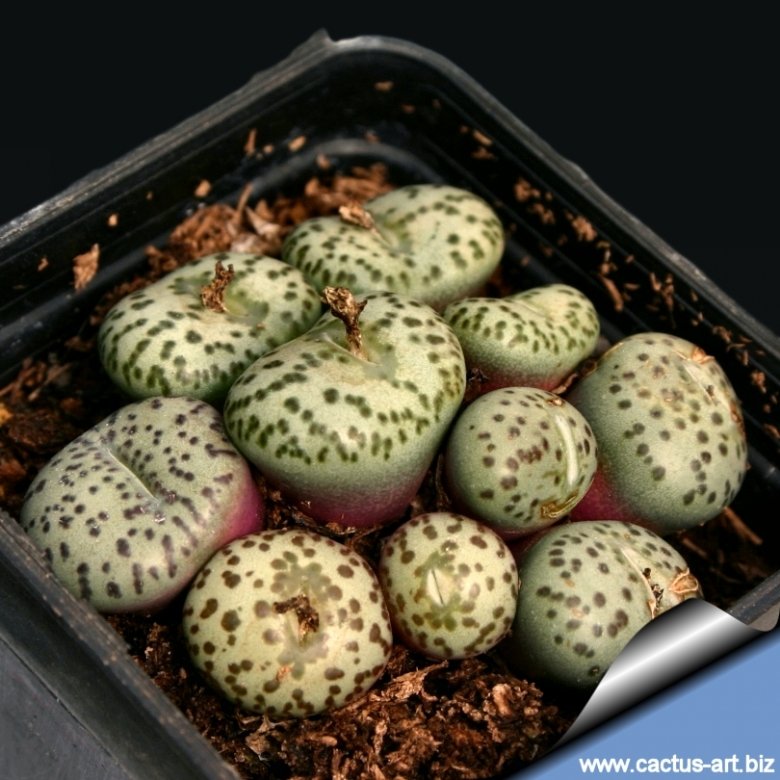
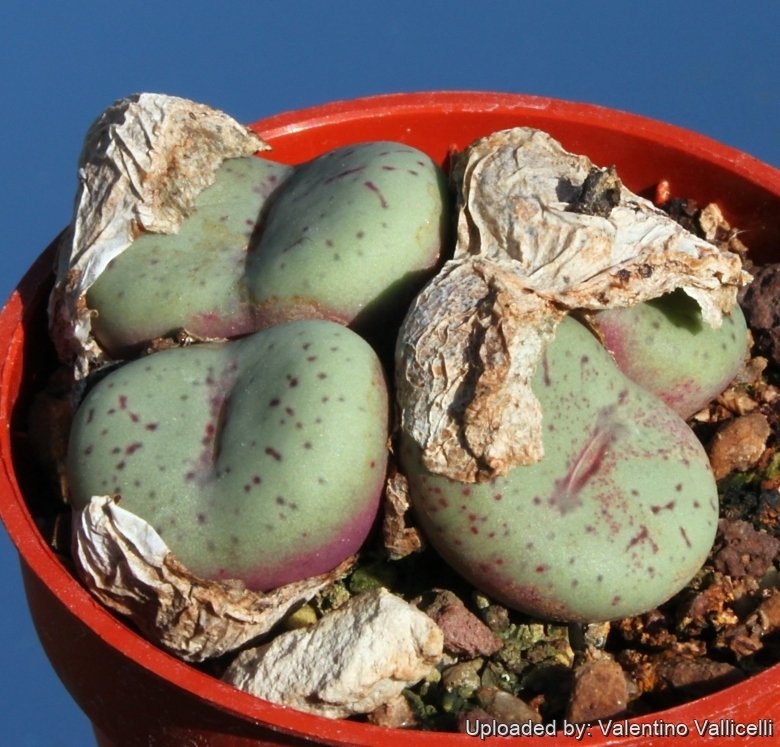
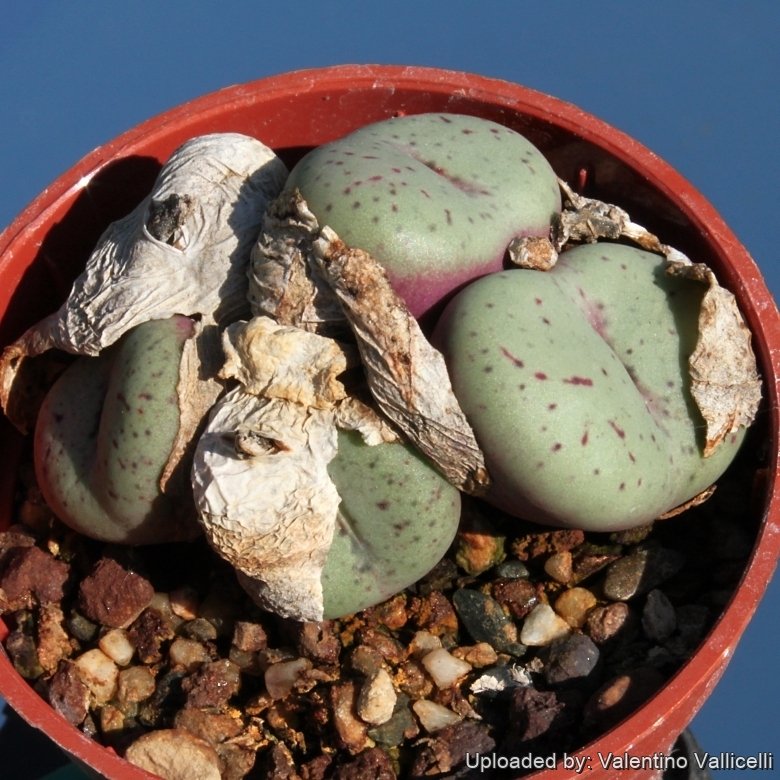
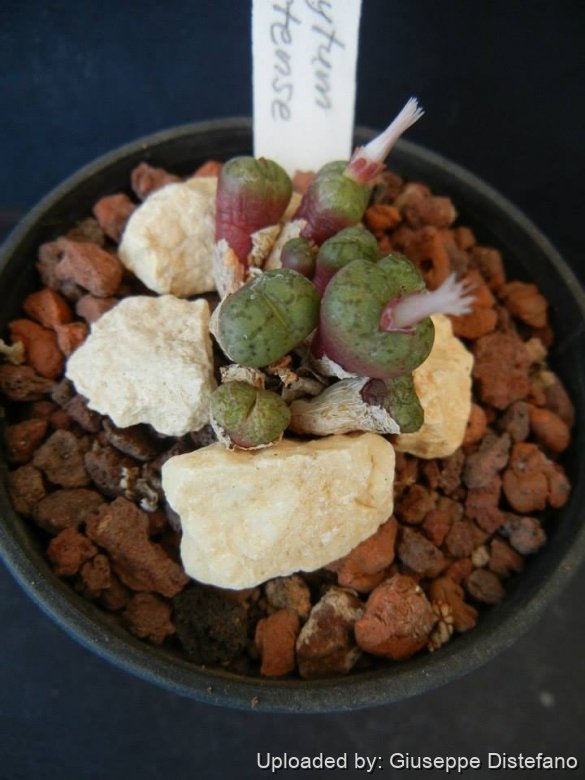
Conophytum obcordellum is a dwarf succulent species with tiny pancake-shaped bodies marked with few to many dots and lines, these often raised and glossy. It is extremely decorative even without flowers.
Habit: It is variably caespitose, with single or double bodies, or forming dense mats or cushions.
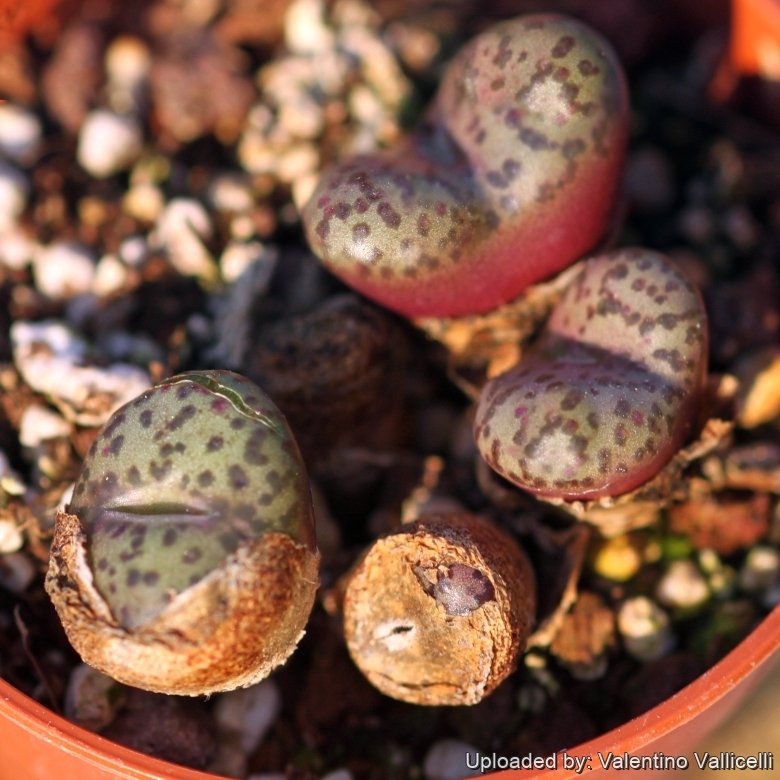
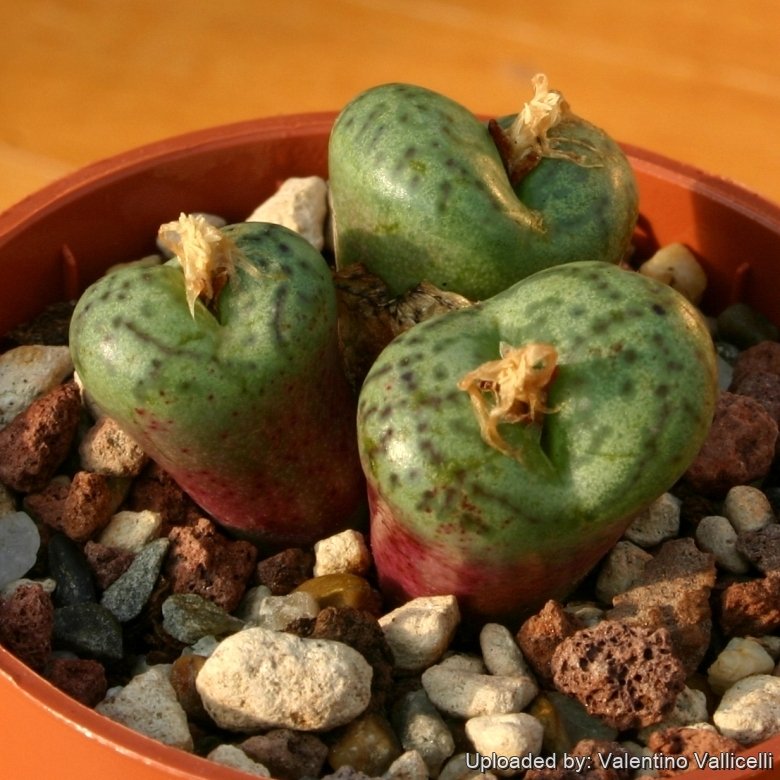
Bodies (paired leaves): Variable bodies, small, pancake-shaped, convex or concave at the apex, about 1 cm in diameter with a small growing cleft that doesn’t reach right across the body.
Colours: Silvery-green, variously spotted light or dark brown. The unspotted sides are pink to a deep dark red, while the apex, which is glabrous, medium green, and variably suffused with reddish or dark green dots that are slightly raised, which sometimes join up to make lines and which turn a beautiful bright red during the resting period.
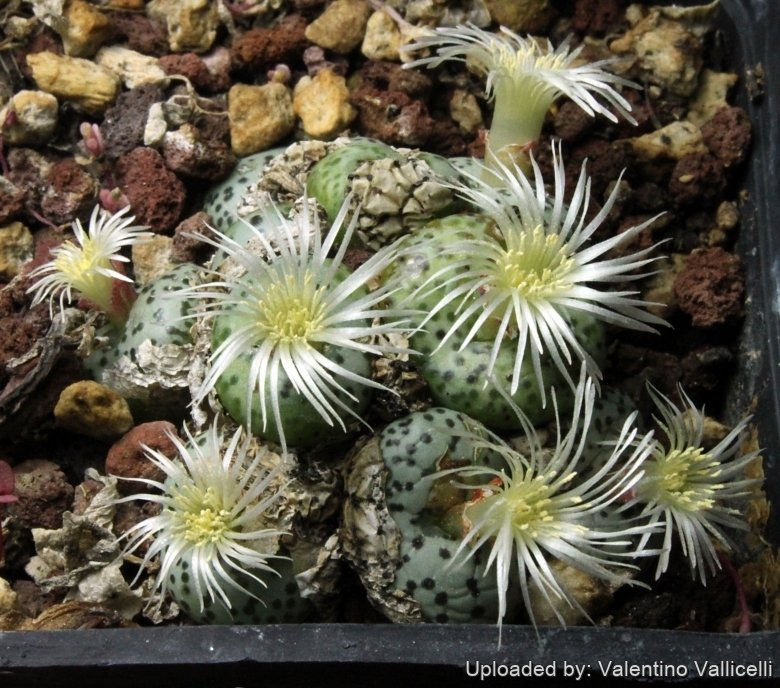
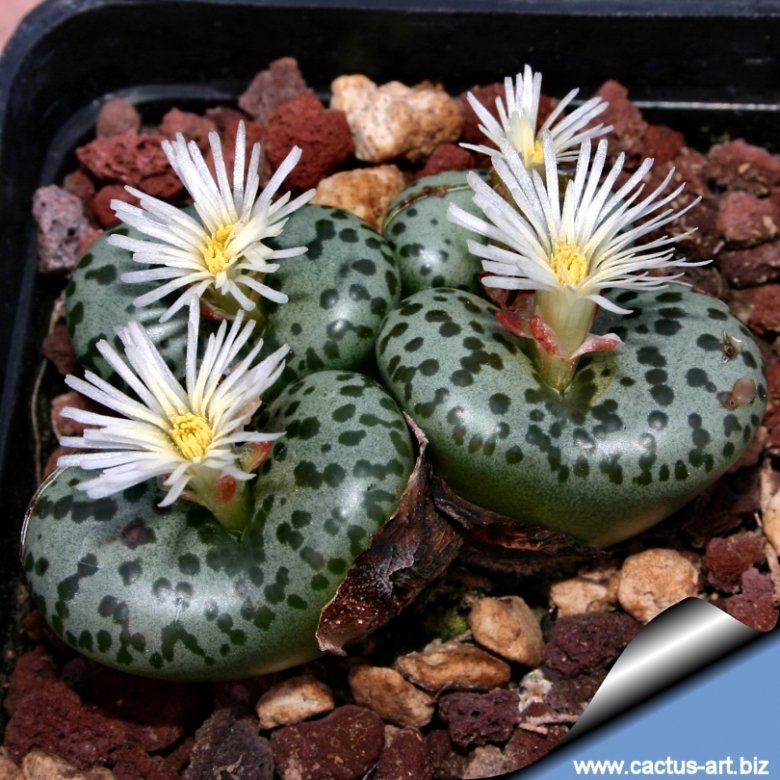
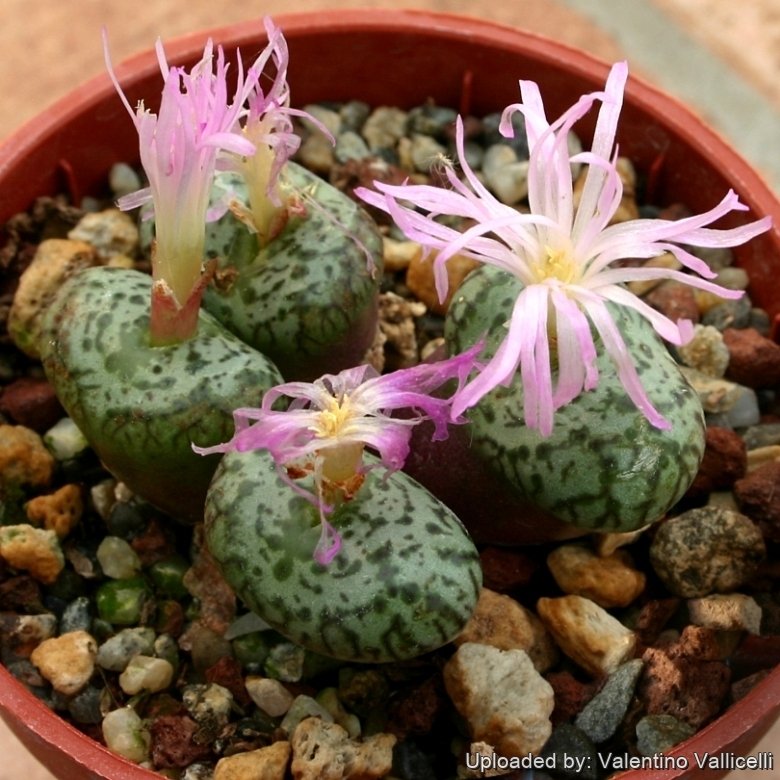
Flowers: Often paired, large with a white, yellow or rich pink-creamy colour with a pale yellow centre. The thin petals form an almost star-like, spidery structure, they are aromatic and very showy.
Blooming season: Blooms mostly in autumn (in cultivation in Europe August-November). The flowers are numerous and open at night.
Fruits: 4-6 locular hygrochastic capsules.
Origin and Habitat
South Africa, Northern Cape (Calvinia) and Western Cape (Clanwilliam, Piquetberg, Vanrhynsdorp, Vredendal)
Habitat: Conophytum obcordellum grows on granite or on Table Mountain Sandstone.
Cultivation and Propagation
Conophytum obcordellum is easy to grow. These plants grow on winter rain and head for summer dormancy. More or less dormant in summer. The plant requires little water; otherwise its epidermis breaks (resulting in unsightly scars). Water throughout the year although minimally in summer, (only when the plant starts shrivelling), but it will generally grow even in summer if given water. Water regularly in winter after the previous year’s leaves have dried up. Requires good drainage. Keep cool and shaded from hot sun in mid-summer; it needs full sun or light shade in the other seasons. Hardy to -2°C. Ensure a very good ventilation. Avoid to repot frequently. This plant may stay in the same pot for many years. Plants grown in larger containers have frequently relatively poor flowers. It might improve when the plants are given their own, small individual pots.
Propagation: It can be reproduced both by cuttings and seeds. Take the cutting from a grown-up mother plant. Each cutting must contain one or more heads, along with a fraction of root.
Bibliography
Major references and further lectures
-
Gordon D. Rowley “The illustrated encyclopedia of succulents” Crown Publishers, 01/Aug/1978
-
James Cullen, Sabina G. Knees, H. Suzanne Cubey “The European Garden Flora Flowering Plants: A Manual for the Identification of Plants Cultivated in Europe, Both Out-of-Doors” Cambridge University Press, 11/Aug./2011
-
Raimondo, D., von Staden, L., Foden, W., Victor, J.E., Helme, N.A., Turner, R.C., Kamundi, D.A. and Manyama, P.A. 2009. “Red List of South African Plants.” Strelitzia 25. South African National Biodiversity Institute, Pretoria.
-
Hammer, S. 1993. “The Genus Conophytum - A Conograph.” Succulent Plant Publications, Pretoria.
-
Hammer, S. 2002. “Dumpling and His Wife: New Views of the Genus Conophytum.” East Anglia Engraving Creative Colour Ltd, Norwich, England.
-
Ernst Van Jaarsveld, Ben-Erik Van Wyk, Gideon Smith “Succulents of South Africa: A Guide to the Regional Diversity” Tafelberg Publishers, Limited, 01/lug/2000
-
Heidrun E.K. Hartmann “Illustrated Handbook of Succulent Plants: Aizoaceae A-E” Springer, 2002
-
Werner Rauh “The Wonderful World of Succulents: Cultivation and Description of Selected Succulent Plants Other Than Cacti” Smithsonian Institution Press, 1984
-
Hermann Jacobsen “Lexicon of Succulent Plants” Littlehampton Book Services Ltd. 1974
From llifle page Conophytum giftbergense
Description
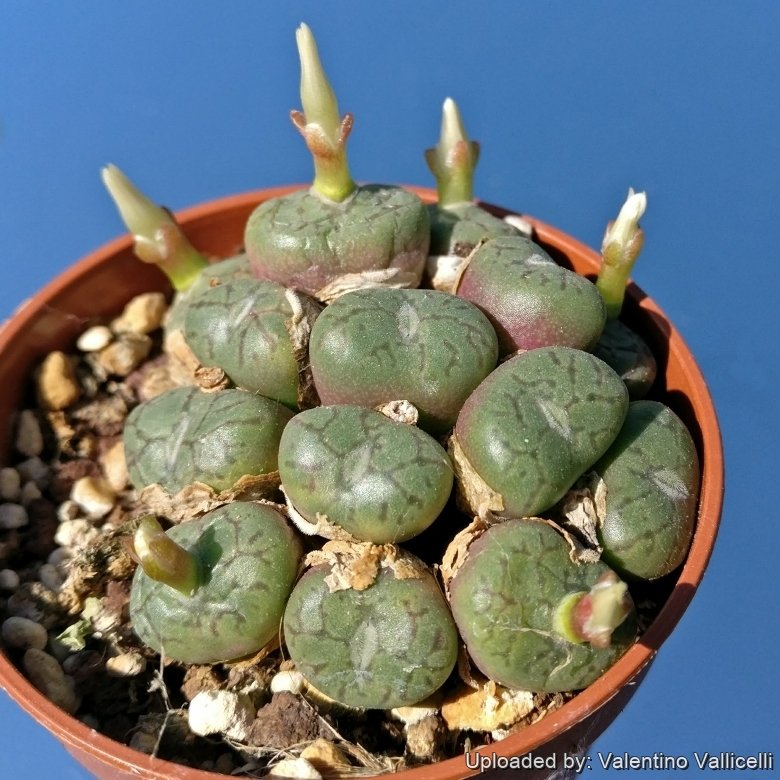
Conophytum giftbergense is a dwarf leaf-succulent with broad and flat-topped bodies decorated with exquisite markings. It branches to form loose cushions up to 45 mm tall, up to 60 mm in diameter. Conophytum giftbergense distinguish from Conophytum obcordellum by the usually larger pancake-shaped bodies, with more curved upper surface, smaller, not merging dots and less lively colouring.
Stem: It is almost stemless (branches very short subterranean). Internodes up to 1,5 mm.
Bodies (paired leaves): Small, obconical, pancake-shaped or somewhat heart-shaped, convex or somewhat depressed at the apex, up to 18 mm tall, 16 mm in diameter and 13 mm thick with a small growing cleft up to 5 mm. long, slightly depressed that doesn’t reach right across the body. Faces broad elliptical in contour, glabrous, transition to the sides fairly rounded, somewhat unequal in size; upper surface smooth, bare, basic colour light grey green, marked on the upper side with irregularly distributed raised, , not merging, dark green to carmine coloured dots, often forming short rows that turn a beautiful bright red during the resting period. Dots on the centre of the leaf larger than towards the edge, fissure surrounded by dark row of dots, sides tinted slightly purple. The unspotted sides are pink to a deep dark red. Sheaths light brownish, dotted dark brown above, strong paper-like.
Flowers: Large straw coloured. The thin petals 35-40 crown segments, in 2-3 rows form an almost star-like, spidery structure, they are aromatic and very showy. Ovary enclosed or barely visible in the fissure, calyx tube up to 3,5 mm long light green or brownish, with stamens few united at the centre with the coronary tube as from the middle, filaments white, anthers projecting, style up to 2 mm long with 4-5 stigmas.
Blooming season: Blooms mostly Aug-Nov. The flowers are numerous and open at night.
Origin and Habitat
Vredendal, West Cape Province, South Africa
Habitat: It grows on Table Mountain Sandstone in crevices or in lichens and moss carpets.
Cultivation and Propagation
The Conophytums belonging to the obcordellum group are some of the world’s most fascinating plants and are sought by the collector of succulent plants. They grow on winter rain and heads for summer dormancy. If you provide them with the right conditions, they will reward you with their unique shape, size, colour and a proliferation of blooms in autumn. While Conphytum are picky about their care, if you are patient and remember the basics, your efforts will be rewarded. Being small plants, a representative collection can be grown on a patio table, a sunny windowsill or a shelf in the greenhouse. The growing season in northern hemisphere is from September to March.
Soil: Conophytum giftbergense grows best in sandy-gritty soil and requires good drainage as it it is prone to root rot. It can grows outdoor in sunny, dry, rock crevices (protection against winter wet is required) It can also be cultivated in alpine house, in poor, drained soil.
Repotting: Repotting every year is not recommended. They may stay in the same pot for many years. Plants grown in larger containers have frequently relatively poor flowers. They might improve when the plants are given their own, small individual pots.
Fertilization: Feed it once during the growing season with a fertilizer specifically formulated for cactus and succulents (poor in nitrogen), including all micro nutrients and trace elements diluted to ½ the strength recommended on the label. It thrives in poor soils and need a limited supplies of fertilizer to avoid the plants developing excess vegetation, which is easily attacked by fungal diseases.
Watering: The Conophytums thrive in dry and desert regions and are able to stand extended periods of drought and require careful watering. Water minimally in summer, (only occasional misting), water more abundantly after the previous year’s leaves have dried up when they are growing in the autumn and spring, but let the soil dry between soaking. Requires little water otherwise its epidermis breaks (resulting in unsightly scars). If grown in a container, bottom watering by immersing the container is recommended. Ensure a very good ventilation. .
Light: It enjoy some shade (avoid direct sun as it grows wild among rocks and under the shade of other plants) and in summer it need to be kept in a cool area.
Hardiness: It prefer a very bright situation and require a minimum temperature 5°C (But will take a light frost and is hardy down to -7° C for short periods if it is in dry soil). USDA zones 9A – 11.
Uses: Container, rock garden.
Pests and diseases: It is vulnerable to mealybugs and rarely scale.
Propagation: It can be reproduced both by seed in autumn or (or rarely) cuttings. Take the cutting from a grown-up mother plant. Each cutting must contain one or more heads along with a fraction of root and permit to dry out a couple of days, lay it on the soil and insert the stem end partially into the soil. Try to keep the cutting somewhat upright so that the roots are able to grow downward. It is relatively difficult to root Conophytums from cuttings and generally pointless as well, so quick are they from seed.
Bibliography
Major refences and further lectures
-
A. Tischer “Conophytum giftbergense Tisch. spec. nov.” Cactus and Succulent J. of great Britain, Vol. 22. page 76 - Oct/1960
-
Heidrun E. K. Hartmann (2001) “Aizoaceae A – E” Springer
-
Hammer, S. 1993. “The Genus Conophytum - A Conograph.” Succulent Plant Publications, Pretoria.
-
Hammer, S. 2002. “Dumpling and His Wife: New Views of the Genus Conophytum.” East Anglia Engraving Creative Colour Ltd, Norwich, England.
-
Germishuizen, G. & N. L. Meyer, eds. 2003. “Plants of southern Africa: an annotated checklist.” Strelitzia 14.
-
S. M Walters “The European Garden Flora Flowering Plants: Casuarinaceae to Aristolochiaceae” Cambridge University Press, 1989
Source: Conophytum giftbergense, LLIFLE - Encyclopedia of living forms, CC-BY-SA, retrieved 2026-10-25.
From llifle page Conophytum lambertense
Description
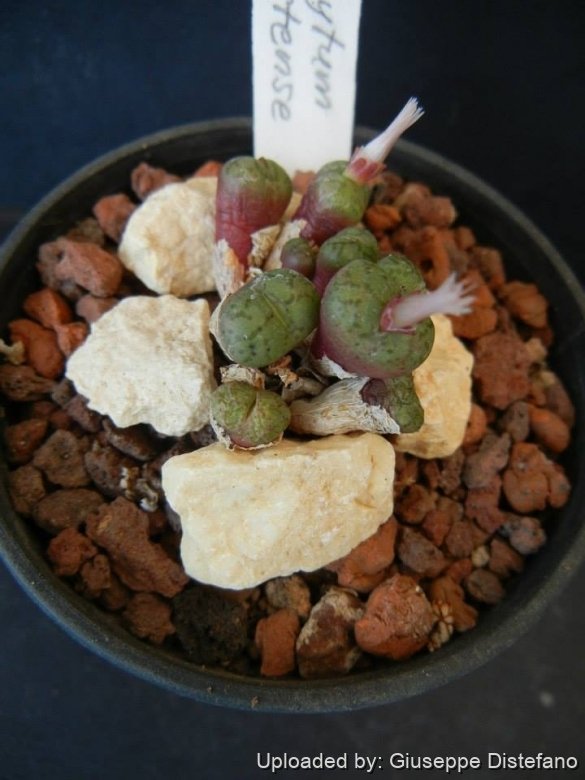
Conophytum lambertense is a small coastal form of the widespread and morphologically variable Conophytum obcordellum subsp. obcordellum coming from Lambert Bay (hence the name), however the two plants are not readily distinguishable, if not for the geographical provenance. This dwarf succulent species has tiny pancake-shaped bodies marked with few to many dots and lines, these often raised and glossy. It is extremely decorative even without flowers.
Habit: It is variably caespitose, with single or double bodies, or forming dense mats or cushions.
Bodies (paired leaves): Small, pancake-shaped, convex or concave at the apex, about 1 (or less) cm in diameter with a small growing cleft that doesn’t reach right across the body.
Colours: Silvery-green, variously spotted light or dark brown. The unspotted sides are pink to a deep dark red, while the apex, which is glabrous, medium green, and variably suffused with reddish or dark green dots that are slightly raised, which sometimes join up to make lines and which turn a beautiful bright red during the resting period.
Flowers: Often paired, large with a white, yellow or rich pink-creamy colour with a pale yellow centre. The thin petals form an almost star-like, spidery structure, they are aromatic and very showy.
Blooming season: Blooms mostly in autumn (in cultivation in Europe August-November). The flowers are numerous and open at night.
Fruits: 4-6 locular hygrochastic capsules.
Origin and Habitat
Lambert Bay, Western Cape province of South Africa.
Cultivation and Propagation
Conophytum lambertense is easy to grow. These plants grow on winter rain and head for summer dormancy. More or less dormant in summer. The plant requires little water; otherwise its epidermis breaks (resulting in unsightly scars). Water throughout the year although minimally in summer, (only when the plant starts shrivelling), but it will generally grow even in summer if given water. Water regularly in winter after the previous year’s leaves have dried up. Requires good drainage. Keep cool and shaded from hot sun in mid-summer; it needs full sun or light shade in the other seasons. Hardy to -2°C. Ensure a very good ventilation. Avoid to repot frequently. This plant may stay in the same pot for many years. Plants grown in larger containers have frequently relatively poor flowers. It might improve when the plants are given their own, small individual pots.
Propagation: It can be reproduced both by cuttings and seeds. Take the cutting from a grown-up mother plant. Each cutting must contain one or more heads, along with a fraction of root.
Source: Conophytum lambertense, LLIFLE - Encyclopedia of living forms, CC-BY-SA, retrieved 2026-10-25.
From llifle page Conophytum multicolor
Description
Conophytum obcordellum is a very variable species with tiny pancake-shaped bodies marked with few to many coloured dots and lines. It comprises several questionable varieties and its taxonomic history has undergone several changes.
Conophytum obcordellum fa. multicolor, formerly known as Conophytum multicolor, is a particularly colourful form of C. obcordellum, distinguished through its particularly lively, grey-green almost metallic colouring, and the sides and the markings on the top of the body are dark purple. The rest of the features are fully identical with C. obcordellum. Dark purple colouring is also evident in Conophytum obcordellum fa. picturatum. Conophytum obcordellum fa. Multicolor is one of the prettiest and priced forms.
Bodies (paired leaves): Inverted-conical to almost pancake-shaped, 10-15 mm tall, 8-12 mm in diameter, top flat or slightly convex, the edge often rolled significantly. Surface smooth, blue-green or steel blue. Sites usually purple, upper surface face marked with numerous short rows or lines of lines of dark ruby points which branch in net fashion.
Flowers: Often paired, large white or creamy with a pale yellow centre. The thin petals form an almost star-like, spidery structure, they are aromatic and very showy.
Blooming season: Blooms mostly in autumn (in cultivation in Europe August-November). The flowers are numerous and open at night.
Origin and Habitat
Van Rhynsdorp district, Cape Province, South Africa.
Cultivation and Propagation
Conophytum obcordellum f. multicolor is easy to grow. These plants grow on winter rain and head for summer dormancy. More or less dormant in summer. The plant requires little water; otherwise its epidermis breaks (resulting in unsightly scars). Water throughout the year although minimally in summer, (only when the plant starts shrivelling), but it will generally grow even in summer if given water. Water regularly in winter after the previous year’s leaves have dried up. Requires good drainage. Keep cool and shaded from hot sun in mid-summer; it needs full sun or light shade in the other seasons. Hardy to -2°C. Ensure a very good ventilation. Avoid to repot frequently. This plant may stay in the same pot for many years. Plants grown in larger containers have frequently relatively poor flowers. It might improve when the plants are given their own, small individual pots.
Propagation: It can be reproduced both by cuttings and seeds. Take the cutting from a grown-up mother plant. Each cutting must contain one or more heads, along with a fraction of root.
Bibliography
Major references and further lectures
-
“Conophytum multicolor” in The National Cactus and Succulent Journal: The Official Journal of the National Cactus & Succulent Society Volumes 23-26, page 30, National Cactus and Succulent Society, 1968
-
Steven A. Hammer “The genus Conophytum: a conograph” Succulent Plant Publications, Pretoria1993
-
Tischer “Conophytum multicolor” Succulenta 10:127-128 (1928)
-
James Cullen, Sabina G. Knees, H. Suzanne Cubey “The European Garden Flora Flowering Plants: A Manual for the Identification of Plants Cultivated in Europe, Both Out-of-Doors” Cambridge University Press, 11/Aug./2011
-
Hammer, S. 2002. “Dumpling and His Wife: New Views of the Genus Conophytum.” East Anglia Engraving Creative Colour Ltd, Norwich, England.
-
Heidrun E.K. Hartmann “Illustrated Handbook of Succulent Plants: Aizoaceae A-E” Springer, 2002
-
Werner Rauh “The Wonderful World of Succulents: Cultivation and Description of Selected Succulent Plants Other Than Cacti” Smithsonian Institution Press, 1984
-
Hermann Jacobsen “Lexicon of Succulent Plants” Littlehampton Book Services Ltd. 1974
Source: Conophytum multicolor, LLIFLE - Encyclopedia of living forms, CC-BY-SA, retrieved 2026-10-25.
From llifle page Conophytum spectabile
Description
Dwarf succulent bodies with exquisite markings, these plants are variably caespitose, with single or double bodies, or forming dense mats or cushions,
Bodies (paired leaves): Variable bodies, small, pancake-shaped, convex or concave at the apex, about 1 cm in diameter with a small growing cleft that doesn’t reach right across the body. Colour: Silvery-green, variously spotted light or dark brown. The unspotted sides are pink to a deep dark red, while the apex, which is glabrous, medium green, and variably suffused with reddish or dark green dots that are slightly raised, which sometimes join up to make lines and which turn a beautiful bright red during the resting period.
Flowers: Large with a rich pink-creamy colour and a pale yellow centre. The thin petals form an almost star-like, spidery structure, they are aromatic and very showy:
Blooming season: Blooms mostly Aug-Nov. The flowers are numerous and open at night.
Distinguish characters: It has always present and often prominent markings or raised spots; pinkish (or white) strongly scented nocturnal flowers in autumn.
Origin and Habitat
South Africa (Western Cape)
Bibliography
Major refences and further lectures
-
Heidrun E. K. Hartmann (2001) “Aizoaceae A – E” Springer
-
Hammer, S. 1993. “The Genus Conophytum - A Conograph.” Succulent Plant Publications, Pretoria.
-
Hammer, S. 2002. “Dumpling and His Wife: New Views of the Genus Conophytum.” East Anglia Engraving Creative Colour Ltd, Norwich, England.
-
Germishuizen, G. & N. L. Meyer, eds. 2003. “Plants of southern Africa: an annotated checklist.” Strelitzia 14.
-
S. M Walters “The European Garden Flora Flowering Plants: Casuarinaceae to Aristolochiaceae” Cambridge University Press, 1989
Source: Conophytum spectabile, LLIFLE - Encyclopedia of living forms, CC-BY-SA, retrieved 2026-10-25.
Cultivars and forms (3)
Subspecies (1)
Varieties (1)
Forms (1)
Gallery