Publication: Cact. Fl. Silvestre Chile 108. 1989
Description
Copiapoa vallenarensis is one of the several forms of the very variable Coquimbana coquimbana which form a complex of related taxon. It is still unclear whether this variable complex is one or several species. There is so much variation that most authors choose to lump them together. Copiapoa vallenarensis distingushes from the fewer strong spines. This species is considered by Ritter strictly related to Copiapoa fiedleriana.
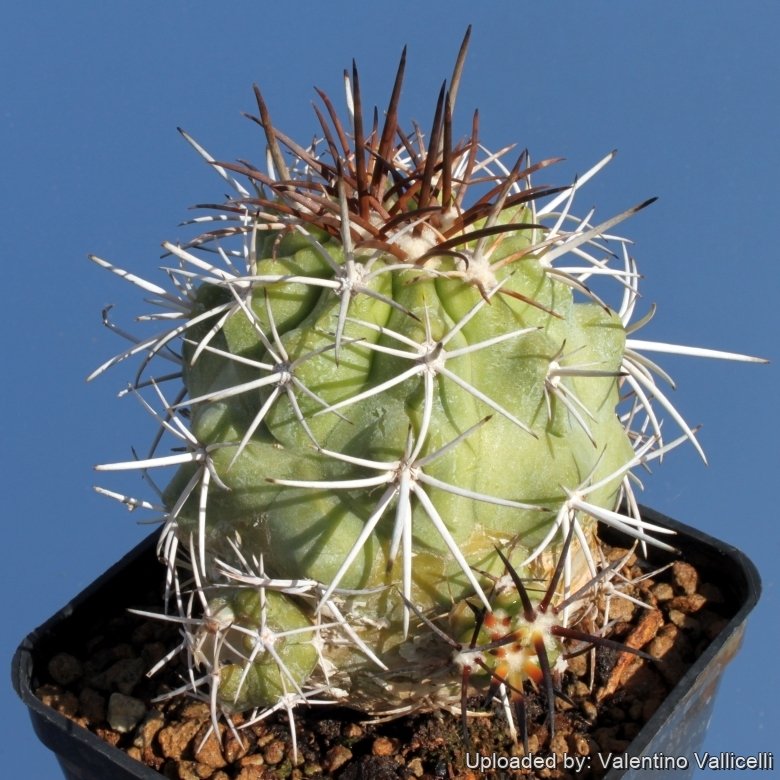
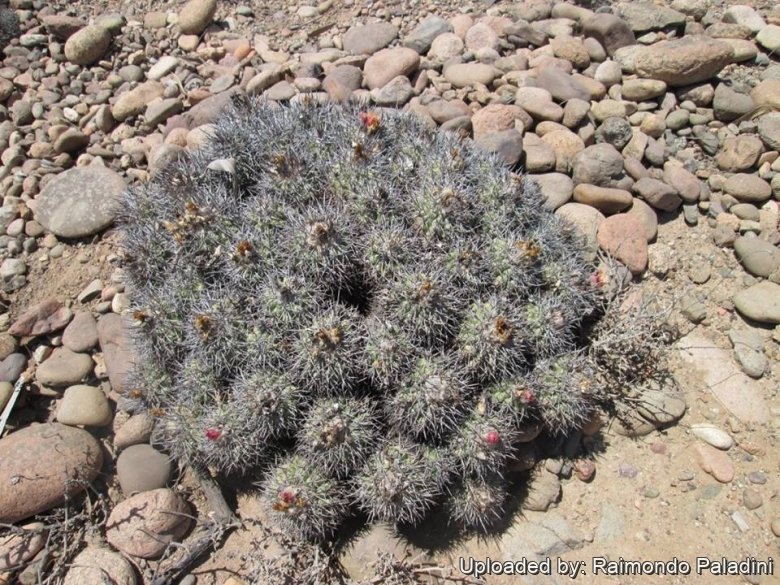
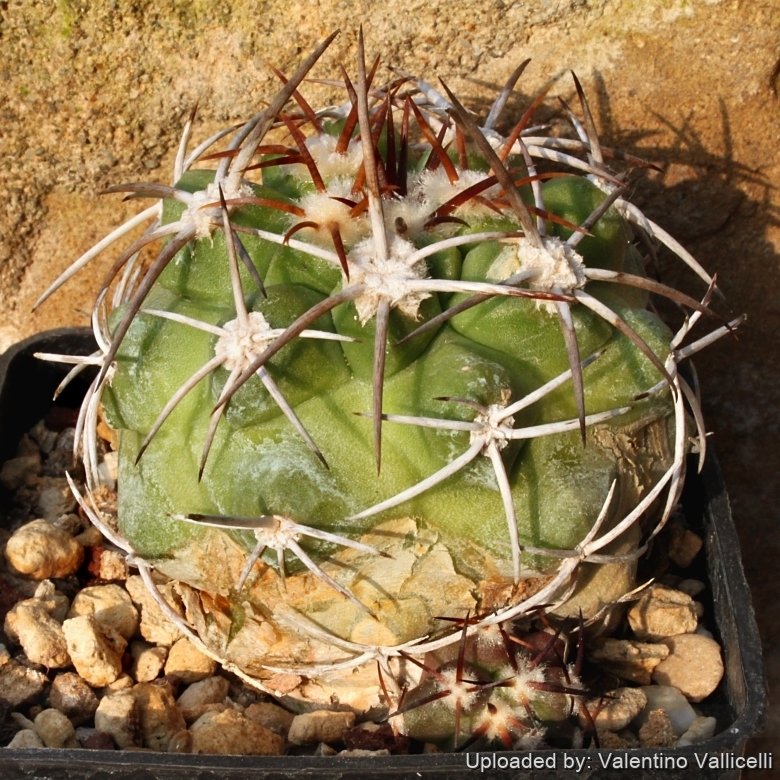
Habit: It is a strongly spined cactus that branches vigorously from the base, forming large clumps or cushions. In habitat, the bodies are much compact and very spiny. When grown in pots, this species tends to elongate and have darker spines on most of the body, with grey-white spines only appearing on the oldest areoles at the bottom of the plant.
Stem: Elongated-globose, pale to bright green or bluish green up to 40 cm tall, but usually less than 30 cm, and crowned by a dense mass of long white wool, particularly at flowering time.
Ribs: There are 10 to 20 strongly tuberculate especially in young specimens
Tubercles: With a rounded, raised edge and a wide base.
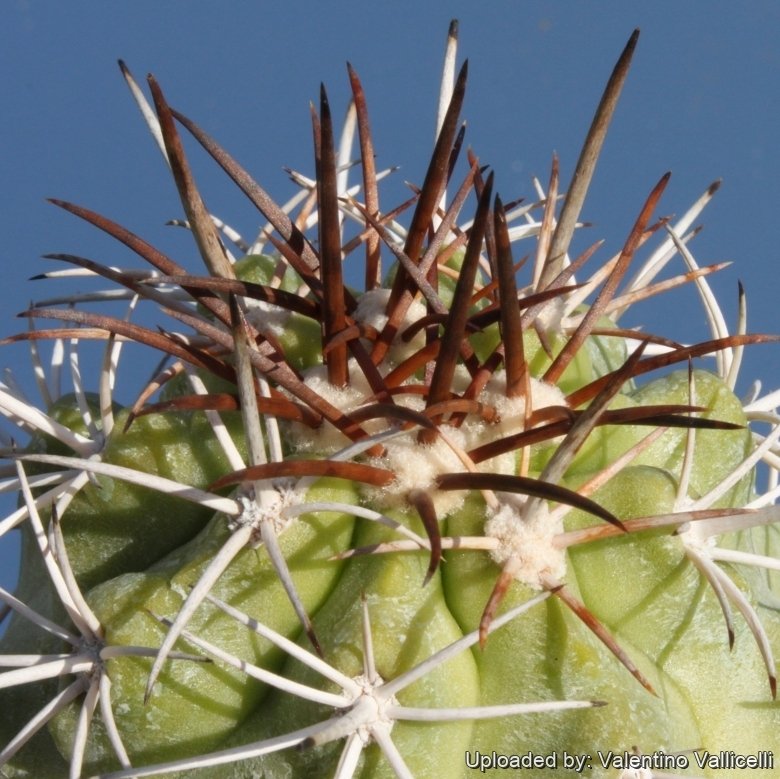
Areoles: Apical, convex, covered with short wool when young, later glabrous.
Radial spines: Few stout, 1-5 cm long, fairly slender or slightly curved, horizontal, pointing outwards, narrowed angle to the central spine, honey-amber, brownish-red or dark brown, becoming grey with age.
Central spines: 1(-4) thicker 3-6 cm long.
Roots: It has a shallow, diffuse root system or (less frequently) a short taproot.
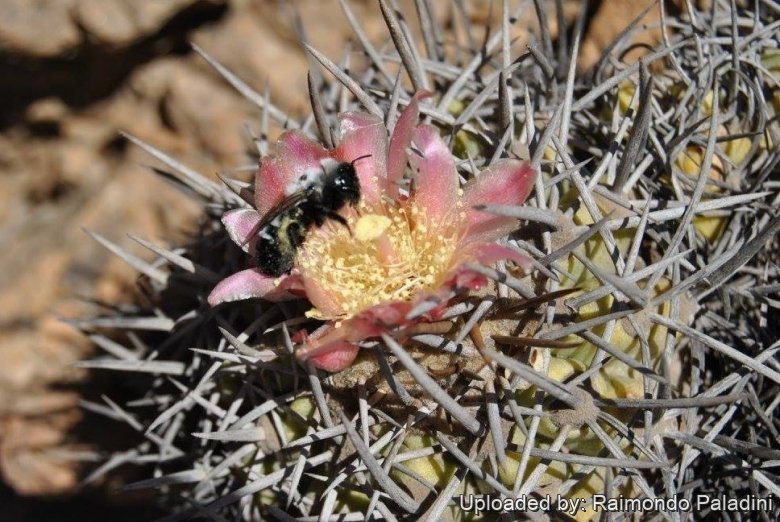
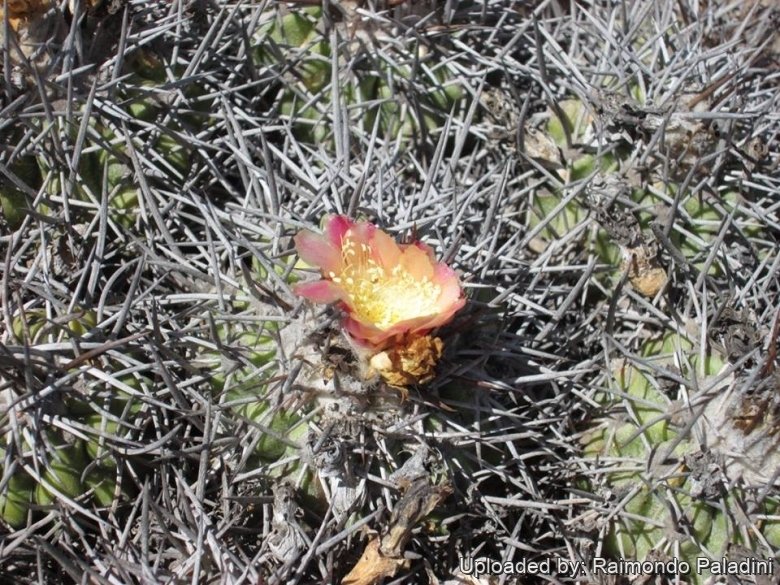
Flowers: At the apex, diurnal closing at night, fragrant, protracting the period of opening many days, campanulate, from the centre of the white wool at the apex. The outer segments of the perianth are linear red-brown or greenish. The inner segments are wide and yellow with a subtle red mid-stripe or occasionally pinkish.
Seeds: Rounded-oblong 1,4-1,6 mm long, 1-1,2 broad and 0,8 mm thick, without papillae and surface sculpturing.
Origin and Habitat
Huasco and Vallenar Valley - Chile.
Altitude: It inhabit along the coast line at low too high elevations up to 1150 m.
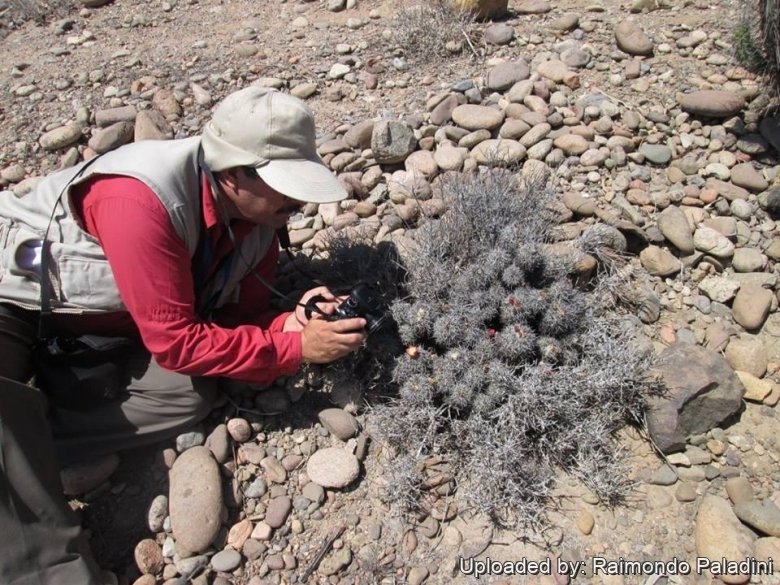
Habitat: It grows on gravel apparently with no soil among granite rocks together with Copiapoa carrizalensis. This is a quite different substrate from other localities characterized by high concentrations of nitrates and minerals such as copper and arsenic.
Cultivation and Propagation
Considering that Copiapoa coquimbana var. vallenarensis comes from a habitat with an extremely arid climate, they are remarkably tolerant of pot culture. These plants have taproots and are susceptible to overwatering. They requires also an appropriate air circulation. Copiapoas are summer grower species easy to cultivate.
Growth rate: This is a slow growing cactus kept for the beauty of its form that will make clumps given the best conditions.
Soils: It likes very coarse mineral cactus mix soil, but can become too elongated if compost is too rich.
Repotting: Use pot with good drainage.
Watering: It requires light but regular waterings in summer, but let the soil mix dry between waterings, but do not overwater (Rot prone), it must be strictly kept dry throughout the winter quiescent period since it is very sensitive to any moisture excesses keep dry in winter.
Fertilization: Feed with a high potassium fertilizer in summer.
Hardiness: Not highly tolerant of a great deal of frost. They need to be kept in a cool place during winter rest and are resistant to light frost if kept on the dry side prior to, and during, cold weather ( they are hardy to -2 C ° C short periods). However some warmth throughout the year will increase the grower’s success (minimum 5° to 10°C during rest season).
Exposition: Requires full sun or light shade and careful watering to keep plant compact with strong coloured spines. Tends to bronze in strong light, which encourages flowering and heavy spine production. Light shadow my be useful in the hottest summer days.
Uses: It is an excellent plant for container growing. It always looks good and stays small. It look fine in a cold greenhouse and frame or outdoor in a rockery.
Pests & diseases: It may be attractive to a variety of insects, but plants in good condition should be nearly pest-free, particularly if they are grown in a mineral potting-mix, with good exposure and ventilation. Nonetheless, there are several pests to watch for:
- Red spiders: Red spiders may be effectively rubbed up by watering the infested plants from above.
- Mealy bugs: Mealy bugs occasionally develop aerial into the new growth among the wool with disfiguring results, but the worst types develop underground on the roots and are invisible except by their effects.
- Scales: Scales are rarely a problem. It is wise to treat your whole collection with a systemic insecticide twice a year in spring and autumn.
- Rot: Rot is only a minor problem with cacti if the plants are watered and “aired” correctly. If they are not, fungicides won’t help all that much. To prevent rottenness it is also advisable to surround its root neck by very rough sand or grit, this help a fast water drainage.
Propagation: Seeds (or offsets if available), Grafting is often used to speed growth rate and to create a back-up to plants in collection. Seeds germinate in 7-14 days at 21-27° C in spring, remove gradually the glass cover as soon the plants will be well rooted (ca 1-2 weeks) and keep ventilated, no full sun for young plants!
Bibliography
Major references and further lectures
-
Edward Anderson “The Cactus family” Timber Press, Incorporated, 2001
-
Friedrich Ritter - Kakteen in Südamerika (Ergebnisse meiner 20jährigen Feldforschungen) 1980
-
David R Hunt; Nigel P Taylor; Graham Charles; International Cactaceae Systematics Group. “The New Cactus Lexicon” dh books, 2006
-
F. Ritter, “Kakteen in Sudamerika.” Bd 3. Spangenberg, 1980. S. 1044-1107 [Copiapoa].
-
Taylor, N. P. “A commentary on Copiapoa II” Cact. Succ. Joum Grt. Brit. 1981. Vol. 43. N 2/3. P. 49-60.
Gallery