Publication: Cact. Fl. Silvestre Chile 108 1989.
Description
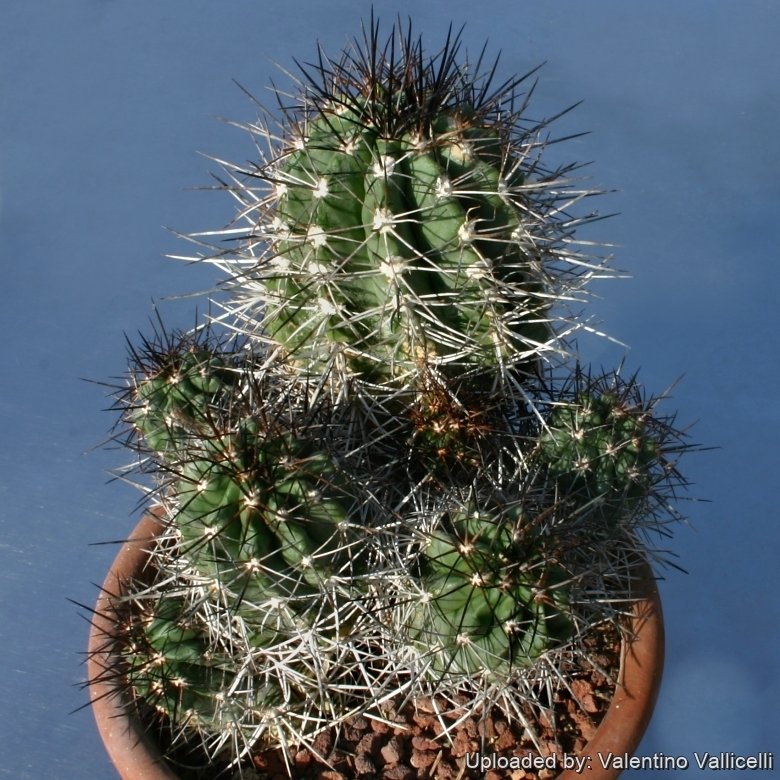
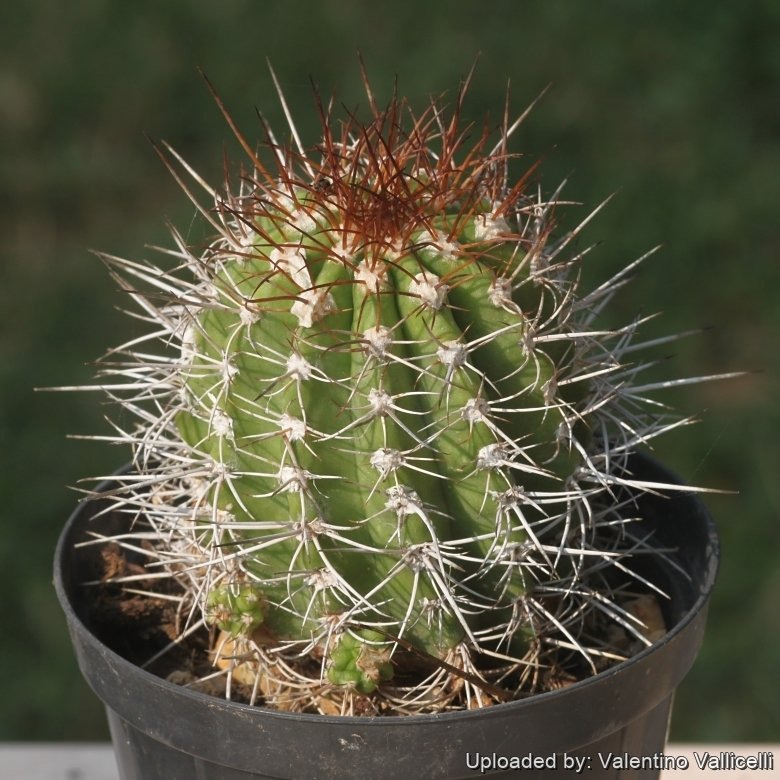
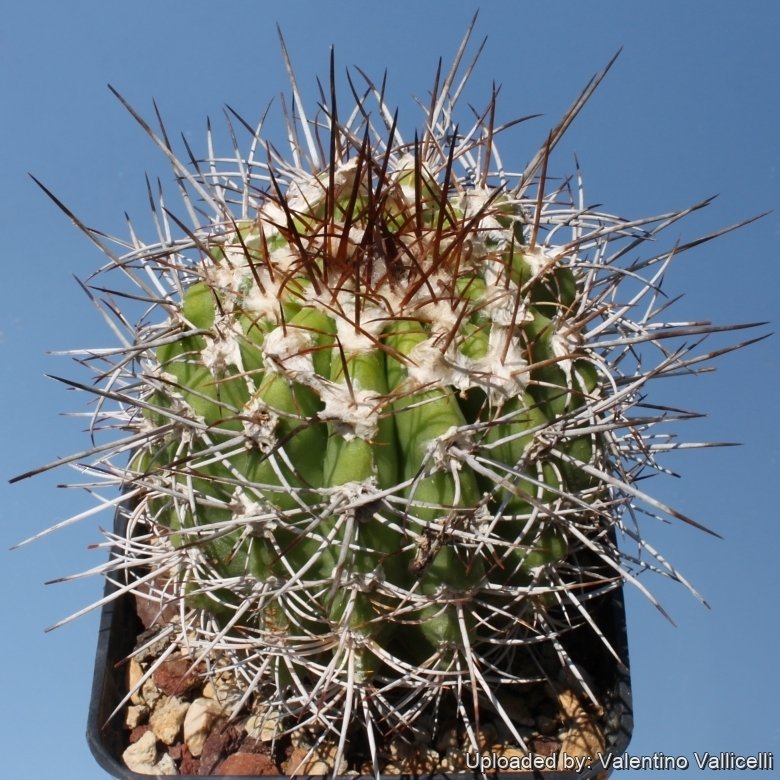
Copiapoa coquimbana var. pseudocoquimbana (false Copiapoa coquimbana) can be referred to a local form within the variability of Copiapoa coquimbana characterized by longer and thinner spines, moreover radial spines are straight whereas they tend to curve toward the plant’s body in the typical coquinbana. However there is a considerable variability in spine shape, size and colour and it is sometimes difficult to separate one local form from another and is also quite problematic to define a clearly distinction with other Copiapoa coquimbana forms.
Habit: Caespitose, with a turnip-like root.
Stems: Depressed-globose 20-30 cm high, 5-10 cm Ø, green, covered with copious grey wool at the apex, particularly at flowering time. 10-15 cm in diameter that branches profusely, forming large clumps up 1 m large and 60 cm high.
Ribs: There are about 10-18 scant crenate.
Areoles: Apical, 5-8 mm diam, depressed or convex, covered with short wool when young, later glabrous about 0,5-0,8 cm, 2 cm apart.
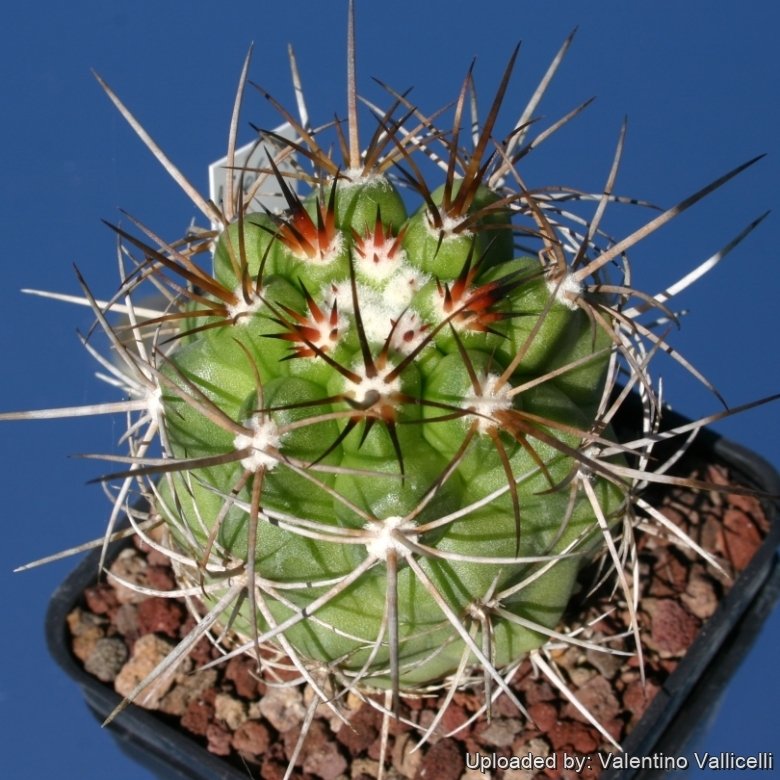
Radial spines: 8-10 fairly slender, mostly straight and acicular, usually pale brown, but also honey-amber, red-brown or black becoming grey with age.
Central spines: 3-4 thicker 3-4,5 cm long (or more).
Roots: Roots-strong, long, thick, narrower at top.
Flowers: Campanulate about 4,5 cm long , bright sulfur yellow and grow from the centre of the white wool at the apex. Outer segments of the perianth are linear and greenishor reddish; inner segments are wide, blunt and yellow. Ovary pale green. Pericarpel scales red.
Fruits: Red brown.
Seeds: with large umbilicus.
Origin and Habitat
The typical area goes from the mouth of the Rio Choros to La Serena but this plant occupies a far broader range, i.e. from Huasco until Fray Jorge National Park, Dept. La Serena, Province of Coquimbo, Nord-Chile.
Altitude: Below 300 metres
Habitat: It is found only in the coastal area and no more than 20 km inland.
Cultivation and Propagation
Considering that Copiapoa coquimbana var. pseudocoquimbana comes from a habitat with an extremely arid climate, they are remarkably tolerant of pot culture. These plants have taproots and are susceptible to overwatering. They requires also an appropriate air circulation. Copiapoas are summer grower species easy to cultivate.
Growth rate: This is a slow growing cactus kept for the beauty of its form that will make clumps given the best conditions.
Soils: It likes very coarse mineral cactus mix soil, but can become too elongated if compost is too rich.
Repotting: Use pot with good drainage.
Watering: It requires light but regular waterings in summer, but let the soil mix dry between waterings, but do not overwater (Rot prone), it must be strictly kept dry throughout the winter quiescent period since it is very sensitive to any moisture excesses keep dry in winter.
Fertilization: Feed with a high potassium fertilizer in summer.
Hardiness: Not highly tolerant of a great deal of frost. They need to be kept in a cool place during winter rest and are resistant to light frost if kept on the dry side prior to, and during, cold weather ( they are hardy to -2 C ° C short periods). However some warmth throughout the year will increase the grower’s success (minimum 5° to 10°C during rest season).
Exposition: Requires full sun or light shade and careful watering to keep plant compact with strong coloured spines. Tends to bronze in strong light, which encourages flowering and heavy spine production. Light shadow my be useful in the hottest summer days.
Uses: It is an excellent plant for container growing. It always looks good and stays small. It look fine in a cold greenhouse and frame or outdoor in a rockery.
Pests & diseases: It may be attractive to a variety of insects, but plants in good condition should be nearly pest-free, particularly if they are grown in a mineral potting-mix, with good exposure and ventilation. Nonetheless, there are several pests to watch for:
- Red spiders: Red spiders may be effectively rubbed up by watering the infested plants from above.
- Mealy bugs: Mealy bugs occasionally develop aerial into the new growth among the wool with disfiguring results, but the worst types develop underground on the roots and are invisible except by their effects.
- Scales: Scales are rarely a problem. It is wise to treat your whole collection with a systemic insecticide twice a year in spring and autumn.
- Rot: Rot is only a minor problem with cacti if the plants are watered and “aired” correctly. If they are not, fungicides won’t help all that much. To prevent rottenness it is also advisable to surround its root neck by very rough sand or grit, this help a fast water drainage.
Propagation: Seeds (or offsets if available), Grafting is often used to speed growth rate and to create a back-up to plants in collection. Seeds germinate in 7-14 days at 21-27° C in spring, remove gradually the glass cover as soon the plants will be well rooted (ca 1-2 weeks) and keep ventilated, no full sun for young plants!
Notes
This taxon taxon has never been described as a species in its own right. Related to this plant, and perhaps not distinct from it, is Copiaoa fiedleriana, but it grows farther north, not along the coast but in an interior valley.
Bibliography
Major references and further lectures
-
Walther Haage “Kakteen von A bis Z” Anaconda ed. 2012 ISBN: 3866472609
-
Edward Anderson “The Cactus family” Timber Press, Incorporated, 2001
-
Friedrich Ritter - Kakteen in Südamerika (Ergebnisse meiner 20jährigen Feldforschungen) 1980
-
David R Hunt; Nigel P Taylor; Graham Charles; International Cactaceae Systematics Group. “The New Cactus Lexicon” dh books, 2006
Gallery