Publication: Cactaceae (Britton & Rose) 3: 88, fig. 100. 1922
Description
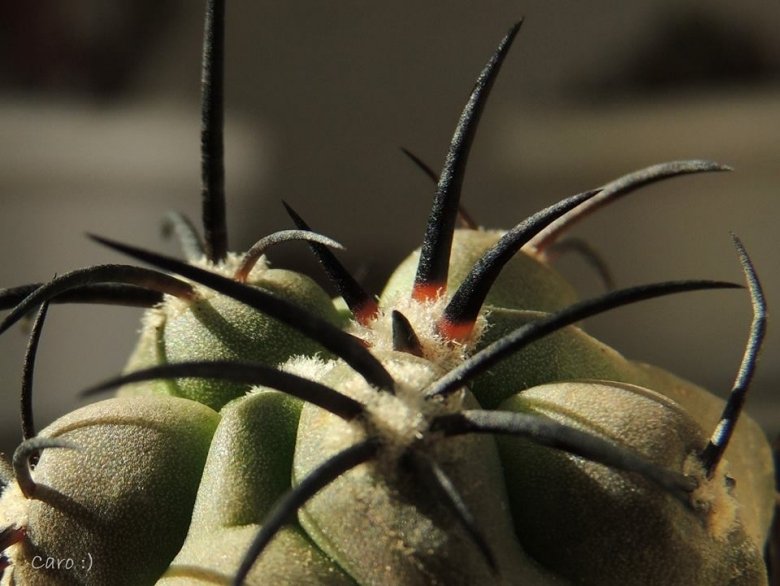
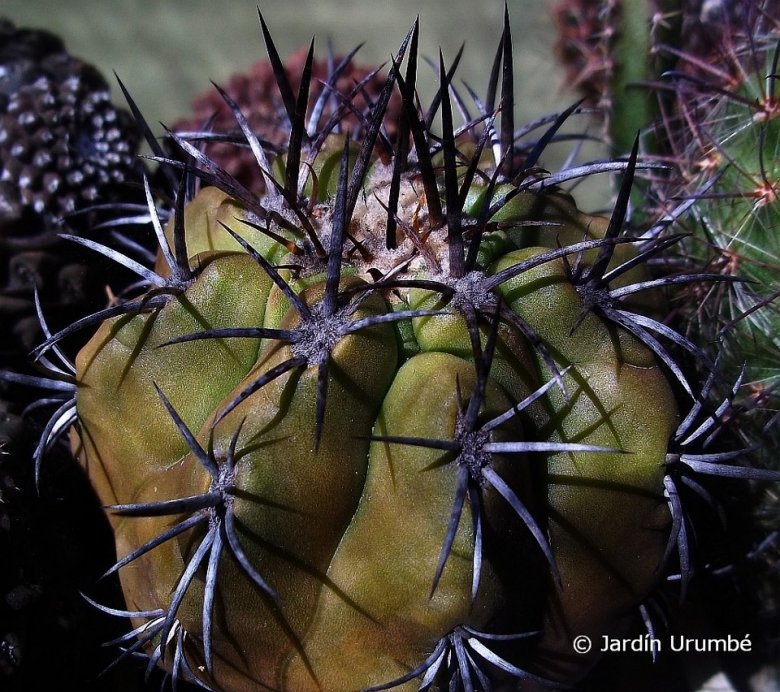
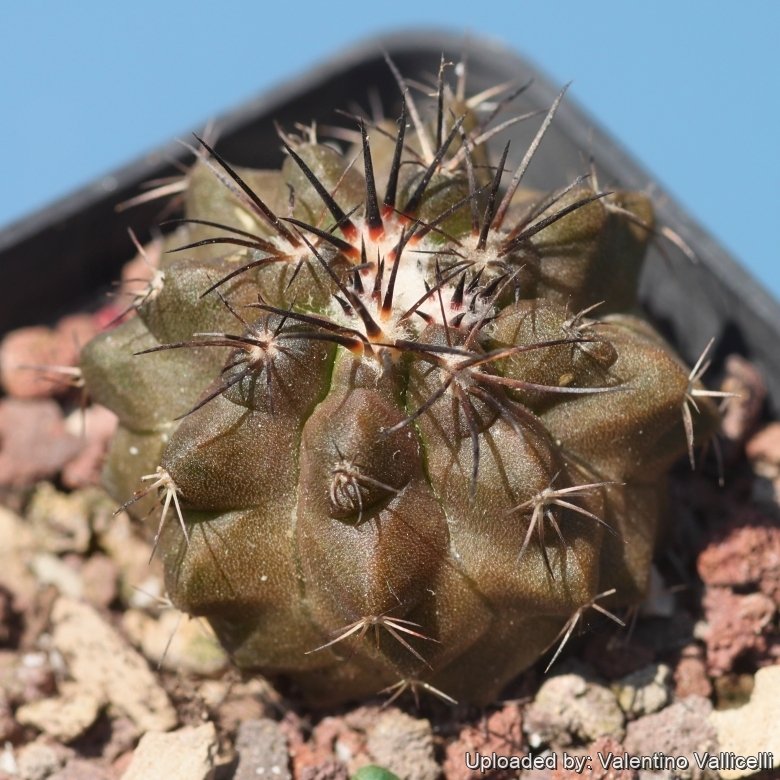
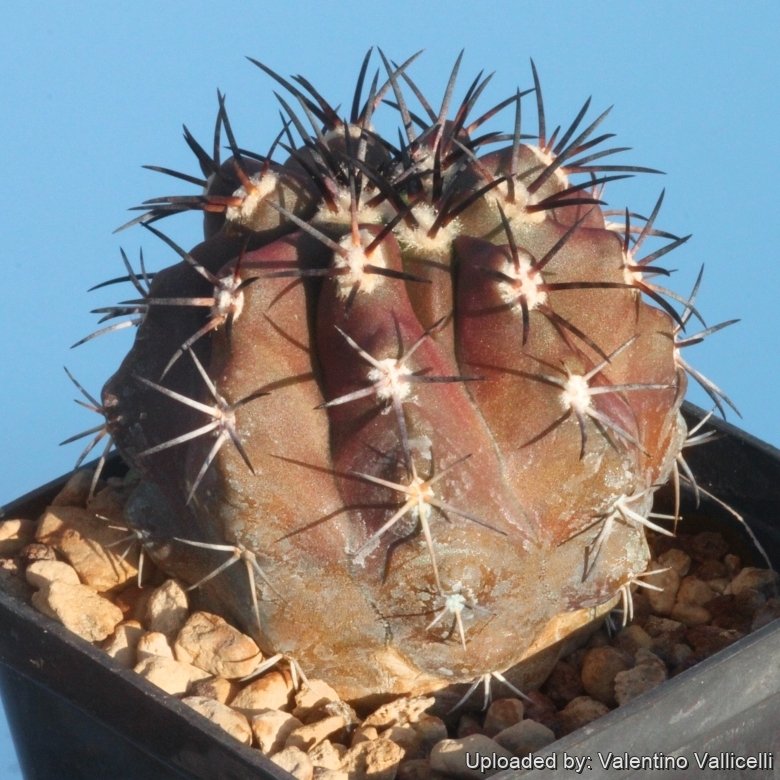
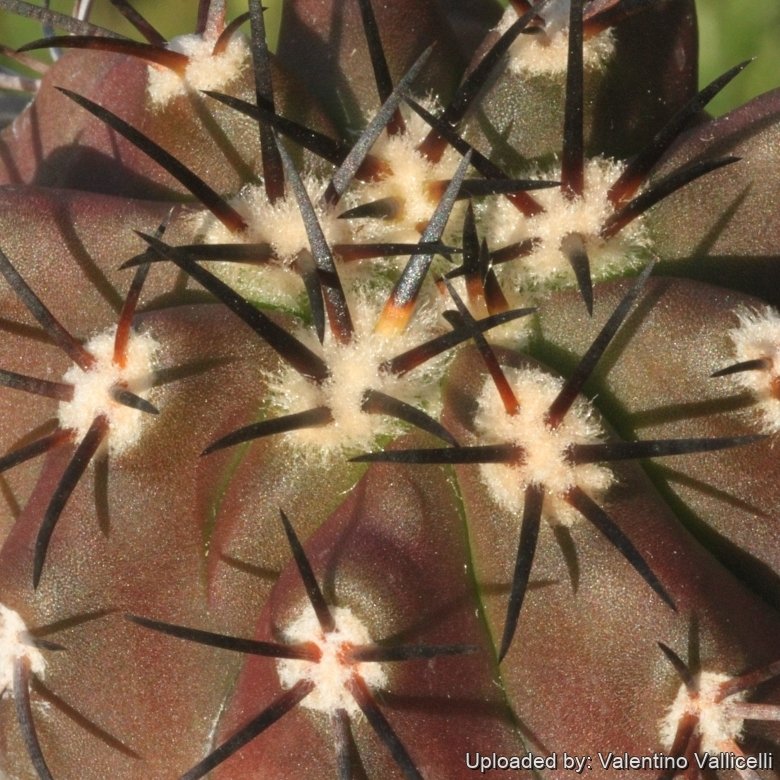
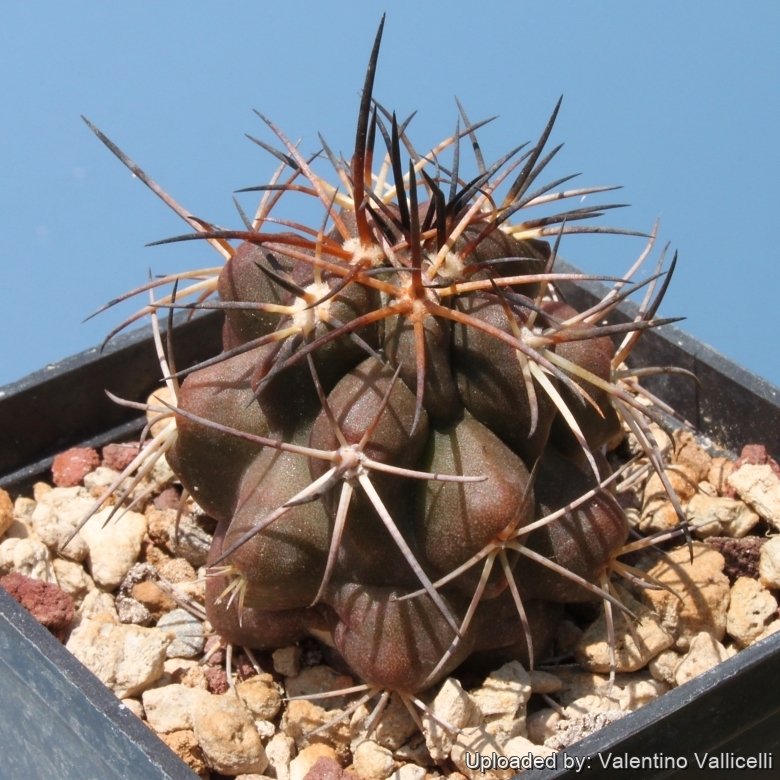
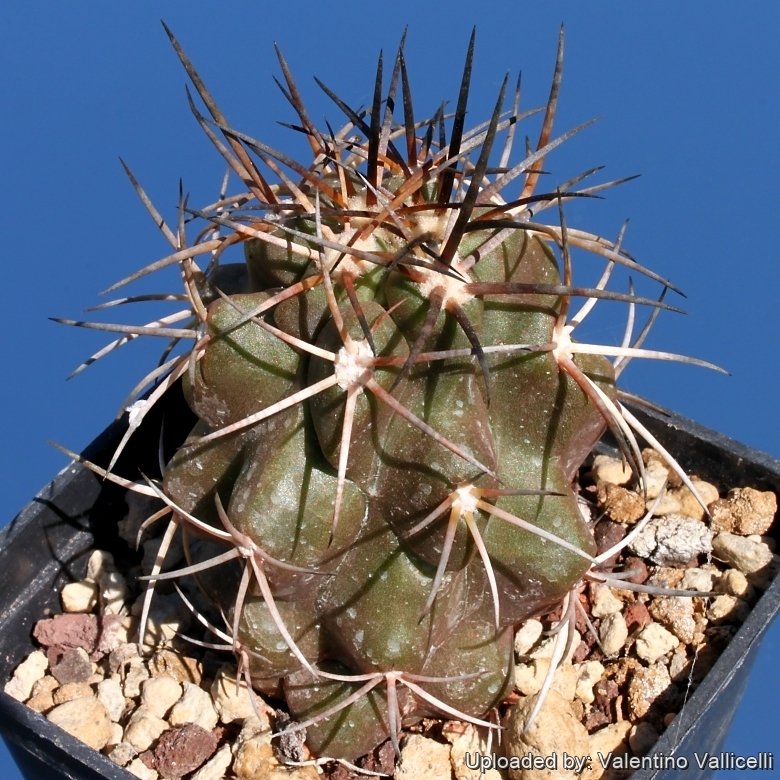
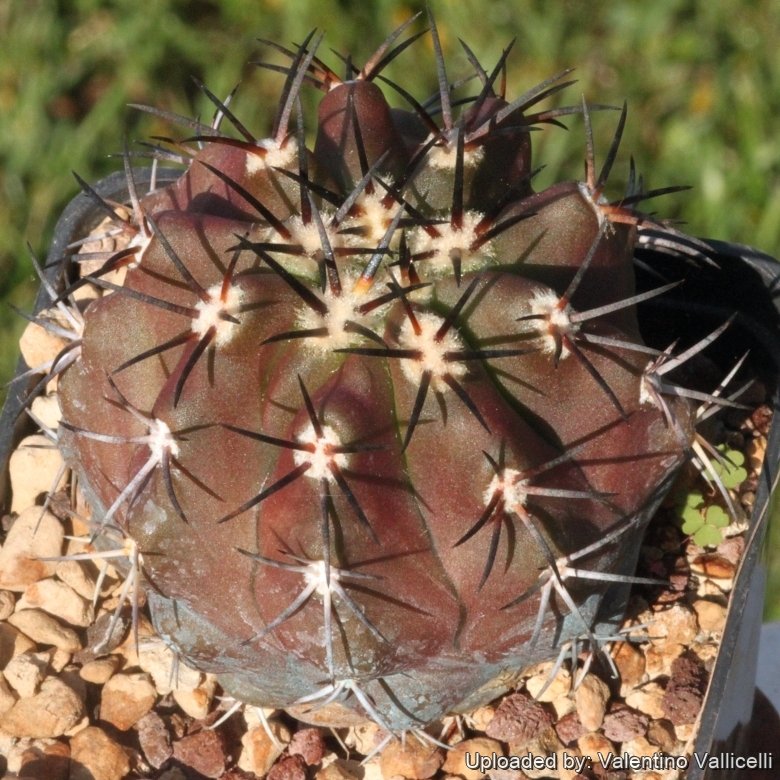
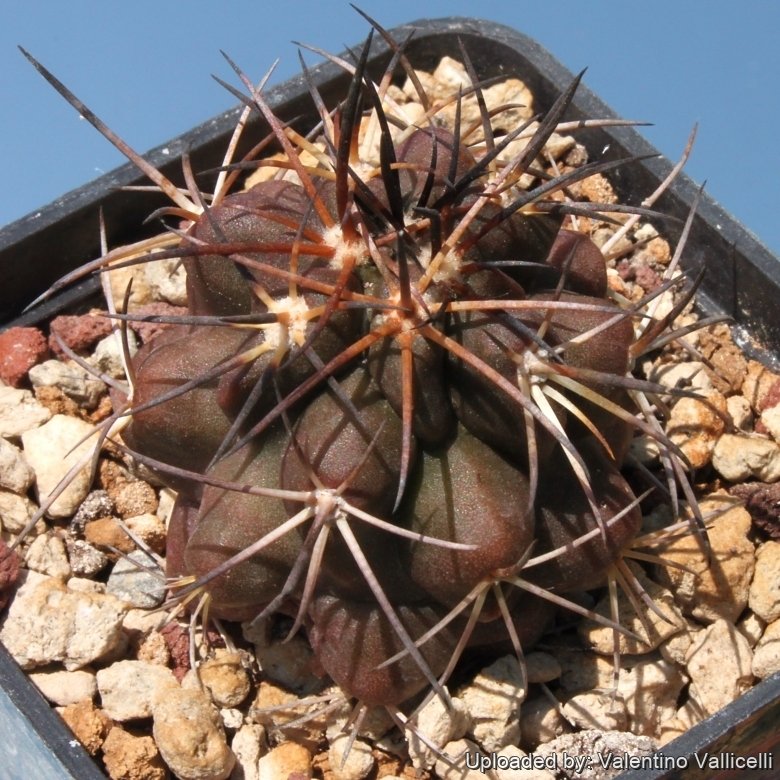
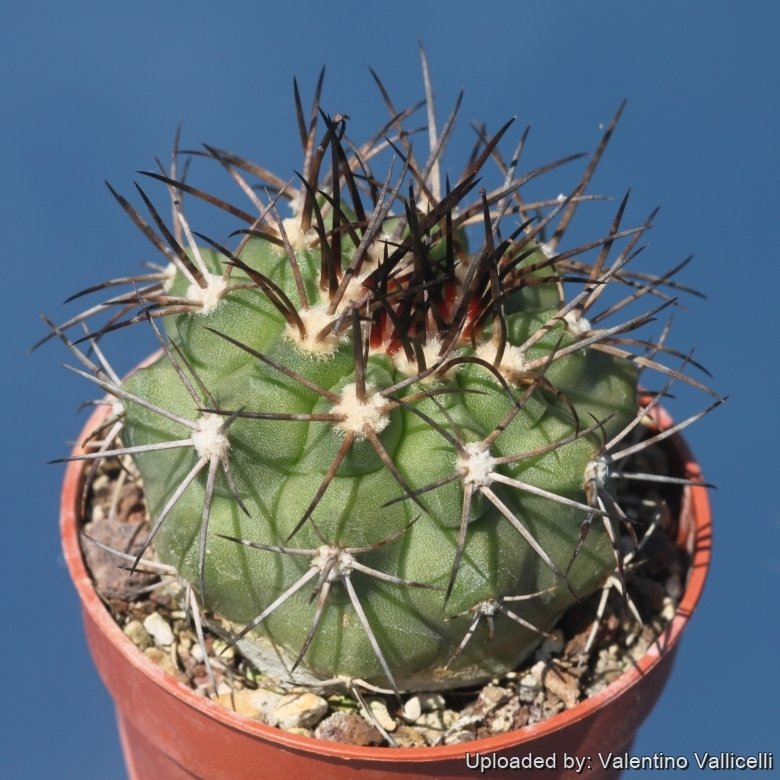
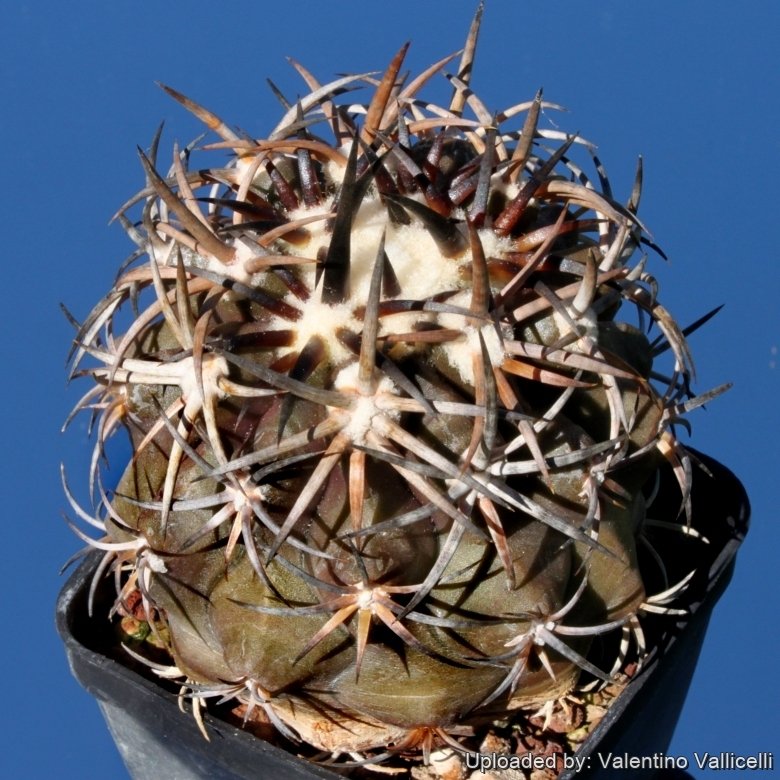
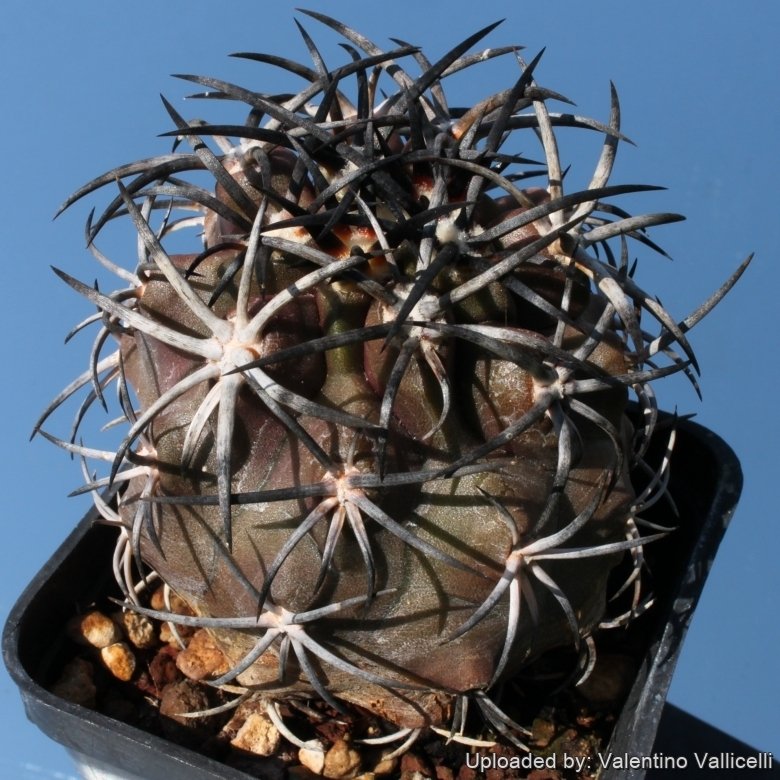
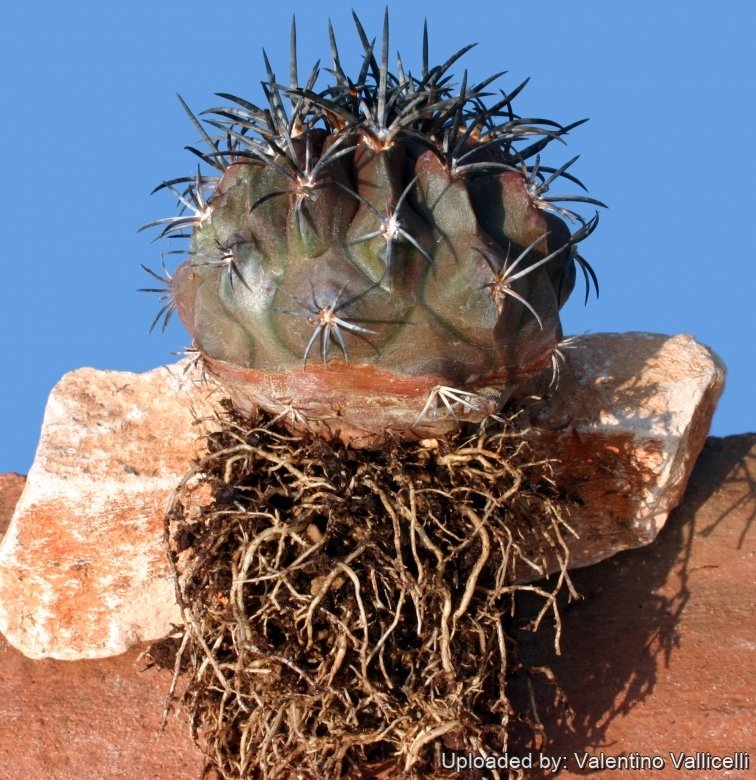
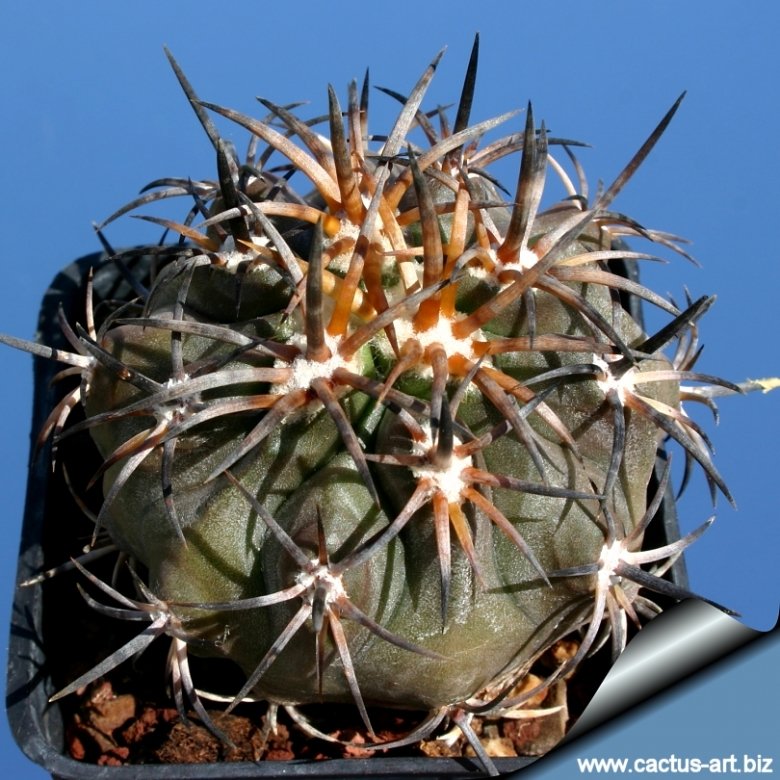
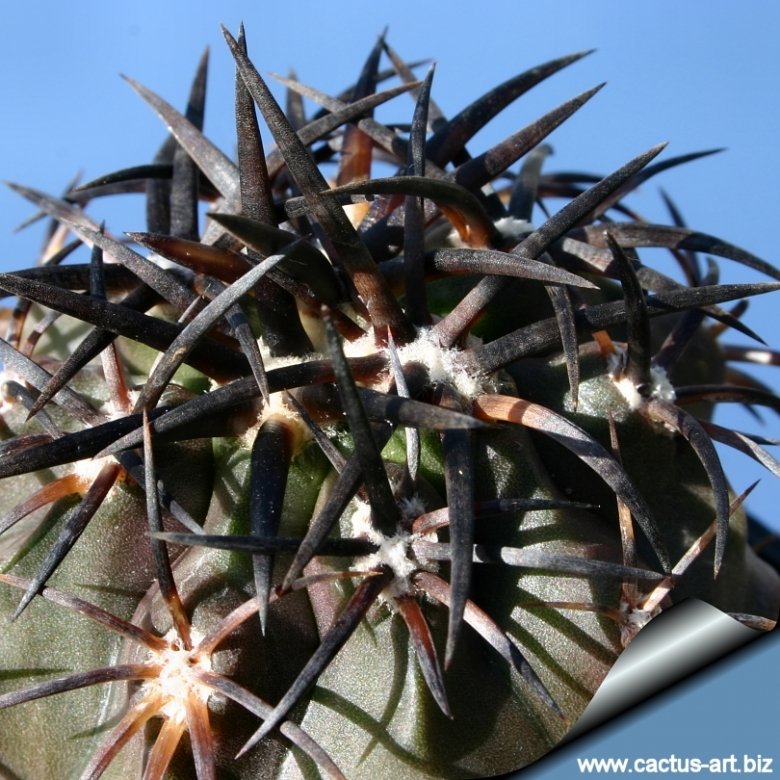
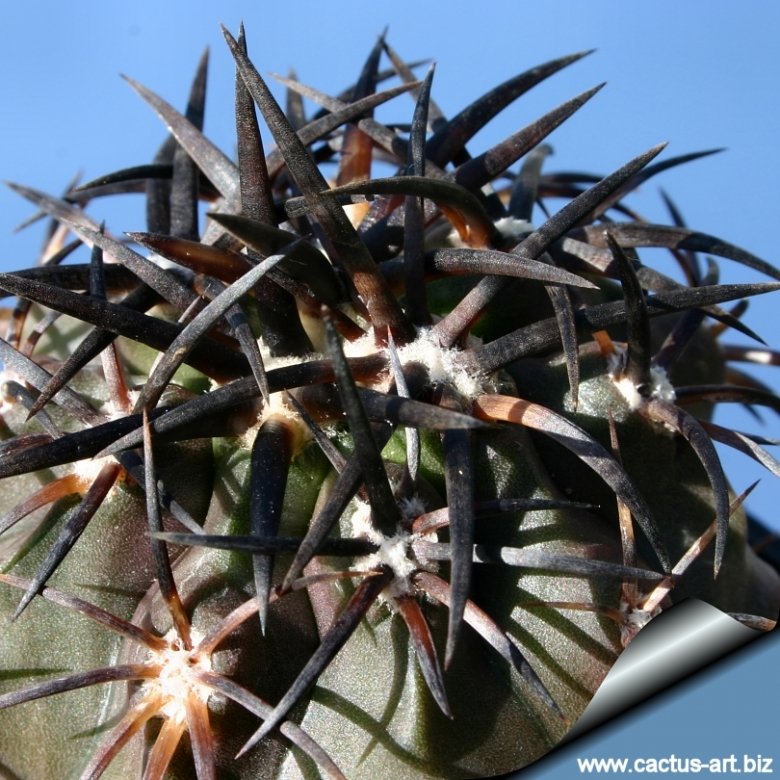
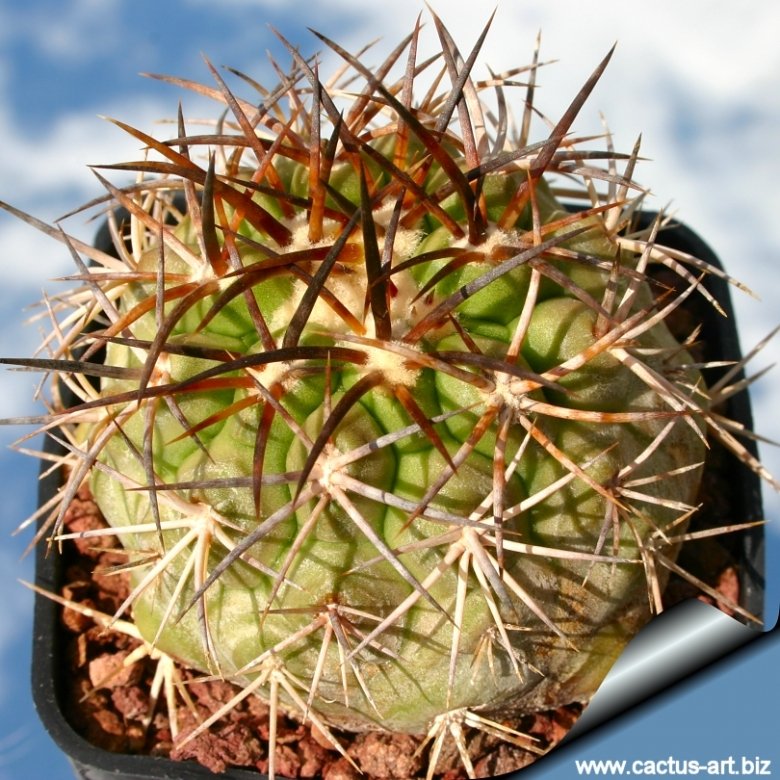
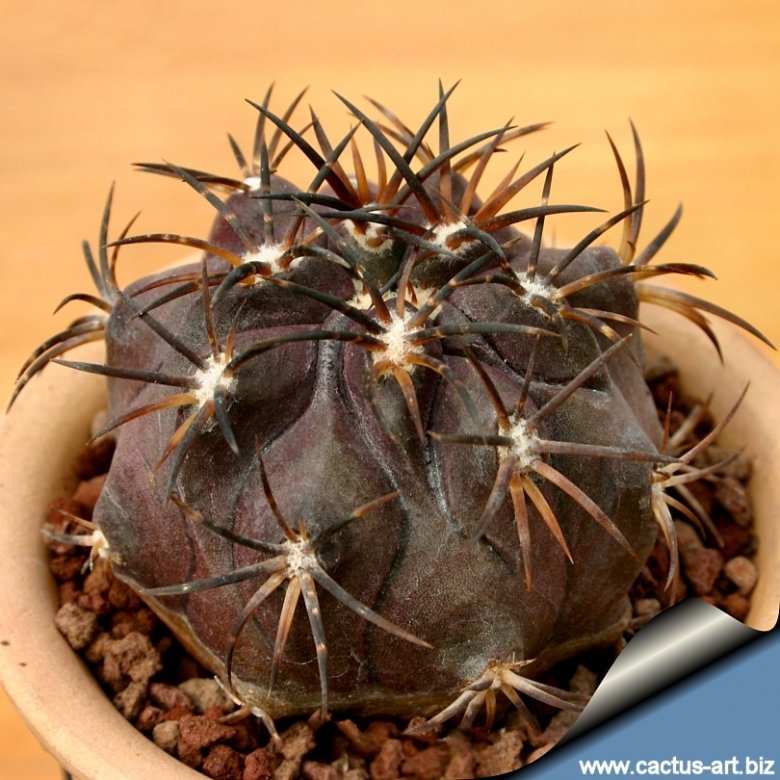
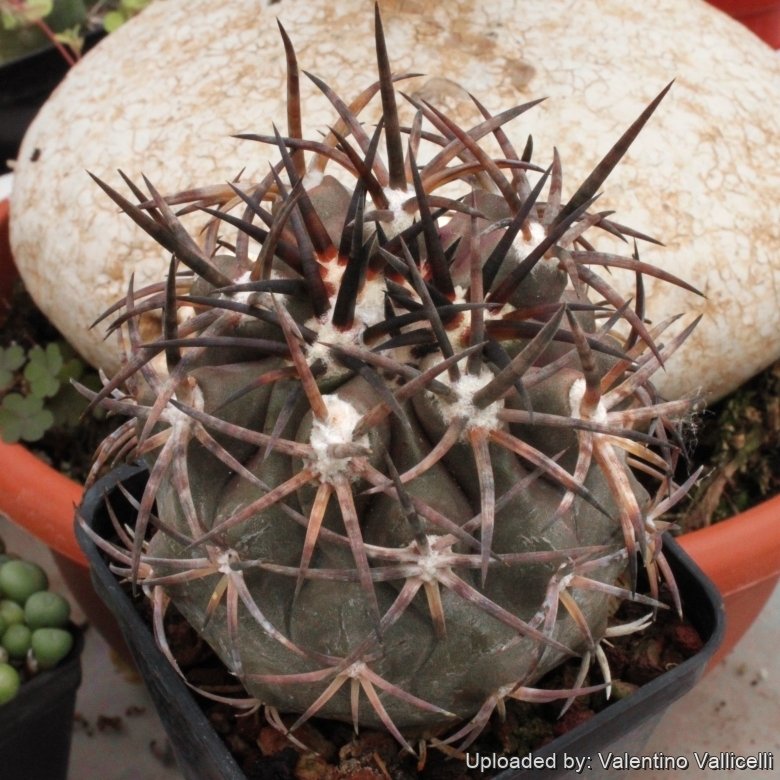
Copiapoa echinoides has a flattened globular shape with woolly top, green to brownish epidermis, stout maroon or black spines, usually slightly curved upward and pale yellow flower. It may be solitary or more usually forms dense clusters. This species is closely related to Copiapoa marginata. There are many different populations with different characteristics.
Stem: Depressed-spherical to spherical, 7-18 cm across, very firm, green, sometimes brownish and woolly at apex. Only in cultivation plants may have an elongate till columnar shape.
Ribs: 11-17, straight, rounded or truncated.
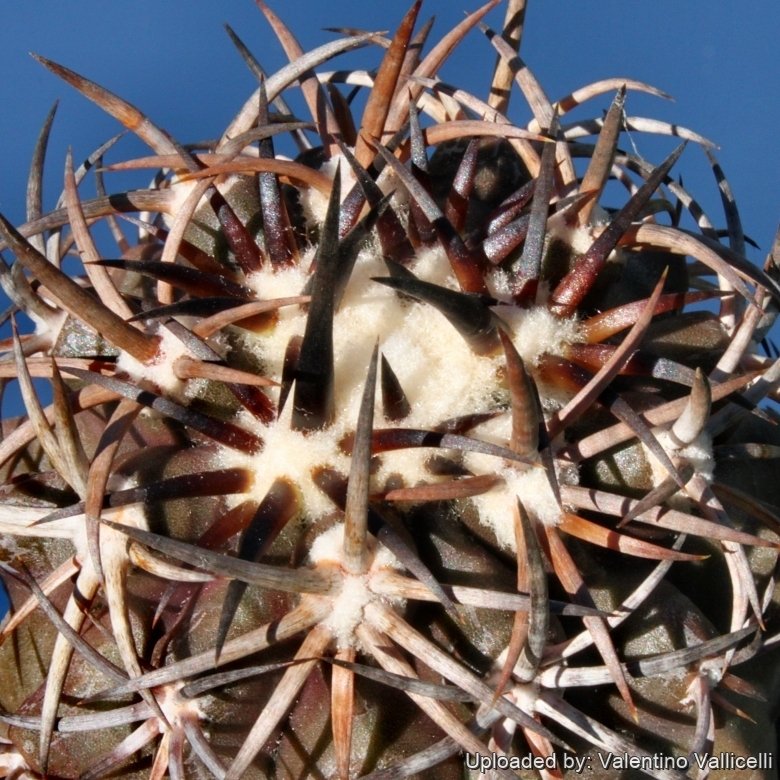
Areoles: Yellowish, becoming grey with age 2-10 mm apart.
Spines: Brownish-red to black, stout, straight to somewhat curved upward.
Radial spines: 6 to 10 to 2.5 cm long.
Central spines: 0-3 porrect, 1-3(-5) cm long.
Flowers: Pale yellow, scented, 3.5-4 cm long; outer perianth-segments narrowly ovate, acute, reddish; inner perianth-segments broadly oblong, obtuse; scales of ovary and flower-tube.
Fruits: Round, c. 1.5 cm in diameter brownish red, with a few scales.
Seeds: 1.7-2 x 1.3-1.5 mm.
Blooming season: Summer.
Remarks: Small seedlings often change considerably as they grow older which adds to the interest of these plants.
Origin and Habitat
Copiapoa echinoides is endemic to Chile, along the coast from north of Huasco up to 50 km inland in the Atacama region (extent of occurrence of approximately 2,500 km2).
Altitude range: It grows at elevations of 0 to 500 metres above sea level.
Habitat and Ecology: This cactus grows in coastal hills (lomas costeras), on relatively compact and rocky soils. The area is extremely dry with very rare rainfall. The dry season lasts 8 - 12 months and in some years it is possible to have no rainfall at all. Rainfall less than 100 mm/year. The plants obtain water mainly from the condensation of coastal fog (camanchaca). It is not abundant. The only major threat is the widening of roads.
Cultivation and Propagation
The location has to be warm and bright, and it has to be in direct sun. Otherwise the bodies tend to elongate in cultivation, but they should be protected from excessive heat and sun in summer. In the spring and late summer, water moderately. Between these times there are dry rest periods. In the winter keep the plant absolutely dry. The roots need a lot of room, so make sure that the pot is large enough. Use regular cacti soil with very good drainage.
Propagation: Seeds (offsets rarely), Grafting is often used to speed growth rate of seedlings and to create a back-up to plants in collection.
Bibliography
Major references and further lectures
-
Faundez, L., Walter, H.E., Guerrero, P., Saldivia, P. & Avilés, R. 2013. Copiapoa echinoides. The IUCN Red List of Threatened Species. Version 2014.3. <www.iucnredlist.org>. Downloaded on 08 May 2015.
-
F. Ritter “Kakteen in Sudamerika” Volume 3. 1980
-
A. Hoffmann, H. Walter “Cactáceas en la flora Silvestre de Chile” Ediciones Fundacion Claudio Gay, Santiago, Chile. Second Edition. 2004
-
Charles “Copiapoa. The Cactus file Handbook 4” Cirio Publ. 1998
-
Edward Anderson “The Cactus family” Timber Press, Incorporated, 2001
-
James Cullen, Sabina G. Knees, H. Suzanne Cubey “The European Garden Flora Flowering Plants: A Manual for the Identification of Plants Cultivated in Europe, Both Out-of-Doors and Under Glass” Cambridge University Press, 11/Aug/2011
-
David R Hunt; Nigel P Taylor; Graham Charles; International Cactaceae Systematics Group. “The New Cactus Lexicon” dh books, 2006
-
Wikipedia contributors. “Copiapoa echinoides.” Wikipedia, The Free Encyclopedia. Wikipedia, The Free Encyclopedia, 18 Nov. 2014. Web. 8 May. 2015.
-
Urs Eggli, Leonard E. Newton “Etymological Dictionary of Succulent Plant Names.” Birkhäuser 2004
-
N. L. Britton, J. N. Rose “The Cactaceae. Descriptions and Illustrations of Plants of the Cactus Family.” Volume III, The Carnegie Institution of Washington, Washington 1922
-
Michail Belov. “Encyclopedia of the Chilean Flora: Copiapoa echinoides” http://www.chileflora.com Web. 8 May. 2015.
From llifle page Copiapoa bridgesii
Description
Copiapoa bridgesii is a soft-bodied, cylindrical, very spiny cactus which is often listed as a synonym of Copiapoa echinoides, but it occurs with minor frequence and its relationship with Copiapoa echinoides is unclear. It is probably a good species (or at the most a subspecies) rather than a variety of Copiapoa echinoides.
Habit: Plants solitary or forming loose clumps.
Stems: At first globose, then short cylindrical to cylindrical, grass green, 20-40 cm high, 5-8 cm in diameter, very woolly at apex.
Ribs: 8-12(-13), straight, rounded, slightly humped.
Areoles: Small to large, ovate , with thick white-brownish felt, close set to confluent,.
Spines: Black to brown, becoming gray with age.
Central spines: 1-3, thick, porrect, pointing upward, 1,5-5 cm long.
Radial spines: 5-10, awl shaped, stout, straight or somewhat curved, 1-2(2,5) cm long.
Flowers: open funnelform, Pale yellow, 3-4 cm long. Scales of ovary and flower-tube hairless in their axils. Outer perianth-segments narrowly ovate, acute, reddish; inner perianth-segments broadly oblong, obtuse.
Fruits: Round to elongate, 1,5 cm on diameter.
Seeds: 1,7-2 x 1,3-1,5 mm.
Origin and Habitat
Distribution: north of Chanaral, Atacama, Chile.
Altitude: 80-400 metres above sea level.
Habitat: It grows in open, fully exposed and very stony coastal areas in a harsh environment together with Copiapoa lembckei and Eriosyce species. The climate is very dry, summer is hot, with extremely rare rainfall in winter. The dry season lasts 8-12 months and in some years it is possible to have no rainfall at all. Rainfall less than 100 mm per annum. The plants obtain water mainly from condensation. It’s a very drought tolerant plant.
Cultivation and Propagation
The location has to be warm and bright, and it has to be in direct sun. Otherwise the bodies tend to elongate in cultivation, but they should be protected from excessive heat and sun in summer. In the spring and late summer, water moderately. Between these times there are dry rest periods. In the winter keep the plant absolutely dry. The roots need a lot of room, so make sure that the pot is large enough. Use regular cacti soil with very good drainage.
Keep warm and dry in winter (10°C) to avoid rot. Not highly tolerant of a great deal of frost. (Frost tolerance 0°C)
Propagation: Seeds (offsets rarely), Grafting is often used to speed growth rate of seedlings and to create a back-up to plants in collection.
Bibliography
Major references and further lectures
-
N. L. Britton, J. N. Rose “The Cactaceae. Descriptions and Illustrations of Plants of the Cactus Family.” Volume 4, The Carnegie Institution of Washington, Washington 1923
-
Edward Anderson “The Cactus family” Timber Press, Incorporated, 2001
-
James Cullen, Sabina G. Knees, H. Suzanne Cubey “The European Garden Flora Flowering Plants: A Manual for the Identification of Plants Cultivated in Europe, Both Out-of-Doors and Under Glass” Cambridge University Press, 11/ago/2011
-
David R Hunt; Nigel P Taylor; Graham Charles; International Cactaceae Systematics Group. “The New Cactus Lexicon” dh books, 2006
-
Graham Charles “Copiapoa” Cirio Pub. Services, 1999
-
Friedrich Ritter - Kakteen in Südamerika (Ergebnisse meiner 20jährigen Feldforschungen) 1980
-
“Acta Horti Botanici Bucurestiensis” Editura “Alo, București!”, 2001
Source: Copiapoa bridgesii, LLIFLE - Encyclopedia of living forms, CC-BY-SA, retrieved 2026-10-25.
From llifle page Copiapoa cuprea
Description
Copiapoa echinoides var. cuprea, originally described as Copiapoa cuprea by F.Ritter in 1959 is a solitary or clumping cactus species, often forming dense clumps or cushion. There exist many populations with different characteristics.
Stem: Spherical, firm, dark tannish-green, cupper-red to very dark-purple and woolly apically,12 to 20 cm tall, 18 cm in diameter.
Ribs: 11 to 17, truncated.
Roots: Fibrous.
Areoles: Yellowish, becoming grey with age.
Spines: Maroon-reddish to pure black, straight or (usually) somewhat curved upward.
Central spines: 0 to 3, 1 to 3(-5) cm long.
Radial spines: 5 to 10, 2.5 cm long.
Flowers: Scented, pale yellow, 4 cm in diameter.
Fruit: Brownish-red, round with a few scales 2.5 cm long.
Seeds: Black.
Remarks: This appears to be a very variable species.
Origin and Habitat
Northern Chile (Near Totoral, Atacama)
Cultivation and Propagation
Watering Needs: The location has to be warm and bright, and it has to be in direct sun. Otherwise the bodies tend to elongate in cultivation, but they should be protected from excessive heat and sun in summer. In the spring and late summer, water moderately. Between these times there are dry rest periods. In the winter keep the plant absolutely dry. The roots need a lot of room, so make sure that the pot is large enough. Use regular cacti soil with very good drainage.
Propagation: Seeds (offsets rarely), Grafting is often used to speed growth rate and to create a back-up to plants in collection.
Source: Copiapoa cuprea, LLIFLE - Encyclopedia of living forms, CC-BY-SA, retrieved 2026-10-25.
From llifle page Copiapoa cupreata
Description
Copiapoa cupreata is a controversial name based on a poorly described Chilean plant of Poselger. The name cupreata is used by some authors to indicate a local form of Copiapoa echinoides, while other authors are inclined to believe that “cupreata” is a synonym of Copiapoa fiedleriana. The following description is based on Walther Haage “Kakteen von A bis Z”:
Derivation: Latin Cupreata, copper coloured.
Stem: Spherical, dark brown.
Ribs: Divided into rhombic tubercles 5 mm tall with rounded edges.
Areoles: Sunken on the tubercles, grey.
Spines: About 6, 1-2 cm long, the upper the shorter, curved brown-black towards the tip and, yellow at the base.
Note: The so called “Copiapoa cupreata” KK1382 Vallenar, Chile 800m, (distributed by Karel Kníže) may be eventually described under a different name.
Origin and Habitat
Northern Chile
Source: Copiapoa cupreata, LLIFLE - Encyclopedia of living forms, CC-BY-SA, retrieved 2026-10-25.
From llifle page Copiapoa dura
Description
Copiapoa dura is a local or morphological form of the widespread and variable Copiapoa echinoides. It has a dark purplish-brown stem and very thick curved amber-maroon to black spines. However the distinguishing characteristics of Copiapoa dura, appear to fall within the natural variation of Copiapoa echinoides and it should be synonymized with the latter.
Habit: Solitary, or forming dense clumps.
Stem: Spherical, firm, dark tannish-green to very dark-purple and woolly apically, 12 to 20 cm tall, 18 cm in diameter.
Ribs: 11 to 17 , truncated.
Roots: Fibrous.
Areoles: Yellowish, becoming grey with age.
Spines: Maroon-reddish to pure black, straight or (usually) somewhat curved upward.
Central spines: 0 to 3, 1 to 3(-5) cm long.
Radial spines: 5 to 10, 2.5 cm long.
Flowers: Scented, pale yellow, 4 cm in diameter.
Fruit: Brownish-red, round with a few scales 2.5 cm long.
Seeds: Black.
Notes
This appears to be a very variable species.
Source: Copiapoa dura, LLIFLE - Encyclopedia of living forms, CC-BY-SA, retrieved 2026-10-25.
Cultivars and forms (1)
Varieties (1)
Gallery