Description
Coryphantha elephantidens is a large, depressed-globular cactus, often clumping and group-forming.
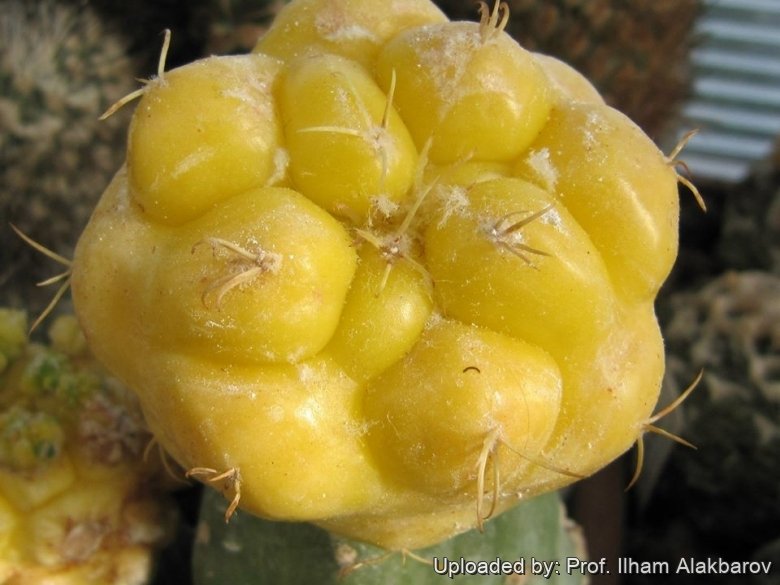
Forma aurea or aurata (yellow form): The schizochromic form (Coryphantha elephantidens f. aurea ) has yellow stems due to the absence (or reduced production) of chlorophyll pigments: every other pigment is present at normal levels, the dominant green colouration is lost, but will still more than likely have normal other pigments that give the yellow overall appearance of the stem. This form with yellow stems is very attractive and highly prized. This schizochromic form is almost always seen grafted on stronger columnar species, and cannot can be grown on its own roots.
Stems: Cream-yellow to bright golden yellow, up 18 cm in diameter, very large tubercles 20-30 (60) mm wide, rounded on top, pentaedrical at the base, always broader than rounded, without glands, the tubercles axil is woolly.
Spines: The tubercles are capped with a 5-8 of stout reflexed radial spines, long (18-26 mm) never porrect, but adpressed to the body.
Flowers: Sweet smelling large 6 to 7.5 cm whitish to pink-coloured (Or yellow) are produced in late summer to autumn. Very big, fruits are long (ca. 4 cm long, 1 cm diameter)
Origin and Habitat
Garden origin (Nursery produced cultivar)
Cultivation and Propagation
Variegated and albinos cacti are regarded as choice and difficult in cultivation, but despite that many of them are relatively easy to grow. But be aware that they cannot tolerate prolonged exposure to direct sun light (especially during the hottest summer days), so grow them in half-shade or under filtered sun. They are sometime seen as grafted plants, but many grow well on their own roots, too.
On the contrary, the albinos can survive only if grafted on a strong green base.
Use mineral well-permeable substratum with little organic matter (peat, humus). Water sparingly from March till October and keep perfectly dry in winter at temperatures from 5 to 15 degrees centigrade. (In general these plants are more tender and cannot endure freezing temperatures ) In the rest period no high atmospheric humidity!!
Propagation: Plants are usually grafted onto a more vigorous and easier columnar stock.
Bibliography
Major references and further lectures
-
Edward Anderson “The Cactus family” Timber Press, Incorporated, 2001
-
James Cullen, Sabina G. Knees, H. Suzanne Cubey “The European Garden Flora Flowering Plants: A Manual for the Identification of Plants Cultivated in Europe, Both Out-of-Doors and Under Glass” Cambridge University Press, 11/Aug/2011
-
David R Hunt; Nigel P Taylor; Graham Charles; International Cactaceae Systematics Group. “The New Cactus Lexicon” dh books, 2006
-
Hernández, H.M., Gómez-Hinostrosa, C., Guadalupe Martínez, J., Sánchez , E., Dicht, R.F. & Lüthy, A.D. 2013. Coryphantha elephantidens. In: IUCN 2013. “IUCN Red List of Threatened Species.” Version 2013.2. <www.iucnredlist.org>. Downloaded on 17 February 2014.
Gallery