Publication: Cactaceae Syst. Init. 11: 14. 2001
Description
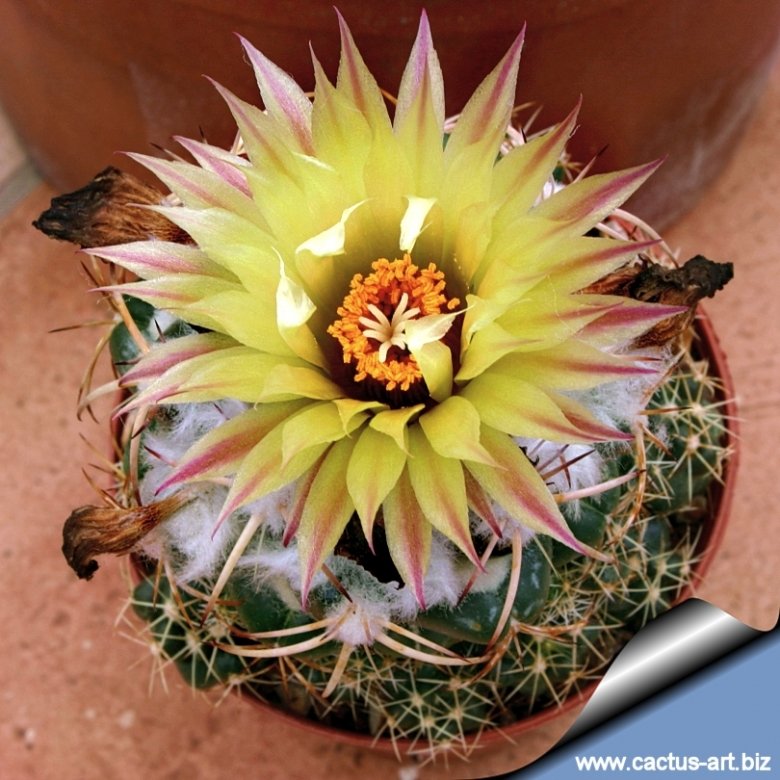
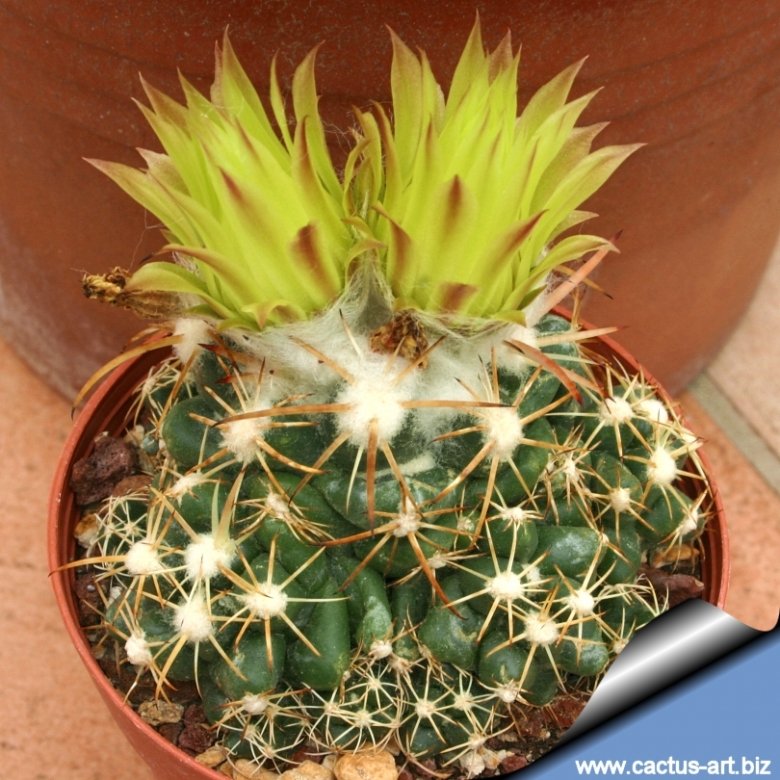
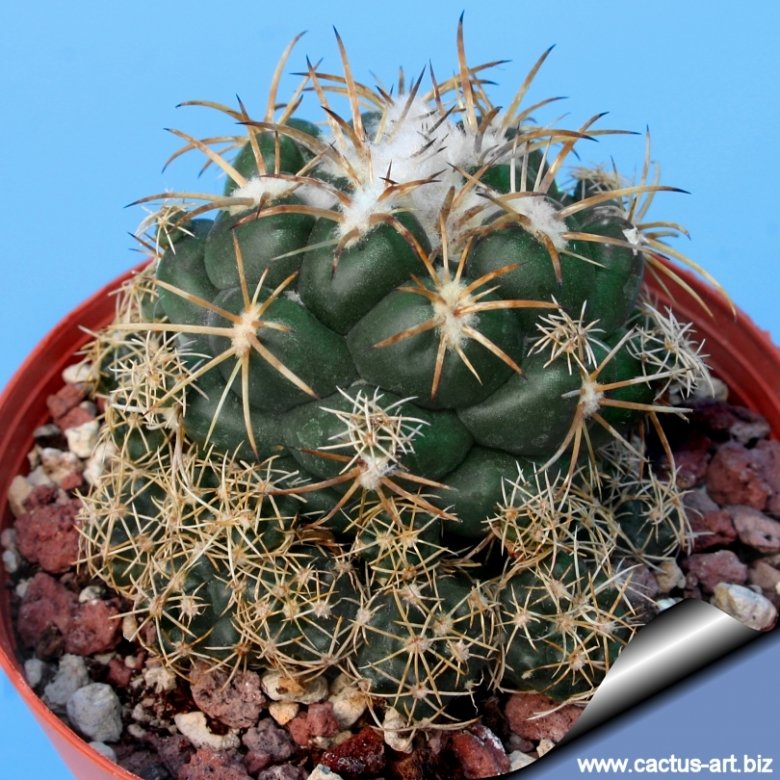
Coryphantha bumamma is a flattened globular cactus with few, very large, rounded tubercles, bluish green. In adulthood it produces an abundant amount of attractive wool that covers its body. This will wash off if watered from above but will re-grow again. It is very similar to Coryphantha elephantidens but the flower are smaller and nearly yellow.
Roots: It has a stout carrot-like root, almost equal in diameter to that of the stem itself.
Stem: Flattened globular, broader than high, often (in habitat) arising only a little above the surface of ground, and are firmly anchored in the soil by a thick root, almost equal in diameter to that of the stem itself, up to 13 cm in diameter.
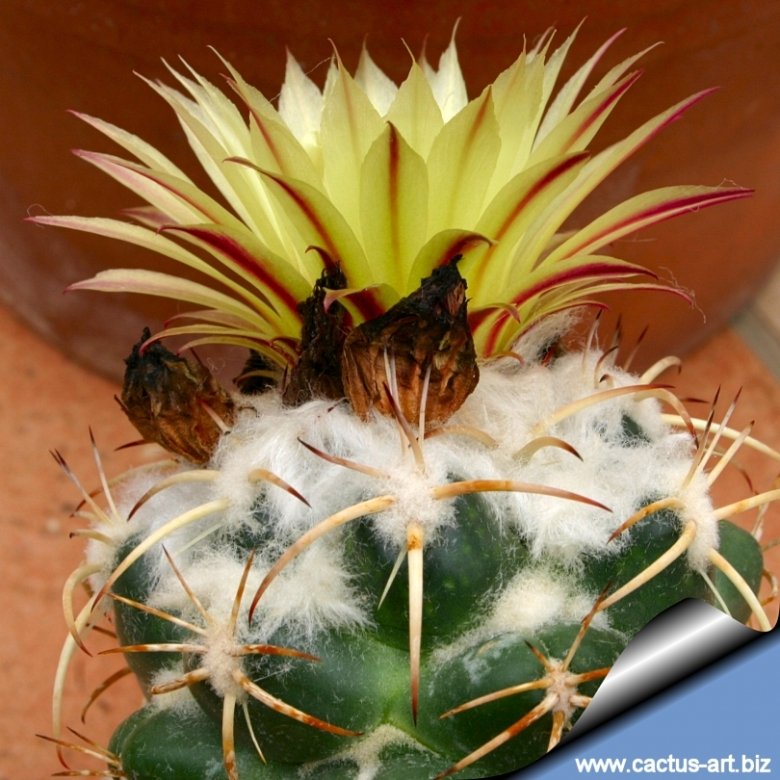
Tubercles: Few, very large up to 27 mm wide and 16 mm tall, glossy green to bluish-green always broader than rounded, in 8-13 series, conical flattened, rounded on top, slightly pentaedrical at the base, with a woolly groove on the upper side. The axil in youth is very woolly, later naked. Without glands.
Areoles: Elongate up to 4 mm long.
Central spines: Absent.
Radial spines: The tubercles are capped with a 5-8 of stout, stiff, evenly spreading, reflexed radial spines, 16-26 mm long, subulated, curved, never porrect, but adpressed to the body, usually 3 more strong are on the sides greyish or brownish with darker tips
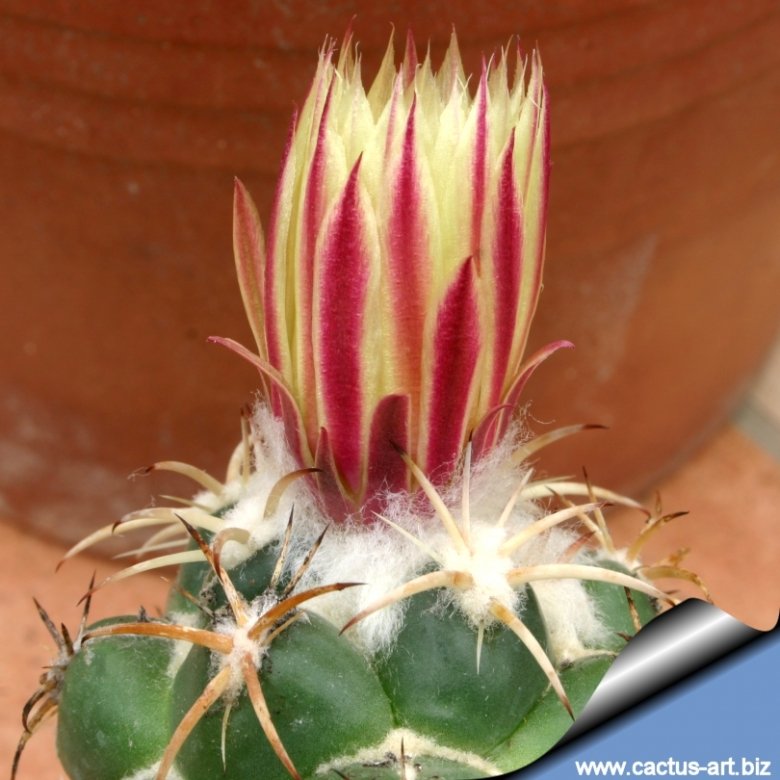
Flowers: Sweet smelling large 5- 6 cm broad, yellow with reddish midstripe dorsally or bright rose with a dark stripe, inner perianth segments narrowly oblong to lanceolate, margin entire, acute, 5 mm wide, filament reddishat the base, lobes greenish, stigma longer then filaments.
Blooming season: The flowers generally appear mid to late summer.
Fruits: Claviform, very big, ca. 4 cm long, 10-13 mm diameter, whitish green with a reddish tinge.
Seeds: About 4 mm long and 1 mm in diameter, light brown.
Remarks: At the moment there are a number of strongly offsetting plants in circulation labeled as Coryphantha bumamma; whilst being attractive plants these are not natural plants but mutant clones also known as caespitosa or prolifera. This plants may form large groups up to 50 cm in diameter.
Origin and Habitat
South western Mexico (Morelos and Guerrero).
Cultivation and Propagation
It is without problems, and regularly shows its large yellow flowers. It does best in slight shade, but does well in full sun too. It is sensitive to overwatering (rot prone), and needs a very porous soil with good drainage. It flowers quite early, but needs about 8-12 years to reach the typical, definite outlook. It tolerates fairly low temperatures as long as it is kept dry (hardy to -5° C or less for short periods of time).
Propagation:: Propagation is by seed.
Bibliography
Major references and further lectures
-
Edward Anderson “The Cactus family” Timber Press, Incorporated, 2001
-
James Cullen, Sabina G. Knees, H. Suzanne Cubey “The European Garden Flora Flowering Plants: A Manual for the Identification of Plants Cultivated in Europe, Both Out-of-Doors and Under Glass” Cambridge University Press, 11/Aug/2011
-
David R Hunt; Nigel P Taylor; Graham Charles; International Cactaceae Systematics Group. “The New Cactus Lexicon” dh books, 2006
-
Edward Anderson “The Cactus family” Timber Press, Incorporated, 2001
-
Nathaniel Lord Britton, Joseph Nelson Rose “Cactaceae: Descriptions and Illustrations of Plants of the Cactus Family” vol. 4 The Carnegie Institution of Washington, Washington 1923
Gallery