Publication: Monatsschr. Deutsch. Kakteen-Ges. 1: 17. 1929
Description
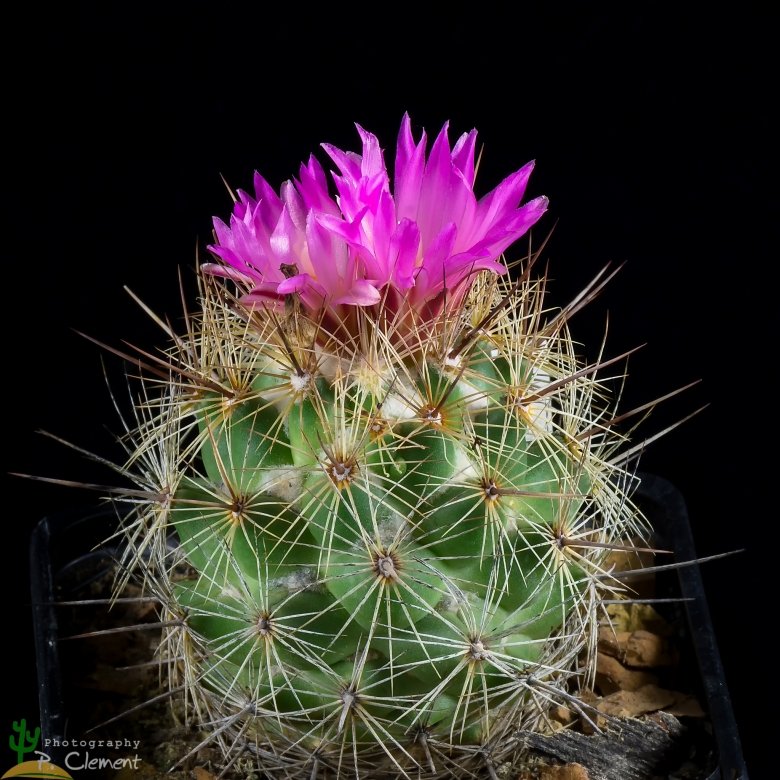
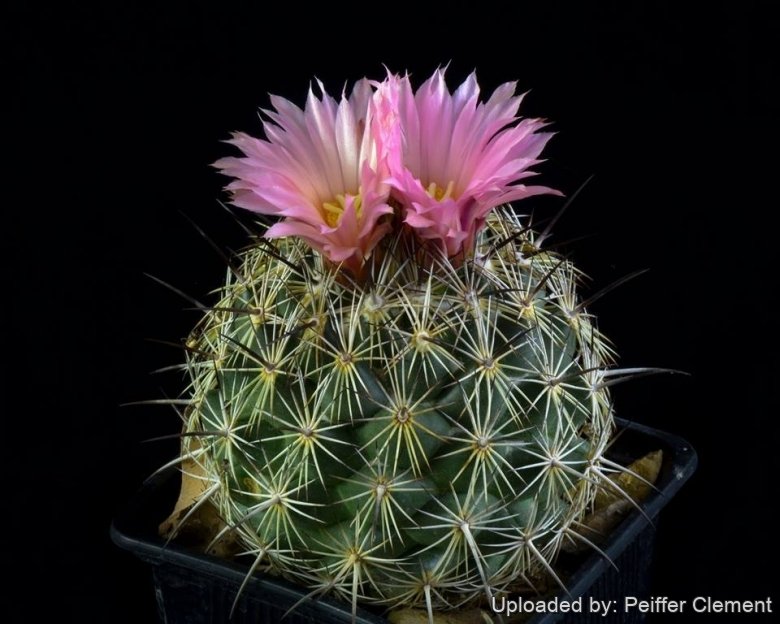
Coryphantha pseudoechinus, fistly described by Bodeker in 1929, is an egg-shaped cactus species solitary when young, then freely branching to form low clumps. This species produces flowers all through spring and summer and seed pods at the same time. These can be seen starting to develop before the withered flower remains fall. The flower is violet-pink and 2.5 cm. long and about 3 cm. broad depending on the heat of the sun. The fruit is dull purple about 12 mm, long and slightly rounded. The seed is brown. Two susbpecies are recognized, the typical form and susbp. laui (L.Bremer) Dicht & A.Lüthy.
Derivation of specific name: Coryphantha pseudoechinus Bodeker so called to distinguish it from Coryphantha echinus Engelmann which it much resembles ; the brilliant yellow flower of the latter however is very different from the smaller crimson blossoms of the former.
Stems: Ovoid to short cylindrical, sprouting from the base, forming large groups, dull leaf green, becoming grey-green with age, 7-12 cm long, 4-6 cm in diameter apex slightly depressed with some wool.
Tubercles: In 5 and 8 series, conical, somewhat flattened on the upper side, rhomboid at the base, strongly ascending, to 12 mm long, with sharp, narrow groove, woolly in youth. Some yellow nectar-glands are only produced during active growth and formation of buds and this immediately behind the spine-bearing areole only. Axils in youth woolly.
Areoles: Round, 2 mm diameter.
Central spines: (0-)1(-3), conspicuous, ascending in the direction of the tubercle axis, some subcentral displaced laterally or even slightly down-wards, very rigid, brown or black, soon greyish and frosted, 13-20 mm long.
Radial spines: 18-20(-25), straight, stiff, needle-like, grey to white to reddish brown, sometimes black tipped, 8-15 mm long.
Flowers: Situated near apex, often numerous and opening at the same time, flattened funnelform, pale rose pink to bright magenta, 2-2.2 cm long, 2-3.5 cm in diameter. Outer perianth segments lanceolate, dark red-brown with a rose margin, greenish at the base up to11 mm long. Inner perianth segments narrow lanceolate, violet-rose, lighter towards the base up to 22 mm long. Filaments numerous, whitish, anthers yellow. Style whitish with 5-6 whitish stigma lobes.
Fruits: Oblong, ovoid, with attached flower remnants, pale yellowish green to bronze to pinkish, to 15(-23) mm long and 7 mm wide.
Seeds: 1 x 1.2 mm, reniform, smooth, brown, reticulate.
Origin and Habitat
Coryphantha pseudoechinus is endemic to Coahuila (Casas Coloradas, San Jose de la Paila, Zona de Minas, north of Estacion Marte, Mount Paila, Las Palomas, San Pedro, El Sacrificio, Parenos, Cuatrocienegas-San Pedro de Las Colonias, west of Hipolito), Mexico. There are more than 20 subpopulations, and the species is locally common.
Altitude: 700-2200 metres above sea level.
Habitat and Ecology: The species is found is xerophyllous scrub on calcareous soils. Other commonly associated plant species in the habitat include Astrophytum senile, Astrophytum niveum, Mammillaria grusonii, Echinocactus horizonthalonius, Thelocactus bicolor, Coryphantha runyonii, Epithelantha micromeris, Ferocactus hamatacanthus, Echinomastus durangensis v. mariposensis, Echinocereus pectinatus and Lophophora williamsii. Some subpopulations are affected by trampling by goats and other livestock.
Cultivation and Propagation
In culture Coryphantha pseudoechinus is without problems, and regularly shows its large yellow flowers. It does best in slight shade, but does well in full sun too. It is sensitive to overwatering (rot prone), and needs a very porous soil with good drainage. It flowers quite early, but needs about 8-12 years to reach the typical, definite outlook. It tolerates fairly low temperatures as long as it is kept dry (hardy to -5° C or less for short periods of time).
Propagation: Propagation is by seed.
Bibliography
Major references and further lectures
-
Gómez-Hinostrosa, C. & Hernández, H.M. 2013. Coryphantha pseudoechinus. In: IUCN 2013. “IUCN Red List of Threatened Species”. Version 2013.2. <www.iucnredlist.org>. Downloaded on 20 March 2014.
-
Edward Anderson “The Cactus family” Timber Press, Incorporated, 2001
-
James Cullen, Sabina G. Knees, H. Suzanne Cubey “The European Garden Flora Flowering Plants: A Manual for the Identification of Plants Cultivated in Europe, Both Out-of-Doors and Under Glass” Cambridge University Press, 11/Aug/2011
-
David R Hunt; Nigel P Taylor; Graham Charles; International Cactaceae Systematics Group. “The New Cactus Lexicon” dh books, 2006
-
Reto Dicht, Adrian Lüthy “Coryphantha: Cacti of Mexico and Southern USA” Springer, 14/March/2006
-
The Cactus Journal, Volumi 1-4 Blandford Press for the Cactus and Succulent Society of Great Britain, 1967
-
The Journal of the Mammillaria Society, Volumi 17-19 Mammillaria Society, 1977
From llifle page Coryphantha pusilliflora
Description
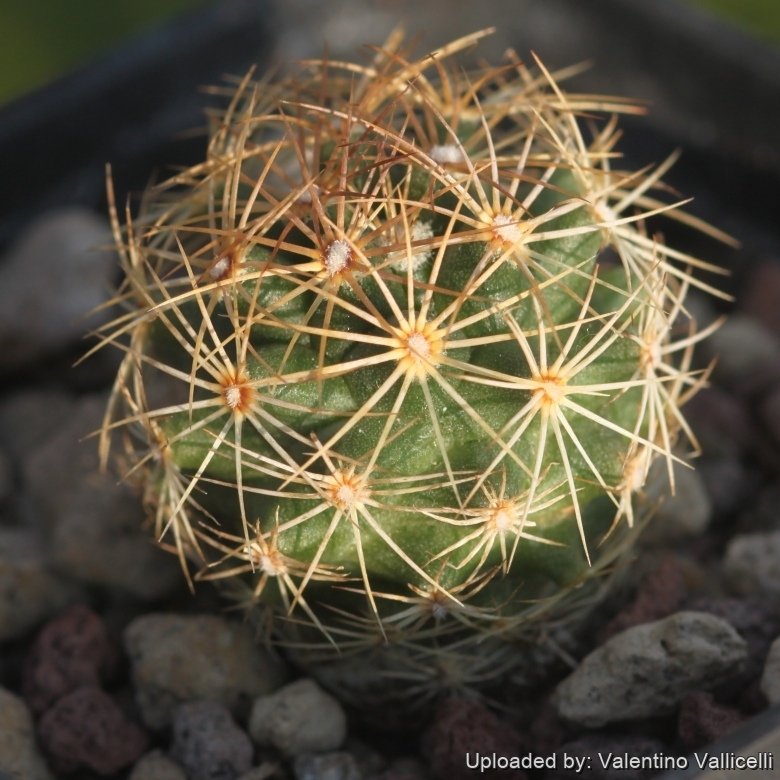
Coryphantha pusilliflora is a very nice, mostly cylindrical offsetting cactus species, with delicate pink flowers and yellowish later greyish spines. Bremer naming the plant pusilliflora, meaning very small or insignificant, in reference to the tiny magenta flower (usually about 2 cm in diameter). It is sometimes considered a synonym of Coryphantha pseudoechinus.
Habit: It is a slow-growing, perennial stem succulent, either solitary or branching from the base to form clusters.
Stems: Ovate to short cylindrical, 12 cm tall, 5-6 cm across, rounded and slightly depressed apically, bright green.
Tubercles: Conical, widening basally, becoming rhombic, erect, in rows of 5, 8 and 13. The axils when young with short white wool.
Areoles: White, with the apical (spine-bearing) and axillary parts of the areola connected by a distinct furrows above.
Central spine: One thin, awl shaped, straight, stiff, erect, slightly expanded basally, dark, becoming grey with age, 11-13 mm long.
Radial spines: 18-20, thin, longer than radials, needle-like, somewhat stiff, straight, white to yellow, becoming grey, often with dark tips, 6-10 mm long.
Flowers: Funnelform, magenta with greenish white throats, about 2 cm in diameter or less (rarely up to 3,5 cm across).
Fruits: Oblong, green, fleshy to 14 mm long.
Origin and Habitat
El Marte, Sierra de Paila, Coahuila de Zaragoza,Mexico (North America)
Cultivation and Propagation
In culture Coryphantha pusilliflora is without problems, and regularly shows its large yellow flowers. It does best in slight shade, but does well in full sun too. It is sensitive to overwatering (rot prone), and needs a very porous soil with good drainage. It flowers quite early, but needs about 8-12 years to reach the typical, definite outlook. It tolerates fairly low temperatures as long as it is kept dry (hardy to -5° C or less for short periods of time).
Propagation: Propagation is by seed.
Notes
Coryphantha pusilliflora is one of those Coryphanthas which pass a purely radial-spined long youth stage in which they are already floriferous. Most of the plants after some years develop the central spines, giving the plant its sea urchin appearance.
Bibliography
Major references and further lectures
-
Gómez-Hinostrosa, C. & Hernández, H.M. 2013. Coryphantha pseudoechinus. In: IUCN 2013. “IUCN Red List of Threatened Species”. Version 2013.2. <www.iucnredlist.org>. Downloaded on 20 March 2014.
-
Edward Anderson “The Cactus family” Timber Press, Incorporated, 2001
-
James Cullen, Sabina G. Knees, H. Suzanne Cubey “The European Garden Flora Flowering Plants: A Manual for the Identification of Plants Cultivated in Europe, Both Out-of-Doors and Under Glass” Cambridge University Press, 11/Aug/2011
-
David R Hunt; Nigel P Taylor; Graham Charles; International Cactaceae Systematics Group. “The New Cactus Lexicon” dh books, 2006
-
Reto Dicht, Adrian Lüthy “Coryphantha: Cacti of Mexico and Southern USA” Springer, 14/mar/2006
Source: Coryphantha pusilliflora, LLIFLE - Encyclopedia of living forms, CC-BY-SA, retrieved 2026-10-25.