Publication: Bradleya 9: 86. 1991
Description
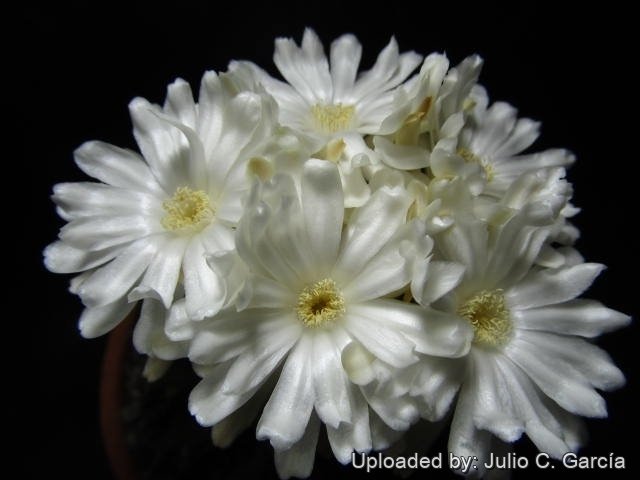
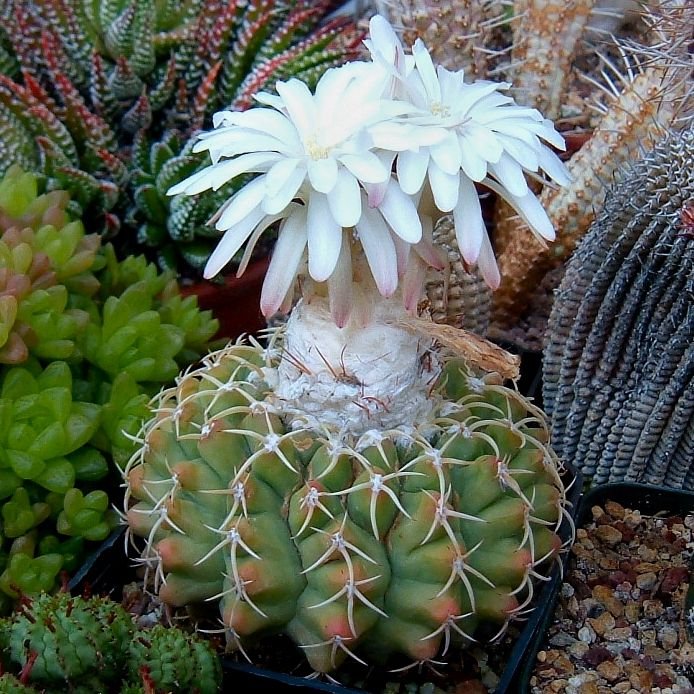
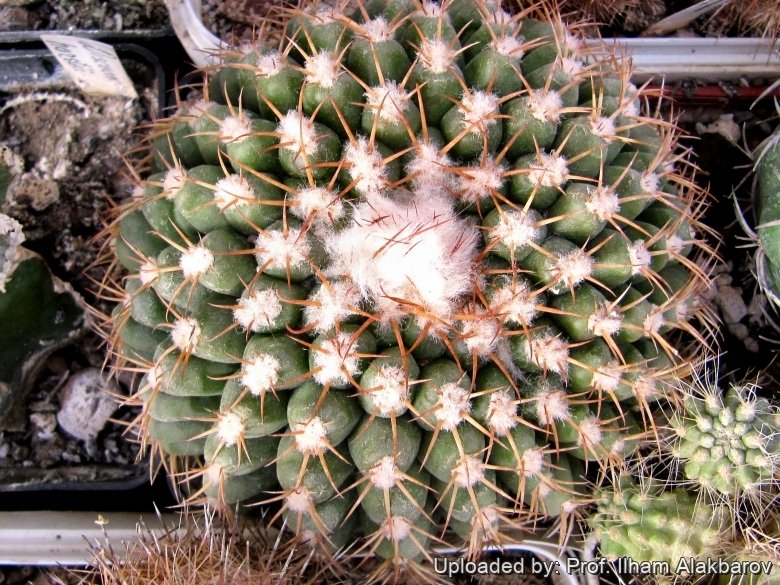
Discocactus magnimammus (now considered a subspecies of Discocactus heptacanthus) is a solitary flattened cactus that form a cephalium at maturity. It distinguishes from the standard species for it more numerous ribs (up to 22) that are completely divided into distinct tubercles, and for the short spines that are round in cross section. It produces fragrant flowers on warm summer nights. Flowers are pollinated by moths.
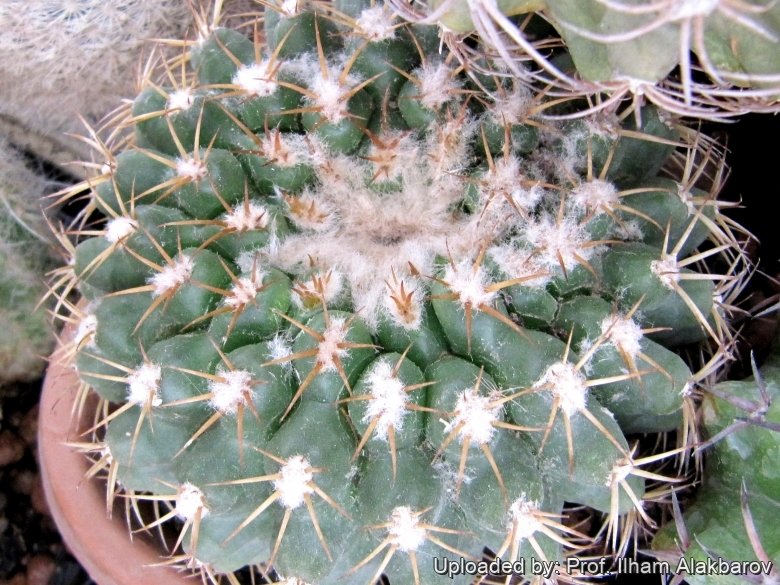
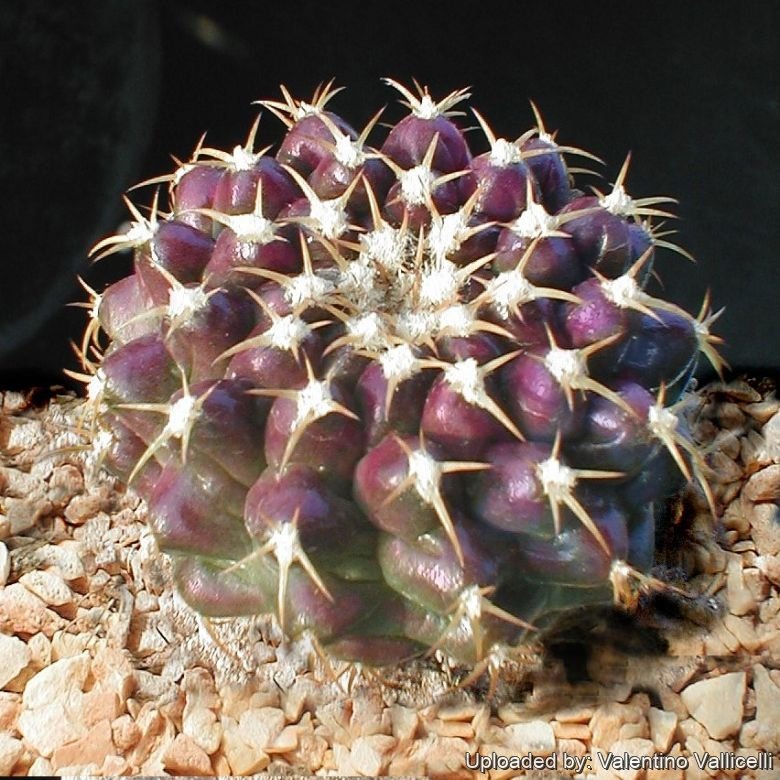
Stem: Globose or slightly depressed, light green to grey-green, up to 14 cm in diameter, 7 cm tall (without cephalium)
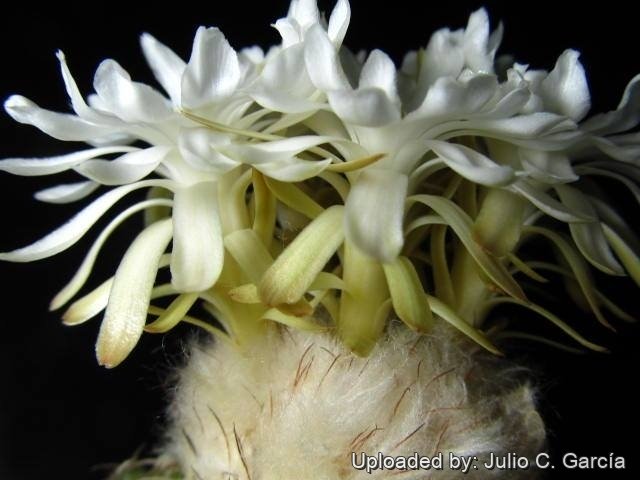
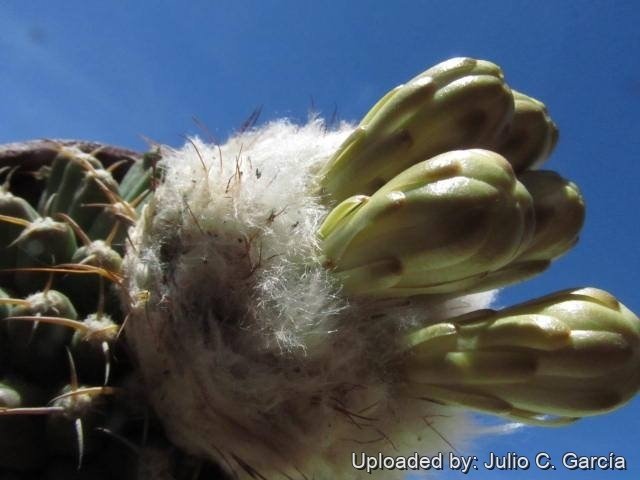
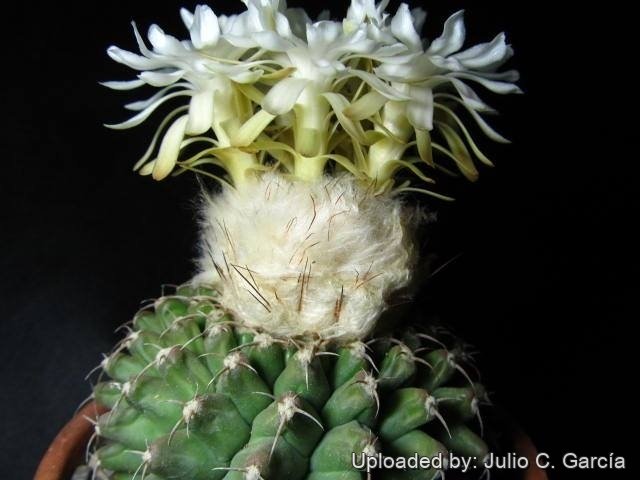
Cephalium: Small, 3-4 cm tall woolly, yellowish-white to dull pastel with brown or black erected bristles 3-5 cm long.
Ribs: 14-22, up to 2 m high, broken up into large, rounded tubercles, with deep furrows between, sometime spiralling.
Areoles: Round or oval, at first tomentose, approx 8 per rib (in plants with cephalium).
Radial spines: 5 to 7, 1-2 cm long, amber coloured, round in cross section and slightly recurved inward.
Central spines: Usually absent.
Flowers: Nocturnal, fragrant, white (or pale pink), funnel form, nocturnal, 5-7,5 cm long and 5 cm in diameter.
Blooming season: Flowers come in profusion in summer, out of the cephalium.
Fruits: Usually white .
Origin and Habitat
Brazil (Between Caracol and Bela Vista, Mato Grosso) and Paraguay.
Altitude: Around 280 metres above sea level.
Cultivation and Propagation
Discocactus magnimammus is not the easiest plant to keep happy, so it isn’t a plants for beginners, in fact collectors consider the Discocactus to be rarities which requires skilful cultivation. Under glass, it isn’t difficult, but appreciates milder winter temperatures and more generous summer watering than most of the other genera of compact cacti. When grown to maturity, however, it possess an exotic look shared by no other cacti, and it generally attract a lot of attention.
Growing rate: It is slow growing.
Soil: It likes very porous standard cactus mix soil. Prefer a low pH compost, avoid substrata rich in limestone; otherwise growth will stop altogether.
Repotting: They generally resent being repotted and can take a long time to establish.
Fertilization: Feed with a high potassium fertilizer in summer.
Exposition: The plant tolerates bright situations but enjoys filtered sunlight or afternoon shade, inside it needs bright light, and some direct sun. Tends to bronze in strong light, which encourages flowering and heavy spine production.
Waterings: Discocacti are very rot prone when kept on their own roots and though they can’t endure long stretches of total dryness, too much water with cool will rot them, as their weak root systems tend to be inefficient at sucking up water from wet soil.
Hardiness: It is rather difficult to grow and frost tender, it can’t stand cold, or even fairly cool temperatures and should be kept at above 15° C if grown on its own roots (8°C if grafted).
Uses: It is an excellent plant for container growing. It always looks good and stays small.
Pests & diseases: It may be attractive to a variety of pests or diseases:
- Red spiders: Red spiders may be effectively rubbed up by watering the plants from above.
- Mealy bugs: Mealy bugs occasionally develop aerial into the new growth among the wool with disfiguring results, but the worst types develop underground on the roots and are invisible except by their effects.
- Scales: Scales are rarely a problem.
- Rot: Rot it is only a minor problem with cacti if the plants are watered and “aired” correctly. If they are not, fungicides won’t help all that much.
Propagation: Seeds or grafting. Seeds germinate in 7-14 days at 21-27° C in spring, remove gradually the glass cover as soon the plants will be well rooted (ca 1-2 weeks) and keep ventilated, no full sun for young plants! .Young seedlings are often grafted on a low stock to keep the plant in a good shape.
Bibliography
Major references and further lectures
-
Edward Anderson “The Cactus family” Timber Press, Incorporated, 2001
-
James Cullen, Sabina G. Knees, H. Suzanne Cubey “The European Garden Flora Flowering Plants: A Manual for the Identification of Plants Cultivated in Europe, Both Out-of-Doors and Under Glass” Cambridge University Press, 11/Aug/2011
-
David R Hunt; Nigel P Taylor; Graham Charles; International Cactaceae Systematics Group. “The New Cactus Lexicon” dh books, 2006
-
N. L. Britton, J. N. Rose “The Cactaceae. Descriptions and Illustrations of Plants of the Cactus Family.” Volume 4, The Carnegie Institution of Washington, Washington 192
-
Urs Eggli, Leonard E. Newton “Etymological Dictionary of Succulent Plant Names” Birkhäuser 2004.
-
Clive Innes “Complete Handbook of Cacti and Succulents” Van Nostrand Reinhold Company, 01/Dec/1981
-
John Pilbeam “Cacti for the Connoisseur: A Guide for Growers & Collectors” Timber Press, 01/Jul/1987
Gallery