Publication: Cactaceae (Britton & Rose) 3: 218, fig. 232. 1922
Description
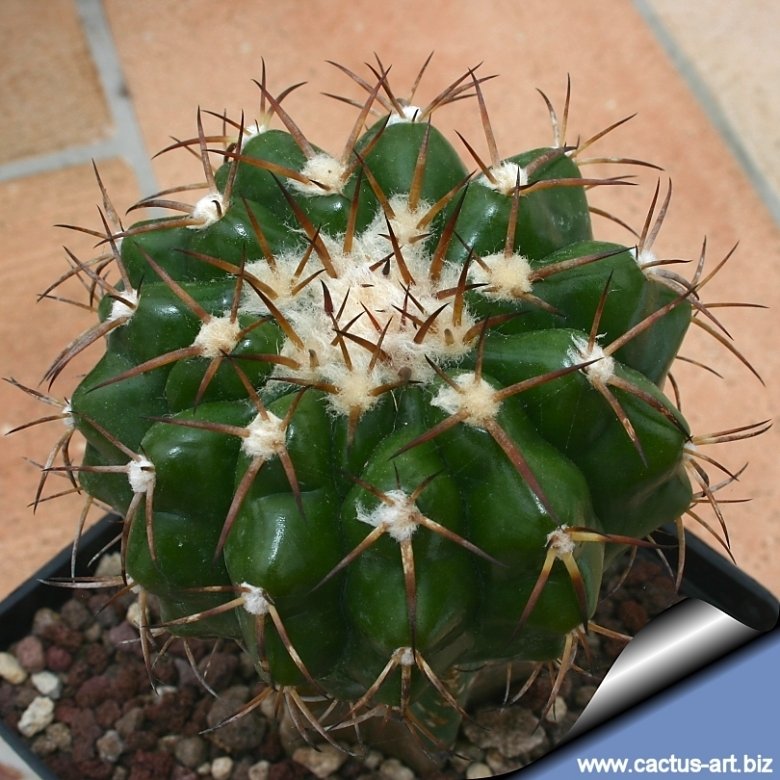
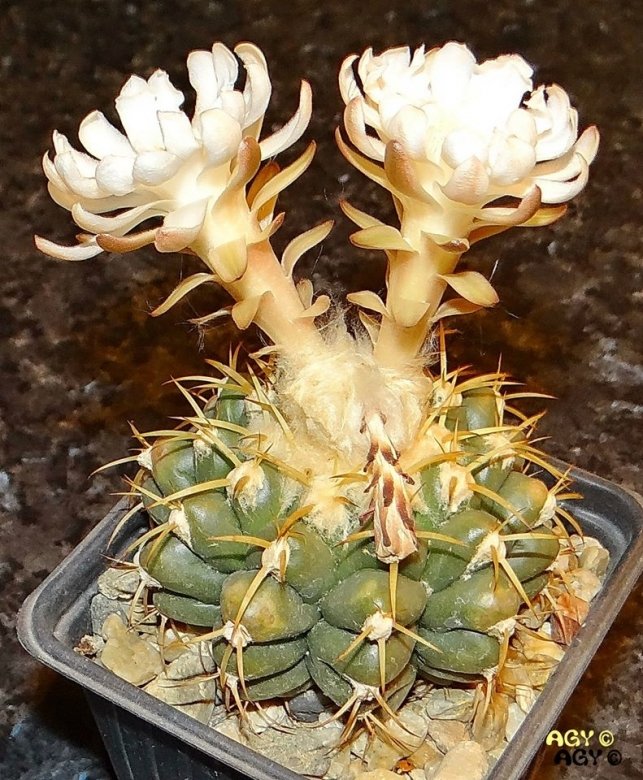
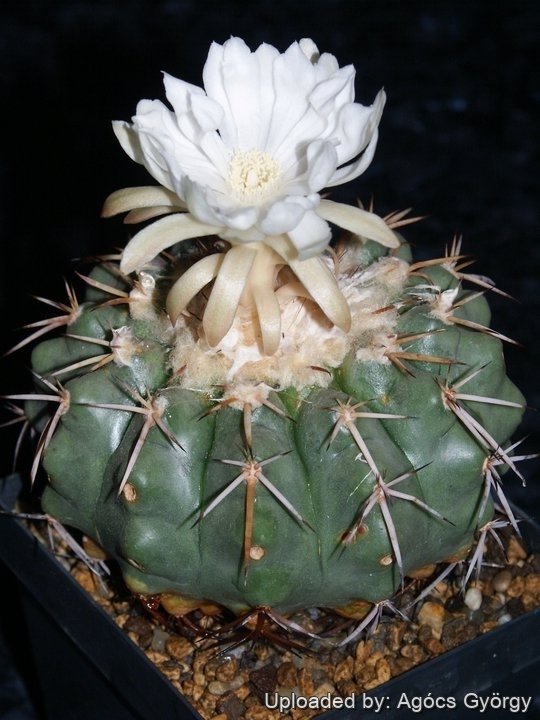
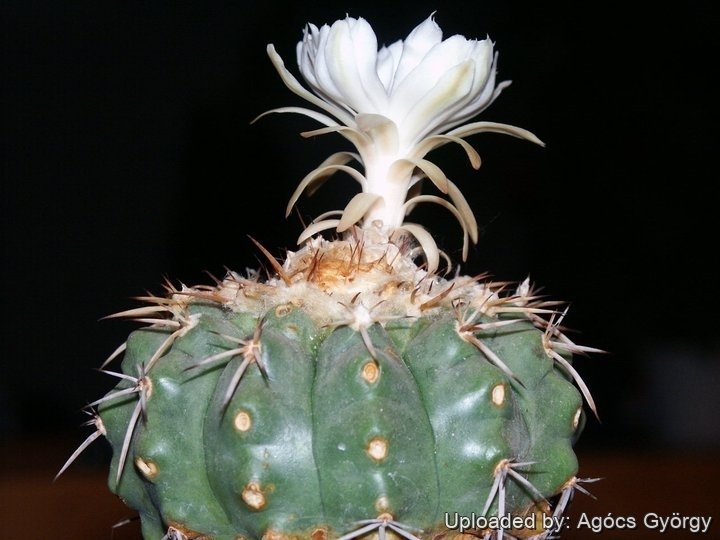
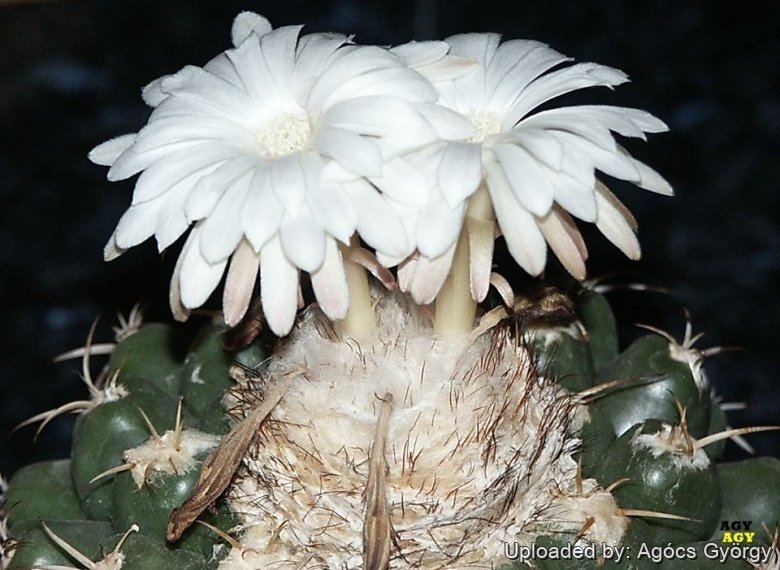
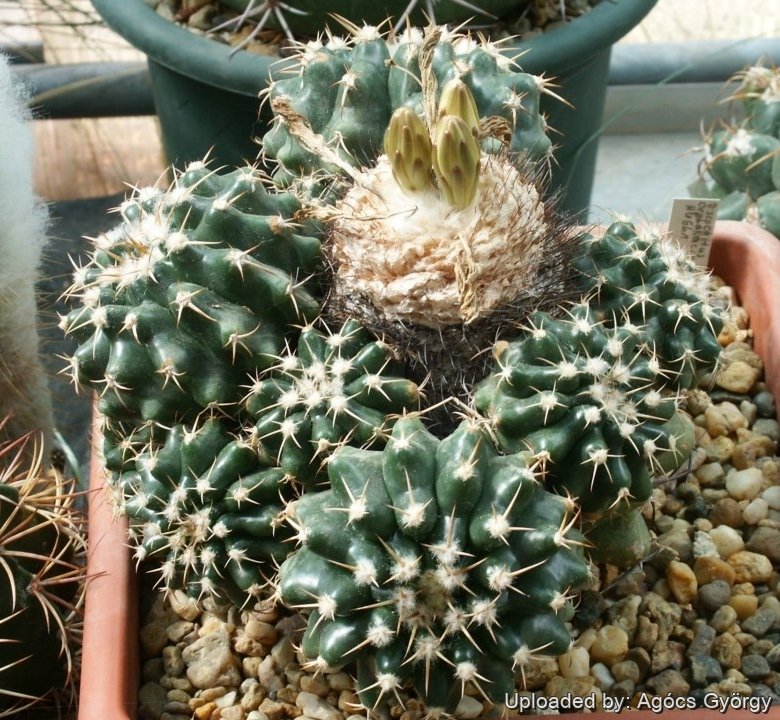
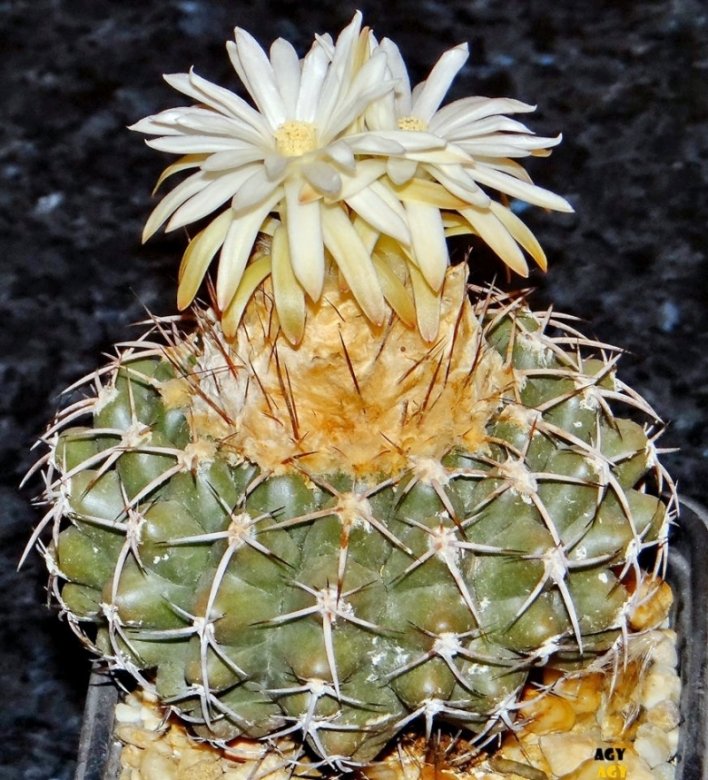
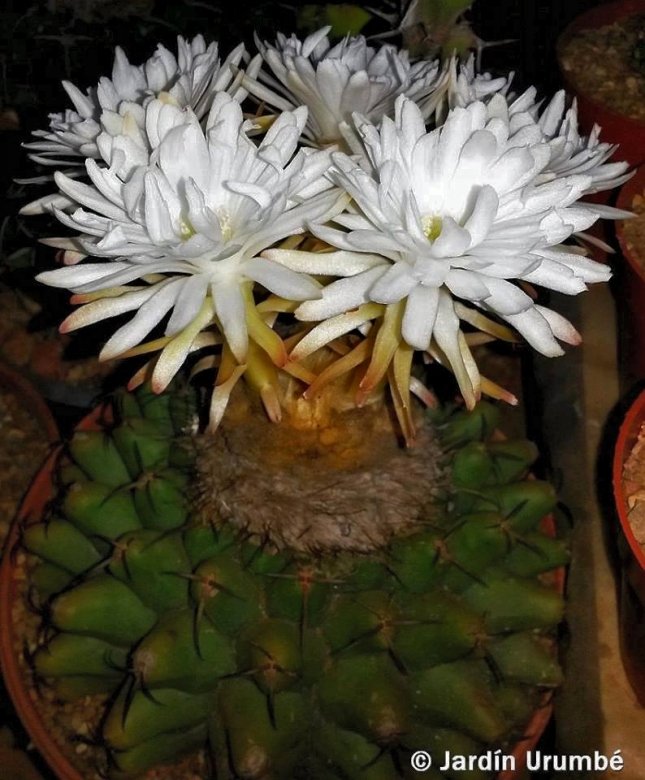
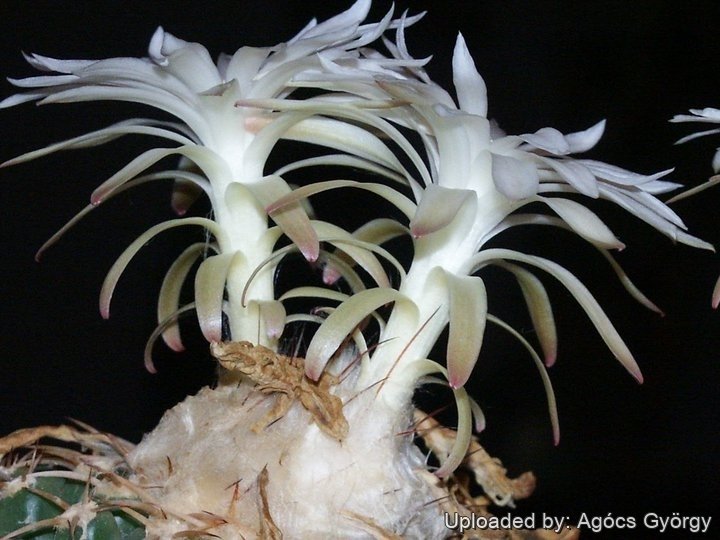
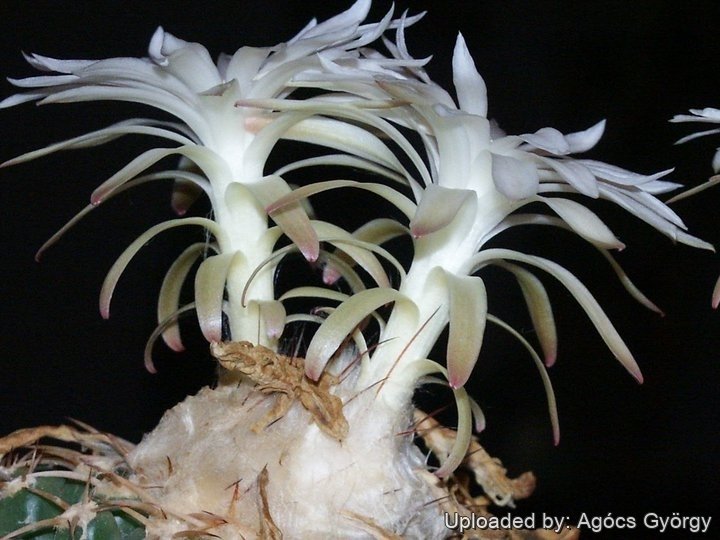
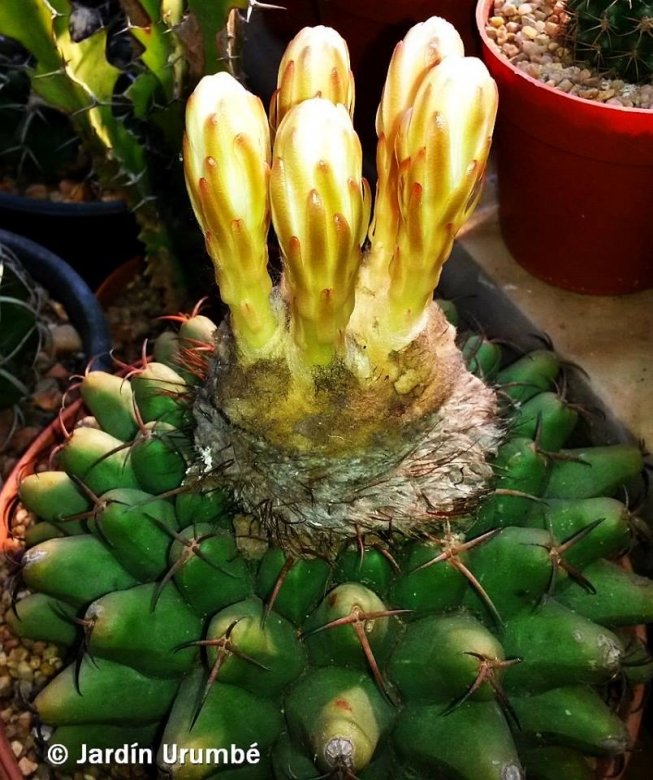
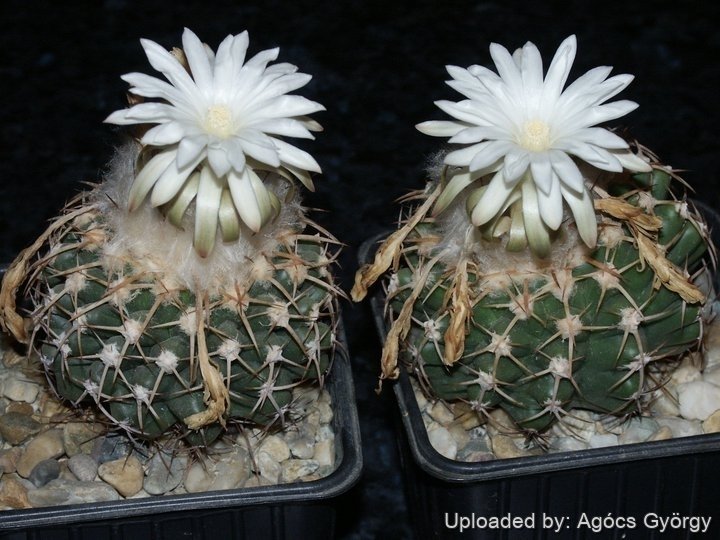
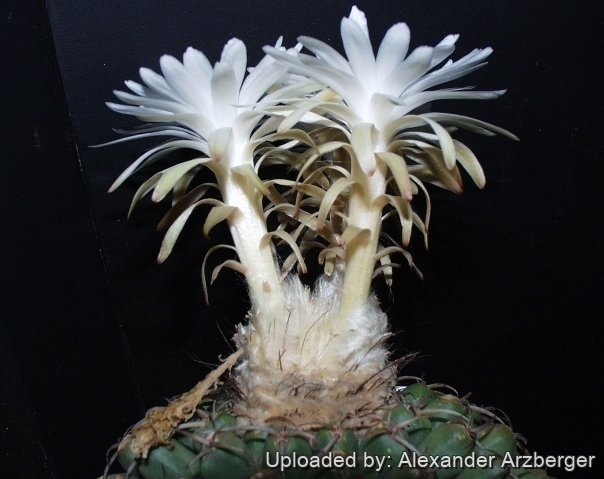
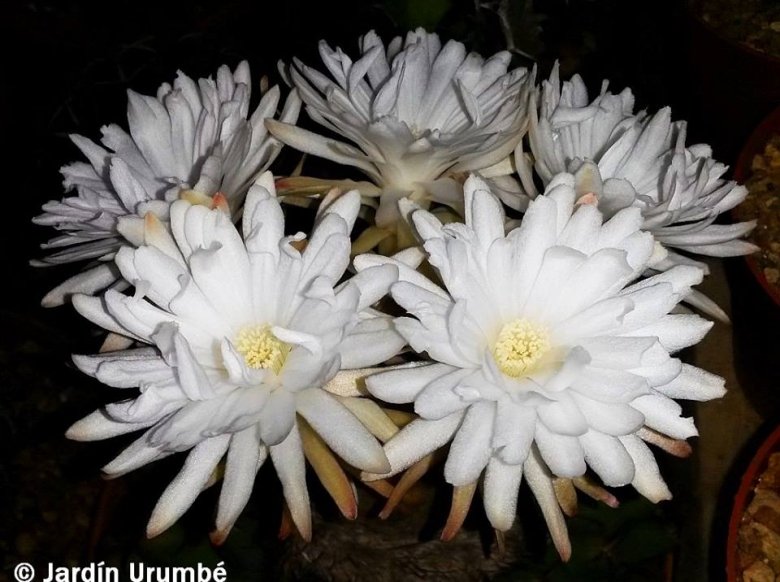
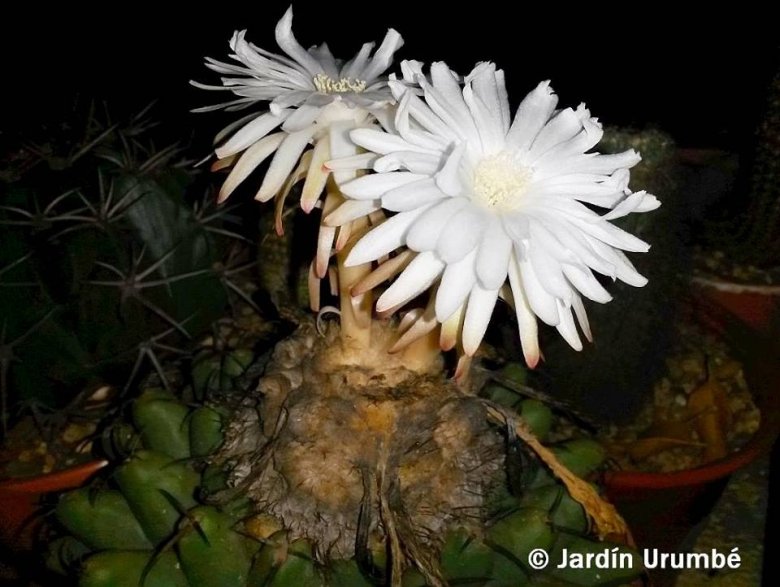
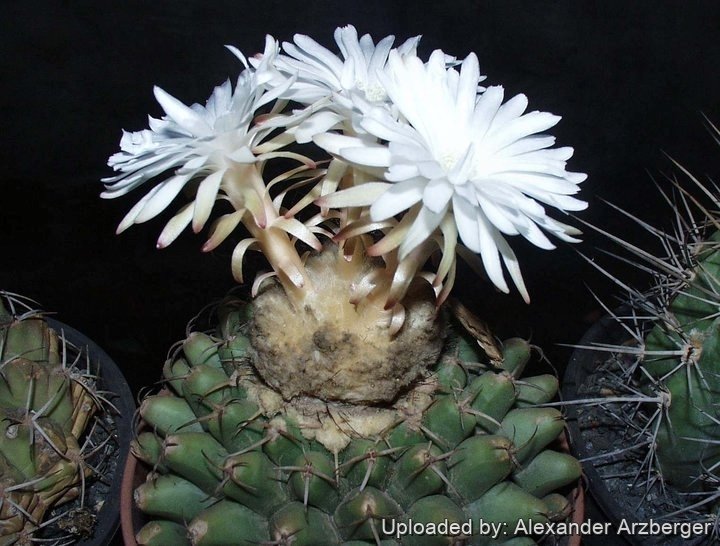
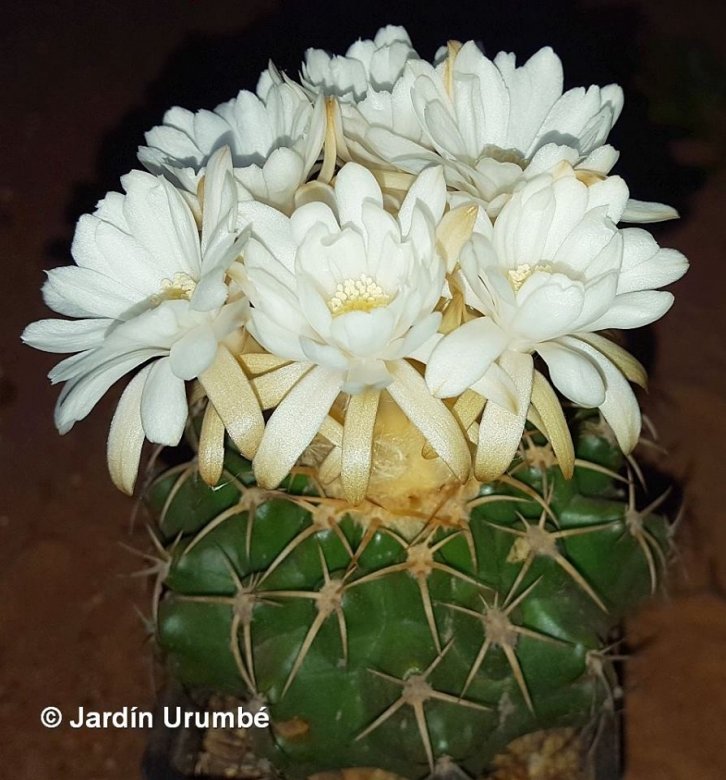
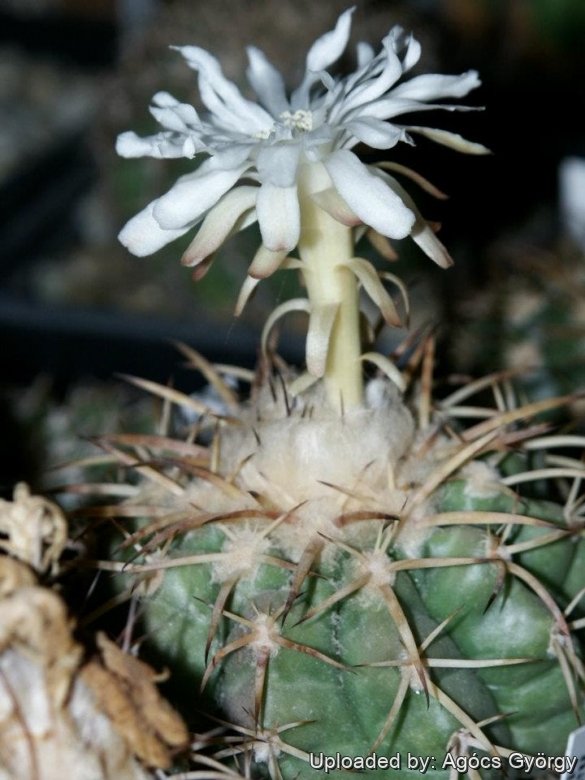
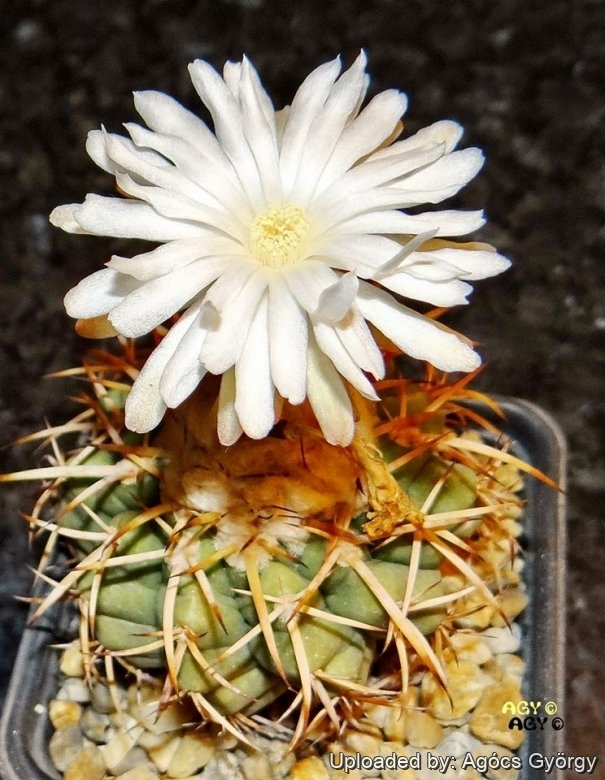
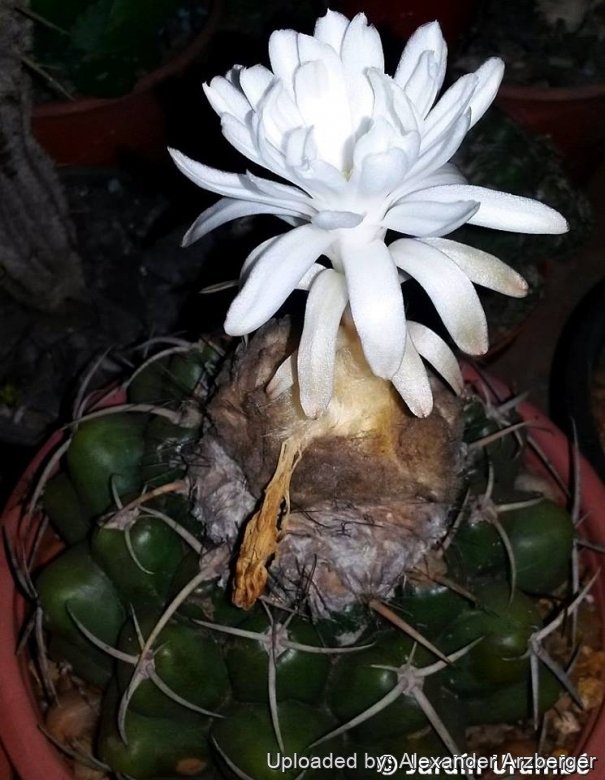
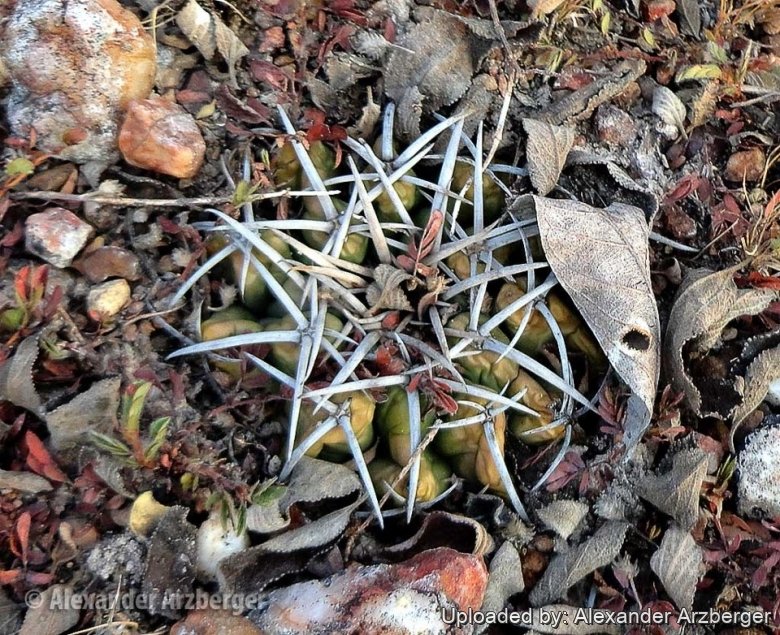
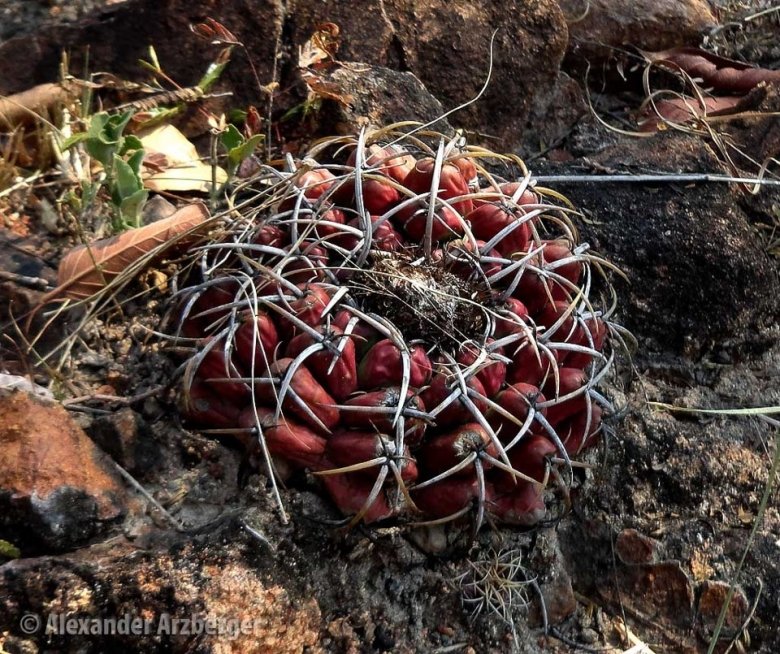
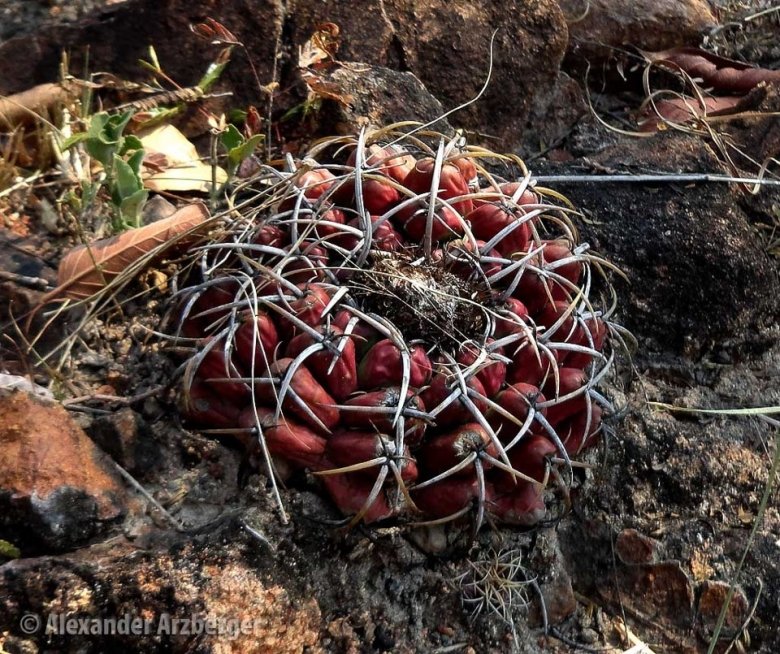
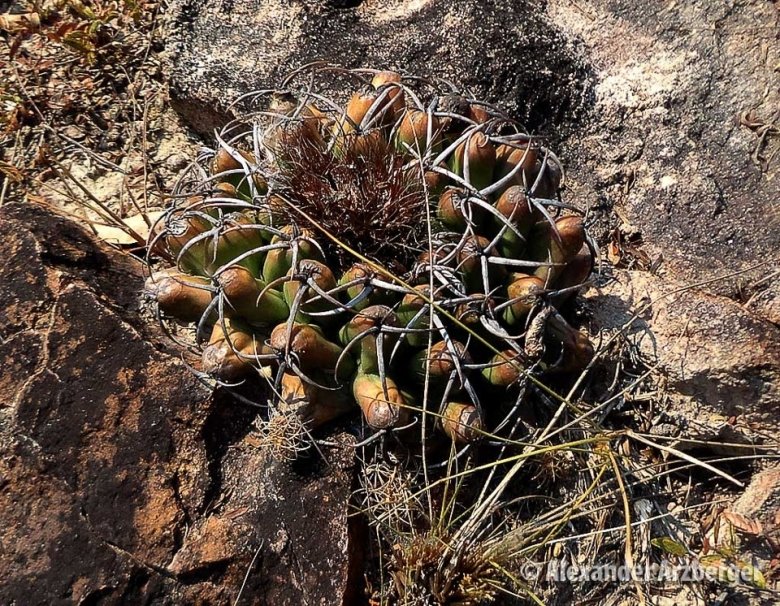
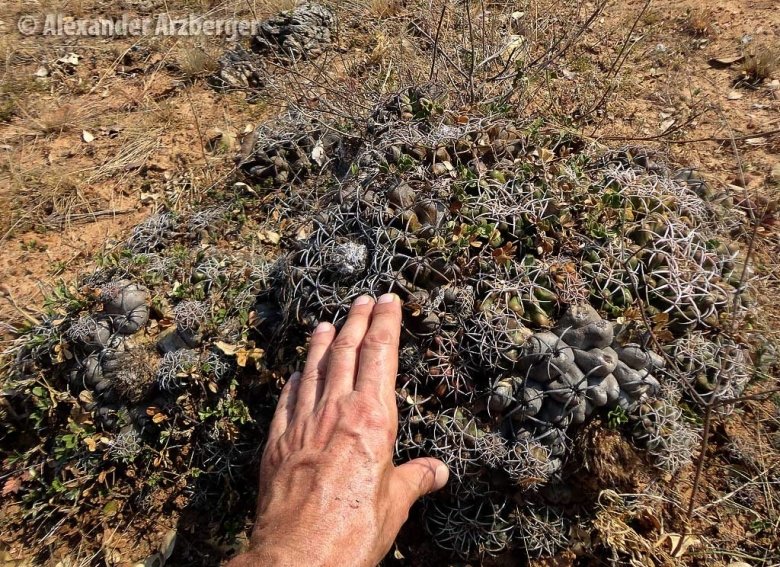
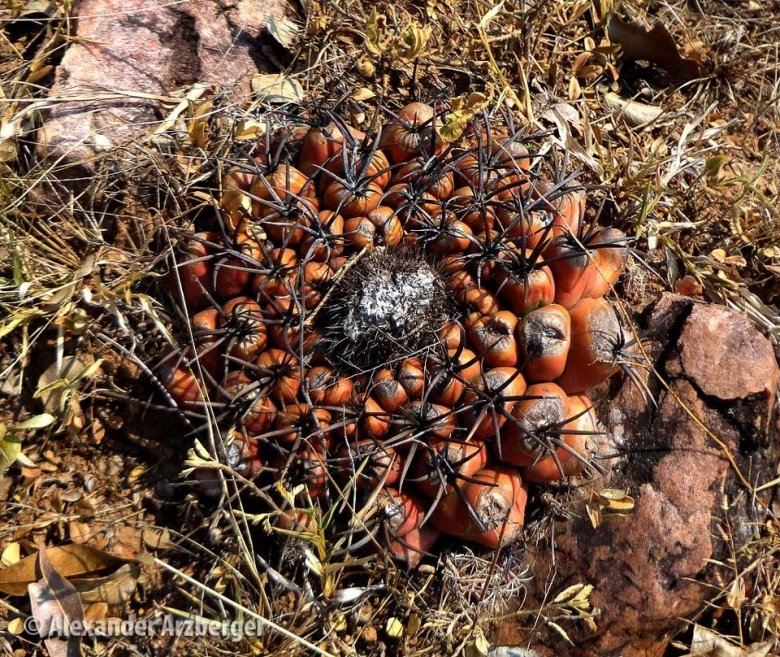
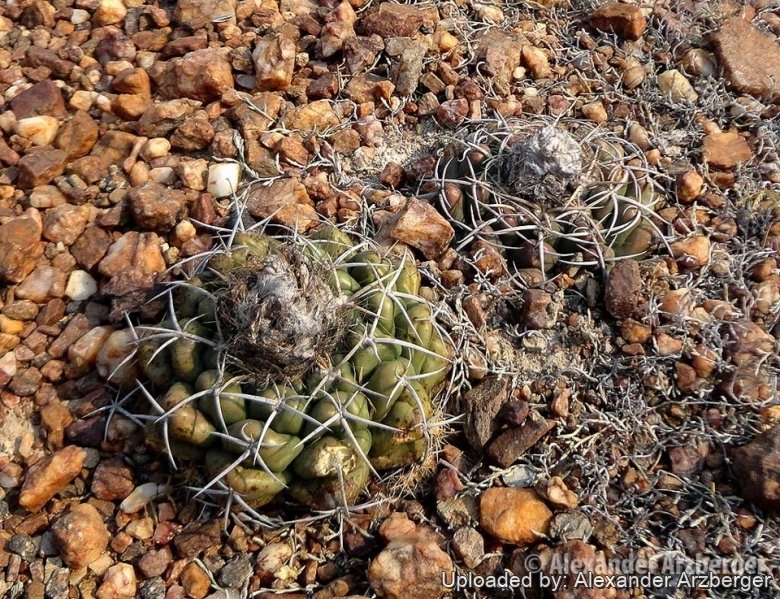
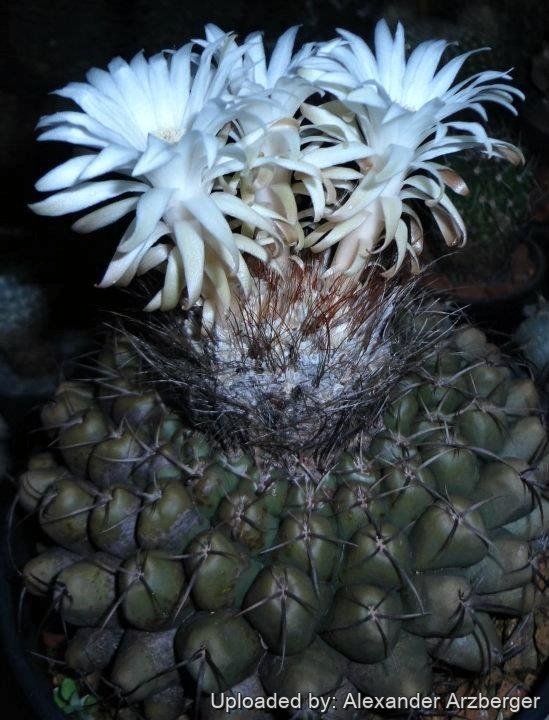
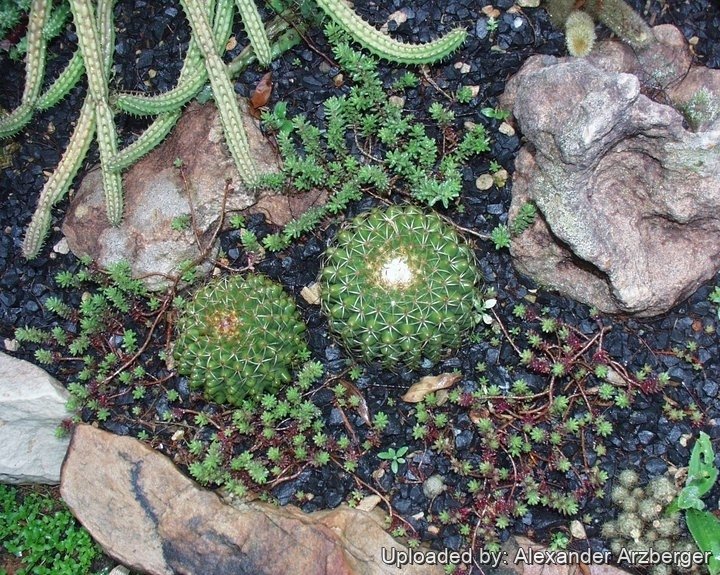
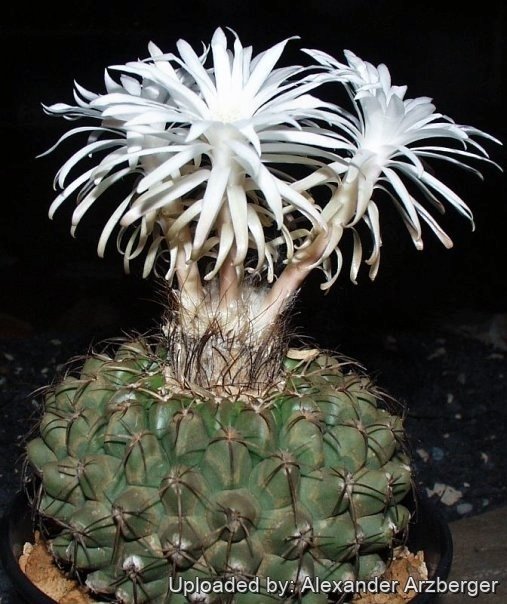
Discocactus heptacanthus is a solitary flattened cactus that form a cephalium at maturity and blooms on warm summer nights. Its fragrant flowers are pollinated by moths. It is a very variable species which received several different controversial names, many of them are still used in the trade. Some authors still consider it a complex of several related species and subspecies while Taylor and Zappi (1991) accepts only three subspecies: subsp. heptacanthus, subsp. catingicola, and subsp. magnimammus.
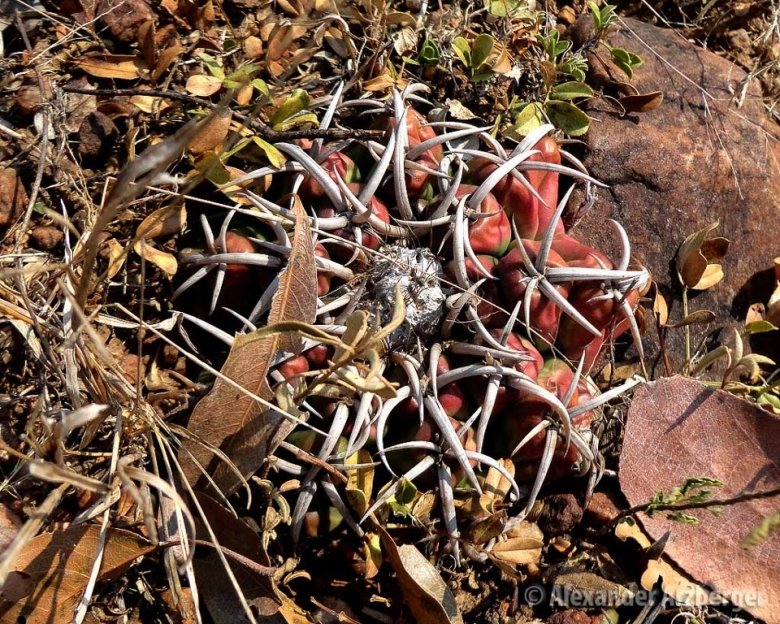
Stem: Globose or slightly depressed, light green to grey-green, 8-28 cm in diameter, 4,5-15 cm tall (without cephalium)
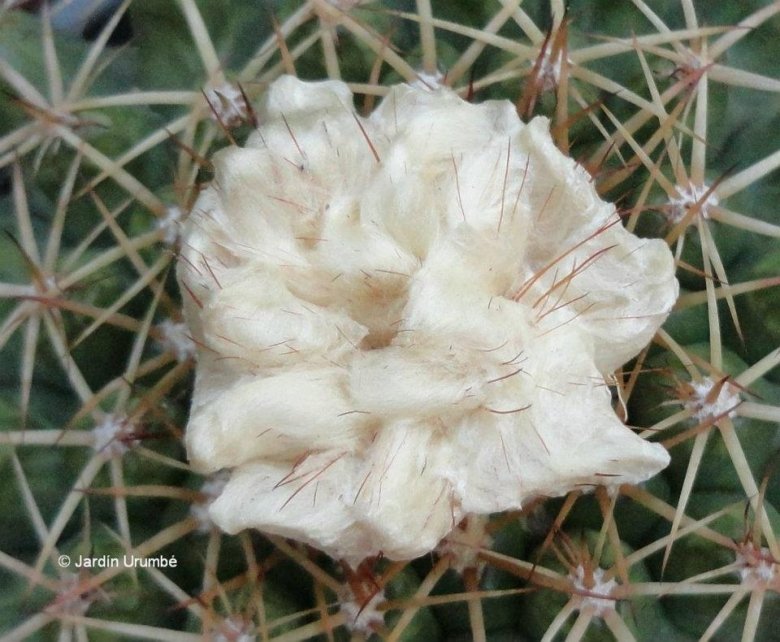
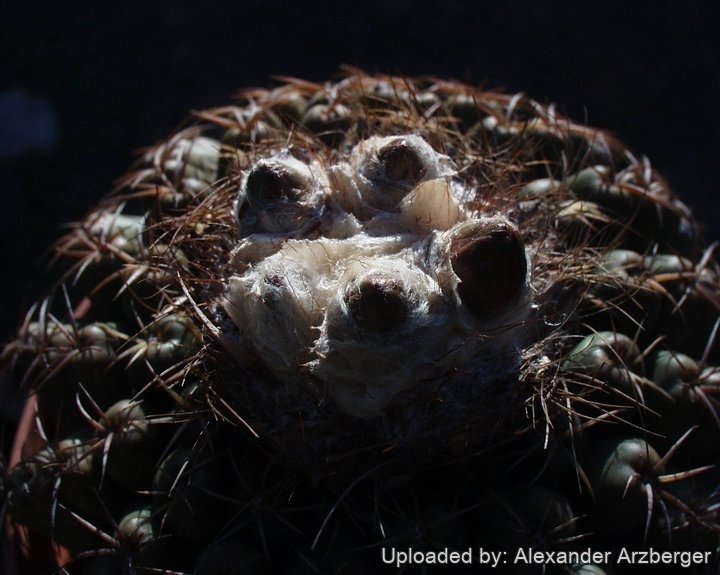
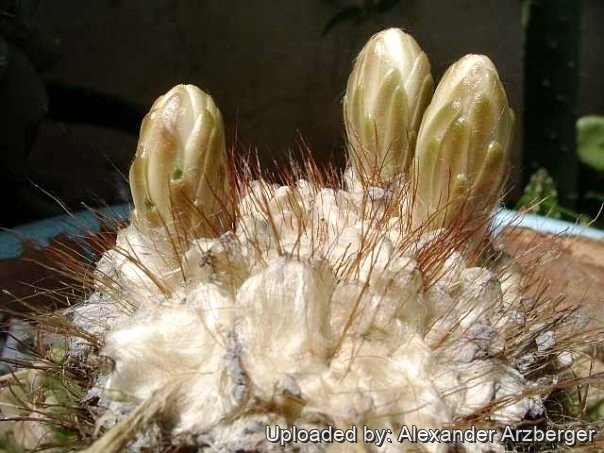
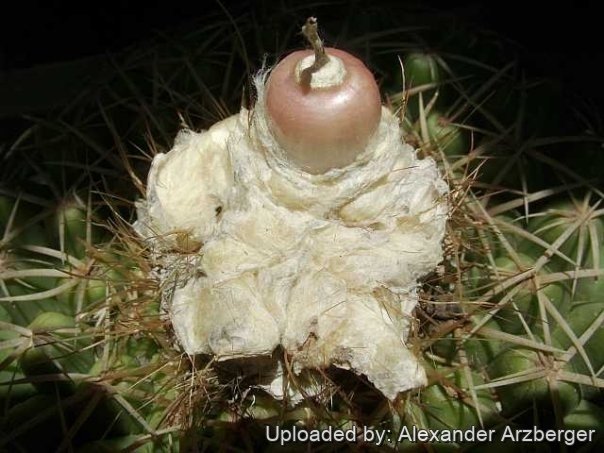
Cephalium: Small, 3-4 cm tall woolly, white to dull pastel with brow or black erected bristles 3-5 cm long.
Ribs: 10-22, up to 2 cm high, broken up into large, rounded tubercles, with more or less deep furrows between, sometime spiralling.
Areoles: Round or oval, at first tomentose, approx 6-10 per rib (in plants with cephalium).
Spines: Whitish, yellowish or brown becoming grey with age, more or less translucent, needle-like or flattened.
Radial spines: Typically 7, but variable in number from 5 to 11, up to 1,5 cm long (or more), stout, very rough and slightly recurved.
Central spines: occasionally a central spine.
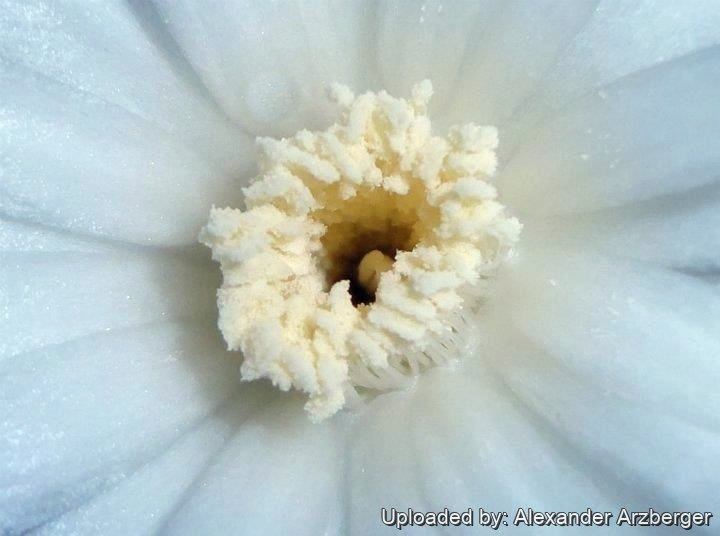
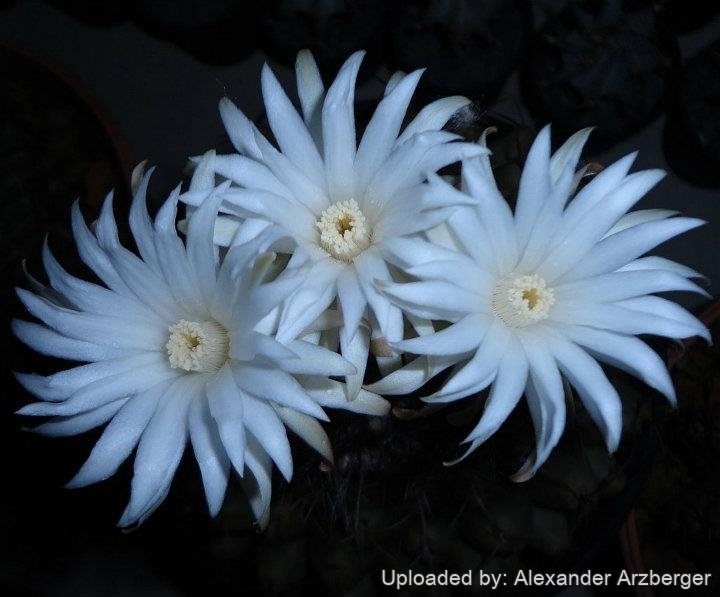
Flowers: Nocturnal, fragrant, white (or pale pink), funnel form, nocturnal, 5-7,5 cm long and 5 cm in diameter.
Blooming season: Flowers come in profusion in summer, out of the cephalium.
Fruits: Usually white or pale pink.
Origin and Habitat
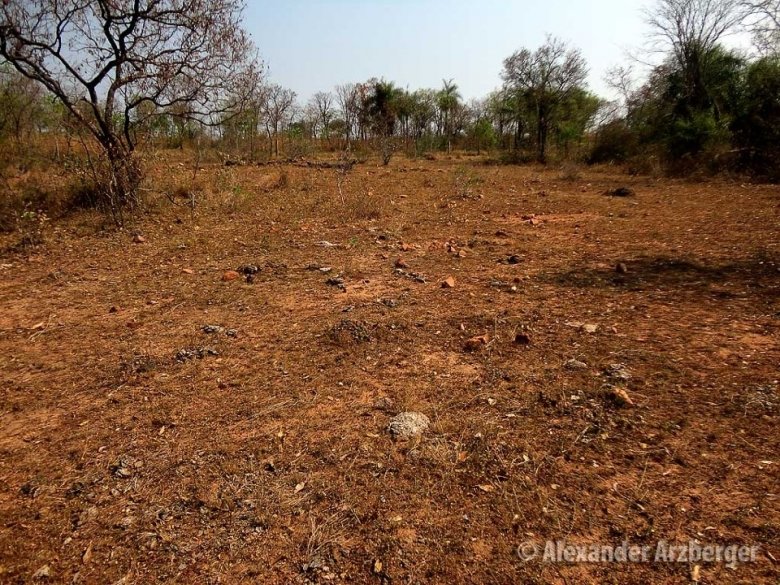
Eastrern Bolivia, Paraguay, Brazil (Goiás, Mato Grosso, Mato Grosso do Sul, Pará, Rondônia, Tocantins), but only occurs in fragmented patches.
Altitude: It grows at low altitude.
Habitat: This cactus grows in the cerrado, mostly in exposed gravel of pedra canga (iron ore) but often in the shade of trees. It is occasionally found in sand or quartz gravel as well as on granite and sandstone outcrops. Generation length is 10 years. The main threat is deforestation of the species habitat for cattle ranching and renewable energy crops. Mining, pollution from mining and urbanization are other important threats in areas where the species grows.
Cultivation and Propagation
Discocactus heptacanthus is not the easiest plant to keep happy, so it isn’t a plants for beginners, in fact collectors consider the Discocactus to be rarities which requires skilful cultivation. Under glass, it isn’t difficult, but appreciates milder winter temperatures and more generous summer watering than most of the other genera of compact cacti. When grown to maturity, however, it possess an exotic look shared by no other cacti, and it generally attract a lot of attention.
Growing rate: It is slow growing.
Soil: It likes very porous standard cactus mix soil. Prefer a low pH compost, avoid substrata rich in limestone; otherwise growth will stop altogether.
Repotting: They generally resent being repotted and can take a long time to establish.
Fertilization: Feed with a high potassium fertilizer in summer.
Exposition: The plant tolerates bright situations but enjoys filtered sunlight or afternoon shade, inside it needs bright light, and some direct sun. Tends to bronze in strong light, which encourages flowering and heavy spine production.
Waterings: Discocacti are very rot prone when kept on their own roots and though they can’t endure long stretches of total dryness, too much water with cool will rot them, as their weak root systems tend to be inefficient at sucking up water from wet soil.
Hardiness: It is rather difficult to grow and frost tender, it can’t stand cold, or even fairly cool temperatures and should be kept at above 15° C if grown on its own roots (8°C if grafted).
Uses: It is an excellent plant for container growing. It always looks good and stays small.
Pests & diseases: It may be attractive to a variety of pests or diseases:
- Red spiders: Red spiders may be effectively rubbed up by watering the plants from above.
- Mealy bugs: Mealy bugs occasionally develop aerial into the new growth among the wool with disfiguring results, but the worst types develop underground on the roots and are invisible except by their effects.
- Scales: Scales are rarely a problem.
- Rot: Rot it is only a minor problem with cacti if the plants are watered and “aired” correctly. If they are not, fungicides won’t help all that much.
Propagation: Seeds or grafting. Seeds germinate in 7-14 days at 21-27° C in spring, remove gradually the glass cover as soon the plants will be well rooted (ca 1-2 weeks) and keep ventilated, no full sun for young plants! .Young seedlings are often grafted on a low stock to keep the plant in a good shape.
Bibliography
Major references and further lectures
-
Edward Anderson “The Cactus family” Timber Press, Incorporated, 2001
-
James Cullen, Sabina G. Knees, H. Suzanne Cubey “The European Garden Flora Flowering Plants: A Manual for the Identification of Plants Cultivated in Europe, Both Out-of-Doors and Under Glass” Cambridge University Press, 11/Aug/2011
-
David R Hunt; Nigel P Taylor; Graham Charles; International Cactaceae Systematics Group. “The New Cactus Lexicon” dh books, 2006
-
N. L. Britton, J. N. Rose “The Cactaceae. Descriptions and Illustrations of Plants of the Cactus Family.” Volume 4, The Carnegie Institution of Washington, Washington 192
-
Urs Eggli, Leonard E. Newton “Etymological Dictionary of Succulent Plant Names” Birkhäuser 2004.
-
Clive Innes “Complete Handbook of Cacti and Succulents” Van Nostrand Reinhold Company, 01/Dec/1981
-
John Pilbeam “Cacti for the Connoisseur: A Guide for Growers & Collectors” Timber Press, 01/Jul/1987
From llifle page Discocactus boliviensis
Origin and Habitat
Bolivia (Western South America, Southern America)
Source: Discocactus boliviensis, LLIFLE - Encyclopedia of living forms, CC-BY-SA, retrieved 2026-10-25.
From llifle page Discocactus cangaensis
Description
Discocactus cangaensis is sometimes included in Discocactus heptacanthus (Barb.Rodr.) Britton and Rose and Hunt et al. (2006) place it under Discocactus catingicola Buining & Brederoo.
Derivation of specific name: “cangaensis” of flat outcrops of pedra canga (iron oxide ore).
Stem: Flattened globular, solitary, ca 7 to 14 cm in diameter, light-green to greyish-green.
Ribs: 10-14, broken up into rounded tubercles,
Areoles: Oval/round, at first heavily woolly. Number of areoles per ribs is 5 to 7 on plants with cephalium.
Radial spines: 5-7(-9), grey, amber, brown or reddish subulate, bent inwards, the lower one the longer, occasionally up to 5 cm long, the lower 2 lateral spines, pointing side-and downwards up to ca. 2 cm long, the 2 (- 4 or more) spines in the upper part of the areole less than 5 mm long.
Central spine: 1 (usually absent).
Cephalium: With whitish to yellowish silky hairs.
Flowers: Night blooming, auto-strerile, white and fragrant.
Origin and Habitat
Discocactus cangaensis is only known from three small sites in east of the Rio Caiapo, South-west to west of Goiás, Brazil that are very close to each other and may be affected simultaneously by a single threat so it is considered to occur in only one location with an extent of occurrence less than 100km2.
Habitat and Ecology: The main habitat consists of flat outcrops of pedra canga (iron ore) among cerrado vegetation. The plants mostly grow in crevices on the bedrock. The population is probably extinct or only occurring as a small remnant. The main site has already been destroyed as it is now used as a parking space for heavy construction machines, and the remaining sites are currently affected by iron ore mining. Livestock grazing is an additional threat to the survival of this species, because either cattle destroy the plants, or because farmers collect the plants to prevent injuries to their cattle. The population has declined by more than 80 percent in the last 20 years. The causes of past declines have not ceased, and the decline is expected to continue. D. cangaensis is therefore listed as Critically Endangered. The remaining number of individuals is probably less than 1,000.
Cultivation and Propagation
Discocactus cangaensis is not the easiest plant to keep happy, so it isn’t a plants for beginners, in fact collectors consider the Discocactus to be rarities which requires skilful cultivation. Under glass, it isn’t difficult, but appreciates milder winter temperatures and more generous summer watering than most of the other genera of compact cacti. When grown to maturity, however, it possess an exotic look shared by no other cacti, and it generally attract a lot of attention.
Growing rate: It is slow growing.
Soil: It likes very porous cactus mix soil enriched with humus and decomposed granite rock. Prefer a low pH compost, avoid substrata rich in limestone; otherwise growth will stop altogether.
Repotting: They generally resent being repotted and can take a long time to establish.
Fertilization: Feed with a high potassium fertilizer in summer.
Exposition: The plant tolerates bright situations but enjoys filtered sunlight or afternoon shade, inside it needs bright light, and some direct sun. Tends to bronze in strong light, which encourages flowering and heavy spine production.
Waterings: Discocacti are very rot prone when kept on their own roots and though they can’t endure long stretches of total dryness, too much water with cool will rot them, as their weak root systems tend to be inefficient at sucking up water from wet soil.
Hardiness: It is rather difficult to grow and frost tender, it can’t stand cold, or even fairly cool temperatures and should be kept at above 15° C if grown on its own roots (8°C if grafted).
Traditional uses: The stems were formerly used to produce candy.
Pests & diseases: It may be attractive to a variety of pests or diseases:
- Red spiders: Red spiders may be effectively rubbed up by watering the plants from above.
- Mealy bugs: Mealy bugs occasionally develop aerial into the new growth among the wool with disfiguring results, but the worst types develop underground on the roots and are invisible except by their effects.
- Scales: Scales are rarely a problem.
- Rot: Rot it is only a minor problem with cacti if the plants are watered and “aired” correctly. If they are not, fungicides won’t help all that much.
Propagation: Seeds or grafting. Seeds germinate in 7-14 days at 21-27° C in spring, remove gradually the glass cover as soon the plants will be well rooted (ca 1-2 weeks) and keep ventilated, no full sun for young plants! .Young seedlings are often grafted on a low stock to keep the plant in a good shape.
Bibliography
Major references and further lectures
-
Braun, P. 2013. Discocactus cangaensis. The IUCN Red List of Threatened Species. Version 2015.2. <www.iucnredlist.org>. Downloaded on 01 July 2015.
-
Diers et Esteves in Cact. and Succ. Journal U.S.A. 1980
-
“Discocactus cangaensis” fiche 2036, Série 2 Texte, Photo & Collection : Joël Lodé. © Edisud, Aix, 1998 <http://www.cactuspro.com/biblio\_fichiers/pdf/Lode/LodeC-Acanthocalycium-Ferocactus\_O.pdf\>
Source: Discocactus cangaensis, LLIFLE - Encyclopedia of living forms, CC-BY-SA, retrieved 2026-10-25.
From llifle page Discocactus catingicola var. griseus
Description
Discocactus griseus is a more or less distinct local form of the variable Discocactus heptacanthus. It is a small solitary flattened cactus distinguished from the type species for the grey-green colour of the body. However the distinguishing characteristics of Discocactus griseus, appear to fall within the natural variation of Discocactus heptacanthus and it should be synonymized with the latter. Mature individuals possess a small cephalium, a structure formed by trichomes (woolly hairs) from which on warm summer nights emerge the tubular, white, flowers. Its fragrant flowers are pollinated by moths.
Derivation of the specific name: Griseus Latin, Grey, for the grey-green colour of the body.
Stem: Single, flattened spherical, up to 4 cm high (without cephalium), but often taller in cultivation (up to 7 cm), 12-14 cm in diameter, blue-green to grey-green.
Ribs: 9-11 vertical.
Areoles: Oval, to 2.5 cm apart, at first with cream hairs, then bare. Number of areoles per rib is 6-8 on plants with cephalium.
Radial spines: 6-10, ivory to grey, with a light brown/red tip, progressively longer from top to bottom of the areole, of which 3-5 stout up to 2 mm in diameter, one of them (the lowermost) to 25(-35) mm long, bent downwards, two to four of them to 15(-30) mm long, pointing sidewards, the uppermost (if present) are usually shorter (ca. 5 mm), also directed to the sides and upward. All spines are slightly bent to the plant.
Central spine: Absent.
Cephalium: Up to 2 cm high and 2.5-4.5 cm in diameter, with creamy white hairs and small brownish or reddish spine-like bristles along the the margin..
Flowers: About 5.5 cm long and 4.5 cm in diameter, white, naked. The position if the stigma is half-way up the secondary stamens.
Fruits: Brownish-reddish, pinkish-white or white.
Seeds: Black helmet-shaped.
Origin and Habitat
Serra dos Alegres (near Joao Pinheiro), West Minas Gerais, Brazil.
Altitude range: Discocactus griseus is found at an altitude of about 850 meters.
Habitat and ecology: This species grows on fine yellowish sand and among grasses and bushes.
Cultivation and Propagation
Discocactus griseus is not the easiest plant to keep happy, especially on year old seedlings are very sensitive to fungal disaeses, so it isn’t a plants for beginners, in fact collectors consider the Discocactus to be rarities which requires skilful cultivation. Under glass, it isn’t difficult, but appreciates milder winter temperatures and more generous summer watering than most of the other genera of compact cacti. When grown to maturity, however, it possess an exotic look shared by no other cacti, and it generally attract a lot of attention. Discocactus griseus is a species very rich in flowers and seeds.
Growing rate: It is slow growing.
Soil: It likes very porous standard cactus mix soil. Prefer a low pH compost, avoid substrata rich in limestone; otherwise growth will stop altogether.
Repotting: They generally resent being repotted and can take a long time to establish.
Fertilization: Feed with a high potassium fertilizer in summer.
Exposition: The plant tolerates bright situations but enjoys filtered sunlight or afternoon shade, inside it needs bright light, and some direct sun. Tends to bronze in strong light, which encourages flowering and heavy spine production.
Waterings: Discocacti are very rot prone when kept on their own roots and though they can’t endure long stretches of total dryness, too much water with cool will rot them, as their weak root systems tend to be inefficient at sucking up water from wet soil.
Hardiness: It is rather difficult to grow and frost tender, it can’t stand cold, or even fairly cool temperatures and should be kept at above 15° C if grown on its own roots (8°C if grafted).
Uses: It is an excellent plant for container growing. It always looks good and stays small.
Pests & diseases: It may be attractive to a variety of pests or diseases:
- Red spiders: Red spiders may be effectively rubbed up by watering the plants from above.
- Mealy bugs: Mealy bugs occasionally develop aerial into the new growth among the wool with disfiguring results, but the worst types develop underground on the roots and are invisible except by their effects.
- Scales: Scales are rarely a problem.
- Rot: Rot it is only a minor problem with cacti if the plants are watered and “aired” correctly. If they are not, fungicides won’t help all that much.
Propagation: Seeds or grafting. Seeds germinate in 7-14 days at 21-27° C in spring, remove gradually the glass cover as soon the plants will be well rooted (ca 1-2 weeks) and keep ventilated, no full sun for young plants! .Young seedlings are often grafted on a low stock to keep the plant in a good shape.
Bibliography
Major references and further lectures
-
Buining, A.F.H. “Die Gattung Discocactus Preiffer.” Venlo, O.J. 1980. page 174
-
Buining & Brederoo in Succulenta Nederlands nr. 54 1975 page 185-190
-
Urs Eggli, Leonard E. Newton “Etymological Dictionary of Succulent Plant Names” Springer Science & Business Media, 29 June 2013
Source: Discocactus catingicola var. griseus, LLIFLE - Encyclopedia of living forms, CC-BY-SA, retrieved 2026-10-25.
From llifle page Discocactus cephaliaciculosus
Description
Discocactus cephaliaciculosus has been treated as belonging to Discocactus heptacanthus which is one of the most widespread and morphologically variable taxon. There are however clear differences (for example in relation to cephalium, flowers, and seed structure) between the aforementioned taxon and Discocactus heptacanthus. D. cephaliaciculosus is a small squat solitary cactus distinguished from the type species for its white cephalium filled with strong, straight and dark red to black spines up 2 cm (or more) cm long. Older specimen may eventually produce some offsets after making a cephalium. The names D. cephaliaciculosus is not accepted by many botanists that treat it as synonym, but it still has a value for a collector because they identify plants with particular characters.
Stem: Globose or slightly depressed, green, ca. 10-20 cm in diameter, 4-8 cm tall (without cephalium).
Ribs: About 10-16.
Areoles: Round, approx 4 to 8 per rib (in plants with cephalium).
Spines: Whitish, yellowish or brown becoming grey with age, more or less translucent, needle-like or flattened.
Radial spines: Typically 5 to 8, yellowish, amber coloured or brownish, 0,5 to 3 cm long, stout, very rough and more or less bent towards the plant’s body.
Central spines: occasionally a central spine.
Cephalium: Small, 3-4 cm tall, white filled with strong, straight, erected dark red or black spines up 2 cm (or more) cm long.
Flowers: Nocturnal, fragrant, white, funnel form, nocturnal. The position of the stigma is half-way between the primary and secondary stamens.
Fruits: Usually white or pale pink.
Seeds: 1.4-1.6 mm long and 2,3-1,4 mm wide.
Origin and Habitat
Discocactus cephaliaciculosus is endemic to Brazil, where it is present in southeastern Goiás and northeastern Tocantins. It extends northwards from Teresina de Goiás in the south to Pindorama de Tocantins in the north. The species has a patchy distribution, with small subpopulations in the lowland areas and extensive ones in mountainous areas. The area of occupancy is significantly smaller than the extent of occurrence.
Altitude range: Discocactus cephaliaciculosus grows at altitudes between 300 and 600 metres above sea level.
Habitat and Ecology: This cactus is mainly found on crystalline rocks, and occasionally on pedra canga (iron ore) and on quartz gravel among grasses, wild plants and small crooked trees. Discocactus cephaliaciculosus is relatively common, but suffers from population declines due to habitat loss (deforestation for cattle ranching and small-scale agriculture, as well as quarrying of rocks), but they are not severe enough to cause extinctions in the near future.
Cultivation and Propagation
Discocactus cephaliaciculosus is not the easiest plant to keep happy, so it isn’t a plants for beginners, in fact collectors consider the Discocactus to be rarities which requires skilful cultivation. Under glass, it isn’t difficult, but appreciates milder winter temperatures and more generous summer watering than most of the other genera of compact cacti. When grown to maturity, however, it possess an exotic look shared by no other cacti, and it generally attract a lot of attention.
Growing rate: It is slow growing.
Soil: It likes very porous standard cactus mix soil. Prefer a low pH compost, avoid substrata rich in limestone; otherwise growth will stop altogether.
Repotting: They generally resent being repotted and can take a long time to establish.
Fertilization: Feed with a high potassium fertilizer in summer.
Exposition: The plant tolerates bright situations but enjoys filtered sunlight or afternoon shade, inside it needs bright light, and some direct sun. Tends to bronze in strong light, which encourages flowering and heavy spine production.
Waterings: Discocacti are very rot prone when kept on their own roots and though they can’t endure long stretches of total dryness, too much water with cool will rot them, as their weak root systems tend to be inefficient at sucking up water from wet soil.
Hardiness: It is rather difficult to grow and frost tender, it can’t stand cold, or even fairly cool temperatures and should be kept at above 15° C if grown on its own roots (8°C if grafted).
Traditional uses: The stems are used to make candies.
Pests & diseases: It may be attractive to a variety of pests or diseases:
- Red spiders: Red spiders may be effectively rubbed up by watering the plants from above.
- Mealy bugs: Mealy bugs occasionally develop aerial into the new growth among the wool with disfiguring results, but the worst types develop underground on the roots and are invisible except by their effects.
- Scales: Scales are rarely a problem.
- Rot: Rot it is only a minor problem with cacti if the plants are watered and “aired” correctly. If they are not, fungicides won’t help all that much.
Propagation: Seeds or grafting. Seeds germinate in 7-14 days at 21-27° C in spring, remove gradually the glass cover as soon the plants will be well rooted (ca 1-2 weeks) and keep ventilated, no full sun for young plants! .Young seedlings are often grafted on a low stock to keep the plant in a good shape.
Bibliography
Major references and further lectures
-
Braun, P. & Machado, M. 2013. Discocactus cephaliaciculosus. The IUCN Red List of Threatened Species. Version 2015.2. <www.iucnredlist.org>. Downloaded on 28 June 2015.
-
“Discocactus cephaliaciculosus Buining et Brederoo spec. nov.” Kakt. andv.Sukk. 26 (5): 97-100. 1975
-
Buining, A.F.H. “Die Gattung Discocactus Preiffer.” Venlo, O.J. 19803) page 56-61.
Source: Discocactus cephaliaciculosus, LLIFLE - Encyclopedia of living forms, CC-BY-SA, retrieved 2026-10-25.
From llifle page Discocactus cephaliaciculosus subs. nudicephalus
Origin and Habitat
Brazil North (Tocantins).
Source: Discocactus cephaliaciculosus subs. nudicephalus, LLIFLE - Encyclopedia of living forms, CC-BY-SA, retrieved 2026-10-25.
From llifle page Discocactus crassispinus
Origin and Habitat
Brazil West-central (Goiás).
Source: Discocactus crassispinus, LLIFLE - Encyclopedia of living forms, CC-BY-SA, retrieved 2026-10-25.
From llifle page Discocactus hartmannii var. mamillosus
Description
Discocactus mamillosus (= Discocactus hartmannii var. mamillosus) is one of the geographical or morphological forms of Discocactus heptacanthus. It is a small globular cactus distinguished from the type species for its more numerous ribs (up to 22), small nipple-like tubercles on the edges, and fewer spines (5-7) in the areole. The name Discocactus mamillosus is not accepted by many botanists that treat it as synonym of Discocactus heptacanthus (Barb.Rodr.) Britton & Rose or of Discocactus heptacanthus subsp. magnimammus (Buining & Brederoo) Taylor & Zappi., but it still has a value for a collector because they identify plants with particular characters.
Stem: Green, about 15 cm in diameter and 8 cm tall.
Ribs: 16-22
Areoles: Oval. Areoles per rib 6 to 7 on plants with cephalium.
Radial spines: 5(-7), 5-11 mm long, yellow/white to brown, sligtly bent toward the plant’s body.
Flowers: Night- blooming, sweet scented, white. The position of the stigma is at the the level of primary stamens.
Cephalium: Cream/white.
Fruit: Pale pink.
Origin and Habitat
West and north of the Rio Apa in the Mato Grosso, Brazil.
Altitude range: Discocactus mamillosus is found at an altitude of 300 tot 700 metres above sea level.
Habitat and ecology: This species occurs in a narrow, rather hilly terrain on a sandy and gravely substrate of quartz and Pedra Canga (iron oxide), amongst grasses, low vegetation and sometimes shrubs.
Cultivation and Propagation
Collectors consider this cactus genus from South America to be rarities as they are not the easiest plant to keep happy. it is rather difficult to grow and frost tender, should be kept at above 15° C if grown on its own roots (8°C if grafted) need full sun or afternoon shade. Young seedlings are generally grafted because they are slow growing and very rot prone when kept on their own roots and though they can’t endure long stretches of total dryness, too much water will rot them, as their weak root systems tend to be inefficient at sucking up water from wet soil. They generally resent being repotted and can take a long time to establish.
Propagation: Seed. Young seedlings are often grafted on a low stock to keep the plant in a good shape.
Bibliography
Major references and further lectures
-
Buining, A. F. H., Brederoo, A. (1974b) “Discocactus mamillosus Buining et Brederoo Spec. nov.” Kakt. and. Sukk. 35 (10): 217-220
-
Discocactus Venlo 1980 page 188.
Source: Discocactus hartmannii var. mamillosus, LLIFLE - Encyclopedia of living forms, CC-BY-SA, retrieved 2026-10-25.
From llifle page Discocactus pachythele
Description
Discocactus pachythele is a controversial species seemingly intermediate between Discocactus heptacanthus ssp. heptacanthus and Discocactus heptacanthus ssp. magnimammus. It is a small a solitary flattened cactus that form a white to light brown cephalium at maturity and blooms on warm summer nights. The names Discocactus pachythele is not accepted by many botanists that treat it as synonym of Discocactus heptacanthus, but it still has a value for a collector because they identify plants with particular characters.
Stem: Flattened-spherical, up to 14-22 cm in diameter and 7-9 cm in height (without cephalum), dark green.
Ribs: 13-16, nearly vertical.
Areoles: Woolly, almost round. Number of areoles per rib is about 5-7 on plants with cephalium.
Spines: Quite powerful, somewhat bent towards the plant’s body, bright yellowish-brown to grey with a dark tip, and somewhat thickened at the base.
Radial spines; 5(-7), the lower one up to 45 mm in length curved down, the other sideward pointing, 10-32 mm long, the upper ones the shorter.
Cephalia: 50-60 mm in diameter, about 30 mm in height, with bright grey brown hairs and several fine, needle-like spines, particularly along the edge.
Central spines: None.
Flowers: 95-110 mm long, 70 mm wide, white. The position of the stigma is at the top of the stamens.
Fruits: White.
Origin and Habitat
Northeast of Aquidauana (Serro de Maracaju) and Cipolandia, Mato Grosso, Brazil
Altitude range: Approximately 230 metres above sea level.
Habitat: Discocactus pachythele grows on rocky clearing in the greater catinga.
Cultivation and Propagation
Discocactus pachythele is not the easiest plant to keep happy, so it isn’t a plants for beginners, in fact collectors consider the discocacti to be rarities which requires skilful cultivation. Under glass, it isn’t difficult, but appreciates milder winter temperatures and more generous summer watering than most of the other genera of compact cacti. When grown to maturity, however, it possess an exotic look shared by no other cacti, and it generally attract a lot of attention.
Growing rate: It is slow growing.
Soil: It likes very porous standard cactus mix soil. Prefer a low pH compost, avoid substrata rich in limestone; otherwise growth will stop altogether.
Repotting: They generally resent being repotted and can take a long time to establish.
Fertilization: Feed with a high potassium fertilizer in summer.
Exposition: The plant tolerates bright situations but enjoys filtered sunlight or afternoon shade, inside it needs bright light, and some direct sun. Tends to bronze in strong light, which encourages flowering and heavy spine production.
Waterings: Discocacti are very rot prone when kept on their own roots and though they can’t endure long stretches of total dryness, too much water with cool will rot them, as their weak root systems tend to be inefficient at sucking up water from wet soil.
Hardiness: It is rather difficult to grow and frost tender, it can’t stand cold, or even fairly cool temperatures and should be kept at above 15° C if grown on its own roots (8°C if grafted).
Pests & diseases: It may be attractive to a variety of pests or diseases:
- Red spiders: Red spiders may be effectively rubbed up by watering the plants from above.
- Mealy bugs: Mealy bugs occasionally develop aerial into the new growth among the wool with disfiguring results, but the worst types develop underground on the roots and are invisible except by their effects.
- Scales: Scales are rarely a problem.
- Rot: Rot it is only a minor problem with cacti if the plants are watered and “aired” correctly. If they are not, fungicides won’t help all that much.
Propagation: Seeds or grafting. Seeds germinate in 7-14 days at 21-27° C in spring, remove gradually the glass cover as soon the plants will be well rooted (ca 1-2 weeks) and keep ventilated, no full sun for young plants! .Young seedlings are often grafted on a low stock to keep the plant in a good shape.
Bibliography
Major references and further lectures
-
Buining, A.F.H. “Die Gattung Discocactus Preiffer.” Venlo, O.J. 1980 page page 208
-
Cac.& Succ.Journal USA 1975.
-
Braun P. Kakteenkartei K.u.a.S. 40 (8) page 22 1989.
Source: Discocactus pachythele, LLIFLE - Encyclopedia of living forms, CC-BY-SA, retrieved 2026-10-25.
From llifle page Discocactus paranaensis
Origin and Habitat
Paraná (Brazil, Southern America)
Source: Discocactus paranaensis, LLIFLE - Encyclopedia of living forms, CC-BY-SA, retrieved 2026-10-25.
From llifle page Discocactus piauiensis
Origin and Habitat
Campo Cerrado et Caatinga, cr. 600 m, Piaui (Brazil, Southern America)
Source: Discocactus piauiensis, LLIFLE - Encyclopedia of living forms, CC-BY-SA, retrieved 2026-10-25.
From llifle page Discocactus silicicola
Description
Discocactus silicicola has been treated as belonging to Discocactus heptacanthus which is one of the most widespread and morphologically variable taxon. This species forms a cephalium when it reaches about 10-12 cm in diameter. The names D. silicicola is not accepted by many botanists that treat it as synonym, but it still has a value for a collector because they identify plants with particular characters.
Derivation of specific name: “silicicola” translates as “loving quartz” and means that this species grows exclusively in alluvial quartz sands.
Stem: Mostly single, but in cultivation older plants may produce several offsets, spherical flattened, up to 150 mm wide and 50 mm tall, dull grey-green or dark green, aften red-brown under stress condition; this pigmentation protects the plant from the sun, like tanning in humans.
Ribs: 10, straight or in slight spirals, divided into tubercles up to 35 mm wide and 25 mm high.
Areoles: Oval, up to 8 mm long and 5 mm wide with yellowish to greyish wool.
Radial spines. 3-6, usually curved toward the stem, yellowish-white to greyish-brown, the lower the longest, up to 40 mm long and 2 mm thick, the other two pairs of spines nearly equal directed obliquely to the sides, the upper spines significantly shorter and weaker.
Central spines: Missing.
Flowers: Funnel-shaped, 70 mm long and 35-40 mm wide, white.
Cephalium: About 25 mm wide (in cultivation up to70 mm) and 20 mm high composed of white-grey to light brown wool and up to 30 mm long brownish bristles.
Fruit: Club-shaped, up to 30 mm long and 6 mm wide, white to pinkish with dried remnants of its flower.
Seeds: 1.5 x 1.9 mm in size, testa papillae, glossy black.
Related species: Discocactus silicicola is variable in shape, but closely related and very similar to other species such as Discocactus magnimammus and Discocactus mamillosa that grow near the Brazilian-Paraguayan border and Discocactus hartmannii that comes from Paraguay, the specific characteristics which separate these species seems tenuous at best. For example, differences in the colour of the cephalium bristles appear to be the only decree for segregated species. The entire genus Discocactus, however, requires a detailed study that would help resolve the relationship between species.
Origin and Habitat
Near Porto Murtinho North of Rio Apa , Mato Grosso do Sul, Brazil
Altitude: 130-220 metres above sea level.
Habitat and ecology. Discocactus silicicola grows on gravelly and sandy sediments resulting from the break-up of quartzite, mostly among grasses and low shrubs and under trees.
Cultivation and Propagation
Discocactus silicicola is not the easiest plant to keep happy, so it isn’t a plants for beginners, in fact collectors consider the Discocactus to be rarities which requires skilful cultivation. Under glass, it present some challenges — all related to that nasty three letter word … ROT. The problem lies somewhere in the fact that most discos have a very shallow wimpy root system composed of many small fine roots. If these roots ever fail, the ability to regenerate roots is not proficient. This may explain the observation that in habitat, these plants are found growing in very sandy soil and — often in pure quartz sand devoid of much organic matter! It appreciates milder winter temperatures and more generous summer watering than most of the other genera of compact cacti. When grown to maturity, however, it possess an exotic look shared by no other cacti, and it generally attract a lot of attention.
Growing rate: It is slow growing.
Soil: It likes very porous standard cactus mix soil. Prefer a low pH compost, avoid substrata rich in limestone; otherwise growth will stop altogether.
Repotting: They generally resent being repotted and can take a long time to establish.
Fertilization: Feed with a high potassium fertilizer in summer.
Exposition: The plant tolerates bright situations but enjoys filtered sunlight or afternoon shade, inside it needs bright light, and some direct sun. Tends to bronze in strong light, which encourages flowering and heavy spine production.
Waterings: Discocacti are very rot prone when kept on their own roots and though they can’t endure long stretches of total dryness, too much water with cool will rot them, as their weak root systems tend to be inefficient at sucking up water from wet soil.
Hardiness: It is rather difficult to grow and frost tender, it can’t stand cold, or even fairly cool temperatures and should be kept at above 15° C if grown on its own roots (8°C if grafted).
Traditional uses: The stems are used to make candies.
Pests & diseases: It may be attractive to a variety of pests or diseases:
- Red spiders: Red spiders may be effectively rubbed up by watering the plants from above.
- Mealy bugs: Mealy bugs occasionally develop aerial into the new growth among the wool with disfiguring results, but the worst types develop underground on the roots and are invisible except by their effects.
- Scales: Scales are rarely a problem.
- Rot: Rot it is only a minor problem with cacti if the plants are watered and “aired” correctly. If they are not, fungicides won’t help all that much.
Propagation: Seeds or grafting. Seeds germinate in 7-14 days at 21-27° C in spring, remove gradually the glass cover as soon the plants will be well rooted (ca 1-2 weeks) and keep ventilated, no full sun for young plants! .Young seedlings are often grafted on a low stock to keep the plant in a good shape.
Bibliography
Major references and further lectures
-
John Pilbeam “Cacti for the Connoisseur: A Guide for Growers & Collectors” Timber Press, 01 July 1987
-
Braun P. “A review of the genus Discocactus”, Cact. Succ. J. Amer., 50 : 190-192; 239-241, 271-273, 1978
-
Buining A.F.H., “The genus Discocactus” (undated, probably 1979)
-
Königs G., “Die Gattung Discocactus”, in Kakt. und and. Sukk., 28 : 182-185, 1977
-
Schütz B., “Discocactus silicicola”, in Kaktusy 77, 13 : 101-102, 1977
-
“Discocactus silicicola Buining et Brederoo”, in Cact. Succ. J. US, 4 : 214-217, 1975
-
Jan Říha. “Discocactus silicicola Buining et Brederoo” retrieved on 25 June 2016 from <http://www.cact.cz/galerie\_test/detail.php?id=196\>
Source: Discocactus silicicola, LLIFLE - Encyclopedia of living forms, CC-BY-SA, retrieved 2026-10-25.
From llifle page Echinocactus hartmannii
Description
Discocactus hartmannii is a low growing cactus species with simple stems, that are broader than high with rounded ribs cut by deep wrinkles into flat humps. At maturity the plant is crowned by a brown bristly cephalium. The flower opens at night and smells like lily of the valley. It is one of the geographical or morphological forms of Discocactus heptacanthus which is one of the most widespread and morphologically variable taxon.
Taxonomy note: The names Discocactus hartmannii is not accepted by many botanists that treat it as synonym of Discocactus heptacanthus subs. magnimammus, but it has perianth-segments more acute (not rounded like in subs. magnimammus), and it still has a value for a collector because they identify plants with particular characters.
Stem: Solitary, flattened globose, green, shining up to 6 cm. tall and 15 cm wide.
Ribs: 12 to 22, broad at base, obtuse, bumpy, completely divided transversely into large tubercles.
Spines: Yellow, up to 2 cm long and up to 1,5(-2) mm thick, subulate, often slightly flattened. Radial spines 6 to 12, curved backward and appressed. Central spines solitary, up to 1 cm long.
Cephalium: Composed of long wool and many erect bristles.
Flowers: Up to 10 cm long, white. Flower-tube funnelform, bearing a few spreading scales. Outer perianth-segments green. Inner perianth-segments lanceolate to nearly oblong, acute, white.
Fruit: Yellow, thin-skinned..
Seeds: Globular, 2 mm in diameter.
Origin and Habitat
Paraguay and Brazil. Discocactus hartmannii stretches from the Amambay, Concepción, San Pedro, and Canindeyu departments in Paraguay, into southern Mato Grosso do Sul to southwestern Goiás in Brazil.
Type Locality: Campos am Capivary, Paraguay.
Altitude range: 200-600 metres above sea level.
Habitat and Ecology: This cactus occurs on sandy soils in grasslands that are a very open form of cerrado (campo sujo). In the past Discocactus hartmannii was widespread and common, but now it only occurs in fragmented patches due to severe habitat loss. As a result of deforestation for large-scale agriculture, the populations have declined by an estimated 80% in the last 30 years (generation length is 10 years) and this decline is continuing. In Paraguay, the main threat to the species is livestock ranching.
Cultivation and Propagation
Discocactus hartmannii is not the easiest plant to keep happy, so it isn’t a plants for beginners, in fact collectors consider the Discocactus to be rarities which requires skilful cultivation. Under glass, it isn’t difficult, but appreciates milder winter temperatures and more generous summer watering than most of the other genera of compact cacti. When grown to maturity, however, it possess an exotic look shared by no other cacti, and it generally attract a lot of attention.
Growing rate: It is slow growing.
Soil: It likes very porous cactus mix soil enriched with humus and decomposed granite rock. Prefer a low pH compost, avoid substrata rich in limestone; otherwise growth will stop altogether.
Repotting: They generally resent being repotted and can take a long time to establish.
Fertilization: Feed with a high potassium fertilizer in summer.
Exposition: The plant tolerates bright situations but enjoys filtered sunlight or afternoon shade, inside it needs bright light, and some direct sun. Tends to bronze in strong light, which encourages flowering and heavy spine production.
Waterings: Discocacti are very rot prone when kept on their own roots and though they can’t endure long stretches of total dryness, too much water with cool will rot them, as their weak root systems tend to be inefficient at sucking up water from wet soil.
Hardiness: It is rather difficult to grow and frost tender, it can’t stand cold, or even fairly cool temperatures and should be kept at above 15° C if grown on its own roots (8°C if grafted).
Traditional uses: The stems were formerly used to produce candy.
Pests & diseases: It may be attractive to a variety of pests or diseases:
- Red spiders: Red spiders may be effectively rubbed up by watering the plants from above.
- Mealy bugs: Mealy bugs occasionally develop aerial into the new growth among the wool with disfiguring results, but the worst types develop underground on the roots and are invisible except by their effects.
- Scales: Scales are rarely a problem.
- Rot: Rot it is only a minor problem with cacti if the plants are watered and “aired” correctly. If they are not, fungicides won’t help all that much.
Propagation: Seeds or grafting. Seeds germinate in 7-14 days at 21-27° C in spring, remove gradually the glass cover as soon the plants will be well rooted (ca 1-2 weeks) and keep ventilated, no full sun for young plants! .Young seedlings are often grafted on a low stock to keep the plant in a good shape.
Bibliography
Major references and further lectures
-
N. L. Britton, J. N. Rose “The Cactaceae. Descriptions and Illustrations of Plants of the Cactus Family.” Volume 3, The Carnegie Institution of Washington, Washington 1922
-
Willy Cullmann, Erich Götz (Dozent Dr.), Gerhard Gröner “The encyclopedia of cacti” Timber Press, 1987
-
Tim Inskipp, Harriet J. Gillett “Checklist of CITES species and annotated CITES appendices and reservations: a reference to the appendices to the Convention on International Trade in Endangered Species of Wild Fauna and Flora” CITES Secretariat, 2005
-
Willy Cullmann, Erich Götz (Dozent Dr.), Gerhard Gröner “The encyclopedia of cacti” Timber Press, 1987
-
Edward Anderson “The Cactus family” Timber Press, Incorporated, 2001
-
James Cullen, Sabina G. Knees, H. Suzanne Cubey “The European Garden Flora Flowering Plants: A Manual for the Identification of Plants Cultivated in Europe, Both Out-of-Doors and Under Glass” Cambridge University Press, 11/Aug/2011
-
David R Hunt; Nigel P Taylor; Graham Charles; International Cactaceae Systematics Group. “The New Cactus Lexicon” dh books, 2006
-
Franz Buxbaum “Morphology of Cacti”, Volume 1, Abbey Garden Press, 1950
-
Braun, P., Pin, A. & Oakley, L. 2013. Discocactus hartmannii. The IUCN Red List of Threatened Species 2013: e.T152807A680849. http://dx.doi.org/10.2305/IUCN.UK.2013-1.RLTS.T152807A680849.en. Downloaded on 22 November 2016.
Source: Echinocactus hartmannii, LLIFLE - Encyclopedia of living forms, CC-BY-SA, retrieved 2026-10-25.
Cultivars and forms (2)
Subspecies (1)
Forms (1)
Gallery