Description
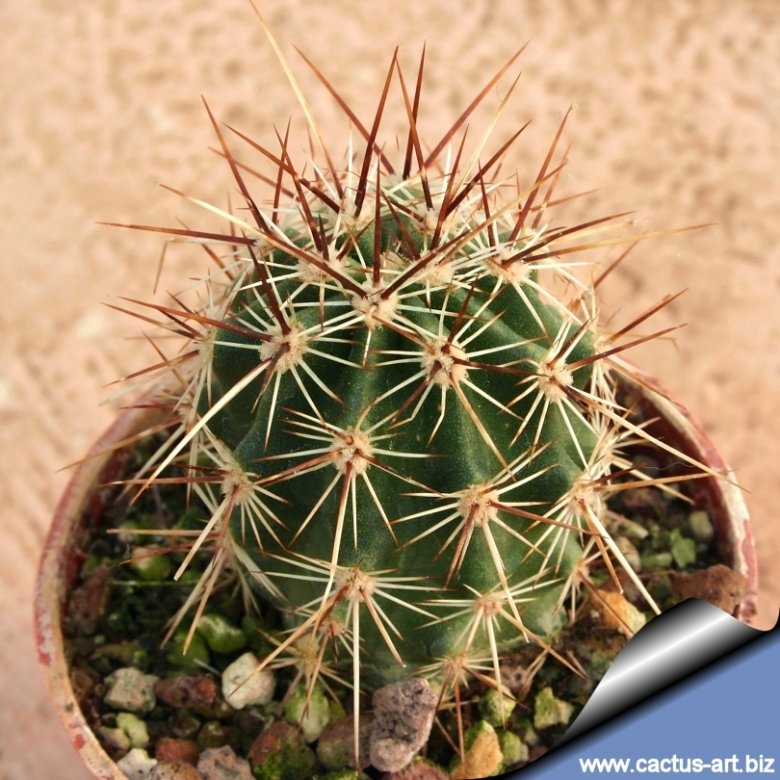
Echinocereus engelmannii var. chrysocentrus is a formidably spined and free clumping columnar cactus, 6-25-branched, ultimately forming somewhat open clumps of stems.
Stems: Suberect, erect or ascending light green, cylindric or somewhat tapering distally, (10-)15-20(-30) cm tall, and about 5-6 cm in diameter, branching freely from the base.
Ribs: 11 to 14 low, obtuse, tubercles indistinct, crests slightly undulate.
Areoles: Large, nearly circular, 6-15 mm apart, with few stout bristles, wool present in first year only.
Central spines: 5-6 Divergent-porrect, very stout, and rigid, straight or curving and somewhat twisted, terete or somewhat flattened, up to 7 cm long (or more) Yellowish to brown, more or less variegated (often purple when young).
Radial spines: About 10, appressed, stiff, lighter whitish to creamy coloured 8-20 mm long long, spreading.
Flowers: Purple, 5-8 cm long and even broader when fully expanded. Flower tube hairy, scales on ovary 3-5 mm long acuminate. Perianth segments oblong, 3-4 cm long, acunimate.
Blooming season: Spring, flowers are diurnal close at night and reopen in the morning and last for about five days.
Fruit: Spheric, obovoid or ovoid, spiny, red or orangish about 3 cm long, fleshy, pulp whitish becoming infused with pink or red from the skin. The fruit is edible, it is said to taste like strawberry.
Seeds: Black nearly globular, or a little oblique, 1,5 mm in diameter or less, tuberculate.
Origin and Habitat
South-western USA (Southern California, Arizona, southern Nevada, Utah) TL: Arizona, Bill Williams River, J. M. Bigelow, 13 Feb. 1854 (MO).
Habitat: Grows on gravel, sand and rocky hills.
Cultivation and Propagation
In cultivation the strawberry hedgehog grows rather slowly and it is sensitive to overwatering (rot prone) needs a very good drainage to avoid rotting, but requires more moisture than true desert cacti to grow and produce flowers, Keep drier and cool in winter. Need full sun. It is cold resistant to -10° ( or less depending on clones) for short periods of time. It is a fine plant for a rock garden or container, contrasts well with agaves, yuccas, and low-growing flowering plants. It will show its flowers only if we provide an adequate winter rest period.
Propagation:: Seeds, also can be grown from cutting as it branches from the base.
Bibliography
Major references and further lectures:
-
Edward Anderson “The Cactus family” Timber Press, Incorporated, 2001
-
James Cullen, Sabina G. Knees, H. Suzanne Cubey “The European Garden Flora Flowering Plants: A Manual for the Identification of Plants Cultivated in Europe, Both Out-of-Doors and Under Glass” Cambridge University Press, 11/Aug/2011
-
David R Hunt; Nigel P Taylor; Graham Charles; International Cactaceae Systematics Group. “The New Cactus Lexicon” dh books, 2006
-
Urs Eggli, Leonard E. Newton: “Etymological Dictionary of Succulent Plant Names” Springer, Berlin/Heidelberg 2010
-
N. L. Britton, J. N. Rose: “The Cactaceae. Descriptions and Illustrations of Plants of the Cactus Family.” Volume II, The Carnegie Institution of Washington, Washington 1920
Gallery