Publication: Echinocereus Monogr. (preprint) [2] (1998)
Description
Echinocereus fendleri var. hempelii is the Mexican counterpart of the New Mexican Echinocereus fendleri var. kuenzleri, both these taxa are based mainly on the stem feature (strongly tubercled ribs) and are varieties of the wide ranging and very variable Echinocereus fendleri.
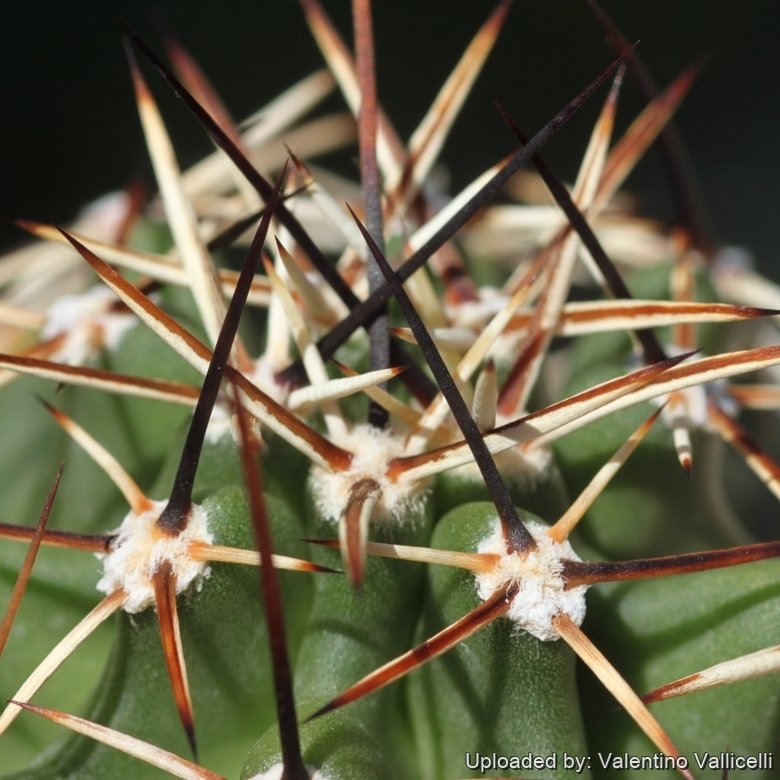
Distinguishing features: Echinocereus fendleri var. hempelii is distinguished for its lack of central spines, the strongly tubercled ribs and the very loosely arranged perianth-segments.
Habit: It is a low growing, scrubby cactus, that grows solitary or slowly basally branching.
Stems: 15-20 cm tall, 6-7 cm in diameter, dark green, soft, with a flabby surface.
Ribs: 8 to 10 strongly tuberculate.
Areoles: Circular, white, 8 to 17 mm apart.
Radial spines: Few (3 to 6) about 1 cm long or less, spreading white needle-like, thick, angular, flattened, e radials with brown or blackish tips.
Central spines: Absent.
Flowers: Funnelform, from near the top of plant, rather large, 6-8 cm in diameter, purple-violet and delicate, inner perianth segments, few, about 14, loosely arranged, relatively broad, obtuse 3 cm. long and strongly toothed above. Ovary bearing conspicuous red scales, spiny. Style longer than the stamens.
Blooming season: Spring ( in habitat April to June).
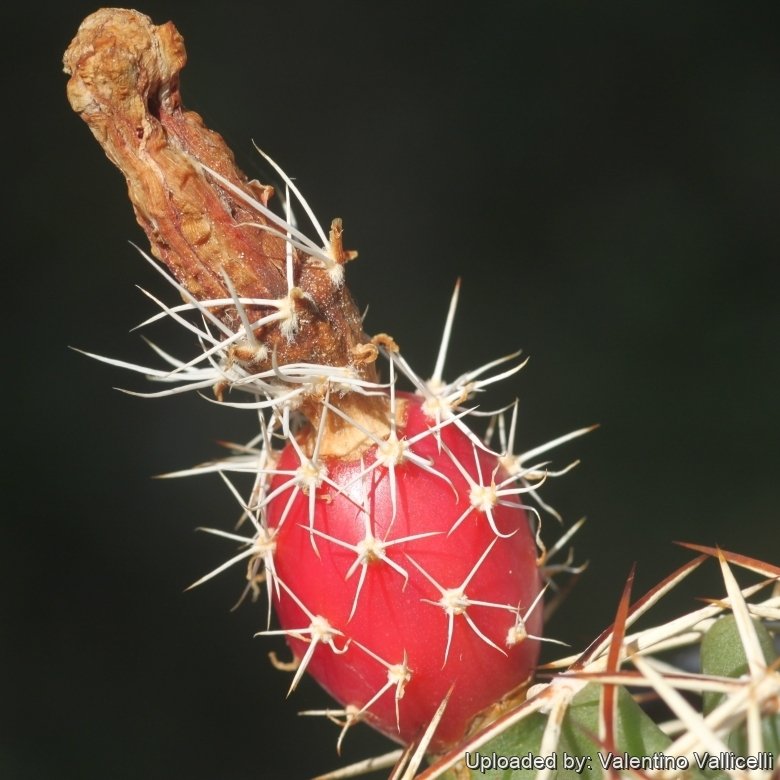
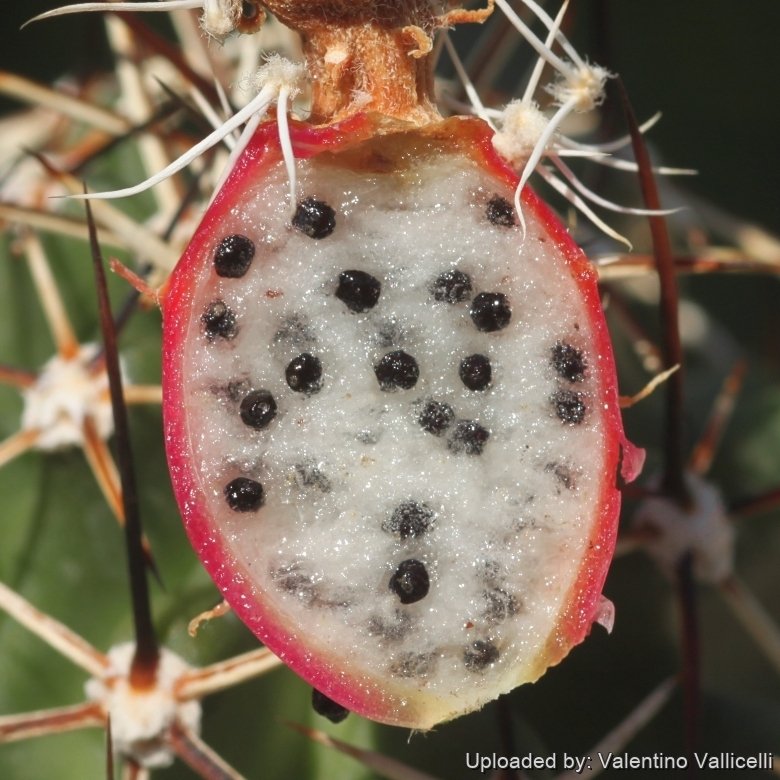
Fruit: 2,5-5 cm long, 12 mm in diameter, turning scarlet, less often orange-tan or purplish orange, pulp magenta or red. All varieties have delicious edible fruits.
Origin and Habitat
Probably northern Mexico, North-Central Chihuahua, unknown in the wild.
Cultivation and Propagation
It grows rather slowly and is sensitive to over-watering (rot prone). Keep drier and cool in winter. It needs full sun. Very cold resistant, reportedly to -18°C or less (depending on clones), but needs good drainage and protection from excessive moisture in winter and well mulched with gravel chips. It is a fine plant for a rock garden or container, and contrasts well with agaves, yuccas, and low-growing flowering plants. It will show its flowers only provided with an adequate winter rest period.
Propagation: Seeds, can also be grown from cuttings, as it branches from the base.
Bibliography
Major references and further lectures
-
Edward Anderson “The Cactus family” Timber Press, Incorporated, 2001
-
Nathaniel Lord Britton, Joseph Nelson Rose “Cactaceae: Descriptions and Illustrations of Plants of the Cactus Family” vol. 4 The Carnegie Institution of Washington, Washington 1923
-
James Cullen, Sabina G. Knees, H. Suzanne Cubey “The European Garden Flora Flowering Plants: A Manual for the Identification of Plants Cultivated in Europe, Both Out-of-Doors and Under Glass” Cambridge University Press, 11/Aug/2011
-
David R Hunt; Nigel P Taylor; Graham Charles; International Cactaceae Systematics Group. “The New Cactus Lexicon” dh books, 2006
-
A. Michael Powell, James F. Weedin “Cacti of the Trans-Pecos & Adjacent Areas” Texas Tech University Press, 2004
-
Del Weniger “Cacti of Texas and Neighboring States: A Field Guide” University of Texas Press, 1984
-
United States. Bureau of Land Management. Las Cruces District Office “Grazing management: McGregor Eis Area, New Mexico” U.S. Dept. of the Interior, Bureau of Land Management, Las Cruces District Office, 1980