Publication: Cactaceae Consensus Init. 3: 9. 1997
Description
Solitary or slowly clumping
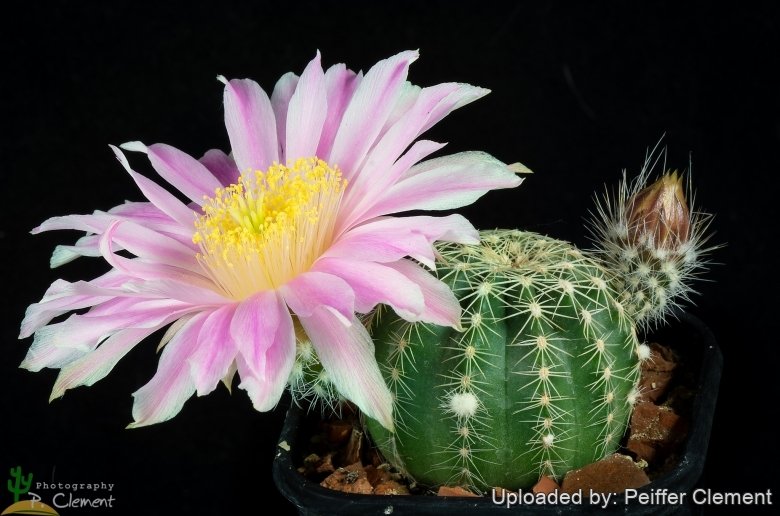
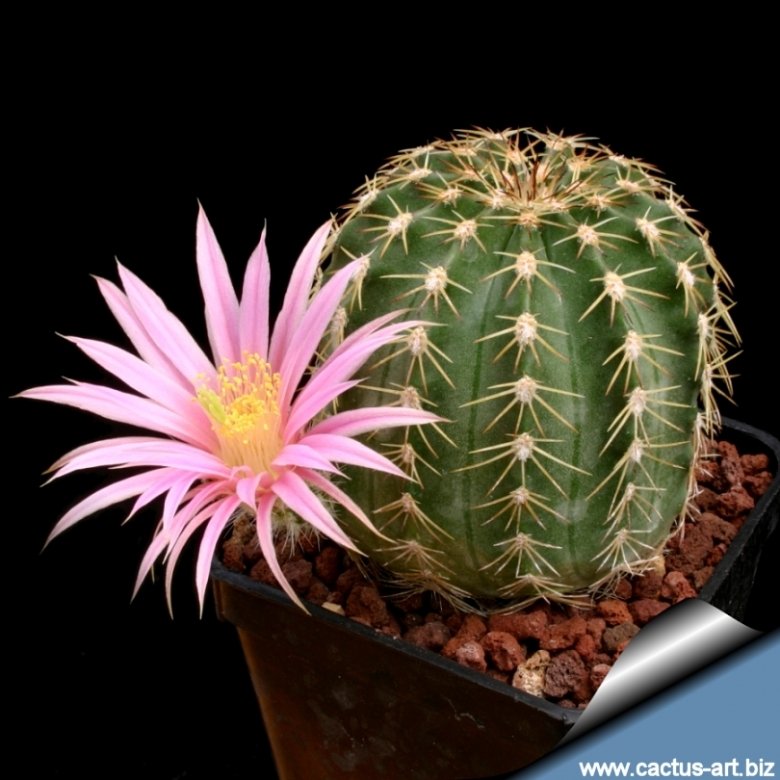
Stems: Flat globular, conical as it ages, up to 13 cm in diameter (but cultivated plants are frequently larger), bluish green when young;
Ribs: 14 or 15, acute
Areoles: 5 to7 mm apart; 3 to 7
Central spines: Not present.
Radial spines: 8 to 11 spines per areole, 3-12 mm long, pale yellowish.
Roots: It has a strong taproot.
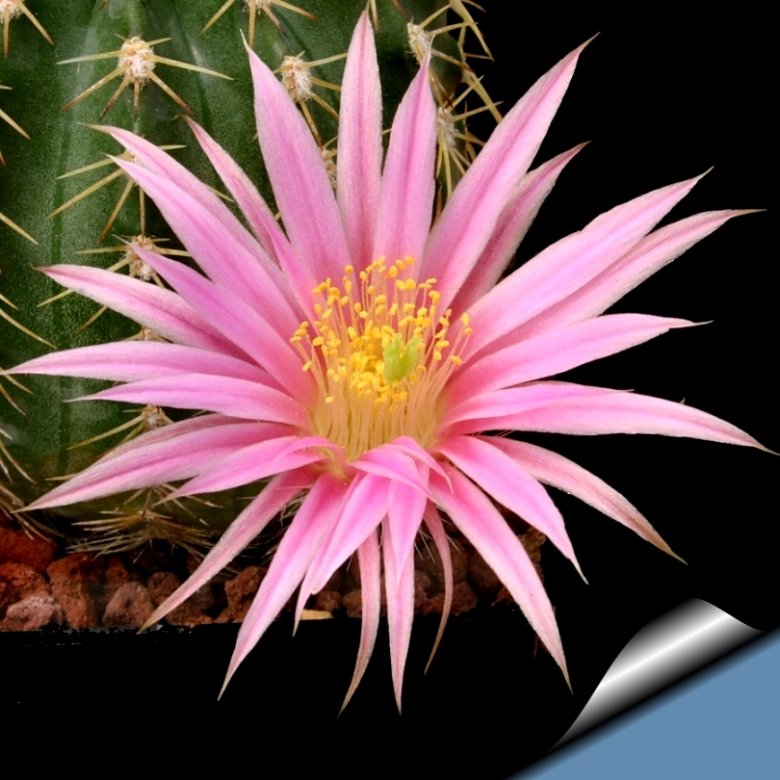
Flowers: Abundant pink or purple/red (rarely white) flowers, up to 6 cm in diameter.
Origin and Habitat
Mexico (Zacatecas)
Ecology: It is a geophyte cactus with a swollen underground storage taproot. In the wild it tends to disappear completely in the ground, in times of drought.
Cultivation and Propagation
It is relatively easy to grow on its own roots.
Growth rate: It is a relatively slow growing and easily flowering species that will make clumps given the best conditions.
Soils: It likes very porous standard cactus mix soil.
Repotting: It has a strong tap root and should have a deep pot to accommodate it. Use pot with good drainage.
Watering: Water carefully, too much water will make it rot, keep dry in winter.
Fertilization: Feed with a high potassium fertilizer in summer.
Hardiness: Keep dry at minimum temperature of 5° C in winter although will tolerate brief periods to -10 degrees. Sun Exposure: Full sun to light shade. However warmth throughout the year will increase the grower’s success (5-12°C during rest season).
Exposition: Outside full sun to light shade or afternoon shade, inside it needs bright light, and some direct sun. Subject to sunburn if exposed to direct sun for too long. Tends to bronze in strong light, which encourages flowering.
Uses: It is an excellent plant for container growing. It always looks good and stays small. It look fine in a cold greenhouse and frame or outdoor in a rockery.
Pests & diseases: It may be attractive to a variety of insects, but plants in good condition should be nearly pest-free, particularly if they are grown in a mineral potting-mix, with good exposure and ventilation. Nonetheless, there are several pests to watch for:
- Red spiders: Red spiders may be effectively rubbed up by watering the plants from above.
- Mealy bugs: Mealy bugs occasionally develop aerial into the new growth among the wool with disfiguring results, but the worst types develop underground on the roots and are invisible except by their effects.
- Scales: Scales are rarely a problem.
- Rot: Rot is only a minor problem with cacti if the plants are watered and “aired” correctly. If they are not, fungicides won’t help all that much.
Propagation: It grow easily from seed or cutting (if available).
Bibliography
Major references and further lectures
-
Edward Anderson “The Cactus family” Timber Press, Incorporated, 2001
-
James Cullen, Sabina G. Knees, H. Suzanne Cubey “The European Garden Flora Flowering Plants: A Manual for the Identification of Plants Cultivated in Europe, Both Out-of-Doors and Under Glass” Cambridge University Press, 11/Aug/2011
-
David R Hunt; Nigel P Taylor; Graham Charles; International Cactaceae Systematics Group. “The New Cactus Lexicon” dh books, 2006
-
Nathaniel Lord Britton, Joseph Nelson Rose “Cactaceae: Descriptions and Illustrations of Plants of the Cactus Family” Courier Dover Publications, 1963