Publication: Cactaceae Consensus Init. 3: 9. 1997
Description
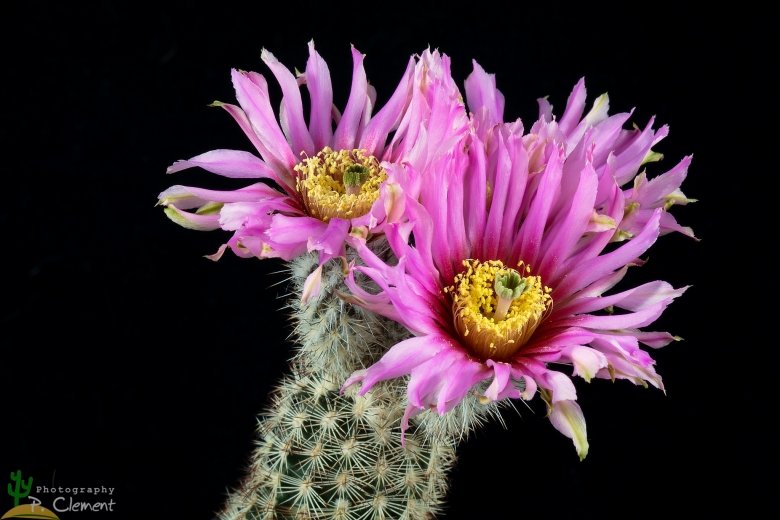
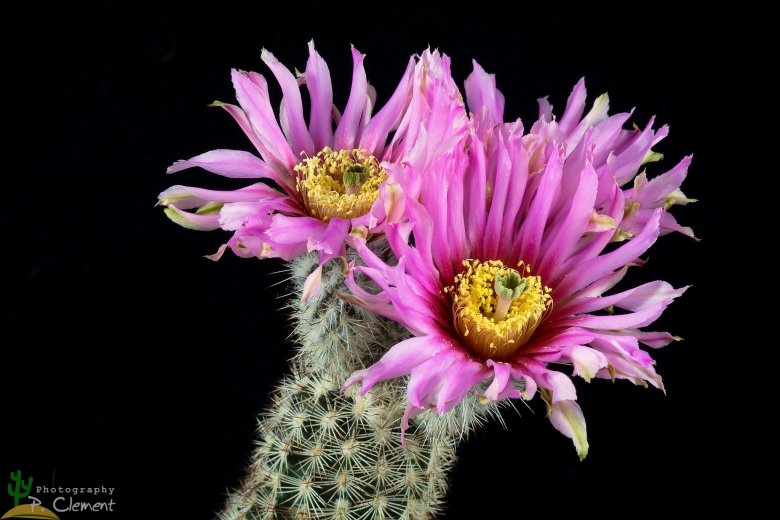
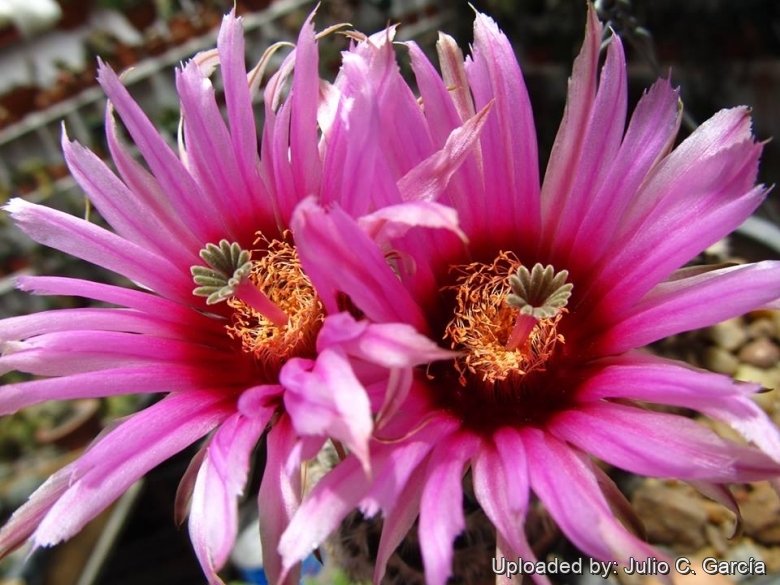
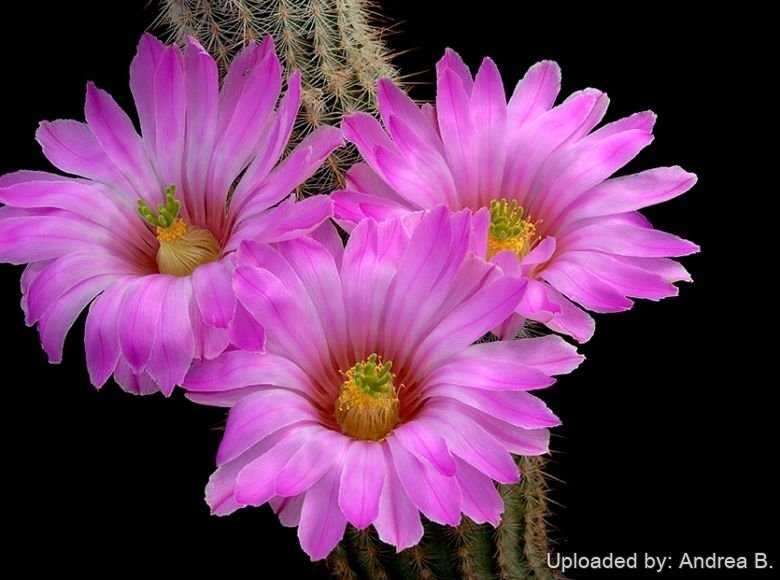
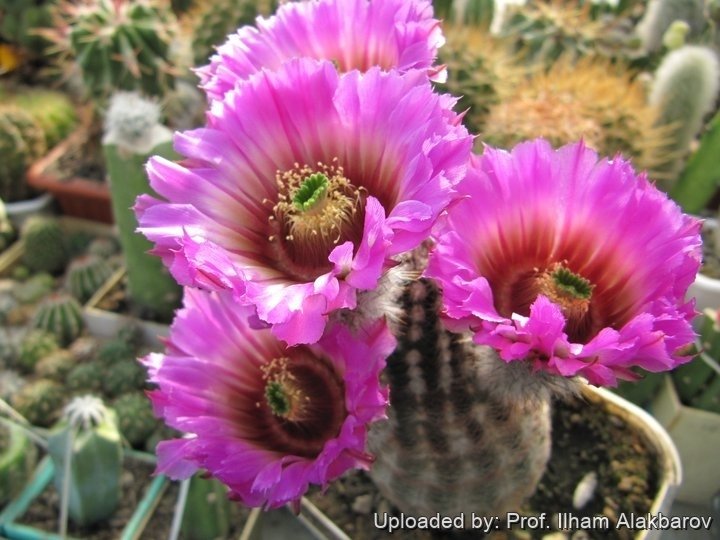
Echinocereus reichenbachii subs. fitchii (a.k.a. Echinocereus fitchii) is a controversial subspecies of the very variable Echinocereus reichenbachii. It distinguishes for the brown central spines, much longer than white radials and for its flowers which are among the largest in the species, and their exact colour pattern may prove taxonomically significant. It blooms quite readily making this species a very beautiful one at flowering time, which is usually May to June.
Related taxa: Echinocereus reichenbachii var. albertii is somewhat morphologically and geographically intermediate between Echinocereus reichenbachii var. caespitosus and Echinocereus reichenbachii var. fitchii, but with flowers more closely resembling var. fitchii.
Habit: Usually single, sometimes 1-2 side branches when very old
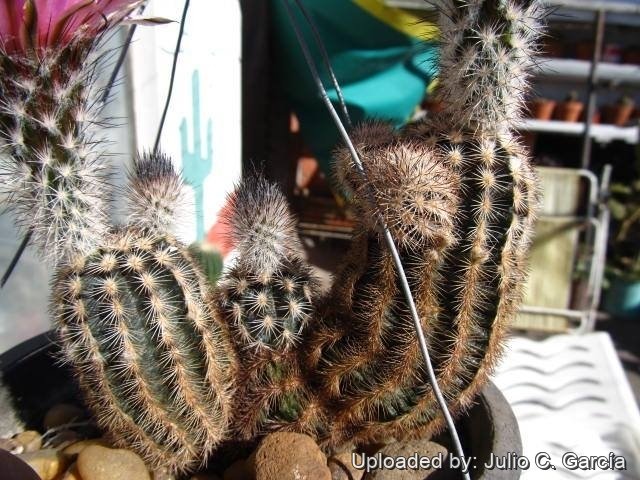
Stems: Upright, short-cylindric or somewhat narrowed above, about 4 to 5 cm thick attaining occasionally a height of 15 cm, but usually not more than 5-10 cm tall, medium to dark green.
Ribs: 10-14 composed of low, rounded confluent tubercles.
Areoles: Round when young, becoming more oval on mature specimens, 4 to 6 mm apart, small.
Radial spines: about 20, white, spreading, 4 to 6 mm long.
Central spines: 4 to 6, slightly spreading, 12 mm long or less, acicular, brownish, but sometimes white at base.
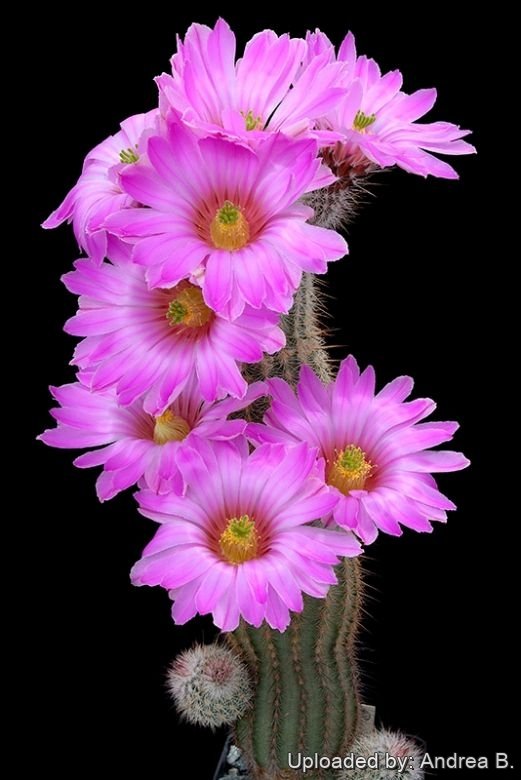
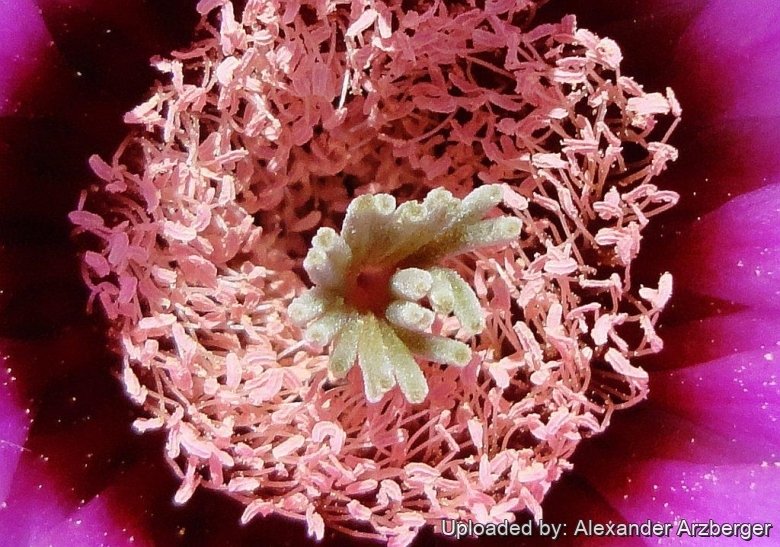
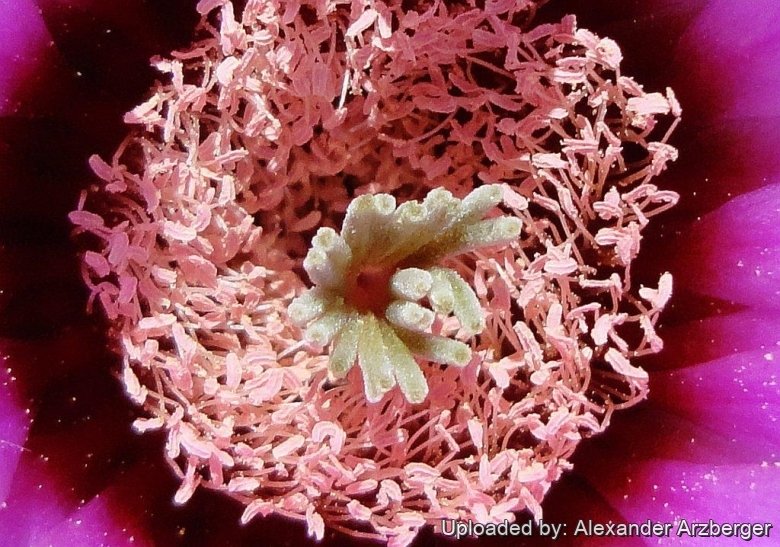
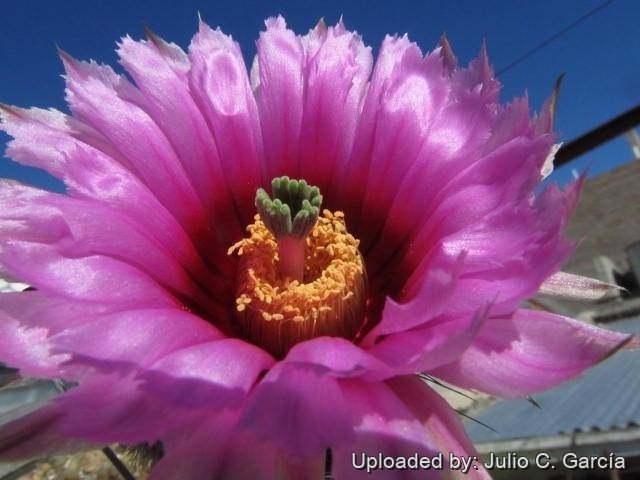
Flowers: 1-3 per plant, 6-7 or more cm long and wide, diurnal, large and showy, slightly scented, pink-purple with dark burgundy centre. Tepals, oblanceolate, widely spreading, acute, serrate on the margin. Ovary 2,5 cm long, bearing numerous areoles, these spiny and very woolly.
Blooming season: Late April/Early May to Late June.
Fruits: Ovoid green, up to 28 mm long, olive green, or dark green and covered with white, dense hair; fruiting 1,5-2,5 months after flowering.
Seeds: Black.
Origin and Habitat
Texas (Starr, Webb, and Zapadta Counties).
Altitude: It grows at low elevations around 100 metres above sea level.
Habitat: It grows on rocky hills overlooking the Rio grande river together with Echinocereus stramineus, Wilcoxia tamaulipensis and Astrophytum asterias.
Cultivation and Propagation
Echinocereus reichenbachii subs. fitchii is fairly easy to grow. It makes great potted specimens.
Soil: Use a mineral well permeable soil with little organic matter (peat, humus). It grows in limestone areas of Texas (Big Bend area) and adjacent areas of Mexico, so will probably benefit from extra calcium in its soil.
Growth rate: It grows well, though slowly, but it possible to increase the speed of growth to some extent by providing adequate amount of water, warmth, and a liquid fertilizer diluted half strength during the active growing season, but it’s susceptible to rotting if too wet. Most plants will offset readily, and clumps can be produced in a few years.
Soil: It needs a very porous, slightly acidic potting medium (add pumice, vulcanite, and perlite). Outdoors it does well on poor, rocky soils.
Exposure: It likes a sunny position also blasting sun in summer. If grown indoor provide 4 to 6 hours, or more, direct morning or afternoon sun.
Watering: It is sensitive to overwatering (rot prone) needs a very good drainage to avoid rotting, but requires more moisture than true desert cacti to grow and produce flowers.
Hardiness: It its natural environment it is very cold resistant from -10° to -25° C (depending on clones) or less for short periods of time. It can be grown outdoors in Mediterranean warm-temperate climates, But for safe cultivations needs anyway to kept above 5 °C and dry in winter. But it can tolerate temperatures down to -5° C (or even less) for very short periods if very dry and ventilated. During winter month, put them in a cool luminous place and encourage them to enter winter dormancy by withholding water and fertiliser over the winter as they will etiolate, or become thin, due to lower levels of light.
Maintenance: Repot every two years. Needs lots and lots of space to grow, use large shallow container or bowl filled with very porous compost. It like pots with generous drain holes.
Pest & diseases: They are susceptible to fungal diseases if overwatered, but are not nearly as sensitive as many other cacti, especially in warm weather. If kept damp through cold periods, they will invariably suffer.
Uses: It is a fine plant for a rock garden or container, contrasts well with agaves, yuccas, and low-growing flowering plants.
Propagation: Seeds, also can be grown from cutting as it slowly branches from the base. The seeds may be germinated and grown in containers. Their main requirements consist of high humidity levels, free-draining soil mix, and enough water, light, and nutrition.
Bibliography
Major references and further lectures
-
Edward Anderson “The Cactus family” Timber Press, Incorporated, 2001
-
James Cullen, Sabina G. Knees, H. Suzanne Cubey “The European Garden Flora Flowering Plants: A Manual for the Identification of Plants Cultivated in Europe, Both Out-of-Doors and Under Glass” Cambridge University Press, 11/Aug/2011
-
David R Hunt; Nigel P Taylor; Graham Charles; International Cactaceae Systematics Group. “The New Cactus Lexicon” dh books, 2006
-
Brian Loflin, Shirley Loflin “Texas Cacti: A Field Guide” Texas A&M University Press, 26/ott/2009
-
Albert Michael Powell, James F. Weedin “Cacti of the Trans-Pecos and Adjacent Areas” Texas Tech University Press, 2004
-
Del Weniger “Cacti of the Southwest: Texas, New Mexico, Oklahoma, Arkansas, and Louisiana” University of Texas Press, 1969
-
“Rare Plants of Texas: A Field Guide” Texas A&M University Press, 2007
-
Nathaniel Lord Britton, Joseph Nelson Rose “Cactaceae: Descriptions and Illustrations of Plants of the Cactus Family” Volume 3, 1922
-
Campbell Loughmiller “Texas Wildflowers” University of Texas Press, 2006
-
Urs Eggli, Leonard E. Newton: “Etymological Dictionary of Succulent Plant Names.” Birkhäuser 2004
-
J. H. Everitt, Dale Lynn Drawe, Robert I. Lonard “Trees, Shrubs, and Cacti of South Texas” Texas Tech University Press, 2002
-
Alfred Richardson “Plants of Deep South Texas: A Field Guide to the Woody and Flowering Species” Texas A&M University Press, 2010
-
Lyman David Benson “The Cacti of the United States and Canada” Stanford University Press, 1982
From llifle page Echinocereus melanocentrus
Description
Echinocereus melanocentrus is an old name used to describe Echinocereus reichenbachii subs. fitchii which is itself a controversial subspecies of the very variable Echinocereus reichenbachii. It distinguishes for the brown central spines, much longer than white radials and for its flowers which are among the largest in the species, and their exact colour pattern may prove taxonomically significant. It blooms quite readily making this species a very beautiful one at flowering time, which is usually May to June.
Habit: Usually single, sometimes 1-2 side branches when very old
Stems: Upright, short-cylindric or somewhat narrowed above, about 4 to 5 cm thick attaining occasionally a height of 15 cm, but usually not more than 5-10 cm tall, medium to dark green.
Ribs: 10-14 composed of low, rounded confluent tubercles.
Areoles: Round when young, becoming more oval on mature specimens, 4 to 6 mm apart, small.
Radial spines: about 20, white, spreading, 4 to 6 mm long.
Central spines: 4 to 6, slightly spreading, 12 mm long or less, acicular, brownish, but sometimes white at base.
Flowers: 1-3 per plant, 6-7 or more cm long and wide, diurnal, large and showy, slightly scented, pink-purple with dark burgundy centre. Tepals, oblanceolate, widely spreading, acute, serrate on the margin. Ovary 2,5 cm long, bearing numerous areoles, these spiny and very woolly.
Blooming season: Late April/Early May to Late June.
Fruits: Ovoid green, up to 28 mm long, olive green, or dark green and covered with white, dense hair; fruiting 1,5-2,5 months after flowering.
Seeds: Black.
Origin and Habitat
Starr County, Texas, USA.
Altitude: It grows at low elevations around 100 metres above sea level.
Habitat: It grows on rocky hills overlooking the Rio grande river together with Echinocereus stramineus, Wilcoxia tamaulipensis and Astrophytum asterias.
Cultivation and Propagation
Echinocereus melanocentrus (=Echinocereus reichenbachii subs. fitchii) is fairly easy to grow. It makes great potted specimens.
Soil: Use a mineral well permeable soil with little organic matter (peat, humus). It grows in limestone areas of Texas (Big Bend area) and adjacent areas of Mexico, so will probably benefit from extra calcium in its soil.
Growth rate: It grows well, though slowly, but it possible to increase the speed of growth to some extent by providing adequate amount of water, warmth, and a liquid fertilizer diluted half strength during the active growing season, but it’s susceptible to rotting if too wet. Most plants will offset readily, and clumps can be produced in a few years.
Soil: It needs a very porous, slightly acidic potting medium (add pumice, vulcanite, and perlite). Outdoors it does well on poor, rocky soils.
Exposure: It likes a sunny position also blasting sun in summer. If grown indoor provide 4 to 6 hours, or more, direct morning or afternoon sun.
Watering: It is sensitive to overwatering (rot prone) needs a very good drainage to avoid rotting, but requires more moisture than true desert cacti to grow and produce flowers.
Hardiness: It its natural environment it is very cold resistant from -10° to -25° C (depending on clones) or less for short periods of time. It can be grown outdoors in Mediterranean warm-temperate climates, But for safe cultivations needs anyway to kept above 5 °C and dry in winter. But it can tolerate temperatures down to -5° C (or even less) for very short periods if very dry and ventilated. During winter month, put them in a cool luminous place and encourage them to enter winter dormancy by withholding water and fertiliser over the winter as they will etiolate, or become thin, due to lower levels of light.
Maintenance: Repot every two years. Needs lots and lots of space to grow, use large shallow container or bowl filled with very porous compost. It like pots with generous drain holes.
Pest & diseases: They are susceptible to fungal diseases if overwatered, but are not nearly as sensitive as many other cacti, especially in warm weather. If kept damp through cold periods, they will invariably suffer.
Uses: It is a fine plant for a rock garden or container, contrasts well with agaves, yuccas, and low-growing flowering plants.
Propagation: Seeds, also can be grown from cutting as it slowly branches from the base. The seeds may be germinated and grown in containers. Their main requirements consist of high humidity levels, free-draining soil mix, and enough water, light, and nutrition.
Bibliography
Major references and further lectures
-
Edward Anderson “The Cactus family” Timber Press, Incorporated, 2001
-
James Cullen, Sabina G. Knees, H. Suzanne Cubey “The European Garden Flora Flowering Plants: A Manual for the Identification of Plants Cultivated in Europe, Both Out-of-Doors and Under Glass” Cambridge University Press, 11/Aug/2011
-
David R Hunt; Nigel P Taylor; Graham Charles; International Cactaceae Systematics Group. “The New Cactus Lexicon” dh books, 2006
-
Brian Loflin, Shirley Loflin “Texas Cacti: A Field Guide” Texas A&M University Press, 26/ott/2009
-
Albert Michael Powell, James F. Weedin “Cacti of the Trans-Pecos and Adjacent Areas” Texas Tech University Press, 2004
-
Del Weniger “Cacti of the Southwest: Texas, New Mexico, Oklahoma, Arkansas, and Louisiana” University of Texas Press, 1969
-
“Rare Plants of Texas: A Field Guide” Texas A&M University Press, 2007
-
Nathaniel Lord Britton, Joseph Nelson Rose “Cactaceae: Descriptions and Illustrations of Plants of the Cactus Family” Volume 3, 1922
-
Campbell Loughmiller “Texas Wildflowers” University of Texas Press, 2006
-
Urs Eggli, Leonard E. Newton: “Etymological Dictionary of Succulent Plant Names.” Birkhäuser 2004
-
“Rare Plants of Texas: A Field Guide” Texas A&M University Press, 2007
-
Alfred Richardson “Plants of Deep South Texas: A Field Guide to the Woody and Flowering Species” Texas A&M University Press, 2010
-
Lyman David Benson “The Cacti of the United States and Canada” Stanford University Press, 1982
-
J. H. Everitt, Dale Lynn Drawe, Robert I. Lonard “Trees, Shrubs, and Cacti of South Texas” Texas Tech University Press, 2002
-
Terry, M. & Heil, K. 2013. “Echinocereus reichenbachii”. The IUCN Red List of Threatened Species. Version 2014.3. <www.iucnredlist.org>. Downloaded on 21 December 2014.
Source: Echinocereus melanocentrus, LLIFLE - Encyclopedia of living forms, CC-BY-SA, retrieved 2026-10-25.
Gallery