Publication: Cact. Succ. J. (Los Angeles) 41: 127. 1969
Description
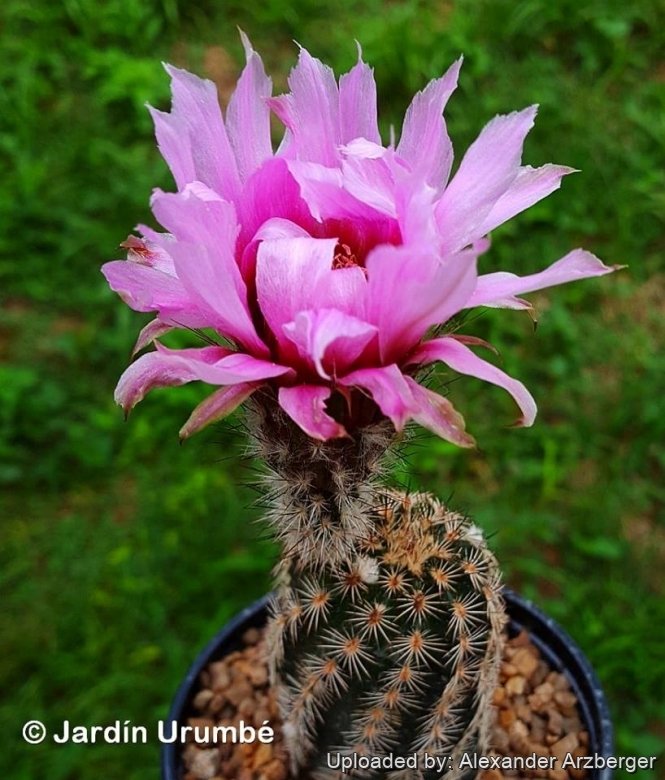
The black lace cactus, Echinocereus fitchii subsp. albertii (Echinocereus reichenbachii var. albertii), is a small cactus single or branching when old with dense closely pectinate spines. The spines are white to dark dark purple.
Stem: Cylindrical, deep green in color, 3 to 15 cm long, 3 to 5 cm thick.
Ribs: 10 to 13, tuberculate.
Areoles: Elliptic, 1,5 mm long, almost touching.
Central spines: 0 or 1, dark, 2 to 3 mm long, purple-black in colour, perpendicular to the stem, or turning slightly upward.
Radial spines: 14 to 20, white with dark purple tip, straight, closely pectinate, 3 to 6 mm long.
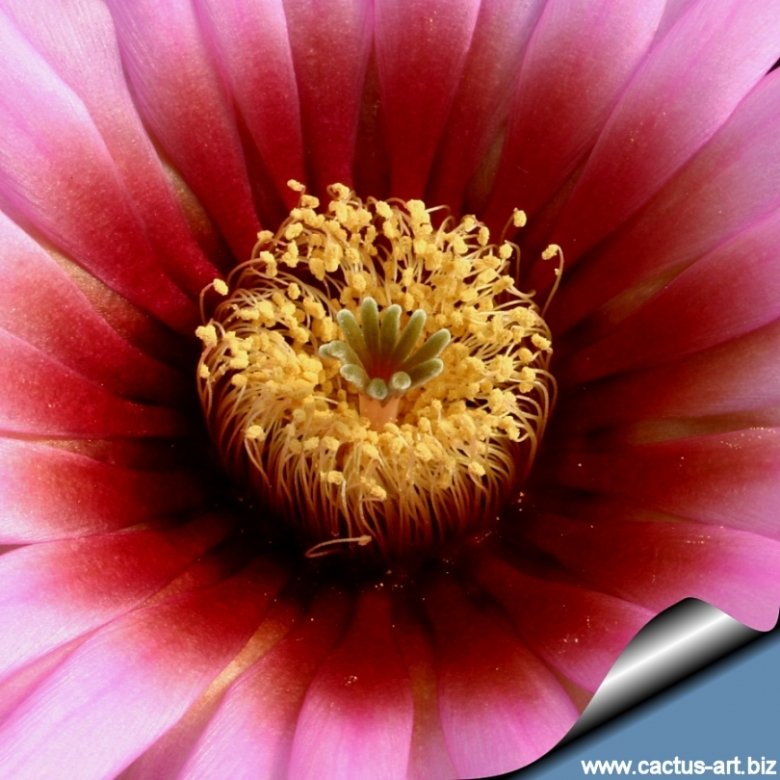
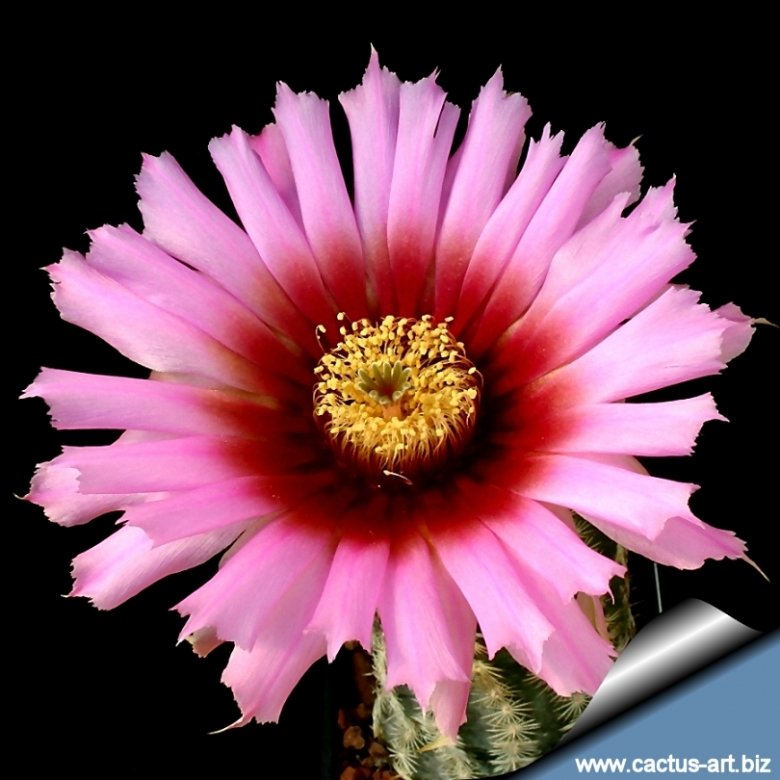
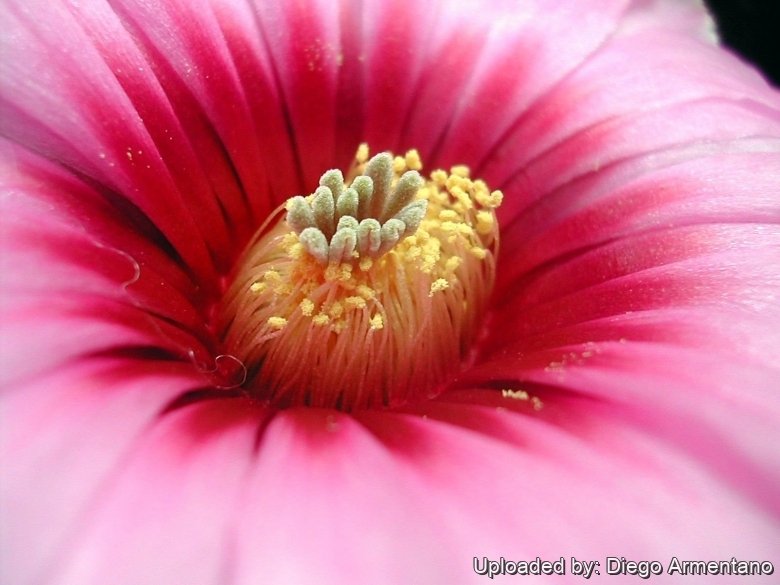
Flowers: 5 to 8 cm long, 5 to 7,5 cm wide, and pink to purple in colour with a very dark purple-brown throat.
Blooming season: Budding and anthesis occur intermittently through the spring and summer.
Fruit: Green.
Remarks: The taxonomic and geographic boundaries among the segregate species or infraspecific taxa of Echinocereus reichenbachii remain nebulous and controversial. In no place do pure populations exist sympatrically, and all taxa appear completely interfertile. E. reichenbachii var. albertii is intermediate between Echinocereus reichenbachii var. reichenbachii, with a more northern distribution, and Echinocereus reichenbachii var. fitchii, with a more southern distribution in the Rio Grande Valley. Echinocereus melanocentrus is an invalid name of uncertain application, perhaps referable to E. reichenbachii var. albertii.
Origin and Habitat
Known populations of the black lace cactus are in Kleberg, Jim Wells, and Refugio counties of south Texas.
Currently less than 4000 plants are known in the wild, with several populations being destroyed. The black lace cactus is endangered because its rangeland habitat has been cleared or planted to crops.
Habitat: It is found in coastal areas or along creeks in open unshaded grasslands, dominated by halophytic grasses and forbs and or under heavy brush on south Texas range and invaded by mesquite and other shrubs. The local topography is fairly flat, with water standing after heavy rains. The elevation varies from 3 to 60 meter. The climate is semi-arid. Black lace cactus occurs on somewhat saline clay and silt sheets (composed of clay, fine silt sand and gravel). It is often found growing along with Thelocactus setispinus, Echinocactus texensis, Mammillaria heyderi var. hemisphaerica, Opuntia leptocaulis and Opuntia engelmannii.
Cultivation and Propagation
It is sensitive to overwatering (rot prone) needs a very good drainage to avoid rotting, but requires more moisture than true desert cacti to grow and produce flowers, Keep drier and cool in winter. Need full sun. It is very cold resistant from -10° to -25° C (depending on clones) or less for short periods of time. It is a fine plant for a rock garden or container, contrasts well with agaves, yuccas, and low-growing flowering plants.
Propagation: Seeds, also can be grown from cutting as it slowly branches from the base;
Bibliography
Major references and further lectures
-
Edward F. Anderson (2001) “ The Cactus Family”.
-
Curt Backeberg “Cactus Lexicon” Sterling Publishing Company, Incorporated, 1978
-
David Hunt, Nigel Taylor “The New Cactus Lexicon” DH Books, 2006 ISBN 0953813444, 9780953813445
-
Del Weniger “Cacti of the Southwest: Texas, New Mexico, Oklahoma, Arkansas, and Louisiana” University of Texas Press, 1969
-
James Cullen, Sabina G. Knees, H. Suzanne Cubey “The European Garden Flora Flowering Plants: A Manual for the Identification of Plants Cultivated in Europe, Both Out-of-Doors and Under GlassCambridge University Press, 11/ago/2011
-
Lyman David Benson “The Cacti of the United States and Canada” Stanford University Press, 1982
Gallery