Publication: 1996 nom. nud.
Description
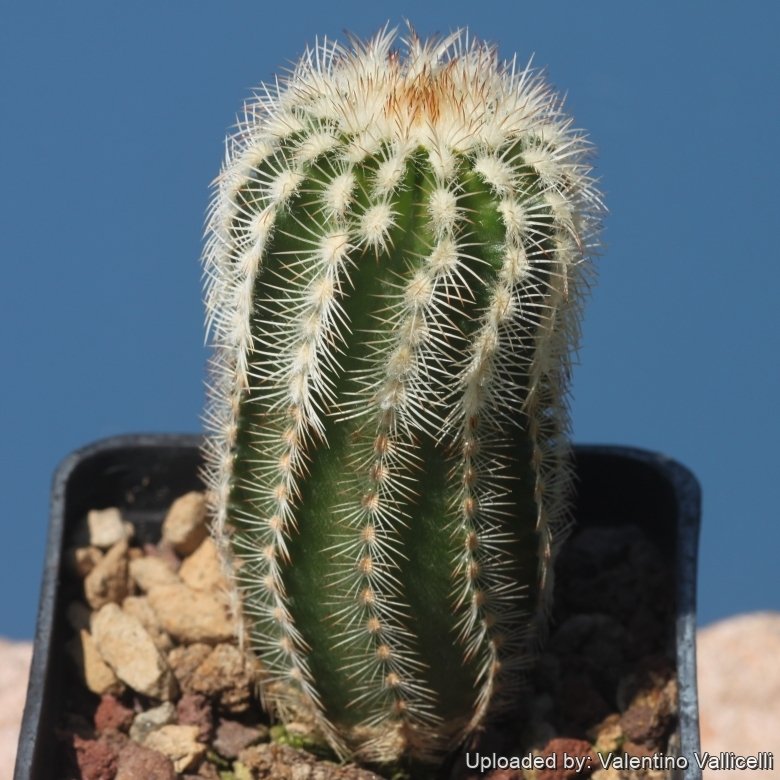
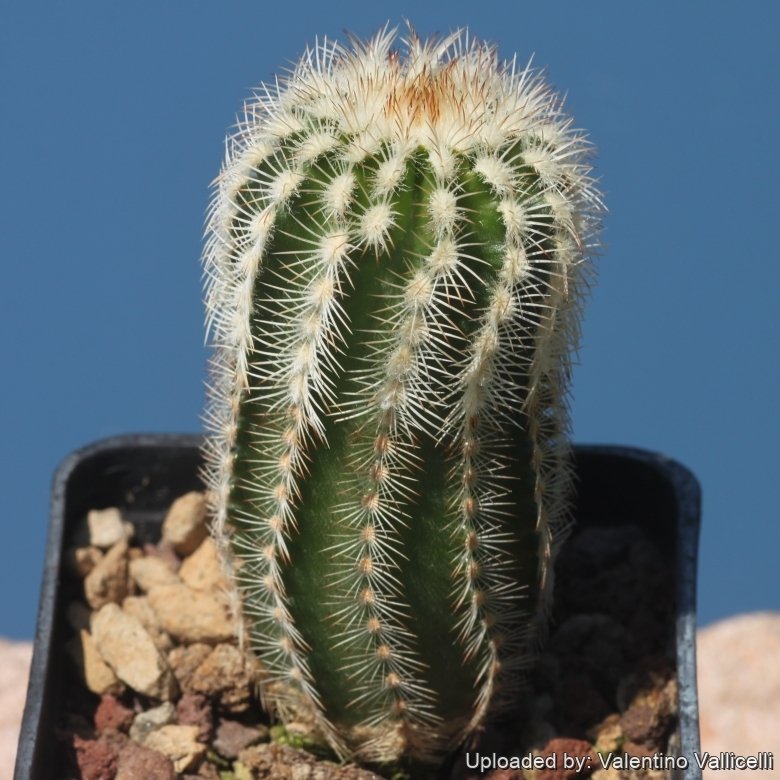
The “Echinocereus purpureus” from Oklahoma is merely one of the several forms of the very variable Echinocereus reichenbachii and is intermediate between Echinocereus reichenbachii subsp. baileyi and Echinocereus reichenbachii subsp. caespitosus. It has reddish neat comb-like short spination. It is one of the smaller Echinocereus species. However Echinocereus reichenbachii occurs over quite a wide area and the “purpureus” form is often regarded as a mere ecotype. However red spined form with bright purple flowers occurs at random elsewhere.
Stem: Erect, cylindrical or short cylindrical, as the the species, but smaller in maximum size and in diameter.
Ribs: 10-19 straight or slightly undulate.
Areoles:1-6 mm apart.
Radial spines: 14 to 22, straight to slightly curved, held closely against the the ribs of the stems, organized in 2 series, pectinately arranged or nearly so, 5 to 8 mm long. Multi-coloured, dullcreamy-white, glistering purplish to almost black at their tips, at first, whitish on older areoles.
Central spines: 0 to3 ( but usually absent) small, terete.
Flowers: Beautiful, abundant, scented, always purple in colour, 5 to 7 cm long. Flower tube 22-40 long, 10-30 mm in diameter, clothed with dense greyish wool, flower tube hairs 5-15 mm long; anthers yellow; nectar chamber 2-5 mm. Stigma lobes 12.
Blooming season: Early May to Late June.
Fruits: Ovoid green, olive green, or dark green, fruit up to 28 mm long; fruiting 1,5-2,5 months after flowering.
Seeds: Black.
Origin and Habitat
Oklhoma
Cultivation and Propagation
It is sensitive to overwatering (rot prone) needs a very good drainage to avoid rotting, but requires more moisture than true desert cacti to grow and produce flowers, Keep drier and cool in winter. Need full sun. It is very cold resistant from -10° to -25° C (depending on clones) or less for short periods of time. It is a fine plant for a rock garden or container, contrasts well with agaves, yuccas, and low-growing flowering plants.
Propagation: Seeds, also can be grown from cutting as it slowly branches from the base.
Bibliography
Major references and further lectures
-
Edward F. Anderson (2001) “ The Cactus Family”.
-
Curt Backeberg “Cactus Lexicon” Sterling Publishing Company, Incorporated, 1978
-
David Hunt, Nigel Taylor “The New Cactus Lexicon” DH Books, 2006 ISBN 0953813444, 9780953813445
-
Del Weniger “Cacti of the Southwest: Texas, New Mexico, Oklahoma, Arkansas, and Louisiana” University of Texas Press, 1969
-
James Cullen, Sabina G. Knees, H. Suzanne Cubey “The European Garden Flora Flowering Plants: A Manual for the Identification of Plants Cultivated in Europe, Both Out-of-Doors and Under GlassCambridge University Press, 11/ago/2011
-
Lyman David Benson “The Cacti of the United States and Canada” Stanford University Press, 1982
Gallery