Publication: Echinocereus Monogr. (preprint) [10] (1998)
Description
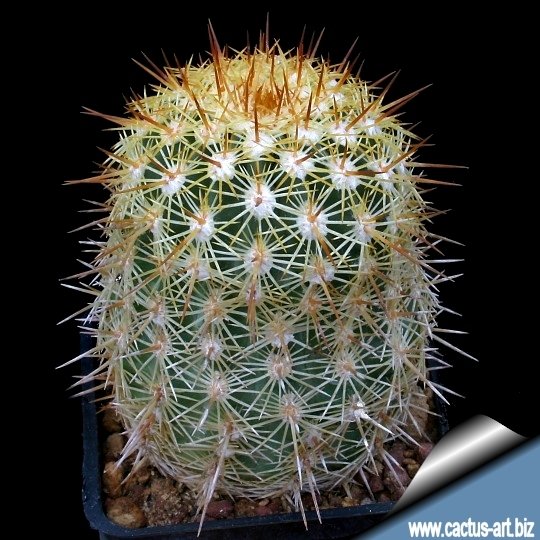
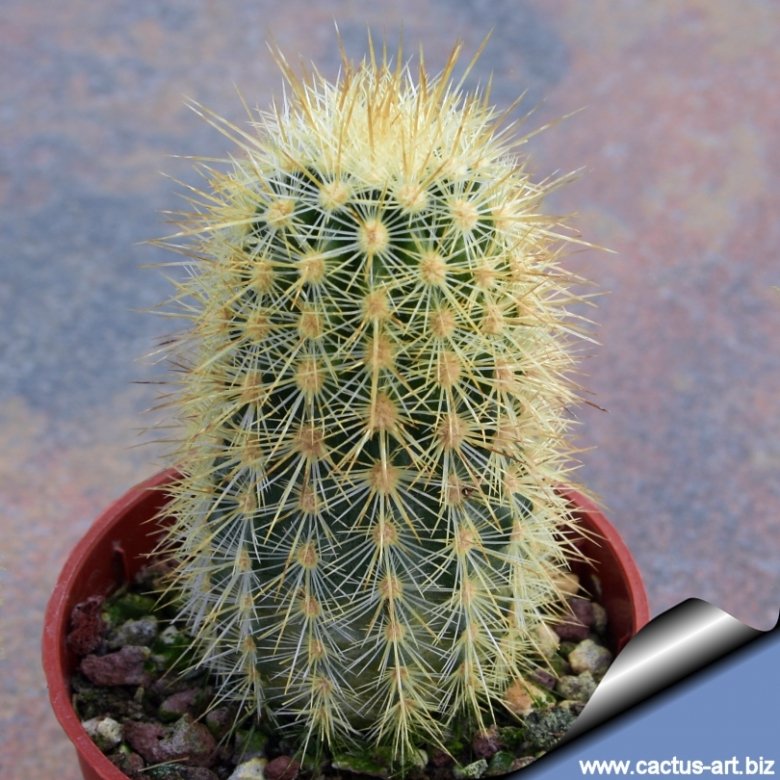
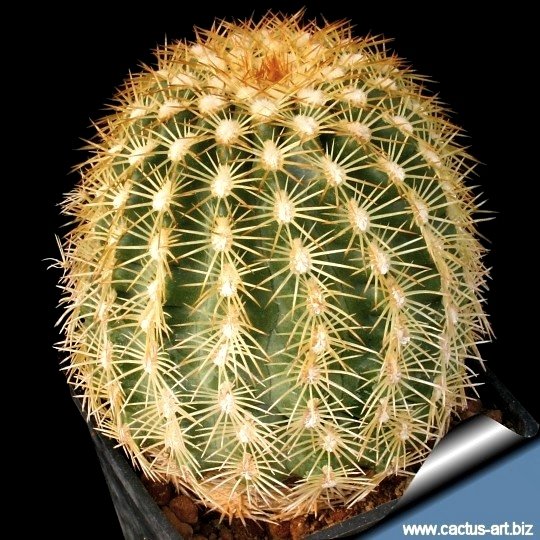
Usually grows singly or forms two or more stems , but never forms large clusters or mounds.
Stems: as much as 7,5 cm in diameter and 15 (25) cm tall.
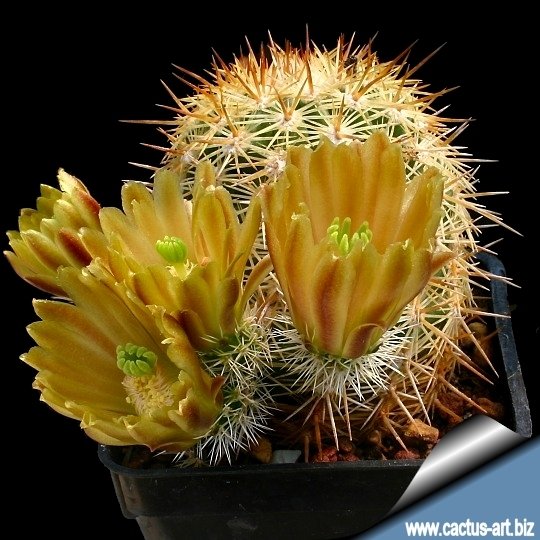
Spines: This species has short shiny yellowish spines but show a considerable variability in spine shape, some plants has only radials while other have a variable number of short centrals.
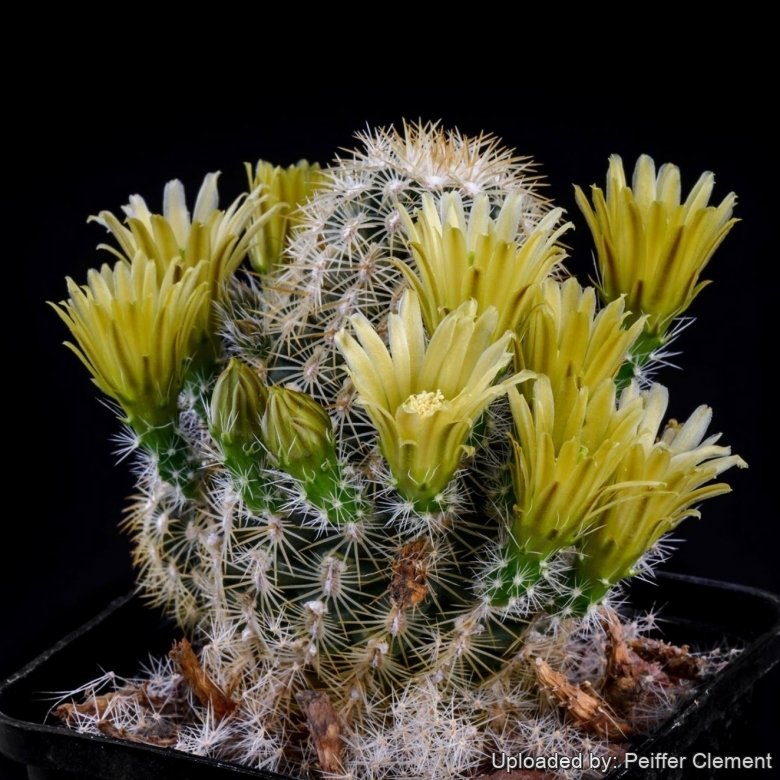
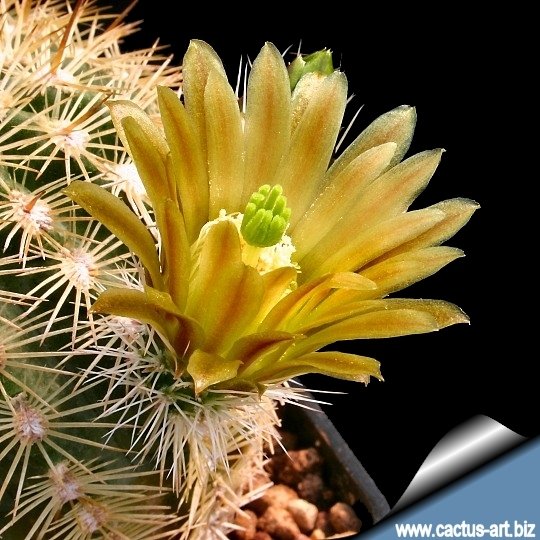
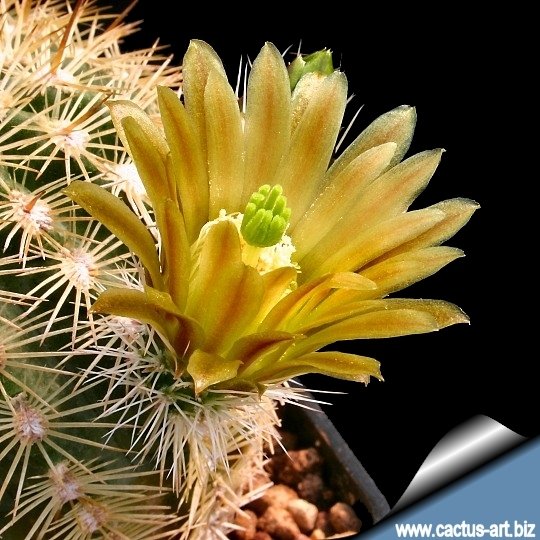
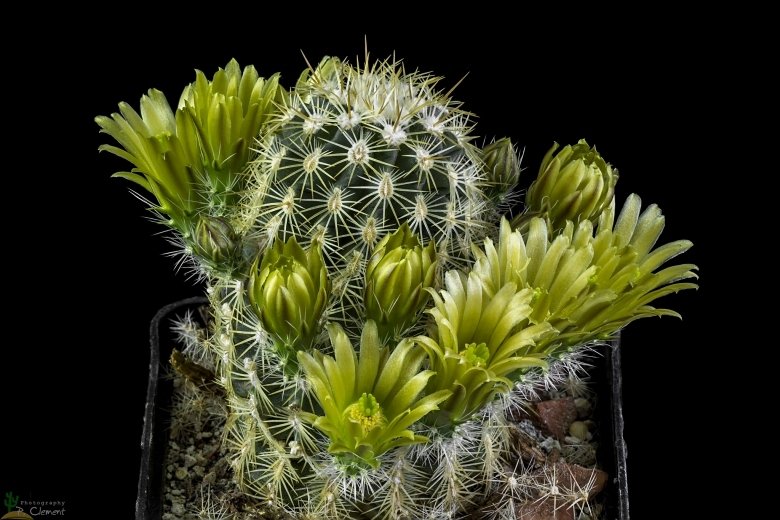
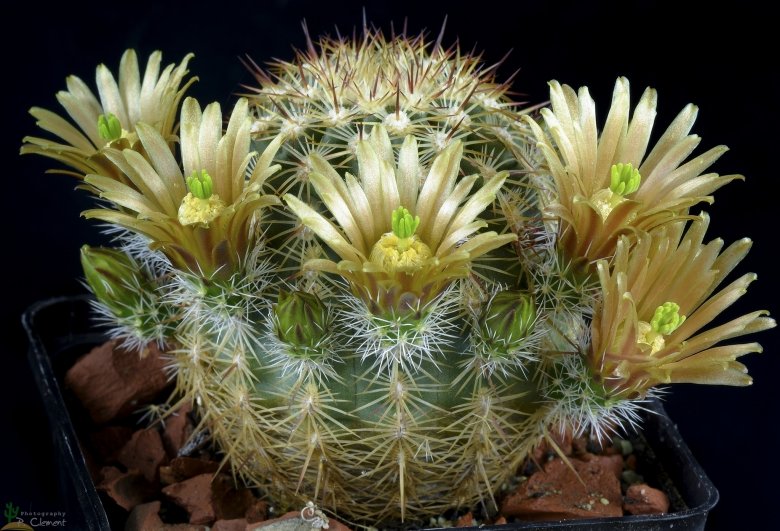
Flowers: Smaller than others in this genus about 2,5 cm long and 2,5 cm inch broad. Brown yellowish, and grow well down on the busides, often forming a band around the middle. Blooms in March or April.
Fruit: The fruit is small about the size of a small grape, green at first and later turning a purplish red and spiny.
Remarks: Echinocereus chloranthus is part of the Echinocereus viridiflorus compless that comprises a large number of infraspecific taxa, differing in various combinations of flower color, spine color, number and thickness of central spines, and other characters, including floral scent. Wherever such taxa are sympatric they intergrade; all are freely interfertile in the greenhouse.
Origin and Habitat
S. Marathon, Brewster CO, Davis Mts, Texas.
Cultivation and Propagation
Rot easily it is sensitive to overwatering (rot prone) needs a very good drainage to avoid rotting, Keep drier and cool in winter. Need full sun. Cold resistant above approx - 12C or less for short periods of time.
Propagation: It can be grown from seeds.
Bibliography
Major references and further lectures
-
David Hunt, Nigel Taylor “The New Cactus Lexicon” DH Books, 2006
-
John Pilbeam (1999) “Mammillaria The Cactus File Handbook” Nuffield Press.
-
Edward F. Anderson “The Cactus Family” Timber Press, 2001
-
James Cullen, Sabina G. Knees, H. Suzanne Cubey “The European Garden Flora Flowering Plants: A Manual for the Identification of Plants Cultivated in Europe, Both Out-of-Doors and Under Glass”Cambridge University Press, 11/ago/2011
From llifle page Echinocereus carmenensis
Description
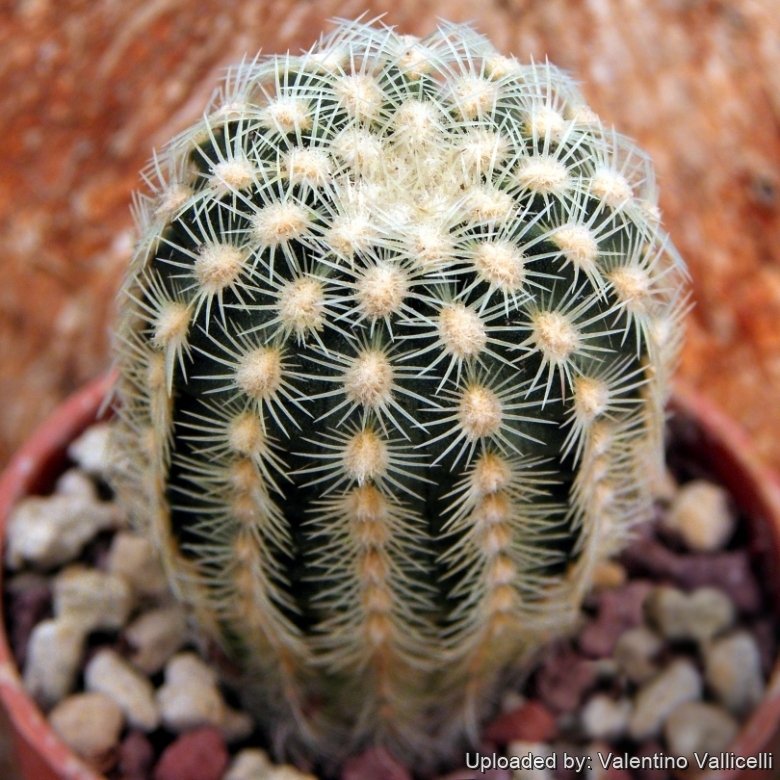
Echinocereus carmenensis (a.k.a. chocolate-scented hedgehog) is one of the innumerable local form of the very variable Echinocereus viridiflorus that distinguishes for the stocky body covered by tight yellowish pectinate spines and for its very peculiar chocolate-scented flowers. Some immature seedlings are covered with, white, flexible hairs somewhat like Echinocereus viridiflorus var. neocapillus. The yellowish-white spines are produced only when plants attain an height of 2-3 cm. Bases of older plants often show belt of white wool, with typical spines above. But not all seedlings shows this hairy phase.
Stem: Spherical to shortly cylindrical, but usually more compact than in Echinocereus viridiflorus, erect, pale or yellowish-green.
Areoles: Oval to elongate covered with much white or yellowish wool when young, bare when old except for very small tuft at upper end of areole where flower is produced.
Spines: Partially or mostly obscuring the stem, often crowded, interlocking with spines from other areoles, needle-like, usually all radial, but mature specimens may occasionally produce a single dark reddish-purple central spine 1-1,2 mm long.
Radial spines: 25-30 or more, tightly appressed, evenly radiating around the areoles and more or less pectinate, creamy-white to clear yellowish, glassy, the upper ones thin, shorter and weaker 2-3 mm long, length increases around areole; laterals to 6 mm long, lower ones slightly shorter, straight or slightly curved. All the spines has a bulbous base but usually covered, until they are very old, by the wool of the areoles.
Flowers: Diurnal, with a very unusual chocolate scent, produced on lateral mid stems, but sometime lower, very similar in colour and shape to those of Echinocereus viridiflorus var. chloranthus, funnelform, not opening widely, 25-32 mm long, 15-25 mm in diameter, yellowish green to bronze-green. Filaments pale yellow or greenish. Anthers cream coloured or yellow. Stile greenish with 8-10 dark green stigma lobes.
Origin and Habitat
La Cuesta, passo Sierra del Carmem, Coahuila, Mexico
Habitat: It grows on red soil in a warm to hot and dry climate.
Cultivation and Propagation
In culture it is without problems and regularly shows its small greenish flowers if we provide an adequate winter rest period. They are re small plants with scented flowers that are better close to nose level. Displaying your cacti on shelves has the added benefit of keeping them off the ground and away from potential rodent or snail damage.
Soil: Use mineral well-permeable substratum with little organic matter (peat, humus).
Repotting: Repotting every 2-3 years. It will need a pot with sufficient depth to allow the tap root. As it is especially prone to rot under-pot in a smaller container filled with very porous compost. Use pot with good drainage.
Watering: Water sparingly from March till October, and keep perfectly dry in winter, at temperatures from 5 to 15 degrees centigrade. In the rest period no high atmospheric humidity!!Care must be taken with watering as they tends to become swollen and untidy in growth habit if given too much water and shade.
Exposition: Outside bright sun, filtered sunlight or afternoon shade, inside it needs bright light, and some direct sun. Subject to sunburn if exposed to direct sun for too long. Tends to bronze in strong light, which encourages flowering and heavy spine production.
Hardiness: Keep drier and cool in winter. Very cold resistant hardy to -10° C or less for short periods of time.
Fertilization: During the growing season enrich the soil using a fertilizer rich in potassium and phosphorous, but poor in nitrogen, because this chemical element doesn’t help the development of succulent plants, making them too soft and full of water.
Pests & diseases: It may be attractive to a variety of insects, but plants in good condition should be nearly pest-free, particularly if they are grown in a mineral potting-mix, with good exposure and ventilation. Nonetheless, there are several pests to watch for:
- Red spiders: Sensitive to red spider mite. Overhead watering is helpful in controlling mites.
- Mealy bugs: Occasionally mealy bugs they develop aerial into the new growth among the wool with disfiguring results, but the worst types develop underground on the roots and are invisible except by their effects.
- Scales: Scales are rarely a problem.
- Rot: Rot it is only a minor problem with cacti if the plants are watered and “aired” correctly. If they are not, fungicides won’t help all that much.
Propagation: Seeds or cutting (if available). Seeds germinate in 7-14 days at 21-27° C in spring, remove the glass cover gradually as the plants develops and keep ventilated, no full sun for young plants! The seedlings should not be disturbed until they are well rooted, after which they can be planted separately in small pots.
Source: Echinocereus carmenensis, LLIFLE - Encyclopedia of living forms, CC-BY-SA, retrieved 2026-10-25.
Gallery