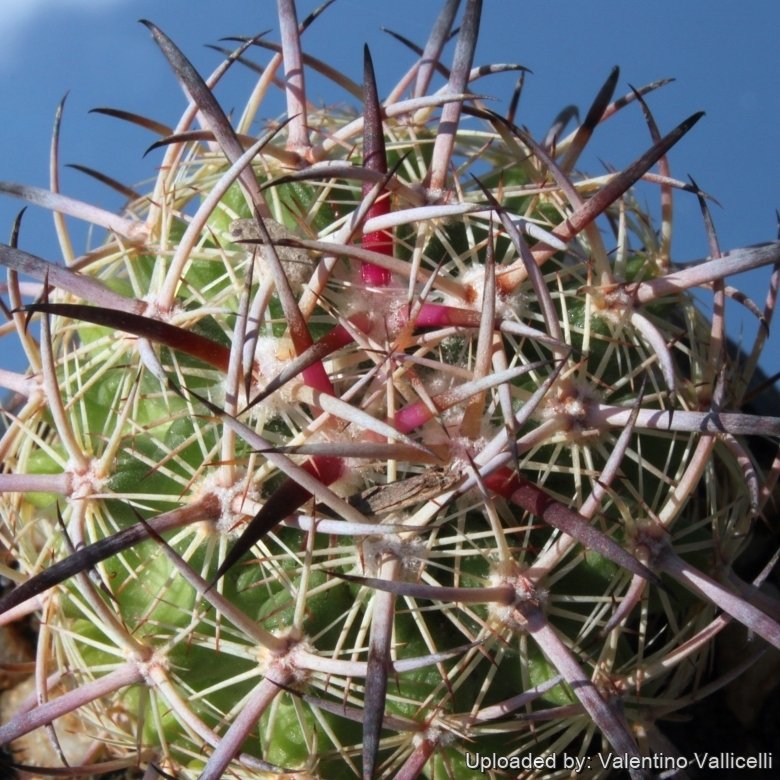
Publication: Guía Identif. Cact. Amenazadas México 1: Echinom/un ssp. laui (1998 publ. 1997)
Description
Echinomastus unguispinus subs. laui , better known as Echinomastus laui is one of the geographical or morphological forms of Echinomastus unguispinus. Many of its geographical variant was early classified as different independent species, but nowadays all this plant are considered part of a multiform species, where each form is linked to others by populations of plants with intermediate characteristics. E. unguispinus subs. Laui does not appear to differ from typical E. unguispinus in any significant respect apart its heavier central spines and occupies the southernmost regione of the distribution range of the species.
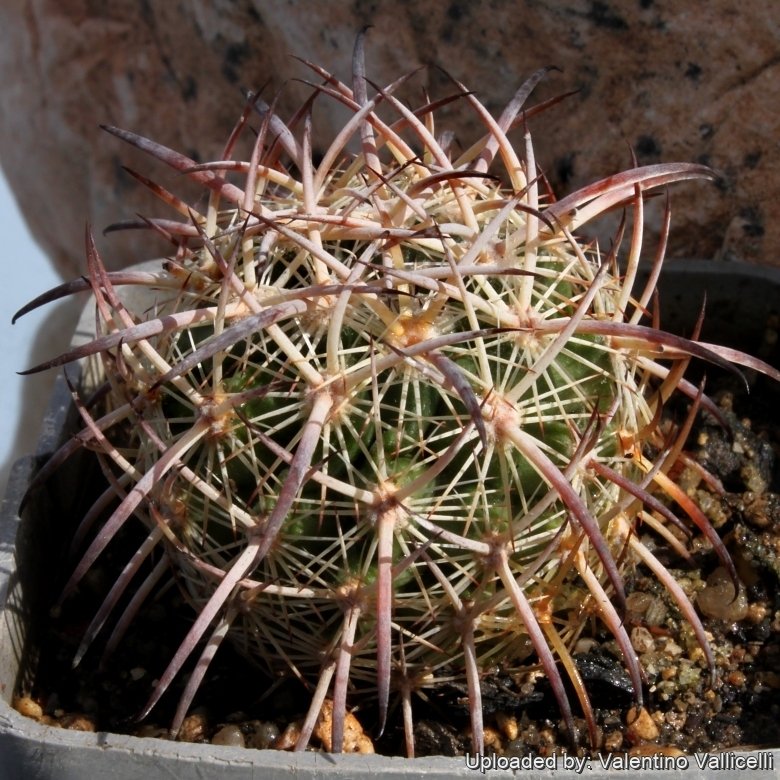
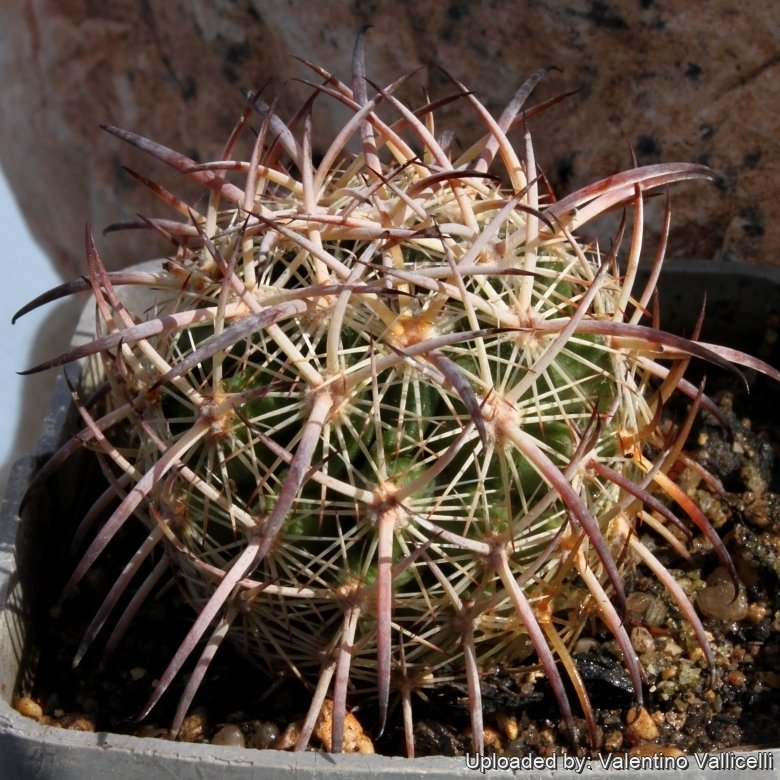
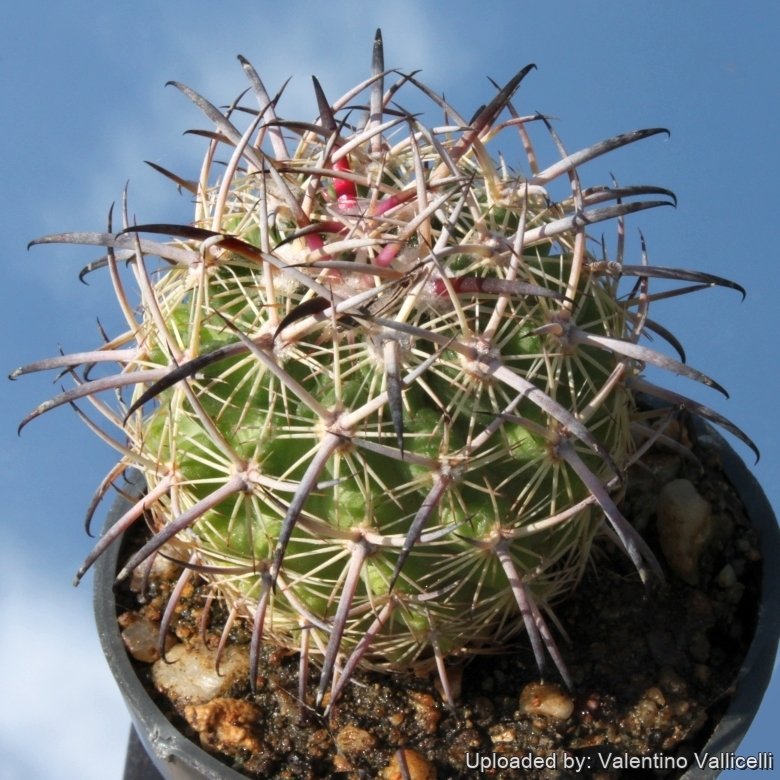
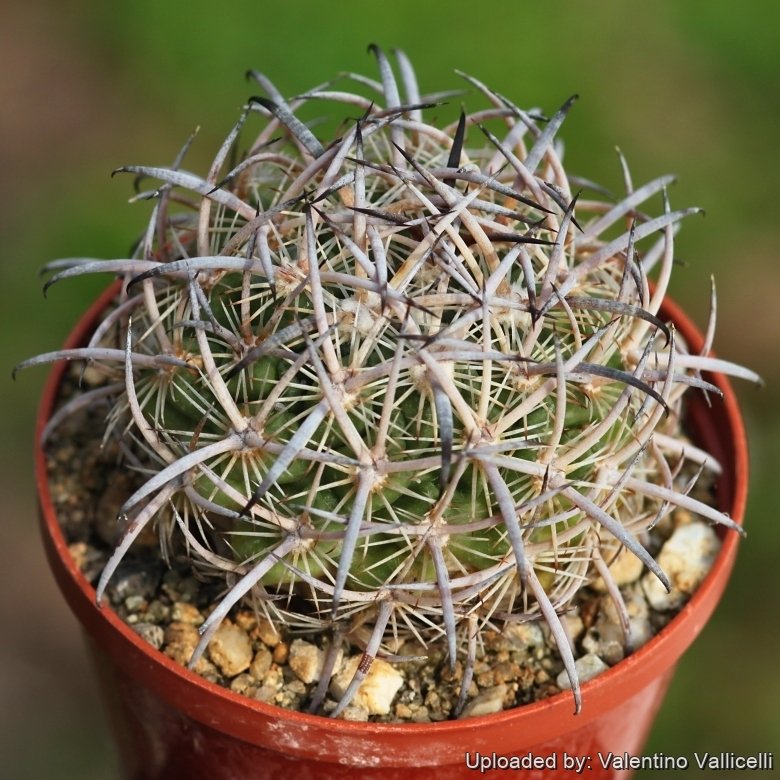
Habit: Plants solitary with spines almost hiding the body.
Stem: Globular with a slightly flattened apex to short cylindrical 7-14 cm tall, 7-15 cm in diameter, gray-green or bluish green.
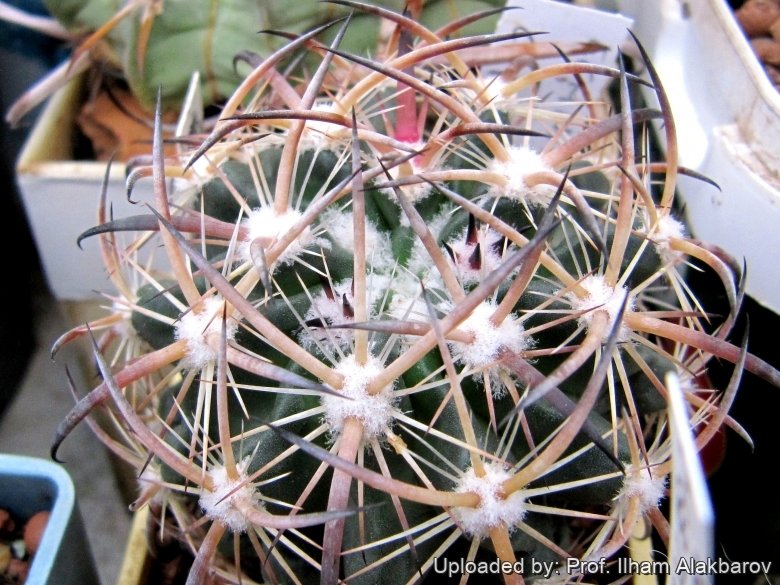
Ribs: 13-21(-25) strongly tuberculate.
Areoles: Slightly elongated without (or with very reduced) nectar glands.
Radial spines:15-30 white to yellowish to blue-gray with black apex, becoming gray with age, 15-33 mm long irregularly spreading, some interlacing.
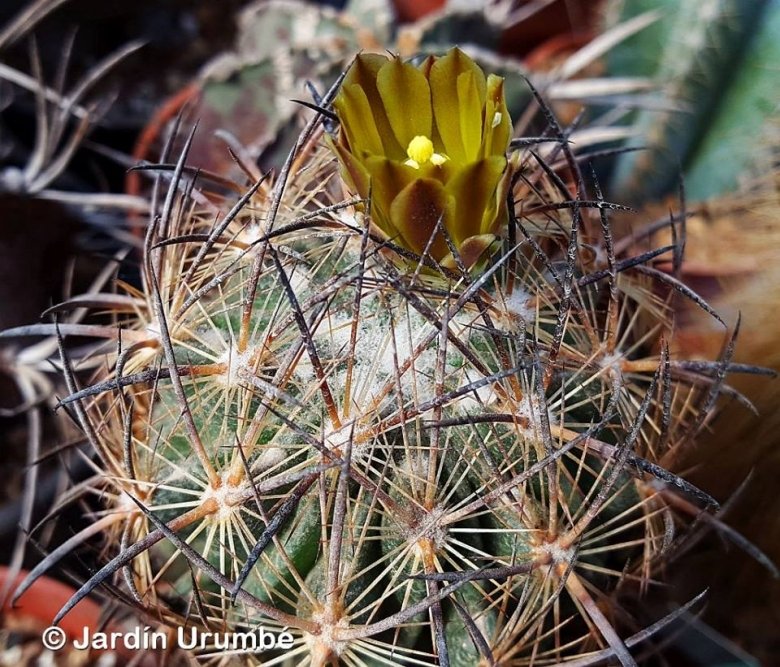
Central spines: 3-9 (usually 4), stronger than in typical Echinomastus unguispinus, acicular, white, pale yellow to brownish but with brown to black tips, the upper side is always darker than the bottom side, straight to curved, up to 35 mm long, directed upwards, lower one robust, noticeably down-curved from near the base pointing outward and downward.
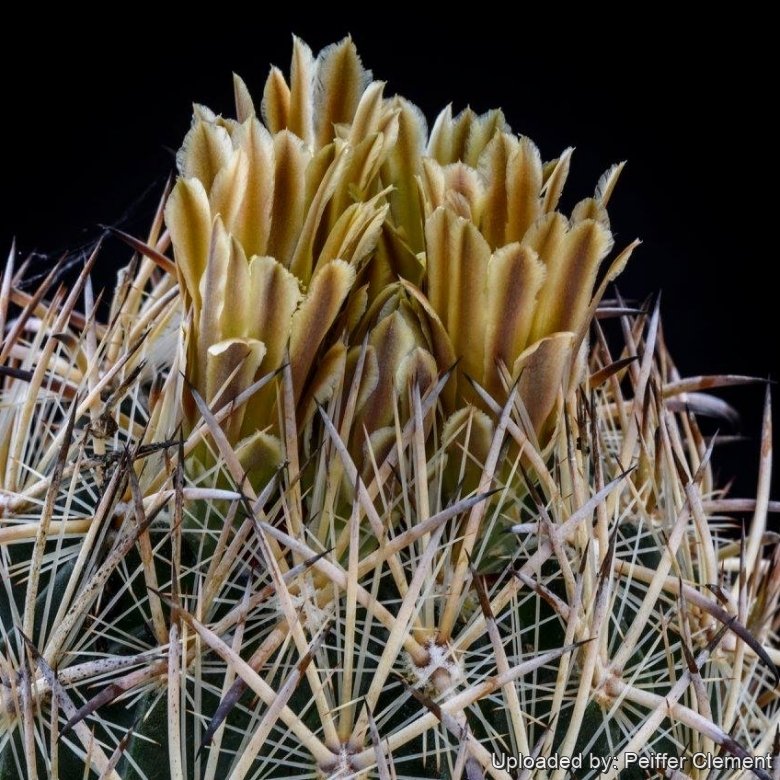
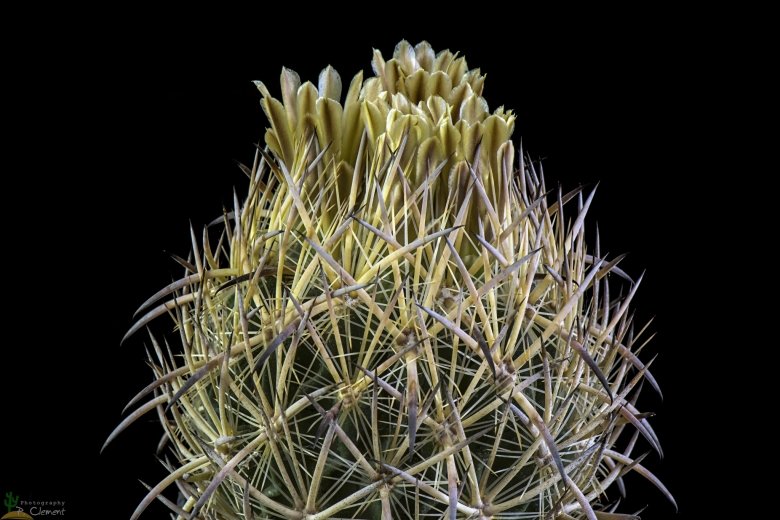
Flowers: Hardly gettig through the dense apical spines, funnelform, dirty yellowish-green but darkening as they ripen getting from green to reddish-brown, remaining erect up to 2.5 cm in diameter.
Origin and Habitat
Salinas, San Luis Potosi, Mexico.
Altitude: 1800-2000 metres above sea level.
Habitat: Grows together with Echinofossulocactus zacatecasensis.
Cultivation and Propagation
This is one of the most beautiful cacti but rarely seen in cultivation, it needs perfect drainage to flourish. It is quite difficult to grow on its own roots. Very easily rot! It’s thought that’s better to watch this species in photo or in the natural habitat rather than to try to cultivate it. For this reasons the plant is often grafted on a frost hardy stock.
Soil: Give an open soil that drains fast, and avoid mixtures containing peat or any other form of sphagnum moss.
Exposure: This plant need full sun and above all a very good ventilation, especially in winter.
Water requirements: Keep totally dry during winter, and in summertime make sure that the soil dries enough between waterings. It can tolerate temperature below zero (-5° C or less).
Remarks: Mature individuals - if the growing conditions are not optimal, easily rot and die.
Propagation: Seeds are relatively difficult to germinate (only a limited percentage of seeds germinate). Moreover it is easy for the seed to get lost behind the spines, which are stiff enough that when you try to retrieve them you just might loose them altogether. Grafting is often used to speed growth rate and to create a back-up for plants in collection.
Bibliography
Major references and further lectures
-
Edward Anderson “The Cactus family” Timber Press, Incorporated, 2001
-
James Cullen, Sabina G. Knees, H. Suzanne Cubey “The European Garden Flora Flowering Plants: A Manual for the Identification of Plants Cultivated in Europe, Both Out-of-Doors and Under Glass” Cambridge University Press, 11/Aug/2011
-
David R Hunt; Nigel P Taylor; Graham Charles; International Cactaceae Systematics Group. “The New Cactus Lexicon” dh books, 2006
-
Krainz, Hans et al. “Die Kakteen” 1956-1975
-
Hiroshi Hirao “Colour encyclopaedia of cacti” Seibundo Shinkosha, 1979
-
Gómez-Hinostrosa, C. & Hernández, H.M. 2013. Sclerocactus unguispinus. In: IUCN 2013. “IUCN Red List of Threatened Species.” Version 2013.2. <www.iucnredlist.org>. Downloaded on 06 April 2014.
Gallery