Publication: Anales Mus. Nac. Buenos Aires ser. 3, 4: 492. 1905
Description
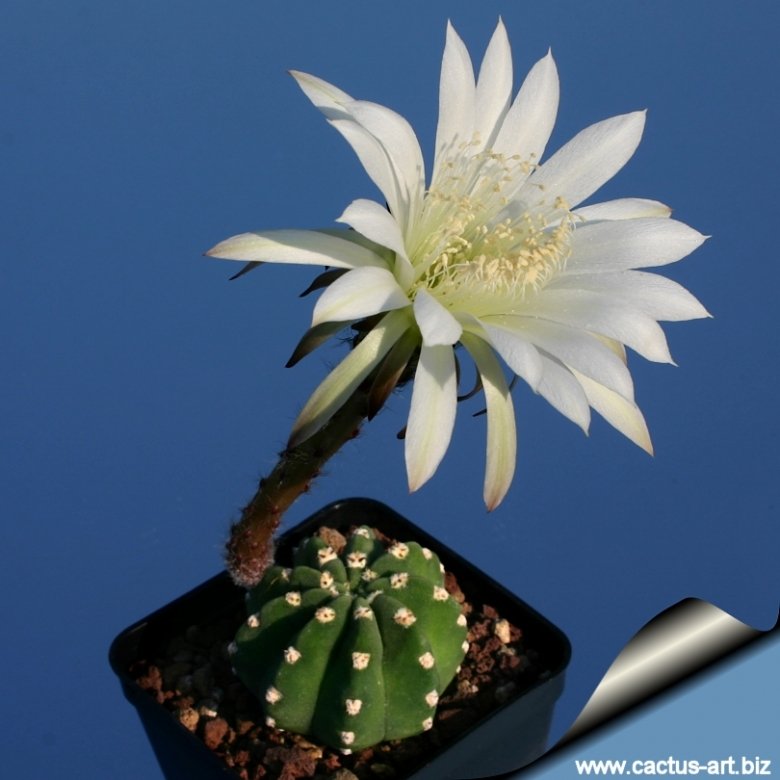
Echinopsis ancistrophora is a striking Andean hookspined cactus of wide distribution showing extreme variation in flower colour and zize, with corolla lengths varying between 4.5 and 24 cm, and colour varying from white to dark-red. It is both solitary or forming clumps. Four subspecies are recognized, the nominate form subs. arachnacantha, subsp. cardenasiana and subs. pojoensis.
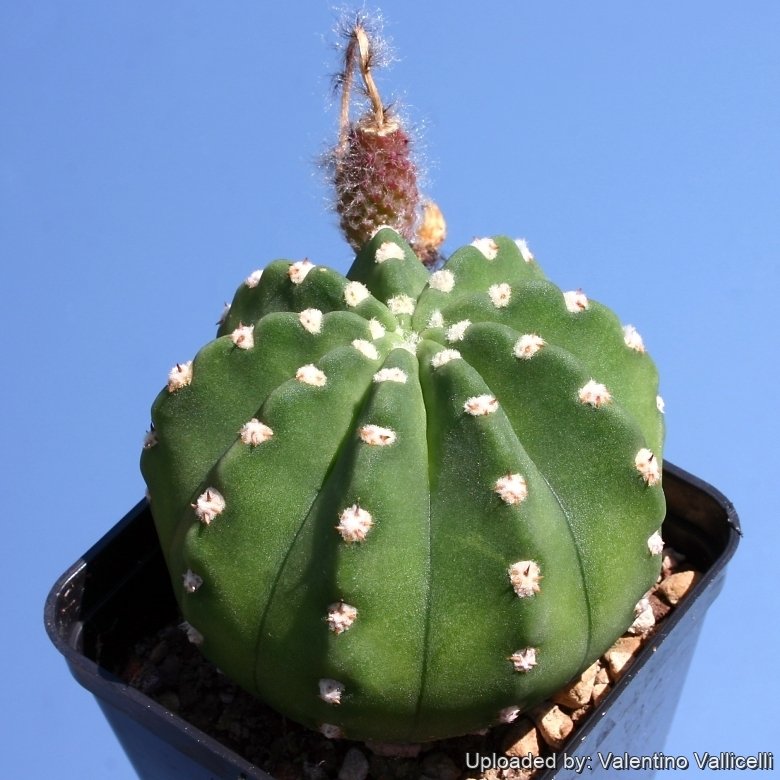
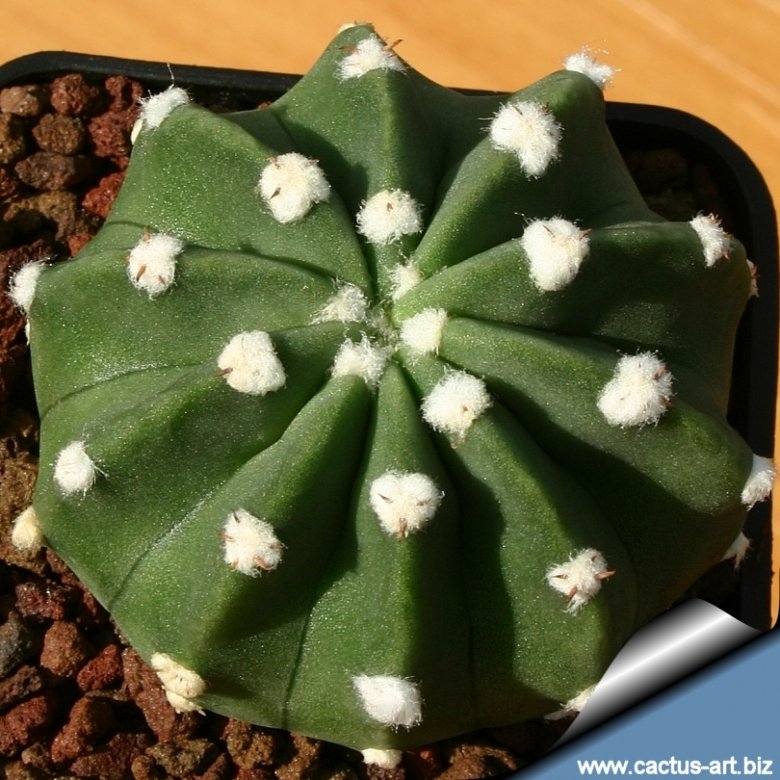
Stem: Simple, subglobose, depressed, 5 to 8 cm in diameter, shining dark green.
Ribs: 15-16(-20), stout, 1 cm high, broad at base, somewhat crenate, divided into many small tubercles.
Radial spines: 3 to 7(-10), whitish, slender, flexible, spreading backward, 5 to 15 mm long.
Central spine: Solitary, rarely as many as 4, sometimes absent, more or less curved or hooked, 1 to 2 cm long light brown.
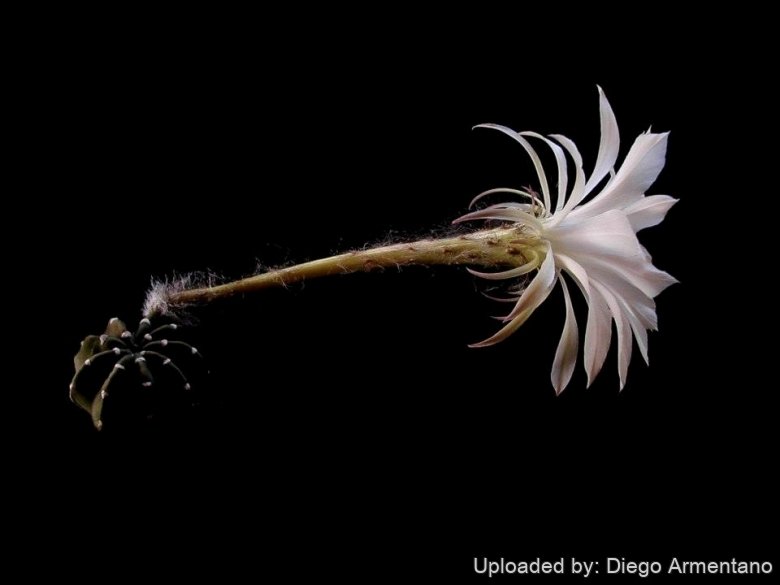
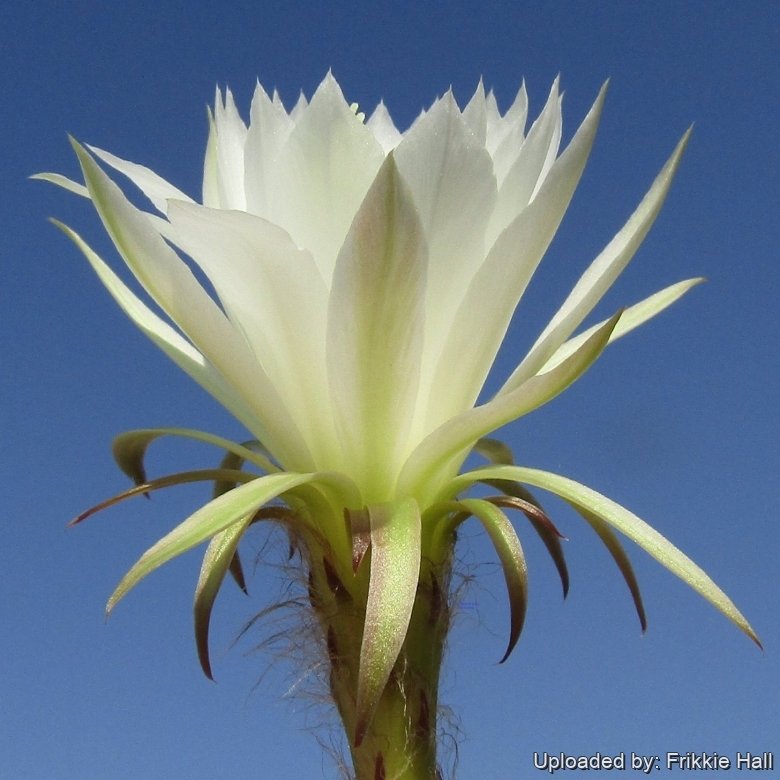
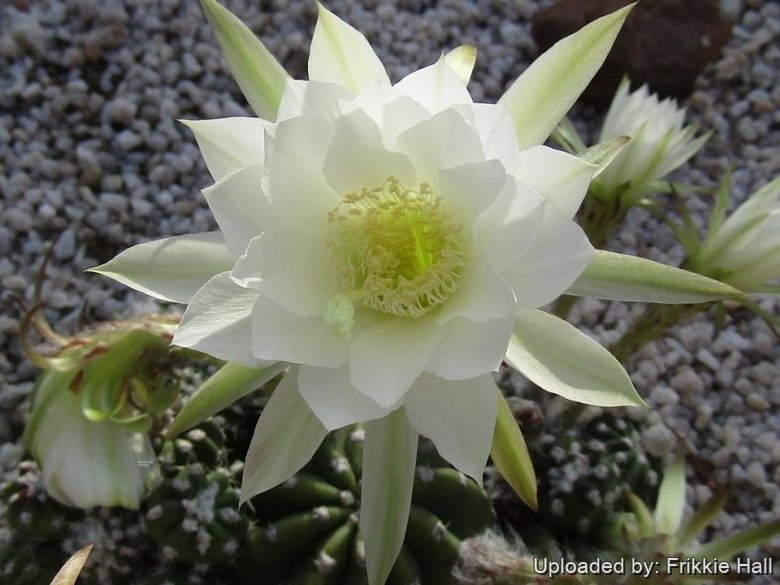
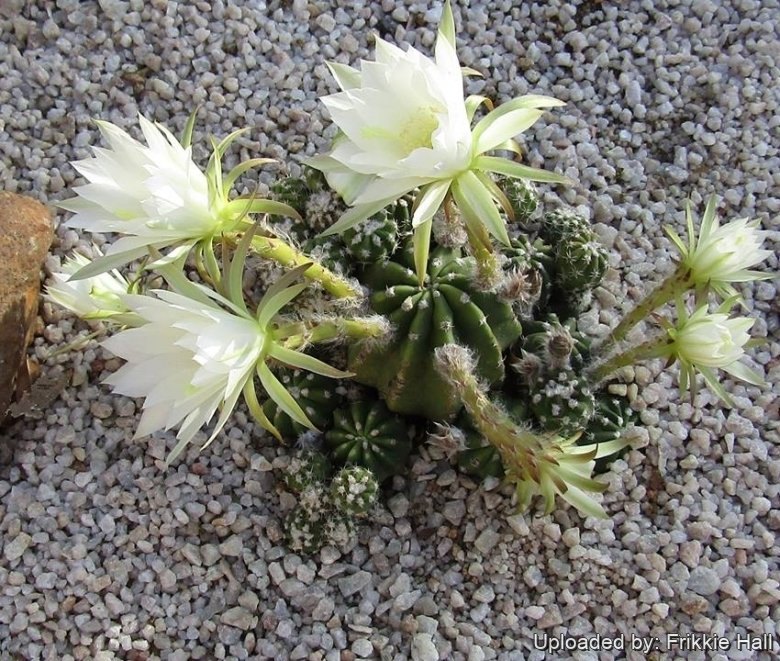
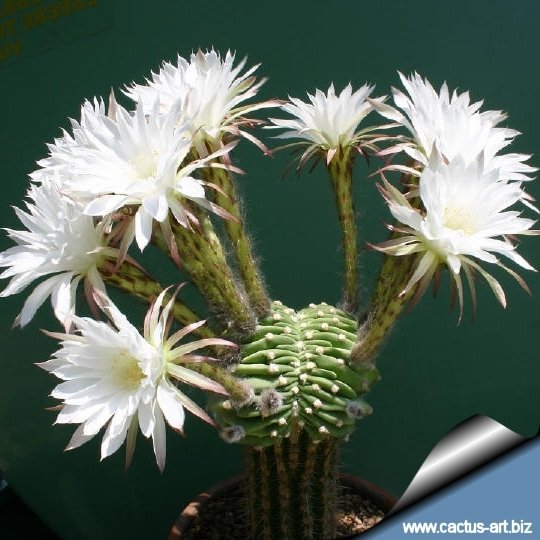
Flowers: Inodorous, borne laterally, open during the day, usually white or tinged pink outside, but also pink to deep red, (4-)12 to 16(-24) cm long. Floral tubes slender. Outer perianth-segments greenish, linear, acuminate. Inner perianth-segments multi-coluored, oblong, acute. Scales of pericarpel and tube with axillary hairs. The shortest flowed forms usually have morning anthesis and low nectar production while the longer flowered forms open at dusk with prolific nectar. Sphingid moths are prevalent only in the populations with the longest corollas, and all other populations are mainly pollinated by solitary bees.
Fruit: Ellipsoid, dirty green to greenish purple, somewhat dry, 16 mm long, 8 mm in diameter. Scales on ovary and flower-tube small, their axils lanate.
Seeds: Spherical to ellipsoid, slightly constricted above the hilum, black, whit no aril.
Origin and Habitat
Western Argentina (Jujuy, Salta and Tucumán) and southern Bolivia (Tarija and Chuquisaca).
Type locality: Between Tucuman and Salta, Argentina.
Altitude range: It grows at elevations of 600 to 2,500 metres above sea level.
Habitat and Ecology: This species grows in many habitat types, such as grasslands, shrublands, and forests. This species is locally but has a patchy distribution. Field observations indicate that the populations are steadily declining due to expanding agriculture, urbanization and extraction for ornamental use.
Cultivation and Propagation
Echinopsis ancistrophora is a good beginner cactus and very easy to grow and flower. It is quite resistant and occasionally gets covered by bright showy yellow blossoms also neglected in a dry windowsill. Requires good drainage and very porous potting mix. Watering Needs Need regular water in spring to fall but do not water again until dry. Also, it is a species that is dormant in the winter and require very little water (maybe even none) during the cold months.
Frost Tolerance: Light frost protection required. Minimum of 5ºC for safe growing (but hardy up to -5°C or less) but some clones are hardy to lower temperatures. Requires to be kept below 7°C in winter to flower well in the spring.
Sun Exposure: Requires bright light (protect from strong midday sun). In shade the body colour will remain mostly green, while full sun will darken it and give it red/brown body colour. Can be sunburned if moved from shade/greenhouse into full sun too quickly. The amount of sunlight it can withstand without scorching depends upon the how hot it becomes in the summer in the locale in which it is planted. It will have more colour if it receives more light. During the spring it may be able to take full sun until the heat arrives at the end of spring. In an area that has hot afternoon sun, it may be able to take full morning sun, but requires afternoon shade or afternoon light shade.
Propagation: Seeds or offsets that appear at the base; leave them attached to form a cluster, or wait until they are 1/3 the size of the parent and then detach and plant.
Bibliography
Major references and further lectures.
-
Nathaniel Lord Britton, Joseph Nelson Rose “Cactaceae: Descriptions and Illustrations of Plants of the Cactus Family” vol. 1 The Carnegie Institution of Washington, Washington 1919
-
Edward Anderson “The Cactus family” Timber Press, Incorporated, 2001
-
James Cullen, Sabina G. Knees, H. Suzanne Cubey “The European Garden Flora Flowering Plants: A Manual for the Identification of Plants Cultivated in Europe, Both Out-of-Doors and Under Glass” Cambridge University Press, 11/Aug/2011
-
David R Hunt; Nigel P Taylor; Graham Charles; International Cactaceae Systematics Group. “The New Cactus Lexicon” dh books, 2006
-
Urs Eggli, Leonard E. Newton: “Etymological Dictionary of Succulent Plant Names” Birkhäuser 2004
-
Ortega-Baes, P. & Lowry, M. 2013. Echinopsis ancistrophora. The IUCN Red List of Threatened Species. Version 2014.2. <www.iucnredlist.org>. Downloaded on 03 August 2014.
-
E Haustein “Der Kosmos Kakteenfuehrer (the Kosmos Cactus Guide)” Balogh Scientific Books 01 December 1998
-
Pat Willmer “Pollination and Floral Ecology” Princeton University Press, 05/Jul/2011
-
Walter Rausch “Lobivia: The Day Flowering Echinopsidinae from a Geographical Distribution Point of View”, Volumes 1-3 R. Herzig, 1975
-
Willy Cullmann, Erich Götz (Dozent Dr.), Gerhard Gröner “The encyclopedia of cacti” Timber Press, 1987
-
John Pilbeam “Cacti for the Connoisseur: A Guide for Growers & Collectors” Timber Press, 01/Jul/1987
-
Carlos Luis Spegazzini “Cactacearum Platensium Tentamen.” In: Anales del Museo Nacional de Buenos Aires. 3(4): 492–493 1905
-
Martin Lowry: “Echinopsis.” In: Cactaceae Systematics Initiatives. 13: 16–17 2002
-
Succulenta.37,1956
-
Walter Rausch: Kakteen und andere Sukkulenten. 23(2): 32.1972
-
Heimo Friedrich: Kakteen und andere Sukkulenten. 25(4) 82. 1974
-
Urs Eggli, Leonard E. Newton: “Etymological Dictionary of Succulent Plant Names.” Springer, Berlin/Heidelberg 2010
-
Zuloaga, F. O., O. N. Morrone, M. J. Belgrano, C. Marticorena & E. Marchesi: Monogr. Syst. Bot. Missouri Bot. Gard. 107: 3 Vols., 3348 p. 2008.
From llifle page Echinopsis subdenudata
Description
Echinopsis subdenudata is a globular, almost spineless or with very short cream spines that produces splendid night-blooming, white fragrant flowers up to 22 cm long. It is generally included within (as a synonym of) Echinopsis ancistrophora, suggesting that there is not really a fundamental difference between the two. The key difference by which this species was separated, namely: its much shorter spines (less than 2 mm long) almost concealed among the felt of the areoles appears to fall within the natural variation of Echinopsis ancistrophora and it should be synonymized with the latter. It is at most a race of Echinopsis ancistrophora, but it still has a value for a collector because they identify plants with particular characters.
Stem: Solitary or offsetting from near the base, globose, grey-green, depressed apically, 5-8 cm tall, 7-12 cm in diameter (often elongate and up to 30 cm high in cultivation)
Ribs: 8 to 12, very acute, slightly notched.
Areoles: Small, cream coloured, transversely elliptical, to 1.5 cm apart.
Spines:Almost spineless or with very short cream or greyish brown spines, often hidden by areolar wool. Central spine one, directed upward, to 2 mm long. Radial spines 3-7, swollen
basally, to 1.5 mm long.
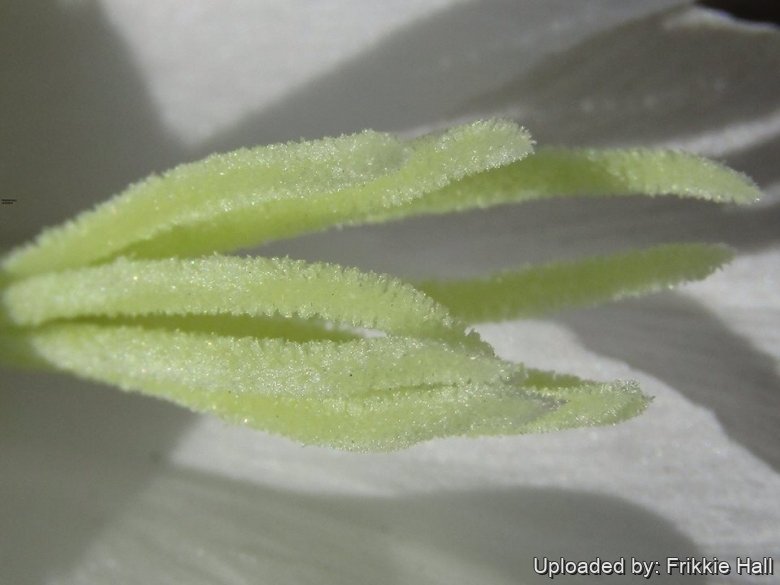
Flowers: These cacti produce gorgeous, night-blooming flowers borne near the stem tips. They are fragrant, white (or very light pink), narrow funnel-shaped, with long, slightly curved tubes 15-22 cm long. Old plant may have many flowers at a time.
Blooming season: This species blooms from late spring to all summer long, the flowers open on the morning of the first day and remain opened all the night long but last only one day in full beauty, at the second day they start to wither.
Origin and Habitat
Bolivia (Santa Cruz, Tarija, Chuquisaca) and (maybe) Paraguay.
Altitude: 600-1800 metres above sea level.
Habitat: This species grows in many habitat types, such as grasslands, shrublands, and forests. The major threats to this species are urbanization, agriculture and extraction for ornamental use.
Cultivation and Propagation
The Easter Lily cactus is a summer grower species that offers no cultivation difficulties. Water regularly in summer (but do not overwater ) needs good drainage and very porous soil, keep rather dry in winter. Feed with a high potassium fertilizer in summer. It is quite frost resistant if kept dry (hardy to -7° C). Need a bright exposure, full sun or half shade in summer.
Propagation: Direct sow after last frost, offsets.
Bibliography
Major references and further lectures
-
David R Hunt; Nigel P Taylor; Graham Charles; International Cactaceae Systematics Group. “The New Cactus Lexicon” dh books, 2006
-
Edward Anderson “The Cactus family” Timber Press, Incorporated, 2001
-
James Cullen, Sabina G. Knees, H. Suzanne Cubey “The European Garden Flora Flowering Plants: A Manual for the Identification of Plants Cultivated in Europe, Both Out-of-Doors and Under Glass” Cambridge University Press, 11/Aug/2011
Source: Echinopsis subdenudata, LLIFLE - Encyclopedia of living forms, CC-BY-SA, retrieved 2026-10-25.
From llifle page Echinopsis subdenudata f. cristata
Description
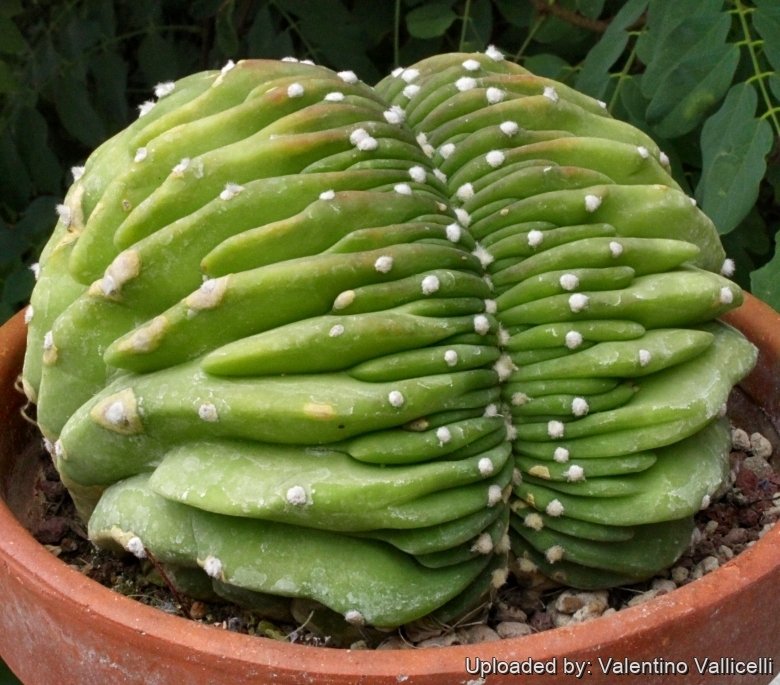
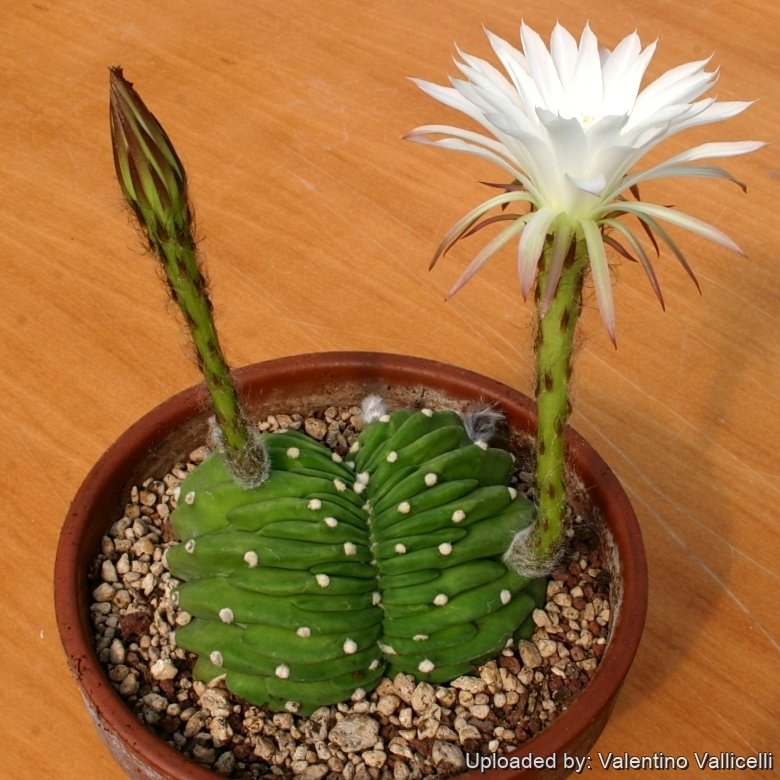
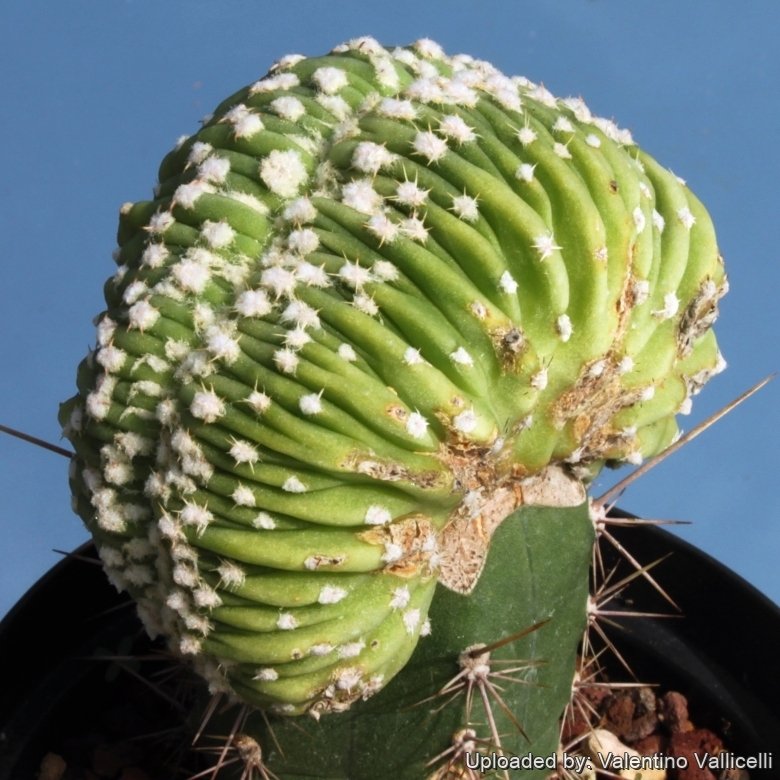
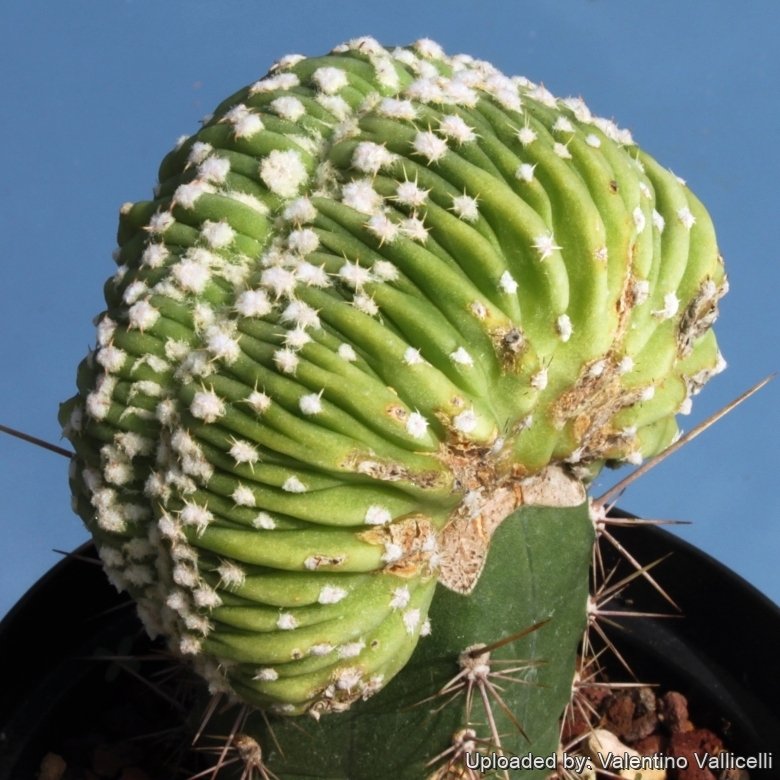
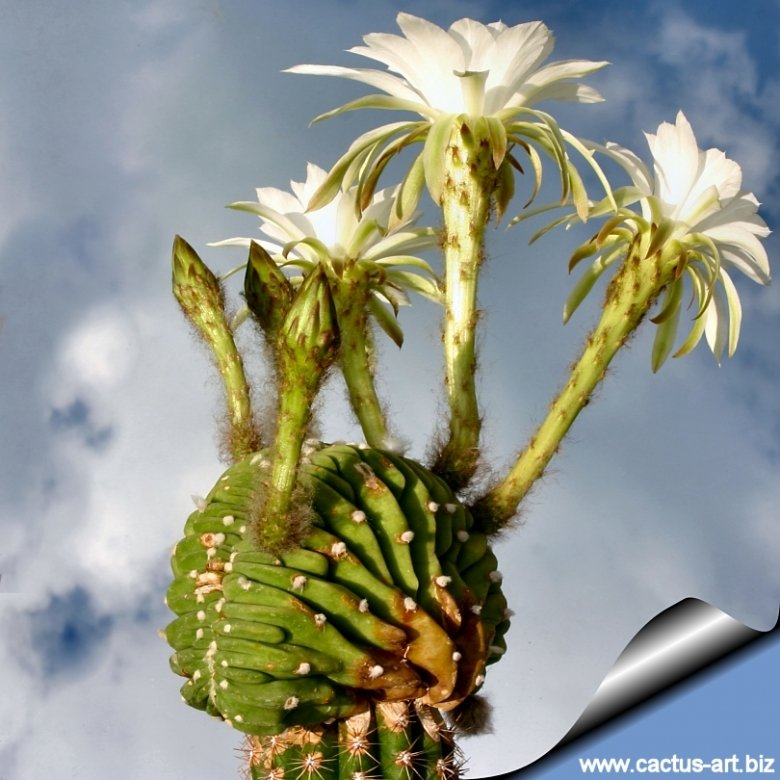
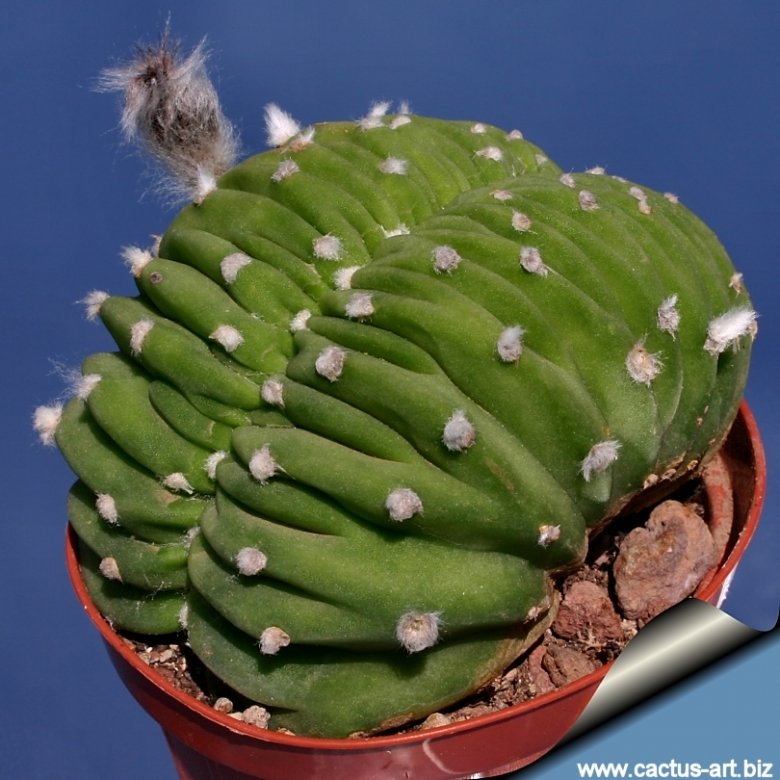
This is a very nice crested Echinopsis, easily recognizable for its almost spineless body.
Stem: Very fat (quite large for a crested plant ( 8 to 20 cm thick) it can form in age a huge convoluted mound.
Spines: absent
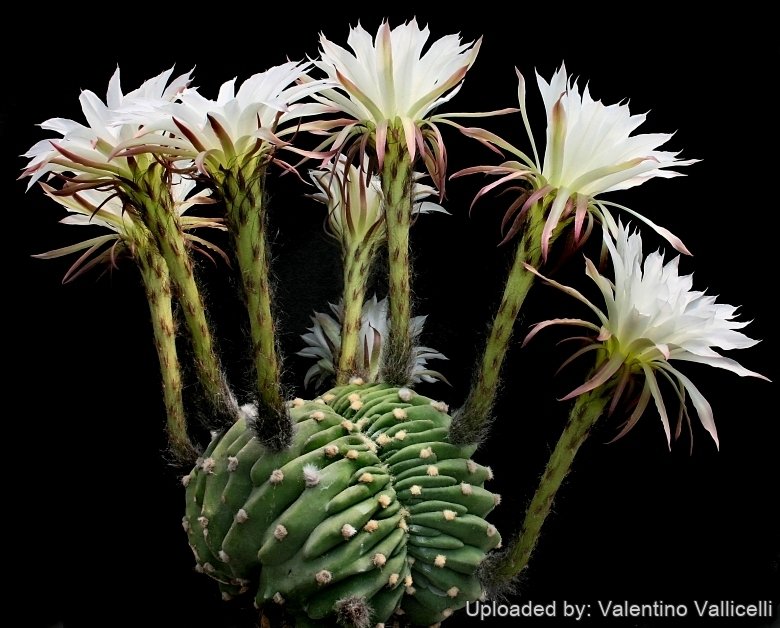
Flowers: These cacti produce gorgeous, night-blooming, white funnel-shaped, fragrant flowers with long tubes 15-22 cm long. Old plant may have many flowers at a time. This species blooms from late spring to all summer long, the flowers open on the morning of the first day and remain opened all the night long but last only one day in full beauty, at the second day they start to wither.
Origin and Habitat
Garden origin (Nursery produced cultivar)
Cultivation and Propagation
The grafted plants are easy to grow and will form a large brain-like mounds with age. Watering during the active growing season (spring and summer); this will encourage steady growth, and prevent the large tubercles from becoming flabby.
The plants on their own roots do well under cultivation. Use very draining soil, water during the aestival growth cycle (They need plenty of water), but need to be avoided wetting the bodies of these plants while they are in sunlight. A wet cactus in the sun light can cause sun burning which can lead to scars or even fungal infections and death.
Need half sun. Keep dry at 10°C in winter, but they can tolerate sporadic light frost.
Propagation: Grafting or stem cutting.
Notes
The cause of cresting: The cause of cresting is not fully explained. Biologists disagree as to why some plants grow in this unusual form. Some speculate that it is a genetic mutation. Others say it is the result of a strike of lightning or freeze damage, but whatever the stimulus, the growth point of the stem has switched from a geometric point, to a line, which folds and undulates as the crest expands. Though these crested Echinocactus subdenudata are very rare, cresting occurs naturally, and can be encountered in many other cactus species.
Source: Echinopsis subdenudata f. cristata, LLIFLE - Encyclopedia of living forms, CC-BY-SA, retrieved 2026-10-25.
From llifle page Echinopsis subdenudata f. cristata aurea
Description
Echinopsis subdenudata f. cristata is a very nice crested Echinopsis, easily recognizable for its almost spineless body.
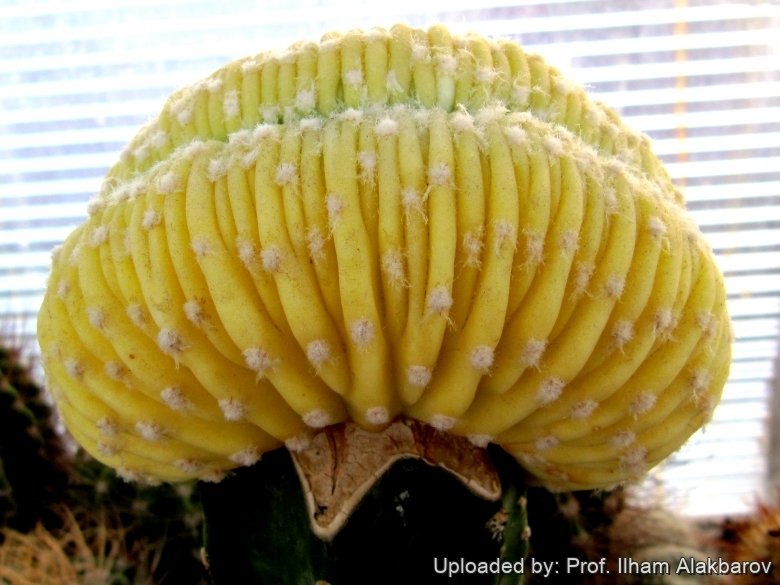
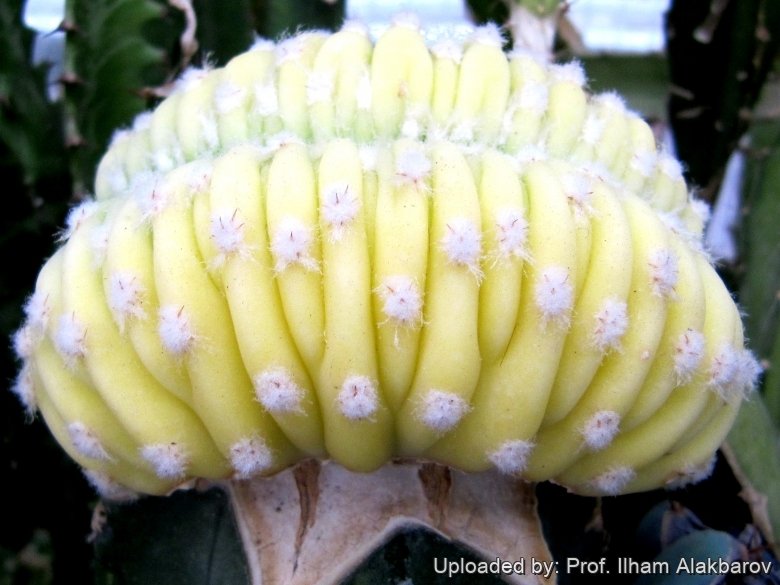
Forma aurea or aurata (yellow form): The schizochromic form (Echinopsis subdenudata f. cristata aurea) has yellow stems due to the absence (or reduced production) of chlorophyll pigments: every other pigment is present at normal levels, the dominant green colouration is lost, but will still more than likely have normal other pigments that give the yellow overall appearance of the stem. This form with yellow stems is very attractive and highly prized. This schizochromic form is almost always seen grafted on stronger columnar species, and cannot can be grown on its own roots.
Stem: Very fat, yellow (quite large for a crested plant ( 8 to 20 cm thick) it can form in age a huge convoluted mound.
Spines: Absent.
Flowers: These cacti produce gorgeous, night-blooming, white funnel-shaped, fragrant flowers with long tubes 15-22 cm long. Old plant may have many flowers at a time. This species blooms from late spring to all summer long, the flowers open on the morning of the first day and remain opened all the night long but last only one day in full beauty, at the second day they start to wither.
Cultivation and Propagation
Variegated and albinos cacti are regarded as choice and difficult in cultivation, but despite that many of them are relatively easy to grow. But be aware that they cannot tolerate prolonged exposure to direct sun light (especially during the hottest summer days), so grow them in half-shade or under filtered sun. They are sometime seen as grafted plants, but many grow well on their own roots, too.
On the contrary, the albinos can survive only if grafted on a strong green base.
Use mineral well-permeable substratum with little organic matter (peat, humus). Water sparingly from March till October and keep perfectly dry in winter at temperatures from 5 to 15 degrees centigrade. (In general these plants are more tender and cannot endure freezing temperatures ) In the rest period no high atmospheric humidity!!
Propagation: Plants are almost always grafted onto column-shaped cacti.
Source: Echinopsis subdenudata f. cristata aurea, LLIFLE - Encyclopedia of living forms, CC-BY-SA, retrieved 2026-10-25.
Cultivars and forms (4)
Gallery