Publication: Neue Kakteen 83, 84, fig. 1931 et: Fedde, Rep. Spec. Nov. 30: 64. 1932
Description
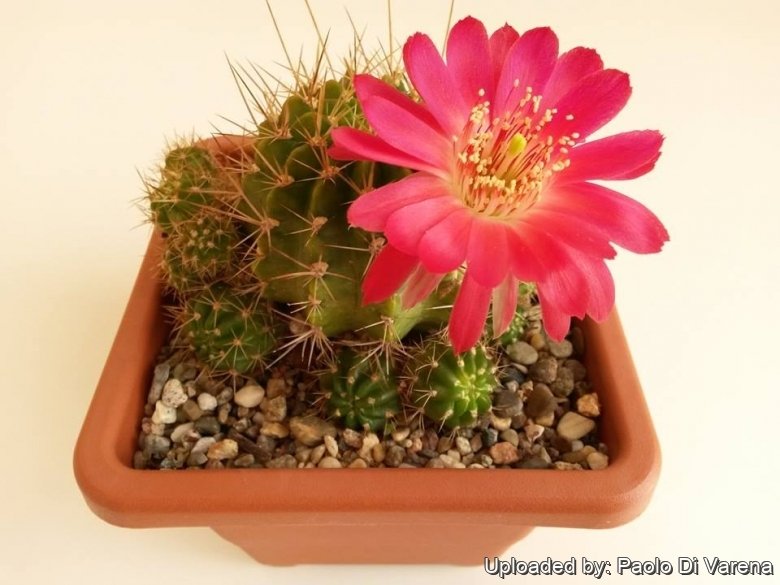
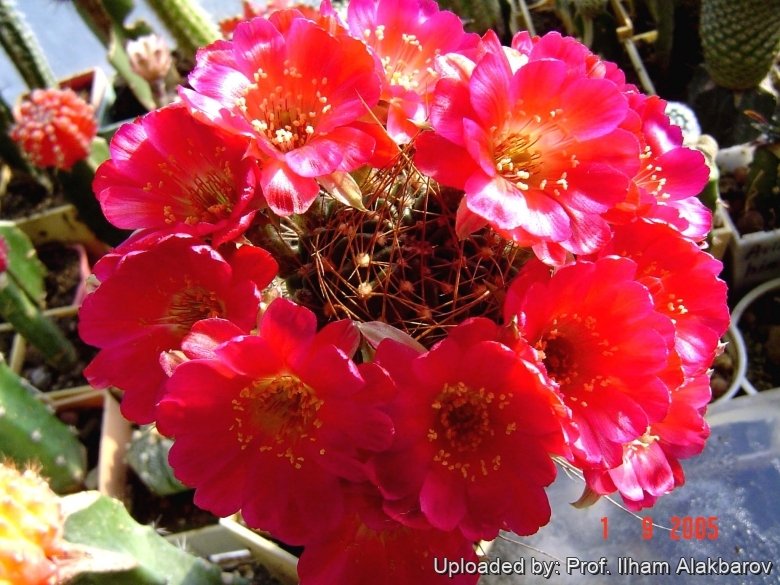
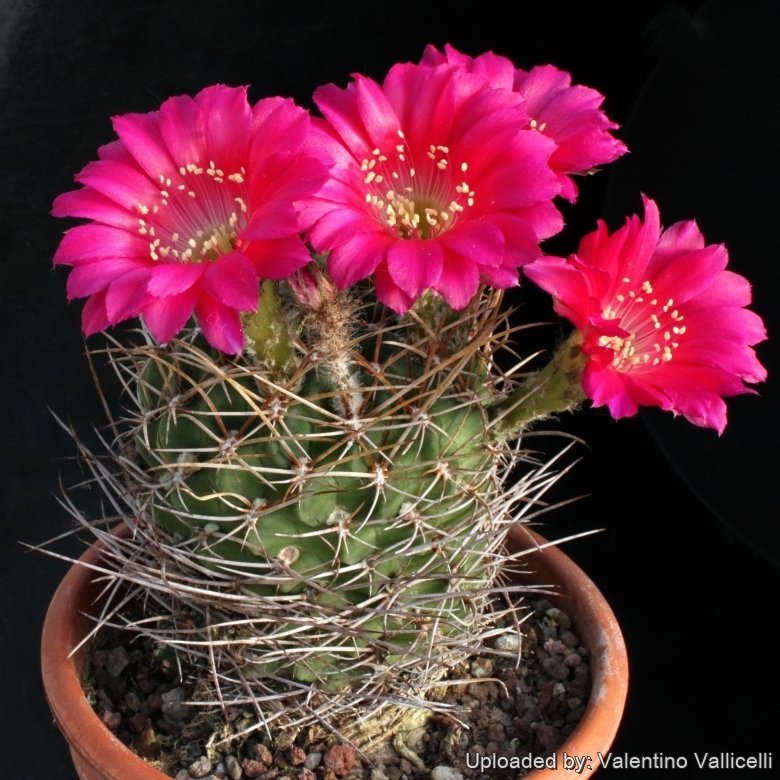
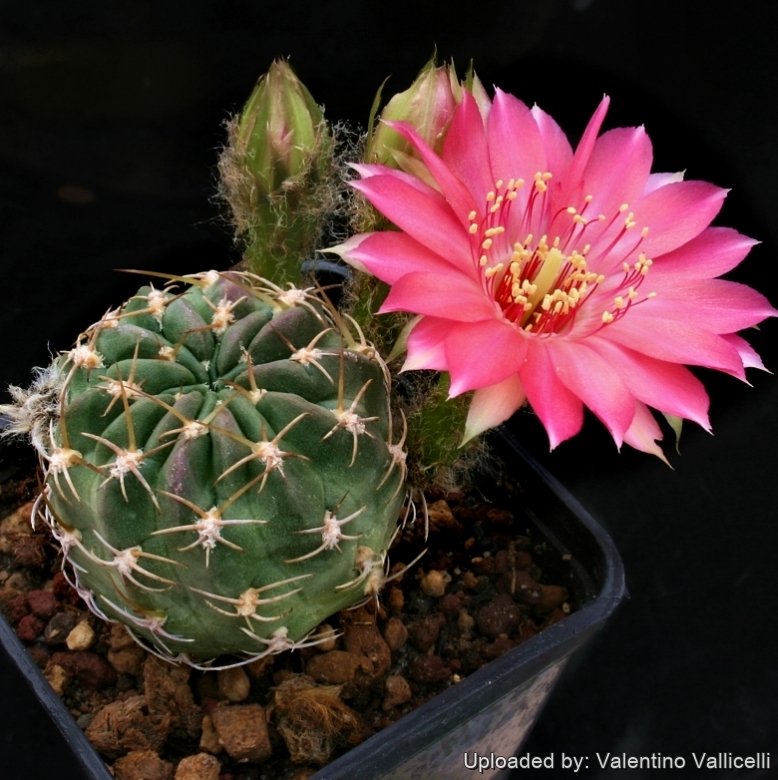
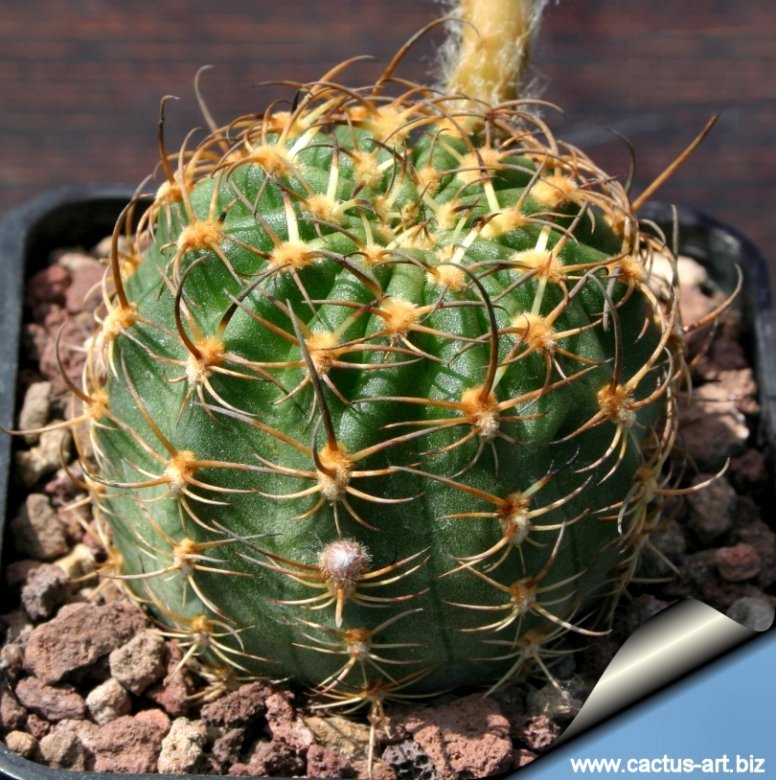
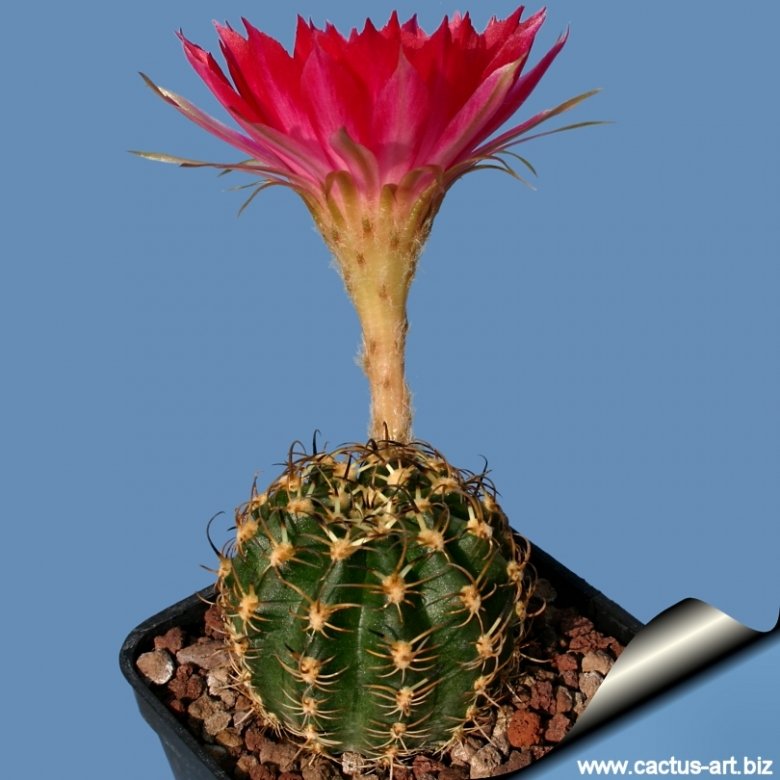
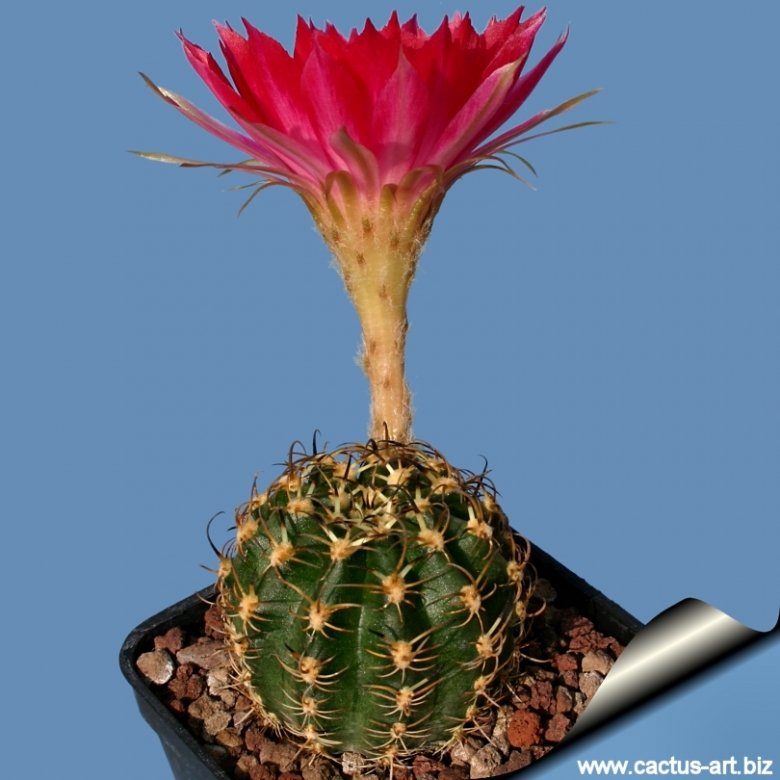
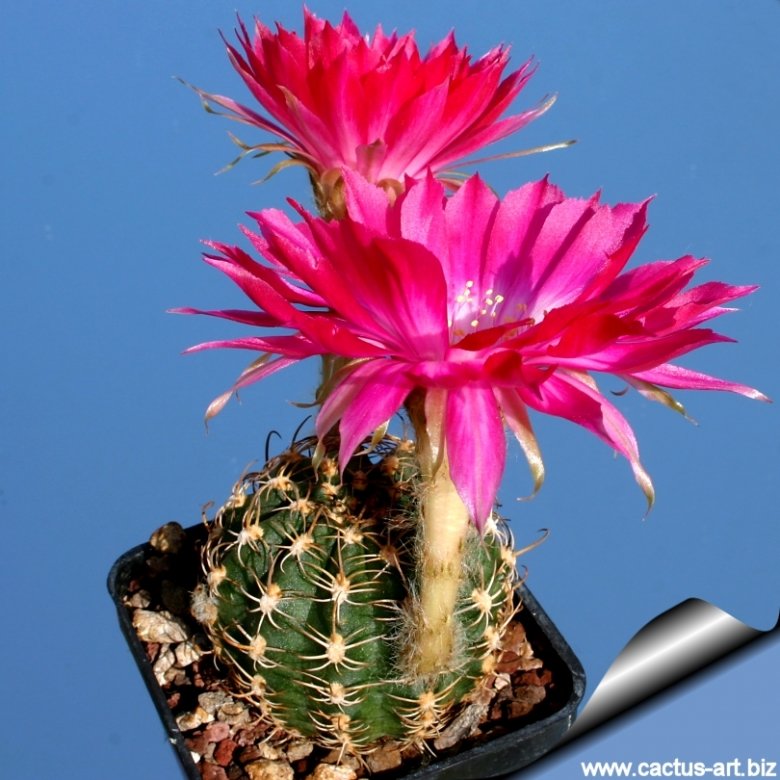
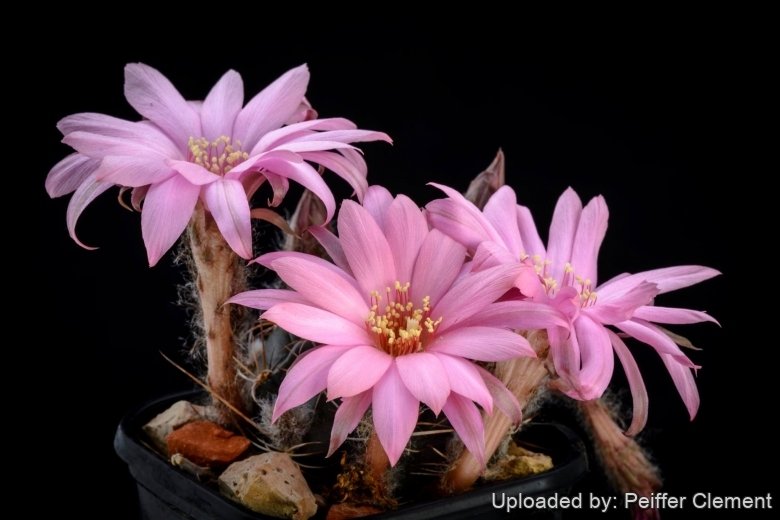
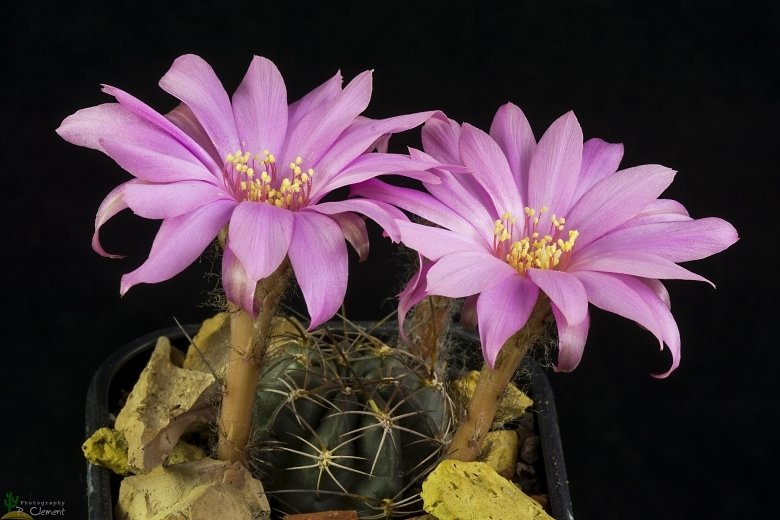
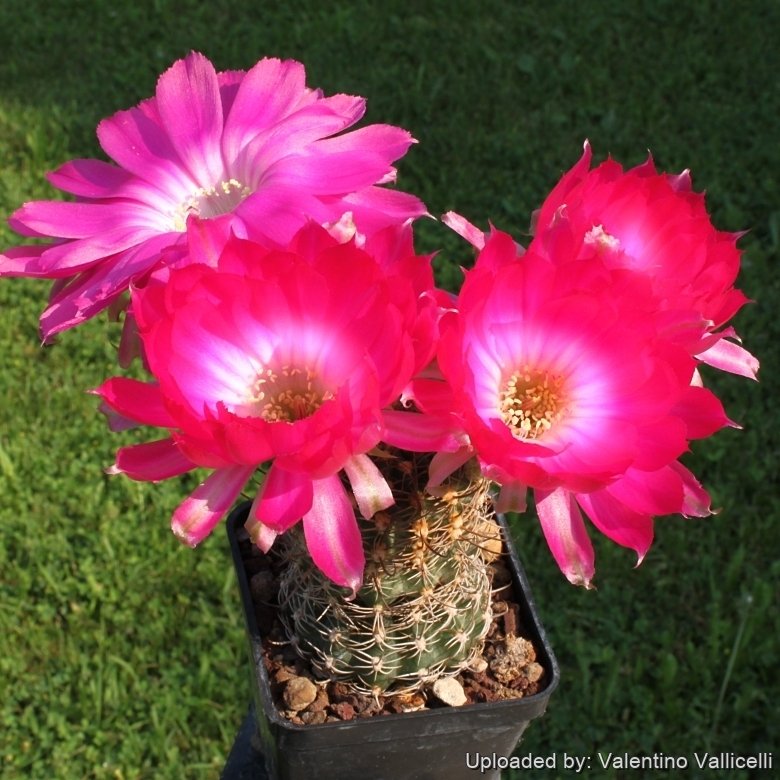
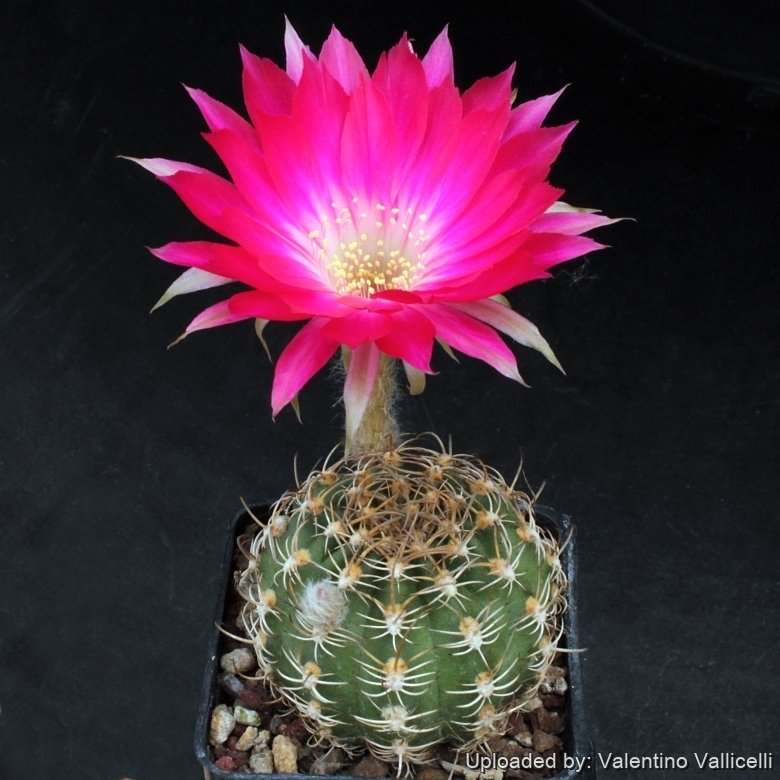
Echinopsis backebergii is a small cactus species, with conspicuous bright coloured blooms. Due to its flower structure typical of the Lobivias it is commonly known as Lobivia backebergii. It is very variable and has received lots of names (like most Lobivias) whit several controversial varieties and subspecies.
Habit: It is a globose perennial stem succulent, that grows individually, but also sprouts abundantly at base, older plants may form mats.
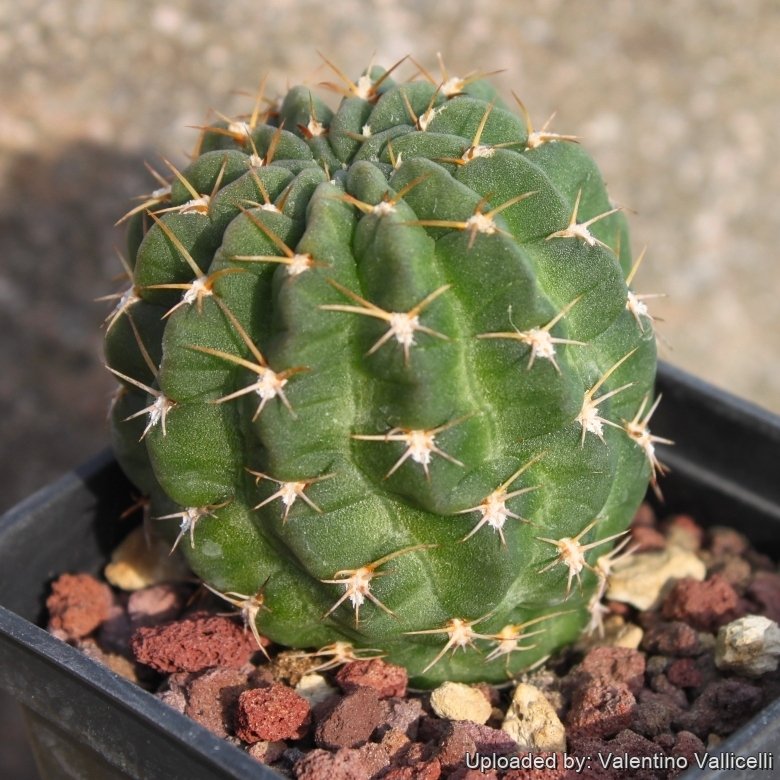
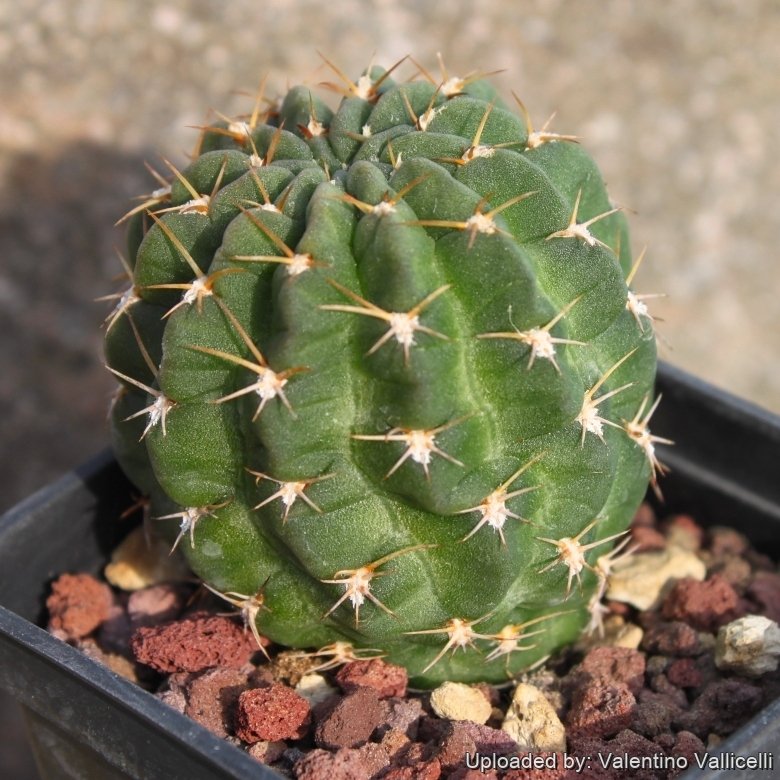
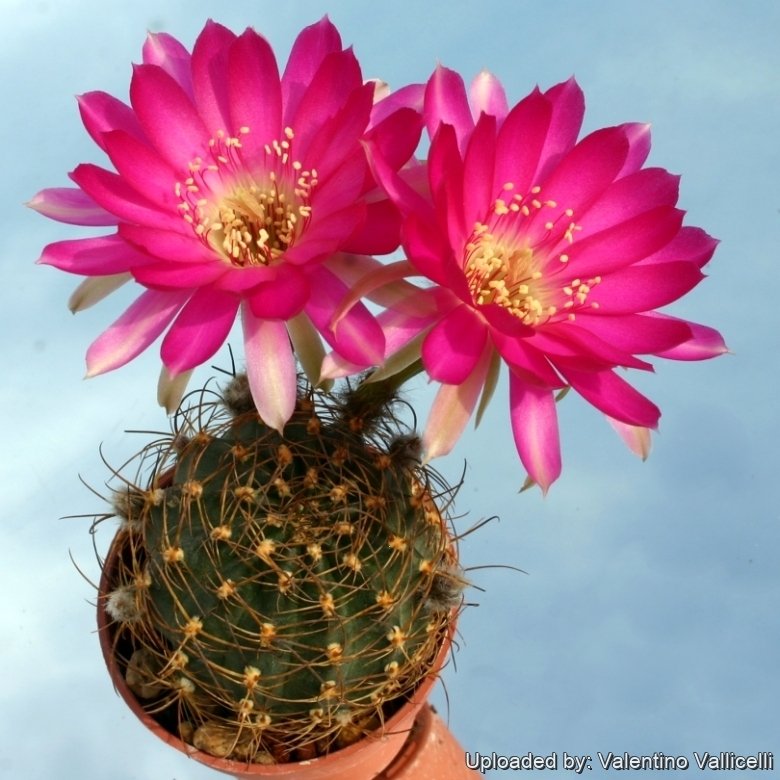
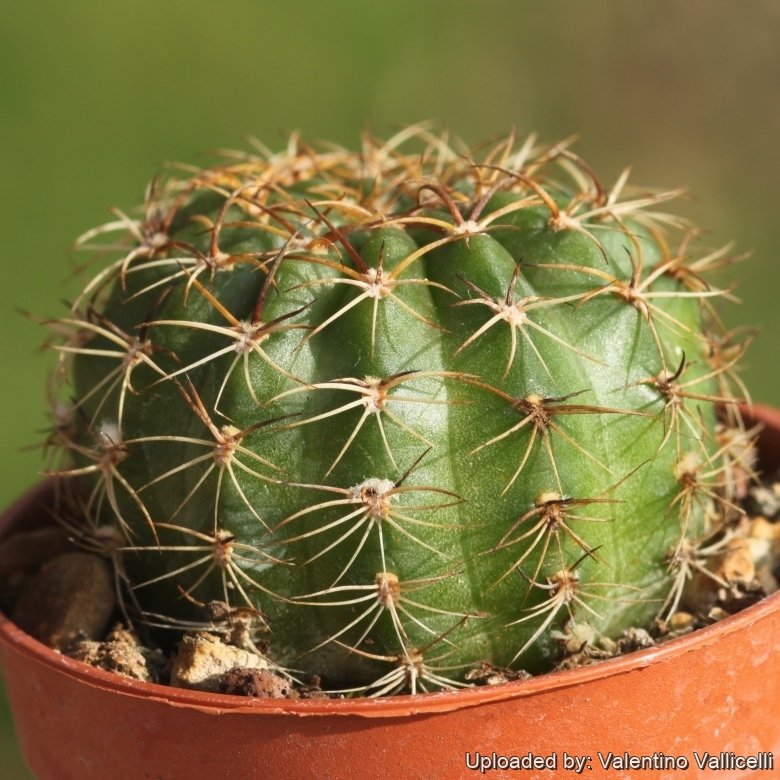
Stem: At first globular becoming cylindrical as it ages, diameter about 4-5(-7) cm. Epidermis pale green to greys-green. The crown is somewhat sunken.
Ribs: 13-19 acute,more or le spiralling, notched, incised above the areoles.
Root: Napiform (Carrot like).
Areoles: Oval with dull white felt at first, 1-1,5 cm distant.
Spines: 1-11 variable, unequal, not always differentiated as centrals and radials
Radial spines: 3-7(-11) short, about 4-50 mm long, thin,curved backward somehow pectinated, at first pale reddish brown, yellow or amber, later greys, sometimes hooked at tip.
Central spines: None or sometime 1 stouter about 1 to 3 cm long, darker with black tip.
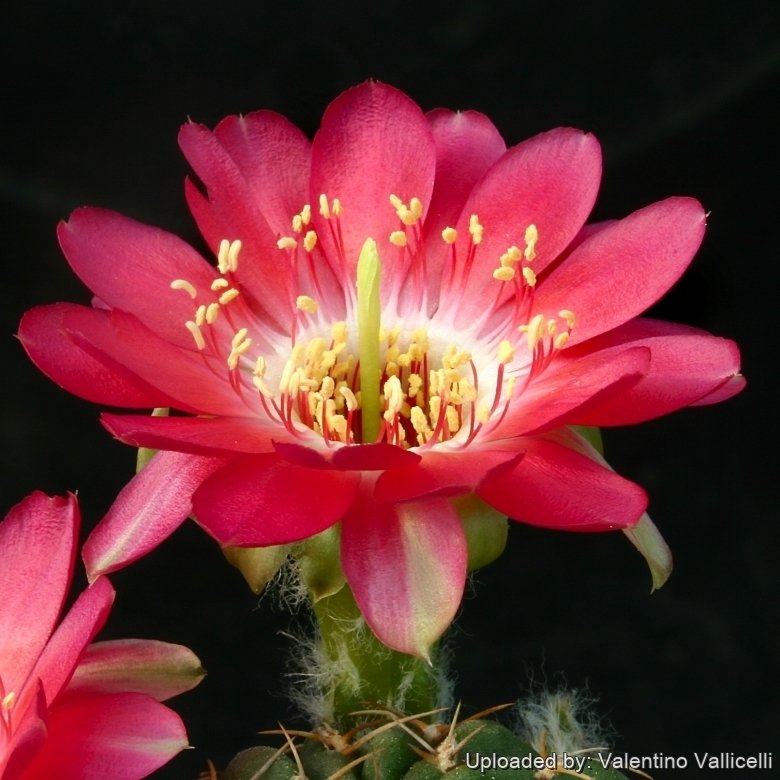
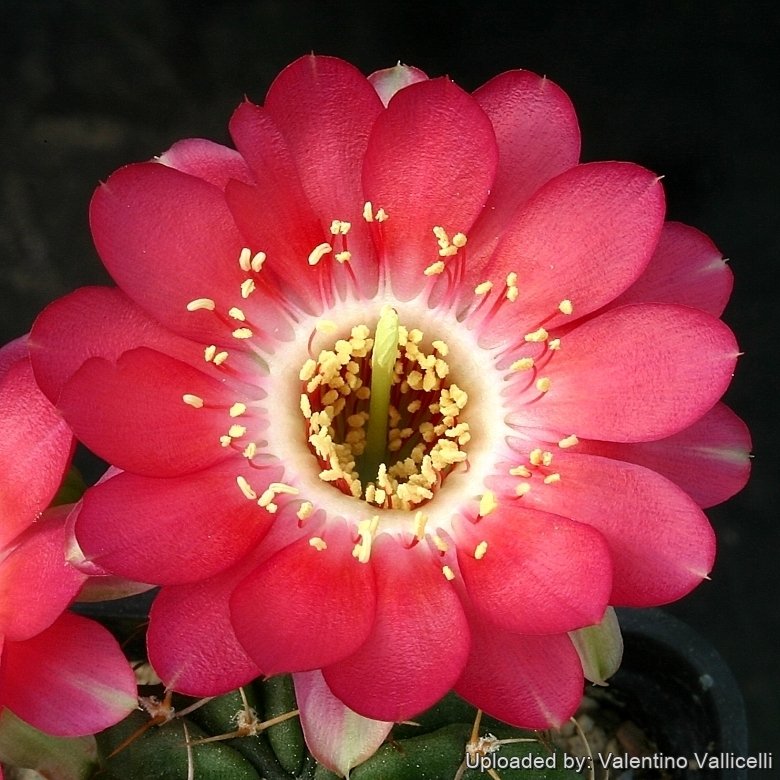
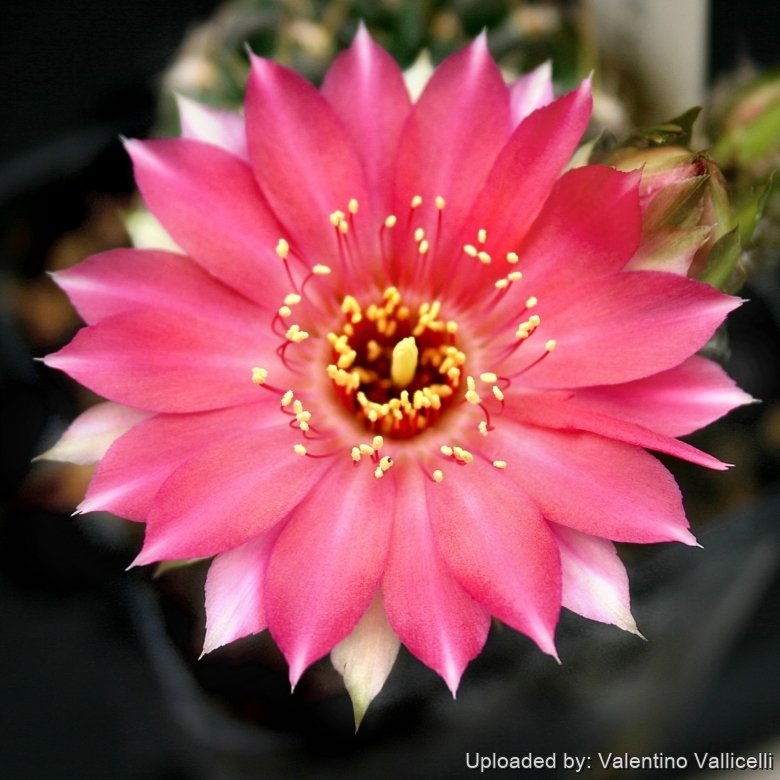
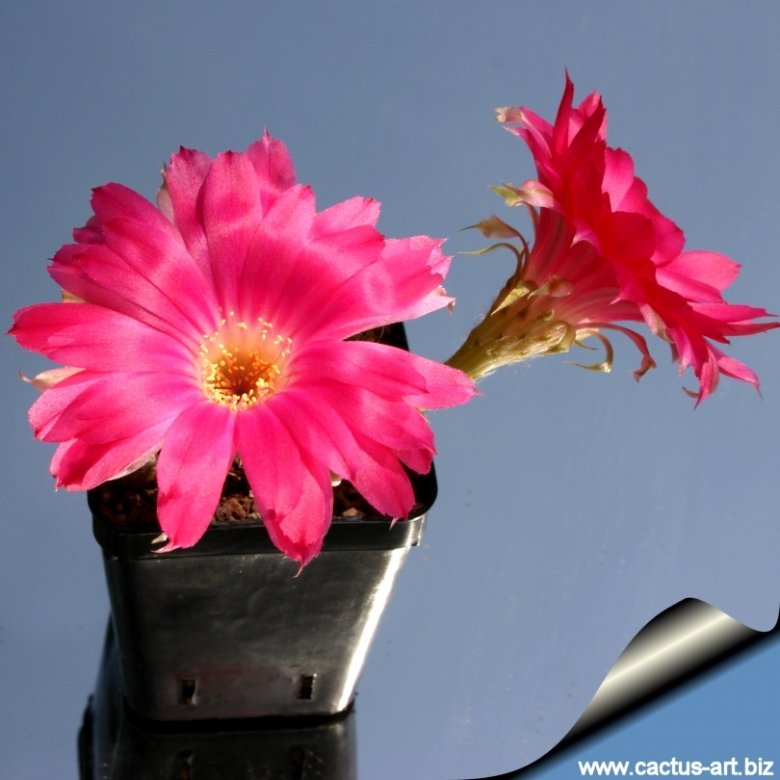
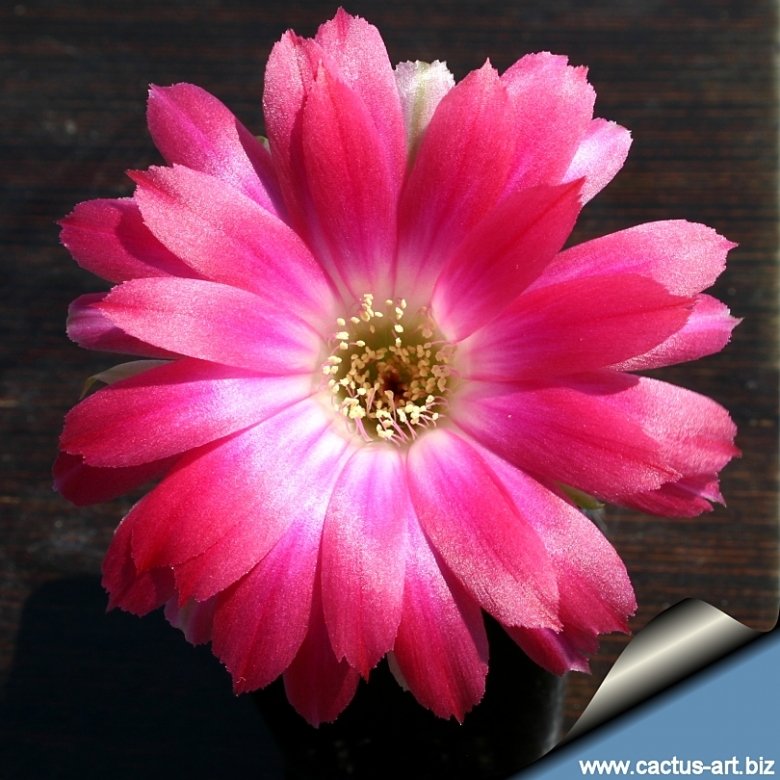
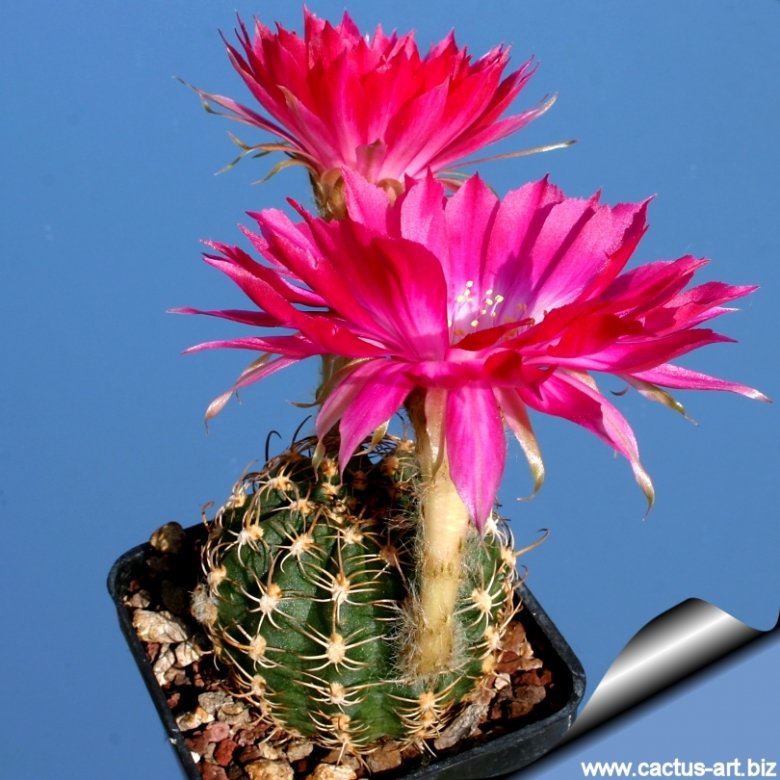
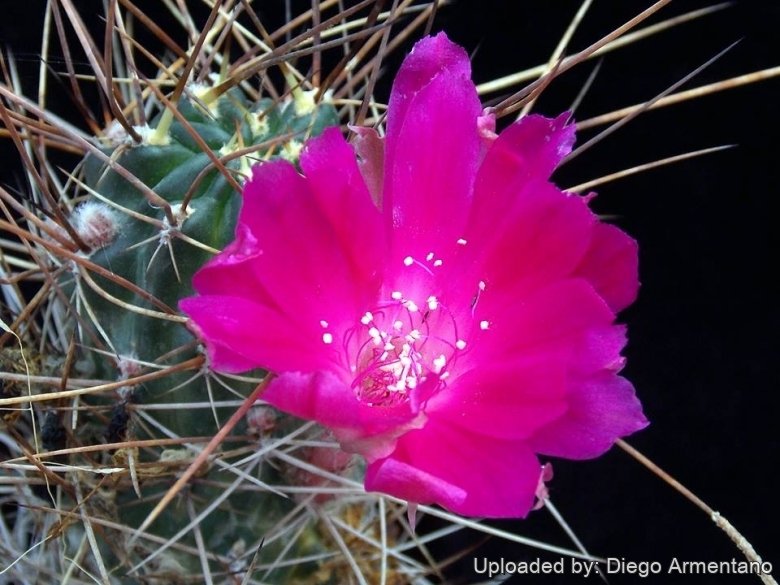
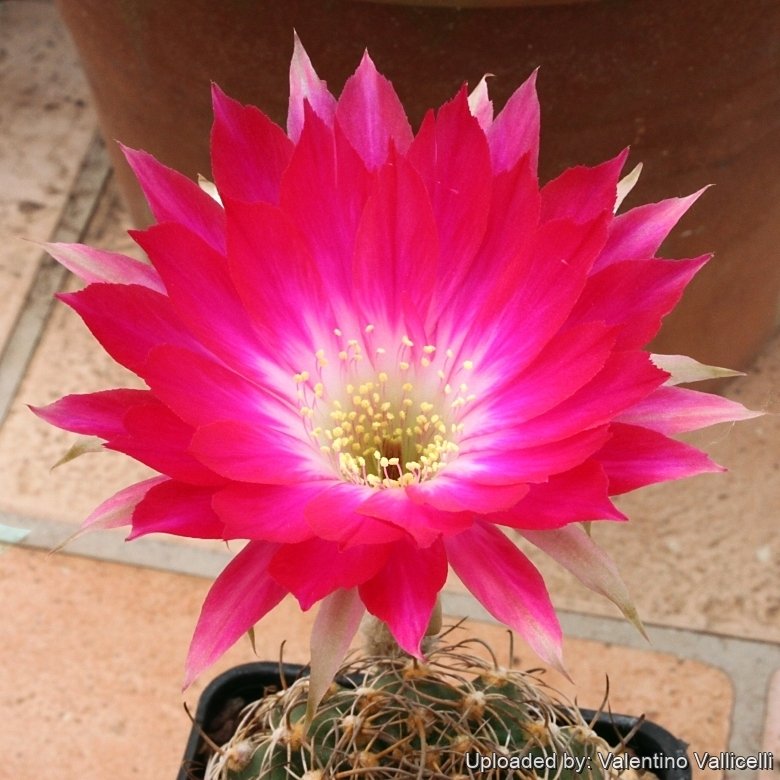
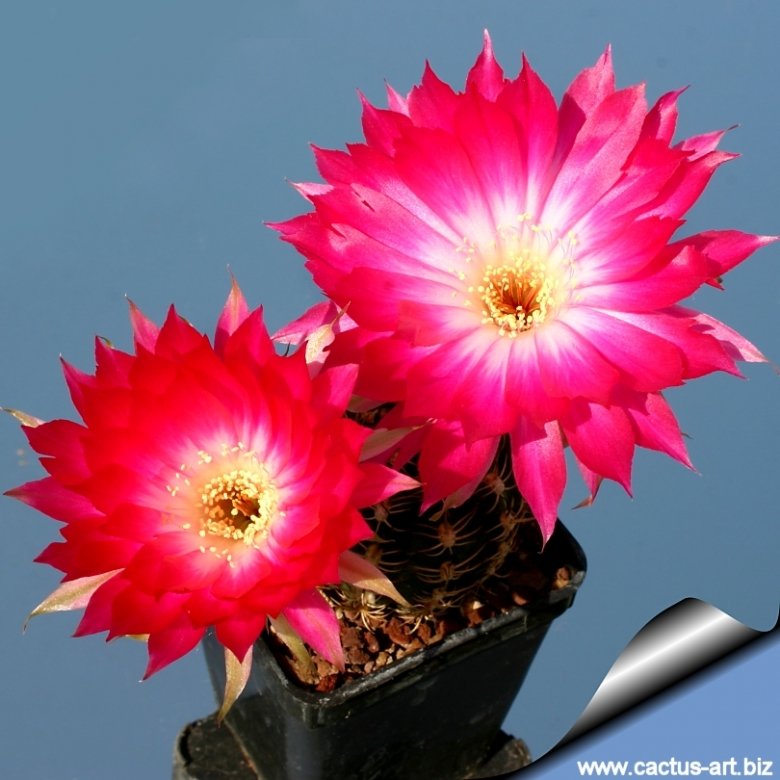
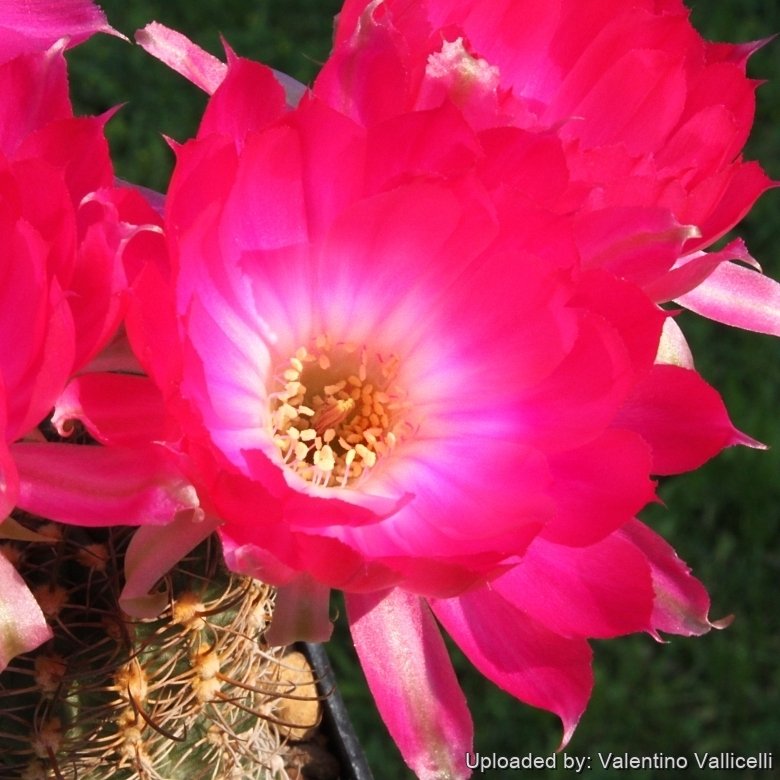
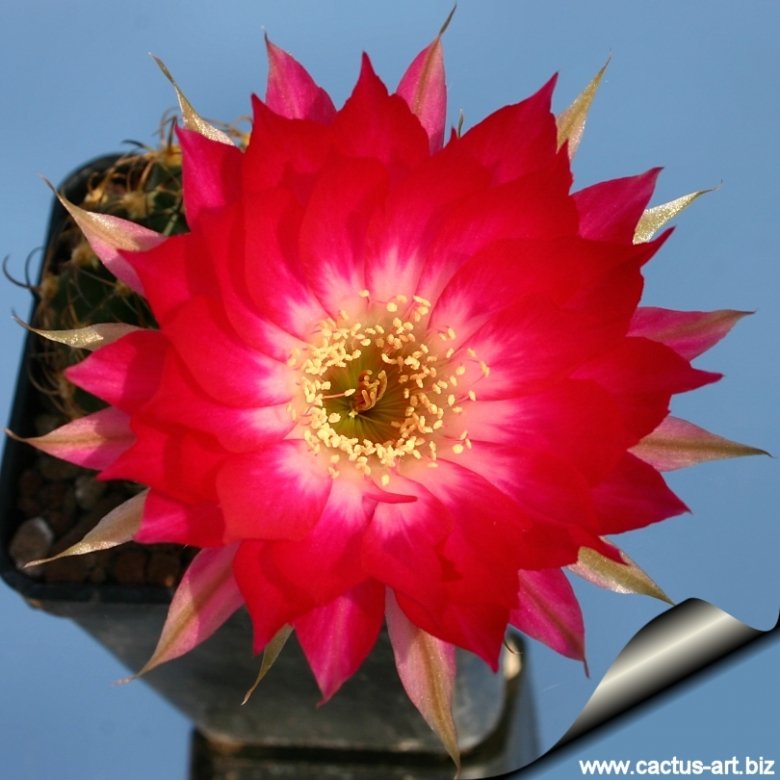
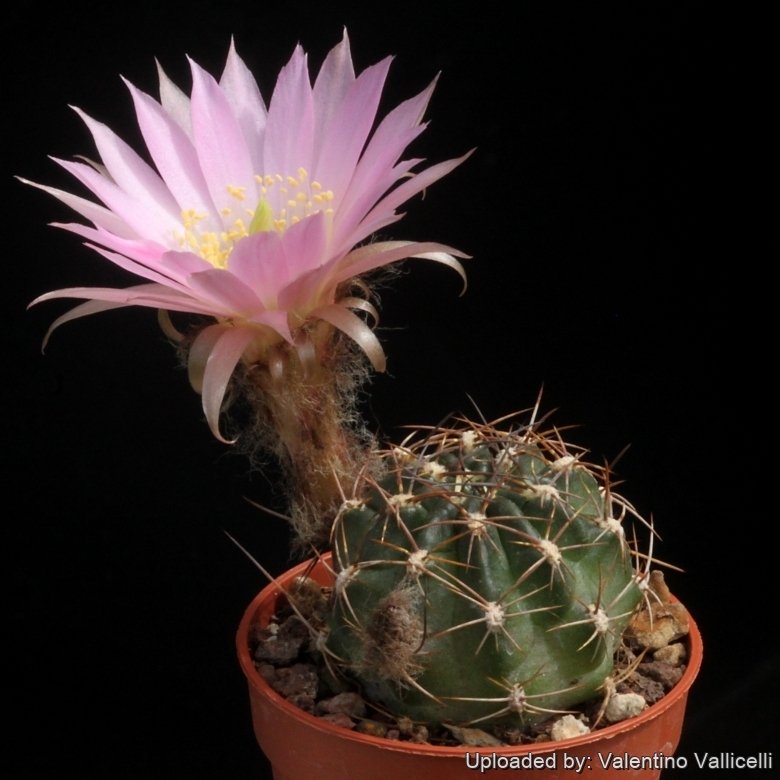
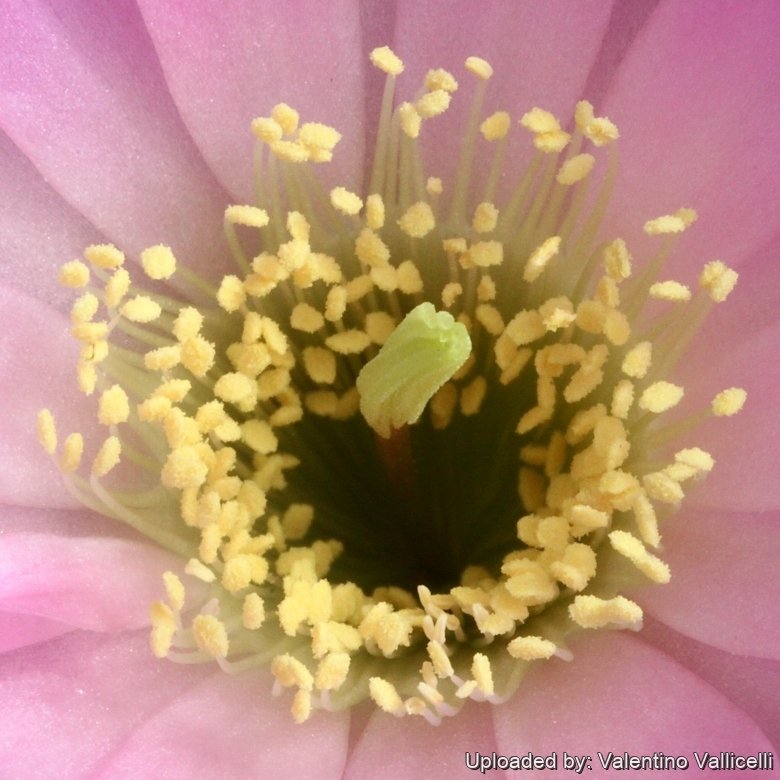
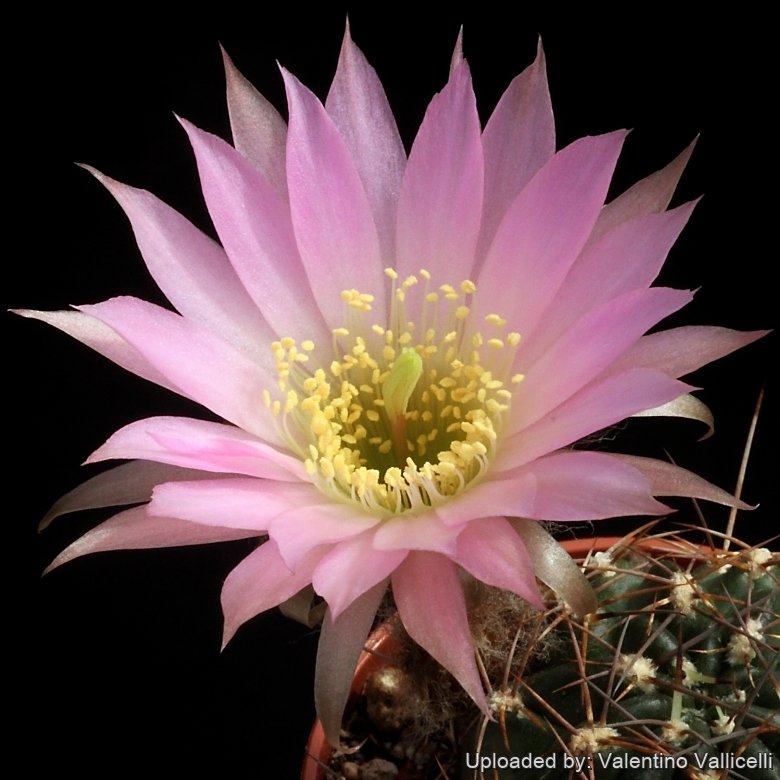
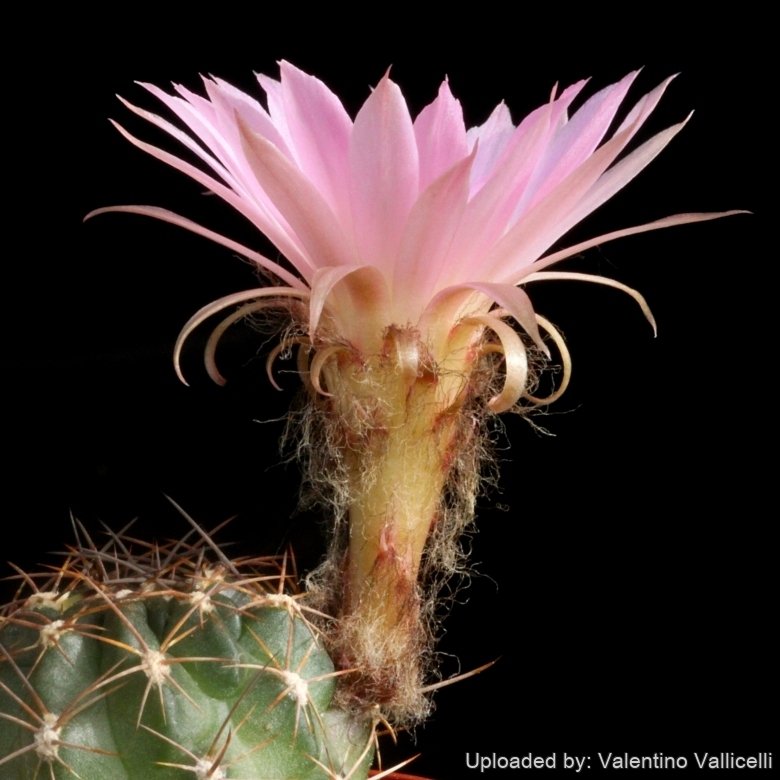
Flowers: Large, diurnal, borne laterally near the stem tips, funnel shaped, very colourful pale to dark carmine-red or violet, often with a bluish sheen and white throats, 4-9 cm long, 7,5-9 cm in diameter. Tube relatively slender 4-7 mm in diameter. Tepals lanceolate.
Fruit: About 1,5 cm in long, tannish-green to brownish-red semi-dry splitting vertically or horrizontally.
Seed: Relatively large, black, finely rough.
Origin and Habitat
South-east La Paz (Bolivia) up to Ayacucho , Cusco and Huancavelica (Peru)
Altitude: 3200-4000 m. above sea level
Habitat: It grows on high altitude in the Peruvian regions of in the Puna widespread vegetation. The climate conditions are dry, with scarce rains. During the dry time, the plant bodies tend to retract and hide into the ground.
Note: The indigenous word “Puna” indicate the western region up to 4500 m that extends from the Peru, going throughout Bolivia to the Argentinian North. Delimited at west by a costal chain of high volcanic picks and by the Cordillera mountainous chain to the east. The Argentinian Puna is the natural continuation of the Bolivian highland.
Cultivation and Propagation
Echinopsis backebergii grows rather slowly and it is sensitive to overwatering (rot prone) and needs a very good drainage to avoid rotting, but requires more moisture than true desert cacti to grow and produce flower. It is a very easy flowerer, if you keep it reasonably cool and absolutely dry during winter and lots of fresh air and sunshine tends to produce better plants and more flowers.
Soil: Use a loose well drained cactus mix.
Repotting: It require a deep pot suited to accommodate the swollen root, repotting with fresh potting-mix should be done every other year or when the plant has outgrown its pot. However, repotting doesn’t necessarily mean they’ll need larger containers.
Sun Exposure: Light shade when young, full sun later. Outside it likes strong sunshine, but is tolerant and do well with light shade during the hot Summer months. Tends to bronze in strong light, which encourages spine production.
Hardiness: It is cold resistant to -10° ( or even less depending on clones) for short periods of time. It will show its flowers only if we provide an adequate winter rest period.
Watering: Water regularly through the growing season. This can be done weekly or more frequently during the summertime, if the weather is sunny enough, but allow to dry fully before watering again. Kept this way, plants will show a healthy growth. Keep rather dry as soon as the temperature starts dropping in October and keep it dry in winter. The plant survives outside without protection in winter but is then somewhat prone to rot, too.
Fertilization: Give an occasional high potassium liquid feed during the active growing period.
Garden uses: It is a fine plant for a rock garden or container, contrasts well with agaves, yuccas, and low-growing flowering plants.
Pest and diseases: They are generally fairly easy to grow, especially if kept pest-free. They are susceptible to, scale insects and spider mite. Watch carefully for infestations of stem and root mealy bugs, and damage from these may well initiate fungal attack.
Propagation: Seeds, also can be grown from cutting as it branches from the base. Take cuttings spring or summer, let them dry till the ends callous well. Then replant them in fresh cactus soil that is ever so slightly moist, and keep it that way till they root. Surface sowing is the best; seeds germinate in 14-28 days at 20° C , remembering that seedlings dislike strong light and dry conditions.
Bibliography
Major references and further lectures:
-
Edward Anderson “The Cactus family” Timber Press, Incorporated, 2001
-
James Cullen, Sabina G. Knees, H. Suzanne Cubey “The European Garden Flora Flowering Plants: A Manual for the Identification of Plants Cultivated in Europe, Both Out-of-Doors and Under Glass” Cambridge University Press, 11/Aug/2011
-
David R Hunt; Nigel P Taylor; Graham Charles; International Cactaceae Systematics Group. “The New Cactus Lexicon” dh books, 2006
-
Willy Cullmann, Erich Götz (Dozent Dr.), Gerhard Gröner “The encyclopedia of cacti” Timber Press, 1984
-
Walter Rausch “Lobivia: The Day Flowering Echinopsidinae from a Geographical Distribution Point of View,” Volumes 1-3 R. Herzig, 1975
-
Hans Hecht “Cacti & succulents” Sterling Pub. Co., 1997
-
Clive Innes, Charles Glass “Cacti” Portland House, 1991
-
John Borg “Cacti: a gardener’s handbook for their identification and cultivation” Blandford P., 1970
-
RHS “A-Z encyclopedia of garden plants.” United Kingdom: Dorling Kindersley. 2008
From llifle page Echinopsis winteriana
Description
Echinopsis winteriana, better known as Lobivia winteriana is one of the many geographical form of Echinopsis backebergii. Many of its morphological and geographical variant was early classified as different independent species, but nowadays all this plant are considered part of a multiform species, where each form is linked to others by populations of plants with intermediate characteristics. Echinopsis winteriana has distinctive bright fuchsia pink petals that contrast nicely with the with a paler or white throat. It is a very prolific bloomer, if you keep it reasonably cool and absolutely dry during winter. The species is however controversial and is now fully synonymized with Echinopsis backebergii.
Habit: It is a small solitary or basally branched cactus, older plants may form mats.
Stem: At first globular becoming cylindrical as it ages, diameter about 5-7 cm. Epidermis greys-green.
Ribs: 13-19 more or le spiralling.
Root: Napiform (Carrot like).
Areoles: Oval with dull white felt.
Radial spines: 6-14 short, about 4-7 mm long, thin, unequal, curved backward somehow pectinated, pale brown, yellow or amber when young, later greys.
Central spines: None or sometime 1 stouter about 1-3 cm long, darker with black tip.
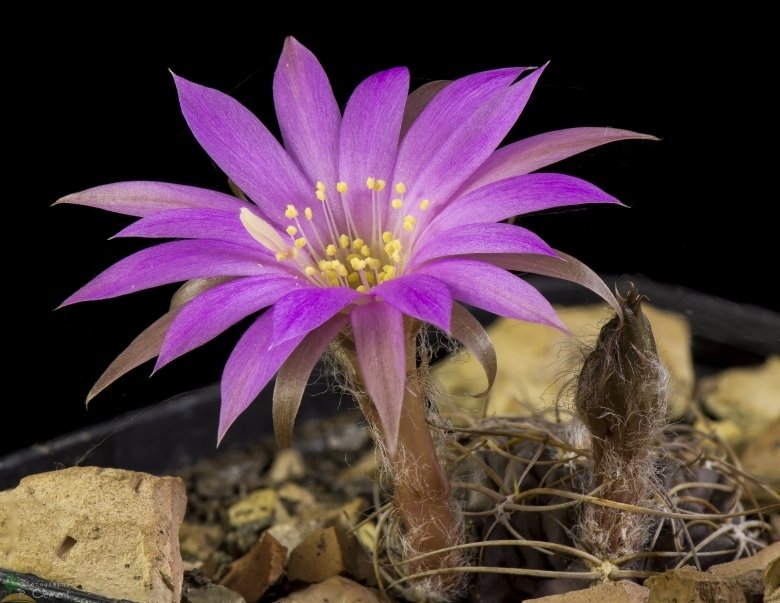
Flowers: Large, funnel shaped, very colourful fuchsia pink to purple-violet, often with a bluish sheen and white throats 7,5-9 cm in diameter. Tepals lanceolate.
Fruit: About 1,5 cm in long, tannish-green to brownish-red.
Seed: Black.
Origin and Habitat
Peru, Huancavelica, Villa Azul altitudes about 3000 m.
Cultivation and Propagation
Echinopsis winteriana grows rather slowly and it is sensitive to overwatering (rot prone) and needs a very good drainage to avoid rotting, but requires more moisture than true desert cacti to grow and produce flower. It is a very easy flowerer, if you keep it reasonably cool and absolutely dry during winter and lots of fresh air and sunshine tends to produce better plants and more flowers.
Soil: Use a loose well drained cactus mix.
Repotting: It require a deep pot suited to accommodate the swollen root, repotting with fresh potting-mix should be done every other year or when the plant has outgrown its pot. However, repotting doesn’t necessarily mean they’ll need larger containers.
Sun Exposure: Light shade when young, full sun later. Outside it likes strong sunshine, but is tolerant and do well with light shade during the hot Summer months. Tends to bronze in strong light, which encourages spine production.
Hardiness: It is cold resistant to -10° ( or even less depending on clones) for short periods of time. It will show its flowers only if we provide an adequate winter rest period.
Watering: Water regularly through the growing season. This can be done weekly or more frequently during the summertime, if the weather is sunny enough, but allow to dry fully before watering again. Kept this way, plants will show a healthy growth. Keep rather dry as soon as the temperature starts dropping in October and keep it dry in winter. The plant survives outside without protection in winter but is then somewhat prone to rot, too.
Fertilization: Give an occasional high potassium liquid feed during the active growing period.
Garden uses: It is a fine plant for a rock garden or container, contrasts well with agaves, yuccas, and low-growing flowering plants.
Pest and diseases: They are generally fairly easy to grow, especially if kept pest-free. They are susceptible to, scale insects and spider mite. Watch carefully for infestations of stem and root mealy bugs, and damage from these may well initiate fungal attack.
Propagation: Seeds, also can be grown from cutting as it branches from the base. Take cuttings spring or summer, let them dry till the ends callous well. Then replant them in fresh cactus soil that is ever so slightly moist, and keep it that way till they root. Surface sowing is the best; seeds germinate in 14-28 days at 20° C , remembering that seedlings dislike strong light and dry conditions.
Bibliography
Major references and further lectures:
-
Edward Anderson “The Cactus family” Timber Press, Incorporated, 2001
-
James Cullen, Sabina G. Knees, H. Suzanne Cubey “The European Garden Flora Flowering Plants: A Manual for the Identification of Plants Cultivated in Europe, Both Out-of-Doors and Under Glass” Cambridge University Press, 11/Aug/2011
-
David R Hunt; Nigel P Taylor; Graham Charles; International Cactaceae Systematics Group. “The New Cactus Lexicon” dh books, 2006
-
The encyclopedia of cacti
-
Willy Cullmann, Erich Götz (Dozent Dr.), Gerhard Gröner “Copertina anteriore” Timber Press, 1984
-
Lobivia:
-
Walter Rausch “The Day Flowering Echinopsidinae from a Geographical Distribution Point of View,” Volumes 1-3 R. Herzig, 1975
-
Hans Hecht “Cacti & succulents” Sterling Pub. Co., 1997
-
Clive Innes, Charles Glass “Cacti” Portland House, 1991
-
John Borg “Cacti: a gardener’s handbook for their identification and cultivation” Blandford P., 1970
-
RHS “A-Z encyclopedia of garden plants.” United Kingdom: Dorling Kindersley. 2008
Source: Echinopsis winteriana, LLIFLE - Encyclopedia of living forms, CC-BY-SA, retrieved 2026-10-25.
From llifle page Echinopsis wrightiana
Description
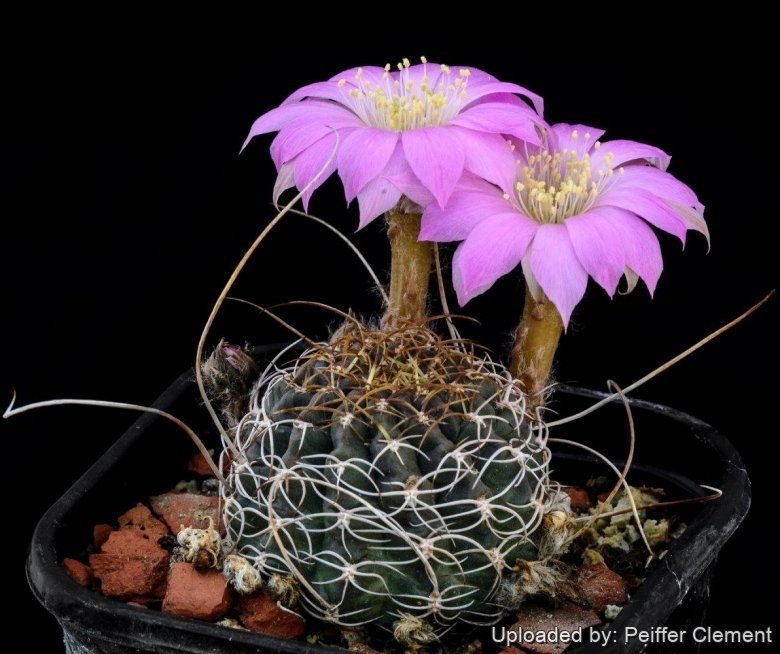
Echinopsis backebergii subs. wrightiana is a small cactus species, with conspicuous bright coloured blooms and long thin wispy spines that, due to its flower structure typical of the Lobivias, it is commonly known as Lobivia wrightiana. It is one of the more popular, hardy, and beautiful among the small, globe-shape Easter Lily cacti.
Habit: It is a solitary or rarely clumping species.
Stem: Flattish-globose to more or less clavate or short-cylindric ash-green to dark greyish green up to 7 cm tall, 5 cm in diameter. Ribs (13-)16-17(-19), slightly spiral, low, slightly tuberculate, with round white areoles.
Root: Large turnip-like storage root.
Central spines: Conspicuous, erect, curved to almost hooked, variable in length mostly 4-6 cm long but sometime up to 18 cm long (there are also forms with only short spines).
Radial spines: Thin, variable in number and length.
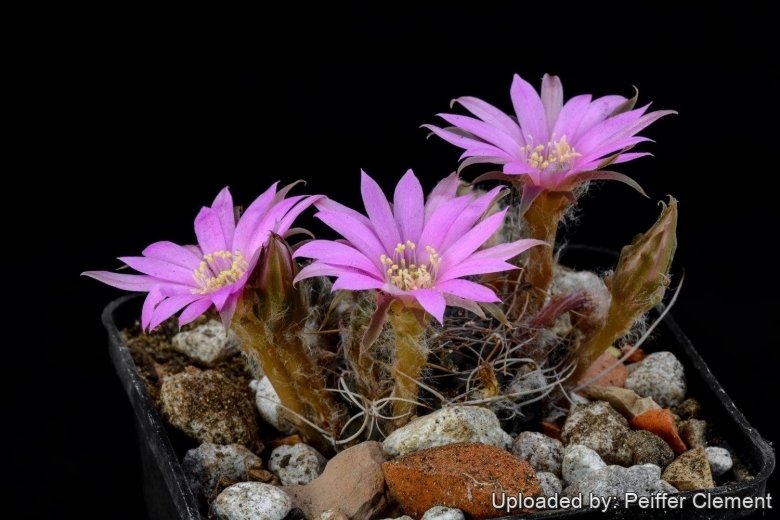
Flowers: On the side of the stem, 4 cm in diameter, 4-5(or more) cm tall, pale lilac to bright-pink with often lighter throats, stamens adpressed, short, longer in older specimens; the flower tube is long and narrow.
Blooming season: Flowers are produced in spring and remain open for about four days. Easy to grow and flower if kept cool during winter.
Origin and Habitat
Huancavelica, Central Peru.
Altitude: 2200-330 metres above sea level.
Habitat: Mountains and high mountains.
Cultivation and Propagation
It is a good beginner cactus and easy to grow and flower. It is quite resistant and occasionally gets covered by bright showy blossoms also neglected in a dry windowsill. Requires good drainage and very porous potting mix. Watering Needs Need regular water in spring to fall but do not water again until dry. Also, it is a species that is dormant in the winter and require very little water (maybe even none) during the cold months. Frost Tolerance: Light frost protection required. Minimum of 5ºC for safe growing (but hardy up to -5°C or less). Requires to be kept below 7°C in winter to flower well in the spring. Sun Exposure: Requires bright light (protect from strong midday sun). In shade the body colour will remain mostly green, while full sun will darken it and give it red/brown body colour. Can be sunburned if moved from shade/greenhouse into full sun too quickly. The amount of sunlight it can withstand without scorching depends upon the how hot it becomes in the summer in the locale in which it is planted. It will have more colour if it receives more light. During the spring it may be able to take full sun until the heat arrives at the end of spring. In an area that has hot afternoon sun, it may be able to take full morning sun, but requires afternoon shade or afternoon light shade.
Propagation: Seeds or offsets that appear at the base; leave them attached to form a cluster, or wait until they are 1/3 the size of the parent and then detach and plant.
Source: Echinopsis wrightiana, LLIFLE - Encyclopedia of living forms, CC-BY-SA, retrieved 2026-10-25.
From llifle page Echinopsis zecheri
Description
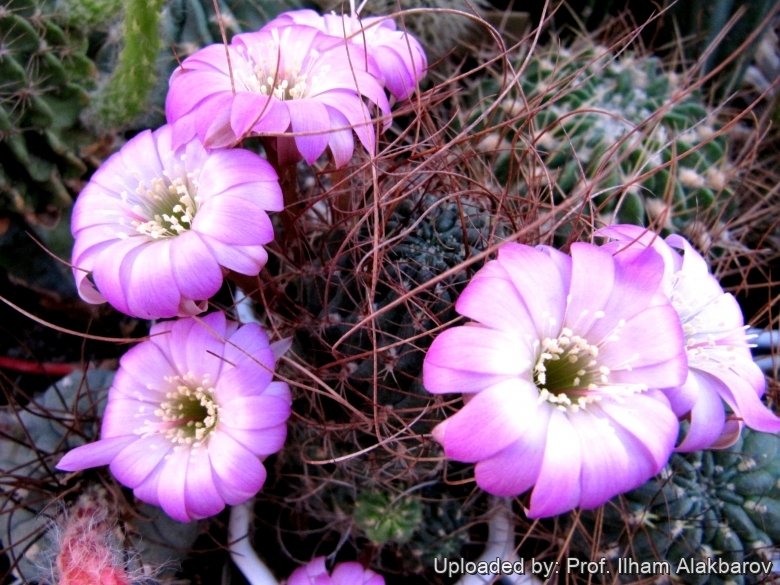
Echinopsis zecheri (a.k.a. Lobivia zecheri) is a cold hardy species in the Cactus family (Cactaceae). This is one the several questionable varieties of the morphologically variable Echinopsis backebergii (Lobivia backebergii), a taxon growing widespread in southern Bolivia and northern Peru. Echinopsis zecheri from Ayocucho is an attractive form with hard sharp spines and rather coarser flowers with rich liliac or purple petals and a white throat. However the distinguishing characteristics of Echinopsis zecheri, appear to fall within the natural variation of Echinopsis backebergii and it should be synonymized with the latter.
Note: W. Rausch, Lobivia 1985, consider this taxon an extreme form of Lobivia hertrichiana (Echinopsis hertrichiana) distinguished by the harder long spines.
Stems: Up to about 6 cm in diameter with straight ribs. Usually solitary but in age it may offsets forming small clump up to 20 cm in diameter.
Flowers: About 3-4 cm long and wide (occasionally larger), bright purple to liliac or violet with a white throat. Pistil and stamens pink to red violet. Flower colour, as elsewhere in the genus is quite variable.
Fruit: About 1 cm wide, drying at maturity with relatively large seeds.
Origin and Habitat
Ayacucho to Huanta, Ayacucho, Peru
Altitude range: 2400-3400 metres above sea level.
Cultivation and Propagation
Echinopsis zecheri grows rather slowly and it is sensitive to overwatering (rot prone) and needs a very good drainage to avoid rotting, but requires more moisture than true desert cacti to grow and produce flower. It is a very easy flowerer, if you keep it reasonably cool and absolutely dry during winter and lots of fresh air and sunshine tends to produce better plants and more flowers.
Soil: Use a loose well drained cactus mix.
Repotting: It require a deep pot suited to accommodate the swollen root, repotting with fresh potting-mix should be done every other year or when the plant has outgrown its pot. However, repotting doesn’t necessarily mean they’ll need larger containers.
Sun Exposure: Light shade when young, full sun later. Outside it likes strong sunshine, but is tolerant and do well with light shade during the hot Summer months. Tends to bronze in strong light, which encourages spine production.
Hardiness: It is cold resistant to -10° ( or even less depending on clones) for short periods of time. It will show its flowers only if we provide an adequate winter rest period.
Watering: Water regularly through the growing season. This can be done weekly or more frequently during the summertime, if the weather is sunny enough, but allow to dry fully before watering again. Kept this way, plants will show a healthy growth. Keep rather dry as soon as the temperature starts dropping in October and keep it dry in winter. The plant survives outside without protection in winter but is then somewhat prone to rot, too.
Fertilization: Give an occasional high potassium liquid feed during the active growing period.
Garden uses: It is a fine plant for a rock garden or container, contrasts well with agaves, yuccas, and low-growing flowering plants.
Pest and diseases: They are generally fairly easy to grow, especially if kept pest-free. They are susceptible to, scale insects and spider mite. Watch carefully for infestations of stem and root mealy bugs, and damage from these may well initiate fungal attack.
Propagation: Seeds, also can be grown from cutting as it branches from the base. Take cuttings spring or summer, let them dry till the ends callous well. Then replant them in fresh cactus soil that is ever so slightly moist, and keep it that way till they root. Surface sowing is the best; seeds germinate in 14-28 days at 20° C, remembering that seedlings dislike strong light and dry conditions.
Bibliography
Major references and further lectures
- Walter Rausch “Lobivia: The Day Flowering Echinopsidinae from a Geographical Distribution Point of View,” Volumes 1-3 R. Herzig, 1975
Source: Echinopsis zecheri, LLIFLE - Encyclopedia of living forms, CC-BY-SA, retrieved 2026-10-25.
From llifle page Echinopsis winteriana cv. Fluorescent
Description
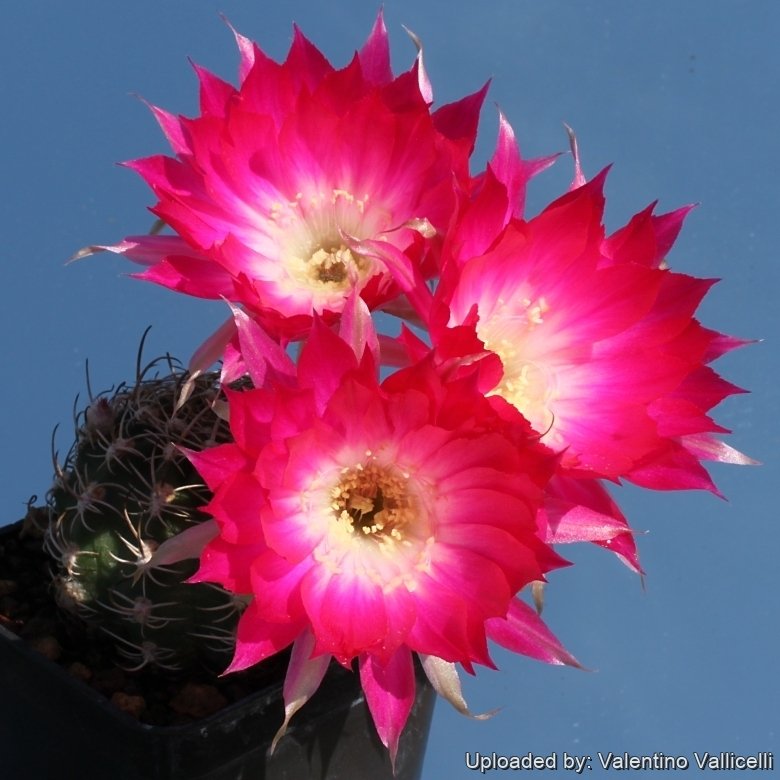
Echinopsis winteriana cv. Fluorescent, better known as Lobivia winteriana cv. Fluorescent is a selected cultivated form with “shocking fuchsia pink” to purple-violet flowers that contrast nicely with the bright white throat. The vivid contrast of colours is absolutely fantastic, especially immediately after the first opening of a floral bud. The brightness of colours fades a little on the second day. It is a very prolific bloomer, if you keep it reasonably cool and absolutely dry during winter. It reproduces by seeds and the special colour of flowers is inherited by offspring, however there may be some differences between seedlings.
Habit: It is a small solitary or basally branched cactus, older plants may form mats.
Stem: At first globular becoming cylindrical as it ages, diameter about 5-7 cm. Epidermis greys-green.
Ribs: 13-19 more or le spiralling.
Root: Napiform (Carrot like).
Areoles: Oval with dull white felt.
Radial spines: 6-14 short, about 4-7 mm long, thin, unequal, curved backward somehow pectinated, pale brown, yellow or amber when young, later greys.
Central spines: None or sometime 1 stouter about 1-3 cm long, darker with black tip.
Flowers: Large, funnel shaped, very colourful fuchsia pink to purple-violet, often with a bluish sheen and bright white throats 7,5-9 cm in diameter. Tepals lanceolate.
Fruit: About 1,5 cm in long, tannish-green to brownish-red.
Seed: Black.
Origin and Habitat
Garden origin .
Cultivation and Propagation
Echinopsis winteriana cv. Fluorescent grows rather slowly and it is sensitive to overwatering (rot prone) and needs a very good drainage to avoid rotting, but requires more moisture than true desert cacti to grow and produce flower. It is a very easy flowerer, if you keep it reasonably cool and absolutely dry during winter and lots of fresh air and sunshine tends to produce better plants and more flowers.
Soil: Use a loose well drained cactus mix.
Repotting: It require a deep pot suited to accommodate the swollen root, repotting with fresh potting-mix should be done every other year or when the plant has outgrown its pot. However, repotting doesn’t necessarily mean they’ll need larger containers.
Sun Exposure: Light shade when young, full sun later. Outside it likes strong sunshine, but is tolerant and do well with light shade during the hot Summer months. Tends to bronze in strong light, which encourages spine production.
Hardiness: It is cold resistant to -10° ( or even less depending on clones) for short periods of time. It will show its flowers only if we provide an adequate winter rest period.
Watering: Water regularly through the growing season. This can be done weekly or more frequently during the summertime, if the weather is sunny enough, but allow to dry fully before watering again. Kept this way, plants will show a healthy growth. Keep rather dry as soon as the temperature starts dropping in October and keep it dry in winter. The plant survives outside without protection in winter but is then somewhat prone to rot, too.
Fertilization: Give an occasional high potassium liquid feed during the active growing period.
Garden uses: It is a fine plant for a rock garden or container, contrasts well with agaves, yuccas, and low-growing flowering plants.
Pest and diseases: They are generally fairly easy to grow, especially if kept pest-free. They are susceptible to, scale insects and spider mite. Watch carefully for infestations of stem and root mealy bugs, and damage from these may well initiate fungal attack.
Propagation: Seeds, also can be grown from cutting as it branches from the base. Take cuttings spring or summer, let them dry till the ends callous well. Then replant them in fresh cactus soil that is ever so slightly moist, and keep it that way till they root. Surface sowing is the best; seeds germinate in 14-28 days at 20° C , remembering that seedlings dislike strong light and dry conditions.
Source: Echinopsis winteriana cv. Fluorescent, LLIFLE - Encyclopedia of living forms, CC-BY-SA, retrieved 2026-10-25.
From llifle page Lobivia wrightiana ollaoana
Description
Lobivia wrightiana is a solitary or rarely clumping species and one of the more popular, hardy, and beautiful among the small, globe-shape Easter Lily cacti.
Stem: Flattish-globose to more or less clavate or short-cylindric ash-green to dark greyish green up to 7 cm tall, 5 cm in diameter. Ribs (13-)16-17(-19), slightly spiral, low, slightly tuberculate, with round white areoles.
Root: Large turnip-like storage root.
Central spines: Conspicuous, erect, curved to almost hooked, variable in length mostly 4-6 cm long but sometime up to 18 cm long (there are also forms with only short spines).
Radial spines: Thin, variable in number and length.
Flowers: On the side of the stem, 4 cm in diameter, 4-5(or more) cm tall, pale lilac to bright-pink with often lighter throats, stamens adpressed, short, longer in older specimens; the flower tube is long and narrow.
Blooming season: Flowers are produced in spring and remain open for about four days. Easy to grow and flower if kept cool during winter.
Origin and Habitat
Central Peru.
Habitat: Mountains and high mountains.
Source: Lobivia wrightiana ollaoana, LLIFLE - Encyclopedia of living forms, CC-BY-SA, retrieved 2026-10-25.
From llifle page Lobivia backebergii var. chilensis
Description
Lobivia wrightiana fa. chilensis is an undescribed name (nomen nudum - Abbreviation n.n. a title lacking valid description). It was first named by the Czech cactus trader Karel Knize, resident in Lima, Peru, and in 1975, Walter Rausch in “Lobivia 75”, page 23, shows an image of this plant (Lobivia chilensis - Knize - n.n.). It has been said that Knize gave most of the plants he collected/sold new names to increase sales. Knize never properly described his plants, he just gave them names and sold them. He deliberately hunted down unusual looking things so it can be difficult to characterise them in terms of the existing described species. Rausch says this is an undescribed variety of the attractive Lobivia wrightiana, with red rather than white stigmas. It comes from the Peru-Chilean border, whereas L. wrightiana is from Central Peru. In 1980, after his habitat research, Ritter in his “Kakteen in Südamerika” states that L. chilensis does not exist as described above, also casting doubt on the fact that it may be a Chilean plant, because the Tacora Volcano area is located on border of three countries: Bolivia, Chile and Peru.
In 1985 Raush published “Lobivia 85” where, accepting Ritter’s theory and ironizing with Knize, reduced Lobivia chilensis (Knize) to synonym of Lobivia wrightiana (Backeberg - 1937). Still, the plant is so accepted (cf. Rod & Ken Preston Mafhan - Cacti: the illustrated dictionary)
It is a beautiful, hardy plant, and easy to grow as many lobivias.
Origin and Habitat
Putre, Tarapaca, Chile, 3800 metres above sea level.
Bibliography
Major references and further lectures
-
Lobivia chilensis in: Cactus and Succulent Journal of Great Britain, Cactus and Succulent Society of Great Britain, 1977
-
Friedrich Ritter “Kakteen in Südamerika: Ergebnisse meiner 20jährigen” Volume 2, Argentinien/Bolivien, Volume 2 Selbstverlag, 1980
-
Walter Rausch “Lobivia 85” Rudolf Herzig Vienna 1985/86 (text in German) 6)
-
Rod Preston-Mafham, Ken Preston-Mafham “Cacti: the illustrated dictionary” Timber Press, 1991
-
“Una pianta, una storia: Lobivia chilensis (KK – n.n.)” http://forum.cactus-co.com/viewtopic.php?f=5&t=27218
Source: Lobivia backebergii var. chilensis, LLIFLE - Encyclopedia of living forms, CC-BY-SA, retrieved 2026-10-25.
Cultivars and forms (2)
Subspecies (1)
Gallery