Description
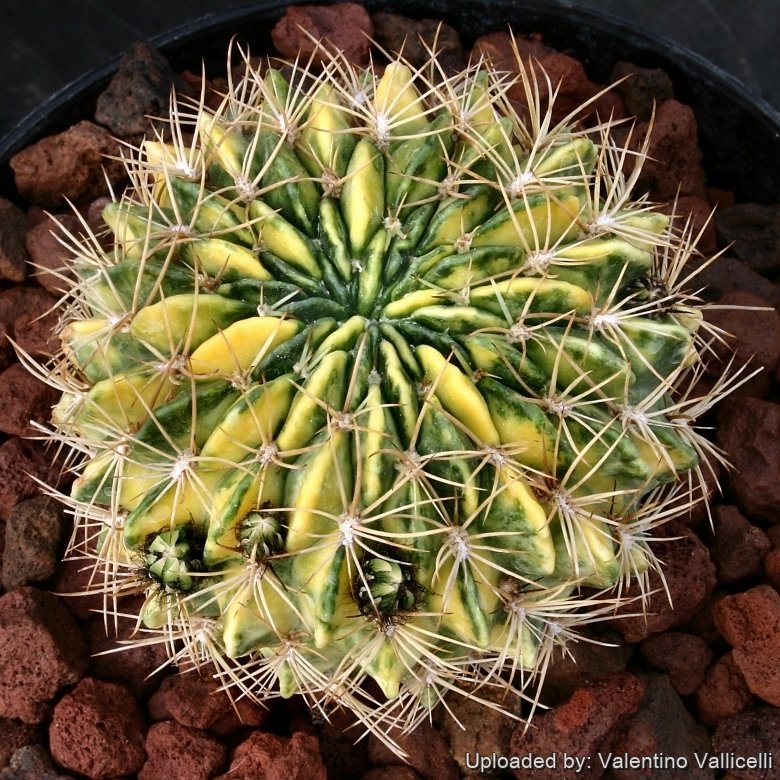
The classical Echinopsis cinnabarina (syn: Lobivia cinnabarina) is a small cactus with a much flattened usually solitary body (sometime forms small few branched clumps). The variegated form (Echinopsis cinnabarina f. variegata) has sectors, patches or stripes with distinct shades of yellow. A very few variegated plants sprout unpredictably time by time among normal green seedling and are very rare. Plants with variegated stems are often attractive and highly prized.
Stems: Glossy dark green stripped with yellow, spherical broader than high, deprssed and unarmed at apex, up to 15 cm in diameter.
Ribs: It has about 20 ribs spirally arranged, irregular and oblique, with raised to acute tubercles between which the areoles appear.
Areoles: Rounded with short whitish felt.
Radial spines: 8-10, about 1-2 cm long, arranged like little spiders, more or less curved backward, acicular, slender, brownish, turn greyish eventually.
Central spines: None or 1 to 3 stouter, somewhat curved.
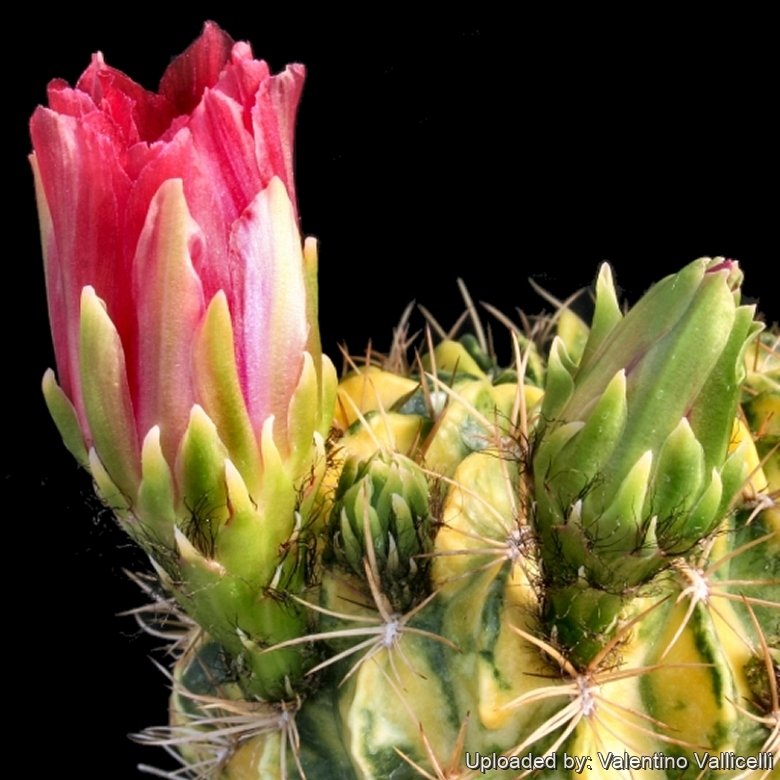
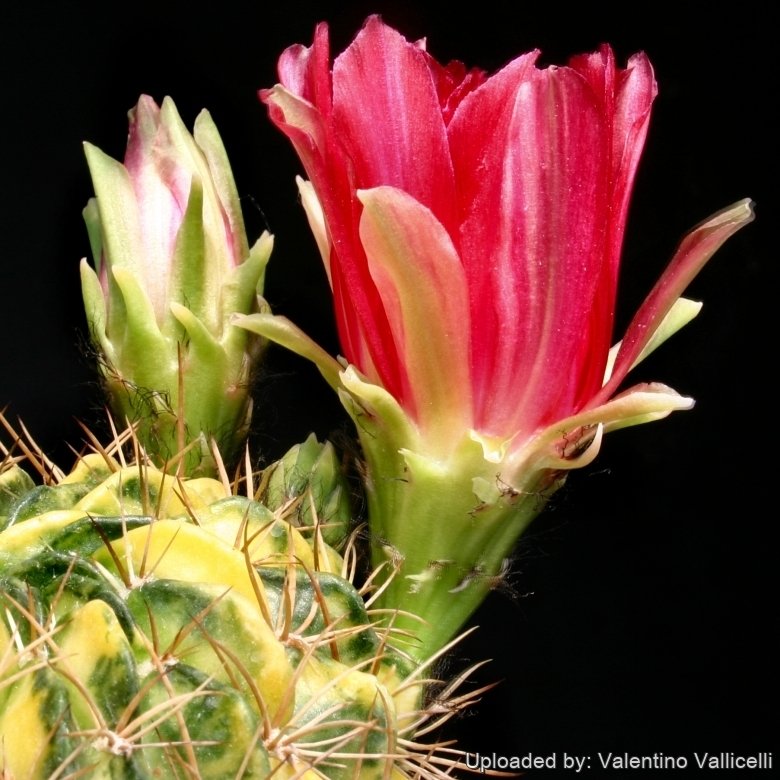
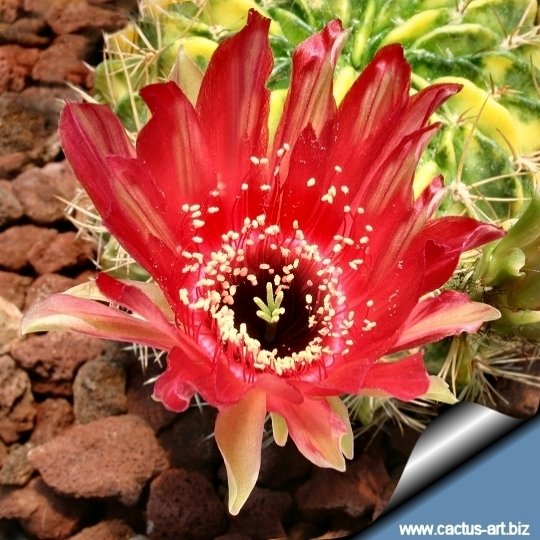
Flowers: About 4 to 8 cm broad, near the plant apex, scarlet to deep red and often variegated (with paler strips).
Origin and Habitat
Garden origin (Nursery produced cultivar)
Cultivation and Propagation
Variegated cacti are regarded as choice and difficult in cultivation, but despite that many of them are relatively easy to grow. But be aware that they cannot tolerate prolonged exposure to direct sun light (especially during the hottest summer days), so grow them in half-shade or under filtered sun. They are sometime seen as grafted plants, but some of this colourful plants (those with some chlorophyll) are able to grow on their own roots and are priced by collectors.
Soil: Use mineral well-permeable substratum with little organic matter (peat, humus).
Watering: Water sparingly from March till October, and keep perfectly dry in winter, at temperatures from 5 to 15 degrees centigrade. (In general these plants are more tender and cannot endure freezing temperatures). In the rest period no high atmospheric humidity!!
Propagation: By seeds, grafting or cutting. Because the variegation is due to the presence of two kinds of plant tissue, propagating the plant must be by a vegetative method of propagation that preserves both types of tissue in relation to each other. A most common way way to cultivate this partially de-coloured cultivars is to graft them onto another cactus which has chlorophyll and which will provide sugar to the mutant scion. The chlorophyll containing bottom part of the graft, called the stock, can be any number of different columnar cactus species.
Remarks: Seeds from variegated parents often give raise to some variegated seedlings too.
Bibliography
Major references and further lectures
-
James Cullen, Sabina G. Knees, H. Suzanne Cubey “The European Garden Flora Flowering Plants: A Manual for the Identification of Plants Cultivated in Europe, Both Out-of-Doors and Under Glass” Cambridge University Press, 11/Aug./2011
-
David Hunt, Nigel Taylor “The New Cactus Lexicon” DH Books, 2006
-
Edward F. Anderson “The Cactus Family” Timber Press, 2001