Publication: Monogr. Cact. 288. 1853
Description
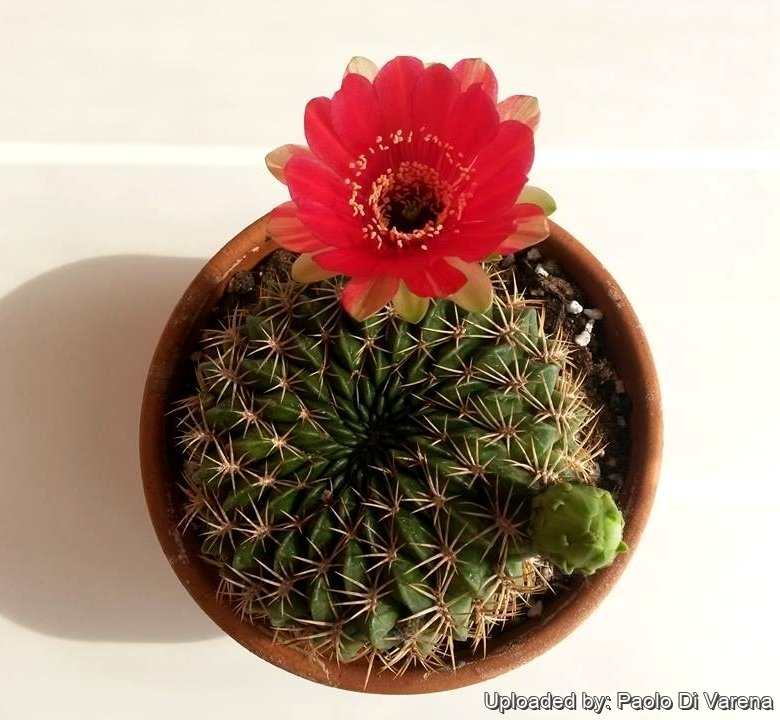
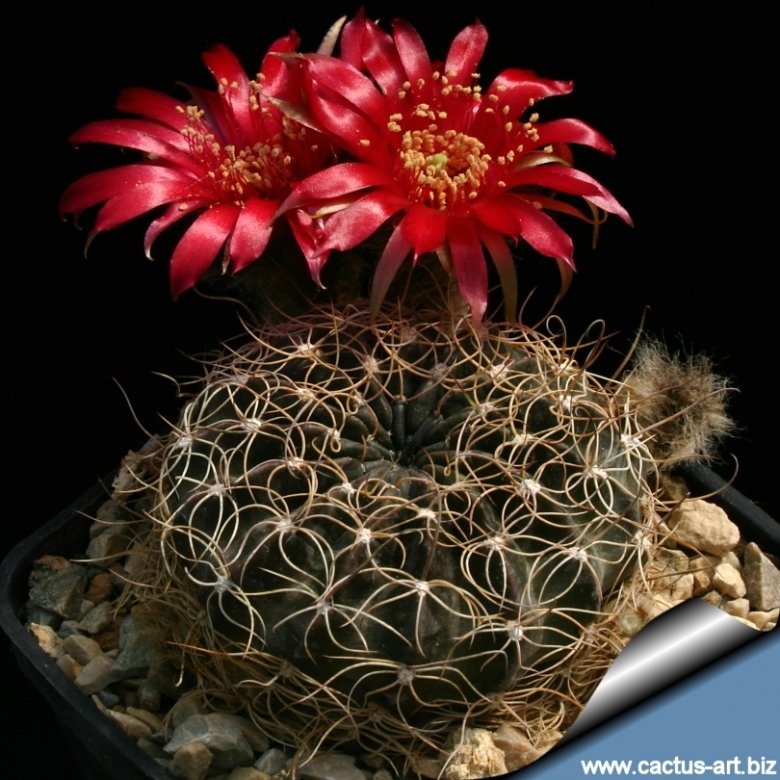
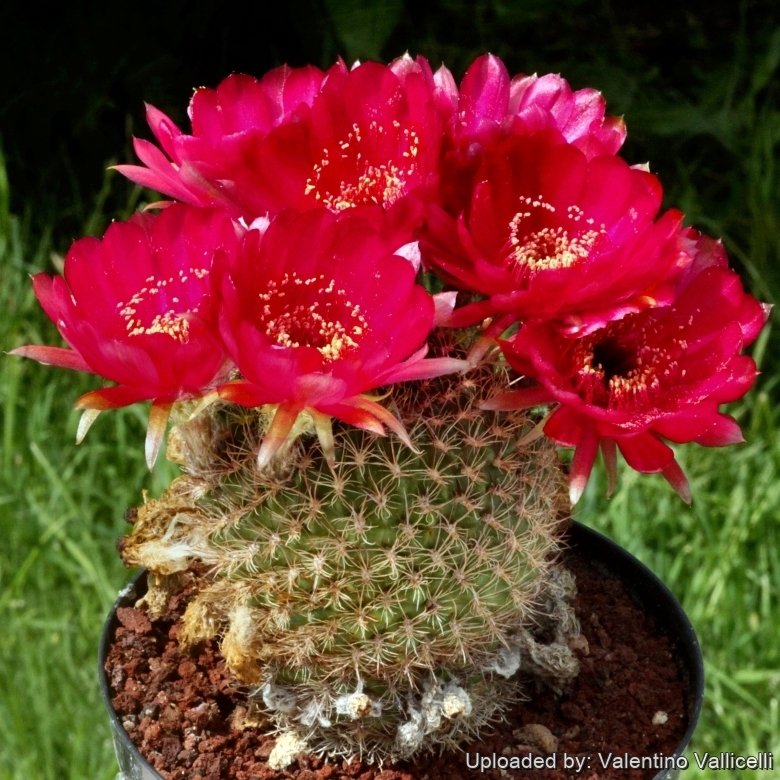
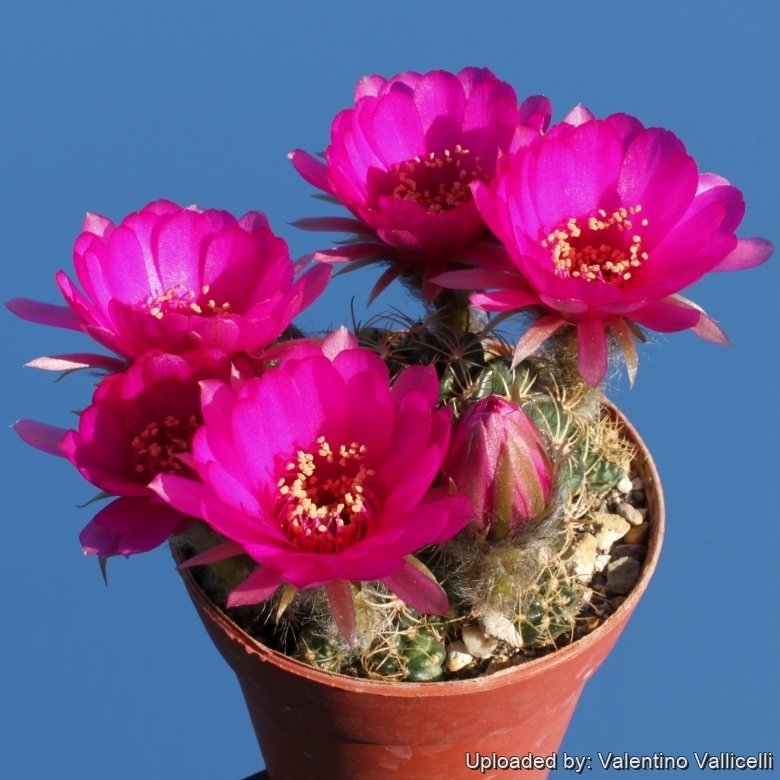
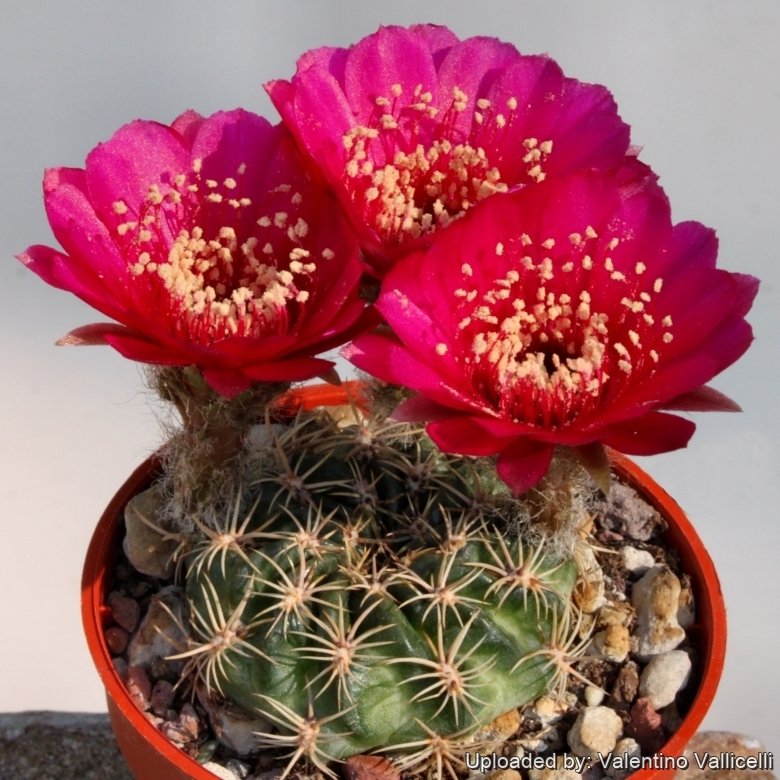
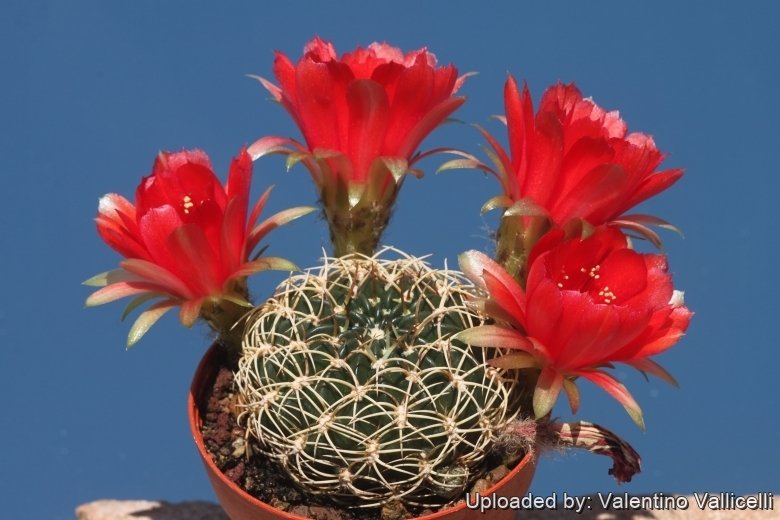
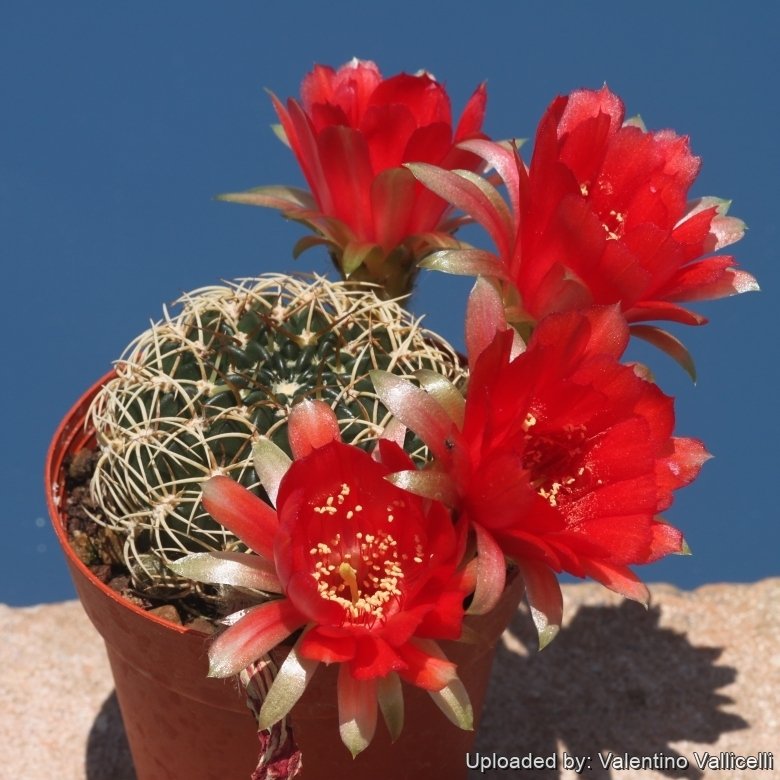
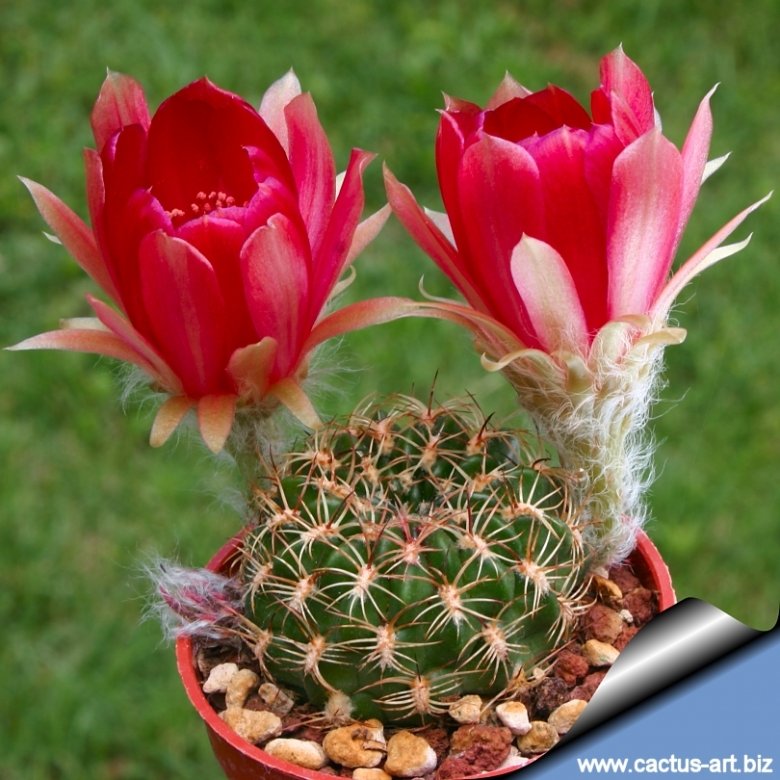
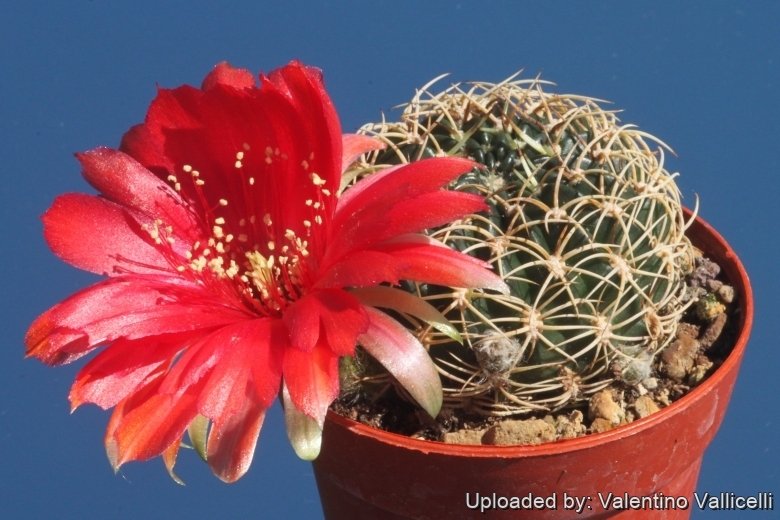
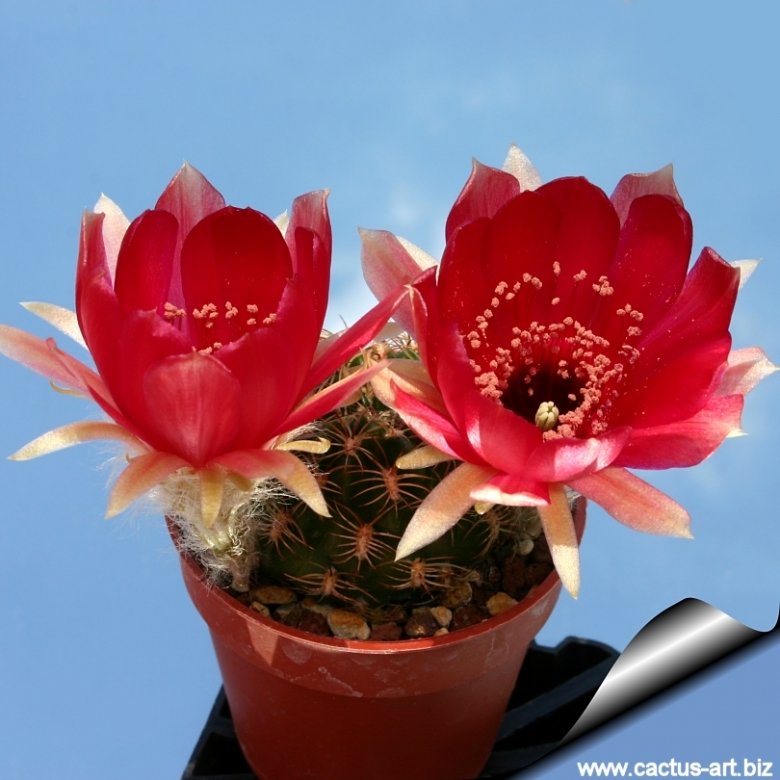
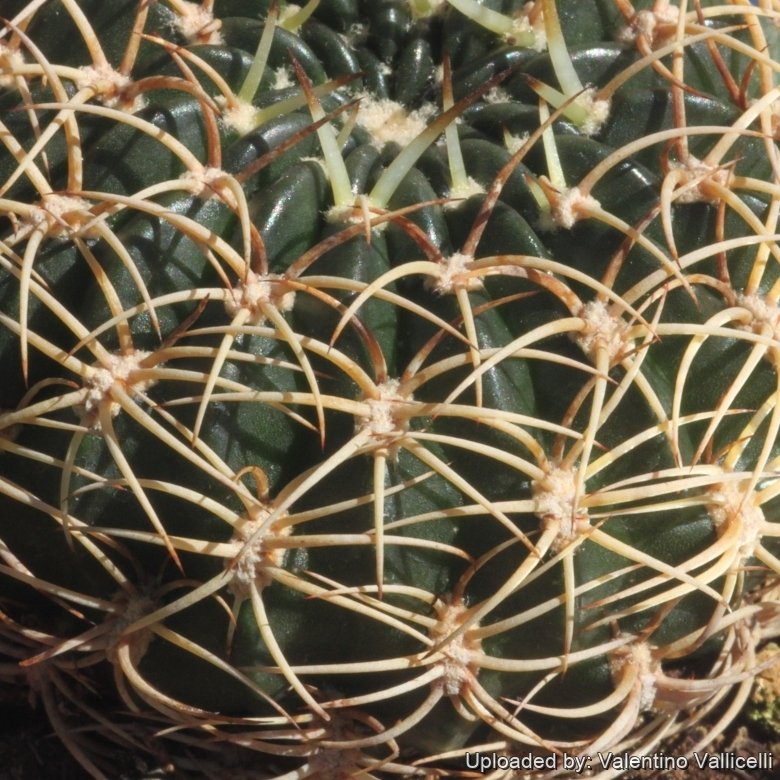
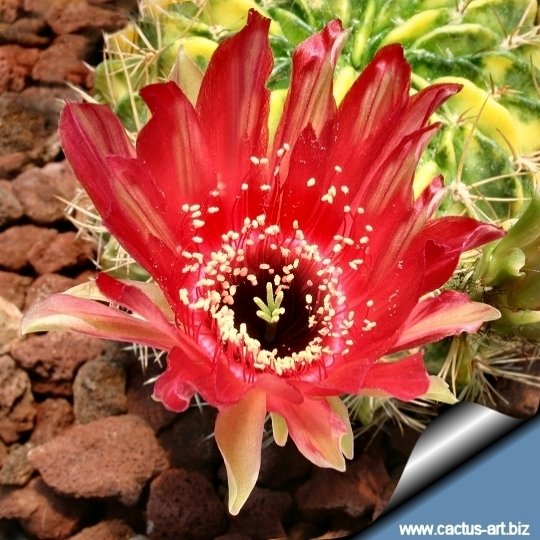
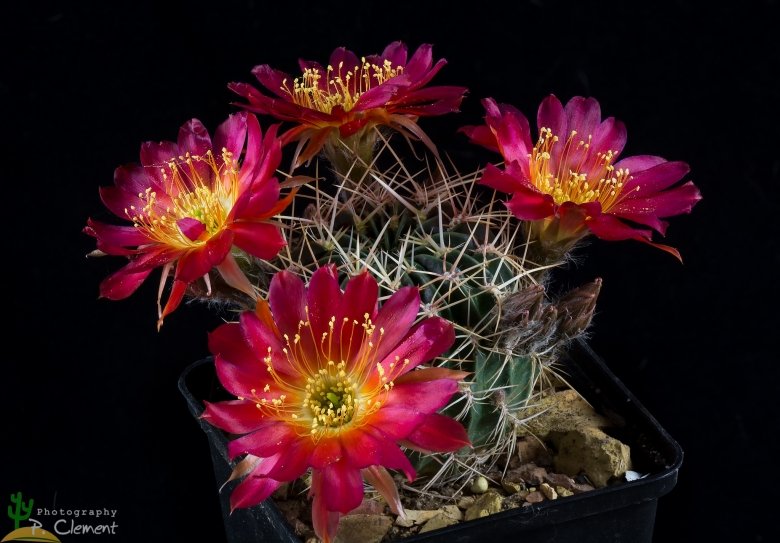
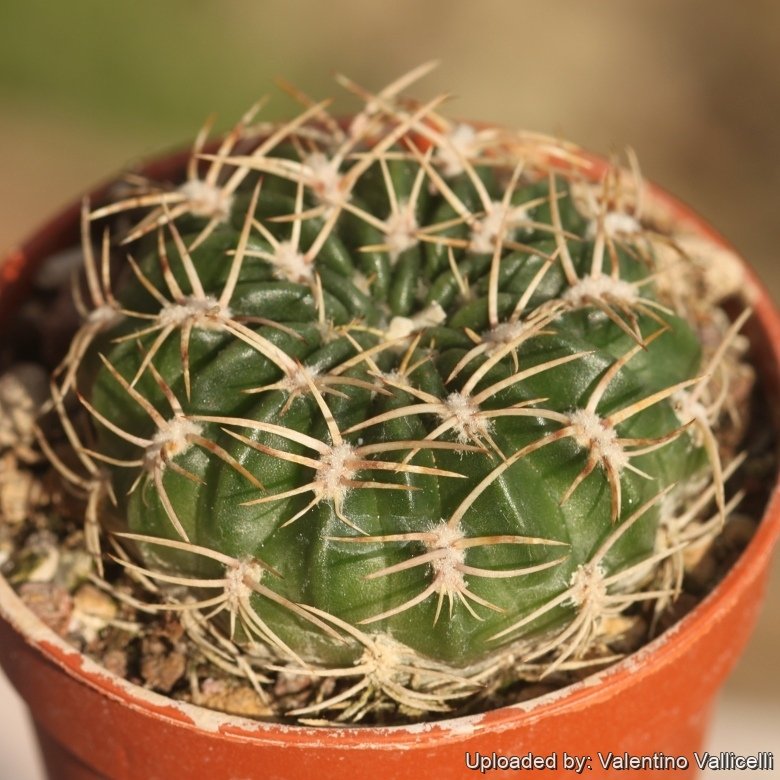
Echinopsis cinnabarina much better known under its old name, Lobivia cinnabarina is a small cactus with a much flattened usually solitary body (sometime forms small few branched clumps).
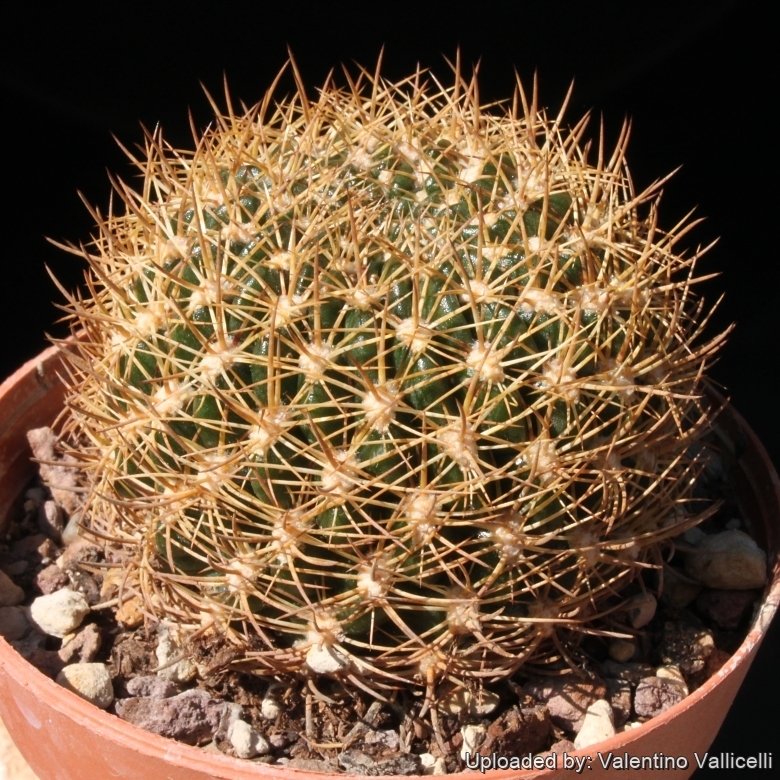
Stems: Glossy dark green, spherical broader than high, depressed and unarmed at apex, up to 15 cm in diameter.
Ribs: It has 20 ribs spirally arranged, irregular and oblique, with raised to acute tubercles between which the areoles appear.
Areoles: Rounded with short whitish felt.
Radial spines: 8-10, about 1-2 cm long, arranged like little spiders, more or less curved backward, acicular, slender, brownish, turn greyish eventually.
Central spines: None or 1 to 3 stouter, somewhat curved.
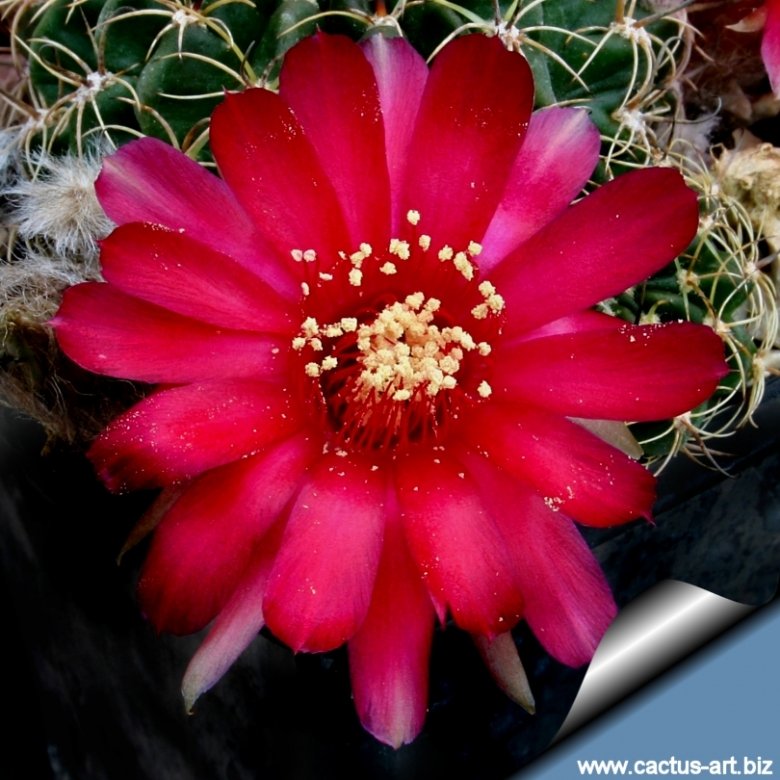
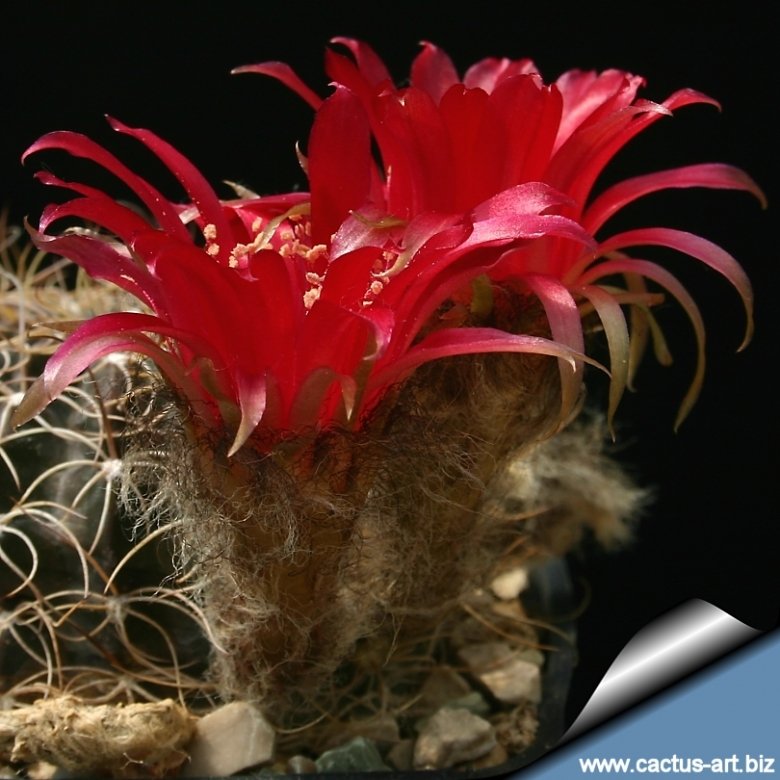
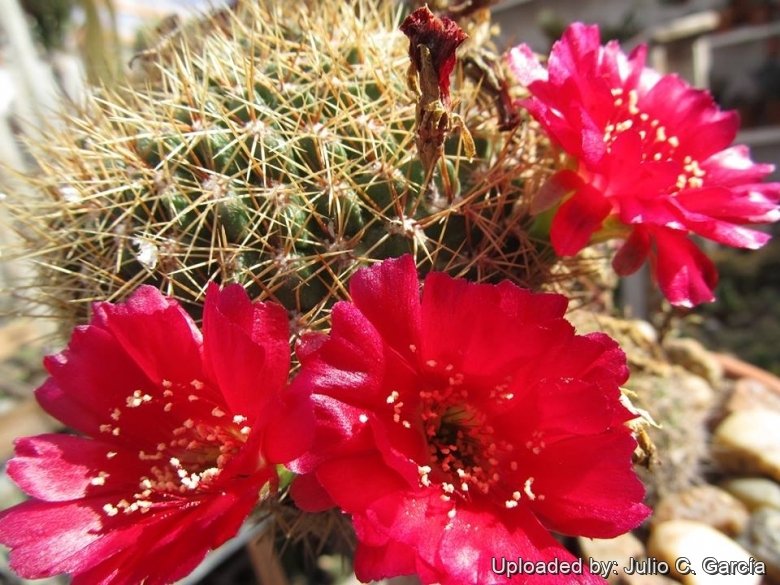
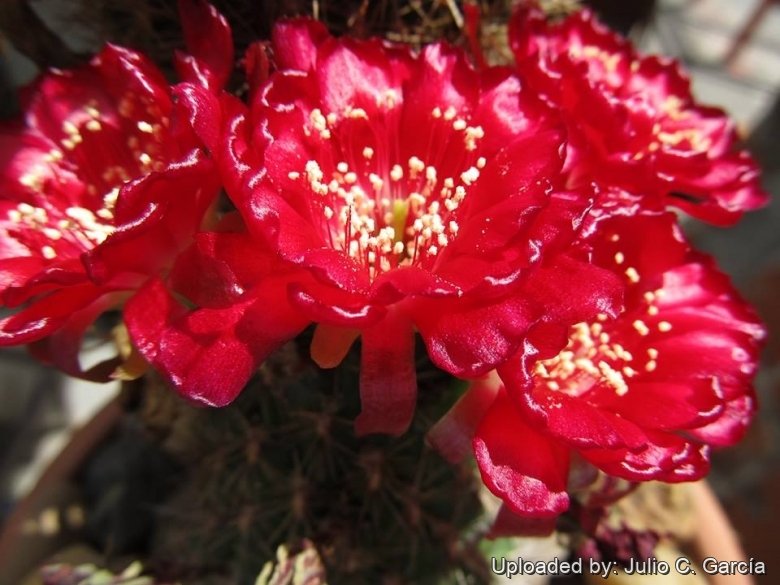
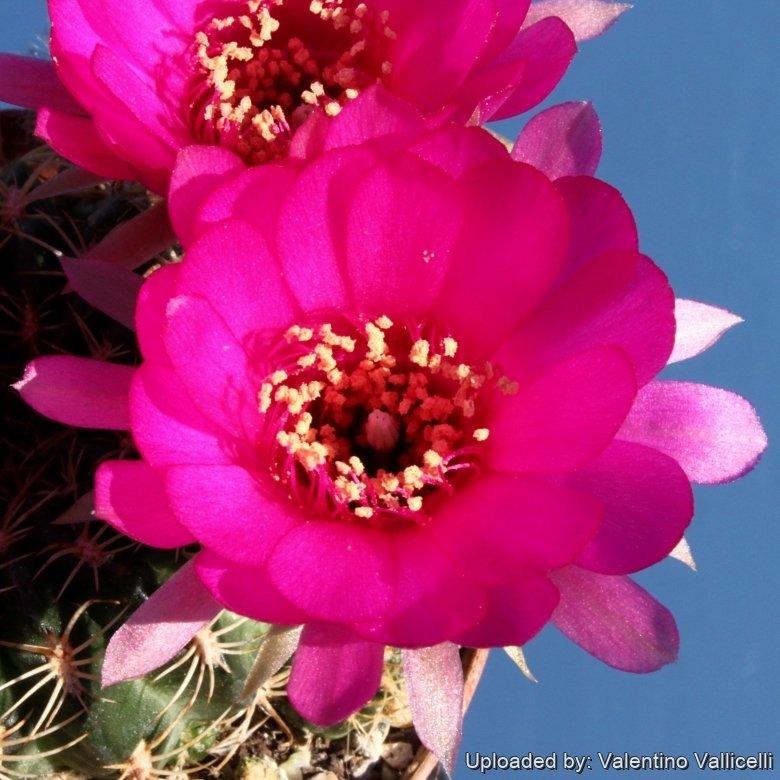
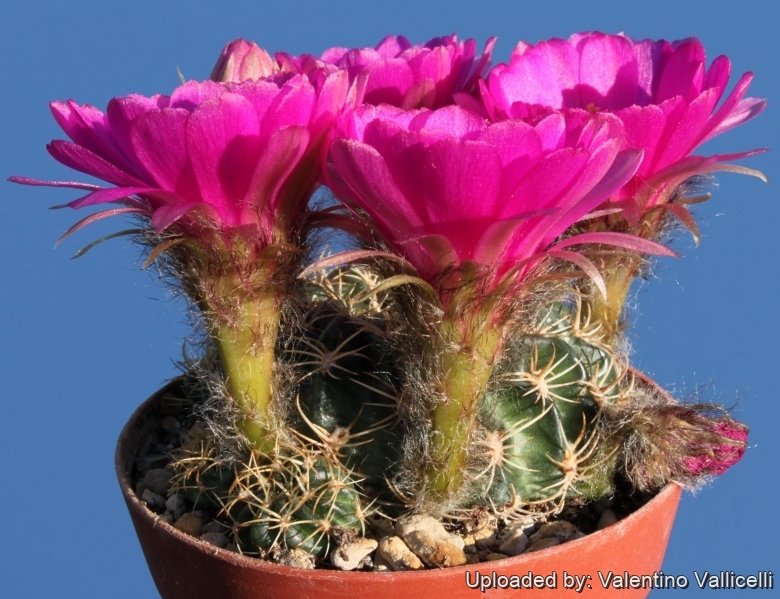
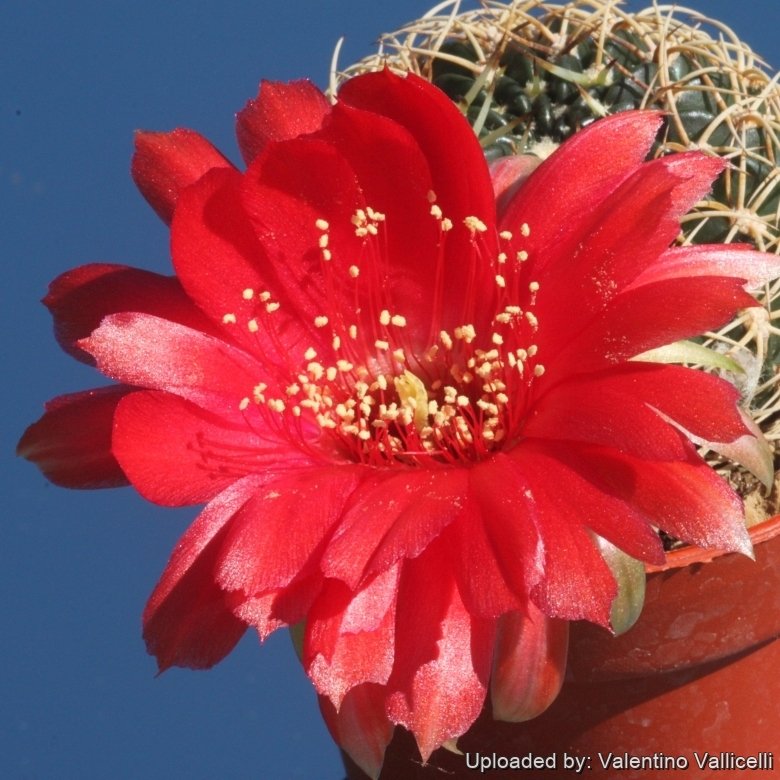
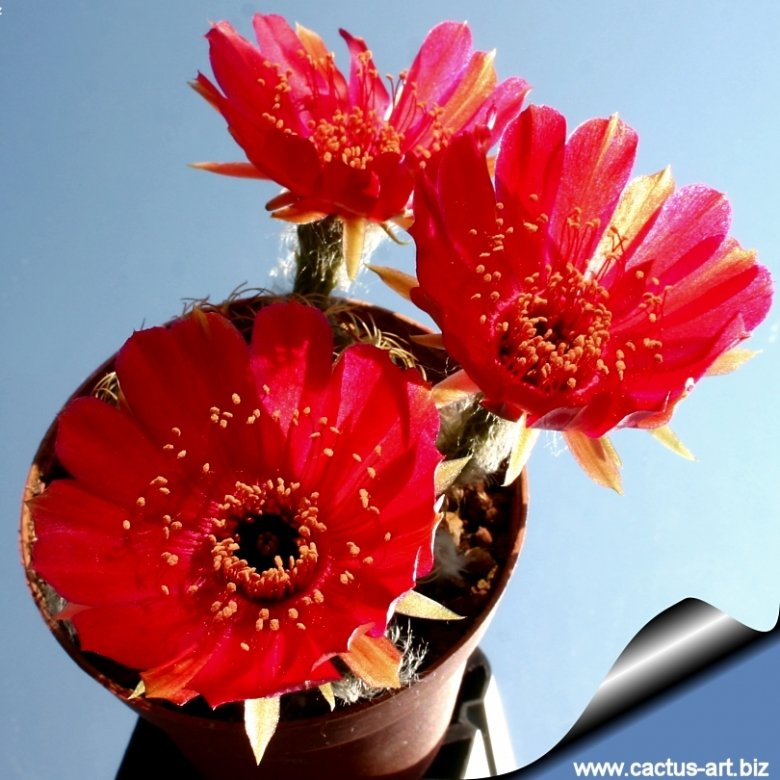
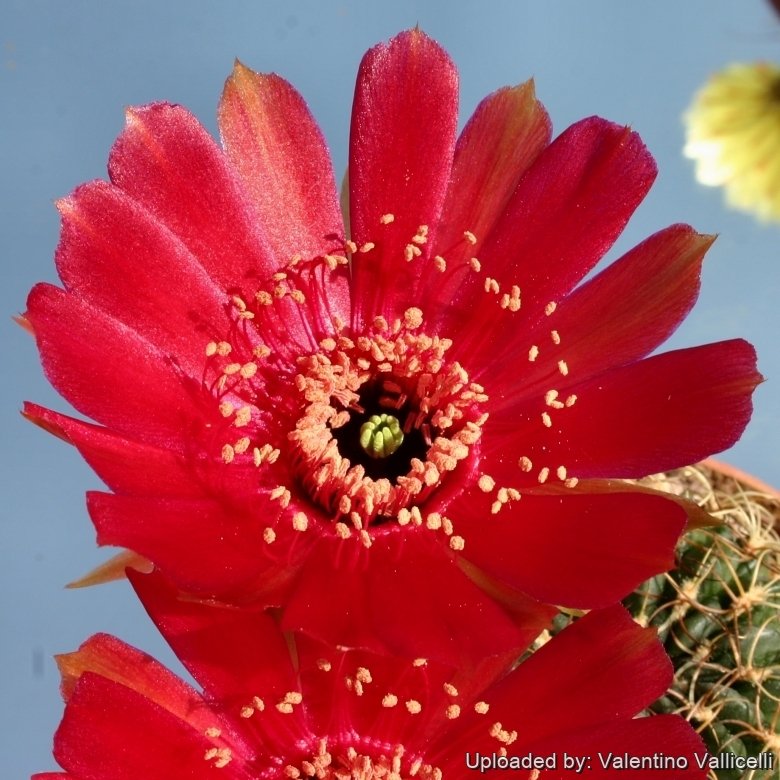
Flowers: About 4 to 8 cm broad, near the plant apex, rotate-campanulate, scarlet to deep red. Inner perianth segments broad, obtuse, the outer one greenish or whitish, stamen and stile much shorter than the perianth-segments. The flower’s tube is covered by hairy lanceolate-acute scales with hairy axils.
Origin and Habitat
Higher Andes of Southern Bolivia (Chuquisaca, Cochabamba, Potosi and Santa Cruz) and Northern Argentina
Altitude: 2000 to 4000 metres of altitude.
Habitat and Ecology: The species occurs in pre-Puna and on rocky lands within shrubby vegetation in seasonally dry inter-Andean valleys. There are no major threats other than subsistence farming, but seedlings establish quite well after a disturbance.
Cultivation and Propagation
Echinopsis cinnabarina is a summer grower species that offers no cultivation difficulties. Water regularly in summer (but do not overwater ) needs good drainage and very porous, keep rather dry in winter. Feed with a high potassium fertilizer in summer. It is quite frost resistant if kept dry (hardy to -12° C). Need a bright exposure, full sun or half shade in summer.
Propagation: Direct sow after last frost, offsets (if available).
Notes
This taxon has lots of synonyms (like most Lobivia) whit several controversial varieties and subspecies.
Bibliography
Major references and further lectures
-
James Cullen, Sabina G. Knees, H. Suzanne Cubey “The European Garden Flora Flowering Plants: A Manual for the Identification of Plants Cultivated in Europe, Both Out-of-Doors and Under Glass” Cambridge University Press, 11/Aug./2011
-
David Hunt, Nigel Taylor “The New Cactus Lexicon” DH Books, 2006
-
Edward F. Anderson “The Cactus Family” Timber Press, 2001
-
Walter Rausch in: Kakteen And. Sukk. 28(4): 75. 1977
-
Walter Rausch “Lobivia 85.” Rudolf Herzig Verlag, Wien. 1986.
-
Walter Rausch “Lobivia: The Day Flowering Echinopsidinae from a Geographical Distribution Point of View” Volumes 1-3 R. Herzig, 1975
-
Brian Lamb “Letts guide to cacti of the world” Letts, 17/ott/1991
-
Lowry, M. 2013. Echinopsis cinnabarina. In: IUCN 2013. IUCN Red List of Threatened Species. Version 2013.2. <www.iucnredlist.org>. Downloaded on 12 January 2014.
From llifle page Cinnabarinea acanthoplegma
Description
Echinopsis cinnabarina var. acanthoplegma, best known as Lobivia acanthoplegma is small cactus species with colourful flowers ranging from orange to dark violet-red with contrasting white throat.
Habit: It is a small, low growing cactus that grows usually solitary (unless damaged).
Stem: Spherical-flattened to spherical, 15 cm diameter.
Ribs: Aprrox. 26 with noticeable tubercles up to 15 mm long.
Radial spines: Approx. 10, up to 20 mm long, awl-like, lying flat to the body, more or less interlaced.
Central spines: Usually absent.
Flower: Arising from the basal tubercles on the side of the plant, up to 5 cm long and in diameter, unscented, orange to dark violet-red, throat usually lighter or white.
Fruit: Globose to oval, semi-dry and perpendicularly splitting.
Seed: Spherical, rough, grey, covered with skin remainders.
Origin and Habitat
Higher Andes of Southern Bolivia, Cochabamba to La Paz and adjacent area.
Altitude: 2300-3500 metres above sea level.
Habitat and Ecology: The species occurs in pre-Puna and on rocky lands within shrubby vegetation in seasonally dry inter-Andean valleys. It grows together with Echinopsis obrepanda.
Cultivation and Propagation
Echinopsis cinnabarina var. acanthoplegma is a summer grower species that offers no cultivation difficulties. Water regularly in summer (but do not overwater ) needs good drainage and very porous, keep rather dry in winter. Feed with a high potassium fertilizer in summer. It is quite frost resistant if kept dry (hardy to -12° C). Need a bright exposure, full sun or half shade in summer.
Propagation: Direct sow after last frost, offsets (if available).
Source: Cinnabarinea acanthoplegma, LLIFLE - Encyclopedia of living forms, CC-BY-SA, retrieved 2026-10-25.
From llifle page Cinnabarinea oligotricha
Description
Echinopsis oligotricha (syn: Lobivia cinnabarina subvar. oligotricha) is similar in habit to Echinopsis cinnabarina var. acanthoplegma but the flowers tube are typically nearly naked (or with few hairs). It is a small plant with flattened stem, but worth growing for the fantastic pink-violet to red flowers with a contrasting white throat. As most Libivias it is easy to grow and ready flowering plant.
Habit: It is a small, low growing cactus that grows usually solitary (unless damaged).
Stem: Green, spherical-flattened to spherical, 15 cm diameter.
Ribs: Approx 26 with noticeable tubercles up to 15 mm long.
Radial spines: Approx. 10, up to 20 mm long, awl-like, lying flat to the body, more or less interlaced.
Central spines: Usually absent.
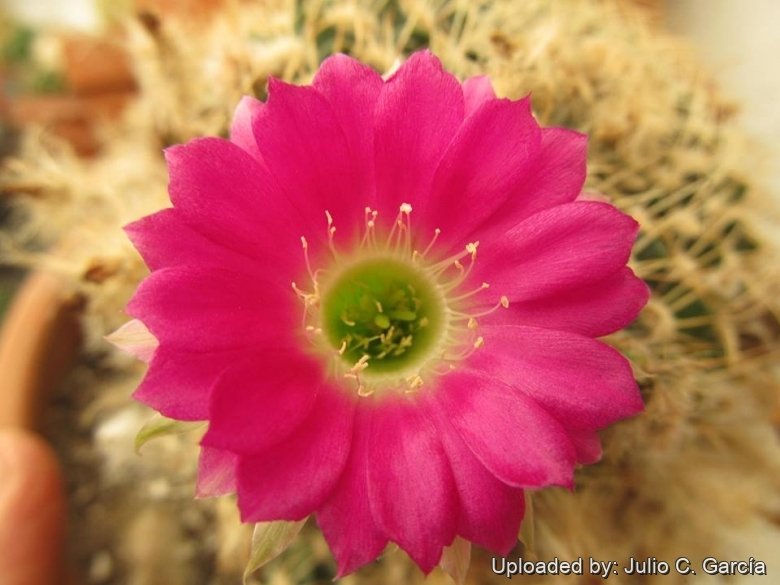
Flower: Arising from the basal tubercles on the side of the plant, up to 5 cm long and in diameter, unscented, pink-violet to red, throat usually lighter or white.
Fruit: Globose to oval, semi-dry and perpendicularly splitting.
Seed: Spherical, rough, grey, covered with skin remainders.
Origin and Habitat
Arani and adjacent areas, Cochabamba, Bolivia (Western South America)
Altitude: 2800-3450 metres above sea level.
Habitat and Ecology: The species occurs in pre-Puna and on rocky lands within shrubby vegetation in seasonally dry inter-Andean valleys. It grows together together with Parodia schwebsiana v. applanata.
Cultivation and Propagation
Echinopsis oligotricha is a summer grower species that offers no cultivation difficulties. Water regularly in summer (but do not overwater ) needs good drainage and very porous, keep rather dry in winter. Feed with a high potassium fertilizer in summer. It is quite frost resistant if kept dry (hardy to -12° C). Need a bright exposure, full sun or half shade in summer.
Propagation: Direct sow after last frost, offsets (if available).
Source: Cinnabarinea oligotricha, LLIFLE - Encyclopedia of living forms, CC-BY-SA, retrieved 2026-10-25.
From llifle page Cinnabarinea walterspielii
Description
Echinopsis cinnabarina var. walterspieli much better known under its old name, Lobivia walterspielii is one of the morphological or local form of the very variable Echinopsis cinnabarina. It distinguishes mostly in having a very flat body, longer and more porrect yellowish spines and clear red cup-shaped flower.
Habit: is a small cactus with a much flattened usually solitary body (sometime forms small few branched clumps).
Stems: Glossy dark green, spherical broader than high, depressed and unarmed at apex, up to 15 cm in diameter.
Ribs: It has 20 ribs spirally arranged, irregular and oblique, with raised to acute tubercles between which the areoles appear.
Areoles: Rounded with short whitish felt.
Radial spines: Longer and more porrect than in the standard Echinopsis cinnabarina, spreading, acicular, slender, Yellowish turning greyish eventually.
Central spines: None or 1 to 3 stouter.
Flowers: About 4 to 8 cm broad, near the plant apex, red cup-shaped. The flower’s tube is covered by hairy lanceolate-acute scales with hairy axils.
Origin and Habitat
Lobivia walterspielii, grows south of the type locality near Potosi (between Otuyo and Betanzos)
Altitude: 3000-3500 metres above sea level.
Bibliography
Major references and further lectures
-
James Cullen, Sabina G. Knees, H. Suzanne Cubey “The European Garden Flora Flowering Plants: A Manual for the Identification of Plants Cultivated in Europe, Both Out-of-Doors and Under Glass” Cambridge University Press, 11/Aug./2011
-
David Hunt, Nigel Taylor “The New Cactus Lexicon” DH Books, 2006
-
Edward F. Anderson “The Cactus Family” Timber Press, 2001
Source: Cinnabarinea walterspielii, LLIFLE - Encyclopedia of living forms, CC-BY-SA, retrieved 2026-10-25.
From llifle page Lobivia draxleriana
Description
Echinopsis cinnabarina var. draxleriana| is a small cactus with a much flattened, usually solitary body (sometime forms small few branched clumps). It distinguishes mostly in having a very flat body, and paler creamy-yellow spines.
Stems: Glossy dark green, spherical broader than high, depressed and unarmed at apex, up to 15 cm in diameter.
Ribs: It has 20 ribs spirally arranged, irregular and oblique, with raised to acute tubercles between which the areoles appear.
Areoles: Rounded with short whitish felt.
Radial spines: 8-10, about 1-2 cm long, arranged like little spiders, more or less curved backward, acicular, slender, creamy-yellow turning greyish eventually.
Central spines: None or 1 to 3 stouter, somewhat curved.
Flowers: About 4 to 8 cm broad, near the plant apex, rotate-campanulate, scarlet to deep red. Inner perianth segments broad, obtuse, the outer one greenish or whitish, stamen and stile much shorter than the perianth-segments. The flower’s tube is covered by hairy lanceolate-acute scales with hairy axils.
Origin and Habitat
Cochabamba and Chuquisaca, Bolivia.
Altitude: 2400-3100 metres above sea level.
Habitat: It grows together with Rebutia donaldiana, Rebutia pulchella, Rebutia ithyacantha and Rebutia vallegrandensis.
Cultivation and Propagation
It is a summer grower species that offers no cultivation difficulties. Water regularly in summer (but do not overwater ) needs good drainage and very porous, keep rather dry in winter. Feed with a high potassium fertilizer in summer. It is quite frost resistant if kept dry (hardy to -12° C). Need a bright exposure, full sun or half shade in summer.
Propagation: Direct sow after last frost, offsets (if available)
Bibliography
Major references and further lectures
-
Edward Anderson “The Cactus family” Timber Press, Incorporated, 2001
-
James Cullen, Sabina G. Knees, H. Suzanne Cubey “The European Garden Flora Flowering Plants: A Manual for the Identification of Plants Cultivated in Europe, Both Out-of-Doors and Under Glass” Cambridge University Press, 11/Aug/2011
-
David R Hunt; Nigel P Taylor; Graham Charles; International Cactaceae Systematics Group. “The New Cactus Lexicon” dh books, 2006
-
N. L. Britton, J. N. Rose “The Cactaceae. Descriptions and Illustrations of Plants of the Cactus Family.” Volume 4, The Carnegie Institution of Washington, Washington 1923
Source: Lobivia draxleriana, LLIFLE - Encyclopedia of living forms, CC-BY-SA, retrieved 2026-10-25.
From llifle page Cinnabarinea pseudocinnabarina var. microthelis
Description
Small cactus with a much flattened usually solitary body (sometime forms small few branched clumps).
Stems: Glossy dark green, spherical broader than high, deprssed and unarmed at apex, up to 15 cm in diameter.
Ribs: It has 20 ribs spirally arranged, irregular and oblique, with raised to acute tubercles between which the areoles appear.
Areoles: Rounded with short whitish felt.
Radial spines: 8-10, about 1-2 cm long, arranged like little spiders, more or less curved backward, acicular, slender, brownish, turn greyish eventually.
Central spines: None or 1 to 3 stouter, somewhat curved.
Flowers: About 4 to 8 cm broad, near the plant apex, rotate-campanulate, scarlet to deep red. Inner perianth segments dbroad, obtuse, the outer one greenish or whitish, stamen and stile much shorter than the perianth-segments. The flower’s tube is covered by hairy lanceolate-acute scales with hairy axils.
Origin and Habitat
Higher Andes of Southern Bolivia and Northern Argentina (2000 to 4000 m of altitude)
Source: Cinnabarinea pseudocinnabarina var. microthelis, LLIFLE - Encyclopedia of living forms, CC-BY-SA, retrieved 2026-10-25.
From llifle page Lobivia cinnabarina f. variegata
Description
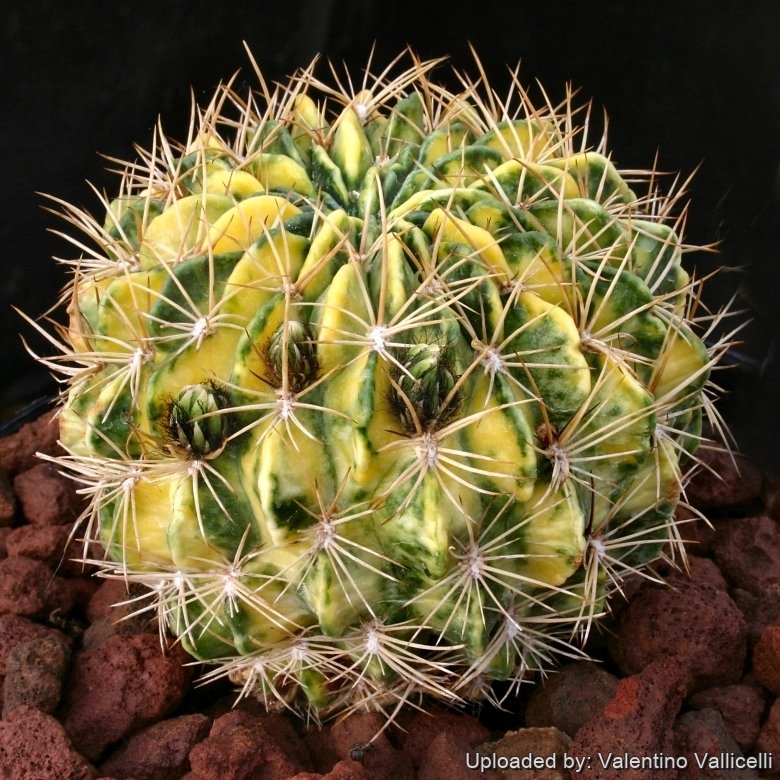
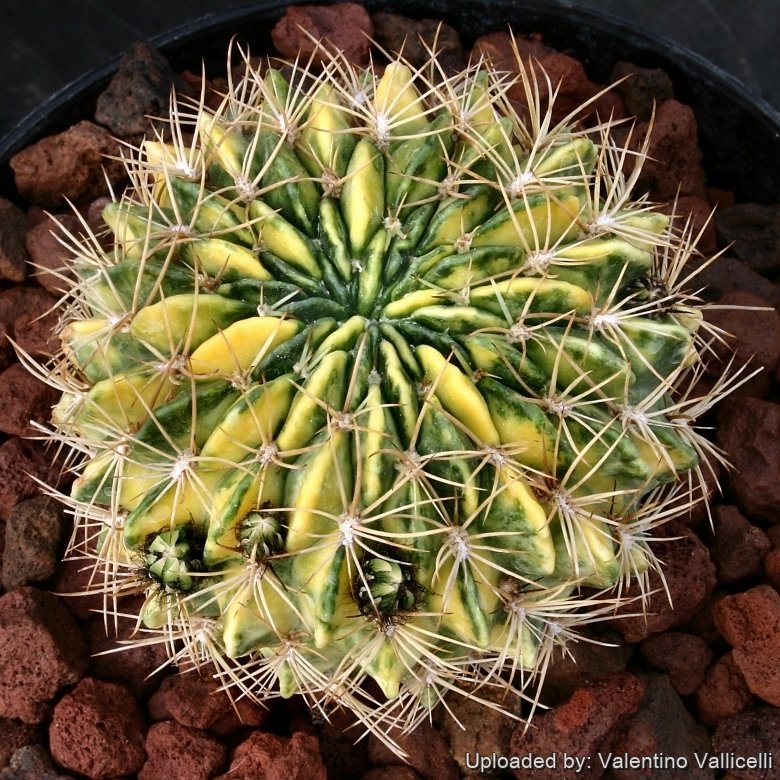
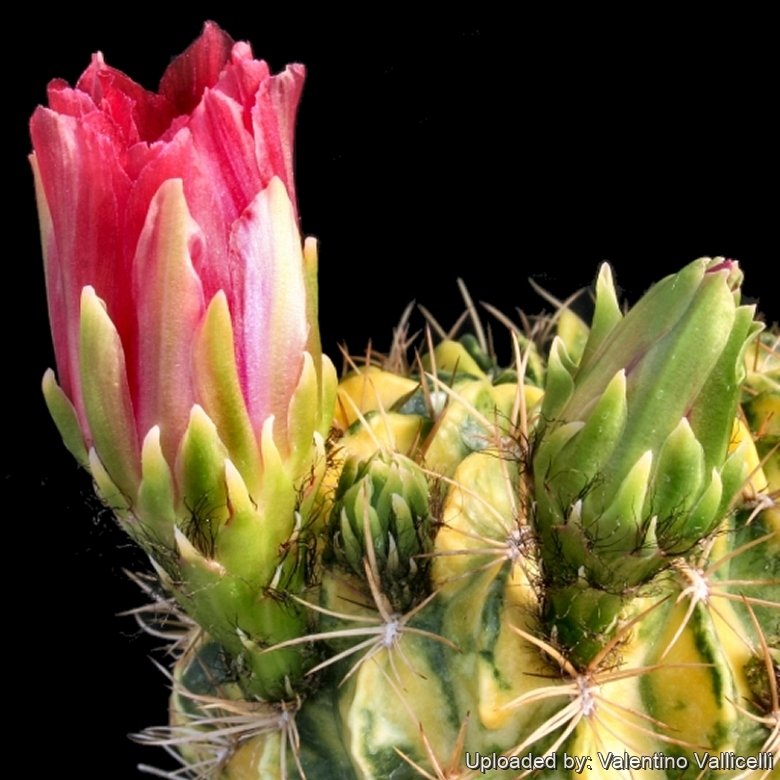
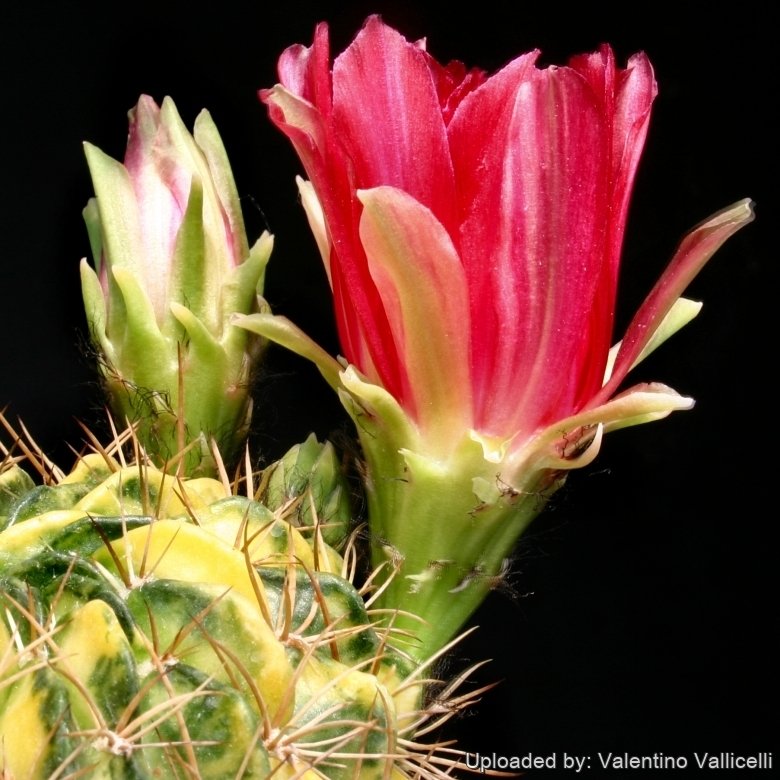
The classical Echinopsis cinnabarina (syn: Lobivia cinnabarina) is a small cactus with a much flattened usually solitary body (sometime forms small few branched clumps). The variegated form (Echinopsis cinnabarina f. variegata) has sectors, patches or stripes with distinct shades of yellow. A very few variegated plants sprout unpredictably time by time among normal green seedling and are very rare. Plants with variegated stems are often attractive and highly prized.
Stems: Glossy dark green stripped with yellow, spherical broader than high, deprssed and unarmed at apex, up to 15 cm in diameter.
Ribs: It has about 20 ribs spirally arranged, irregular and oblique, with raised to acute tubercles between which the areoles appear.
Areoles: Rounded with short whitish felt.
Radial spines: 8-10, about 1-2 cm long, arranged like little spiders, more or less curved backward, acicular, slender, brownish, turn greyish eventually.
Central spines: None or 1 to 3 stouter, somewhat curved.
Flowers: About 4 to 8 cm broad, near the plant apex, scarlet to deep red and often variegated (with paler strips).
Origin and Habitat
Garden origin (Nursery produced cultivar)
Cultivation and Propagation
Variegated cacti are regarded as choice and difficult in cultivation, but despite that many of them are relatively easy to grow. But be aware that they cannot tolerate prolonged exposure to direct sun light (especially during the hottest summer days), so grow them in half-shade or under filtered sun. They are sometime seen as grafted plants, but some of this colourful plants (those with some chlorophyll) are able to grow on their own roots and are priced by collectors.
Soil: Use mineral well-permeable substratum with little organic matter (peat, humus).
Watering: Water sparingly from March till October, and keep perfectly dry in winter, at temperatures from 5 to 15 degrees centigrade. (In general these plants are more tender and cannot endure freezing temperatures). In the rest period no high atmospheric humidity!!
Propagation: By seeds, grafting or cutting. Because the variegation is due to the presence of two kinds of plant tissue, propagating the plant must be by a vegetative method of propagation that preserves both types of tissue in relation to each other. A most common way way to cultivate this partially de-coloured cultivars is to graft them onto another cactus which has chlorophyll and which will provide sugar to the mutant scion. The chlorophyll containing bottom part of the graft, called the stock, can be any number of different columnar cactus species.
Remarks: Seeds from variegated parents often give raise to some variegated seedlings too.
Source: Lobivia cinnabarina f. variegata, LLIFLE - Encyclopedia of living forms, CC-BY-SA, retrieved 2026-10-25.
From llifle page Lobivia acanthoplegma var. patula
Description
Lobivia acanthoplegma var. patula is one of the many geographical or morphological form of Echinopsis cinnabarina. Many variant of Echinopsis cinnabarina was early classified as different independent species, but nowadays all this plants are considered part of a multiform species, where each form is linked to others by populations of plants with intermediate characteristics. This variety has more porrect-spreading spines than the similar Echinopsis cinnabarina var. acanthoplegma, this different spination is probably due to the lower altitude of Cliza, and the patula must be included in to the type. This plant puts out a few flowers at a time continuously for several weeks in spring to early summer.
Habit: It is a small, low growing cactus that grows usually solitary (unless damaged).
Stem: Spherical-flattened to spherical, 15 cm diameter.
Ribs: Aprrox. 26 with noticeable tubercles up to 15 mm long.
Radial spines: Approx. 10, up to 20 mm long, awl-like, more porrect-spreading , more or less interlaced.
Central spines: Usually absent.
Flower: Arising from the basal tubercles on the side of the plant, up to 5 cm long and in diameter, unscented, orange to dark violet-red, throat lighter or white.
Fruit: Globose to oval, semi-dry and perpendicularly splitting.
Seed: Spherical, rough, grey, covered with skin remainders.
Origin and Habitat
Cliza and adjiacent ares, Cochabamba, Bolivia
Altitude: 2000-3200 metres above sea level.
Habitat and Ecology: The species occurs in pre-Puna and on rocky lands within shrubby vegetation in seasonally dry inter-Andean valleys. In Cacti the Illustrated Dictionary by Rod and Ken Preston-Mafham they write that this form occurs “in an unusual habitat for a Lobivia on flat alluvial land where farming and building have rendered this beautiful variety virtually extinct.”
Cultivation and Propagation
Lobivia acanthoplegma var. patula is a summer grower species that offers no cultivation difficulties. Water regularly in summer (but do not overwater ) needs good drainage and very porous, keep rather dry in winter. Feed with a high potassium fertilizer in summer. It is quite frost resistant if kept dry (hardy to -12° C). Need a bright exposure, full sun or half shade in summer.
Propagation: Direct sow after last frost, offsets (if available).
Bibliography
Major references and further lectures
-
Rod Preston-Mafham, Ken Preston-Mafham “Cacti: the illustrated dictionary” Timber Press, 1991
-
Friedrich Ritter “Kakteen in Südamerika: Ergebnisse meiner 20jährigen” Volume 2, Argentinien/Bolivien, Volume 2 Selbstverlag, 1980
-
Curt Backeberg “Die Cactaceae: Handbuch der Kakteenkunde,” Volume 2 G. Fischer, 1959
-
James Cullen, Sabina G. Knees, H. Suzanne Cubey “The European Garden Flora Flowering Plants: A Manual for the Identification of Plants Cultivated in Europe, Both Out-of-Doors and Under Glass” Cambridge University Press, 11/Aug./2011
-
David Hunt, Nigel Taylor “The New Cactus Lexicon” DH Books, 2006
-
Edward F. Anderson “The Cactus Family” Timber Press, 2001
-
Walter Rausch in: Kakteen And. Sukk. 28(4): 75. 1977
-
Walter Rausch “Lobivia 85.” Rudolf Herzig Verlag, Wien. 1986.
-
Walter Rausch “Lobivia: The Day Flowering Echinopsidinae from a Geographical Distribution Point of View” Volumes 1-3 R. Herzig, 1975
-
Brian Lamb “Letts guide to cacti of the world” Letts, 17/ott/1991
-
Lowry, M. 2013. Echinopsis cinnabarina. In: IUCN 2013. IUCN Red List of Threatened Species. Version 2013.2. <www.iucnredlist.org>. Downloaded on 12 January 2014.
Source: Lobivia acanthoplegma var. patula, LLIFLE - Encyclopedia of living forms, CC-BY-SA, retrieved 2026-10-25.
From llifle page Lobivia acanthoplegma f. pilosa
Description
Echinopsis cinnabarina var. acanthoplegma f. pilosa|, best known as Lobivia acanthoplegma f. pilosa, is a small usually single stemmed species. In habitat it is very similar to Echinopsis oligotricha, but has dense hairy dark carmine flowers up to 50 mm large .
Habit: This population grows depending upon location flat and drawn into the soil.
Stem: 100 mm wide and tall globose to short-cylindrical, crown slightly depressed, light green to dark green with about 20 spiralling ribs, with narrow tubercles about 10 mm long.
Areoles: Oval to circular 4-5 mm long, 3 to 4 mm wide, apart from each other with white tomentum in younger areoles that soon disappears..
Radial spines: Approx 13-14, needle-like, spreading, addpressed and bent inwards 8-10 mm long, straw-yellow, horn coloured, sometimes light or dark brown to black with a darker tip.
Central spines: 1-5(-7) difficult to distinguish, subulate, 10-18 mm long, reddish-brown with a darker tip.
Flower: Funnel-shaped 45 mm in length and 50 mm in diameter, ovary and tube light green with very delicate pink scales and dense long brown hair, outer tepals very narrow and long, green with pink edges, the inner tepals oval serrate, dark red with a purple bloom and a white throat.
Stamens: Whitish-pink with a green base set in two series, the first not numerous on the inner surface of the throat, the other on its edge.
Style: Very short, green, stigma lobes12 yellowish-green.
Fruit: Oval, tapering upward, 15 mm long, with very small pink scales and long brown to grey hair, drying at maturity, cracking vertically,
Seeds: Like Lobivia acanthoplegma Backeberg, ovoid spherical, about 1 mm long, covered with remnants of pulp, testa black, bumpy.
Origin and Habitat
Cerro Kara-Kara, Cochabamba, Bolivia.
Altitude: 3100 metres above sea level.
Habitat and Ecology: The species occurs in pre-Puna and on rocky lands within shrubby vegetation in seasonally dry inter-Andean valleys.
Cultivation and Propagation
It is a summer grower species that offers no cultivation difficulties. Water regularly in summer (but do not overwater) needs good drainage and very porous, keep rather dry in winter. Feed with a high potassium fertilizer in summer. It is quite frost resistant if kept dry (hardy to -12° C). Need a bright exposure, full sun or half shade in summer.
Propagation: Direct sow after last frost, offsets (if available)
Source: Lobivia acanthoplegma f. pilosa, LLIFLE - Encyclopedia of living forms, CC-BY-SA, retrieved 2026-10-25.
From llifle page Lobivia acanthoplegma var. roseiflora
Description
Echinopsis cinnabarina var. acanthoplegma f. roseiflora|, best known as Lobivia acanthoplegma var. roseiflora, is somewhat more delicate than the type with shorter spines and smaller light to dark pink flowers with contrasting white centre.
Habit: It is a small, low growing cactus that grows usually solitary (unless damaged).
Stem: Spherical-flattened to spherical, up to 7,5 cm tall and 10 cm diameter.
Ribs: Approx. 26 with noticeable tubercles up to 15 mm long.
Radial spines: 10-14, up to 20 mm long, yellowish to greyish, needle-like to awl-like, somewhat curved inward and lying flat to the body, more or less interlaced.
Central spines: Usually absent.
Flower: Arising from the basal tubercles on the side of the plant, up to 5 cm long and in diameter, unscented, light to dark pink flowers with contrasting white centre. Occasionally white.
Fruit: Globose to oval, semi-dry and perpendicularly splitting.
Seed: Spherical, rough, grey, covered with skin remainders.
Origin and Habitat
Cochabamba to Santa Cruz and adjacent areas, Cochabamba, Bolivia
Altitude: 2500-3100 metres above sea level.
Habitat and Ecology: The species occurs in pre-Puna and on rocky lands within shrubby vegetation in seasonally dry inter-Andean valleys. It grows together with Echinopsis obrepanda.
Cultivation and Propagation
Echinopsis cinnabarina var. acanthoplegma f. roseiflora| is a summer grower species that offers no cultivation difficulties. Water regularly in summer (but do not overwater ) needs good drainage and very porous, keep rather dry in winter. Feed with a high potassium fertilizer in summer. It is quite frost resistant if kept dry (hardy to -12° C). Need a bright exposure, full sun or half shade in summer.
Propagation: Direct sow after last frost, offsets (if available).
Source: Lobivia acanthoplegma var. roseiflora, LLIFLE - Encyclopedia of living forms, CC-BY-SA, retrieved 2026-10-25.
Cultivars and forms (2)
Varieties (1)
Forms (1)
Gallery