Publication: (= inermis cristata variegata) a.k.a. “Crested variegate Penis Cactus”
Description
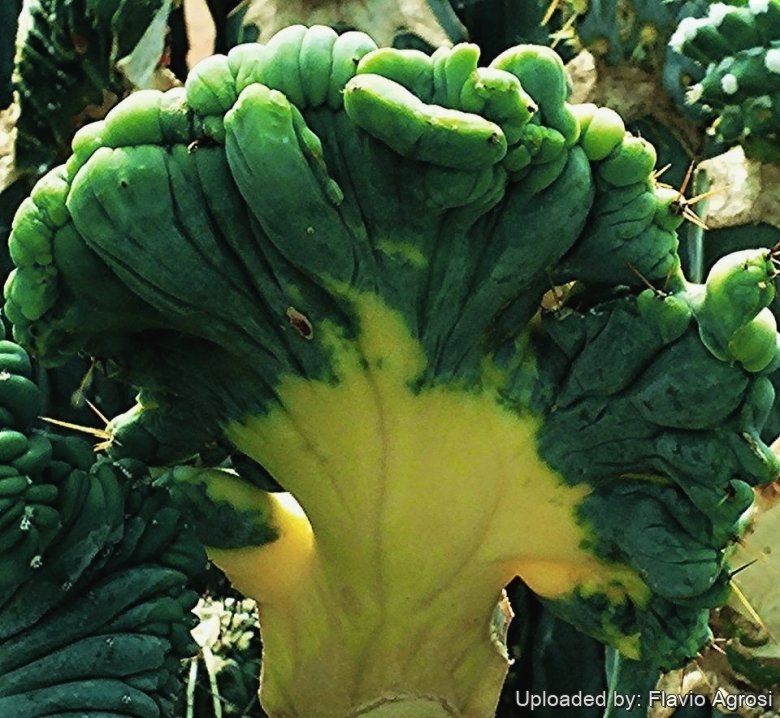
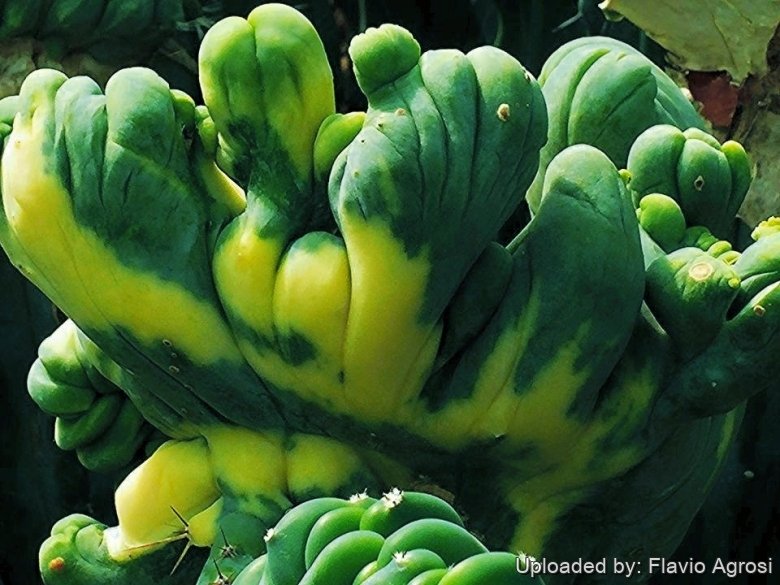
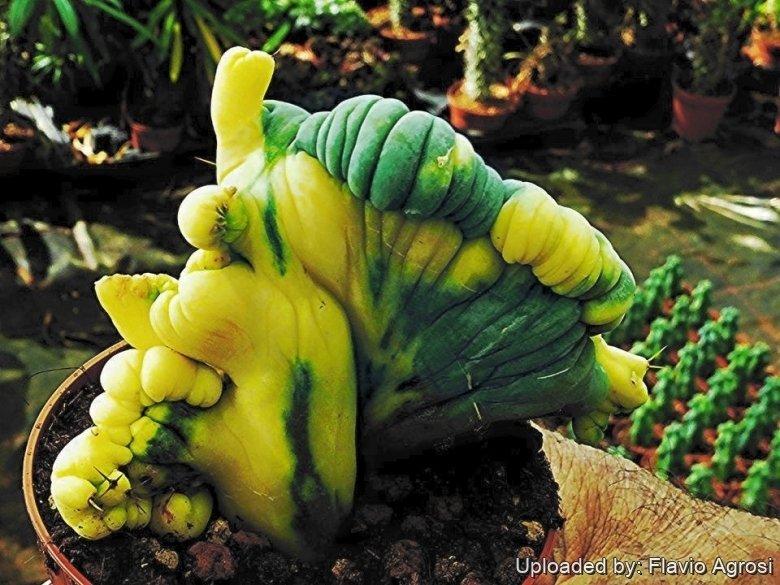
This is the odd crested and variegated in creamy-yellow clone of the monstrous form of Trichocereus bridgesii (a.k.a. “Crested variegated Penis Cactus”) It is one of the rarest and more fascinating crested cacti sought after by cactus impassioned. This cultivar is stable and remain mostly monstrous.
Stem: Glaucous-green with cream-yellow patches or sectors, forming intricately upright fan shaped sculpture that can slowly grow up to 25 (-40) cm tall. It shows different crested, monstrous and variegate shapes even on the same plant.
Spines: Absent or ( if present) in group of up to 4 on rare areoles located in the thinner part of the monstrous crested growth. They are aciculate, straight, quite strong, honey-coloured to brown up to 4 cm long.
NOTE 1: There exist several mutant varieties of Tichocereus bridgesii that are highly prized by cactus impassioned. These include a crested variety, a variegated variety and two variants of monstrous growth. Of the monstrous varieties, one is often known by the name Penis Plant. Two more recently developed clones are now available, the fist of which exhibits both monstrous and crested growth whilst the second shows both monstrous and variegated growth.
NOTE 2: The chemical composition of the ‘Penis Plant’ is supposedly the same as that of the typical Trichocereus bridgesii.
Origin and Habitat
Garden origin (Nursery produced cultivar). The wild species comes from Bolivia, where it occurs in La Paz, Cochabamba, and possibly Santa Cruz.
Cultivation and Propagation
Variegated cacti are regarded as choice and difficult in cultivation, but despite that many of them are relatively easy to grow. But be aware that they cannot tolerate prolonged exposure to direct sun light (especially during the hottest summer days), so grow them in half-shade or under filtered sun. They are sometime seen as grafted plants, but some of this colourful plants (those with some chlorophyll) are able to grow on their own roots and are priced by collectors.
Soil: Use mineral well-permeable substratum with little organic matter (peat, humus).
Watering: Water sparingly from March till October, and keep perfectly dry in winter, at temperatures from 5 to 15 degrees centigrade. (In general these plants are more tender and cannot endure freezing temperatures). In the rest period no high atmospheric humidity!!
Propagation: By grafting or cutting. Because the variegation is due to the presence of two kinds of plant tissue, propagating the plant must be by a vegetative method of propagation that preserves both types of tissue in relation to each other. A most common way way to cultivate this partially de-coloured cultivars is to graft them onto another cactus which has chlorophyll and which will provide sugar to the mutant scion. The chlorophyll containing bottom part of the graft, called the stock, can be any number of different columnar cactus species.