Publication: I.O.S. Bull. 3(3): 96 (1974), as ‘lagenaeformis’.
Description
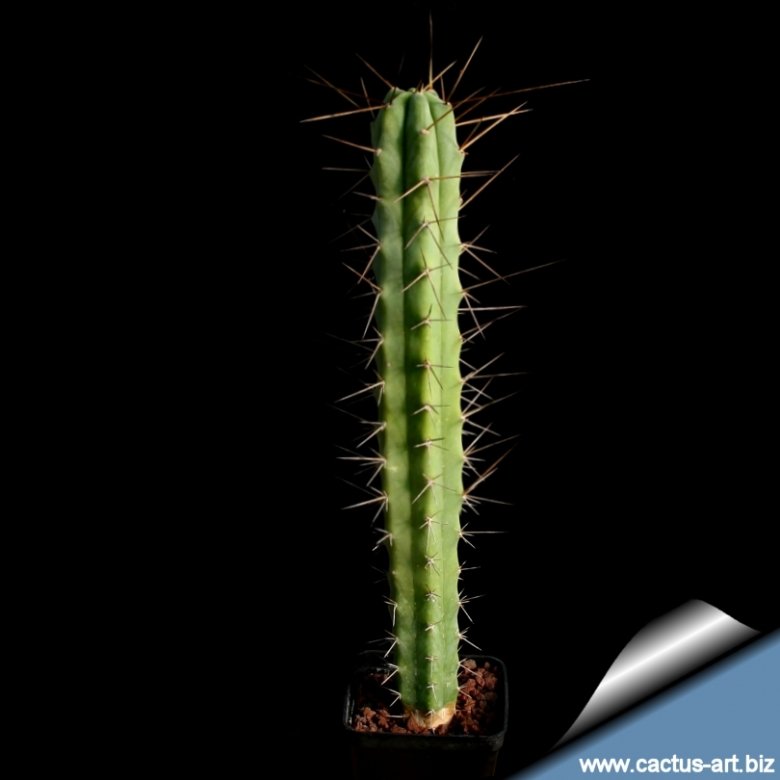
Echinopsis lageniformis, best known in cultivation as Trichocereus bridgesii, is a shrubby or small treelike fast-growing columnar cactus species, called in Bolivia Achuma or Wachuma. It is 2 to 5 meters high, more or less branching, pale green, a little glaucous. Among the indigenous populations of Bolivia, it is sometimes called achuma or wachuma, although these names are also applied to related species such as Echinopsis pachanoi which are also used for their psychedelic effects.
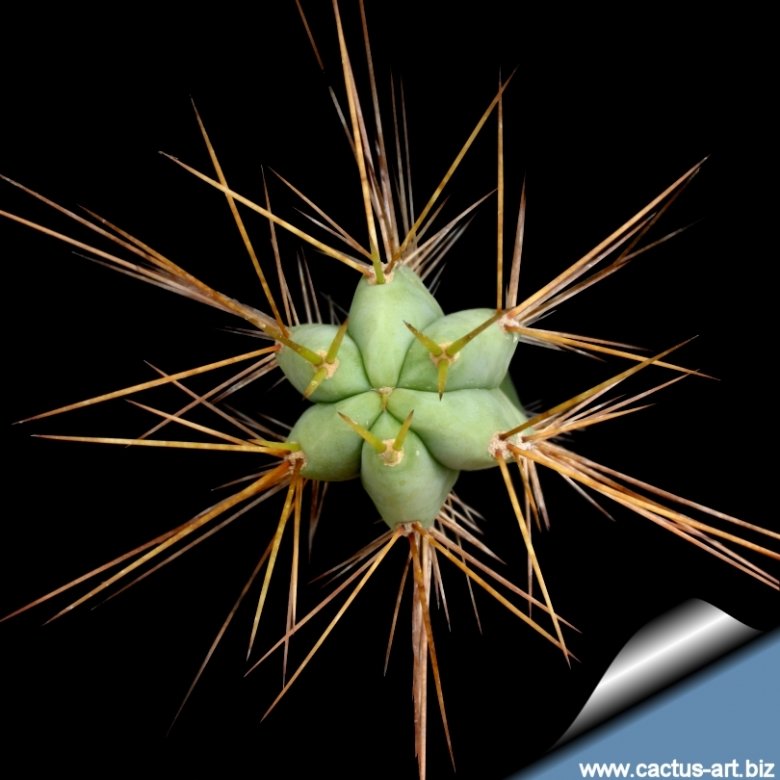
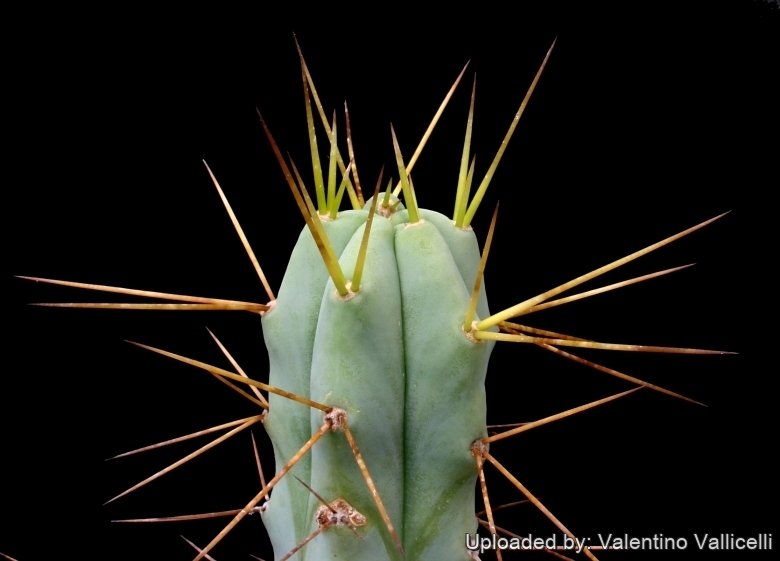
Stems (branches): 2–5 m tall,10 to15(-20) cm in diameter, 4 to 8-ribbed, light green to bluish.
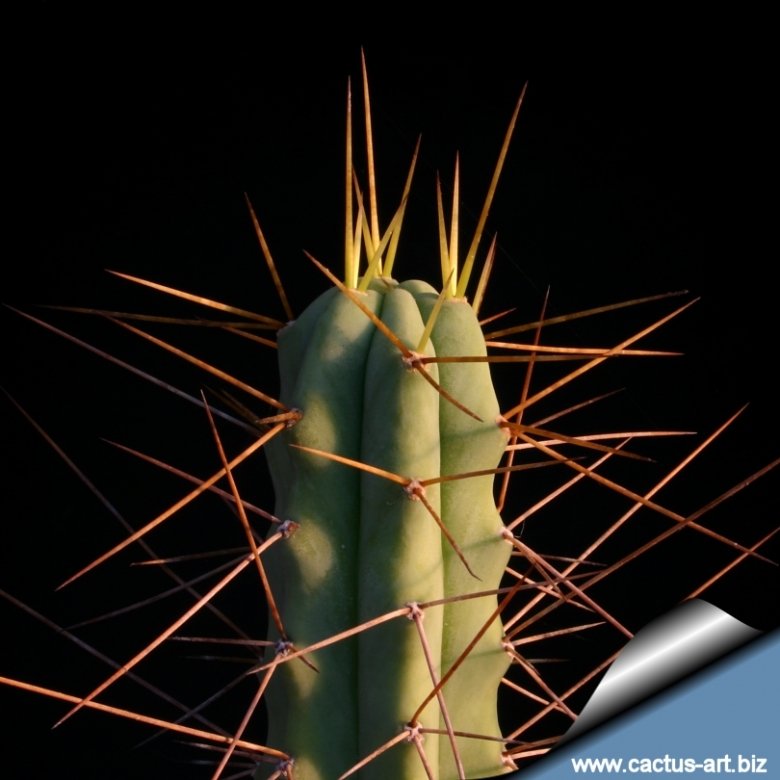
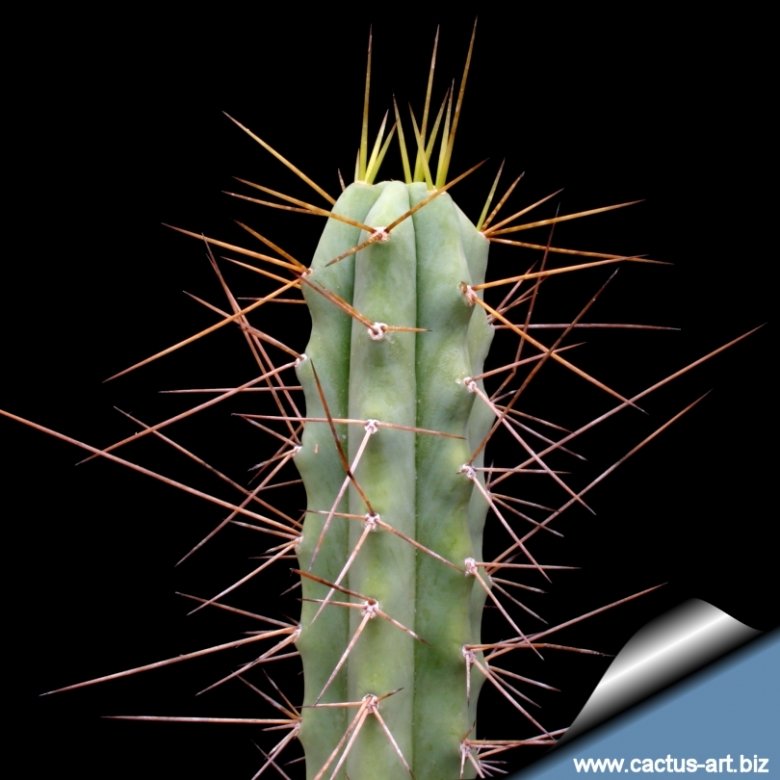
Ribs: Obtuse, separated by broad but shallow intervals.
Areoles: Large, spaced evenly on the ribs, about 2-3 cm apart.
Spines: 2 to 4(-6), yellowish, honey-coloured to brown acicular to subulate, very unequal, up to 6–7 cm in length (sometimes 10 cm long), not swollen at base.
Flowers: Large, 18 cm long; flower-tube 5 to 6 cm long; throat broad. Inner perianth-segments oblong, perhaps white, 5 to 6 cm long. Scales on ovary and flower-tube small, sometimes only 3 to 4 mm long.
Remarks: Echinopsis bridgesii, a globular or elogate cactus species forming clumps of three to six stems less than 40 cm tall is often confound with Trichocereus bridgesii which is a synonym of Echinopsis lageniformis.
Note:Several varieties of this species are highly prized by ornamental cactus collectors. These include a cristate variety, two variants of monstrose growth, and a more recently developed clone that exhibits both monstrose and cristate growth. These all tend to be much slower growing than the standard form of the species, but owing to their highly unusual shapes, they are sought after by cactus collectors. The monstrose form of Echinopsis lageniformis is known as the penis plant or penis cactus. Contrary to the typical columnar habit of the species, this cultivar displays short stem sections that branch avidly, forming a low spiny bush. The upper part of each stem segment is smooth and spineless, resembling a penis. The lower part is spiny and shows a tendency to form ribs. The plant is light green. The German name for this cultivar, frauenglück, is more euphemistic than its English equivalent; it translates as “women’s joy”.
Origin and Habitat
Echinopsis lageniformis is endemic to Bolivia, where it occurs in La Paz, Cochabamba, and possibly Santa Cruz.
Altitude range: Approximately between 2,000 and 3,000 metres above sea level.
Habitat and Ecology: It grows on cliffs alongside rivers in the La Paz valley in several isolated area. It can be also observed at the edge of fields. The species is used due to its alkaloid content, but there is no direct threat.
Notes
The plant contains a number of psychoactive alkaloids, in particular the well-studied chemical mescaline, which it may contain at levels higher than those of the San Pedro cactus. Chemical analysis of some variants of this species have shown it may include some of the most potent of the psychedelic Trichocereus species, although this is not conclusive nor does it apply to all strains of the species. Outside of its native habitat, it is one of the least known and used of the Trichocereus cacti for either its psychoactive or ornamental uses. This is not true in areas where it is the dominant species, for example, the La Paz area of Bolivia. As with related species, it seems to have long shamanic tradition of use throughout its native habitat.
Bibliography
Major references and further lectures
-
N. L. Britton, J. N. Rose: “The Cactaceae. Descriptions and Illustrations of Plants of the Cactus Family.” Vol I, The Carnegie Institution of Washington, Washington 1919
-
Edward Anderson “The Cactus family” Timber Press, Incorporated, 2001
-
James Cullen, Sabina G. Knees, H. Suzanne Cubey “The European Garden Flora Flowering Plants: A Manual for the Identification of Plants Cultivated in Europe, Both Out-of-Doors and Under Glass” Cambridge University Press, 11/Aug/2011
-
David R Hunt; Nigel P Taylor; Graham Charles; International Cactaceae Systematics Group. “The New Cactus Lexicon” dh books, 2006
-
Curt Backeberg “Die Cactaceae: Handbuch der Kakteenkunde,” Volume 2 G. Fischer, 1959
-
Urs Eggli, Leonard E. Newton “Etymological Dictionary of Succulent Plant Names.” Springer, Berlin/Heidelberg 2010
-
Gordon Douglas Rowley “Reunion of the genus Echinopsis.” In: IOS Bulletin. Journal of the International Organization for Succulent Plant Study. 3(3): 98, 1974.
-
Lowry, M. 2013. Echinopsis lageniformis. The IUCN Red List of Threatened Species. Version 2014.3. <www.iucnredlist.org>. Downloaded on 02 May 2015.
-
Wikipedia contributors. “Echinopsis lageniformis.” Wikipedia, The Free Encyclopedia. Wikipedia, The Free Encyclopedia, 26 Mar. 2015. Web. 2 May. 2015.
-
Madsen, Jens. “5. Echinopsis Zucc.”. Flora of Ecuador (Gunnar Harling & Lennart Andersson) (35): 27–30.A
-
Herrero-Ducloux, Enrique. “Datos quimicos sobre el Echinopsis eyriesii”. Revista de la Facultad de Ciencias Quimicas Universidad Nacional de La Plata (in Spanish) 2 (6): 43–49.
-
“Cactacae - Sacred Succulents”. Sacred Succulents. <http://sacredsucculents.com/cactaceae/\> Web. 2 May. 2015.