Publication: (= inermis variegata) a.k.a. “Variegated Penis Cactus”
Description
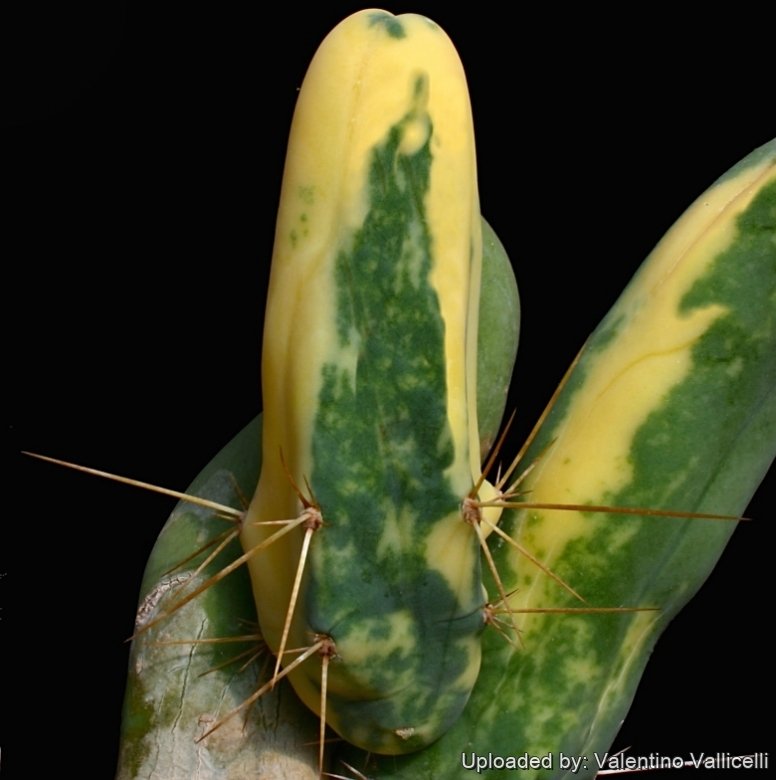
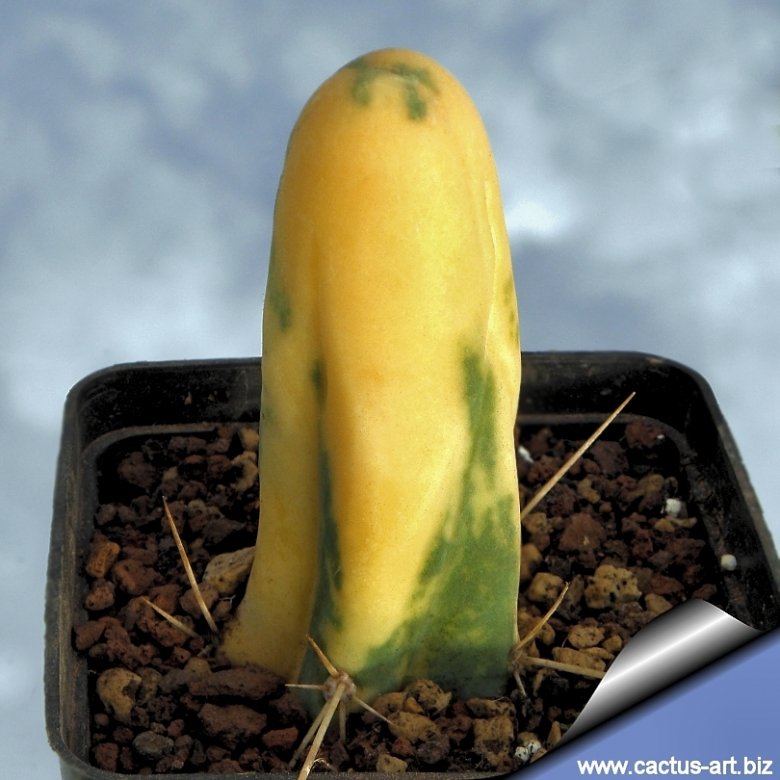
The variegated form of Trichocereus bridgesii forma mostruosa is an extraordinary plant.This plant derived from the long jointed clone, one of the two Montrose form o T. bridgesii . It is a clustering plant that branches at the base and can slowly grow up to 40 cm tall.
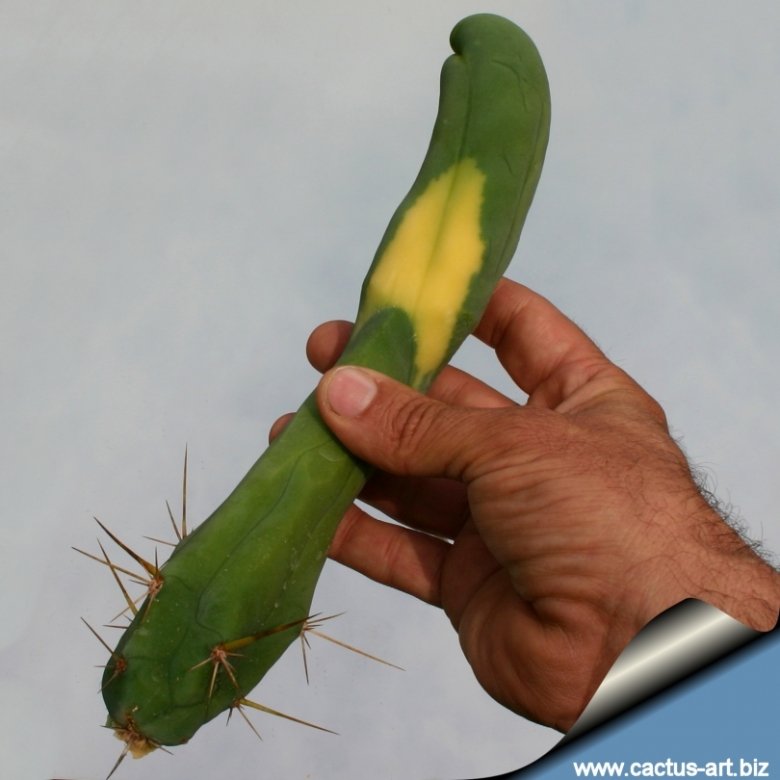
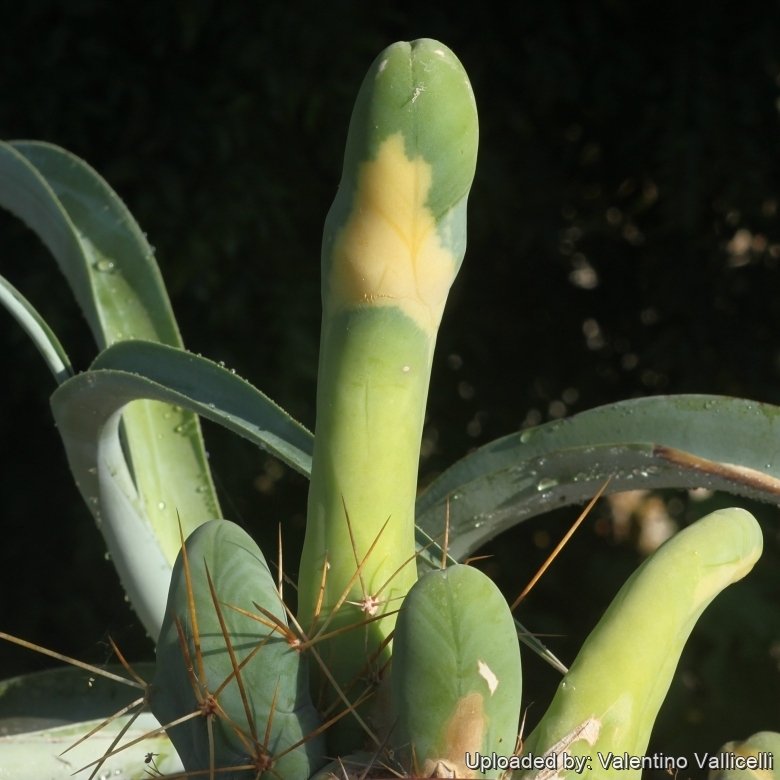
Stem: The stem are composed by short upright sections that branches avidly up to 10-20 (-35) cm tall by 5 cm in diameter, light glaucous green variegated in creamy-yellow, with only a few areoles and spines in the basal portion. The upper part of the stem is cylindrical, smooth without areoles and resemble a penis. The lower part is spiny and shows a tendency to form ribs.
Spines: Honey-coloured to brown, located on the few basal nodes in groups of up to 4. They can grow up to 4–7 cm long.
Flowers: Not known.
NOTE 1: There exist several mutant varieties of this T. bridgesii that are highly prized by cactus impassioned. These include a cristate variety, a variegated variety and two variants of monstrose growth. Of the monstrose varieties, one is often known by the name Penis Plant.
Two more recently developed clones are now available, the fist of which exhibits both monstrose and cristate growth whilst the second shows both monstrose and variegated growth.
NOTE 2: The chemical composition of the ‘Penis Plant’ is supposedly the same as that of the typical T.bridgesii.
Origin and Habitat
Garden origin (Nursery produced cultivar)
Cultivation and Propagation
It is very easy to grow and cold hardy as low as -12°C (or less). Need a fertile, well drained soil mix. Water the plants well and allow them to dry before watering again. This cultivar seems to do better with a little more water than most cacti. In fact, its cultivation requirements are really more like ‘normal’ plants than most other cacti. During the growing season fertilize them monthly with a balanced fertilizer
Sun Exposure: This cactus need strong light exposures but it is subject to sun burning during the hottest month of summer especially if the temperatures are high and ventilation insufficient, so grow them in light shade, inside needs bright light, and some direct sun.. During winter month, put them in a cool luminous place and encourage them to enter winter dormancy by withholding water and fertiliser over the winter as they will etiolate, or become thin, due to lower levels of light. They are susceptible to fungal diseases if overwatered, but are not nearly as sensitive as many other cacti, especially in warm weather. They tend characteristically towards black rotted spots unless watering is moderate and only in hot weather, if kept damp through cold periods, they will invariably suffer.
Propagation: It can easily be multiplied from cutting. Single sections are taken off, dried and rooted.
Bibliography
Major references and further lectures
-
N. L. Britton, J. N. Rose: “The Cactaceae. Descriptions and Illustrations of Plants of the Cactus Family.” Vol I, The Carnegie Institution of Washington, Washington 1919
-
Edward Anderson “The Cactus family” Timber Press, Incorporated, 2001
-
James Cullen, Sabina G. Knees, H. Suzanne Cubey “The European Garden Flora Flowering Plants: A Manual for the Identification of Plants Cultivated in Europe, Both Out-of-Doors and Under Glass” Cambridge University Press, 11/Aug/2011
-
David R Hunt; Nigel P Taylor; Graham Charles; International Cactaceae Systematics Group. “The New Cactus Lexicon” dh books, 2006
-
Curt Backeberg “Die Cactaceae: Handbuch der Kakteenkunde,” Volume 2 G. Fischer, 1959
-
Urs Eggli, Leonard E. Newton “Etymological Dictionary of Succulent Plant Names.” Springer, Berlin/Heidelberg 2010
-
Gordon Douglas Rowley “Reunion of the genus Echinopsis.” In: IOS Bulletin. Journal of the International Organization for Succulent Plant Study. 3(3): 98, 1974.
-
Lowry, M. 2013. Echinopsis lageniformis. The IUCN Red List of Threatened Species. Version 2014.3. <www.iucnredlist.org>. Downloaded on 02 May 2015.
-
Wikipedia contributors. “Echinopsis lageniformis.” Wikipedia, The Free Encyclopedia. Wikipedia, The Free Encyclopedia, 26 Mar. 2015. Web. 2 May. 2015.
-
Madsen, Jens. “5. Echinopsis Zucc.”. Flora of Ecuador (Gunnar Harling & Lennart Andersson) (35): 27–30.A
-
Herrero-Ducloux, Enrique. “Datos quimicos sobre el Echinopsis eyriesii”. Revista de la Facultad de Ciencias Quimicas Universidad Nacional de La Plata (in Spanish) 2 (6): 43–49.
-
“Cactacae - Sacred Succulents”. Sacred Succulents. <http://sacredsucculents.com/cactaceae/\> Web. 2 May. 2015.
Gallery